Golden Text
“So mightily grew the word of God and prevailed.” (Acts 19:20, KJV) · Read in the Bible
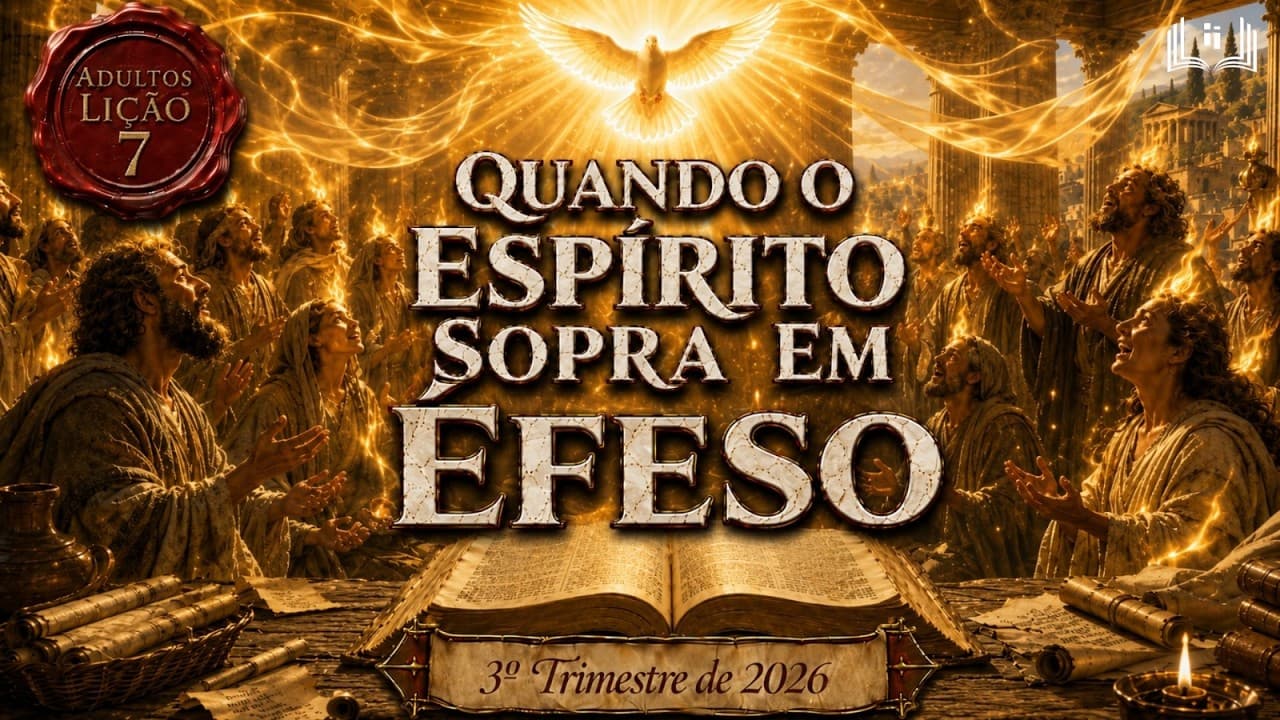
Ephesus had a temple among the seven wonders of the world and was the world capital of magic. That was where Paul spent the longest period of his ministry — and the revival did not begin with a spectacle: it began with corrected doctrine, two years in the classroom, and a bonfire made by the believers themselves.
There was a city in the Roman Empire where no one, in their right mind, would bet on a church. Ephesus held a temple that stood among the seven wonders of the world, sustained the most profitable magic industry in the Mediterranean, and lived off the money that religion kept circulating. In the eyes of reason, it was the worst possible place to plant the Gospel. In the eyes of God, it was the perfect setting.
It was there that Paul remained for the longest period of his entire ministry — about three years (Acts 20:31) — and it was from there that Luke wrote one of the most astonishing statements in the book: that all who lived in Asia heard the word of the Lord Jesus (Acts 19:10). An entire province reached. Yet notice how that revival began: not with a spectacle, but with a question about doctrine asked of a group of twelve people. And see where it was confirmed: in a bonfire lit by the believers themselves, at their own loss. That is the path this lesson follows, walking through the three topics of the quarterly (the lesson magazine).
🏛 Archaeology — the metropolis of Asia. Ephesus was the largest city in the Roman province of Asia and one of the largest in the Empire — responsible estimates place its population at around two hundred to two hundred and fifty thousand inhabitants. It stood where the sea routes of the Aegean met the roads climbing into the interior: anyone wishing to reach an entire province did not need to travel across it; it was enough to plant oneself in Ephesus and let the province come to him. An honest note for the teacher: the ruins that can be visited today are impressive, but the city's postcard image — the facade of the Library of Celsus — dates from the second century, after Paul; the apostle never saw it. The great theater, however, carved into the slope of Mount Pion with an estimated capacity of about twenty-five thousand people, is the very same theater of the riot in Acts 19. To that stage the teacher can point with confidence.
The temple of Diana — the Artemision, dedicated to the goddess whom traditional translations call by her Roman name — measured about one hundred and thirty by seventy meters atop more than a hundred columns, four times the area of the Parthenon. And it was much more than a temple: it functioned as the central bank of Asia, where kings, cities, and private citizens deposited their treasures; it held the right of asylum; and it drove an entire economy of pilgrimage, lodging, and souvenirs — hence Demetrius's silver shrines (Acts 19:24). The Ephesian Artemis, moreover, was not the slender huntress of Greek mythology: she was a fertility deity, depicted stiffly, with her torso covered in protuberances whose exact identification scholars debate to this day. Keep the theological point in mind: the Ephesians worshiped prosperity personified. When Paul said that things made with hands are not gods (Acts 19:26), he did not attack a statue — he attacked the religion of guaranteed profit. That god has not died; it only changed its name.
And there was the second industry, less monumental and more profitable: magic. The city was so closely associated with the occult that the most famous magical formulas in the ancient world bore its name — the Ephesia grammata, the "Ephesian Letters", unintelligible words engraved on amulets and sewn into clothing to bring luck and protection. When Luke speaks of books of curious arts (Acts 19:19), he is speaking of very expensive manuals from a massive market, copied by hand and kept under lock and key.
I — The Holy Spirit upon Paul's Ministry (Acts 19:1-10)
The link the lesson does not cover: Apollos and the couple who corrected without humiliating
Before opening chapter 19, it is worth going back a few verses — without them, the beginning of the revival is left half-told. Upon leaving Corinth, after the tribunal of Gallio, Paul took Priscilla and Aquila with him and left them in Ephesus (Acts 18:19). What that couple did there, on their own, explains what the apostle would find upon his return.
"And a certain Jew named Apollos, born at Alexandria, an eloquent man, and mighty in the scriptures, came to Ephesus. This man was instructed in the way of the Lord; and being fervent in the spirit, he spake and taught diligently the things of the Lord, knowing only the baptism of John." (Acts 18:24-25) Notice the résumé: an Alexandrian, from the city of the greatest library in the ancient world; eloquent; mighty in the Scriptures; fervent; diligent. Four commendations in a row — and then the clause that changes everything: knowing only the baptism of John (Acts 18:25). The best-prepared man in the chapter had a gap. He preached the Messiah who was to come, without fully knowing the Messiah who had come, died, risen, and poured out the Spirit.
📜 Pedagogy — the most beautiful discipleship lesson in Acts. "And he began to speak boldly in the synagogue: whom when Aquila and Priscilla had heard, they took him unto them, and expounded unto him the way of God more perfectly." (Acts 18:26) Three details for every Sunday School (EBD) teacher. Who corrects: it is not an apostle, not a doctor of the law — it is a couple of tentmakers, without a title. The greatest orator of the early church was discipled in the home of two laypeople. Where they correct: they took him aside with them — in private, in the intimacy of their home, not in the middle of the synagogue. They mended the doctrine while preserving the gift. How they correct: expounding the way more perfectly translates the Greek comparative akribésteron, "with greater exactness". They did not tear down what he knew; they completed it. And the result is the opposite of what pride would produce — Apollos accepts, grows, and goes to Corinth, where he publicly refuted the Jews, showing from the Scriptures that Jesus was the Christ (Acts 18:28).
Keep the bridge in mind: Apollos knew only the baptism of John — the exact same deficit as the disciples whom Paul will find a few verses later (Acts 19:3). It is no literary coincidence. Luke is showing that there were, in that city, sincere, God-fearing, and instructed people who had stopped halfway along the road of revelation. Ephesus was full of "almost there" people. The revival of chapter 19 begins, therefore, with a question of completeness — and not with a spectacle.
The incomplete disciples and the question no one was asking (19:1-7)
Having passed through the upper regions, Paul arrived in Ephesus (Acts 19:1) — fulfilling the promise of Acts 18:21, he returned overland through the interior of the province. There he finds certain disciples, and Luke uses mathētaí, the term that normally designates Christians. Let the honest debate be noted: were they still-incomplete believers or disciples only of John the Baptist? The vocabulary and Paul's own question favor the first reading, though their rebaptism shows that their faith was deficient regarding its object. Either way, the practical lesson is the same: there was sincerity without fullness.
"He said unto them, Have ye received the Holy Ghost since ye believed? And they said unto him, We have not so much as heard whether there be any Holy Ghost." (Acts 19:2) Two observations. First: their answer does not indicate absolute ignorance of the Spirit's existence — John the Baptist preached precisely that the One coming after him would baptize with the Holy Spirit (Matthew 3:11). The meaning is that they had not heard that the outpouring had already taken place, that Pentecost had been consummated. Second, and more decisive: Paul's question is, in itself, theologically revealing. He asks whether they received the Spirit when they believed — for the apostle, it was possible that someone had already believed and had not yet received the fullness of the Spirit. It is this possibility, presupposed in the question, that grounds our doctrinal emphasis.
🕊 Doctrine — baptism in the Holy Spirit. This is the fifth and final great account of the outpouring of the Spirit in Acts, after Jerusalem (Acts 2:1-4), Samaria (Acts 8:14-17), Saul (Acts 9:17), and the house of Cornelius (Acts 10:44-46). From them our theology draws three points. (1) Subsequence: baptism in the Spirit is an experience distinct from regeneration and subsequent to it in logical order — as Paul's question presupposes and as Samaria and Ephesus illustrate. It is not a matter of a "better" believer, but of a believer endued with power to bear witness (Acts 1:8). (2) Initial evidence: in Ephesus, as in Jerusalem and Caesarea, speaking in tongues accompanies the enduement — and here prophecy is added. (3) Purpose: the Spirit is not given for display, but for mission — right afterward Paul enters the synagogue and speaks boldly (Acts 19:8), and within two years all Asia hears. And the necessary pastoral honesty: God is not bound to repeat a formula. In Acts, sometimes there is the laying on of hands, sometimes not; sometimes it precedes water baptism, sometimes it follows it. What is constant is not the method — it is the sovereign Spirit who endues His own for the work.
"When they heard this, they were baptized in the name of the Lord Jesus. And when Paul had laid his hands upon them, the Holy Ghost came on them; and they spake with tongues, and prophesied." (Acts 19:5-6) On the rebaptism, a necessary note: this is the only case in the New Testament of people being baptized again, and the reason is precise — their first baptism was not Christian baptism, but John's preparatory rite, which pointed to a Messiah not yet identified. It is not a precedent for rebaptizing someone who has already been baptized in the name of the Lord Jesus; it is the completion of those who had received only the shadow of what was to come.
And note the number: there were about twelve men in all (Acts 19:7). That qualifier — about twelve — is in the text itself: it is an approximate number, and it is a small number. The greatest recorded revival of Paul's career began with a dozen people patiently corrected.
Three months in the synagogue, two years in the classroom (19:8-10)
"And he went into the synagogue, and spake boldly for the space of three months, disputing and persuading the things concerning the kingdom of God." (Acts 19:8) Three months is a long time by Paul's standards — in Thessalonica it was three Sabbaths. But the limit came: "But when divers were hardened, and believed not, but spake evil of that way before the multitude, he departed from them, and separated the disciples, disputing daily in the school of one Tyrannus." (Acts 19:9) Pay attention, teacher: the hardening and the departure from the synagogue are in verse 9, not in verse 8. Paul did not slam the door at the first sign of resistance; he left when opposition turned into public defamation.
אב In the original — "the Way", the oldest name for Christianity. ἡ ὁδός (hē hodós) — before the word "Christian" existed, coined in Antioch (Acts 11:26), and before any denomination, the faith was simply called "the Way". Luke uses the term repeatedly: Saul's letters were against any who belonged to this way (Acts 9:2); here the opponents speak evil of that way (Acts 19:9); the riot arises concerning that way (Acts 19:23); and Paul confesses before Felix that he serves God according to the way which they call a sect (Acts 24:14). The root is deeply biblical — the Old Testament speaks of the way of holiness on which the redeemed walk (Isaiah 35:8) — and the name only makes full sense because of one declaration, when Jesus declares Himself to be the way, the truth, and the life (John 14:6). Christianity, at its origin, was not an identity label: it was a road to be walked behind a Person who is the road itself.
🔬 History — the school of Tyrannus. The Greek term is scholē: a lecture hall where a master taught paying students; Tyrannus would have been the owner or the resident lecturer. A valuable piece of textual criticism: Codex Bezae — an important fifth-century manuscript of the so-called Western text — adds that Paul taught "from the fifth hour to the tenth", that is, from roughly eleven in the morning until four in the afternoon. Let it be noted honestly that this detail does not appear in the oldest manuscripts nor in the standard biblical text; it is an ancient addition that scholars nevertheless consider historically plausible — those were precisely the hours of the midday rest, when the lecture halls stood empty. If accurate, the portrait is moving: Paul working with his own hands from dawn until eleven (cf. Acts 20:34), teaching for five hours in the heat of the day, and still visiting from house to house (Acts 20:20). Even if it is only tradition, the arithmetic of the canonical text is already impressive: two years of daily teaching amount to thousands of hours of doctrine — the greatest Bible school of the apostolic era.
And the result: all who lived in Asia heard the word of the Lord Jesus, both Jews and Greeks (Acts 19:10). How? Not because Paul traveled across the province, but because he trained people who traveled across it. The best example has a name: Epaphras, who evangelized Colossae, Laodicea, and Hierapolis — the cities of the Lycus Valley, about one hundred and sixty kilometers from Ephesus. Paul calls him a faithful minister of Christ and bears witness to his labor for the three cities (Colossians 1:7; 4:12-13). And he tells the Colossians that many of them had never seen his face (Colossians 2:1): the church in Colossae was born out of the Ephesian revival without the apostle ever setting foot there. Add to this that the seven churches of Revelation 2 and 3 are all in this same province, and it is quite possible that most of them were born, directly or indirectly, out of those classrooms.
The principle is pure gold for Sunday School today: systematic, ongoing teaching multiplies far more than an isolated campaign. Paul traded the itinerant pulpit for a fixed classroom — and reached an entire province. Every faithful Sunday School class is, on a smaller scale, doing exactly what the school of Tyrannus did.
II — The Outpouring of the Spirit and the Impact of the Gospel on the City (Acts 19:11-20)
The extraordinary miracles — and the care the text demands (19:11-12)
"And God wrought special miracles by the hands of Paul: So that from his body were brought unto the sick handkerchiefs or aprons, and the diseases departed from them, and the evil spirits went out of them." (Acts 19:11-12) Three observations that the teacher needs to have at the tip of the tongue.
First, the subject of the sentence: it was God who wrought them. Not Paul, not the cloths. Luke builds the sentence to make it crystal clear who was at work. Second, the vocabulary: the handkerchiefs (soudária) and aprons (simikínthia) were, by all indications, the craftsman's work cloths — the sweatband from his forehead and the apron from his workshop. They were not religious objects, they were not consecrated, and they cost nothing. Third, and decisive, the word Luke chooses: the adjective rendered special or extraordinary translates a Greek expression that literally means "not ordinary" — the narrator himself signals that this was not the standard pattern even in the apostolic ministry. God did something exceptional in an exceptionally superstitious city. And note further that miracles, here, translates dynámeis, the plural of dýnamis — power, might: the same word used for the enduement promised in Acts 1:8.
❤ Delicate application — the power of God and the merchandising of faith. We believe fully in divine healing and in the power of the Spirit today. And it is precisely because we believe that we must guard this text against abuse. Observe what the New Testament itself never does: Paul never sold a handkerchief, never instituted the practice as a method, never asked for an offering in exchange, and never told the sick person that the cloth contained power. In the letters written after Ephesus, he does not mention the practice a single time. The account is descriptive — Luke tells what God did — not prescriptive. And Scripture records, in the very same book, what happens when someone tries to turn the power of God into a business: Simon the sorcerer wanted to buy the gift and heard from Peter the harshest rebuke in Acts (Acts 8:18-23). The difference between Paul's handkerchief and the sorcerer's amulet never lay in the fabric — it lies in who acts, toward whom faith is directed, and what is charged for it.
The sons of Sceva: the name without the Person (19:13-17)
"Then certain of the vagabond Jews, exorcists, took upon them to call over them which had evil spirits the name of the Lord Jesus, saying, We adjure you by Jesus whom Paul preacheth." (Acts 19:13) Itinerant Jewish exorcists were a familiar figure in the ancient world, and the magical papyri of that period actually include Hebrew names in their formulas, because the God of the Jews had a reputation for being powerful. These men simply added a new name to their repertoire. And notice the formula: neither "my Lord" nor "the One in whom I believe" — but "Paul's Jesus". They had no relationship with Christ; they had a secondhand reference. They treated the name as a password, not as a Person.
On the identity of their father, an honest note: the text speaks of seven sons of Sceva, a Jew and chief of the priests (Acts 19:14). There is no historical record of any Jewish high priest by that name, and the office was exercised in Jerusalem, not in Asia. The two most likely explanations are that he either belonged to a prominent priestly family or — what many consider more plausible — used the title as advertising to impress pagan clients. He would be, in that case, a charlatan touting impressive religious credentials: a practice any era can recognize.
And then comes the verdict: "And the evil spirit answered and said, Jesus I know, and Paul I know; but who are ye?" (Acts 19:15) The Greek uses two different verbs, and the distinction is revealing: regarding Jesus, the verb is that of recognized knowledge — I know who He is, I recognize His authority; regarding Paul, the verb indicates familiarity, something like "I am well acquainted with who he is". Hell had a file on both of them. On the seven impostors, none at all.
Pay attention to what happens next, because it is common to tell this scene wrong: it was one man, with one evil spirit. He leaped on them and, overpowering two of them, prevailed against them (Acts 19:16) — it was not all seven who were overpowered, and it was not "demons" in the plural. There were seven sons of Sceva; two were subdued; and the result is humiliating and literary: they came dressed in authority and went out naked and wounded, fleeing from that house. This is the most frightening warning in the chapter: it is possible to pronounce the name of Jesus with phonetic perfection and be a complete stranger in the spiritual realm. Faith is not a formula; it is a relationship. Authority is not imitated; it is received.
And the effect on the city was the opposite of what the impostors wanted: fear fell on them all, and the name of the Lord Jesus was magnified (Acts 19:17). God used even the failure of the counterfeiters to exalt the true name.
The bonfire that cost a fortune (19:18-20)
"And many that believed came, and confessed, and shewed their deeds. Many of them also which used curious arts brought their books together, and burned them before all men: and they counted the price of them, and found it fifty thousand pieces of silver." (Acts 19:18-19)
Pay close attention to who made the bonfire: many of those who had believed. They were converts — people who were already in the church and who still kept the manuals of their old life at home. Revival did not begin with outsiders; it began by cleaning up those inside. There was an unsurrendered drawer among the believers of Ephesus, and the Spirit went straight there. The expression curious arts (in Greek, tà períerga) is precisely the polite term the era used for magic — the same elegant euphemism used today when people say "esotericism", "alternative spirituality", or "just a curiosity".
🔬 Calculation — how much the bonfire in Ephesus was worth. The fifty thousand pieces of silver are, in all probability, drachmas or denarii; the text does not specify, and the equivalence is an estimate, not a biblical datum. If denarii, the New Testament itself gives us the scale — in the parable of the workers in the vineyard, a denarius is a day's wage (Matthew 20:2) — and fifty thousand days of work equal more than five men would earn in thirty years. That is what went up in smoke in a public square, all at once, by the spontaneous decision of the owners themselves. And there is an ethical detail that deserves emphasis: they burned them; they did not sell them. They could have recovered their investment by passing the books on to other magicians — and they would have passed the evil forward at a profit. True repentance does not outsource sin: it destroys what must die, even when the loss is one's own. Whoever sells what ought to be burned has not repented; he has merely changed his inventory.
And then comes the Golden Text, which is also a structural milestone of the book: "So mightily grew the word of God and prevailed." (Acts 19:20) Luke punctuates Acts with these refrains of growth — after the organization of the service in Jerusalem (the word of God increased, Acts 6:7), after the death of Herod (the word of God grew and multiplied, Acts 12:24), and now, after the bonfire in Ephesus. The pattern is constant and instructive: the Word grows when the church deals with integrity with what was wrong inside it.
Note also the order of events in the chapter, which is the order of any genuine revival: doctrine corrected (vv. 1-7), systematic teaching (vv. 8-10), power manifested (vv. 11-12), counterfeit unmasked (vv. 13-17), sin confessed and destroyed (vv. 18-19) — and only then does the Word prevail (v. 20).
III — The Manifestation of the Power of God among the Gentiles (Acts 19:21-41)
The riot: when revival hits the cash register
Verse 21 is the hinge of the entire book: Paul purposed in the spirit to go to Jerusalem, saying that after he had been there, he must also see Rome. From here on, Acts has a destination. And it is precisely when the apostle plans to leave that the city explodes — not over doctrine, but over money.
"For a certain man named Demetrius, a silversmith, which made silver shrines for Diana, brought no small gain unto the craftsmen; Whom he called together with the workmen of like occupation, and said, Sirs, ye know that by this craft we have our wealth." (Acts 19:24-25) Demetrius opens with their pocketbook and only afterward appeals to religion — the order of his arguments betrays the order of his priorities. First their wealth from this craft (v. 25); then the risk that their trade might fall into disrepute; and last, almost as an afterthought, the honor of the goddess (v. 27).
And, without realizing it, he drafts the best growth report of the church in Ephesus: "Moreover ye see and hear, that not alone at Ephesus, but almost throughout all Asia, this Paul hath persuaded and turned away much people, saying that they be no gods, which are made with hands:" (Acts 19:26) The enemy confirmed, in a hate speech, the exact thing Luke had stated in v. 10. When the opposition has to acknowledge the size of the work to justify its own panic, the revival is real.
🏛 History and irony — the theater, the Asiarchs, and the word "church". The crowd drags into the theater Gaius and Aristarchus, Macedonians and Paul's travel companions (Acts 19:29) — Aristarchus will reappear later as a faithful companion, including on the voyage to Rome (Acts 20:4; 27:2; Colossians 4:10). A surprising detail in v. 31: some of the chief officials of Asia, who were his friends, beg Paul not to venture into the theater. Those chief officials are the Asiarchs — the high provincial elite, responsible, among other things, for the imperial cult. In other words: Paul had influential friends among the pagan nobility, people who cared about his life. The Gospel had penetrated even there. And there is a magnificent irony that only the Greek reveals: the word that the biblical text translates as "assembly" in verses 32, 39, and 41 is ekklēsía — the very same word translated as "church" in the rest of the New Testament. Luke describes, with subtle humor, a "church" that shouted for two hours without knowing why it had come together (v. 32) and that only dispersed when a public official ordered it to. Meanwhile, the true church was outside the theater. A noisy crowd is not a sign of revival — not every assembly is a church.
The resolution comes through the civil authority. The town clerk — the municipal secretary, the chief local magistrate, answerable to Rome for public order — calms the crowd with three legal arguments: the prestige of Ephesus as temple keeper was not at risk (v. 35); the accused were neither robbers of temples nor blasphemers of their goddess (v. 37); and, if there was a complaint, the courts were open and there were proconsuls (v. 38), as well as the lawful assembly (v. 39).
Notice the involuntary compliment in v. 37: a pagan magistrate publicly testifies that the Christian missionaries had neither profaned temples nor insulted someone else's religion. Paul preached the truth without vandalism and without mockery — he converted multitudes by confronting idolatry with argument and testimony, not with ridicule. It is a model for our generation, which argues about religion in family group chats and on social media. One last honest note: the Alexander pushed to the front by the Jews (v. 33) is often associated with the Alexander of 1 Timothy 1:20 or 2 Timothy 4:14 — but the name was extremely common in the Greek world, and the identification remains uncertain. The teacher may mention the possibility without stating it as fact.
Power of God or magic? The criterion was never intensity
Ephesus is, among other things, a narrative treatise on the difference between the supernatural work of God and magic. Both appear side by side: Paul's cloths healing and the spellbooks burning; true power and the seven impostors. The error of cessationism is to throw away the first out of fear of the second; the error of mysticism is to confuse the two. Scripture does neither — it teaches us to discern. And the criterion was never the existence of power, but the source and the posture.
| The power of the Holy Spirit | Magic and the occult |
|---|---|
| The source is God: God worked them by the hands of Paul (Acts 19:11) | The source is the power of darkness, even when disguised as light (2 Corinthians 11:14) |
| The posture is submission: it is received on one's knees, as He wills (1 Corinthians 12:11) | The posture is control: it is wielded by technique, formula, and decree |
| It is based on a relationship with the Person of Christ | It is based on pronouncing a formula correctly (Acts 19:13) |
| It is free of charge: freely received, freely given (Matthew 10:8) | It is commercial: very expensive books, amulets, paid services |
| It glorifies the name of Jesus (Acts 19:17) | It glorifies the operator, the method, or the object |
| It produces holiness and confession of sins (Acts 19:18) | It coexists with sin and disguises it as curious arts (Acts 19:19) |
| It builds up the Church and fulfills the mission (Acts 19:10, 20) | It builds up the ego and enslaves the client |
The church needs two things at the same time: hunger for the supernatural and discernment to judge it. The New Testament gives the measuring rod in three texts that must walk together. "Beloved, believe not every spirit, but try the spirits whether they are of God: because many false prophets are gone out into the world." (1 John 4:1) — and the criterion there is Christological. "Quench not the Spirit. Despise not prophesyings. Prove all things; hold fast that which is good." (1 Thessalonians 5:19-21) — four commands in a sequence that prevents both fanaticism and coldness. And among the gifts is precisely the discerning of spirits (1 Corinthians 12:10): God did not leave the church without an instrument to separate the true from the false.
What revival is — and what it brings down
The word "revival" does not appear in Acts 19, but the phenomenon is there in full. Revival, in Ephesus, was: doctrine corrected before any manifestation; daily, systematic teaching for two years; the power of God confirming the Word; counterfeits exposed; sin publicly confessed by the believers themselves; illicit goods destroyed at a loss; and an idolatrous economy shaken to the point of sparking a riot.
Note what is not on the list: no self-promoted spectacle, no technique for manufacturing manifestations, no inflated numbers. And note the price: where the Word prevailed, someone lost money. A revival that bothers no vested interest, costs no one anything, and changes the economy of no one's life is, at most, enthusiasm.
Church history repeats the pattern. The Welsh Revival in 1904, under the leadership of Evan Roberts, changed the habits of an entire nation; the Azusa Street Revival in Los Angeles, beginning in 1906 under the ministry of William Seymour, became a landmark of modern Pentecostalism and sent missionaries across the world — including to Brazil, where in 1910 and 1911 the Congregação Cristã and the Assemblies of God would be born, the latter through the work of the Swedish missionaries Daniel Berg and Gunnar Vingren in Belém do Pará; and, in recent times, the awakening of February 2023 at Asbury University in Kentucky drew worldwide attention precisely because of the absence of spectacle — simple songs, confession, and continuous prayer for days. In all of them, the same axis as Ephesus: the Word at the center, sin dealt with, the name of Jesus magnified.
One final warning, and it is serious. The church born in the greatest revival of Paul's career is the very same church that, about forty years later, receives from the glorified Christ praise for being hardworking, patient, and doctrinally vigilant — and the rebuke for having left its first love (Revelation 2:1-7). Revival is not an automatic inheritance: it is a flame that every generation must guard. Ephesus is, at the same time, the greatest example and the greatest warning in the New Testament.
Christ in the Lesson
Where is Christ in this story of temples, magic, and a bonfire?
In the Name. The entire chapter revolves around a name. The incomplete disciples are baptized in the name of the Lord Jesus (Acts 19:5). The impostors try to use that name as a formula and fail, because hell answers that it knows Jesus and knows Paul, but asks who they are (Acts 19:15). And the outcome of the whole episode is this: the name of the Lord Jesus was magnified (Acts 19:17).
The difference between the church of Ephesus and Ephesian magic never lay in the intensity of faith, nor in the correctness of pronunciation — it lies in knowing, and being known by, the Person. Christ is not a power word; He is the Lord to whom we surrender. That is why true revival never ends in a preacher's fame, in a technique, or in an object: it ends in the name of Jesus being magnified. And it is at that name that, one day, every knee shall bow (Philippians 2:10) — including the knees of those who today shout the name of other gods for two hours.
Practical Application
Sincere faith can be incomplete faith. Apollos was eloquent, fervent, and diligent — and he was missing something. The twelve in Ephesus were disciples — and they did not know the outpoured Spirit. Sincerity is not the same as fullness, and no one should be offended at being taught the way of God more accurately. To reflect: in what area of your faith have you been content with what you already know, instead of seeking what is still lacking?
God uses ordinary people to form great people. A couple of tentmakers discipled the greatest orator of the early church — at home, in private, without humiliating him. You do not need a title to teach; you need to know the way of God well and have the love to correct without embarrassing. To reflect: is there someone God has placed in your path for you to explain His way more accurately — with patience and discretion?
Steady teaching is worth more than an isolated event. It took two years of daily classes in a rented hall — and an entire province heard the Gospel. Your Sunday School class is, on a smaller scale, the school of Tyrannus: the place where those who will reach people you will never meet are formed. To reflect: have you been treating Sunday School as a commitment to formation — or as an optional item on your schedule?
There are unsurrendered drawers inside the church. Those who lit the bonfire in Ephesus were those who had believed. There were believers with magic manuals kept at home. Revival began by cleaning up those inside — and it cost dearly for those who truly repented. This applies to the hidden shrine, the horoscope app, the work contract that only closes with a small lie, the money that comes in through a path that cannot bear the light. To reflect: what are you still keeping "just in case" that needs to burn once and for all — without reselling, without passing it on?
The name of Jesus is not a formula. The sons of Sceva pronounced the right name and walked away wounded, because they had the word without the Person. Spiritual authority is neither imitated nor decreed: it is born of relationship, intimacy, and submission to the Lord. To reflect: if hell were to answer today, would it say that it knows you — or would it ask who you are?
Closing Prayer
Lord, God who blows where He wills, thank You because You do not need an easy city or great people to do Your work. In a city surrendered to idolatry and the occult, You began with a dozen people patiently corrected and a rented classroom — and an entire province heard Your Word. Do that among us. Correct our doctrine where it has stopped halfway; give us patience for the teaching that makes no noise; and fill us with Your Spirit, not for display, but for mission. Lord, show us the drawers we have not yet surrendered to You — what we keep out of precaution, vanity, or fear — and give us the courage to destroy what must die, even when the loss is ours. Guard our home, guard our work, guard our children; may our family be protected by You and may our speech be clean. And may none of this end in the fame of any man: may the name of Your Son, the only name hell recognizes and before which every knee shall bow, be magnified among us. In Jesus' name. Amen.
Soli Deo Gloria — Scripture governs; everything else, on its knees.
Frequently asked questions about this lesson
Doesn't everyone who believes already receive the Holy Spirit at conversion? Why speak of baptism in the Spirit?+
Everyone who believes is sealed and indwelt by the Spirit — without Him no one belongs to Christ (Romans 8:9). What Acts presents, and Paul presupposes in his own question in Acts 19:2 asking whether they had received the Holy Spirit when they believed, is a distinct experience of being clothed with power for witness (Acts 1:8). It is not about one believer being better than another: it is about a believer equipped for the mission.
Can I use an anointed handkerchief to bring healing to someone?+
The account in Acts 19:11-12 is descriptive, not prescriptive. Luke writes that God worked extraordinary miracles through Paul's hands (Acts 19:11) — the subject is God, and the very word translated extraordinary means uncommon, that is, outside the norm even for the apostolic ministry. Paul never sold a handkerchief, never instituted the practice as a method, and does not mention it a single time in his letters. Where there is a set price, a guaranteed promise, and an object for sale, it is no longer the faith of Ephesus — it is the commerce that Ephesus practiced before converting.
Was Sceva really a Jewish high priest?+
The text speaks of seven sons of Sceva, a Jewish chief priest (Acts 19:14). To be honest: there is no historical record of any Jewish high priest by that name, and the office was exercised in Jerusalem, not in Asia. The two most likely explanations are that he belonged to a prominent priestly family or — what many consider more plausible — that he used the title as advertising to impress pagan clients.
If the sons of Sceva used the name of Jesus and it went badly for them, doesn't the name of Jesus have power?+
It does — and that is precisely why it went badly for them. The spirit replied that he knew Jesus and knew who Paul was, but asked who they were (Acts 19:15). The problem was not in the name, it was in them: they pronounced the word without having the Person. They spoke of the Jesus whom Paul preached (Acts 19:13) — their faith was secondhand. Spiritual authority is neither imitated nor decreed; it is born of relationship and submission to the Lord.
Why did the Ephesians burn the books instead of selling them?+
Because true repentance does not outsource sin. They could have recovered their investment by passing the manuals on to other magicians — and they would have passed the evil along at a profit. They preferred taking the loss themselves. Whoever sells what should be burned has not repented; they have only changed their inventory.
Teacher's Guide
Essence of the class
Where the Spirit blows, the Word grows — and true revival begins with corrected doctrine, steady teaching, and sin destroyed inside the home, not with spectacle.
Map of the class
| Time | Stage |
|---|---|
| 0–5 min | Opening (what is a revival, really?) |
| 5–10 min | Overview of Ephesus + the link of Apollos (Acts 18:24-28) |
| 10–20 min | Point 1 — The Spirit upon Paul's ministry (Acts 19:1-10) |
| 20–30 min | Point 2 — The power, the impostors, and the bonfire (Acts 19:11-20) |
| 30–36 min | Point 3 — The city shaken and what revival is (Acts 19:21-41) |
| 36–41 min | Pair discussion + Christ in the Lesson |
| 41–45 min | Wrap-up + challenge of the week + prayer |
Start like this
Begin by asking: "What is a revival, really — and how do we know whether it is from God?" Let three or four students answer before opening the Bible. You will likely hear "lots of people", "an emotional worship service", "manifestations", "a packed church". Write the answers in a corner of the board and say: "Hold on to that. At the end of class we are coming back to this list, because Acts 19 shows a real revival — and its list looks very different from ours."
Point 1 — The Holy Spirit upon Paul's ministry (Acts 19:1-10)
- In the quarterly: topic I ("The Holy Spirit upon Paul's Ministry", Acts 19:1-10) — the three sub-items: the restoration of doctrine, teaching in the face of resistance, and training that reaches a region.
- What to teach: the revival in Ephesus began with a doctrinal correction in a group of about twelve men, not with a spectacle. Paul asks whether they received the Holy Spirit when they believed — and the question itself presupposes that one can have believed and still not have received the enduement of power. After three months in the synagogue, the hardening (v. 9, not v. 8) leads him to the school of Tyrannus: two years of daily teaching, and all Asia heard — including cities Paul never visited, such as Colossae, evangelized by Epaphras (Colossians 1:7; 2:1).
- Anchor verse (KJV): "He said unto them, Have ye received the Holy Ghost since ye believed? And they said unto him, We have not so much as heard whether there be any Holy Ghost." (Acts 19:2)
- Key question: "Which is harder today: having a hunger for the supernatural or having the patience for every Sunday's teaching?"
- Likely answers (+ going deeper): "people want what is fast", "no one has time", "class is tiring, a worship service is exciting". Go deeper: "Paul reached an entire province by teaching five hours a day for two years. What does that say about the value of our class?"
- If no one speaks: tell about someone you watched become grounded in the faith because of years in Sunday School — and hand the question back to them.
Point 2 — The power, the impostors, and the bonfire (Acts 19:11-20)
- In the quarterly: topic II ("The Outpouring of the Holy Spirit and the Impact of the Gospel on the City", Acts 19:11-20), along with the bibliological aid on the handkerchiefs and aprons.
- What to teach: God worked special, extraordinary miracles — and the word means "not ordinary", that is, outside the norm even for the apostolic ministry; the subject of the sentence is God, not Paul and not the cloths. Next, the contrast: the sons of Sceva use the name of Jesus as a formula and hear the spirit ask who they are. It was one man, with one evil spirit, and two of the seven were subdued. Finally, the believers themselves burn the magic manuals — fifty thousand pieces of silver up in smoke — and only then did the word of the Lord grow mightily and prevail.
- Anchor verse (KJV): "And the evil spirit answered and said, Jesus I know, and Paul I know; but who are ye?" (Acts 19:15)
- Key question: "If the Spirit passed through your home today the way He passed through the homes of Ephesus, what would He send to the bonfire?"
- Likely answers (+ going deeper): "a book", "an app", "a friendship", "a practice I call harmless". Go deeper: "and why is it easier to sell than to burn? What does selling reveal about repentance?"
- If no one speaks: give the first example — something you yourself once had to get rid of — and the class will open up. No one needs to say what it is in front of the others.
Point 3 — The city shaken and what revival is (Acts 19:21-41)
- In the quarterly: topic III ("The Manifestation of the Power of God among the Gentiles"), including the historical examples of the outpouring of the Spirit.
- What to teach: the riot did not break out over doctrine, but over money — Demetrius opens his speech with their wallet (reminding them that by this craft they have their wealth) and only afterward remembers the goddess. Unwittingly, he confirms the scale of the work (v. 26). And the town clerk gives an involuntary compliment: the Christians were neither robbers of temples nor blasphemers of their goddess (v. 37) — Paul preached the truth without vandalism and without mockery. Close by showing the list of genuine revival: doctrine, teaching, power, counterfeit exposed, sin destroyed — and the Word prevailing.
- Anchor verse (KJV): "So mightily grew the word of God and prevailed." (Acts 19:20)
- Key question: "If revival came to your city today, which 'Demetriuses' would complain — which businesses would lose money?"
- Likely answers (+ going deeper): gambling houses, loan sharks, the seduction industry, religious commerce itself. Go deeper: "and what if one of those interests is inside your own income?"
- If no one speaks: go back to the list on the board from the opening and compare it, item by item, with the list from Acts 19.
Class activity
- Goal: to move revival out of the realm of emotion and place it in the realm of concrete obedience.
- Materials: the board (or a poster board) and a small slip of paper for each student.
- Step by step: leave on the board the list the class gave during the opening ("what revival is"). Beside it, write the list from Acts 19 in the order of the text: doctrine corrected (vv. 1-7) → daily teaching (vv. 8-10) → power of God (vv. 11-12) → counterfeit exposed (vv. 13-17) → sin confessed and destroyed (vv. 18-19) → the Word prevails (v. 20). Ask them to compare in pairs for two minutes: what does our list have that Ephesus's list does not? What is missing from ours? Afterward, each person writes on the slip of paper, without showing anyone, one thing from their home, their routine, or their work that needs to go to the bonfire. The paper goes into their pocket — it is a reminder for the week, not a public confession.
- Wrap-up (back to the text): "In Ephesus, the one who lit the bonfire was not the preacher: it was those who had believed. Revival did not begin with outsiders — it began by cleaning up those inside. And it cost dearly."
If they ask you this
- Question: "Not every believer has spoken in tongues. Is someone who has not spoken in tongues a second-class believer?" Short answer: No. Everyone who believes is indwelt by the Spirit — without Him no one belongs to Christ (Romans 8:9). Baptism in the Spirit is an enduement of power for witness (Acts 1:8), and Scripture presents it as a promise to be sought, not a medal to be displayed. Ephesus, moreover, shows that God does not repeat a formula: in Acts, sometimes there is the laying on of hands, sometimes not; sometimes it comes before water baptism, sometimes after.
- Question: "Can I buy that anointed handkerchief the preacher offers on TV?" Short answer: The text is descriptive, not prescriptive — Luke tells what God did, and says that those miracles were extraordinary, that is, out of the ordinary even among the apostles. Paul never sold a handkerchief, never charged for one, and never taught the practice in his letters. And the Bible records in the very same book what Peter said to someone who wanted to buy the gift of God (Acts 8:18-23). Where there is a price list and a guaranteed promise, it is not the faith of Ephesus.
- Question: "Reading a horoscope, doing a little superstition, hanging a lucky charm in the car — what is the harm, if I do not even believe in it?" Short answer: Curious arts (Acts 19:19) was the exact polite term Ephesus used for that. The euphemism changes from century to century; the substance does not. And notice that the Ephesians were not debating whether they really believed in it — they were surrendering what they kept at home. The criterion in the table is simple: toward whom faith is directed and to whom the glory is given.
- Question: "Isn't throwing away something expensive a waste? Wouldn't it be more responsible to sell it and give the money to the church?" Short answer: That was the exact way out the Ephesians refused. They burned the books instead of selling them because selling would mean passing the evil on at a profit — and the church does not need dirty money. True repentance does not outsource sin: it destroys what must die, even when the loss is one's own.
Wrap-up + challenge of the week
- Wrap-up: "Ephesus was the worst address in the world to plant a church: a temple among the seven wonders, the largest magic industry in the Mediterranean, and an entire economy living off it. And it was there that the Word prevailed — not through spectacle, but because doctrine was corrected, teaching was steady, and the believers themselves burned what they kept at home. Where the Spirit blows, someone loses money and the name of Jesus is magnified."
- Challenge: this week, make your own Ephesian bonfire. Choose one concrete thing from your home, your phone, or your routine that belongs to the old life — and destroy, delete, or cancel it, without selling it and without passing it on to anyone. On Sunday, come back with the story.
Teacher's kit
- Before: read all of Acts 19 and go back to Acts 18:24-28 to understand the link with Apollos. Also check Colossians 1:7 and 2:1, which show the reach of what came out of the school of Tyrannus.
- Bring: a Bible, a board or poster paper for the two lists, and small slips of paper for the class. A map of the province of Asia helps greatly in the opening overview.
- Pray beforehand: ask God that the class not stop at admiring an ancient revival — that each student leave with a name, an object, or a habit to surrender. And pray for those who will discover today that they have kept a drawer locked shut.
Homework
Your mission for the week
Make your own Ephesian bonfire. Choose one concrete thing that is still in your home, on your phone, or in your routine and that belongs to the old life — an object, an app, a subscription, a file, a habit of consulting what you should not — and destroy, delete, or cancel it this week. Without selling, without donating, without passing it on to anyone.
Why
Those who lit the bonfire in Ephesus were not outsiders: they were many of those who had believed (Acts 19:18). They were church people with the manuals of their old life kept at home. They burned fifty thousand pieces of silver instead of selling them, because true repentance does not pass evil forward at a profit — it destroys what must die. And it was only after this that Luke wrote: "So mightily grew the word of God and prevailed." (Acts 19:20)
How to know you did it
The thing no longer exists. You cannot undo it with two clicks, you did not save it "just in case", and no one else ended up with it. If it can still be recovered, you postponed it — you did not burn it.
On Sunday, come back with the story
The next class begins with those who burned it. Bring the story — what it was, what it cost, what has changed since then. Do not stay out.