Golden Text
“Take heed therefore unto yourselves, and to all the flock, over the which the Holy Ghost hath made you overseers, to feed the church of God, which he hath purchased with his own blood.” (Acts 20:28, KJV) · Read in the Bible
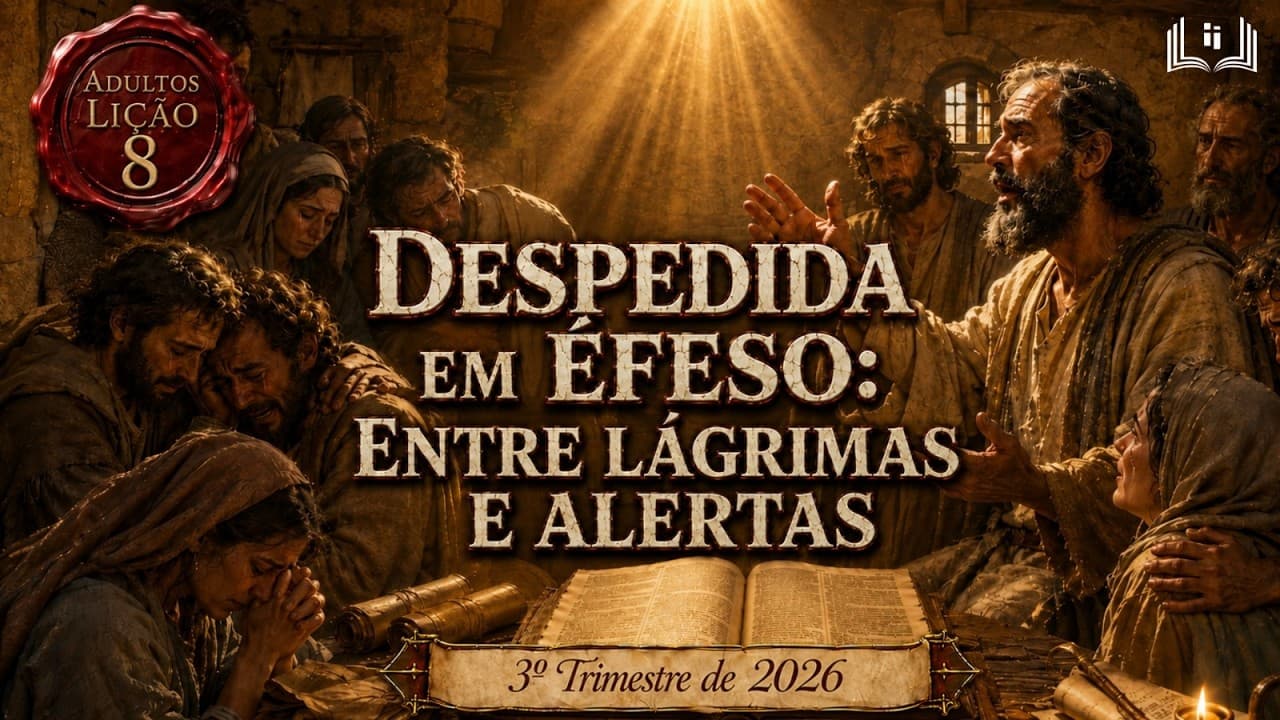
Paul sailed past Ephesus and sent for the elders to come to Miletus. It is his only recorded sermon to an audience made up solely of Christians — a spiritual testament made of an account rendered, a stern warning about wolves, and many tears.
Lesson 8 • Tears and Warnings — Exhaustive Research Resource for the Lesson.
Complete study of Acts 20:16-38 — exegesis of the Greek text, textual criticism, primary sources, archaeology, pastoral theology, patristics and teaching method.
Marcas do Evangelho (church in Cariacica, Brazil) • Pastor Jairo Carvalho and Pastor Jaciana Carvalho • 3rd Quarter of 2026 (Lições Bíblicas — the CPAD Sunday School quarterly, Adults).
✶ Golden Text — Acts 20:28
"Take heed therefore unto yourselves, and to all the flock, over the which the Holy Ghost hath made you overseers, to feed the church of God, which he hath purchased with his own blood." (Acts 20:28)
Central truth: the Church is property acquired by God at the price of His own blood — therefore it must be cared for with vigilance, taught in the whole counsel of God and served with selflessness.
- Study Text — Acts 20:16-38
- Scripture Reading in Class — Acts 20:17-25, 36-38
- Daily Reading — Mon Acts 20:19-21 • Tue Philippians 1:20, 21 • Wed Acts 20:28 • Thu 1 Peter 5:2, 3 • Fri Acts 20:32 • Sat 1 Timothy 6:6-10
- Hymns (Harpa Cristã) — 15, 187 and 304
- Bible version — Scripture quotations in this translation are copied from the King James Version (KJV), never from memory. Transliterations follow the usual academic standard.
Objectives and how to use this resource
Objectives: (I) to situate the Miletus discourse within the third missionary journey and explain why Paul avoided entering Ephesus; (II) to expound Acts 20:16-38 block by block, with attention to the Greek text; (III) to identify the three terms Scripture uses for the same office and what each one teaches; (IV) to deal honestly with the textual and Christological question of Acts 20:28; (V) to apply to today's church the doctrine of the Church as property acquired by blood, heir of God and generous servant.
Structure: Part I brings the overview, the chronology, the city of Miletus and the literary genre of the discourse; Part II analyzes the rhetoric; Part III expounds the text block by block, with the Greek; Part IV explores six theological axes; Part V lists the common interpretive mistakes; Part VI gathers the voices of the Church; Part VII brings the lexicon of the lesson; and the final parts offer tables, application, class plan, review quiz and bibliography.
Convention adopted: historical claims come accompanied by the ancient source that supports them, so that the teacher can verify and cite them with confidence. When a point is debated, this is stated plainly — this material does not present a hypothesis as if it were a certainty.
Part I — Overview: Miletus, the haste and the genre of the discourse
1) The place of the lesson in the book of Acts
This is the last free act of Paul's life. After Miletus he goes up to Jerusalem, is arrested and does not return to planting churches: the final eight chapters of Acts narrate the legal proceedings that will take him to Rome. The discourse of this lesson is, therefore, the apostle's ministerial testament — and there is a fact that makes it unique in the New Testament: it is the only discourse of Paul in Acts addressed exclusively to Christians, and to leaders. The others are evangelistic (Pisidian Antioch, Lystra, Athens) or forensic (before Felix, Festus and Agrippa). It is the most direct sample we possess of Paul the pastor speaking with pastors — and for that reason the text became, across twenty centuries, the manual of Christian ministry.
2) Chronology — when this happened
Pauline chronology is anchored in an archaeological piece: the Gallio Inscription, found at Delphi, which fixes Gallio's proconsulship in Achaia to AD 51–52 and makes it possible to date Paul's stay in Corinth (Acts 18:12). From there the third journey is calculated between approximately 53 and 57. The meeting at Miletus takes place in the spring of 57, a few weeks before Pentecost, and the arrest in Jerusalem follows right after. Paul will spend two years imprisoned in Caesarea (Acts 24:27) and will arrive in Rome around 60. Variations of one or two years exist among scholars; the framework is firm.
Within the chapter, the itinerary is detailed — a sign of the travel diary of an eyewitness. Note the sections in which Luke writes in the first-person plural, the so-called "we" passages of Acts: setting sail from Philippi after the days of unleavened bread (v. 6), Troas and the raising of Eutychus (vv. 7-12), the crossing past Assos, Mitylene, Chios, Samos and Trogyllium (vv. 13-15) and the arrival at Miletus. The nautical detail and the naming of secondary ports belong to the genre of the ancient travel narrative and reinforce the documentary character of the account.
3) Miletus: the city where philosophy was born
Miletus was a very ancient Ionian colony at the mouth of the Maeander River, on the western coast of modern-day Turkey, and had been the richest and most influential city of Asia Minor centuries before Paul. Herodotus calls it the ornament of Ionia and narrates its destruction by the Persians in 494 BC, after the Ionian revolt (Histories 5.28; 6.18-21). It was there that Western philosophy was born: Thales, the first thinker to seek a natural explanation for the world — Aristotle points to him as the founder of this kind of inquiry (Metaphysics I.3) — followed by Anaximander and Anaximenes, formed the so-called Milesian school; Diogenes Laertius devotes the first book of his Lives of the Philosophers to them. There is a beautiful irony in this: the most pastoral discourse of the New Testament, full of tears and blood, was delivered in the cradle of Greek rationalism.
The city had four harbors, a great theater that can still be visited, and was connected by a sacred way to the oracular sanctuary of Apollo at Didyma, one of the most important in the Greek world. But the Maeander continually silted up the bay, and the process, already underway in antiquity, eventually pushed Miletus away from the sea: today the ruins lie several kilometers inland — the port city ended up on dry land. Miletus reappears once more in the New Testament, in a moving note from Paul's last letter, where he mentions that he left Trophimus sick at Miletus (2 Timothy 4:20) — the same Trophimus who appears in the company of Acts 20:4 and who will be at the center of the accusation in Jerusalem (Acts 21:29).
🔬 Archaeology — the Miletus theater inscription
On one of the rows of seats in the theater of Miletus, a Greek inscription was found reserving a place for the Jews. The text is short and its exact reading is debated among scholars: it can mean "place of the Jews, who are also called God-fearers", or "place of the Jews and of the God-fearers". The difference matters, because the second reading would attest, on the stone itself, to the existence of that category of Gentile sympathizers with Judaism whom Luke mentions so many times in Acts — the God-fearers (cf. Acts 10:2; 13:16, 26; 17:4). Note of honesty: the inscription is later than the Pauline era and the interpretation remains debated. What it establishes with certainty is the stable and socially recognized presence of a Jewish community in Miletus — a natural backdrop for the elders who gathered there.
4) The haste: the collection and the day of Pentecost
"For Paul had determined to sail by Ephesus, because he would not spend the time in Asia: for he hasted, if it were possible for him, to be at Jerusalem the day of Pentecost." (Acts 20:16)
This verse, which falls outside the class reading, is the key to the scene. Paul decides not to enter Ephesus — if he entered the city where he had ministered for three years, affection, visits and demands would hold him past his deadline. He anchors at Miletus, about fifty kilometers to the south, and sends for the elders; those men walked more than a day to get there and just as much to return. The haste had a concrete motive: he was carrying the collection from the Gentile churches for the poor of Jerusalem, a project that occupied years of his ministry (1 Corinthians 16:1-4; 2 Corinthians 8 and 9; Romans 15:25-27) and that he would sum up before Felix by saying that he had come to bring alms and offerings to his nation (Acts 24:17).
And why Pentecost in particular? Because Pentecost is the Feast of Weeks, the harvest feast, in which Israel presented the offering of the firstfruits at the sanctuary (Leviticus 23:15-21). Paul timed the journey so that the offering of the Gentile churches would arrive in Jerusalem on the day of the feast when the harvest was presented — and he himself gives the theological meaning of the gesture by describing himself as a minister of Christ to the Gentiles so that the offering of the Gentiles might be acceptable, sanctified by the Holy Spirit (Romans 15:16). It was not only the money that was going up to Jerusalem: the Gentiles were the offering.
🔬 The list that is not ornament — and apostolic financial transparency
"And there accompanied him into Asia Sopater of Berea; and of the Thessalonians, Aristarchus and Secundus; and Gaius of Derbe, and Timotheus; and of Asia, Tychicus and Trophimus." (Acts 20:4) These seven names are the delegates chosen by the churches to accompany the delivery of the offering; each one represents a congregation that contributed — Berea, Thessalonica, Derbe, Asia. Paul took deliberate care not to travel alone with the funds, and explained why: he avoided having anyone blame him in the administration of this abundance, providing for honest things not only in the sight of the Lord, but also in the sight of men (2 Corinthians 8:20, 21). Financial transparency is neither a modern invention nor a secular demand imposed on the church: it is documented apostolic practice. Note for the teacher: here is precious material for teaching accountability in any ministry.
5) The literary genre: the farewell discourse
The Miletus discourse belongs to a well-defined biblical genre, the testament or farewell discourse, and recognizing it changes the reading. Jacob gathers his sons before dying (Genesis 49); Moses bids farewell to Israel at the gates of Canaan (Deuteronomy 31–33); Joshua summons the elders at the end of his life (Joshua 23–24); Samuel renders public account of his own ministry (1 Samuel 12); David hands over the work of the Temple to Solomon (1 Chronicles 28–29); and the greatest of all, Jesus, in the upper room, on the eve of the cross (John 13–17). The elements repeat with remarkable consistency: review of past conduct, warning of future dangers, exhortation to faithfulness, commending to God and an emotional farewell. In a testament, what matters most is not the sentiment, but what remains on record.
| WHO BIDS FAREWELL | TEXT | ELEMENTS IN COMMON |
|---|---|---|
| Jacob, to his twelve sons | Genesis 49 | Blessings, warnings and prophecy about the future of each tribe |
| Moses, to Israel | Deuteronomy 31–33 | Review of the covenant, warning of apostasy, charge to his successor, final blessing |
| Joshua, to the elders | Joshua 23–24 | Rendering of accounts, warning against other gods, call to decision |
| Samuel, to the people | 1 Samuel 12 | Public audit of his own conduct (asking whose ox he had taken), warning |
| David, to Solomon | 1 Chronicles 28–29 | Handing over of the work, charge of faithfulness, prayer and offerings |
| Jesus, to the disciples | John 13–17 | Service, warning of persecution, promise of the Spirit, priestly prayer |
| Paul, to the elders | Acts 20:17-38 | Review of his ministry, warning of the wolves, commending to God, prayer on his knees |
| Paul, to Timothy | 2 Timothy 3–4 | Warning of the last days, charge to preach, having finished his course |
Part II — The rhetoric of the discourse: how Paul organized the testament
The discourse has a visible architecture, and showing it to the class helps fix the content in mind. It moves across three times — past, future and commending — with a verb governing each one.
| MOVEMENT | TEXT | FUNCTION AND KEY VERB |
|---|---|---|
| The audited past | 20:18-21 | You know — Paul summons witnesses to his own conduct. Only one who lived with open doors begins like this. |
| The surrendered present | 20:22-24 | Bound in the spirit — the journey without guarantees, with the sole goal of finishing the race. |
| The clear conscience | 20:25-27 | Pure from the blood of all men — watchman language; the measure is all the counsel of God. |
| The charge and the warning | 20:28-31 | Take heed… feed… watch — three imperatives that structure the pastoral office. |
| The commending and the example | 20:32-35 | I commend you to God — a banking deposit; and his calloused hands as the final argument. |
| The farewell | 20:36-38 | Knees, weeping and kisses. The genre demands affection; Luke records it unsparingly. |
A stylistic observation worth gold for the teacher: Paul uses the same rare verb twice, in verses 20 and 27 — saying that he kept back nothing that was profitable and that he did not shun to declare all the counsel of God. This repetition forms what rhetoric calls an inclusio: the same term opens and closes the section of accountability, framing everything in between. The point he wants to leave behind is precisely this: I hid nothing from you.
Part III — Exposition of the text — Acts 20:17-38
Block 1 (vv. 17-21) — The rendering of accounts: "you yourselves know"
"Serving the Lord with all humility of mind, and with many tears, and temptations, which befell me by the lying in wait of the Jews: And how I kept back nothing that was profitable unto you, but have shewed you, and have taught you publickly, and from house to house, Testifying both to the Jews, and also to the Greeks, repentance toward God, and faith toward our Lord Jesus Christ." (Acts 20:19-21)
אב In the original — the words of Paul's ministry
ταπεινοφροσύνη (tapeinophrosynē) — "humility". In the Greco-Roman world the term was practically pejorative: it designated the mindset of a slave, of the small, of one who does not count. No pagan moralist would place it on a list of virtues. It was Christianity that turned it into glory — because the Lord Himself humbled Himself (Philippians 2:8). Paul opens his self-defense with the word the world despised.
δάκρυα (dakrya) — "tears". They appear three times in this discourse (vv. 19, 31 and 37). Biblical ministry is not cold: Paul weeps while serving, weeps while warning and is wept over at the farewell.
ὑπεστειλάμην (hypesteilamēn) — "I kept back" (vv. 20 and 27). From ὑποστέλλω, to shrink back, to retreat, to draw back out of fear — used, for example, of someone who lowers the sails or hides. Paul says, literally, that he did not shrink back. He neither edited the message to please nor silenced what made people uncomfortable.
δημοσίᾳ καὶ κατ᾽ οἴκους (dēmosia kai kat’ oikous) — "publicly, and from house to house". The pair describes the entire methodology: the pulpit and the kitchen table, the collective and the individual. A healthy church needs both, and neither replaces the other.
διαμαρτυρόμενος (diamartyromenos) — "testifying". The prefix intensifies it: to testify solemnly, to attest with full force. And the content is summed up in two terms — repentance toward God, and faith toward our Lord Jesus Christ — repentance and faith, for Jews and Greeks alike.
Block 2 (vv. 22-27) — The uncertain future and the clear conscience
"And now, behold, I go bound in the spirit unto Jerusalem, not knowing the things that shall befall me there: Save that the Holy Ghost witnesseth in every city, saying that bonds and afflictions abide me." (Acts 20:22-23)
Two things coexist here without contradiction: Paul does not know what will happen, yet he knows it will be hard. The Spirit did not give him the script — He gave him the warning. This dismantles two popular ideas: that being led by God means having all the details revealed, and that divine guidance always points to the comfortable path. The Spirit was leading him straight toward chains. And note that this is the key to understanding the next lesson, in which the brothers, hearing the same revelation, will conclude that he should not go up (Acts 21:4, 12): what the Spirit reveals and the conclusion men draw from the revelation are not the same thing.
אב In the original — the race and the watchman
δρόμος (dromos) — "course" (v. 24). It is the running track of the stadium, the course marked out to the finish line — not "career" in the modern professional sense. The same image returns at the end of his life, when he says he has finished his course and kept the faith (2 Timothy 4:7). And note what Paul considers precious: not his life, but the completion of the course. Here is the antidote to ministerial discouragement — the goal is not to survive, it is to finish.
καθαρός (katharos) — "pure" (v. 26). Being pure from the blood of all men is a biblical legal formula of responsibility for another's life (cf. 2 Samuel 1:16; 1 Kings 2:33), and the closest background is the figure of the watchman in Ezekiel: the sentinel who blows the trumpet is clear of the blood of the one who refused to listen; if he keeps silent, the blood will be required at his hand (Ezekiel 3:17-19; 33:1-9). Paul declares himself a faithful watchman.
βουλή (boulē) — "counsel" (v. 27). It is not "opinion", but the deliberate purpose, the resolved plan of God. The whole counsel of God means the entire plan: creation and fall, law and grace, cross and resurrection, sanctification and judgment, church and the return of Christ. It is the measure of a pulpit's faithfulness.
Direct application for Sunday School (EBD): a pulpit that preaches only part of the Bible forms half-believers, and a hearer who listens only to what pleases him educates himself by halves. It is precisely to walk through the whole counsel of God — and not only the comfortable texts — that Sunday School exists.
Block 3 (vv. 28-31) — The charge: take heed, shepherd, watch
"Take heed therefore unto yourselves, and to all the flock, over the which the Holy Ghost hath made you overseers, to feed the church of God, which he hath purchased with his own blood." (Acts 20:28)
אב In the original — three words, one office
πρεσβύτερος (presbyteros) — "elder" (v. 17). A term inherited from the synagogue and the organization of Israel; it points to the maturity and experience of the person.
ἐπίσκοπος (episkopos) — "overseer" / "bishop" (v. 28). A secular Greek word for supervisor, inspector, administrator — one who is accountable for something. It points to the responsibility of the function.
ποιμαίνω (poimainō) — "to feed" / "to shepherd" (v. 28). The verb of the shepherd of sheep: to feed, to lead, to defend. It points to affection and care.
They are the same people and the same office, with three emphases. Peter makes an identical overlap — he calls himself an elder, commands them to feed the flock and uses the verb for overseeing (1 Peter 5:1, 2) — and Paul repeats it in Titus 1:5-7, where the elders of v. 5 are a bishop in v. 7. Exegetical conclusion: the New Testament does not know three distinct hierarchical ranks; it knows mature men, charged with overseeing and called to care.
Note also the order of the charge, which is not casual: taking heed first to themselves, and to all the flock — first their own life, then that of the people. It is the same principle Paul would write to Timothy, to take heed to himself and to the doctrine (1 Timothy 4:16). And the authority does not come from human election: it was the Holy Spirit who made them overseers. The One who places them is God, even if through the church.
📜 The textual and Christological question of Acts 20:28
Two variants, two grammatical readings — and why the traditional reading is well founded
This is one of the most discussed verses in the New Testament, and the teacher does well to know the debate. There are two distinct questions. First, textual: some manuscripts read the church of God and others the church of the Lord. The KJV, following the Received Text, reads the church of God — a reading supported by important manuscript witness and consistent with Pauline usage, which employs the expression in other letters (1 Corinthians 1:2; 1 Timothy 3:5). Second, grammatical: the expression translated "his own blood" can also be read as "the blood of his Own", taking the adjective as a noun — an expression of affection equivalent to "his Beloved", that is, the Son. Both readings are orthodox and neither of them is heretical.
How the Church has always understood the traditional reading: God, in His divine nature, is spirit, does not have blood and does not die. But in Jesus the eternal Son assumed a true human nature, remaining a single Person; and because the properties of both natures are attributed to the Person — a principle that classical theology calls the communication of idioms — Scripture can say that God purchased the church with His own blood, just as it can say that they crucified the Lord of glory (1 Corinthians 2:8). Two necessary guardrails: the statement does not teach that the Father suffered on the cross (an error called Patripassianism, condemned by the early Church), nor that the deity died. It teaches that the One who died is truly God. And it was precisely because of texts like this that Arianism was rejected: if Christ were the greatest of creatures, the church would have been bought with the blood of a creature, and the price would not cover the debt.
אב In the original — the verb of acquisition and the wolves
περιεποιήσατο (periepoiēsato) — "purchased" (v. 28). The verb means to acquire for oneself, to take possession of as property. It is the language of the covenant: at Sinai, Israel is called God's peculiar treasure above all people (Exodus 19:5); in the psalm, God is asked to remember His congregation, which He purchased of old (Psalm 74:2). The same field reappears in the letter written to this church — the Spirit as the earnest of our inheritance until the redemption of the purchased possession (Ephesians 1:14) — and in Peter, who speaks of a peculiar, purchased people (1 Peter 2:9). The titles of Israel are conferred upon the church formed of Gentiles, not because Israel was annulled, but because grace widened the family.
λύκοι βαρεῖς (lykoi bareis) — "grievous wolves" (v. 29). The adjective indicates weight, harshness, oppression — heavy beasts that crush. And the following verb, translated "not sparing", is that of one who shows no clemency. The image of the flock and the wolf comes from the Old Testament and reappears on the lips of Jesus (Matthew 7:15; John 10:12).
διεστραμμένα (diestrammena) — "perverse things" (v. 30). Literally twisted, distorted things. The false teacher rarely invents another religion: he twists the one that exists. And note the declared goal — to draw away disciples after them: the sign is not necessarily blatant heresy, but the diversion of the direction of loyalty. Whoever leads the people to himself, and not to Christ, is already inside the warning.
γρηγορεῖτε / νουθετῶν (grēgoreite / nouthetōn) — "watch" and "warn" (v. 31). The first is the verb of the sentinel who stays awake — the same one used in Gethsemane (Matthew 26:41). The second means to put something into someone's mind, to correct with words. The defense prescribed by Paul is not institutional, it is personal and laborious: three years, night and day, with tears, and — the detail that dismantles any mass pastoring — every one of them.
Block 4 (vv. 32-35) — The commending, the inheritance and the agraphon
"And now, brethren, I commend you to God, and to the word of his grace, which is able to build you up, and to give you an inheritance among all them which are sanctified." (Acts 20:32)
אב In the original — the deposit and the portion
παρατίθεμαι (paratithemai) — "I commend" (v. 32). A technical term for a deposit: entrusting a good to someone so that he may keep it and return it intact. It was the word of contracts. And note in what bank Paul deposits them: not in a structure, a successor or a set of regulations, but to God and to the word of His grace. Those are the two guardians he leaves behind — and the practical consequence is enormous: when a leader departs, what sustains the church is not his memory, but the Word he taught.
κληρονομία (klēronomia) — "inheritance" (v. 32). It is the term of the division of Canaan — the measured, marked-out and registered portion that each tribe received. Paul applies it to former pagans of Asia Minor: they have a share. The same doctrine appears in the letter to the Ephesians (that believers are no more strangers and foreigners, but fellowcitizens with the saints, Ephesians 2:19), whose earnest is the Holy Spirit (Ephesians 1:14; 2 Corinthians 1:22). The legal foundation is adoption: Christ is the heir of all things (Hebrews 1:2), and the adopted become heirs of God and joint-heirs with Christ (Romans 8:17).
"I have coveted no man’s silver, or gold, or apparel. Yea, ye yourselves know, that these hands have ministered unto my necessities, and to them that were with me. I have shewed you all things, how that so labouring ye ought to support the weak, and to remember the words of the Lord Jesus, how he said, It is more blessed to give than to receive." (Acts 20:33-35)
Silver, gold and apparel were the three classical forms of wealth in the ancient world — coin, precious metal and fine fabric. Paul declares that he coveted none of them and points to his own hands as proof; the gesture is more eloquent than the argument, for as he spoke he showed calluses. It is worth explaining to the class why he worked, since he defended the right to support (1 Corinthians 9:3-14): beyond the contrast with itinerant teachers who charged for wisdom, there was the issue of patronage. Accepting support from a wealthy patron, in that world, meant becoming his client — socially indebted to the one who pays. Working with his own hands, Paul owed nothing to anyone and could correct everyone.
📜 Giving is more blessed than receiving — the only agraphon in the New Testament
This sentence does not appear in any of the four Gospels. It is the only word of Jesus preserved in the New Testament outside Matthew, Mark, Luke and John — what scholars call an agraphon, a saying "not written" in the Gospels. It reached us because it circulated in the oral tradition of the apostolic church, and Paul recorded it here. John had already noted that Jesus did and said much more than could fit into books (John 21:25). Two notes. First, the pastoral weight: of everything more from the Lord's mouth that could have been kept, what the apostolic church preserved was not a promise of prosperity — it was a command of generosity. Second, the doctrinal warning: this case is exceptional and stands within the canon, recorded by an apostle under inspiration. It does not authorize treating extrabiblical traditions as the Word of God. The rule remains the sufficiency of Scripture (2 Timothy 3:16, 17). There are other sayings attributed to Jesus in ancient literature; none of them has the authority of this one, precisely because none of the others is in the canon.
And notice where Paul places the quotation: at the exact point where any speaker would make a financial appeal — the farewell. He does the opposite: he cites the Lord to say that one works in order to support the weak (the term covers the frail and needy). Here is where Saturday's daily reading finds its place: 1 Timothy 6:6-10 turns this biography into doctrine. Godliness with contentment is great gain, because we brought nothing into this world and it is certain we can carry nothing out; and the diagnosis that almost everyone misquotes does not condemn money, but the love of money as the root of all kinds of evil, through which some, coveting after it, have erred from the faith. Notice the outcome: they erred from the faith — the same deviation as that of the false teachers in verse 30, now seen at its root.
Block 5 (vv. 36-38) — Knees, weeping and a face
"And when he had thus spoken, he kneeled down, and prayed with them all. And they all wept sore, and fell on Paul’s neck, and kissed him, Sorrowing most of all for the words which he spake, that they should see his face no more. And they accompanied him unto the ship." (Acts 20:36-38)
אב In the original — the three gestures of the farewell
The knees. The customary posture of prayer in Judaism was standing; kneeling indicated intensity and urgency. That is how Solomon prayed at the dedication of the temple (1 Kings 8:54), Daniel before the open window (Daniel 6:10), Stephen as he died (Acts 7:60) and the Lord Himself in Gethsemane (Luke 22:41). A leaders' meeting that ends on its knees has understood what it is about.
κατεφίλουν (katephiloun) — "kissed him" (v. 37). An intensive verb, in the imperfect tense: they kissed him repeatedly, without stopping. It is the same verb used of the father who runs to meet the prodigal son (Luke 15:20) and of the woman who kisses the feet of Jesus (Luke 7:38). Luke chooses a word of extreme affection.
And the finest detail of the chapter lies in the exact cause of the grief: that they sorrowed most of all for the words which he spoke, that they should see his face no more. It was not the warning about the wolves that made those people weep. It was not the doctrinal admonition. It was the loss of a face. For the church of Christ, the deepest grief has never been losing an argument — it is losing a presence. And it is remarkable that Scripture ends by answering that exact grief: of God's servants in the city that comes down from heaven, it is said that they shall see His face, and His name shall be in their foreheads (Revelation 22:4). Every Christian farewell is provisional because there is a promised face.
Part IV — Theology of the lesson — six axes
1) The pastoral office: one office, three names — and what came after
Acts 20 is the decisive text on the identity of ministry in the local church, because in it the three terms describe the same people: the elders of v. 17 are the overseers of v. 28, charged with shepherding the flock. The same overlap appears in 1 Peter 5:1, 2 and in Titus 1:5-7. Historically, however, it is honest to record what happened afterward: already at the beginning of the second century, in the letters of Ignatius of Antioch, the distinction between a single bishop and the body of elders appears clearly — the so-called monarchical episcopate. This is a development later than the New Testament, and the teacher should state it calmly: Scripture knows bishops in the plural in each local church, not one bishop above several elders. This is not a polemic against anyone; it is simply a faithful reading of the text.
2) The atonement: purchased by blood, offered to all
Verse 28 affirms that the church was purchased by blood, and it is necessary to balance two truths that Scripture holds together. On the one hand, the purchase is real, definitive and effective: whoever is in Christ belongs to God by right of acquisition. On the other hand, the sacrifice was not restricted to a previously selected group: God desires all men to be saved and to come to the knowledge of the truth, and Christ gave Himself a ransom for all (1 Timothy 2:4, 6); the Lord is not willing that any should perish, but that all should come to repentance (2 Peter 3:9); and John affirms that He is the propitiation for the sins of the whole world (1 John 2:2). The atonement is sufficient for all and effective in those who believe. It is this doctrine that gives meaning to the warnings of the chapter itself: if no one could turn aside, there would be no reason to warn each one, night and day, with tears, for three years.
3) Inheritance, adoption and the earnest of the Spirit
The inheritance promised in v. 32 is not a vague metaphor: it is the language of the possession of Canaan applied to salvation. The believer receives now the down payment — the Holy Spirit as earnest — and will receive later the full possession. The right comes neither from merit nor from lineage, but from adoption. And there is an immediate practical consequence: one who knows himself to be an heir takes care of the house, because the house is his; one who considers himself a visitor passes through it without committing himself.
4) Perseverance, warning and the candlestick of Ephesus
No study of Acts 20 is complete without the outcome of the story. About forty years after this farewell, the glorified Christ dictates to John a letter to this same church, and the result is striking. Before any rebuke come seven commendations: works, labor, patience, not being able to bear those who are evil, having tried those who say they are apostles and are not, having borne with patience and not having fainted (Revelation 2:2, 3). In other words: Ephesus carried out to the letter what Paul had commanded at Miletus — it watched, discerned the false, persevered. And even so it heard that the Lord had somewhat against it. A church can lose its light without losing its doctrine. The threat is concrete — that He would remove its candlestick out of its place (Revelation 2:5) — and the way back consists of three practical verbs: remember, repent and do the first works. Restoration does not begin with a feeling; it begins by redoing the actions. From the standpoint of our Arminian-Wesleyan confession, this is the exact portrait of why biblical warnings are real and not decorative: grace sustains, but it does not annul responsibility.
5) Work, support and vocation
The example of the calloused hands generated a doctrine. John Chrysostom, preaching on Acts in the fourth century, exalted the apostle's hands, saying that leather and awl did not shame the greatest preacher in the world. The Reformation went further and turned the scene into a theology of vocation: Luther taught that the milkmaid in the stable and the cobbler at his bench serve God in their calling just as much as the preacher in the pulpit. Beware, however, of the opposite extreme: Paul does not establish that every church worker must work secularly. He himself defends the right to support for an entire chapter (1 Corinthians 9:3-14) and affirms that the Lord ordained that those who preach the Gospel should live of the Gospel. What he did in Ephesus was a voluntary renunciation of a real right, for missionary and pastoral reasons — not a rule for everyone.
6) The sufficiency of Scripture and the unwritten saying
The agraphon of v. 35 raises a question that deserves careful treatment in class. If there is a word of Jesus outside the Gospels, there could be others — and, in fact, ancient Christian literature preserves various sayings attributed to the Lord. The biblical answer is simple and firm: what guarantees the authority of Acts 20:35 is not its oral origin, but the fact that it was recorded by an apostle within the canon, under inspiration. Outside it, traditions may be historically interesting, yet they are not a rule of faith. Scripture is sufficient for every good work (2 Timothy 3:16, 17), and that is why the Church never added to the Gospels what popular memory wished to attribute to Jesus.
Part V — Common interpretive mistakes — what to avoid when teaching
1. "Paul was boasting when speaking of his own conduct"
That reading ignores the genre. In a farewell discourse, reviewing one's conduct is a mandatory element — Samuel does the exact same thing in 1 Samuel 12, asking whose ox he had taken. Paul is not showing off a résumé: he is rendering account before witnesses before handing the flock over to others.
2. "Bishop, elder and pastor are three distinct hierarchical offices"
In Acts 20:17, 28 the three terms describe the same people, and the same occurs in 1 Peter 5:1, 2 and Titus 1:5-7. The distinction between a single bishop and elders appears only in the second century, in Ignatius of Antioch. Teach the text, without hostility toward those who organize the church differently.
3. ""Purchased with his own blood" means that the Father suffered on the cross"
No. That would be Patripassianism, an error rejected by the early Church. The phrase is explained by the communication of idioms: what the human nature experienced is attributed to the Person, and the Person is God. The One who died was the incarnate Son — true God and true man.
4. "The text teaches that every pastor must work secularly"
Paul voluntarily renounced a right that he himself defends as an ordinance of the Lord (1 Corinthians 9:3-14). His example teaches selflessness and freedom regarding money, not a universal rule against ministerial support.
5. "Revelation 2:4, 5 proves that the church of Ephesus lost its salvation"
The text threatens to remove the candlestick — the position of witness of that local church — not to declare consummated individual apostasy. The warning is serious and real, and the response required is repentance with works. Teach the gravity without turning the verse into what it does not say.
6. ""I am pure from the blood of all men" is a formula of self-justification"
It is the language of the watchman of Ezekiel 3 and 33, concerning responsibility for the life of others. Paul does not declare himself sinless: he declares that he sounded the alarm in full, without shrinking back. The measure of this is the whole counsel of God — and that is the question the text puts to every pulpit.
7. "The agraphon of Acts 20:35 authorizes extrabiblical traditions"
On the contrary. What gives authority to that sentence is its being in the canon, recorded by an apostle under inspiration. The case is exceptional and confirms, rather than weakens, the sufficiency of Scripture (2 Timothy 3:16, 17).
Part VI — Voices of the Church — patristics and Reformation
John Chrysostom, bishop of Constantinople in the fourth century, preached the only complete expository series on Acts that has come down to us from antiquity. In dealing with this discourse, he insists on two points that remain timely: Paul's calloused hands as the crown, and not the shame, of the greatest preacher of the Church; and the pastoral tenderness of the apostle, which he contrasts with the harshness of those who exercise authority without affection.
Augustine of Hippo returns frequently, in his sermons, to the theme of the pastor who feeds himself, taking as his basis the denunciation of Ezekiel 34 — the natural backdrop of Acts 20:28 — and insisting that the flock belongs to Christ, and not to the one who feeds it. It is the same logic of His own blood: the pastor is the steward of another's property.
The Reformers read this chapter as a founding charter of the ministry. Calvin, in his commentary on Acts, insists on the identity between elder and bishop and on the centrality of the Word as that to which the church is entrusted when the worker departs. Luther drew from the example of Paul's hands the doctrine of vocation, which dignified ordinary work. Let it be noted, for clarity: we read Calvin with profit regarding the office and providence, without following him in unconditional election, which our Arminian-Wesleyan confession rejects in the light of 1 Timothy 2:4 and 2 Peter 3:9.
Methodological note: reading the ancients is not an appeal to human authority, but an exercise in humility. Scripture governs; interpreters help. When a commentator diverges from the text, the text prevails.
Part VII — Lexicon of the lesson — Greek terms in order of appearance
| TEXT | TERM | MEANING AND RELEVANCE |
|---|---|---|
| 20:17 | πρεσβύτερος (presbyteros) | "elder" — maturity of the person; a term inherited from the synagogue. |
| 20:19 | ταπεινοφροσύνη (tapeinophrosynē) | "humility" — almost an insult in the Greek world; Christianity made it a virtue. |
| 20:19, 31, 37 | δάκρυα (dakrya) | "tears" — three occurrences in the discourse: in service, in warning and in farewell. |
| 20:20, 27 | ὑποστέλλω (hypostellō) | "to keep back" — to shrink back, to retreat out of fear. Repeated, it forms a rhetorical inclusio. |
| 20:20 | δημοσίᾳ καὶ κατ᾽ οἴκους | "publicly, and from house to house" — the pulpit and the kitchen; neither replaces the other. |
| 20:21 | διαμαρτυρόμενος | "testifying" — to attest solemnly; content: repentance and faith. |
| 20:24 | δρόμος (dromos) | "course" — the running track, not the profession. The goal is to finish (2 Timothy 4:7). |
| 20:26 | καθαρός (katharos) | "pure" — formula of responsibility for another's life; background in Ezekiel 3 and 33. |
| 20:27 | βουλή (boulē) | "counsel" — the deliberate purpose of God; the measure of the pulpit's faithfulness. |
| 20:28 | ἐπίσκοπος (episkopos) | "overseer" / "bishop" — supervisor; a secular term of administration applied to the office. |
| 20:28 | ποιμαίνω (poimainō) | "to feed" / "to shepherd" — to feed, lead and defend the flock. |
| 20:28 | περιεποιήσατο | "purchased" — to acquire for oneself; language of Sinai (Exodus 19:5) and of Ephesians 1:14; 1 Peter 2:9. |
| 20:28 | τοῦ αἵματος τοῦ ἰδίου | "his own blood" — an expression with a twofold possible reading; see the box in Part III. |
| 20:29 | λύκοι βαρεῖς | "grievous wolves" — heavy beasts that crush; image of Matthew 7:15 and John 10:12. |
| 20:30 | διεστραμμένα | "perverse things" — twisted things. The false teacher twists what exists. |
| 20:31 | γρηγορέω (grēgoreō) | "to watch" — the verb of the awake sentinel; the same one used in Gethsemane. |
| 20:31 | νουθετέω (noutheteō) | "to warn" — to put something into the mind; personal correction, to "every one". |
| 20:32 | παρατίθεμαι | "I commend" — a deposit entrusted to be kept and returned intact. |
| 20:32 | κληρονομία (klēronomia) | "inheritance" — the measured portion of Canaan, applied to former pagans. |
| 20:35 | ἀσθενούντων | "the weak" — covers the frail and needy, not only the sick. |
| 20:37 | καταφιλέω (kataphileō) | "to kiss repeatedly" — intensive verb, the same one used of the prodigal's father (Luke 15:20). |
Part VIII — Summary tables
Harmony: Acts 20 side by side with the letters
| WHAT LUKE NARRATES (ACTS 20) | WHAT THE LETTERS CONFIRM |
|---|---|
| The hurry to reach Jerusalem (20:16) | The collection from the Gentile churches (Romans 15:25-27; 1 Corinthians 16:1-4; 2 Corinthians 8–9) |
| The seven appointed delegates (20:4) | The requirement of transparency in the offering (2 Corinthians 8:20, 21) |
| Tears in the ministry (20:19, 31) | Writing out of much affliction and with many tears (2 Corinthians 2:4) |
| His own hands ministered to his necessities (20:34) | Laboring night and day (1 Thessalonians 2:9; 2 Thessalonians 3:8); making the gospel without charge (1 Corinthians 9:18) |
| Finishing his course with joy (20:24) | Having finished the course and kept the faith (2 Timothy 4:7) |
| Inheritance among all who are sanctified (20:32) | The earnest of our inheritance and the purchased possession (Ephesians 1:14); joint-heirs (Romans 8:17) |
| The church of God purchased with His own blood (20:28) | A peculiar people (1 Peter 2:9); a peculiar treasure (Exodus 19:5) |
| Men arising from among their own selves (20:30) | Timothy left in Ephesus to restrain false doctrines (1 Timothy 1:3) |
| Detachment regarding money (20:33-35) | Godliness with contentment as great gain (1 Timothy 6:6-10) |
| The watchful church of Ephesus (20:28-31) | Forty years later: seven commendations and one rebuke (Revelation 2:1-7) |
Apologetic value: Acts and the letters were written by different authors, at different times, without one copying the other — and they fit together in the details: names, trades, arrivals, ports, habits. Unplanned coincidences of this kind are one of the classic marks of true historical testimony.
And the last line deserves pastoral comment. The church born out of the greatest revival of Paul's career is the same one that, forty years later, receives from the glorified Christ the praise of being hardworking, patient and doctrinally watchful — and the rebuke of having left its first love. Revival is not an automatic inheritance: it is a flame that each generation must guard. Ephesus is, at the same time, the greatest example and the greatest warning in the New Testament.
Itinerary of chapter 20 — from Macedonia to Miletus
- 20:1-3 — After the riot in Ephesus, Paul goes to Macedonia and Greece; three months there; plots by the Jews make him change his route.
- 20:4-6 — The seven delegates accompany him; the company gathers at Troas after the days of unleavened bread.
- 20:7-12 — In Troas, on the first day of the week, Paul preaches until midnight; Eutychus falls from the third story and is restored.
- 20:13-15 — Voyage past Assos, Mitylene, Chios, Samos and Trogyllium to Miletus.
- 20:16, 17 — Decision not to enter Ephesus; the elders are summoned to Miletus (about 50 km away).
- 20:18-35 — The farewell discourse.
- 20:36-38 — Prayer on their knees, weeping, kisses and accompanying him to the ship.
Christ in the Lesson
✝ The owner of the flock and the promised face
The whole discourse converges on Christ at three points. First, He is the buyer: the church belongs to God, purchased with His own blood — the flock does not belong to the one who shepherds it, but to the One who paid for it; every pastor is a steward of another's property. Second, He is the content: Paul sums up his own ministry as testifying the gospel of the grace of God (v. 24) and commends the church to the word of His grace (v. 32) — the center of apostolic preaching is not an ethic, it is a Person who gave Himself. Third, He is the last word quoted: the discourse closes by recalling the words of the Lord Jesus (v. 35). And the text ends with what hurts most — a face that would be seen no more (v. 38). That is why the final promise of Scripture sounds like a direct answer: they shall see His face (Revelation 22:4). What the church loses in farewells, Christ gives back forever.
Devotional application — five points for the life of the class
- You know how much you cost. The church is not an institution that accepted you because it needed people: it is property purchased at the price of the blood of God. The price reveals the value — and no one pays dearly for something cheap.
To reflect: In what area of your life have you been treating yourself as disposable, after having been bought at such a high price?
- Live as an heir, not as a visitor. A stranger visits, a foreigner lives without belonging, a son inherits. The Spirit you received is the earnest — the down payment of the inheritance. An heir takes care of the house because the house is his.
To reflect: If the church were an estate you inherited, would you take care of it the way you have been taking care of it?
- Teach and hear the whole counsel of God. Paul declared a clear conscience because he did not shrink back from any subject. A pulpit that preaches only part of the Bible forms believers by halves — and a listener who only hears what pleases him educates himself by halves.
To reflect: When was the last time you purposefully studied a biblical subject that is not comfortable for you?
- Work so that you can share. Paul showed his own hands and quoted the only saying of Jesus preserved outside the Gospels: that it is more blessed to give than to receive. And 1 Timothy 6 completes it: godliness with contentment is great gain, for we brought nothing into this world and can carry nothing out.
To reflect: Has your work served only to sustain your standard of living — or also to help someone in need?
- Leave no unfinished business. Paul said everything he needed to say, wept all he needed to weep, prayed on his knees and departed without debts. We live putting off conversations, forgiveness and gratitude, as if people were going to stay forever.
To reflect: What conversation are you putting off with someone who may not be here next year?
Suggested class plan — 50 minutes
- 0-5 min — Welcome and opening question: "If you had one last meeting with the people you discipled, what would you make a point of saying?"
- 5-13 min — Overview (Part I): the chronology, Miletus, the collection and Pentecost; the genre of the farewell discourse, with the table of the eight examples.
- 13-22 min — Blocks 1 and 2 (vv. 17-27): the rendering of accounts, humility and tears, the verb for not shrinking back, the course and the whole counsel of God with Ezekiel.
- 22-34 min — Block 3 (vv. 28-31): the three terms for the office, the verb for purchasing, the question of His own blood and the twofold warning about false teachers.
- 34-43 min — Block 4 (vv. 32-35): the commending to God and to the Word, the inheritance, detachment and the agraphon of Jesus, with 1 Timothy 6:6-10.
- 43-50 min — Block 5 (vv. 36-38) and Revelation 2:1-7 as the outcome; application (choose 2 of the 5 points) and closing.
For classes with two sessions: session 1 — Overview, rhetoric and blocks 1 and 2 (Paul's ministry and a clear conscience); session 2 — blocks 3 to 5 (the charge, the inheritance, detachment and the farewell), closing with Revelation 2. The natural boundary lies between verses 27 and 28. For advanced classes, Parts IV and VII allow a third session on the pastoral office and the original text.
Questions for discussion: (a) Why does Paul begin his farewell by calling the listeners as witnesses of his own conduct? (b) What does it mean, in practice today, to preach the whole counsel of God? (c) How can a church be doctrinally watchful and still be rebuked by Christ? (d) What does the collection teach about the way the church should handle money? (e) Why does Scripture use three different words for the same office?
Review quiz — with answers
1. Why did Paul not enter Ephesus and instead summon the elders to Miletus? Because he had determined to sail past Ephesus, so as not to spend time in Asia, hurrying to reach Jerusalem on the day of Pentecost (Acts 20:16). Entering the city where he had ministered for three years would have cost precious days; therefore he anchored at Miletus, about 50 km away, and summoned the leaders.
2. What was the reason for the hurry? He was carrying the collection from the Gentile churches for the poor in Jerusalem (Romans 15:25-27; 1 Corinthians 16:1-4; 2 Corinthians 8–9; cf. Acts 24:17). Pentecost was the harvest feast, at which the offering of the firstfruits was presented — and Paul calls the Gentiles themselves the offering of the Gentiles (Romans 15:16).
3. What is historically notable about the city of Miletus? It was the richest city in Asia Minor before the Roman era — Herodotus calls it the ornament of Ionia — and the cradle of Western philosophy, with Thales, Anaximander and Anaximenes. It was linked to the oracular sanctuary of Apollo at Didyma, had four ports and ended up cut off from the sea by the silting of the Maeander. It reappears in 2 Timothy 4:20 (where Trophimus is left sick at Miletus).
4. To what literary genre does the speech belong, and what other examples does the Bible bring? To the farewell discourse, or testament: Jacob (Genesis 49), Moses (Deuteronomy 31–33), Joshua (Joshua 23–24), Samuel (1 Samuel 12), David (1 Chronicles 28–29) and Jesus in the upper room (John 13–17). All of them combine a review of the past, a warning about the future, exhortation and commending to God.
5. What stylistic feature marks Paul's rendering of accounts in vv. 20 and 27? The repetition of the verb for keeping back or shunning to declare (hypostellō, to shrink back, to retreat out of fear), forming a rhetorical inclusio: the same word opens and closes the section. The point is that he hid nothing, edited nothing of the message and did not shrink back before any subject.
6. What does the word for course mean in Acts 20:24? The Greek dromos designates the racecourse of the stadium, the marked course up to the finish line — not a profession. The same image returns in 2 Timothy 4:7. Paul does not count his life dear, but the completion of the course: the goal is not to survive, it is to finish.
7. What does Paul's declaration that he is pure from the blood of all men (v. 26) mean? It is the language of the watchman in Ezekiel 3:17-19 and 33:1-9: the sentinel who blows the trumpet is free from responsibility for whoever refused to listen. Paul declares himself faithful because he declared all the counsel of God (v. 27) — the complete plan, and not only the pleasant themes.
8. What are the three terms used for the same office, and what does each one emphasize? Presbýteros, elder (v. 17), the maturity of the person; epískopos, bishop or overseer (v. 28), the responsibility of the function; and poimainō, to shepherd or feed (v. 28), pastoral care. They are the same people, as 1 Peter 5:1, 2 and Titus 1:5-7 confirm. The distinction between a single bishop and presbyters only appears in the second century, in Ignatius of Antioch.
9. What verb does the text use in speaking of the church He purchased, and what is its biblical weight? Periepoiēsato: to acquire for oneself, to take possession. It is the language of the covenant — Israel as God's peculiar treasure (Exodus 19:5) and the congregation He purchased of old (Psalm 74:2) — and it reappears in Ephesians 1:14 (the purchased possession) and 1 Peter 2:9 (a peculiar, acquired people). The titles of Israel are conferred upon the church formed by Gentiles.
10. How is the expression regarding His own blood explained? There are two issues. Textually, some manuscripts read the church of the Lord; the KJV, with the Received Text, reads the church of God, a well-supported reading coherent with 1 Corinthians 1:2 and 1 Timothy 3:5. Grammatically, the expression can be read as His own blood or the blood of His Own [Son]; both are orthodox. The traditional reading is explained by the communication of attributes: the properties of the two natures are attributed to the Person, and the Person is God. It does not teach that the Father suffered (patripassianism), but that the One who died is truly God.
11. What are the two types of threat foretold, and what is the sign of the false teacher? The external one — grievous wolves entering in among them (v. 29) — and the internal one, more serious: men arising from among their own selves (v. 30). The sign is the diversion of loyalty: they speak perverse (twisted) things to draw away disciples after themselves. Whoever leads the people to himself, and not to Christ, is already inside the warning.
12. What image lies behind the verb for commending them (v. 32)? That of a deposit entrusted to someone to be kept and returned intact — a technical term from contracts. And the deposit is not made in a structure or in a successor, but to God and to the word of His grace: when the leader departs, what sustains the church is the Word he taught.
13. What is special about the saying that it is more blessed to give than to receive? It is the only saying of Jesus preserved in the New Testament outside the four Gospels — an agraphon —, kept by oral tradition and recorded by Paul. Note what the apostolic church chose to preserve: not a promise of prosperity, but an order of generosity. The case is canonical and exceptional, and does not authorize equating extrabiblical traditions with the Word (2 Timothy 3:16, 17).
14. Does the example of Paul's hands establish that every pastor must work secularly? No. He defends for an entire chapter the right to support (1 Corinthians 9:3-14) and affirms that the Lord ordained that those who preach the gospel should live of the gospel. What he did in Ephesus was a voluntary renunciation of a real right, for missionary reasons and so as not to become the client of any patron.
15. What does Revelation 2:1-7 reveal about the outcome of the church in Ephesus? About forty years later, Christ praises seven qualities — works, labor, patience, rejection of evil men, discernment of false apostles, perseverance and not having fainted (vv. 2, 3) — and yet rebukes them, saying He has somewhat against them. He threatens to remove the candlestick (v. 5), showing that one can lose the light without losing the doctrine, and points out the way back in three verbs: remember, repent and do the first works. He ends by promising the tree of life (v. 7).
Going further — bibliography consulted and recommended
Commentaries and studies
ARRINGTON, French L. O Novo Testamento Pentecostal. Rio de Janeiro: CPAD.
BRUCE, F. F. The Book of the Acts. Rev. ed. Grand Rapids: Eerdmans, 1988.
BRUCE, F. F. Paulo, o apóstolo da graça. São Paulo: Shedd Publicações, 2003.
HORTON, Stanley M. O Livro de Atos. Rio de Janeiro: CPAD.
KEENER, Craig S. Acts: An Exegetical Commentary. v. 3 (15:1–23:35). Grand Rapids: Baker Academic, 2014.
LONGENECKER, Richard N. Atos (Comentário Bíblico Expositivo). São Paulo: Vida Nova.
MARSHALL, I. Howard. Atos: introdução e comentário. São Paulo: Vida Nova / Mundo Cristão.
METZGER, Bruce M. A Textual Commentary on the Greek New Testament. 2nd ed. Stuttgart: Deutsche Bibelgesellschaft, 1994 (on the variant in Acts 20:28).
STOTT, John. A Mensagem de Atos. São Paulo: ABU Editora, 1994.
TREBILCO, Paul. The Early Christians in Ephesus from Paul to Ignatius. Grand Rapids: Eerdmans, 2007.
WITHERINGTON III, Ben. The Acts of the Apostles: A Socio-Rhetorical Commentary. Grand Rapids: Eerdmans, 1998.
Ancient sources: HERODOTUS, Histories 5.28 and 6.18-21 (Miletus and the Ionian revolt); ARISTOTLE, Metaphysics I.3 (Thales and the Milesian school); DIOGENES LAERTIUS, Lives and Opinions of Eminent Philosophers, book I; IGNATIUS OF ANTIOCH, Letters (monarchical episcopate, early 2nd cent.); Miletus theater inscription (place reserved for the Jews); Gallio inscription (Delphi), basis of Pauline chronology.
Patristics and Reformation: JOHN CHRYSOSTOM, Homilies on the Acts of the Apostles; AUGUSTINE, Sermons (on pastors, from Ezekiel 34); CALVIN, Commentary on Acts; LUTHER, writings on vocation and work.
Lexicon: DANKER, F. W. et al. A Greek-English Lexicon of the New Testament and Other Early Christian Literature (BDAG). 3rd ed. Chicago: University of Chicago Press, 2000; RUSCONI, Carlo. Dicionário do Grego do Novo Testamento. São Paulo: Paulus.
☩ SOLI DEO GLORIA ☩
Scripture governs; everything else, on its knees.
SUNDAY SCHOOL ONLINE • escoladominicalonline.com • Marcas do Evangelho Church
Closing Prayer
Lord, Shepherd who does not go away, thank You because Your Church does not depend on any of us. You bought her with Your own blood, and that is why she remains standing when men fall. Forgive us the times when we have treated as ours the people who are Yours — at home, in class, at work — and the times when we have taken care of everyone except ourselves. Teach us to take heed first to ourselves and then to all the flock, in the order You Yourself determined.
Give us, Lord, the courage to declare Your whole counsel, including the part no one wants to hear, so that we may sleep with a clear conscience like Your servant Paul. Keep us from the wolves that come from outside and, above all, from the wolf that can be born inside us — the desire to draw people to ourselves instead of leading them to Christ. Deliver our home from the love of money, and teach our children to see us celebrating contentment and sharing, rather than conquest.
And do not let our watchfulness turn sour. May firmness in Your Word never cost us tenderness; may no one among us keep the doctrine and lose the first love. Give us tears, Lord — the tears of those who truly care —, and hands that work so as to be able to share. We entrust ourselves to You and to the word of Your grace, which is able to build us up and give us an inheritance among all who are sanctified. In the name of Jesus, the Good Shepherd who laid down His life for the sheep. Amen.
Soli Deo Gloria — Scripture governs; everything else, on its knees.
Frequently asked questions about this lesson
Are elder, bishop, and pastor three different offices?+
No. They are three names for the same office, each showing one side of it. Luke calls the men of Ephesus elders in v. 17, and in v. 28 Paul calls the same men bishops and tells them to shepherd the flock — that is, to act as pastors. Elder points to maturity, bishop to oversight and care, pastor to feeding and protecting. One office, three angles.
Does Acts 20:28 really say that God purchased the church with His own blood? Does this prove that Jesus is God?+
While translations differ on this point, the text speaks of shepherding the church of God, which He purchased with His own blood (Acts 20:28). It is the church of God, and the price was His blood — the blood of Christ. The verse strongly supports the deity of the Son. And it does not depend on a single text: the Word was God (John 1:1); Thomas confesses Him as his Lord and his God (John 20:28); Christ is over all, God blessed forever (Romans 9:5); He is called our great God and Savior Jesus Christ (Titus 2:13); and the Father says to the Son that His throne, O God, is forever and ever (Hebrews 1:8).
If the Holy Spirit is the one who appoints leaders, why does the church choose and approve someone?+
Because the calling belongs to God and the recognition belongs to the church. The Spirit appoints (v. 28), and the church confirms what He has done — praying, fasting, and examining the candidate by the standard that Scripture itself gives (1 Timothy 3:1-7; Titus 1:5-9). Where the office becomes a stepping stone for personal ambition, the process has already started wrong. An office is not seized; a calling is recognized.
If the flock belongs to God, how can wolves manage to draw people away? Can a believer be lost?+
Yes — and that is precisely why Paul spends the entire speech warning them. If falling away were impossible, the warning would just be decoration. God keeps His own and is able to build us up (v. 32), but grace does not cancel our responsibility: the one who is warned can either listen or turn his back. The believer cooperates, stays watchful, and remains steadfast — and, if he lets his guard down, he can be carried away. Paul's warning is serious because the danger is real.
Can a pastor make his living from the ministry? Didn't Paul work with his own hands?+
Yes. Scripture upholds the support of the church worker, and Paul defends this elsewhere (1 Corinthians 9:14). What he does at Miletus is give up a right of his own, in a specific context, so that no one would confuse the Gospel with a business: "I have coveted no man’s silver, or gold, or apparel." (Acts 20:33). The goal of the text is not to forbid ministerial support — it is to kill greed.
Isn't crying this much a lack of faith?+
If it were, Paul would have been the man of least faith in the New Testament. He weeps while serving (v. 19), weeps while warning for three years (v. 31), and is wept over at the farewell (v. 37). Tears here are not weakness: they are proof that the care was real and not mere protocol. Ministry without tears is usually ministry without people.
Lesson Article
This is the article for the recorded lesson, published on August 9, 2026 — the reading of Acts 20 at the pace of the class, with the Teacher's Guide and Homework in the tabs beside it. The Pastor's research resource is under the Study tab.
Every preacher has a sermon he did not choose. This is Paul's.
There was no audience to win over, no synagogue to persuade, no idolater to confront. There was a handful of men whom he himself had trained, sitting on a beach, knowing that this was the last time. It is the only speech of Paul recorded in Scripture before an audience made up solely of Christians — and that is why it sounds so different from everything the apostle had ever said in Acts. Here there is no apologetics. There is accountability, warning, and weeping.
The lesson calls this passage a spiritual testament, and the name is exact. Paul does three things: he presents his own ministry as proof (vv. 17-27), he delivers a warning that the Church has never been able to retire (vv. 28-31), and he places the leaders into the only hands that would remain there after he was gone (vv. 32-38). In the end, everyone is on their knees in the sand.
Why Miletus, and not Ephesus
The logistical detail is not ornament; it explains the tone of everything that comes after. Luke records that Paul had decided to sail past Ephesus so as not to spend time in Asia (Acts 20:16). He was in a hurry: he wanted to be in Jerusalem on the day of Pentecost. And, knowing the church that he himself had planted in that city, he knew what would happen if he dropped anchor there — three years of bond are not settled in an afternoon.
So the ship stops at Miletus, farther south, and Paul sends for the elders. Estimates of the distance between the two cities vary depending on whether one measures in a straight line or along the road that skirted the valley of the Maeander River — around fifty kilometers in one case, close to seventy in the other. By either count, it is a two- or three-day walk each way, to hear a sermon.
And they went. Keep that in mind: before a single word is spoken, the text has already shown the size of that affection. No one walks for a week for a boss. You walk for a father.
I — The ministry that could be audited (Acts 20:17-27)
"You know well" — the defense that needs no outside witness
Paul opens with a sentence of enormous courage: you know well how I lived among you from the very first day. He does not ask them to believe him; he tells them to remember. His argument is the listeners' memory.
Notice what he lists as his résumé. It is not the number of converts, it is not miracles, it is not crowds. It is this: "Serving the Lord with all humility of mind, and with many tears, and temptations, which befell me by the lying in wait of the Jews:" (Acts 20:19). Humility, tears, and ambush. True ministry is born of brokenness and perseverance — that is how the lesson sums it up, and the verse leaves no room for any other reading.
Then comes the method, on two fronts that no one can separate: "And how I kept back nothing that was profitable unto you, but have shewed you, and have taught you publickly, and from house to house," (Acts 20:20). Pulpit and dining room. The man who taught the whole city was the same one who sat in people's homes. And the content, summed up in two words that sustain everything: repentance toward God and faith in our Lord Jesus Christ (Acts 20:21).
📜 A detail that changes the weight of the text. Paul does not say "I preached well." He says "you saw." His spiritual authority does not rest on a title or an office — it rests on a life that the listeners watched up close for three years. It is the difference between the leader who needs to explain himself and the leader who only needs to be remembered. When life and message walk together, testimony authenticates preaching without the preacher having to defend himself.
Bound by the Spirit, walking into the dark (vv. 22-24)
"And now, behold, I go bound in the spirit unto Jerusalem, not knowing the things that shall befall me there:" (Acts 20:22). The verb behind "bound" is déō (δέω): to tie, to fasten, to bind. Paul is not taking a stroll; he is handcuffed on the inside. And what he knows of the future is just enough to rob him of sleep: "Save that the Holy Ghost witnesseth in every city, saying that bonds and afflictions abide me." (Acts 20:23).
Note well the nature of this revelation. The Spirit does not show him the outcome — He shows the price. Paul walks knowing that it will hurt and without knowing how it ends. That is how obedience works most of the time.
And then the sentence that ought to be nailed to the wall of every Christian home: "But none of these things move me, neither count I my life dear unto myself, so that I might finish my course with joy, and the ministry, which I have received of the Lord Jesus, to testify the gospel of the grace of God." (Acts 20:24).
αβ In the original — the "course" that is not a career. The word is drómos (δρόμος): race, racecourse. It is not a career in the sense of professional advancement, climbing steps, improving one's position. It is the lane of the stadium, with a finish line marked by someone else. Paul does not want to reach higher; he wants to reach the end. And notice the expression: to finish it with joy. It is not the resignation of someone carrying a burden — it is a runner who loves the race, even knowing that the track runs through prison. It is the same conviction as in the letter he would write later: "For to me to live is Christ, and to die is gain." (Philippians 1:21).
A clear conscience: the watchman who cried out (vv. 25-27)
Paul declares that those men would see his face no more (v. 25) and then makes the most solemn statement of the speech: "Wherefore I take you to record this day, that I am pure from the blood of all men." (Acts 20:26). And he gives the reason: "For I have not shunned to declare unto you all the counsel of God." (Acts 20:27).
This language comes straight from Ezekiel. God sets the prophet as a watchman — in Hebrew, tsofeh (צֹפֶה), the lookout on the tower, the one who sees danger before the city does and blows the trumpet. The rule is relentless: if the watchman sees the sword coming and does not warn, the blood of the people will be required at his hand (cf. Ezekiel 33:6). If he warns and no one listens, he is clear — the people answer for themselves.
Paul sleeps in peace for one reason alone: he cried out. He did not choose comfortable subjects, did not edit the message to please, did not save the hard part for later. He declared the whole counsel of God.
❤ Application — the comfortable silence. There is a cowardice that does not look like cowardice: that of someone who preaches only what pleases. He does not lie, does not distort — he simply stays silent about the half that disturbs. Everyone leaves satisfied, and the watchman sleeps with blood on his hands. That applies to the pulpit, and it applies to the table in your home: the father who never corrects, the friend who only agrees, the leader who avoids the subject so as not to lose people. Loving someone includes telling that person what they do not want to hear.
II — The flock is not yours (Acts 20:28-31)
The Golden Text, word by word
Here is the heart of the lesson: "Take heed therefore unto yourselves, and to all the flock, over the which the Holy Ghost hath made you overseers, to feed the church of God, which he hath purchased with his own blood." (Acts 20:28).
Four things in this verse, in the order in which Paul says them.
First: taking heed to yourselves comes before all the flock. The order is not accidental. No one cares for others out of a heart that is not being cared for. It is the same instruction Paul would give Timothy: to take heed to himself and to the doctrine (1 Timothy 4:16) — in that sequence. A leader who neglects his own spiritual life is merely managing time until disaster.
Second: the One who appoints is the Holy Spirit. Not the assembly, not influence, not charisma, not family inheritance. The church recognizes and confirms; the appointment, however, belongs to the Spirit. That does not diminish responsibility — it increases it. Whoever was placed by God gives account to God.
Third: three names, one office. In v. 17 they are "elders" — presbýteros (πρεσβύτερος), the mature and experienced brother. In v. 28 they are "overseers" — epískopos (ἐπίσκοπος), the guardian who supervises, the one who watches from above and sees far. And in the same verse they receive the command to shepherd, the work of the poimḗn (ποιμήν), the pastor who feeds, leads, and protects. They are the same men. There is no ladder of offices here: there is one function seen from three angles — maturity, vigilance, and care.
Fourth, and the heaviest: whose flock it is. The church of God, which He purchased with His own blood (Acts 20:28). The verb carries the idea of acquiring for oneself, taking possession at a price. And the price is written there, without evasion: blood. The flock does not belong to the pastor. It does not belong to the presbytery, to the denomination, to the founder, to the family that supports the work. It belongs to the One who paid for it.
✝ Doctrine — the blood of God. This is one of the strongest texts in the New Testament on the deity of Christ. The church belongs to God, and God purchased it with His own blood — yet God, in His essence, does not have blood; the One who bled was Jesus. The verse only makes sense because the One who died on the cross is God incarnate. There is a record that, already at the beginning of the second century, Ignatius of Antioch wrote to the church at Ephesus using the exact expression "blood of God" — the same theology, in the same city, one generation after Paul. And the doctrine does not rest on a single verse: "In the beginning was the Word, and the Word was with God, and the Word was God." (John 1:1); Thomas before the Risen One, confessing Him as his Lord and his God (John 20:28); Christ, who is over all, God blessed forever (Romans 9:5); the great God and our Savior Jesus Christ (Titus 2:13); and the Father, addressing the Son, declaring that His throne, O God, endures forever and ever (Hebrews 1:8). Five witnesses, besides this one. The house stands firm.
The wolves that come from outside and those already sitting in the pew (vv. 29-30)
Paul does not soften it. "For I know this, that after my departing shall grievous wolves enter in among you, not sparing the flock." (Acts 20:29). And then the blow no one expected: "Also of your own selves shall men arise, speaking perverse things, to draw away disciples after them." (Acts 20:30).
Two threats, and the second is worse. The first comes from outside, and you can see it coming. The second is born on the inside — it is born among the very leaders who were standing there listening. Paul is warning that group that some of them would become the problem.
Notice the wolf's objective, because that is where he gives himself away: to draw away the disciples after themselves. Not to draw them to Christ. To themselves. Every false doctrine, at bottom, has that address — it diverts the flock from the Person to a person. The simplest test the Church has remains this: where are people being led? If the path ends in a man, a method, or a name other than that of Jesus, the wolf has already come in.
The lesson notes that the historical setting may include Gnostic influences — a mixture of Greek philosophy, pagan religions, and Christianity that would prowl around the churches of Asia. But the warning was never confined to that century. It merely changes clothes. What does not change is the method: distorting what the Word says, and then charging for it — in money, in blind loyalty, or in both.
Watching is not being afraid (v. 31)
"Therefore watch, and remember, that by the space of three years I ceased not to warn every one night and day with tears." (Acts 20:31).
Three details in that sentence. Night and day is a figure of speech — the Hebrew way of saying "without truce." Every one of you shows that this was not a mass campaign: it was name by name. And with tears sets the tone: Paul did not warn with contempt; he warned weeping. Correcting without loving is easy; loving without correcting is too. Doing both at the same time costs dearly.
🔬 The image the lesson uses — the soldier on sentry duty. Christian vigilance is not anxiety; it is readiness. The soldier on guard is not afraid of the dark; he stays alert to the dark. He knows where the blind spots are, keeps the lantern lit and his weapon at hand. Our two weapons have names: the Word, which lights the path, and prayer, which sustains the fight. And the practical list that pastoral care demands is well known: constant prayer, study and meditation in the Word, honest self-examination, sanctification and forsaking of sin, priority to the Kingdom, fellowship with the brothers and sisters, and service to one's neighbor. It is worth underlining the last two, which are often treated as optional and are not: whoever isolates himself falls — and falls without anyone noticing, which makes getting back up much harder.
And here is the reason the warning exists. If it were impossible for the believer to fall away, this speech would be a rhetorical exercise. Paul spends his final breath warning because the danger is real: the flock can be dragged away, the leader can be corrupted, the church can grow sick. God is able to keep and to build up, but He does not carry us in His arms against our will. Grace enables; we cooperate. That is why we watch.
III — What Paul left in place of himself (Acts 20:32-38)
The inheritance: God and the word of His grace (v. 32)
The time comes to leave, and Paul needs to leave something in his place. Look at what he does not leave: he does not leave a handpicked successor, he does not leave a statute, he does not leave a structure, he does not leave his own memory as the reference.
"And now, brethren, I commend you to God, and to the word of his grace, which is able to build you up, and to give you an inheritance among all them which are sanctified." (Acts 20:32).
The verb "commend" is paratíthēmi (παρατίθημι): to deposit, to entrust something precious into someone's hands — the gesture of someone handing over a treasure to be kept safe. Paul is depositing those men into two hands that would remain there after the ship vanished on the horizon: God and the Word.
And the effect of the Word is to "build up" — oikodoméō (οἰκοδομέω), to build a house, brick upon brick. It is not an emotion; it is a work. The Word is not information: it is foundation.
⌂ Application — the empire that collapsed along with the man. Imagine an eloquent, magnetic leader, capable of filling any hall. People are converted to the message, but they anchor themselves in him. One day that man falls, or grows sick, or simply dies — and the faith of hundreds crumbles with him, because the whole house was set upon a person. The recent history of the church in Brazil has far too many examples of this. Jesus had already said where one builds: "Therefore whosoever heareth these sayings of mine, and doeth them, I will liken him unto a wise man, which built his house upon a rock:" (Matthew 7:24). The true leader never places himself above the Word — he places the Word above himself. Thus, when he is gone, what truly sustains remains standing.
A word about giving an inheritance among all those who are sanctified. The inheritance is God's gift, and it is He who is able to build us up until we reach it. But note that the same mouth that promises the inheritance has just commanded them to watch. Promise and vigilance walk together in the same speech, and that is how Scripture teaches us to live: trusting wholly in the One who sustains, without letting go of the path.
Calloused hands: detachment as proof (vv. 33-35)
"I have coveted no man’s silver, or gold, or apparel." (Acts 20:33). Silver, gold, and clothing — the three forms of wealth in that world. Paul lists all three and says: none.
And he proves it in a way no one could dispute: "Yea, ye yourselves know, that these hands have ministered unto my necessities, and to them that were with me." (Acts 20:34). Those men had seen his hands. They knew the smell of leather, the callouses, the early mornings in the workshop. The apostle who reached an entire province paid his own bills.
Then comes the capstone, and it is a gem: "I have shewed you all things, how that so labouring ye ought to support the weak, and to remember the words of the Lord Jesus, how he said, It is more blessed to give than to receive." (Acts 20:35). This saying of Jesus does not appear in any of the four Gospels. It reached us through this single door — Paul's memory, preserved in a farewell speech. It is the remembrance of someone who heard it from those who walked with the Lord and did not let it fall.
Notice also the purpose of work: Paul does not work to accumulate, nor even merely to support himself. He works so that he can help those who cannot. His account balances outward.
💰 The wallet, the family, and the faith. The lesson ties this point to a hard text: "But godliness with contentment is great gain." (1 Timothy 6:6). And it explains why: "For we brought nothing into this world, and it is certain we can carry nothing out. And having food and raiment let us be therewith content." (1 Timothy 6:7-8). The warning comes right after, and it is about a desire, not an amount: "But they that will be rich fall into temptation and a snare, and into many foolish and hurtful lusts, which drown men in destruction and perdition." (1 Timothy 6:9), because "For the love of money is the root of all evil: which while some coveted after, they have erred from the faith, and pierced themselves through with many sorrows." (1 Timothy 6:10). Read that again: they strayed from the faith. The problem was never having; it is wanting to the point of trading away. Bring this into your home: what do your children hear you celebrate? The raise, the purchase, the "opportunity" — or contentment? What is celebrated at the table is what is taught as a value.
Knees in the sand (vv. 36-38)
The speech ends and the scene dissolves into gestures. Three, in sequence.
First, prayer: "And when he had thus spoken, he kneeled down, and prayed with them all." (Acts 20:36). The man who has just given orders kneels down beside those who received them. There is no platform in Miletus.
Then, weeping: "And they all wept sore, and fell on Paul’s neck, and kissed him," (Acts 20:37). Grown men, church leaders, weeping in each other's arms on a beach. No one found that embarrassing.
And the reason, stated with a simplicity that hurts: "Sorrowing most of all for the words which he spake, that they should see his face no more. And they accompanied him unto the ship." (Acts 20:38). They did not weep over the wolves, nor over the prisons that awaited Paul. They wept over the face they would see no more.
💧 Paul's tears. There are three different kinds of weeping in this chapter, and it is worth distinguishing them. Tears of suffering — he served the Lord with many tears and trials in the midst of the plots (v. 19). Tears of zeal — for three years he warned each one with tears (v. 31), weeping as he corrected. And tears of love — those of the farewell, which were not his alone (v. 37). Paul is, rightly, the apostle of tears: that weeping is not emotional fragility; it is transparency of soul. A heart that truly cares overflows. In a culture that confuses firmness with hardness, this text teaches the opposite — whoever has never wept for someone has probably never shepherded anyone.
The warning that Ephesus itself did not heed
There is a sad epilogue, and the lesson does not hide it. Decades later, the glorified Christ writes to that very same church. It passed the test of doctrine: it was hardworking, patient, able to spot a false apostle from miles away. It did everything Paul had commanded on the front of vigilance. And it heard this: "Nevertheless I have somewhat against thee, because thou hast left thy first love." (Revelation 2:4).
Ephesus kept the truth and lost the tenderness. It got the doctrine right and let its love grow cold. And the Lord treated that as a grave fault — not as a detail of temperament.
Keep this sentence, because it is the closing of the lesson: vigilance without love turns sour; love without truth grows sick. Paul delivered both things on the same afternoon, on the same beach, with the same voice: the hardest warning of his ministry and the frankest tears of his life. Whoever separates the two has already lost something.
Christ in the Lesson — class reading
Where is Christ in a pastor's farewell?
In the price. The phrase that governs the entire speech is not about Paul, nor about the elders: it is about whose flock it is. It is the church of God, which He purchased with His own blood (Acts 20:28). Before any leader cares for someone, Someone has already paid for that person — and the payment was His own blood.
That is why Paul can leave in peace. The flock was never his. He was, at most, a temporary steward of a property bought by another. The Owner remains there.
And the Owner is a shepherd Himself. "I am the good shepherd: the good shepherd giveth his life for the sheep." (John 10:11). Paul sheds tears; Christ shed blood. Paul warns for three years, night and day; Christ intercedes without ceasing. Paul says they would see his face no more; Christ says the opposite — He is coming back, and when the Chief Shepherd appears, you will receive the unfading crown of glory (1 Peter 5:4).
All Christian leadership is secondary, provisional, and borrowed. One day the pastor of your church will leave — by moving away, by illness, or by death. The One who stays is the Shepherd who is going nowhere. That is why Paul entrusted those men to God and to the word of His grace, and not to himself: he knew that the only hand that never lets go is the one that was pierced for us.
Practical Application
You lead someone — even if no one calls you a leader. The speech is for elders, but the standard applies to everyone who has people under their care: father, mother, Sunday School (EBD) teacher, team leader, older brother in the faith. Every father is the pastor of his own home, and no Sunday worship service makes up for a home without the Word during the week. To reflect: who are, by name, the people under your care — and when was the last time you prayed for them in front of them?
Take care of yourself first, without guilt. Take heed to yourselves, and to all the flock (Acts 20:28) — in that order. Whoever serves on an empty tank begins to serve out of obligation, then for appearances, and one day collapses. Personal devotion is not a luxury for those who have time; it is maintenance for those who carry weight. To reflect: is your life with God today food for your own soul, or has it become merely preparation to serve others?
Do not let your faith rest on a man. Pastors fall, leaders disappoint, role models leave the stage. If your house is built on a person, it falls with that person. Ground yourself on the Word, which remains the same when the name in the pulpit changes. To reflect: if the leader you admire most were to fail tomorrow, would your faith remain standing?
Check the address of those who teach you. The wolf gives himself away by the destination: he draws disciples after himself (Acts 20:30). Look at where the teaching you consume is leading you — toward greater intimacy with Christ and greater obedience to Scripture, or toward dependence on a name, a method, a product? To reflect: does what you have been listening to during the week draw you closer to Jesus or to someone who talks about Jesus?
Keep money in its proper place — and teach that at home. Paul gave up what he had a right to so that no one would confuse the Gospel with a business, and he worked so that he could help those who could not. Contentment is not complacency: it is freedom. To reflect: what does your family hear you celebrate more — what you have acquired or what you have been able to share?
Weep. Do not apologize for tears born of love. They are the signature of a care that is not mere protocol. To reflect: when was the last time you wept because of someone — and did that person know?
Teacher's Guide
Essence of the class
The Church is preserved when those who care for her watch with faithfulness to the Word and love with tears — remembering that the flock is not theirs: it was bought with blood.
Map of the class
| Time | Stage |
|---|---|
| 0–5 min | Opening (the hook) |
| 5–9 min | Why Miletus and not Ephesus — setting the scene |
| 9–19 min | Point 1 — The ministry that could be audited (vv. 17-27) |
| 19–30 min | Point 2 — The flock is not yours (vv. 28-31) |
| 30–38 min | Point 3 — What Paul left in place of himself (vv. 32-38) |
| 38–42 min | Class activity + Christ in the Lesson |
| 42–45 min | Wrap-up + challenge of the week + prayer |
Start like this
Start like this, without opening the Bible yet: "If you knew that today was the last time you would speak with the most important people in your life, what would you say? Not what you would feel — what you would say." Let three or four answer. You will hear "I would say I love them", "I would ask for forgiveness", "I would give a piece of advice". Write the answers in a corner of the board. Then say: "Paul had that exact afternoon. And what he said was three things: he rendered an account of his own life, he gave a hard warning about the future and he wept. Let's see if our list matches his." Come back to this board in the wrap-up.
Point 1 — The ministry that could be audited (Acts 20:17-27)
- In the quarterly: topic I ("Paul's ministry as an example of faithfulness"), with the three sub-items — ministry lived with coherence and surrender, faithfulness as guardian of the truth and a blameless conscience before the future.
- What to teach: Paul does not ask them to believe him; he tells them to remember, appealing to what they themselves know (v. 18). His résumé is humility, tears and plots (v. 19), and his method has two inseparable fronts: publicly and from house to house (v. 20). He walks toward Jerusalem bound in the spirit (v. 22), knowing the price and not the outcome (v. 23) — and even so he wants only to finish his course with joy (v. 24). He closes by declaring himself pure from the blood of all men, because he never omitted anything (vv. 26, 27) — the language of Ezekiel's watchman, who answers for it if he does not blow the trumpet.
- Anchor verse (KJV): "But none of these things move me, neither count I my life dear unto myself, so that I might finish my course with joy, and the ministry, which I have received of the Lord Jesus, to testify the gospel of the grace of God." (Acts 20:24)
- Key question: "If the people who see you up close — at home, at work — were witnesses of your Christianity, what would they say?"
- Likely answers (+ going deeper): "at home I am worse", "at work nobody knows I am a believer", "I talk more than I do". Go deeper: "Paul rested his whole defense on the memory of those who lived around him. Why is it easier to be a Christian in front of strangers than inside the home?"
- If no one speaks: start yourself — tell of an inconsistency of your own that God dealt with — and hand the question back. When the teacher exposes himself first, the class opens up.
Point 2 — The flock is not yours (Acts 20:28-31)
- In the quarterly: topic II ("Warnings to the elders against false teachers"), with the Holy Spirit as originator of the pastoral ministry, the real and continuous danger of false doctrines and watchfulness as a permanent duty.
- What to teach: unpack the Golden Text in four parts, in the order Paul speaks them. (1) Taking heed to yourselves comes before taking heed to all the flock — no one cares for others if he himself is not cared for (cf. 1 Timothy 4:16). (2) The One who appoints is the Holy Spirit; the church recognizes, she does not invent. (3) Three names, one office: elder (v. 17), overseer and shepherd (v. 28) are the same men seen from three angles — maturity, oversight and care. (4) The flock belongs to God, bought with blood. Then, the warning: wolves from outside (v. 29) and men from within (v. 30), and the sign that exposes both — they draw away disciples after themselves. Close on watching (v. 31): three years, name by name, with tears.
- Anchor verse (KJV): "Take heed therefore unto yourselves, and to all the flock, over the which the Holy Ghost hath made you overseers, to feed the church of God, which he hath purchased with his own blood." (Acts 20:28)
- Key question: "Is the teaching you consume during the week — video, audio, livestream, book — leading you to Christ or to someone who talks about Christ?"
- Likely answers (+ going deeper): "I listen to everything", "I like so-and-so's style", "I had never thought about that". Go deeper: "the wolf of verse 30 does not deny Jesus; he only changes the destination of the flock. How would you test what you hear?"
- If no one speaks: give a generic example without a proper name — a teaching that promises a result upon payment — and ask: "where does that lead the listener?" Never name people or churches; the target is the criterion, not gossip.
Point 3 — What Paul left in place of himself (Acts 20:32-38)
- In the quarterly: topic III ("Paul's pastoral care for the leaders of the church"), with the Word as a sure foundation, the example of detachment and service, and the farewell marked by love, fellowship and tears.
- What to teach: Paul leaves neither a successor, nor bylaws, nor his own memory — he leaves God and the word of His grace (v. 32), depositing those men like someone entrusting a treasure. The Word builds up: it builds a house, brick by brick (Matthew 7:24). Next, the proof of integrity: silver, gold and apparel, none coveted (v. 33), and hands that worked to support himself and still help the weak (vv. 34, 35). And the outcome: knees on the sand, weeping, embracing and the walk to the ship (vv. 36-38). Finish by showing the epilogue of Revelation 2:4 — Ephesus kept the doctrine and lost its first love.
- Anchor verse (KJV): "And now, brethren, I commend you to God, and to the word of his grace, which is able to build you up, and to give you an inheritance among all them which are sanctified." (Acts 20:32)
- Key question: "If you stepped off the scene today, what would remain standing in the faith of the people who depend on you?"
- Likely answers (+ going deeper): "very little", "my children would go to church only out of habit", "I have never thought about that". Go deeper: "Paul entrusted the elders to God and to the Word. What have you been entrusting to your family — your opinion or Scripture?"
- If no one speaks: read verse 32 aloud and ask only: "why didn't he entrust them to a man?"
Class activity
- Goal: to take "caring for the flock" out of abstraction and turn it into concrete names.
- Materials: a small piece of paper and a pen for each student.
- Step by step: ask each one to fold the paper into two columns. In the left column, write the names of the people who are under his or her care — children, spouse, students, team, the new brother or sister he or she is discipling. It is not a list of who they like: it is the list of those whom, if they do not care for them, no one will. Give two minutes. In the right column, beside each name, write one word: "how is this person really doing?" — and, if they do not know how to answer, write a question mark. Ask that no one show it to anyone else. Then ask the class, without asking for individual answers: "how many question marks showed up?" Let the silence do its work.
- Wrap-up (back to the text): "Paul warned each one of them for three years, name by name, weeping. Watching is not a pretty idea: it is knowing how the person God put under your care is doing. That paper goes home with you — it is your task for this week."
If they ask you this
- Question: "I heard that Acts 20:28 does not prove that Jesus is God. What now?" Short answer: Our Bible says what it says, and says it clearly: the elders are to shepherd the church of God, which He purchased with His own blood. The church belongs to God, and the price was His blood — the blood that only the incarnate Son could shed. Besides, the deity of Christ has never depended on a single verse. Have these five on the tip of your tongue: the Word was God (John 1:1); Thomas confessing Him as his Lord and his God (John 20:28); Christ who is over all, God blessed forever (Romans 9:5); the great God and our Savior Jesus Christ (Titus 2:13); and the Father saying to the Son that His throne, O God, is forever and ever (Hebrews 1:8). Do not get into a translation debate in class — read the text, show the five witnesses and move on.
- Question: "If the believer belongs to God's flock, can he be lost for good?" Short answer: Paul's warning only makes sense because yes, the danger is real — no one warns against the impossible. God is able to build up and to keep (v. 32), and salvation is His work from beginning to end; but He does not drag us. Grace enables and we cooperate: we watch, we remain, we obey. Whoever drifts away from the Word and isolates himself from the brethren truly exposes himself. That is why verse 31 commands us to watch and not to relax.
- Question: "My leader failed badly. Can we still trust the church?" Short answer: This text already foresaw that — and the worst of it is that it foresaw it would come from among their own selves (v. 30). The fall of a man does not bring down the Word he preached, because faith should never have been deposited in him. Do what Paul did: entrust yourself to God and to the word of His grace (v. 32). And do not confuse disappointment with walking away — the response of someone who was hurt in the church is to seek the Shepherd, not to abandon the flock. If there was grave sin or a crime, take it to the leadership and to the authorities; covering it up is not mercy.
- Question: "So is it wrong for a pastor to receive support from the church?" Short answer: No. Scripture supports the worker (1 Corinthians 9:14), and Paul defends that right elsewhere. What he does at Miletus is give up his right, in a specific context, so that no one could accuse him of greed. The text does not condemn support — it condemns covetousness and the exploitation of the flock. The measuring stick is in verse 35: work also exists to support the weak, that is, to be able to give.
Wrap-up + challenge of the week
- Wrap-up: "Paul had only one afternoon with the people he loved most, and he used that afternoon to render an account, to warn and to weep. He did not leave an office or a name — he left God and the Word. And the reason for it all fits into one sentence: the flock is not ours. It was bought with blood. The person who is under your care cost the life of the Son of God. Treat that person like someone who knows the price."
- Challenge: this week, make your shepherd's rounds. Choose one person from the list you wrote today — a child, your spouse, a brother or sister from class, someone you are walking with — and sit down with them: read a Bible passage aloud, ask how they are really doing and pray for them, by name, right in front of them. On Sunday, come back with the story.
Teacher's kit
- Before: read Acts 20:13-38 in full (the speech does not begin at v. 17). Reread Ezekiel 33:1-9 to understand the language of the watchman and Revelation 2:1-7 for the epilogue of Ephesus. If you can, also reread 1 Timothy 6:6-10 — it is Saturday's reading in the quarterly and closes the point on detachment.
- Bring: a Bible, a board or poster paper to write down the answers from the opening, small pieces of paper and pens for the class activity.
- Pray beforehand: pray to God for the leaders of your church by name, and for each student who is going to discover today that he or she is already a shepherd to someone without ever having received that title. Pray also that no one leaves the class merely admiring Paul — but with a name written down on the paper.
Homework
Your mission for the week
Make your shepherd's rounds. Choose one person who is under your care — a child, your spouse, a brother or sister from your class, someone you walk with in the faith — and sit down with that person this week to do three things: read a Bible passage aloud, ask how he or she is really doing (and listen until the end) and pray for him or her, by name, right in front of them.
Why
Paul warned the Ephesians for three years, each one of them, with tears (Acts 20:31) — name by name, not in bulk. And the reason for all that care is in the Golden Text: the flock is the church of God, which He purchased with His own blood (Acts 20:28). The person God put under your care cost dearly. Caring for that person is not a favor: it is stewardship.
How to know you did it
There is a name, there is a day and there is a time. That person heard you read the Bible aloud and heard you pray for him or her by name. If it stayed only as an intention, or if you prayed for the person alone in your room, you have not done it yet.
On Sunday, come back with the story
The next class begins with those who made the rounds. Bring the story — who it was, what you read, what the person answered when you asked how they were doing. Do not stay out.