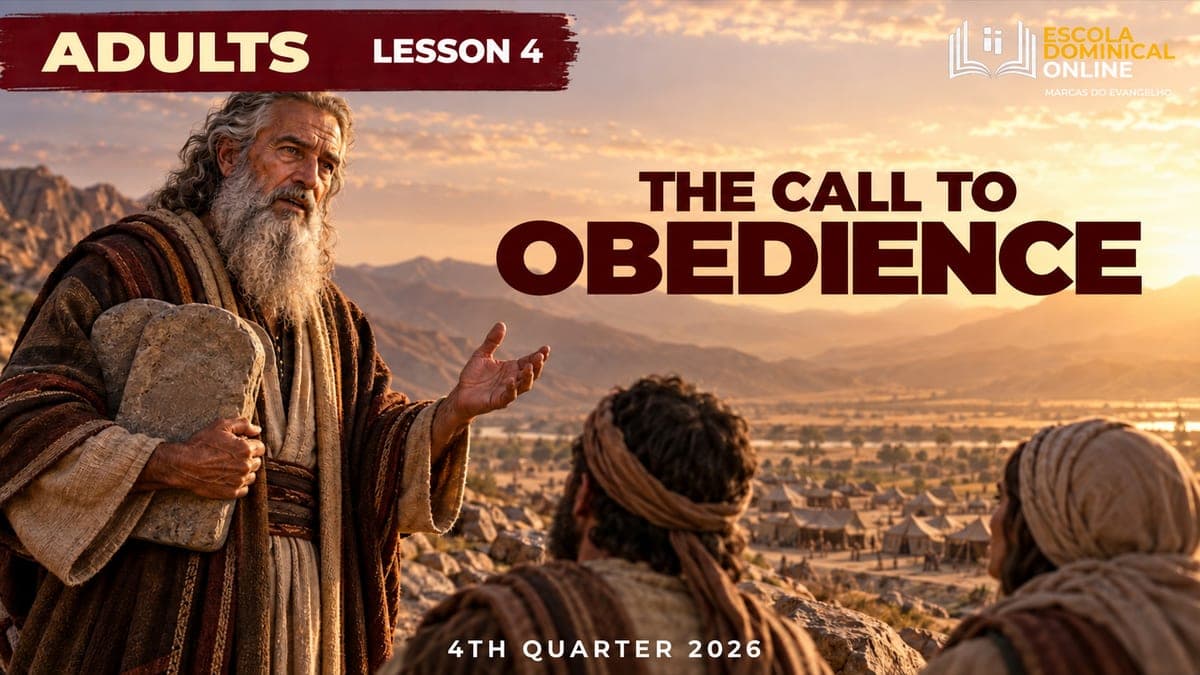
The Call to Obedience
Adults · Lesson 4 · Quarter 4
The video has automatic English dubbing. If you hear Portuguese, open the player settings (⚙) → Audio track → English.
About this lesson
Hearing, learning, and practicing the Word reveal a true relationship with the Lord God.
Golden Text
“Ye shall walk in all the ways which the LORD your God hath commanded you, that ye may live, and that it may be well with you, and that ye may prolong your days in the land which ye shall possess.”
Frequently asked questions about this lesson
1.If I am saved by grace, do the Ten Commandments still apply to me?
They apply as an expression of God's character and as the moral standard that Jesus reaffirmed, not as a code that condemns nor as a ladder to salvation. Paul says both things: "Wherefore the law is holy, and the commandment holy, and just, and good." (Romans 7:12) and "For sin shall not have dominion over you: for ye are not under the law, but under grace." (Romans 6:14). The Law of Moses, as a covenant code, was given to Israel; the church does not live under it (Galatians 5:18; Colossians 2:16-17). But nine of the Ten Commandments are repeated and deepened in the New Testament, and Jesus Himself took each of them to the heart (Matthew 5:21-28). In Christ, God did not lower the standard: He wrote it on the inside (Hebrews 10:16). The Christian keeps the commandments because he loves (John 14:15), not in order to be accepted.
2.Does the Christian have to keep the Sabbath?
Not as a covenant commandment. The seventh day was given to Israel as a sign, tied to creation and to the rescue from Egypt (Deuteronomy 5:15). The New Testament is clear about keeping the day: "Let no man therefore judge you in meat, or in drink, or in respect of an holyday, or of the new moon, or of the sabbath days: Which are a shadow of things to come; but the body is of Christ." (Colossians 2:16-17). The shadow pointed to Him: the rest the Sabbath announced is fulfilled in Jesus (Matthew 11:28; Hebrews 4:9). The principle remains, God wants His people resting, worshipping and giving rest to those who work for them, and the church gathers on the first day of the week, the day of the resurrection (Acts 20:7). What does not remain is keeping the seventh day as a commandment for the Christian; whoever says there is no salvation without it is adding to the Gospel.
3.Isn't obeying God legalism?
Legalism is obeying in order to be accepted; biblical obedience is responding because one has already been accepted. The difference lies in the order of Deuteronomy 5: before any commandment, God says "I am the LORD thy God, which brought thee out of the land of Egypt, from the house of bondage." (Deuteronomy 5:6). First the rescue, then the Law. Whoever reverses the order becomes a legalist (obeying to buy God's favor) or exhausted (obeying out of fear). But the opposite of legalism is not disobedience: it is obedience in the right order. Jesus said "If ye love me, keep my commandments." (John 14:15), and James warns that the hearer who does not do deceives himself (James 1:22). Grace does not dispense with obedience; it makes obedience possible.
4.How do I know whether I obey out of love or only out of fear of losing my salvation?
Ask three questions. First: what happens when no one is watching? Fear obeys where there is an audience; love obeys in the dark, because the tenth commandment, not to covet (Deuteronomy 5:21), can only be kept on the inside. Second: what do you feel when you fail, panic at being rejected, or sorrow at having wounded Someone who already loved you? Third: does your obedience start at verse 6 or at verse 7? Whoever remembers every day that he has already been rescued obeys as a son; whoever has forgotten obeys as a slave. God does not want the gesture without the heart: "O that there were such an heart in them, that they would fear me, and keep all my commandments always, that it might be well with them, and with their children for ever!" (Deuteronomy 5:29). And the heart He desires, He Himself gives by the Spirit (Ezekiel 36:27). If fear is in charge, do not try to obey harder; go back to verse 6.
5.I was raised in church and have done everything right since childhood. Is the covenant already mine?
Inheritance opens the door, but it does not walk through the door for you. Moses speaks to the children and grandchildren of those who stood at Horeb and says: "The LORD made not this covenant with our fathers, but with us, even us, who are all of us here alive this day." (Deuteronomy 5:3). Each generation needs to take up the covenant by its own decision: Joshua chose for himself and for his house (Joshua 24:15), and Timothy received the faith from his grandmother and his mother, but had to make it his own (2 Timothy 1:5). Being the child of believers is an enormous privilege, and it converts no one. If you have never said to God, on your own, "the Lord is my God", say it today. It does not need a stage; it needs a heart.
6.Does Deuteronomy 5:33 promise that everything will go well for those who obey?
It promises the blessing of the covenant: life preserved, safe direction, a house that does not fall apart from the inside, protected generations: "Ye shall walk in all the ways which the LORD your God hath commanded you, that ye may live, and that it may be well with you, and that ye may prolong your days in the land which ye shall possess." (Deuteronomy 5:33). It does not promise a bank balance or the absence of pain. Moses obeyed and did not enter the land; the apostles obeyed and were imprisoned; the Son Himself was obedient unto death: "And being found in fashion as a man, he humbled himself, and became obedient unto death, even the death of the cross." (Philippians 2:8). The "well" of Deuteronomy is not a trade formula; it is what happens to those who walk in God's way instead of destroying themselves outside it. Jesus repeats the same beatitude, with the same two parts: "But he said, Yea rather, blessed are they that hear the word of God, and keep it." (Luke 11:28).
Adults
Quarter 4