Golden Text
“As they ministered to the Lord, and fasted, the Holy Ghost said, Separate me Barnabas and Saul for the work whereunto I have called them.” (Acts 13:2, KJV) · Read in the Bible
Acts 13 is a border text — and at every border three things happen at the same time: the Gospel crosses over (the crossing), darkness reacts (the confrontation in Paphos), and grace remakes the name: 'Christians' in Antioch, and Saul becomes Paul in Cyprus.
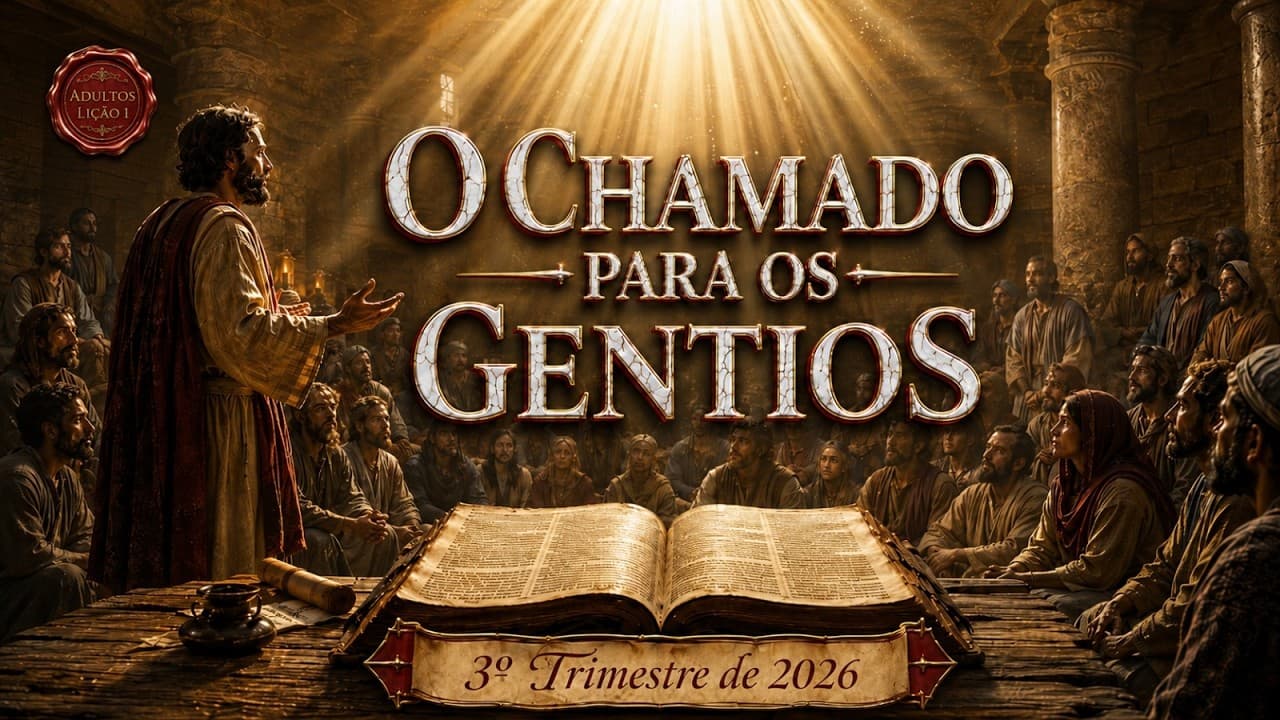
This quarter opens with Lesson 1 — "The Call to the Gentiles" — the entrance door to a study on how the Gospel went out from Jerusalem and reached us. The quarterly from CPAD (the Assemblies of God publishing house in Brazil), commented on by Pastor Wagner Gaby, enters through a true door: the Spirit leads the mission, and the church is the missionary agency. But that is only one of the doors of the text — if we stop there, we miss the drama that Luke wrote on purpose.
Acts 13:1-12 is a frontier text. And on every frontier three things happen at the same time: the Gospel crosses (the crossing), darkness reacts (the confrontation at Paphos), and grace remakes the name — Christians in Antioch, and Saul becomes Paul in Cyprus. Luke ties it all together with irony: the false "son of Jesus" against the true Son; the one who twists against the one who sets apart; the blindness that blinds against the blindness that once opened Saul's eyes.
The lesson, therefore, is not "be a good missionary". It is to see who the God is who sends, who the Christ is who reigns over darkness, and the new name that grace signs on the frontier.
The Crossing (vv. 1-5) — from the altar of Antioch to the sea of Cyprus
The table that already crosses frontiers (v. 1)
Before crossing frontiers, the church at Antioch was already, at its own table, a crossroads of them. The leadership: Barnabas, a Cypriot Levite; Simeon, called Niger — a Latin nickname for "black", suggesting an African; Lucius of Cyrene, in North Africa; Manaen, brought up in Herod's court; and Saul, the Pharisee of Tarsus. Africa, Cyprus, Herodian aristocracy, and Pharisaism, side by side. The church that would send to the nations was already the nations gathered — and it was there that a new name was coined for this new people: Christians (Acts 11:26), no longer defined by ethnicity, but by Christ.
Keep Luke's first irony in mind, which is only completed at Paphos: the church has true prophets (v. 1); the adversary will be a false prophet (v. 6).
🏛 Archaeology — Antioch on the Orontes. Founded by Seleucus I Nicator around 300 BC and named in honor of his father, Antiochus, Antioch of Syria was the third largest city in the Roman Empire, behind only Rome and Alexandria — with an estimated population between 250,000 and 500,000. Cosmopolitan, with a large Jewish population and the port of Seleucia, it was the perfect soil for a faith that crossed frontiers.
Worship that becomes sending (vv. 2-3)
What does this table do? It worships and fasts. And it is in the worship service — not in a planning meeting — that the Spirit speaks, with a concrete word, commanding them to set apart Barnabas and Saul for Him. The church responds with fasting, prayer, and the laying on of hands. Calling is personal and secret; recognition is ecclesial and public.
In the original — Greek
- λειτουργούντων (leitourgoúntōn) — "ministering worship to God". From it comes "liturgy". Mission is born at the altar: worship first, sending afterwards.
- ἀφορίζω (aphorízō) — "to separate, to set apart" (v. 2). It is the key word of the lesson. At Paphos, it will have an enemy: the sorcerer who will try to "twist" (diastréphō) what God set apart.
- προσκέκλημαι (proskéklēmai) — "I have called" (perfect). The calling precedes the worship service. Fasting does not manufacture the call — it only discerns and confirms it.
The Gospel crosses the sea (vv. 4-5)
The laying on of hands does not replace the Sender: Luke repeats the agent — sent forth by the Holy Spirit. They go down to Seleucia, the port, and sail to Cyprus, the native island of Barnabas (Acts 4:36). The crossing of the sea is the crossing of the frontier. In Salamis, they proclaim the Word in the synagogues: Paul's strategy begins with the synagogue, a natural bridgehead, in the order of Romans 1:16 (to the Jew first, and also to the Greek). They had John Mark as their assistant.
And scholarship converses with Scripture: Martin Hengel demonstrated that the "Hellenists" — Greek-speaking Jewish Christians, the circle of Stephen — were the bridge to the Gentile mission, and that the first to preach to the Greeks were men of Cyprus and Cyrene (Acts 11:20), the exact profile of Barnabas and Lucius. And Roland Allen, in Missionary Methods: St. Paul's or Ours? (1912), already showed that the strength of the Pauline method was radical dependence on the Spirit.
❤ For your life. Start where God planted you. Paul set out from Cyprus — the home of Barnabas. Your mission also has a "synagogue": your family, your workplace, the bridge you already possess. And notice John Mark: he would falter further on (Acts 13:13), but grace would restore him (2 Timothy 4:11). There is room, on God's team, for those who are still maturing.
The Confrontation (vv. 6-11) — Paphos, where the frontier becomes a battlefield
Darkness reacts: Bar-Jesus, or Elymas (vv. 6-8)
Once they have crossed the island to Paphos — the capital, seat of the proconsul — the Gospel meets resistance. And what ironic resistance: a Jew, a sorcerer and false prophet, named Bar-Jesus, that is, "son of Jesus/salvation" — a "son of salvation" who fights against salvation. He is with the proconsul Sergius Paulus, an intelligent man, who desires to hear the Word. The sorcerer resists, trying to turn the proconsul away from the faith. It is no coincidence: where the Light advances, darkness stirs.
🏛 Archaeology — Luke's accuracy. Luke calls the ruler "proconsul" (anthýpatos) — historically exact: since 22 BC Cyprus had been a senatorial province, governed by a proconsul, not by an imperial legate. The detail, noted by W. M. Ramsay, is a mark of the reliability of Luke the historian. Inscriptions attest to the family of the Sergii Pauli in the first century, and F. F. Bruce discusses the hypothesis that the proconsul's interest opened the next route to Paul — the family owned estates near Pisidian Antioch, the next destination.
The turning of the name: Saul filled with the Spirit (vv. 9-11)
Now the heart of the frontier. Luke writes that Saul is also called Paul. From here on, he will always be Paul — and he will be the one who leads. The Hebrew name of King Saul yields to the Roman name Paul, on the exact threshold of the Gentile mission, inside a Roman court. The apostle's identity now points outward, toward the nations.
And how does Paul confront the sorcerer? Not with a magician's technique, but filled with the Holy Spirit. The weapon is pneumatic. To the "son of Jesus" (Bar-Jesus) he answers by calling him a child of the devil. And he pronounces judgment: temporary blindness — the same darkness that had once fallen upon Saul himself, on the road to Damascus.
In the original — the vocabulary of power, the name, and twisting
- διαστρέφω (diastréphō) — "to twist, to pervert, to turn aside" (vv. 8, 10). It is the antonym of aphorízō (to set apart, v. 2): God sets apart for the mission; Elymas twists away from the faith. The twister of darkness against the One who makes straight.
- Σαῦλος ὁ καὶ Παῦλος — "Saul, who is also called Paul". A double-name formula (Jewish + Roman). Luke begins using the Roman name at the exact point where the mission turns to the nations.
- πλησθεὶς πνεύματος ἁγίου — "filled with the Holy Spirit". The fullness of the Spirit is not only for worship; it is also for confronting darkness. Pentecostal power at the service of mission.
The irony Luke planted — read the text by contrasts
| The counterfeit (darkness) | The reality (in Christ) |
|---|---|
| Bar-Jesus — "son of Jesus/salvation" (v. 6) | Child of the devil, unmasked (v. 10) |
| A false prophet (v. 6) | True prophets and teachers (v. 1) |
| Sorcery and enchantment (v. 8) | Paul filled with the Holy Spirit (v. 9) |
| diastréphō — to twist, to turn away from the faith (vv. 8, 10) | aphorízō — to set apart and send to the mission (v. 2) |
| Saul — the name of the king who persecuted | Paul — the apostle sent to the Gentiles (v. 9) |
| Elymas blind for a season (v. 11) | Saul, once blind, now sees and sends (Acts 9) |
| The hand of the Lord against you (v. 11) | The hand of the Lord with them (Acts 11:21) |
The New Name (v. 12) — when the frontier is crossed
The outcome is glorious and instructive. The proconsul believes. But notice what he is astonished at: not at the spectacle of the blindness, but at the doctrine of the Lord. The sign opened the door; the Word converted. The first recorded fruit of the journey is a high Roman official — a Gentile — won by Word and Spirit together. The frontier has been crossed, and on the other side a new people is born.
❤ For your life. Spiritual opposition is real — but the Spirit is greater. You do not confront darkness with technique, but filled with the Spirit. And do not be deceived by spectacle: the proconsul believed in the doctrine, not in the wonder — seek the Word more than the sign. And your name: the persecutor became an apostle; Saul became Paul. On the frontier of grace, God renames anyone — including you.
Christ in Acts 13 — the Christological thread
We do not read this text moralistically; the decisive question is not "what should we do?", but "where is Christ here?". There is a false "son of Jesus" (Bar-Jesus) and the true Son. Elymas is a child of the devil; Christ is the Son who came to destroy the works of the devil (1 John 3:8). At Paphos, the risen King exercises dominion over occult powers — and the proconsul is astonished at the doctrine of the Lord: Christ is the content, not the wonder.
And it is the Lord Himself who stands behind the sending: He ascends (Acts 1), pours out the Spirit (Acts 2), and, by that same Spirit, sets apart missionaries (Acts 13). The Gentile mission is the visible execution of the Great Commission (Matthew 28:19) and the fulfillment of the Servant who is a light to the Gentiles (Isaiah 49:6; Luke 2:32). To take the Gospel to the nations is to crown Christ where He is not yet recognized as Lord.
Confirmation comes even from sociology: Rodney Stark, in The Rise of Christianity (1996), showed with demographic data that the faith advanced through urban relational networks — exactly the kind of crossroads of peoples that Antioch and ports like Salamis offered. And Craig Keener, in his monumental commentary on Acts, documents that the confrontation with a court magician like Elymas is plausible in every historical detail.
Our reading — four Pentecostal keys
- The Spirit still speaks and still sends. Acts 13:2 is not a museum piece. The same Spirit who set apart Barnabas and Saul continues calling and sending church workers today.
- The fullness of the Spirit is power for confrontation. Being filled with the Holy Spirit (v. 9) is not an ornament: it is the anointing that confronts darkness. Baptism in the Spirit clothes with power to witness (Acts 1:8).
- The grace that crosses the frontier is for all. The Gentile mission reveals God's universal salvific will — for everyone who believes (Romans 1:16; 1 Timothy 2:4). We read Acts 13:48 in the light of foreknowledge and prevenient grace: God, who knows beforehand those who would believe, prepares and enables — but the invitation is genuinely for the nations.
- The Spirit calls; the church responds — synergy. The calling belongs to the Spirit; the response (fasting, prayer, laying on of hands) belongs to the church. God calls and enables, and we respond freely.
Practical Application
The table: if the church at Antioch seated an African, an aristocrat, and a Pharisee together, our church cannot fit into a single color, class, or origin. Who is still left outside our table?
The altar before the field: no sending without fasting, prayer, and the laying on of hands. May mission be born on our knees, as at Antioch — not out of haste.
Each person's frontier: every student leaves the lesson with a "Gentile" in mind — the neighbor, the coworker, the relative who does not yet know the Light. The crossing begins on your street.
And five appeals: worship before serving; let grace cross your frontiers; confront darkness filled with the Spirit; love doctrine more than spectacle; and receive your new name — whatever your past may be, grace signs a new name and sends you out.
Closing Prayer
Eternal Father, on the frontier of Antioch You set apart church workers and sent Your Church to the nations. Thank You for reaching us — us, a people from far off, today made Yours, called by the name of Your Son. Kindle in us the fire of that table: may our worship flow into sending, may we confront darkness filled with Your Spirit, and may we love Your Word more than any sign. Where the enemy tries to twist, set apart; where there is blindness, open the eyes; and sign in us a new name. Send us, Lord, to the ends of the earth. In the name of Jesus, who reigns over every power. Amen.
Soli Deo Gloria — Scripture governs; everything else, on its knees.
Frequently asked questions about this lesson
Who sent Paul and Barnabas on the first missionary journey?+
The Holy Spirit, who spoke to the leadership of the church in Antioch during a worship service with fasting, telling them to set apart Barnabas and Saul for Him (Acts 13:2). The church responded with fasting, prayer, and the laying on of hands — the calling belongs to the Spirit; the recognition belongs to the church.
Why did Saul come to be called Paul?+
Luke records the change in Acts 13:9, at the exact moment when the mission turns to the Gentiles, inside a Roman court. The Hebrew name gives way to the Roman name: the apostle's identity now points to the nations he was sent to reach.
Who was Elymas the sorcerer?+
A Jew, a magician and false prophet named Bar-Jesus ('son of Jesus/salvation'), who operated alongside the proconsul Sergius Paulus in Cyprus and tried to turn him away from the faith. Paul, filled with the Holy Spirit, confronted him, and Elymas became blind for a time (Acts 13:6-11).
What was the first fruit of the mission to the Gentiles?+
The Roman proconsul Sergius Paulus, who believed, astonished at the teaching of the Lord (Acts 13:12). The sign opened the door, but it was the Word that converted him — a high official of Rome won by the Word and the Spirit together.
Teacher's Guide
Five questions this lesson asks the class:
- Who is the "Gentile" you still avoid — the person from "far off" whom your table does not have room for?
- Has your mission been born at the altar (fasting and prayer) or out of anxiety and improvisation?
- When darkness reacts in your life, do you respond with technique and human strength, or filled with the Spirit?
- Have you been chasing after signs and wonders, or after the doctrine of the Lord — the Word that converts?
- What old name still defines you, when grace has already signed a new name? Are you Saul or Paul?