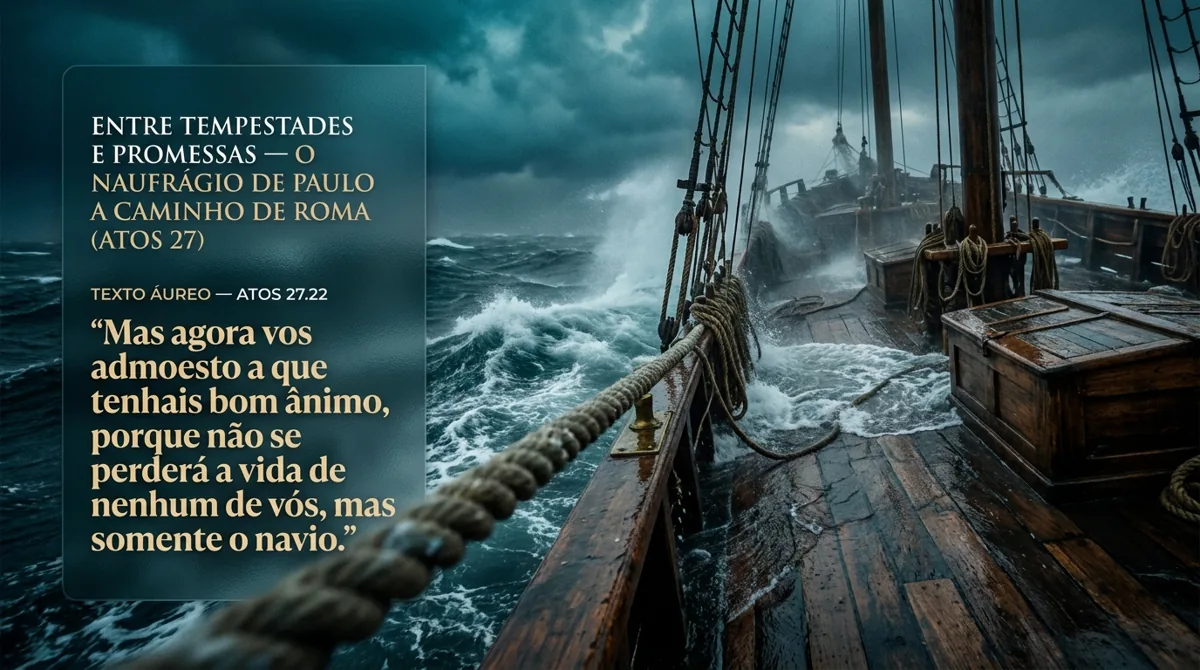
Golden Text
“And now I exhort you to be of good cheer: for there shall be no loss of any man’s life among you, but of the ship.” (Acts 27:22, KJV) · Read in the Bible
A grain ship loaded with 276 people sets sail from Fair Havens at the end of the sailing season, trusting in a south breeze that looked like approval. Fourteen days later, with neither sun nor stars, hope has run out — and it is right there that an angel assures Paul that no life will be lost, only the ship. The entire lesson lives in the tension between two statements in the same chapter: the absolute promise of verse 22 and the warning of verse 31, when Paul says that if the sailors abandon the ship, no one can be saved. The promise was certain; the means were not optional. And everyone reached the shore — many clinging to pieces of the broken ship.
Lesson 11 • Between Storms and Promises: Paul's shipwreck on the way to Rome — Exhaustive Research Study of the Lesson.
Complete study of Acts 27 — exegesis of the text, first-century Roman navigation, the calendar of the sea, maritime archaeology, the doctrine of providence and the tension between divine promise and human responsibility.
Marcas do Evangelho (church in Cariacica/ES, Brazil) • Pastor Jairo Carvalho and Pastor Jaciana Carvalho • 3rd Quarter of 2026 (Lições Bíblicas, the CPAD Sunday School quarterly — Adults).
✶ Golden Text — Acts 27:22
"And now I exhort you to be of good cheer: for there shall be no loss of any man’s life among you, but of the ship." (Acts 27:22)
Practical Truth (CPAD, the Assemblies of God publishing house in Brazil): even when material losses are inevitable, God preserves life and fulfills His promises to those who trust in Him.
- Study Text — Acts 27 (complete chapter)
- Scripture Reading in Class — Acts 27:9-15, 21-26
- Daily Reading — Mon Acts 27:22-25 • Tue Psalm 46:1, 2 • Wed Isaiah 43:2 • Thu 2 Corinthians 4:8, 9 • Fri Hebrews 10:23 • Sat Matthew 10:29, 31
- Hymns (Harpa Cristã, the Brazilian Assemblies of God hymnal) — 4, 515 and 578
- Bible version — Scripture quotations in this translation follow the King James Version (KJV), checked word for word. Transliterations follow the usual academic standard.
Objectives and how to use this study
Lesson Objectives (CPAD): (I) to explain how human decisions precipitate crises; (II) to demonstrate that the divine promise sustains the believer in crisis; (III) to lead the student to trust in God's providence amid losses. Objectives added here: (IV) to place the voyage within the grain supply system of the Empire and the ancient navigation calendar; (V) to explain the nautical maneuvers described by Luke and what their precision attests; (VI) to formulate, with pastoral care, the relationship between God's promise and human responsibility in light of Acts 27:22-24 compared with Acts 27:31; and (VII) to protect the class from two wrong and cruel readings of the chapter — that whoever has faith loses nothing, and that whoever dies in a tragedy did not trust enough.
Structure: Part I brings the overview — the ship, the route, the calendar and the people on board; Part II expounds the chapter block by block; Part III develops the theological axes, with emphasis on the tension between verses 22 and 31; Part IV lists the common interpretive mistakes; Part V brings the nautical lexicon; Part VI gathers summary tables; and the final parts offer the application, the class plan, the quiz and the bibliography. The two bibliological aids of the quarterly are commented on and expanded in Parts II and III.
Convention adopted: historical claims come with the ancient source or archaeological find that supports them, so that the teacher can verify them before citing. Where the subject is debated among scholars — and in this chapter there are two very lively debates — that is stated plainly. Here a hypothesis is never presented as if it were a certainty.
Part I — Overview: the ship, the route and the calendar
1) A grain ship, not a fishing boat
The image many people carry of this chapter is that of a little boat in the middle of the waves. It was not that. In Myra, a city of Lycia, the centurion found an Alexandrian ship sailing for Italy (Acts 27:6) — that is, a freighter on the Egyptian grain route.
Rome, in the first century, had close to a million inhabitants and depended on the cura annonae, the state grain supply system. Egypt was the breadbasket of the Empire, and the Alexandrian fleet carried wheat to the ports of Ostia and Puteoli. These were not small vessels: Lucian of Samosata, in the dialogue Navigium, describes an Alexandrian grain freighter named Isis, forced to dock at Piraeus by contrary winds, measuring about 55 meters in length, 13.7 in beam and 13.4 in depth of hold. Underwater archaeology confirms the order of magnitude: the shipwreck of Madrague de Giens, off the southern coast of France, revealed a merchantman of about 40 meters, carrying hundreds of tons of cargo.
🔬 How a ship like that was built
And why the crew needed to undergird the ship
Roman shipbuilders worked by the shell-first method: the planks were fitted edge to edge by thousands of mortise-and-tenon joints, locked with wooden pegs. This produced a rigid, strong and watertight hull — but one vulnerable to twisting. Under the force of a gale, the joints could give way and the ship could split down the middle. That is precisely why Luke records the maneuver of verse 17, where they used helps to undergird the ship. They passed thick cables under the keel and tightened them across the deck, "hugging" the hull so that it would not come apart. Propulsion came from a large square sail on the mainmast, assisted by a smaller foresail on the bow; and there was no central rudder — steering was done by two large side oars at the stern, which could be hoisted and tied up, the rudder bands of verse 40. Note for the teacher: every technical detail in the chapter has a function in the narrative. Luke is not embellishing; he is describing what he saw.
2) Who was on board
There were 276 souls (Acts 27:37): the military guard, the crew, commercial passengers and a group of prisoners. Paul was under the custody of Julius, a centurion of the Augustan band (v. 1) — the Greek expression speira Sebastē indicates a corps connected to the imperial service, rather than ordinary infantry. The treatment he gives the apostle right at the beginning is noteworthy: Julius treated Paul kindly and gave him liberty to go to his friends so they could care for him (v. 3).
And Paul was not alone. Verse 2 holds two precious pieces of information: we boarded a ship of Adramyttium, with Aristarchus, a Macedonian of Thessalonica, being with us (v. 2). The "we" is Luke — the physician and historian spent the fourteen days in the same storm, with the same hunger and the same fear. And Aristarchus was no ordinary passenger: he had accompanied Paul for years (Acts 20:4) and, later, writing from Rome, the apostle would call him his fellow prisoner (Colossians 4:10). The man went into the storm and later went into prison alongside him. When God promised to preserve those lives through means, one of the means had already been provided before the wind turned: two brothers beside His servant.
3) The calendar of the sea and the Fast of verse 9
The drama of Acts 27 can only be understood with the ancient calendar in hand. The sea was not open all year round. Vegetius, in his treatise Epitoma Rei Militaris (Book IV), divides the year into three periods: the safe season, from late May to mid-September; the dangerous season, from mid-September until early November; and the mare clausum, the closed sea, from November until spring, when civil and military traffic virtually ceased.
Now, Luke writes that much time had been spent and sailing was already dangerous, because the Fast was also already past (Acts 27:9). The Fast is the Day of Atonement, Yom Kippur, on the tenth day of the month of Tishri — somewhere between late September and the first half of October. A first-century Jewish reader understood the sentence immediately: they were entering the dangerous band of the calendar, with the closed sea just ahead. Paul's warning in verse 10 was not a hunch; it was the obvious fact that haste refused to see.
4) Fair Havens and Phenice: the decision that cost the ship
The ship had taken shelter at Fair Havens (Kaloi Limenes), near the city of Lasea, on the south coast of Crete. The problem was that Fair Havens was a bay exposed to winter winds — the harbor was not commodious to winter in (v. 12). The majority voted to risk a short run to Phenice, a better anchorage further west, which lies toward the southwest and northwest winds (v. 12).
Notice what decided the vote: comfort. It was not gratuitous recklessness; it was the search for a better place to spend the winter — the reasonable, defensible decision, backed by the professionals. And then came the clinching argument: when the south wind blew softly, they supposed that they had obtained their purpose (v. 13). The favorable breeze was read as confirmation. Not every gentle breeze is divine approval.
Part II — Exposition of the text — Acts 27, block by block
Block 1 (vv. 9-12) — The ignored counsel
"Nevertheless the centurion believed the master and the owner of the ship, more than those things which were spoken by Paul." (Acts 27:11)
There were three technical voices on board and one voice without rank. The kybernetes was the pilot, responsible for the course; the naukleros was the master or owner of the ship; and Julius, as the officer on a transport of state interest, had the final word. Paul was a Jewish prisoner. From the standpoint of the organizational chart, the decision was impeccable.
On the quarterly's aid, "Divine Intervention in the Midst of Crisis": the quarterly rightly reminds us that Paul never called himself a prisoner of Rome, but a prisoner of Jesus Christ (Philemon 1), and that the imprisonment that looked like defeat turned into a blessing — out of it came the Prison Epistles and the ongoing witness before the guard. It is worth expanding this with a detail from the chapter itself: the man no one wanted to listen to in verse 11 is the very same man whom, fourteen days later, the centurion obeys on the spot and without argument (vv. 31, 32). The authority Paul did not have on paper he won through the word that came true. No one hands the helm to a prisoner because of his résumé; they hand it over because what he said before actually happened. That is how a voice is earned in a home, in a workplace and in a church: through a track record of being right when no one wanted to listen.
Block 2 (vv. 13-20) — Euroclydon and the end of hope
"But not long after there arose against it a tempestuous wind, called Euroclydon." (Acts 27:14)
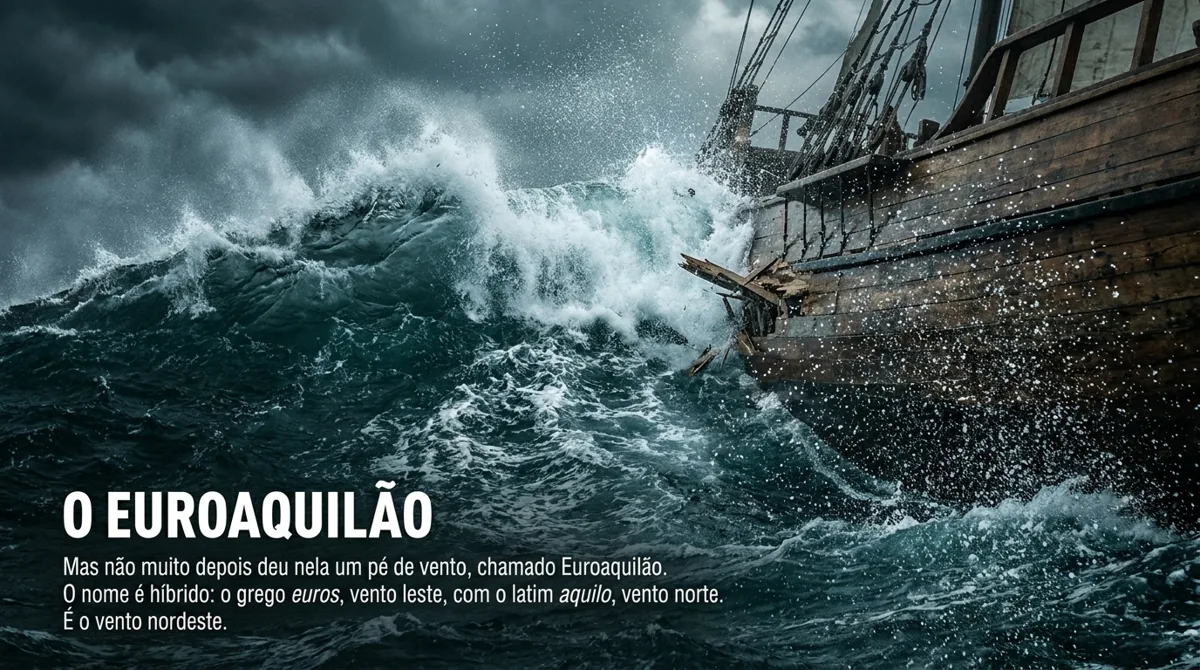
⚓ In the original — the wind that had no name in Latin
Εὐρακύλων (Eurakylōn) — "Euroclydon" / "northeaster" (v. 14). It is a hybrid word, formed from the Greek euros (east wind) and the Latin aquilo (north wind): the northeast wind. The Greeks called this wind kaikias; Latin had no equivalent term, and Roman sailors appear to have coined the expression. An honest textual note for the teacher: the oldest manuscripts read Eurakylōn, while the Textus Receptus reads Euroklydōn — hence the difference among Bible translations.
ὑποζώματα (hypozōmata) — the technique behind undergirding the ship (v. 17). Passing cables under the hull and tightening them across the deck, so that the ship would not split apart.
Σύρτις (Syrtis) — "quicksands" / "Syrtis" (v. 17). The shifting sandbanks off the coast of North Africa, the nightmare of every Mediterranean pilot. The fear of ending up there explains the next maneuver: they lowered the gear and let themselves be driven.
σκάφη (skaphē) — "boat" / "skiff" (vv. 16, 30, 32). The lifeboat, normally towed astern in calm seas. It returns to the center of the scene in verse 30, and what happens to it is the heart of this lesson.
The sequence of losses is gradual and deserves to be read slowly in class. First they hoisted the skiff on board, with difficulty, as they passed under the lee of the small island of Clauda (v. 16) — modern Gavdos, a few dozen kilometers south of Crete. Then they undergirded the hull (v. 17). The next day they lightened the ship, throwing the cargo overboard (v. 18). On the third day, they cast out the tackling of the ship with their own hands (v. 19) — notice the first-person plural: it was not just the crew, it was everyone, including the narrator, throwing overboard with their own hands the very equipment that kept them sailing.
And then the darkest verse of the chapter: when neither sun nor stars appeared for many days, and no small tempest lay on them, all hope that they should be saved was then taken away (v. 20). There was no compass. Sun and stars were the only points of reference that existed. Without them, the most experienced pilot in the Mediterranean did not know where he was. The absence of light is not a poetic detail: it is the literal loss of all capacity for orientation. And it is at that exact point — not before — that God speaks.
Block 3 (vv. 21-26) — The promise that already included the shipwreck
"And now I exhort you to be of good cheer: for there shall be no loss of any man’s life among you, but of the ship." (Acts 27:22)
Before encouraging them, Paul says what needed to be said: they should have listened to him and not loosed from Crete, and so been spared this harm and loss (v. 21). This is not settling scores; it is what gives weight to what comes next. The one who got the diagnosis right earns credit to announce the prognosis.
And now read the whole promise, because almost everyone reads only half of it. There shall be no loss of any man's life among you — that part we memorize. But only of the ship — that part we skip. The angel did not promise that the ship would hold together: he announced that the ship would be lost. Four verses further on, Paul adds that they must nevertheless be cast upon a certain island (v. 26). That "must" is the very same note that sounds in verse 24, when the angel says that Paul must be brought before Caesar. Running aground was not outside the plan. It was inside it.
That changes the way we pray. We are in the habit of asking God to deliver us from the storm and of calling a promise only that which spares us from damage. Yet the promise of Acts 27 was not "the ship will arrive intact"; it was "the ship will be lost and you will live". God promised the shipwreck and the salvation in the same sentence.
✶ The most striking sentence in the chapter
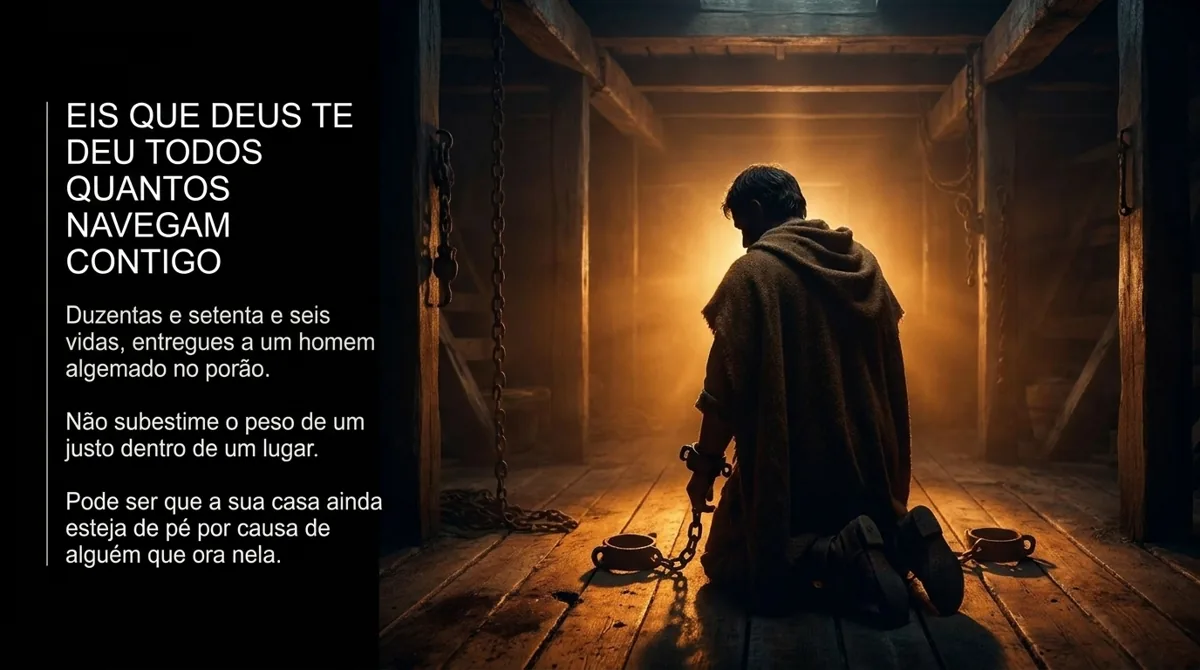
"Saying, Fear not, Paul; thou must be brought before Cæsar: and, lo, God hath given thee all them that sail with thee." (Acts 27:24)
God gave those people to Paul. Two hundred and seventy-six lives, handed over to a man chained in the hold. Remember Abraham before Sodom, bargaining for ten righteous men? There were not ten there. There was one. And the entire ship's company reached the beach alive — the sailor who tried to flee, the soldier who wanted to kill the prisoners, the centurion who made the wrong call at the start. God lost no one in the count, not even those who deserved it least. Do not underestimate the weight of one righteous person inside a place. It may be that your house is still standing because of someone who prays in it.
Block 4 (vv. 27-32) — The haunting "unless"
"Paul said to the centurion and to the soldiers, Except these abide in the ship, ye cannot be saved." (Acts 27:31)

The fourteenth night. The sailors suspect that land is near — probably from the sound of the breakers. They sound with the lead: twenty fathoms. A little further on, fifteen. The bottom is rising fast and the shore is invisible in the dark. They cast four anchors from the stern, so that the ship stays with its bow pointed toward the land, and wish for the day (vv. 27-29).
And then, in the dark, the sailors — the only ones who knew how to handle that vessel — stage an escape. They let the skiff down into the sea under pretense of casting anchors from the bow (v. 30). They were abandoning the ship and leaving some 270 people behind.
It is here that Paul speaks the sentence that haunts the reader. He, who four days earlier had announced the most absolute promise possible, now tells the centurion: unless these men stay in the ship, you cannot be saved. Either the promise was guaranteed, or it depended on the sailors remaining on board. How can it be both things at the same time?
There is no contradiction. There is one of the most important lessons Scripture teaches about how God governs the world: the promise was certain and the means were not optional. God promised the end and provided the way to the end. The promise that no one would die included the sailors on board, included the food in the people's stomachs, included the anchors, the rudders and the foresail. Take away one of those pieces and the outcome does not happen.
"Then the soldiers cut off the ropes of the boat, and let her fall off." (Acts 27:32)
Think of the size of that decision. That lifeboat was everyone's Plan B on board — including the soldiers'. If the ship went down during the night, that was how they would try to escape. And they cut it away. Obeying the word cost them the destruction of their own alternative. As long as the boat is tied to the side, we obey with one eye on the exit.
Block 5 (vv. 33-38) — Bread in the middle of terror
"Wherefore I pray you to take some meat: for this is for your health: for there shall not an hair fall from the head of any of you." (Acts 27:34)
Read the "for" carefully, because it dismantles fatalism once and for all. Paul does not say: "you do not need to eat, for not a hair will fall". He says the opposite: "eat, for not a hair will fall". God's absolute guarantee enters there as a reason to act, not as an excuse not to act. They would need strength in their arms to swim a few hours later.
And then, soaked to the bone, in the middle of terror, with the ship about to break apart, Paul does something disarming: taking bread, he gave thanks to God in the presence of them all, and when he had broken it, he began to eat (v. 35). He did not wait for the storm to pass to give thanks. He gave thanks inside it, in front of 275 hungry and hopeless people. And the next verse records the turning point: then were they all of good cheer, and they also took some food (v. 36).
Gratitude spoken aloud in the middle of a crisis is spiritual leadership — and it is contagious. Sometimes the most powerful thing someone can do for their own household in a time of distress is not a sermon: it is giving thanks out loud before eating.
Block 6 (vv. 39-44) — Clinging to the planks
"And the rest, some on boards, and some on broken pieces of the ship. And so it came to pass, that they escaped all safe to land." (Acts 27:44)

Day breaks. They spot a bay with a beach, take up the anchors, loose the rudder bands, hoist the foresail to the wind and make toward shore. But the ship strikes a place where two seas meet, runs aground, the forepart sticks fast and remains immovable, and the stern is broken with the violence of the waves (v. 41). Exactly as the angel had announced: the ship is lost.
The soldiers panic. Under Roman discipline, a guard who lost a prisoner answered with his own life — the same terror as the Philippian jailer (Acts 16:27). Their counsel was to kill all the prisoners (v. 42). And then comes the final reversal: the centurion, willing to save Paul, kept them from their purpose (v. 43). The officer who at the start preferred to listen to the pilot now risks his own neck for the sake of the prisoner.
And the outcome is the image that carries the entire lesson: those people reached the beach alive clinging to the pieces of the ship that had been shattered. The plank that floated was the same hull that had cracked. What broke became what carried. God did not prevent the shipwreck — He made the wreckage itself the vehicle of salvation.
On the quarterly's aid, "Fear Not, Paul": the quarterly rightly observes that as long as God has an unfinished purpose for someone's life, and that person seeks God and follows the guidance of the Spirit, the Lord keeps them. It is worth stating this precisely so that the class does not draw a conclusion the text does not support. The preservation of those lives is expressly tied to a declared purpose: Paul must be brought before Caesar (v. 24). This is about God's faithfulness to His own purpose, and not an automatic immunity for the believer. Scripture itself is honest: in the very same book of Acts, James is killed with the sword and Peter is released by an angel (Acts 12:2, 7-11) — the same God, the same church praying, two outcomes. What God guarantees is not the script we prefer; it is that no purpose of His is lost along the way. Say this in class in plain words: there will be people in the room who have already buried someone.
Part III — Theology of the lesson — four axes
1) God's promise and human responsibility
This is the richest axis of the chapter, and the teacher must not let it pass. Put the two statements side by side on the board:
v. 22 — there shall be no loss of any man's life among you → what God guarantees
v. 31 — unless these men stay in the ship, you cannot be saved → how God does it
They do not contradict each other: one is the promise, the other is the path. Whoever promises the harvest also promises the sowing, the rain and the sickle. No one reaps without planting by claiming that the harvest was promised.
From this come two rejections. We reject fatalism, which says, "if it is determined, it does not matter what I do". The Bible says the opposite: precisely because God promised the end, what you do matters, because your obedience is part of the way. And we reject self-sufficiency, which treats the promise as an ornament and human competence as the engine — that is what took the ship out of Fair Havens.
The scriptural support is direct: we are commanded to work out our own salvation with fear and trembling, for it is God who works in us both to will and to do of His good pleasure (Philippians 2:12, 13). God works; we work. Grace enables, the believer cooperates. And Paul's warning to the soldiers is serious precisely because our part is real: if the warning were merely decorative, no one would have cut any rope.
Notice also that God did not override a single human will in the entire chapter. He warned through the apostle, and the centurion chose to ignore it. He sent the angel, and Paul chose to believe. He warned again, and the soldiers chose to cut the ropes. He moved Julius's heart, and the officer chose to protect. None of those people became a pawn on a board — and even so, in verse 44, the count came out whole.
2) God preserves life; the ship, He does not
The Practical Truth of the lesson says that material losses may be inevitable. This needs to be taught without anesthesia and without cruelty, because the class has people in real storms: unemployment, illness, debt, grief.
The text clearly separates the accessory from the essential. Overboard went the cargo (v. 18), overboard went the tackling (v. 19), overboard went the wheat (v. 38), and the stern was broken to pieces (v. 41). What remained was life. And Scripture nowhere says that this is little: "Are not two sparrows sold for a farthing? and one of them shall not fall on the ground without your Father. But the very hairs of your head are all numbered. Fear ye not therefore, ye are of more value than many sparrows." (Matthew 10:29-31).
But notice also what is not being said. It is not being said that loss does not hurt, nor that the believer must pretend that losing the ship is a matter of indifference. Paul called it by its name: this harm and loss (v. 21). Biblical faith does not force anyone to smile inside the shipwreck. It sustains the person while they cling to the plank.
And here lies a necessary warning against prosperity theology. This chapter is the exact antidote: the most used apostle of the New Testament, at the center of God's will, fulfilling a mission announced by an angel, reached the beach with nothing, soaked and clinging to a piece of wood. Obedience is not a synonym for ease, and a calling is not an exemption from suffering (cf. John 16:33).
3) Jonah's storm, inverted
Place the two stories side by side and the teacher will have one of the most beautiful hooks of the quarter. In Jonah 1 there is a prophet on a pagan ship, a storm that threatens everyone, terrified sailors crying out each to his own god and the cargo being thrown into the sea to lighten the vessel. They are the exact same elements as Acts 27.
Yet the outcome is the opposite. In Jonah, the man of God was the cause of the storm and had to be cast overboard so that the others might live. In Acts, the man of God is the reason why everyone lives, and the order is that no one leave the ship.
And between the two stands the One who called Himself greater than Jonah (Matthew 12:41): the Son of God, who was cast in neither for His own guilt nor by chance, but descended willingly into the waters of death, the only One truly handed over to the storm so that the whole company on board might reach the shore alive.
4) Providence that uses what is not ours
Notice the instruments God used to fulfill the promise: a Roman centurion, sailors who tried to flee, a cut lifeboat, four anchors, an unknown bay and the planks of a broken ship. None of those means belonged to the church. God governs the whole of history, and not merely the religious piece of it — the king's heart is in the hand of the LORD like rivers of water (Proverbs 21:1, cf. the quarterly's quotation). To govern is not to annul: it is to guide without undoing the person.
Luke repeats one word throughout the entire chapter, like someone checking off a list: all. God gave Paul all those who sailed with him (v. 24). When they were all of good cheer, they also took food (v. 36). And so it came to pass that they all escaped safe to land (v. 44). The angel promised all, and all came ashore.
Part IV — Common interpretive mistakes — what to avoid when teaching
1. "If God promised, my part does not matter." That is the reading verse 31 destroys. Paul treated the promise as the foundation for action, not as a substitute for it. He warned, ordered the rope cut, urged them to eat and gave thanks. Faith is not passivity with a spiritual veneer.
2. "Whoever trusts in God loses nothing." The ship sank. The cargo was lost. The wheat went into the sea. The promise included the shipwreck in the very same sentence — that only the ship would be lost. Teaching the opposite sets the student up to accuse God of unfaithfulness on the day the plank cracks.
3. "No faithful believer dies in a tragedy." This is the most dangerous mistake in the lesson, because it wounds wounded people. The promise of Acts 27:22-24 was specific to that voyage and tied to a declared purpose. In the same book, James dies by the sword and Peter is set free (Acts 12:2, 7-11). Stephen was stoned while praying (Acts 7:59, 60). What is universal is God's faithfulness, not the script of deliverance.
4. "The storm came because someone sinned." The text shows the consequence of a hasty decision, not a judicial sentence. And the consequence fell equally upon the righteous and the unrighteous: Paul, Luke and Aristarchus went through the same fourteen days. Be careful not to let the class turn this into a diagnosis of other people's lives.
5. "Having a Plan B is a lack of faith." The whole chapter is made of prudence: cables, anchors, soundings, a meal before swimming. The sin of the skiff was not that the lifeboat existed; it was the secret flight that saved a few at the expense of all, disguised as a technical maneuver. Do not tell anyone in the class to cancel their insurance or quit their job.
6. "Paul became the hero and the crew became extras." Luke does not write that way. The text gives credit to the skill of the sailors, the decision of the centurion and the effort of each person in the water. And it makes clear that Paul was not alone: Luke and Aristarchus were right there, in the same cold.
7. "God sent the storm to teach a lesson." The text does not say that. It says there was a human decision, a northeast wind and a God who lost control of nothing. Not every storm is pedagogy; some are simply the fallen world operating — and in none of them is God left with nothing to do.
Part V — Lexicon of the lesson — nautical terms in order of appearance
| TEXT | TERM | MEANING AND RELEVANCE |
|---|---|---|
| 27:1 | σπεῖρα Σεβαστή (speira Sebastē) | "Augustan band / cohort" — a unit connected to the imperial service; Julius was no ordinary soldier. |
| 27:9 | ἡ νηστεία (hē nēsteia) | "the Fast" — the Day of Atonement, a calendar marker: the sea was entering the dangerous season. |
| 27:11 | κυβερνήτης (kybernētēs) | "pilot / helmsman" — the steersman, responsible for the route; from this comes our word "cybernetics". |
| 27:11 | ναύκληρος (naúklēros) | "master / owner" — the captain or shipowner; the commercial authority on board. |
| 27:14 | Εὐρακύλων (Eurakylōn) | "Euroclydon / northeaster" — hybrid of euros (east) and aquilo (north): the northeast wind. Textus Receptus variant: Euroklydōn. |
| 27:16 | σκάφη (skaphē) | "skiff / boat" — the lifeboat towed astern; the object that decides verse 32. |
| 27:17 | ὑποζώματα (hypozōmata) | "undergirding the ship" — cables passed beneath the keel so the hull would not split open. |
| 27:17 | Σύρτις (Syrtis) | "quicksands / Syrtis" — the sandbanks off the North African coast, the terror of pilots. |
| 27:20 | περιῃρεῖτο ἐλπίς | "all hope was taken away" — without sun or stars there was no way to know their position. |
| 27:28 | ὀργυιά (orgyiá) | "fathom" — unit of depth for sounding: twenty, then fifteen. |
| 27:29 | ἀγκύρας τέσσαρας | "four anchors" — cast from the stern, to keep the bow pointed toward the beach. |
| 27:37 | ψυχαί (psychai) | "souls" — two hundred and seventy-six persons on board. |
| 27:40 | πηδαλίων (pēdalíōn) | "rudder bands" — the two lateral steering oars, hoisted up while anchored. |
| 27:41 | τόπον διθάλασσον | "place where two seas met" — where two currents meet; the point of grounding. |
| 27:44 | σανίσιν (sanísin) | "on boards / planks" — the wreckage that carried the castaways to the beach. |
Part VI — Summary tables
The promise and the means, phase by phase
| PHASE OF THE CRISIS | WHAT GOD PROMISES | WHAT THE MEN DO |
|---|---|---|
| The storm (vv. 14-20) | Still silent; the promise will come at the peak | Undergird the hull, lighten the ship, cast the tackling overboard |
| The revelation (vv. 21-26) | No life among them will be lost, but only the ship | Paul announces and believes God that it will happen just as it was told him |
| The flight of the skiff (vv. 30-32) | The promise remains standing | Paul warns; the soldiers cut the ropes and destroy Plan B |
| The meal (vv. 33-36) | Not a hair will fall from the head of any of them | They eat, to have strength to swim; Paul gives thanks in front of all |
| The grounding (vv. 39-44) | They must nevertheless be cast upon a certain island | Hoist the foresail, run aground, swim, cling to the planks |
How to use: walk through the table with the class and ask, on each row, "where is the promise and where is their part?". The entire lesson fits into that reading.
What was lost and what was kept
| LOST | REFERENCE | KEPT | REFERENCE |
|---|---|---|---|
| The cargo | 27:18 | The 276 lives | 27:37, 44 |
| The tackling of the ship | 27:19 | The purpose for Rome | 27:24 |
| The wheat of the cargo | 27:38 | The word given by God | 27:25 |
| The stern and the hull | 27:41 | The testimony before all | 27:35, 36 |
Jonah's storm and Paul's
| ELEMENT | JONAH 1 | ACTS 27 |
|---|---|---|
| The man of God | Is the cause of the storm | Is the reason why everyone lives |
| The cargo | Cast into the sea | Cast into the sea |
| The sailors | Cry out each to his own god | Hear the word of the living God |
| The command | Cast me into the sea (Jonah 1:12) | Unless these men stay in the ship (Acts 27:31) |
| The outcome | The prophet is thrown overboard | The apostle remains on board |
On Luke's accuracy — and what is debated
Until the mid-nineteenth century there were those who treated Acts 27 as literary fiction. That skepticism lost ground when James Smith of Jordanhill — an experienced yachtsman well acquainted with the Mediterranean — subjected the chapter to a nautical examination in his work The Voyage and Shipwreck of St. Paul (1848). He reconstructed the drift of a freighter of that size under a northeast gale, hove to, starting from the shelter of Clauda. By his calculations, the ship would drift about thirty-six nautical miles a day; and the distance from Clauda to the coast of Malta is approximately 476 nautical miles. The division yields just over thirteen days — which fits when the fourteenth night was come (Acts 27:27). It was on the basis of verifications like this that Sir William Ramsay, trained in the skepticism of his day, ended up defending Luke as one of the great historians of the ancient world. Later studies observe that the density of place-names and details irrelevant to the plot is typical of eyewitness memory, not literary invention.
🔬 Archaeology — what can be said and what cannot
Two proposals, one caution
The exact identification of the place where two seas met (Acts 27:41) on the coast of Malta is debated. One proposal places the shipwreck on the southeastern coast, near the Munxar reef, based on anchors recovered by fishermen decades ago; most scholars reject it for a simple exegetical reason: that coast was well known to Alexandrian mariners, and the sailors would have recognized the place — which contradicts verse 39, where when it was day, they did not recognize the land. The other line maintains the traditional location in the northern part of the island, and there an interesting piece of data emerged: in 2005, at a depth of several dozen meters in Salina Bay, a massive lead anchor stock was recovered bearing a Latin inscription that mentions Isis and Serapis — deities linked to the Egyptian grain trade. Say this in class with honesty: that anchor cannot be tied to Paul's ship, and no serious, responsible scholar claims that it can. What it shows is that large Alexandrian freighters did in fact wreck and lose anchors in those bays — suggestive evidence of the setting of the account, not proof of the episode. A teacher who presents a hypothesis as a certainty loses the class the day someone looks it up.
Christ in the Lesson
✝ Salvation reached the shore clinging to a piece of wood
Why the shipwreck was not the failure of the promise
What God did in Acts 27 He had already done at Calvary: He promised salvation while announcing, in the very same sentence, destruction. Jesus told the disciples that He would be delivered up and killed and that on the third day He would rise again (Mark 10:33, 34). They heard only the part about the damage and despaired. And when the ship split open on Friday, they thought the promise had failed. Yet the cross was not the shipwreck of the promise: it was the promise. And notice the holy irony of the outcome: all of humanity crosses to the other side holding on to a piece of wood. The very instrument that looked like proof of failure was the means of salvation — God saved the world with wreckage. That is why Paul's call to be of good cheer in the middle of the sea has an echo: "These things I have spoken unto you, that in me ye might have peace. In the world ye shall have tribulation: but be of good cheer; I have overcome the world." (John 16:33). The hope of the lesson does not lie in the strength of the hull or in the courage of the apostle. It lies in Someone who descended willingly into the waters of death so that the entire company on board might arrive alive.
Devotional application — five points for the life of the class
- Read the whole promise, not just the half that pleases you. God said that no one would die and that the ship would be lost. Whoever memorizes only the first part accuses God of unfaithfulness on the day of loss.
To reflect: which promise have you been demanding from God by halves, expecting the good part and refusing the cost He already warned you about?
- Not every gentle breeze is approval. They left Fair Havens because the wind was favorable and the harbor was uncomfortable. A favorable circumstance is not the same thing as God's direction.
To reflect: what decision are you about to make simply because "everything is going smoothly" — and you still have not taken it to God?
- Faith is cutting the lifeboat's rope. As long as the alternative is tied to the side, we obey with one eye on the exit. Faith is not saying amen to the promise; it is surrendering yourself to its path.
To reflect: what alternative do you keep tied up "just in case" that prevents you from depending entirely on God?
- God's guarantee is a reason to act, not an excuse to stop. Paul urged them to eat because not a hair would fall from their heads (Acts 27:34). God promised the end and provided the way — and your part is part of the way.
To reflect: in what area have you been waiting on God for a result toward which you have not done the part He has already shown you?
- The broken piece can become the plank. Those people reached shore alive clinging to the wreckage of their own ship. God does not waste even the broken pieces.
To reflect: what broken part of your story do you still treat as shame, when God wants to turn it into a plank of salvation for someone else?
Suggested class plan — 45 minutes
- 0-5 min — Opening: the two statements of the chapter written side by side on the board (vv. 22 and 31), with the question, "does this contradict itself?".
- 5-13 min — Overview (Part I): the grain ship, the calendar of the sea and the decision to leave Fair Havens.
- 13-22 min — Blocks 1 and 2 (vv. 9-20): the ignored counsel, Euroclydon, the maneuvers and the loss of all hope.
- 22-31 min — Block 3 (vv. 21-26): the promise that already included the shipwreck; the loss of the ship alone (v. 22); God giving Paul all who sailed with him (v. 24).
- 31-38 min — Blocks 4 and 5 (vv. 30-36): the cut skiff, the "for" of verse 34 and the bread broken in the middle of terror.
- 38-42 min — Block 6 (vv. 39-44) and Christ in the Lesson: the planks, the repeated "all" and the cross.
- 42-45 min — Wrap-up, challenge of the week and prayer.
For classes with two sessions: session 1 — Overview and Blocks 1 to 3 (the decision, the storm and the promise); session 2 — Blocks 4 to 6, Part III and the application. The natural boundary lies between verses 26 and 27.
Questions for discussion: (a) How do verse 22 and verse 31 complement rather than contradict each other? (b) Why did the gentle breeze deceive experienced sailors? (c) What does it mean in practice to "cut the lifeboat's rope" in the life of an adult who works and supports a household? (d) How should we speak of Acts 27:22 before someone who has lost a child? (e) Why does Luke repeat the word "all" throughout the entire chapter?
Review quiz — with answers
1. Why was Paul's warning ignored? Because the centurion trusted the technical assessment of the pilot and the master of the ship more than the guidance God was giving through the apostle (Acts 27:11), and because the harbor where they were was not commodious to winter in (v. 12). It was human logic and the search for comfort above divine direction.
2. What does it mean that the fast was already past (v. 9)? It is a reference to the Day of Atonement, on the tenth day of the month of Tishri — between the end of September and the first half of October. A calendar marker: the sea was entering the dangerous season, and winter would close navigation shortly ahead.
3. What factors demonstrated human fragility before the storm? The deceptive south breeze (v. 13), the Euraquilo that took away control of the ship (vv. 14, 15), the need to undergird the hull with cables (v. 17) and, finally, many days without sun or stars — without any point of reference to know where they were (v. 20).
4. What was the message received by Paul, and what exactly did it promise? An angel of God assured him that he must be brought before Caesar and that God had given him all those who sailed with him (v. 24). The promise was the preservation of everyone's life — and, in the same sentence, the loss of the ship (v. 22).
5. How do verse 22 and verse 31 harmonize? Verse 22 says what God guarantees; verse 31 says how God fulfills it. The promise included the means: the sailors remaining on board, the anchors, the rudder, the food. God promised the end and provided the way to the end — and that is why human obedience matters.
6. What did the soldiers do with the skiff, and why is that notable? They cut the ropes and let it fall off (v. 32). It was the only lifeboat, the plan B of everyone on board, including themselves. Obeying the word cost them the destruction of their own alternative.
7. What is the force of the "because" in Acts 27:34? Paul does not say they do not need to eat because not a hair will fall; he tells them to eat because not a hair will fall. God's guarantee comes in as a reason to act, not as an excuse for passivity. They would need strength to swim.
8. What gesture of Paul's changed the atmosphere on the ship? He took bread, gave thanks to God in the presence of all and began to eat (v. 35). The next verse records the effect: once everyone had recovered their courage, they also began to eat (v. 36). Gratitude spoken aloud in a crisis is spiritual leadership.
9. How did the people reach the shore? Some by swimming, and others on planks and other pieces from the ship (v. 44) — that is, clinging to the wreckage of the very ship that had broken apart. What broke was what carried them.
10. Who prevented the massacre of the prisoners, and what does this teach? The centurion Julius, wanting to save Paul (v. 43). It teaches that God also governs the hearts of authorities and uses instruments that do not belong to His people, without thereby nullifying anyone's will (cf. Proverbs 21:1).
11. Does the promise of Acts 27:22 guarantee that no faithful believer will die in a tragedy? No. It was specific to that voyage and tied to a declared purpose (v. 24). In the same book, James is killed with the sword and Peter is released by an angel (Acts 12:2, 7-11). What is universal is God's faithfulness, and not the script of deliverance.
12. What does the lesson teach about material losses? That they can be unavoidable and that God did not commit Himself to preventing them. He preserves what is essential: life and purpose. True security does not lie in the boats we build, but in the faithfulness of the One who promised (Hebrews 10:23).
13. What is the parallel — and the contrast — with Jonah 1? The elements are the same: prophet, ship, storm, pagan sailors, cargo thrown into the sea. The contrast is the outcome: in Jonah, the man of God is the cause of the storm and is cast overboard; in Acts, he is the reason why everyone lives and the order is that no one leave the ship.
14. What word does Luke repeat in the chapter, and why? "All" (vv. 24, 36, 44). It is the roll call of the list: the angel promised all, all ate and all reached land safely. Not even the sailors who tried to flee were left out.
15. How does the chapter flow into Christ? God promised salvation while announcing destruction in the same sentence — just as He did at the cross. The promise reached the shore clinging to a piece of wood, and the instrument that looked like proof of failure was the means of deliverance. That is why the call to be of good cheer in this chapter echoes that of John 16:33.
Going further — bibliography consulted and recommended
Commentaries and studies
ARRINGTON, French L. O Novo Testamento Pentecostal. Rio de Janeiro: CPAD (the Assemblies of God publishing house in Brazil).
BRUCE, F. F. The Book of the Acts. Rev. ed. Grand Rapids: Eerdmans, 1988.
CASSON, Lionel. Ships and Seamanship in the Ancient World. Baltimore: Johns Hopkins University Press, 1995.
HEMER, Colin J. The Book of Acts in the Setting of Hellenistic History. Tübingen: Mohr Siebeck, 1989.
HORTON, Stanley M. O Livro de Atos. Rio de Janeiro: CPAD.
KEENER, Craig S. Acts: An Exegetical Commentary, v. 4 (24:1–28:31). Grand Rapids: Baker Academic, 2015.
MARSHALL, I. Howard. Atos: introdução e comentário. São Paulo: Vida Nova / Mundo Cristão.
RAMSAY, William M. St. Paul the Traveller and the Roman Citizen. London: Hodder & Stoughton, 1895.
RAPSKE, Brian. The Book of Acts and Paul in Roman Custody. Grand Rapids: Eerdmans, 1994.
SMITH, James. The Voyage and Shipwreck of St. Paul. London, 1848.
STOTT, John. A Mensagem de Atos. São Paulo: ABU Editora, 1994.
Sources cited by the lesson itself: PEARLMAN, Myer. Atos: a Igreja Primitiva na força e na unção do Espírito. Rio de Janeiro: CPAD, 2018, pp. 250-251 (aid "A Intervenção Divina em Meio à Crise"); Bíblia de Estudo Pentecostal — Edição Global. Rio de Janeiro: CPAD, 2022, p. 2004 (aid "Paulo, Não Temas"); Ensinador Cristão magazine, issue 106, p. 42.
Ancient sources: LUCIAN OF SAMOSATA, Navigium (the Alexandrian grain ship Isis); VEGETIUS, Epitoma Rei Militaris, book IV (the sailing seasons and the mare clausum); PLINY THE ELDER, Natural History (the autumn storms).
Maritime archaeology: the Madrague de Giens shipwreck (southern coast of France); finds of Roman anchors in the northern bays of Malta. Identifications of the exact site of the shipwreck of Acts 27 remain debated.
Closing Prayer
Lord, You who promised life and announced the shipwreck in the same sentence, teach us to read Your promises in full. Forgive us for calling Your word only the half that spares us from the damage, and for accusing You of unfaithfulness on the day the plank cracks. You did not promise a calm sea; You promised the arrival. And You promised to be with us when we passed through the waters.
Teach us, Father, the difference between trusting and folding our arms. May the certainty of Your promise be in us a reason to act, and never an excuse not to do what we already know is ours — the postponed conversation, the step no one can take in our place, the small obedience we have been dragging our feet on. Give us courage to cut the boat's rope: that alternative we keep tied to the side, just in case, which prevents complete surrender.
Look, Lord, upon those in this class who are in the middle of a real storm — without work, without health, without money, without someone who was still here yesterday. Do not let us treat anyone's pain with a ready-made phrase. Comfort those who have lost the ship and the cargo, and show them that arriving without baggage is not arriving defeated. Make of our broken planks the board that carries someone to the shore.
And establish in us, Father, the only hope that sustains people in the dark: not that everything will work out our way, but that the One who promised has already crossed first. You went down into the waters of death so that the whole crew might arrive alive, and our salvation reached the shore clinging to a piece of wood. While the wind has not yet passed, give us good cheer — because You have overcome the world. In the name of Jesus, the Lord of the winds and the sea. Amen.
Soli Deo Gloria — Scripture governs; everything else, on its knees.
Frequently asked questions about this lesson
If God had already promised that no one would die (Acts 27:24), why does Paul later say that without the sailors no one could be saved (Acts 27:31)?+
Because God's promise includes the path to fulfillment, not just the outcome. Both statements are in the same chapter, spoken by the same mouth, and they do not contradict each other: that no one's life would be lost (v. 22) is what God guarantees; that unless those men stayed in the ship they could not be saved (v. 31) is how God does it. The One who promises the harvest also promises the sowing, the rain, and the sickle — and no one reaps without planting by claiming that the harvest was promised. That is why our reading of Scripture rejects both fatalism ("if it is already decided, it doesn't matter what I do") and self-sufficiency. Paul did not treat the promise as an excuse not to act; he treated it as a reason to act. Notice his argument in verse 34: it is not that they do not need to eat because not a hair will fall, but that they should eat because not a hair will fall. The guarantee serves as the reason to do your part, never as permission not to do it.
So does someone who trusts in God lose nothing?+
The text says the exact opposite, and this must be taught plainly. The angel did not promise that the ship would hold together: he announced that the ship would be lost, though only the ship (Acts 27:22). Four verses later Paul adds: "Howbeit we must be cast upon a certain island." (Acts 27:26). Running aground was not an accident that God failed to prevent; it was part of what He Himself had warned about beforehand. The cargo went into the sea, the tackle went into the sea, the wheat went into the sea, and the stern broke apart under the force of the waves. Anyone who only accepts the good half of the promise will accuse God of unfaithfulness the day the planks crack — when God had already said so. His faithfulness is not the absence of loss: it is the guarantee that loss does not swallow up what is essential or the purpose.
Does the promise that no one's life will be lost (Acts 27:22) apply to every believer who prays today?+
Not as a script; yes as God's character. That promise was specific: given to Paul, on a particular night, for that voyage, and tied to a declared purpose — that he must be brought before Caesar (Acts 27:24). Scripture itself is honest about this: in the same book, James is killed with the sword and Peter is freed by an angel (Acts 12:2, 7-11). The same God, the same church praying, two outcomes. What is universal is not deliverance on the terms we prefer, but the faithfulness of the One who promised: "Let us hold fast the profession of our faith without wavering; (for he is faithful that promised;)" (Hebrews 10:23). Teaching that anyone with enough faith comes through every tragedy unscathed is cruel to those who have buried someone — and it is not what the text says.
Was Paul's statement of what he perceived in Acts 27:10 divine revelation or a sailor's experience?+
Scholars are divided, and it is worth mentioning this in class. Paul had already survived three shipwrecks (2 Corinthians 11:25) and knew the calendar of the sea; his warning could have been an experienced reading of the circumstances. On the other hand, Luke presents Paul throughout the entire book as a man who speaks on behalf of God. The text itself marks a difference in tone: in verse 10 he speaks of what he perceives (Acts 27:10); in verse 23 he declares that the angel of God stood by him (Acts 27:23). The first is a warning; the second is explicit revelation. The practical lesson does not depend on the debate: God also speaks through common sense and the experience of those who have already sailed, and despising the advice of someone without an official position cost that crew dearly.
Is having a Plan B a lack of faith? Does the lesson tell us to throw away all precaution?+
No. Prudence is biblical, and the chapter itself is a manual of prudence: they undergirded the ship with cables, cast anchors, ate before swimming, and lightened the load. The problem with the skiff in Acts 27:30 was not that it was a boat — it was that it was a secret escape to save a few at the expense of everyone, disguised as a technical maneuver under the pretense of laying out anchors from the bow (Acts 27:30). What the lesson confronts is not a savings account, insurance, or an updated resume: it is the alternative we keep tied to the side so we do not have to truly obey — one foot outside the church, an exit plan from marriage, a reserve of dishonesty kept "just in case." While the rope is tied, faith is a declaration; when the rope is cut, it becomes surrender.
If God governs even the centurion's heart (Acts 27:43), are we free or are we pawns on a board?+
Free — and therefore responsible. Scripture affirms both things without embarrassment: "Wherefore, my beloved, as ye have always obeyed, not as in my presence only, but now much more in my absence, work out your own salvation with fear and trembling. For it is God which worketh in you both to will and to do of his good pleasure." (Philippians 2:12-13). God governs history without turning anyone into an automaton: He moves, convicts, helps, and enables, and the person cooperates — or resists. That is what happened throughout the entire chapter. The centurion got it wrong at the beginning (v. 11) and got it right at the end (vv. 31, 32, 43); the sailors tried to flee and were stopped; the soldiers wanted to kill the prisoners and held back. God did not nullify a single will, and yet not one of His purposes was lost along the way. Grace enables, the believer cooperates — and the warning of verse 31 is serious precisely because our part is real.
Was the shipwreck a punishment for the centurion's disobedience?+
The text does not use the word punishment. It shows consequence: a decision made against the warning brought harm and loss (Acts 27:21), as Paul himself says. Yet notice that the consequence fell on the righteous and the unrighteous alike — Paul, Luke, and Aristarchus went through the same fourteen days of hunger, cold, and darkness. And notice also what God did with it: He used a Roman officer's wrong route to place the Gospel in Malta (Acts 28) and the apostle in Rome. Not every storm is punishment, and not every storm is chance. Some we manufacture ourselves, others simply overtake us — and in neither case is God left with nothing to do.
Teacher's Guide
Essence of the class
God promised that no one would die — and even so the ropes of the skiff had to be cut: His promise is certain, the means are not optional, and faith is not passivity.
Map of the class
| Time | Stage |
|---|---|
| 0–5 min | Opening (the hook: the two sentences on the board) |
| 5–15 min | Point 1 — The decision that seemed reasonable (vv. 9-20) |
| 15–27 min | Point 2 — The promise that already included the shipwreck (vv. 21-26) |
| 27–36 min | Point 3 — The haunting "if": cutting the boat's rope (vv. 30-36) |
| 36–40 min | Class activity + Christ in the Lesson (vv. 39-44) |
| 40–45 min | Wrap-up + challenge of the week + prayer |
Start like this
Write the two sentences on the board, one below the other, without saying where they came from:
"Not a single life among you will be lost." "Unless these men stay on the ship, you cannot be saved."
Then say: "Both are from the same chapter, spoken by the same mouth, nine verses apart. One says it is guaranteed. The other says it depends. Which of the two is true?" Let three or four answer. You will hear "the first, because God does not go back on His word", "the second, because we have to do our part" and someone will say they did not understand. Hold the answers: "at the end of the class we will come back here, and you will see that both are true — and that is precisely why this lesson changes your week."
Point 1 — The decision that seemed reasonable (Acts 27:9-20)
- In the quarterly: topic I ("The storm that arises on the voyage"), with the three sub-items — the hasty decision to sail despite Paul's warning, human fragility before the forces of nature and the loss of hope in the face of adversity.
- What to teach: it was not a crazy decision; it was a sensible decision. The harbor was poor for wintering, the professionals recommended moving on and the wind was good. Show the three elements that make up the mistake: haste (the "fast" of v. 9 marks that the season was already closing), technical authority placed above the word of God (v. 11) and the search for comfort (v. 12). And then the final trap: when the south wind blew softly, they thought they already had what they wanted (v. 13). A favorable circumstance was read as approval. Close by showing the progressive loss: the cargo, the tackling and, finally, every point of reference — without sun or stars, the most experienced pilot in the Mediterranean did not know where he was (v. 20).
- Anchor verse (KJV): "Nevertheless the centurion believed the master and the owner of the ship, more than those things which were spoken by Paul." (Acts 27:11)
- Key question: "When was the last time you decided something important just because the wind was good?"
- Likely answers (+ going deeper): "I took a job", "I went into a business partnership", "I bought on installments", "I started a relationship". Go deeper: "and what would you have done differently if you had taken that to God before saying yes?" Do not let it turn into judging anyone — the subject is the decision, not the person.
- If no one speaks: give a small, concrete example of your own (a purchase, a move) and hand the question back. If there is still no answer, read verses 12 and 13 aloud and ask only: "what exactly convinced those people to leave a safe harbor?"
Point 2 — The promise that already included the shipwreck (Acts 27:21-26)
- In the quarterly: topic II ("God's intervention in the hour of despair"), with the sub-items on Paul's word of encouragement and God's promise in the midst of the crisis; plus the aid "Divine Intervention in the Midst of Crisis", right after the topic.
- What to teach: read the Golden Text slowly, twice, and have the class notice the second half. That no life among them would be lost — everyone memorizes that. But only the ship — almost no one quotes that. The angel did not promise that the ship would hold together: he announced that it would be lost. And four verses further on Paul adds that they must be cast upon a certain island (v. 26). Running aground was inside the plan, not outside it. Then go to v. 24 and show the most striking statement: that God had given him all those who sailed with him — 276 lives handed over to a man in chains. End with a firm pastoral warning: that promise was for that voyage, tied to a declared purpose; it is not a guarantee that whoever prays does not die. In the same book, James died by the sword and Peter was released (Acts 12:2, 7-11).
- Anchor verse (KJV): "And now I exhort you to be of good cheer: for there shall be no loss of any man’s life among you, but of the ship." (Acts 27:22)
- Key question: "Have you ever called God's promise only the part that spares you from the damage?"
- Likely answers (+ going deeper): "I prayed for the illness not to come and it came", "I thought God was going to solve it my way", "I got angry with God". Go deeper with care: "and what if His promise is to bring you to the other side, and not to spare you from the crossing?" If someone opens up about a serious loss, welcome them without asking for details in front of the class — "thank you for trusting us, let's talk after class" — and seek out the church leadership that same day.
- If no one speaks: read verse 22 stopping in the middle, and then read the second half separately. Ask only: "why do we never memorize that part?"
Point 3 — The haunting "if": cutting the boat's rope (Acts 27:30-36)
- In the quarterly: topic III ("Divine providence in the shipwreck"), with the sub-items on God's care preserving lives, divine sovereignty above human decisions and the faithful fulfillment of the promise; plus the aid "Paul, Do Not Fear", at the end of the topic. The closing of this point, comparing v. 22 with v. 31, is the wrap-up that the teacher leads.
- What to teach: this is the heart of the class. It is daybreak, the ship is anchored in the dark and the sailors — the only ones who knew how to maneuver it — lower the skiff pretending they are going to cast anchors from the foreship. And Paul, the same man who announced the absolute promise, says that unless those men stay in the ship, they cannot be saved (v. 31). Explain that there is no contradiction: v. 22 is what God guarantees, v. 31 is how God does it. Whoever promises the harvest promises the sowing, the rain and the sickle. Then show the reaction: the soldiers cut off the ropes of the skiff and let it fall off (v. 32) — they destroyed their own plan B. And close with the "because" of v. 34: Paul does not say they do not need to eat because not a hair will fall; he tells them to eat because not a hair will fall. God's guarantee is a reason to act, never an excuse to stop. Say it clearly: we are neither fatalists ("if it is decided, it doesn't matter") nor self-sufficient. Grace enables and the believer cooperates (Philippians 2:12-13).
- Anchor verse (KJV): "Paul said to the centurion and to the soldiers, Except these abide in the ship, ye cannot be saved." (Acts 27:31)
- Key question: "In what area of your life are you waiting for God to act without having done the part He has already shown you?"
- Likely answers (+ going deeper): "I'm waiting for a job but haven't updated my résumé", "I pray for my marriage but haven't talked to my husband", "I ask for health but haven't gone to the doctor", "I want peace at home but won't apologize". Go deeper: "why is it easier to pray for that than to do that?"
- If no one speaks: read verse 34 twice, moving the "because" on the second reading to show the contrast, and ask: "did you notice that he used the promise as a reason to eat, and not as a reason not to eat?"
Class activity
- Goal: to make the class feel, in practice, the difference between a promise that dispenses with our part and a promise that includes it.
- Materials: a board or poster paper, chalk or marker, and a piece of string about 30 cm (12 inches) long for each student (or strips of paper, if there is no string).
- Step by step: divide the board into two columns with the headings "What God guaranteed" and "What they had to do". Read Acts 27:22-26, 31-38 and 40-44 with the class and fill it in together: on one side, "no one dies", "must run aground on an island", "not a hair will fall"; on the other, "the sailors stay on the ship", "cut the ropes of the skiff", "eat to have strength", "hoist the mainsail", "swim", "hold on to the planks". Let the class look at the two columns in silence for a few seconds and ask: "if God had guaranteed it, why does this second column exist?" Then hand out the string and say: this is the rope of your boat. Each person thinks — privately, no one speaks and no one shows — of one thing they are waiting on God for and the part they already know is theirs and still have not done. Whoever wants to may keep the string in their pocket or in their Bible until next Sunday.
- Wrap-up (back to the text): "Those people were not saved by their own effort: they were saved because God promised. But God fulfilled the promise through their effort. That is why the string stays in your pocket all week: not so you can save yourself alone, but to remind you that the part you already know how to do is part of God's way. Cut the rope — and swim."
If they ask you this
Question: "If God has already promised, why do I need to do anything?" Short answer: Because God's promise includes the way to its fulfillment. He promised that no one would die and, nine verses later, warned that without the sailors on board no one would be saved. Whoever promises the harvest also promises the sowing, the rain and the sickle — and no one reaps without planting by claiming that the harvest was promised. Use verse 34 as proof: Paul did not say they did not need to eat because not a hair would fall; he told them to eat because not a hair would fall. God's guarantee is a reason to act. And complete it with "Wherefore, my beloved, as ye have always obeyed, not as in my presence only, but now much more in my absence, work out your own salvation with fear and trembling. For it is God which worketh in you both to will and to do of his good pleasure." (Philippians 2:12-13). God works, and we work.
Question: "My brother prayed, my mother prayed, the whole church prayed — and he died. Where was verse 22?" Short answer: That question deserves silence before an answer. Do not use this chapter to explain anyone's death. The promise of Acts 27:22 was specific: given to Paul, for that voyage, tied to a declared purpose (that he must be brought before Caesar, v. 24). Scripture is honest: in the same book of Acts, James is killed with the sword and Peter is released by an angel (Acts 12:2, 7-11) — the same God and the same church praying. What the Bible guarantees is not the script we prefer; it is that no purpose of God is lost and that none of His own is left alone: "Persecuted, but not forsaken; cast down, but not destroyed;" (2 Corinthians 4:9). And He promises to be with us when we pass through the waters (Isaiah 43:2) — notice that He does not promise there will be no waters.
Question: "So whoever trusts in God loses nothing? Because I lost everything." Short answer: That is not what the text says, and it is important to dismantle that in class. The ship sank. The cargo went into the sea, the tackling went into the sea, the wheat went into the sea and the stern broke apart. Paul called it by its name: this harm and this loss (v. 21). God did not promise exemption from loss; He promised to preserve life and fulfill the purpose. And look at how those people reached the shore: clinging to the pieces of the broken ship. What cracked was what carried them. Whoever arrived without a ship did not arrive defeated.
Question: "Having savings, insurance, a plan B — is that a lack of faith?" Short answer: No. The whole chapter is a lesson in prudence: they undergirded the hull, cast four anchors, sounded the depth and ate before swimming. The problem with the skiff in verse 30 was not that it existed — it was that it was a secret escape to save a few at the expense of all, disguised as a technical maneuver. Bring this home to work and family without pointing at anyone: the "boat's rope" is not your savings account, it is the alternative you keep tied up so you do not have to truly obey. One foot outside the church. The exit plan kept in a drawer. The reserve of dishonesty kept "just in case". As long as the rope is tied, faith is a declaration; when the rope is cut, it becomes surrender.
Question: "If God moved the centurion's heart, are we free or are we puppets?" Short answer: Free, and therefore responsible. Notice that God did not nullify a single will in the chapter: the centurion got it wrong at the beginning and right at the end, the sailors tried to flee, the soldiers wanted to kill and backed down. He warns, convicts, helps and enables — and the person cooperates or resists. That is what Scripture says in Philippians 2:12-13: God works in us both to will and to do, and we work out our salvation with fear and trembling. That is why the warning of verse 31 is truly serious: if our part were mere play-acting, no one would have cut any rope.
Wrap-up + challenge of the week
- Wrap-up: "Go back to the two sentences from the beginning. They do not contradict each other: they complete each other. 'No life among you will be lost' — that is God's promise, and it is unshakeable. 'Unless these men stay on the ship, you cannot be saved' — that is God's way, and it is not optional. And look at how it ends: so it came to pass that they all escaped safe to land — just as He said, including the part about the shipwreck. Many arrived clinging to the pieces of the ship itself, because God does not waste even the wreckage. And there is only one reason we can trust like this: He has already done this before. He promised salvation while announcing destruction in the same sentence, went down willingly into the waters of death, and our salvation reached the shore clinging to a piece of wood. The One who promised has already crossed first."
- Challenge: this week, choose one area in which you are waiting for God to act and take the practical step you already know is yours — the conversation you keep putting off, the appointment you have not scheduled, the résumé you have not sent, the request for help you have not made, the prayer commitment you have not kept. One step, one area, with a set date. On Sunday, come back with the story.
Teacher's kit
- Before: read the whole of Acts 27 aloud, from v. 1 to v. 44 — the chapter is a single narrative and gains a great deal when read all at once. Mark in your Bible verses 22, 24, 26, 31, 32, 34 and 44: they are the seven support points of the class. Reread Acts 23:11 (the promise of Rome, which explains Paul's peace) and Philippians 2:12-13, which sustains the point on cooperation. It is also worth taking a look at Jonah 1, for the closing contrast.
- Bring: a Bible, a board or poster paper for the two columns of the class activity, and string (or strips of paper) cut into pieces of about 30 cm (12 inches), one for each student.
- Pray beforehand: pray to God for those who arrive in class in the middle of a real storm — unemployment, illness, debt, grief — and for those who have already buried someone and are going to hear that not a single life among them would be lost. Ask for wisdom not to turn a specific promise into a general rule. And pray for yourself: that the class does not end in admiration for Paul, but in trust in Christ.
Homework
Your mission for the week
Choose one area in which you are waiting for God to act — and take, this week, the practical step that is already in your hand. The one you know: scheduling the appointment, sending the résumé, starting the conversation you have been putting off, asking for the help you are ashamed to ask for, sitting down with the family to deal with what no one deals with, returning to the prayer you dropped. One step, one area, with a day set during the week. It is not about solving the whole problem — it is about taking the step that is yours.
Why
The Golden Text is an unconditional promise that not one of them would lose his life (Acts 27:22). Yet nine verses later the same Paul says that unless those men stay on the ship, they cannot be saved (Acts 27:31). It is not a contradiction — it is the way God works. He promised the end and provided the way to the end, and your part belongs to the way. Notice his argument in verse 34: it is not "you do not need to eat, because not a hair will fall"; it is "eat, because not a hair will fall". God's guarantee is a reason to act, never an excuse to stop. "Wherefore, my beloved, as ye have always obeyed, not as in my presence only, but now much more in my absence, work out your own salvation with fear and trembling. For it is God which worketh in you both to will and to do of his good pleasure." (Philippians 2:12-13)
How to know you did it
The step has a day and has a verb. If you can say "on Wednesday I called", "on Tuesday I sent it", "on Saturday I sat down and talked", you did it. If the answer is "I thought a lot about it" or "I prayed about it", the part before God is settled — the part that was yours is still waiting.
On Sunday, come back with the story
The next class begins with those who took the step. Bring what you did and what happened afterwards — even if nothing has come of it yet. Do not stay out.