Golden Text
“And the times of this ignorance God winked at; but now commandeth all men every where to repent:” (Acts 17:30, KJV) · Read in the Bible
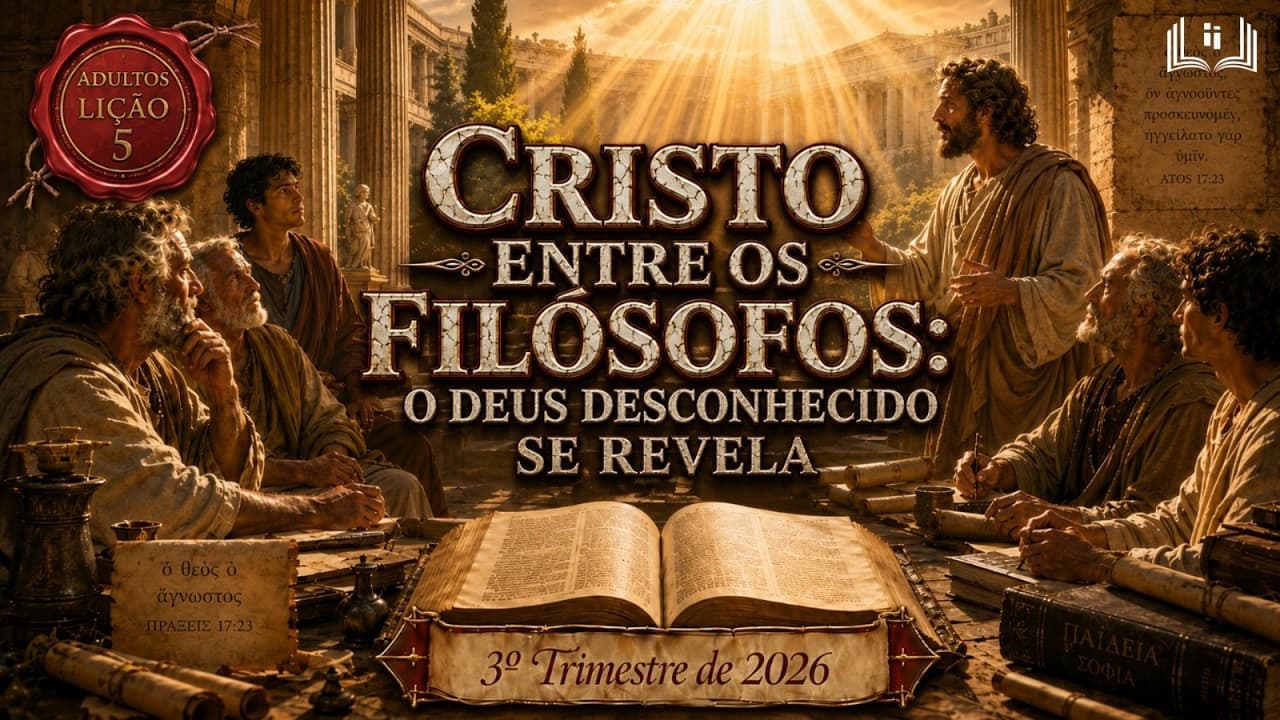
The wisest city in the world raised an altar 'to the Unknown God' — the confession, in stone, of its own blindness. At the Areopagus, Paul reads that inscription aloud and proclaims the Creator who now commands all people everywhere to repent, because He has appointed a day of judgment and proved it by raising the Judge from the dead.
Hello, my brothers and sisters! What an immense joy to welcome you to another EBD Online. We have reached Lesson 5 — "Christ Among the Philosophers: The Unknown God Reveals Himself." And before we open the text, look with me at the path grace has traveled this quarter, because each lesson has been a step.
In Lesson 1, grace crossed the border and confronted the darkness in Cyprus. In Lesson 2, we learned that the door of faith does not open with a human key. In Lesson 3, the Council declared that grace cannot be amended. In Lesson 4, we saw that the citizenship Rome sold, grace gives for free. And now grace climbs the highest and most intimidating step of all: it will confront, face to face, human intelligence on its throne. Not the brute persecution of Philippi, not the envy of the synagogue — but Athens: the university of the ancient world, the city of Socrates, Plato, and Aristotle, the place where the ideas that still govern the West were born.
And today's thesis is a paradox that should keep us awake at night: the wisest city in the world did not know God. Much light, no vision. Athens had all the light that human reason can produce — and remained in the dark regarding the true God. So much so that it raised, in stone, the confession of its own blindness: an altar "to the unknown God." And it was by reading that inscription that Paul preached the most studied sermon in the history of missions.
📖 Lesson outline. Base text: Acts 17:15-34. Scripture Reading in Class: Acts 17:15-20, 30-32. Daily Reading: Mon Acts 17:16 · Tue Acts 17:17 · Wed Acts 17:18 · Thu Acts 17:22-23 · Fri Acts 17:24-25 · Sat Acts 17:30-31. Hymns (Harpa Cristã, the Brazilian Assemblies of God hymnal): 48, 124, and 505.
The ramp — Berea, the portrait of the ideal student
Before arriving in Athens, Paul passed through Thessalonica and Berea — and in Berea, Luke leaves us, almost in passing, the portrait of the ideal Sunday School (EBD) student: the Bereans eagerly welcomed the word and examined the Scriptures every day to see whether these things were so (Acts 17:11). They received with eagerness — and verified with rigor. Neither gullible people who swallow everything, nor skeptics who reject everything: daily examiners of Scripture. That is exactly what this EBD wants to form in each one of you. Keep the Bereans in mind; they are the mirror of this class. From there, because of persecution, the brothers hurriedly took Paul south — and left him alone in the most intimidating city in the world.
Pause at this image. Silas and Timothy stayed behind. A Jewish tentmaker, with no team, no supporting church, no letter of recommendation, walks alone through the streets of the intellectual capital of the planet. It would be understandable if he stayed quiet waiting for his companions. He did not. What happened inside him when he looked at the city is the key to everything that follows.
Movement 1 — Holy Indignation: what Paul saw that tourists do not see (vv. 16-21)
The word that translation tames
"Now while Paul waited for them at Athens, his spirit was stirred in him, when he saw the city wholly given to idolatry." (Acts 17:16)
Saying his spirit "was moved" is too polite a translation. The Greek verb is παρωξύνετο (paroxýneto) — the root from which our word "paroxysm," the peak of a crisis, comes. It does not describe a mild discomfort, a contemplative sadness. It describes a burning indignation, an intense inner provocation — and it is the same root that the Greek version of the Old Testament uses for the wrath of God before the idolatry of Israel. In other words: before the idols of Athens, Paul's heart felt what the heart of God feels. Any cultured visitor of the time looked at Athens and saw the greatest art gallery in the world — the Parthenon, the sculptures of Phidias, the temples that to this day are the standard of beauty. Paul looked at the same masterpieces and saw something else: an entire city on its knees before what is not God. The tourist admires; the prophet is indignant. And pay attention: that indignation did not make him shout against the city — it made him preach to the city. Holy indignation does not produce contempt; it produces mission.
🏛 History — The city with more gods than men. Athens, around AD 50, no longer ruled over anything politically — Rome ruled. Yet it remained the university of the world: anyone who wanted to shine in philosophy, rhetoric, or art studied there. And it was, at the same time, the most idolatrous city in the Empire. Petronius, a Roman writer of that generation, remarked ironically that in Athens it was easier to find a god than a man. Thousands of statues, altars, and sanctuaries piled up along the streets, squares, and hills. And here is the thesis in stone: the pinnacle of human reason did not cure idolatry — it multiplied it. The city of Socrates, who died questioning the gods of the city, four centuries later had more idols than ever. The wiser man is without revelation, the more gods he manufactures.
The two schools — and why they live on your street
In the agora, the public square, Paul reasoned every day with whoever happened to be there. And two groups of philosophers confronted him: Epicureans and Stoics (v. 18). Pay attention to these two, because they did not die in Greece — they moved to Brazil.
The Epicureans, followers of Epicurus, taught that the supreme good of life is pleasure — understood as the absence of pain and fear. The gods, if they exist, live far away and do not care about us; there is no judgment, there is no life after death; death is the absolute end. Therefore, the wise life is to maximize tranquil pleasure and minimize suffering. Paul knew the practical motto of this philosophy and would cite it in writing precisely when defending the resurrection: let us eat and drink, because tomorrow we die (1 Corinthians 15:32). Do you recognize it? It is today's hedonism: life is short, enjoy it, there is no reckoning. The modern Epicurean does not read Epicurus — but lives Epicurus every weekend.
The Stoics, followers of Zeno, were the refined opposite: they preached reason, virtue, and absolute self-control of the emotions. God, for them, was not a person — He was an impersonal force spread through all things, a "universal reason" in which we all share. The wise man is self-sufficient, accepts fate without complaining, and depends on no one. Do you recognize this too? It is today's self-help: "believe in yourself," "you are enough," "the universe conspires," the impersonal energy that replaces the personal God. The modern Stoic does not read Zeno — but repeats Zeno every Monday morning.
And here its relevance today hurts: the average Brazilian is an Epicurean on Saturday and a Stoic on Monday. Pleasure without judgment on the weekend; self-sufficiency without God during working hours. The two best-selling shelves in the bookstore — hedonism and self-help — were already standing in the agora of Athens, confronting Paul. The Gospel does not face new ideas; it faces the same two escapes as always, in new packaging.
The city of novelty — and the shadow of Socrates
Luke closes the scene with a sharp comment: the Athenians spent their time doing nothing else but telling and hearing something new (v. 21). In the Greek there is a subtlety: they always wanted something "newer" — the comparative. The new was not enough; they wanted what was newer than yesterday's new. The city that once sought the truth now collected novelties. If that is not the portrait of our era — the infinite scrolling of the screen, the hunger for content that never becomes conviction, the curiosity that replaced the search — I do not know what is. Athens traded the question "what is true?" for the question "what is new?" And a civilization that only asks for what is new has already given up on what is true.
And they called Paul a proclaimer of foreign deities (v. 18) — and brought him to the Areopagus. Keep the historical chill of this detail: "introducing new deities" was the exact formal accusation that led Socrates to his death in that very same city four and a half centuries earlier — the historian Xenophon recorded it in almost the same words. And the Areopagus, the ancient court of Athens, had a tradition of judging religious matters. Paul was stepping, literally, on the ground of the accusation that killed the greatest philosopher of Greece. Socrates drank hemlock for less. Paul knew this — every educated man knew it — and he did not back down by a single word.
Movement 2 — The Bridge and the Demolition: courteous in form, radical in content (vv. 22-29)
Courtesy that does not lie — and the altar that confesses
Paul opens his speech with a carefully chosen word, telling them that in all things he perceives them to be very religious — in the Greek, δεισιδαιμονεστέρους (deisidaimonestérous). It is a deliberately ambiguous word: it could sound like a compliment ("very devout") or like a diagnosis ("very superstitious"). The audience heard courtesy; Paul's conscience knew it was a diagnosis. He did not praise idolatry — never — yet neither did he open with an insult. He opened with a truth that each side would hear in its own way. That is pulpit wisdom: starting where the listener is able to hear, without betraying what you know.
"For as I passed by, and beheld your devotions, I found an altar with this inscription, TO THE UNKNOWN GOD. Whom therefore ye ignorantly worship, him declare I unto you." (Acts 17:23)
🏛 Archaeology — The altar was real, and the story behind it is astonishing. Those altars actually existed. Pausanias, the second-century Greek geographer, describes in his guide to Athens "altars of unknown gods" near the harbor. And Diogenes Laertius preserves the legend of their origin: centuries earlier, during a devastating plague, the Athenians summoned the sage Epimenides of Crete, who ordered sheep to be released through the city and each one sacrificed wherever it lay down — "to the fitting god," even if unnamed. Thus anonymous altars were born: religious insurance against whichever god they might perhaps have forgotten to please. And now the gem: ancient tradition attributes to the same Epimenides the line Paul cites further on, in v. 28 — that in Him we live, and move, and have our being. If the tradition is right, Paul quoted precisely the poet linked to the origin of the altars to explain to the Athenians who the God of the altar was. He knew their library better than they did. Luke's precision in names, offices, and customs — highlighted by the historian W. M. Ramsay — reinforces Acts as reliable history, not legend.
And see the brilliance of the move. Paul does not invent a bridge — he uses their confession. The city that prided itself on knowing everything had carved in stone the admission that there existed a God it did not know. Paul simply read the inscription aloud and said: this God has a name, and I have come to introduce Him. Notice also the change of verb, because it carries an entire theology: in the synagogue and in the square, Paul "reasoned" (dielégeto, v. 17); but concerning the unknown God he says he proclaims Him (katangéllō, v. 23) — the verb of proclamation, of a herald. Paul dialogues in method and proclaims in content. At the Areopagus, where everything was opinion up for debate, he did not offer a hypothesis for discussion — he announced a fact for decision.
🏛 Reformation — The sense of God and the idol factory. John Calvin read Athens with surgical precision in two principles. First: there exists in every human being an innate sense of the divine — no one is born an atheist on the inside; the awareness that God exists is planted in every soul. The altar to the unknown God is that sense carved in marble: man knows there is a God, even without knowing who He is. Second: without revelation, that sense does not produce true worship — it produces idols. In the Reformer's words, the human heart is a perpetual factory of idols. Athens is the archaeological proof of that statement: the smartest city in the world, given over to an assembly line of gods. Intelligence does not cure idolatry; only revelation cures it.
The demolition, point by point — the chart nobody shows
Now what a hasty reading misses. The Areopagus sermon is usually remembered as a model of cultural delicacy — and it is courteous, indeed. But read it sentence by sentence and see what each statement of Paul was doing to the convictions of the audience: every brick of the bridge was, at the same time, a sledgehammer blow to a Greek foundation.
| What Paul affirmed | What he demolished |
|---|---|
| God made the world and everything in it (v. 24) | The eternal universe of the Epicureans and the cosmos-god of the Stoics: there is a Creator distinct from creation |
| He does not dwell in temples made by human hands (v. 24) | The entire civic religion of Athens — the city of the most beautiful temples in the world |
| He is not served as though He needed anything (v. 25) | The whole pagan sacrificial system: the "I give so that you may give" that fed needy gods |
| From one man He made the whole human family (v. 26) | The Athenian pride of being a superior race, "born from the soil itself," above the barbarians |
| He determined the times and the boundaries (v. 26) | The blind chance of the Epicureans and the fatalistic destiny of the Stoics: neither luck nor fate — providence |
| He will judge the world, having raised Him from the dead (v. 31) | The Greek denial of the bodily resurrection and the Epicurean illusion that death is the end of everything |
Sensitive in form, inflexible in content. That is the lesson our generation urgently needs to relearn, because we live in an age that idolizes dialogue that never confronts and a gospel that adapts until it disappears. Paul proves that the two walk together: you can deeply respect the listener and, in the very same speech, demolish every lie on which he leans. The bridge serves the truth — it does not replace it. A bridge without demolition is surrender; demolition without a bridge is rudeness. The Areopagus is the perfect balance of the two.
The God who needs nothing — and the blind man who gropes
At the heart of the sermon there is a statement that turns all religion upside down: God is not served by human hands, as though He needed anything, since He Himself gives to all life, breath, and all things (v. 25). Theology calls this aseity — God exists of Himself, without any lack whatsoever. Does that sound abstract? It is the most practical demolition in the sermon. All pagan religion worked in one direction: man feeds the god — with sacrifices, offerings, rituals — so that the god will pay him back. Paul reverses the arrow: the true God receives nothing from us that He needs; He is the One who gives everything — life, the breath of this exact second, all things. Pagan religion climbs up from man to a needy god; the Gospel comes down from the full God to needy man. And let us be honest: how many people in the church still treat God like a Greek god — giving an offering to "activate" a blessing, praying like someone feeding a deity that will not act without the ritual? That is not biblical faith; it is paganism with evangelical vocabulary.
And then Paul describes humanity without revelation with the most precise image ever written about philosophy: God arranged all things so that people would seek the Lord and perhaps, groping for Him, find Him (v. 27). The Greek verb, psēlapháō, is that of a blind man feeling his way in the dark. Philosophy is this: blindfolded humanity, groping after God. Paul does not despise the groping — God Himself willed it, so that they would seek Him. Yet groping does not find; it merely confesses the search. Socrates groped. Plato groped higher than anyone. And they died without finding, because what a blind man needs is not better hands — it is light. Revelation is God turning on the light that four centuries of philosophy failed to reach. And the next phrase shatters both errors of the public square at once: this God is not far from each one of us. Not far — against the Epicureans, who exiled Him into indifference. From each one of us — personal, not diluted into everything, against the Stoics. Transcendent and near: only the biblical God is both at the same time.
🔬 Scripture and science — of one blood. From one man He made every nation of humankind to dwell on all the face of the earth (v. 26). Paul said this to the elite of a city that boasted of being autochthonous — born from the soil of Attica itself, a race apart, superior to the barbarians. And twenty centuries later, genetics confirmed the apostle against the Athenians: the sequencing of the human genome demonstrated that we are a single species, a single family, with common ancestry — human beings share about 99.9% of their genetic code, and the visible differences among peoples are a superficial veneer over a single humanity. All racism, ancient or modern, is bad science as well as heretical theology. Scripture declared the unity of the human family at an altar in Athens; the laboratory simply arrived late at the same conclusion.
The plundered poets — the gold of Egypt
And then Paul makes the boldest move of the sermon: he quotes pagan literature. "In him we live, and move, and exist" — a line that ancient tradition attributes to Epimenides, the Cretan of the altars. And "for we are also his offspring" — this one with a known address: it is line 5 of the poem Fenômenos, by Aratus. And here is a detail that moves me: Aratus was a native of Cilicia — the same region as Tarsus, Paul's homeland. The apostle quoted from memory a poet from his own land, whom he had memorized in his youth, decades before imagining that that line would serve Christ in a court in Athens. Nothing in your background is wasted in the hands of God — not even the pagan poetry you learned before knowing the Lord.
Yet pay attention to what Paul does and what he does not do. He does not validate the poem — Aratus's poem was a hymn to Zeus. Paul takes the fragment of truth left over in fallen culture — the intuition that humanity comes from the divine — and wrenches it away from the idol to hand it over to the true God. He does not quote Scripture to those who do not recognize it; he uses what the listener already accepts to lead him to where he would never go on his own. And notice the iron logic of v. 29: if we are God's offspring, then God cannot be a statue that we generate. The Creator is not the work of the creature. With their own poet, Paul dismantles their statuary.
🏛 The Church Fathers — Athens or Jerusalem? The ancient Church fought this exact debate, and it is worth hearing both sides. Justin Martyr, a philosopher converted in the second century — who continued wearing his philosopher's cloak after believing — taught that there are "seeds of the Word" scattered through culture: fragments of truth that the Logos left even among the pagans, and which belong by right to Christ. Tertullian, the African, reacted with the question that became a banner: "What has Athens to do with Jerusalem? What has the Academy to do with the Church?" — fearing that philosophy would contaminate the faith. And Augustine gave the synthesis that endured: just as Israel took the gold of Egypt when leaving, the Christian may take the partial truths of the pagans — which do not belong to them by right — and consecrate them to the service of God. Acts 17 settles the debate in practice: Paul went to Athens, but he went with Jerusalem in his heart. He plundered the poets; he did not surrender to them.
Movement 3 — The Stumbling Block: the most universal verse in the New Testament (vv. 30-34)
"Now" — the adverb that changes the era
There is a play on words that stitches the sermon together and that only the Greek shows: the altar said "to the unknown God" — ágnōstos; and Paul declares that God overlooked "the times of ignorance" — ágnoia. Same root. The altar was the confession; ignorance was the diagnosis. For centuries God patiently endured that groping in the dark — not out of indifference, but out of longsuffering. And then Paul utters the adverb that splits history in two: He commands NOW. Now that the Son has come, died, and risen again, the time of excuse is over. Patience with ignorance was not approval of ignorance; it was the waiting period until the full revelation. After Calvary and the empty tomb, no one worships in ignorance with innocence anymore.
🕊 Our reading (Assemblies of God / CPAD) — the most universal verse in the New Testament. He now commands all people everywhere to repent (v. 30). Read it slowly: all people — pántas. Everywhere — pantachoû. Not some people in some places; not those previously chosen from a closed list. All people, everywhere. God commands repentance universally — and God does not command the impossible nor mock those who cannot obey: if He commands all to repent, it is because His grace reaches and enables all to respond (cf. 1 Timothy 2:4; Titus 2:11). The offer is universal; prevenient grace is universal; responsibility is universal. And the response remains personal: at the end of the chapter, before the same preaching, some mock, some postpone, some believe. God threw the door wide open for everyone; whoever responds enters. It is our Arminian and Pentecostal faith engraved in a single verse — and not by chance is it the Golden Text of the lesson.
And notice what kind of conversion Paul demands from an audience of philosophers: metanoéō — repentance — means, literally, a change of mind. To men who lived by the mind, Paul commands the conversion of the mind. Biblical repentance does not begin as an emotional weeping; it begins as an intellectual surrender — radically changing what one thinks about God, about oneself, and about the world, and then living accordingly. Athens could keep thinking a great deal; it needed to start thinking right.
The public proof — and the audience that splits
"Because he hath appointed a day, in the which he will judge the world in righteousness by that man whom he hath ordained; whereof he hath given assurance unto all men, in that he hath raised him from the dead." (Acts 17:31)
Giving assurance to all — in the Greek, He furnished proof, a public guarantee. This is decisive for our age: God did not ask the world to believe in the dark. He drove a verifiable fact into history — an empty tomb on the outskirts of Jerusalem, a Man seen alive by hundreds of witnesses who let themselves be killed upholding what they saw. The resurrection is not a private devotional feeling; it is the public evidence presented by God to the planet that the Judge has already been appointed and the court already has a date. Christianity is the only faith in the world that ties everything it believes to a datable event — and invites anyone to examine it.
And it was right there that the audience split. As long as Paul spoke of a Creator God who is moral and near, the philosophers followed along — all of that fit within a debate. When he proclaimed a dead man raised bodily, the lecture was over: for the Greek, the body was the prison of the soul, and salvation was to be rid of it forever; a body back from death was not good news — it was a scandal. And look at the three responses in vv. 32-34, because they are the three responses to all preaching to this day: some mocked — rejection by ridicule; others said they would hear him again on this matter — the most elegant and most dangerous rejection, the polite postponement that never sets a date; and some believed. Mockery, postponement, faith. Every person who has ever heard the Gospel is sitting in one of those three chairs. And notice where the stone trips them: not on ethics, not on creation — always on the resurrection. The supernatural is the permanent dividing line. A Christianity that hides the resurrection in order to be accepted in the debate has already given up on converting anyone.
And those who believed were no small thing. Luke names two: Dionysius the Areopagite — a judge of the very court that was listening to Paul, a member of the supreme religious court of Athens surrendered to Christ — and a woman named Damaris, named in a world that rarely recorded women's names. Ancient tradition tells us that Dionysius became the first pastor of the church in Athens. Do not read Athens as a failure, as some preach out there; Luke does not narrate it as a failure, and the text itself displays the fruit: the seed entered the court and blossomed. Where the Word is faithfully preached, it never returns void — not even at the hardest address in the world.
Christ at the Areopagus — the Unknown God has an exegesis
There is a verse in the Gospel of John that seems written for this lesson: "No man hath seen God at any time; the only begotten Son, which is in the bosom of the Father, he hath declared him." (John 1:18). And the verb John chose for declaring Him is exēgēsato — the word from which "exegesis" comes. Christ is the exegesis of the Father: the living, definitive, incarnate explanation of the God whom no eye has seen and no philosophy has reached. Athens wrote on an altar the question of all humanity — "who is the God we do not know?" — and God's answer was not an argument: it was a Man. The man whom He ordained (v. 31), the appointed Judge, is the same crucified Savior; the court of the last day has on the throne the One who carried the cross. Whoever knows Him does not fear the day He has appointed — because the Judge has already signed, in blood, the acquittal of everyone who believes.
Pastoral Application — where Athens meets Cariacica
Athens is not an ancient city — it is the world where you will go to work tomorrow morning. Let me bring the Areopagus into our lives, and may each point end with a question to take home.
First: do you still get indignant — or have you become a tourist? Paul looked at the beauty of Athens and felt a holy paroxysm, because he saw souls where others saw art. We run the opposite risk: from living so closely with the idolatry of our time — money, the body, pleasure, fame, the self on the altar — it has become part of the scenery. We scroll the screen, admire, consume, and feel nothing anymore. The first sign that the heart has grown cold is not gross sin; it is the scenery that has stopped hurting. And remember: Paul's indignation did not turn into contempt for people — it turned into preaching to people. Holy indignation that does not become mission is just religious bad temper. The question: what, in the culture around you, has already stopped hurting in you — and should hurt?
Second: which of the two philosophers lives in you? The Epicurean whispers: life is short, enjoy it, there is no reckoning — and he rules your weekends, your hidden pleasures, your "I deserve it." The Stoic whispers: you are enough, depend on no one, sort yourself out — and he rules your Monday, your self-sufficiency, your difficulty in kneeling down and asking. Hedonism and self-help: the two escapes of the agora continue to be the two escapes of the Brazilian. The Gospel confronts both at once: there is judgment — against the Epicurean; and there is grace, because you are not enough — against the Stoic. The question: which of the two voices — "enjoy it, there is no judgment" or "you are enough on your own" — has been guiding your decisions more than the voice of Christ?
Third: the altar to the unknown god is full of worshipers today. It is called "I believe in something," "there is an energy," "the universe conspires," "I am spiritual, not religious." It is the same vague religiosity of Athens: sincere, careful, and completely in the dark. And there are people like that in your family, at your workplace, on your street — people who worship without knowing. The question of Athens is whether your mouth is ready: do you know how to do what Paul did — start from the altar the person already has and present, with respect and without backing down, the God who made Himself known in Christ? The question: who around you worships an "unknown god" — and what keeps you from reading the inscription aloud to that person?
Fourth: a bridge without demolition is surrender; demolition without a bridge is rudeness. One part of the church only builds bridges: it dialogues so much, softens so much, that the Gospel becomes friendly advice that confronts nothing — and converts no one. Another part only demolishes: it shouts truths without love, wins arguments, and loses people. Paul did both in the same speech: he quoted their poets with respect and demolished every pillar of their worldview without blinking. Courteous in form, inflexible in content. That is the measure — and it demands both kinds of courage: the humility to learn the other person's language and the firmness not to translate the truth until it vanishes. The question: which side have you been erring on — bridges that never confront, or truths that never embrace?
Fifth: "we will hear you again on this matter" — polite postponement is the most dangerous rejection in the world. The mocker is at least honest; the postponer deceives himself into thinking he will still decide. Some at that Areopagus died waiting for the "again" they never scheduled. And perhaps there is someone in this class like that: years of listening, agreeing, finding it beautiful — and postponing. Verse 30 does not say that God suggests; it says that God commands, now, that all people, everywhere, repent. Grace threw the door wide open for everyone — but no one enters by postponing. The question: if God commands "now" — what exactly are you still waiting for in order to respond?
Closing Prayer
My brothers and sisters, the wisest city in the world did not know God — and had the honesty to carve that into a stone. Four centuries of philosophy groping in the dark, thousands of altars, and the sum of it all was a plaque: "to the unknown God." Much light, no vision. Until a tentmaker, alone, climbed the hill where Socrates had been condemned and read the plaque aloud: this God has a name. He made the world and does not live in temples. He needs nothing and gives everything. He made from one man the entire human family. He is not far from any one of us. And He gave the world a public proof: He raised from the dead the Man who will judge the earth — and who first saved it.
The grace that crossed borders, that no one could amend, that gave citizenship to those without citizenship — that very same grace confronted the academy of the world and did not lose the debate: it won a judge of the court and a courageous woman, and planted a church in the heart of philosophy. The unknown God has revealed Himself — and His exegesis is Jesus. Whoever knows the Son knows the Father whom Athens sought by groping and did not find. You know Him. Then live as those who know — and read the plaque aloud to those who still worship without knowing whom. Father, stir our hearts as You stirred Paul's, give us bridges that can bear the weight of the Gospel and courage to proclaim the resurrection without shame; and may there always be, among us, a Dionysius and a Damaris who hear, believe, and live. In the name of Jesus, the Man whom You raised and by whom You will judge the world in righteousness. Amen.
Soli Deo Gloria — Scripture governs; everything else, on its knees.
Frequently asked questions about this lesson
What was the altar 'to the Unknown God' in Athens?+
An altar that the Athenians raised out of religious precaution — for fear of offending some god they might have forgotten to honor. Ancient tradition (Diogenes Laertius) links these altars to a plague during which the sage Epimenides ordered sacrifices 'to the appropriate god,' even if unnamed. Paul (Acts 17:23) uses this altar as a bridge: what they worshiped without knowing, he now proclaims — the true God, Creator of all things, revealed in Christ.
Who were the Epicureans and the Stoics who debated with Paul?+
Two philosophical schools in Athens (Acts 17:18). The Epicureans, followers of Epicurus, taught that the highest good is tranquil pleasure and denied divine providence, judgment, and life after death — today's hedonism ('enjoy yourself, there is no reckoning'). The Stoics, followers of Zeno, exalted reason and self-control, but their god was an impersonal force and fate was fixed — today's self-help ('you are enough,' 'the universe conspires'). Both denied the resurrection of the body.
Did Paul succeed or fail at the Areopagus?+
There was no mass conversion, but there was real fruit: some believed (Acts 17:34), among them Dionysius the Areopagite — a judge of the court itself — and a woman named Damaris. Tradition says that Dionysius became the first pastor of Athens. The lesson does not measure the Gospel by numbers: the Word faithfully preached entered the court and planted a church. The breaking point was the resurrection, not philosophy.
Can a Christian engage in dialogue with culture without betraying the Gospel?+
Yes — that is exactly what Paul does. He quotes the Greek poets (Epimenides, Aratus), acknowledges Athenian religiosity, and starts from their culture; yet he does not dilute the message: he proclaims the Creator God, demolishes idolatry point by point, calls for repentance, and announces judgment through the risen Christ. Courteous in form, unyielding in content: a bridge without demolition is surrender; demolition without a bridge is rudeness.
Teacher's Guide
Essence of the lesson
The wisest city in the world did not know God — and confessed this on an altar. Erudition does not cure idolatry; only the revelation of Christ cures it. By the end of the lesson, the class should leave ready to "read aloud" the altar to the unknown god of the people around them.
Quarterly's summary statement. In Athens, Paul starts from Greek religiosity and culture to proclaim the Creator God who now commands all people, everywhere, to repent — having given proof of this by raising Christ, the Judge of the world.
Class map (~45 min)
| Time | Stage |
|---|---|
| 0–5 min | Opening: the question Athens carved in stone |
| 5–15 min | Point 1 — Holy indignation (vv. 16-21) |
| 15–28 min | Point 2 — The bridge and the demolition (vv. 22-29) |
| 28–38 min | Point 3 — The stumbling block + Christ (vv. 30-34) |
| 38–45 min | Application, challenge of the week, and prayer |
Start like this
Write on the board "TO THE UNKNOWN GOD" and ask: "If the smartest city in the world, with all its philosophy, ended up raising an altar to a god it did not know — what does that say about the limits of human wisdom?" Let the class react and lead into the thesis: much light, no vision.
Point 1 — Holy Indignation (vv. 16-21)
- In the quarterly: Paul, alone in Athens, is deeply provoked at seeing the city given over to idolatry; he debates in the synagogue and in the agora with Epicureans and Stoics.
- What to teach: the verb paroxýneto is burning indignation, not mild discomfort — the tourist admires, the prophet is indignant, and indignation becomes mission (not contempt). The two philosophies are today's two escapes: hedonism (Saturday) and self-help (Monday).
- Anchor verse: Acts 17:16.
- Key question: what, in the culture around you, has already stopped hurting in you — and should hurt?
- Likely answers: "violence," "consumerism," "pornography"; or silence (idolatry has become part of the scenery).
- If no one speaks: give a concrete example (the worship of money, the body, the "self") and ask: "does this still bother you, or has it already become normal?"
Point 2 — The Bridge and the Demolition (vv. 22-29)
- In the quarterly: Paul starts from the altar "to the unknown God," proclaims the Creator God who does not dwell in temples, quotes the Greek poets, and dismantles idolatry point by point.
- What to teach: courteous in form, inflexible in content. Use the demolition table (each statement by Paul tears down a Greek pillar). A bridge without demolition is surrender; demolition without a bridge is rudeness.
- Anchor verse: Acts 17:24-25.
- Key question: which side have you been erring on — bridges that never confront, or truths that never embrace?
- Likely answers: the more timid err on the side of the bridge; the more zealous, on the side of demolition.
- If no one speaks: tell about a real conversation of faith that stalled for lack of a bridge — or from excessive harshness.
Point 3 — The Stumbling Block (vv. 30-34)
- In the quarterly: God commands all people, everywhere, to repent; He has appointed a day of judgment and given proof of this by raising Christ. Some mock, some postpone, some believe (Dionysius and Damaris).
- What to teach: the "now" splits history in two; repentance (metanoéō) is a change of mind; the resurrection is the PUBLIC proof (not a private feeling); and the most dangerous rejection is polite postponement.
- Anchor verse: Acts 17:30-31 (Golden Text).
- Key question: if God commands "now," what exactly are you still waiting for in order to respond?
- Likely answers: "changing such-and-such a habit," "getting baptized," "forgiving someone"; some will admit postponement.
- If no one speaks: remind them that "we will hear you again on this matter" was the answer of people who died without deciding.
Preparation tip. Close the class with the four commitments of Marcas do Evangelho (church in Cariacica, Brazil): (1) to be a church of Bereans — examining the Word every day; (2) to know the culture in order to confront it with love; (3) to dialogue in method, proclaim in content; (4) to preach the resurrection without shame. And pray that, as in Athens, there will always be a Dionysius and a Damaris in your class.
Homework
Your mission for the week
Find, this week, ONE person who worships an "unknown god" — the "I am spiritual, not religious," the "I believe in an energy," the "the universe conspires." Instead of arguing, do what Paul did: ask respectfully what that person believes in and, starting from what he or she said, present in a few sentences the God who made Himself known in Christ.
Why
Because the altar to the unknown God is full of worshipers today — in your family, at work, on your street. The lesson does not end in "what a beautiful sermon"; it ends in reading the inscription aloud to someone who worships without knowing.
How to know you did it
You had a real conversation (not a debate) in which you named Jesus as the God the person is searching for without knowing — and you listened more than you spoke.
On Sunday, come back with the story
Write down whom you spoke with and what happened. Next Sunday we will begin by hearing those accounts — five minutes of testimony are worth more than any review.