Golden Text
“Preaching the kingdom of God, and teaching those things which concern the Lord Jesus Christ, with all confidence, no man forbidding him.” (Acts 28:31, KJV) · Read in the Bible
Years before setting foot in Rome, Paul wrote to the church there confessing a frustration: he had often wanted to go and had been hindered (Romans 1:13). When he finally arrived, he arrived in handcuffs—and that is precisely where Luke closes the entire book with the opposite word: without any hindrance. The lesson lives in this inversion. The apostle spends two years in a rented house, with a soldier at his wrist, welcoming everyone who knocks at the door, preaching the Kingdom from morning till night. Some believe, others do not; the Word keeps running. Acts does not end with 'amen'—it ends with an adverb hanging in the air, because the mission is not over. This is the axis, and it allows no triumphalism: the messenger may be bound, the Word is not (2 Timothy 2:9).
Lesson 12 • The Gospel in Rome: The Unhindered Mission — Exhaustive Research Study of the Lesson.
Complete study of Acts 28:16-31 — exegesis of the text, Roman custody and the rented house, the Jewish community of the capital, the quotation of Isaiah 6 and the Arminian reading of hardening, the thread of the verb "to hinder" throughout Acts, and the open ending of the book.
Marcas do Evangelho (church in Cariacica/ES, Brazil) • Pastor Jairo Carvalho and Pastor Jaciana Carvalho • 3rd Quarter of 2026 (Lições Bíblicas — the CPAD Sunday School quarterly, Adults).
✶ Golden Text — Acts 28:31
"Preaching the kingdom of God, and teaching those things which concern the Lord Jesus Christ, with all confidence, no man forbidding him." (Acts 28:31)
Practical Truth (CPAD — the Assemblies of God publishing house in Brazil): nothing can hinder the advance of the Kingdom of God when the Gospel is proclaimed with faithfulness, courage, and hope.
- Study Text — Acts 28:16-24, 28-31, with Philippians 1:12-14 and 2 Timothy 2:8-9
- Scripture Reading in Class — Acts 28:16-24, 28-31
- Daily Reading — Mon Acts 28:30-31 • Tue Matthew 24:14 • Wed Philippians 1:12-14 • Thu 2 Timothy 2:8-9 • Fri Acts 4:29-31 • Sat Romans 8:31
- Hymns (Harpa Cristã — the Brazilian Assemblies of God hymnal) — 18, 192, and 298
- Bible version — Scripture quotations in this translation are from the King James Version (KJV). Transliterations follow the standard academic convention.
Objectives and how to use this study
Lesson Objectives (CPAD): (I) to show that imprisonment did not hinder the advance of the Kingdom of God; (II) to highlight the reaction of the Jews and discern the field of decision; (III) to emphasize Paul's example for the mission of the Church today. Objectives added here: (IV) to explain the custody regime under which Paul lived in Rome and why it allowed what it allowed; (V) to situate the Jewish community of the capital and understand the caution of the leaders who answered the apostle's summons; (VI) to read the quotation of Isaiah 6:9-10 in full, with the final clause about turning and being healed in its place, and to formulate hardening as human responsibility before grace; (VII) to address Acts 28:28 without replacement theology and without diluting anyone's responsibility; and (VIII) to protect the class from two mistaken readings of the text — that preaching without hindrance means the absence of suffering, and that the dispute in verse 29 says anything against the Jewish people.
Structure: Part I provides the overview — the arrival along the Appian Way, the prison regime, and who the Jews of Rome were; Part II expounds the text block by block; Part III develops the four theological axes; Part IV lists common interpretive mistakes; Part V provides the lexicon; Part VI gathers the summary tables, highlighting the thread of the verb "to hinder" throughout the entire book of Acts; and the final parts offer the application, the class plan, the review quiz, and the bibliography. The two bibliological aids in the quarterly are commented on and expanded in Parts II and III.
Convention adopted: historical claims come with the ancient source or archaeological find that supports them. Where the subject is church tradition rather than a statement of Scripture — which happens often in this lesson, because Acts ends without telling the outcome — that is stated plainly. Here tradition is never presented as if it were biblical text.
Part I — Overview: the road, the chain, and the city
1) The entry into Rome: an escort that became a procession
Paul arrived in Italy through the port of Puteoli, on the Bay of Naples, and went up to the capital along the Appian Way, the oldest and busiest road in the Empire. Before he arrived, the brothers in Rome heard the news and came out to meet him: "And from thence, when the brethren heard of us, they came to meet us as far as Appii forum, and The three taverns: whom when Paul saw, he thanked God, and took courage." (Acts 28:15).
The two places are well-known stops along the road: the Market of Appius (Forum Appii) and the Three Taverns (Tres Tabernae), rest stations a few dozen miles south of Rome — the poet Horace describes the first as a noisy and dirty place, full of boatmen and tavern keepers. We do not know how those brothers traveled or exactly how many they were. We know the effect: a man coming from two years in prison, a dragged-out trial, a fourteen-day storm, and a shipwreck thanked God and took courage when he saw people from the church by the side of the road.
Keep this detail for the class, because it is pastoral before it is historical. The strongest apostle of the New Testament needed brothers showing up. Someone's presence along the way did for him what no argument could do.
2) The prison regime: why he could receive visitors

Upon arriving in the capital, the prisoners were handed over to the military authority, and Paul received different treatment: instead of the common prison, he was allowed to live by himself, with a soldier guarding him (Acts 28:16). This arrangement has a name in Roman law: it was called military custody, one of the detention regimes described by ancient jurists for defendants awaiting trial.
It is worth explaining the differences so the class understands what the text is saying:
| Regime | What it was | Paul's case |
|---|---|---|
| Public prison (custodia publica) | State dungeon, punitive and unsanitary environment, defendant in the stocks | This was not the regime of this imprisonment; Paul was a Roman citizen and an appellant |
| Free custody (custodia libera) | Supervised liberty under bond from a magistrate, for people of high standing | Did not apply — he had neither patrons nor standing for this |
| Military custody (custodia militaris) | The defendant lives in his own or a rented house, but remains chained to a guard soldier | This is the condition described in Acts 28:16, 20, 30 |
Three practical consequences follow from this, and all of them appear in the text. First: he paid the rent himself (Acts 28:30) — the State did not support a defendant awaiting trial, and that is where the generosity of the church in Philippi comes in, sending him resources (Philippians 4:14-18). Second: he was truly a prisoner — bound with that chain for the hope of Israel (Acts 28:20). Third: he could receive whomever he wished. He could not go out, so everyone came in.
⛓ The chain that became an audience
What the guard heard while on duty
A soldier stood on duty beside the prisoner and was relieved; whoever came in on the next shift took over the post. We do not know the exact length of the shifts or the details of the equipment — anyone who states this with precision is going beyond the sources. What we do know is the effect, because Paul recorded it: writing from this prison to the church in Philippi, he says that his situation ended up serving to advance the Gospel and that his chains for Christ became known throughout the whole praetorian guard, besides encouraging the brothers to speak the Word with greater confidence (Philippians 1:12-14). In other words: the chain placed Rome's military elite sitting, in shifts, beside the greatest preacher of the early church. Note for the teacher: four New Testament letters — Ephesians, Philippians, Colossians, and Philemon — are traditionally linked to this period of captivity. Four books of your Bible with the same return address: a rented room, with a soldier at the door.
3) Who the Jews of Rome were
Three days after arriving, Paul called together the leading men of the Jews (Acts 28:17). To understand their reaction, it helps to know what kind of community this was.
There had been a Jewish presence in Rome since long before the first century, and it grew substantially after the wars in the East, with prisoners brought to the capital and later freed. Population estimates vary widely among scholars — the most cited one, assembled from funerary inscriptions, speaks of somewhere between forty and fifty thousand people, but treat that as an estimate, not a census. Most lived across the Tiber, in the working-class district of Trastevere.
An important feature: unlike Alexandria, the Jews of Rome did not have a single central leadership. They were several independent congregations, each with its own council of elders and its own synagogue ruler. When Paul called the leading men of the Jews together, he did not summon a single chief — he summoned a group of synagogue leaders scattered across the city.
And there was a recent wound. The Roman historian Suetonius records that the emperor Claudius expelled Jews from Rome because of disturbances connected to someone he calls "Chrestus" — almost certainly a confused Latin spelling for "Christ", which suggests that the conflict was precisely over Christian preaching in the synagogues. Acts confirms the effect of the decree: Aquila and Priscilla were in Corinth because Claudius had commanded all the Jews to depart from Rome (Acts 18:2). The exact date of the decree is debated among historians, but the pastoral point does not depend on it: when Paul summons them, that community had been expelled from the city only a few years earlier and was starting over. No one there wanted a new fight. That explains much of the cautious politeness of their reply.
Part II — Exposition of the text — Acts 28:16-31, block by block
Block 1 (vv. 16-20) — The prisoner explains his chain
"For this cause therefore have I called for you, to see you, and to speak with you: because that for the hope of Israel I am bound with this chain." (Acts 28:20)
Notice what Paul does first. He does not open with doctrine; he opens by clearing the ground. He says that he did nothing against the people or the customs of the fathers, that the Romans would have released him because they found no capital crime in him, and that he appealed to Caesar not to accuse his own nation, but because the opposition left him no other way out (vv. 17-19).
This is method, and the teacher should name it. Before speaking of Christ, the apostle removed the misunderstandings that would get in the way of the message. The offense of the Gospel must lie in the cross, not in the behavior or reputation of the messenger. It is worth bringing this to the class without pointing fingers at anyone: many people in the church have the right doctrine and a closed door, because their daily life contradicts their Sunday speech. A consistent life opens doors that no argument can open.
And notice what he says about his own chain: he is not imprisoned because of Rome, he is imprisoned for the hope of Israel — that is, for proclaiming that Jesus is the promised Messiah and that He rose from the dead (cf. Acts 23:6; 26:6-8). Paul reads his own situation through the lens of God's purpose, not through the lens of the injustice suffered. He had already heard the promise that he must also bear witness in Rome (Acts 23:11). Prison did not contradict that word. It was from inside prison that the word was fulfilled.
Block 2 (vv. 21-24) — A whole day of an open Bible
"And some believed the things which were spoken, and some believed not." (Acts 28:24)
The leaders' reply is remarkably polite: they had received no letters from Judea, nor had anyone arrived speaking evil of him; yet they would like to hear what he thinks, since concerning that sect they knew that it was spoken against everywhere (v. 22).
Two reasonable explanations for the absence of letters: the sea closed to navigation in winter, and Paul spent three months stranded on Malta before sailing again — messengers coming from Judea would hardly arrive before him; and falsely accusing a Roman citizen before the imperial court was costly and risky for the accuser. Present this as a probable explanation, not as a fact recorded in the text.
Once they had appointed a day, many came to him at his lodging (v. 23). And then comes the portrait of Paul's ministry in a single sentence: he expounded and testified to the Kingdom of God, seeking to persuade them concerning Jesus from both the Law of Moses and the Prophets, from morning until evening.
Three things for the teacher to highlight. First: it was the Bible. He did not put together a new argument; he opened the Old Testament and showed Christ within it — the same method used by the Lord Himself on the road to Emmaus (Luke 24:27). Second: it was patient. From morning until evening, with a handcuffed man in the middle of the room. Third: the result was divided. Some believed; others did not. Same room, same exposition, same Spirit at work — different responses.
And it is precisely this division that dismantles two mistaken ideas at once. It is not that the Word was weak: it was proclaimed clearly for hours. And it is not that God prevented anyone from believing: He offered, persuaded, and waited. The difference was not in the seed; it was in the soil where it fell (cf. Luke 8:15).
On the quarterly's aid, "Isaiah and the Rejection of Christ in Rome": the quarterly rightly observes that the Jews of Rome had heard of the sect but had received no official communication from Jerusalem, and that the decisive moment of the conversation was Paul's word about the obstinacy foretold by Isaiah. It is worth adding a detail that changes the tone of the reading: Paul quotes Isaiah after a full day of exposition, not before. The quotation is not the beginning of the conversation; it is the verdict of one who has already offered everything he had to offer. This matters pastorally: Isaiah 6 is never used as a prior diagnosis of anyone. It is the acknowledgment of a refusal that has already been repeated, not a label applied at the start of the conversation.
Block 3 (vv. 25-27) — The quotation that must be read to the end
"For the heart of this people is waxed gross, and their ears are dull of hearing, and their eyes have they closed; lest they should see with their eyes, and hear with their ears, and understand with their heart, and should be converted, and I should heal them." (Acts 28:27)
As they departed disagreeing among themselves, Paul says that the Holy Spirit spoke rightly to their fathers through the prophet Isaiah, and quotes Isaiah 6:9-10: hearing they will hear and by no means understand, seeing they will see and by no means perceive, because the heart of that people has grown dull, their ears are hard of hearing, and they have closed their eyes — and then comes the closing line that is almost always left out of quotations: lest they should see with their eyes, hear with their ears, understand with their heart, and turn, and I should heal them.
Read that last part aloud in class, slowly, and then read it again. It changes everything. The sentence does not end in condemnation; it ends in offered healing. What is described is a refusal that locked itself from the inside — and even so the door continues to be described as open on God's side.
✶ Who closed their eyes?
Why this verse is not a decree
Two observations from the text itself suffice. First: the verb is theirs. They closed their eyes — the action is on the side of the people; it is not a blindness applied from the outside onto people who wanted to see. Second: the sentence ends with the prospect that they might turn and be healed by God. If conversion and healing were forbidden by decree, those words would have no reason to be there. This is the reading we have always upheld: God desires all people to be saved, grace goes ahead and enables the response, the Holy Spirit convicts of sin, of righteousness, and of judgment — and the person cooperates or resists. Biblical hardening is the result of repeated resistance to grace, not the cause explaining why someone never had a chance. An honest exegetical note for the teacher: in Isaiah 6 the sentence is addressed to the prophet as a mission mandate; in Acts 28 it appears as a statement about the condition of the people. Luke is quoting the text in its Greek form, which is older than our modern translations, and the difference in tone between the two passages is real. Do not present the two as if they had the exact same wording.
Block 4 (vv. 28-29) — Salvation sent to the Gentiles, and the dispute that remained
"Be it known therefore unto you, that the salvation of God is sent unto the Gentiles, and that they will hear it." (Acts 28:28)
"And when he had said these words, the Jews departed, and had great reasoning among themselves." (Acts 28:29)
Here a steady hand and a careful heart are needed, because this is the point in the lesson where the most people slip.
What verse 28 says: the salvation of God is being sent to the Gentiles, and they will hear it. It is the fulfillment of what had already been promised to Abraham and foretold by the prophets, and of the map that the Lord Himself drew in Acts 1:8. It is expansion.
What verse 28 does not say: that God has rejected Israel. Paul's own letter to that city answers that God has by no means cast away His people (Romans 11:1), and that the gifts and the calling of God are without repentance (Romans 11:29). Add to this the simple fact that the reaction in Rome was not unanimous — some believed (v. 24) — and that the one preaching was a Jew bound for the hope of Israel. Treat the matter with balance and without polemics: the door that opens to the nations was never a door that closes to Israel.
On verse 29, two notes. The first is textual and the teacher should know it, because a student may ask: the verse appears in the traditional text, though translations differ on this point because some modern editions omit it based on the manuscripts preferred by critical editors. In our version it is present, and that is how the class will read it.
The second note is pastoral and non-negotiable: this verse authorizes absolutely nothing against Jews, neither at that time nor today. It records an internal dispute among people who had just heard a full day of the Bible and left divided. It is not a collective sentence, it is not an ethnic label, and it is not ammunition for contempt of any kind. Say this in class in plain words — on the internet this kind of text is hijacked all the time, and the student needs to leave class knowing what the text does not authorize.
Block 5 (vv. 30-31) — Two years, the open door, and the final word
"And Paul dwelt two whole years in his own hired house, and received all that came in unto him, Preaching the kingdom of God, and teaching those things which concern the Lord Jesus Christ, with all confidence, no man forbidding him." (Acts 28:30-31)
Three details, and each one is worth the entire class.
Two whole years. Kept in the same place, without a verdict and without a forecast. And there is not a single line of complaint in the text. It is not that the waiting did not hurt; it is that it did not interrupt the work.
Receiving all who came to see him. He could not go out — so everyone came in. The chain bound his legs; it did not bind the door. Notice where the Bible closes the narrative of the expansion of the Gospel: not in a temple, not in a synagogue, not in an auditorium. In a rented room, with a soldier at the door. That house had no name, no sign, and no structure — and it is the last recorded address of the Kingdom of God in all of Scripture.
Without any hindrance. The last word of the book, in Greek, is an adverb: akōlytōs. It is not an "amen". Luke did not close the book; he left the last word hanging in the air on purpose.
On the quarterly's aid, "Acts Continues: The Mission Has Not Ended": the quarterly asks why the book ends so abruptly and answers that the theme of Acts is not the life of Paul, but the spread of the Good News — and concludes by remembering the "unsung heroes" who continued to preach by the power of the Spirit, generation after generation. That is exactly right, and we can tighten the screw even further with the text itself: in Acts 1:8 the Lord drew the map to the ends of the earth. Rome is not the end of the earth; it is the junction from which the roads of the known world went out. Luke closed twenty-eight chapters with the mission still halfway — and he did so on purpose. It is not a closed report; it is a passed baton.
Part III — Theology of the lesson — four axes
1) The messenger may be bound; the Word is not
This is the axis of the lesson, and the teacher must not let the class leave without it. Put the two phrases side by side on the board:
Acts 28:31 — without any hindrance → the Word, free
Acts 28:20 — bound with this chain for the hope of Israel → the man, bound
Both describe the same day, the same house, and the same person. And Paul himself would write the synthesis later, from another prison and under much worse conditions: "Wherein I suffer trouble, as an evil doer, even unto bonds; but the word of God is not bound." (2 Timothy 2:9).
From this come two necessary rejections. We reject triumphalism, which reads preaching without hindrance as if it were a promise that the faithful believer's life never stalls, never falls ill, and never suffers. The man of whom this is said was in chains. And we reject defeatism, which treats limitation as if it had the power to silence the mission. It does not. The Word ran from inside a cell, reached the palace through a soldier's shift, and produced New Testament books in a rented room.
Notice also what Paul prayed for from this captivity. He did not ask for release, nor for the end of the trial, nor for comfort: he asked for courage to speak inside the prison (Ephesians 6:19-20) and that God would open a door for the Word (Colossians 4:3). Those are two completely different requests — and it is the second one that Scripture records as answered. It is worth asking the class: what if, this week, the prayer changed from "Lord, get me out of here" to "Lord, give me boldness here"?
2) Hardening is not a decree — it is resistance to grace
We already dealt with the text in Block 3; here it is worth organizing the doctrine, because the adult class will encounter this discussion on the internet and at work.
Our reading is simple and lies in the verse itself. God desires the salvation of all; grace goes ahead, enables, and convicts; the person responds or resists. When resistance is repeated, it hardens — and that is what Isaiah describes. Notice again the two points the text gives freely: they closed their eyes (the action is theirs) and that they should turn, and I should heal them (the offer still stands). There is no unconditional election here deciding beforehand who can and who cannot believe, and there is no decree of reprobation here. There is a God who offers healing down to the very last line of the quotation.
And there is a timely warning built into this, which applies even more inside the church than outside. Hardening does not happen overnight. It begins when a person stops obeying the small corrections of the Holy Spirit, and little by little what once brought brokenness comes to be treated with indifference. It has never been easier to hear the Word — preaching, study, video, audio, a Bible in your pocket. But hearing is not obeying. Knowledge without submission produces religiosity; knowledge with obedience produces transformation. The heart never stays neutral before the voice of God: either it opens a little more, or it closes a little more.
3) The Gentiles come in without Israel being discarded
This axis calls for balance on both sides, and the teacher must hold the wheel steady.
On the one hand, there is no replacement theology here. God did not trade one people for another. Paul asks whether God has cast away His people, and answers: by no means (Romans 11:1). The entry of the nations is the fulfillment of an ancient promise — since Abraham — and not the cancellation of another.
On the other hand, human responsibility is not diluted either. The text is honest: there was rejection, there was hardening, and there was consequence. Pretending that the refusal carried no weight would be just as unfaithful to the text as turning it into an eternal sentence upon a people.
What stands in the middle, and is what the lesson teaches, is this: no one enters the Kingdom by ethnicity, tradition, surname, or synagogue attendance — and no one is discarded by any of those things either. The door is Christ, and it is open to all: God's salvation is sent to the Gentiles, and they will hear it (Acts 28:28). Treat the subject without polemics and without grandstanding. And go further: if the Gospel tore down the greatest ethnic barrier in ancient history, it cannot be used today to raise any barrier inside the church.
4) The Kingdom that cannot be stopped — and the thread of the verb "to hinder"
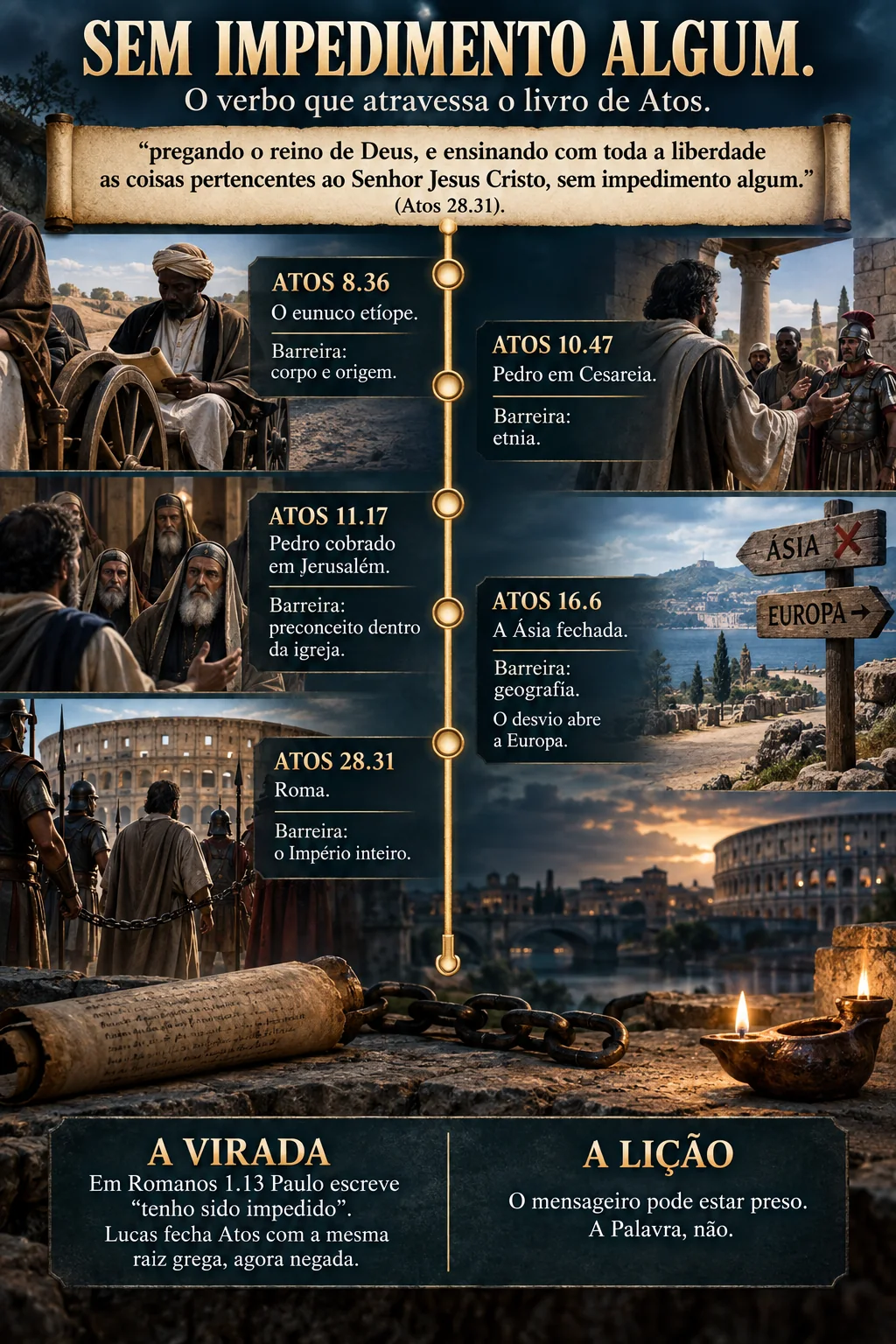
Here is the finest discovery to bring to the class, and it lies entirely inside the Bible.
A few years before setting foot in Rome, Paul wrote to the church in that city confessing a frustration: many times he had planned to go to them, but had been hindered up to that point (Romans 1:13). Keep that word in mind. Now jump to the last line of Acts: without any hindrance (Acts 28:31). It is the same Greek root, now negated. The apostle wrote that he was hindered; Luke closes the book by writing that the preaching went on unhindered.
And what is most striking is that this verb runs through the whole book of Acts, appearing right in front of the barriers that could have stopped the Gospel:
| Where | Who speaks | The barrier | What happens |
|---|---|---|---|
| Acts 8:36 | The Ethiopian eunuch | Body and origin: foreigner and eunuch | asks what hinders him from being baptized |
| Acts 10:47 | Peter, at Cornelius's house | Ethnicity: Gentiles receiving the Spirit | asks whether anyone can forbid water for baptism |
| Acts 11:17 | Peter, questioned in Jerusalem | Prejudice from within the church itself | asks who he was that he could withstand God |
| Acts 16:6 | Luke, narrating | Geography: Asia | forbidden by the Holy Spirit to preach in Asia — and the detour opens Europe |
| Acts 28:31 | Luke, in the last line | The entire Empire | preaching continues without any hindrance |
Body, race, religious prejudice, map, and power. Five different barriers, one single answer: nothing hinders.
Notice the conclusion. Back in chapter 8, a man doubly excluded by the law asks a question and it hangs in the air: what hinders him from being baptized? Luke does not answer there with a speech. He answers twenty chapters later, with the last word of the book. The whole book of Acts is the answer to that question.
And notice that one of the occurrences is the Holy Spirit hindering — in Acts 16:6. Not every roadblock is the work of the enemy. Sometimes the door that does not open is the hand of God changing the address of the preaching. Teach this carefully and without turning it into a rule: not every handcuff is an answer to prayer, and not all suffering is the will of God. There is pain that comes from sin, pain that comes from human wickedness, and pain that simply comes — and Scripture never tells us to romanticize any of them. What it affirms is something else: no circumstance, not even the worst, can stop God from fulfilling what He promised. The guarantee does not lie in the shape of the road; it lies in the character of the One who promised.
Part IV — Common interpretive mistakes — what to avoid when teaching
1. Saying that preaching without any hindrance means the faithful believer's life never stalls. No. The subject of the sentence is the preaching, not the preacher. The man described that way was handcuffed, paying rent, and without a verdict. Confusing the two sets the student up to accuse God of unfaithfulness on the day the door does not open.
2. "God replaced Israel with the Church in Acts 28:28." The text speaks of salvation sent to the Gentiles, and the same author wrote Romans 11. Expansion is not replacement.
3. "The hardening in Acts 28:27 is a divine decree." The quotation says that they closed their eyes and ends with the prospect of their turning and being healed by God. It is human refusal before offered grace, not a sentence prior to the refusal.
4. "The dispute in verse 29 says something about Jews today." It does not. It is a discussion among people who had just heard the exposition and left divided. Anyone who turns this into an ethnic label is doing the opposite of what Paul did in that room.
5. "If you have faith, God gets you out of prison." He did not get Paul out. He took the muzzle off the message from inside the prison. The apostle's prayer request during this period was for boldness to speak there and for an open door for the Word (Ephesians 6:19-20; Colossians 4:3) — not for release.
6. "Paul was released, went to Spain, and died beheaded on the Ostian Way." That is church tradition and inference, not a statement of Scripture. Acts ends without telling the outcome. If the subject comes up in class, introduce it with the right phrase: "church tradition records that..." — never as if it were biblical text.
7. "Acts is incomplete." It is open, which is different. The theme of the book is the expansion of the witness by the Holy Spirit, and the map of Acts 1:8 goes beyond Rome. The ending is a passed baton.
8. "Paul is the hero of the book." He is not, and he would be the first to say so. The protagonist of Acts is the Holy Spirit leading the Church (Acts 1:8). A class that ends in admiration for Paul has ended in the wrong place.
Part V — Lexicon of the lesson — terms in order of appearance
| TEXT | TERM | MEANING AND RELEVANCE |
|---|---|---|
| 28:16 | custodia militaris (Latin) | Roman regime in which the defendant lives in his own or a rented dwelling, chained to a guard soldier. Explains why Paul paid rent and received visitors. |
| 28:17 | οἱ πρῶτοι τῶν Ἰουδαίων | "the chief of the Jews" — not a single chief, but the leaders of the several independent synagogues of Rome. |
| 28:20 | ἅλυσις (halysis) | "chain" — the physical chain; the same word Paul uses when calling himself an "ambassador in bonds" (Ephesians 6:20). |
| 28:22 | αἵρεσις (hairesis) | "sect" — how the Jewish leaders of Rome referred to Christianity: a party within Judaism that was "spoken against" everywhere. |
| 28:23 | διαμαρτύρομαι (diamartyromai) | "testified" — to bear solemn witness, like one testifying under oath. It is not small talk; it is a serious warning. |
| 28:25 | ἀσύμφωνοι (asymphōnoi) | "agreed not" — literally "without symphony", out of accord among themselves. Describes the division with which that group departed. |
| 28:29 | συζήτησις (syzētēsis) | "great reasoning" — the dispute that continued among them after they left. Translations differ on this verse: it stands in traditional Bibles based on the Textus Receptus, while some modern editions omit it. |
| 28:31 | βασιλεία τοῦ Θεοῦ | "Kingdom of God" — the active and sovereign rule of God breaking into history; the theme with which Luke opens (Acts 1:3) and closes the book. |
| 28:31 | παρρησία (parrēsia) | "with all confidence" — the courageous frankness of one who speaks the truth without fear of power. In the New Testament, it is boldness granted by the Spirit, not a right guaranteed by the State. |
| 28:31 | ἀκωλύτως (akōlytōs) | "no man forbidding him" ("without any hindrance") — the last word of the book; an adverb, not an "amen". |
| Romans 1:13 | κωλύω (kōlyō) | "to hinder" — the same root. Paul writes that he was "let" (hindered) from coming to the church in Rome; Luke closes Acts with the same word negated. |
Part VI — Summary tables
What was bound and what was free

| BOUND | REFERENCE | FREE | REFERENCE |
|---|---|---|---|
| The apostle's body | 28:16, 20 | The preaching of the Kingdom | 28:31 |
| The freedom to come and go | 28:30 | The door of the house, open to all | 28:30 |
| The legal case, without a verdict for two years | 28:30 | The teaching, with all boldness | 28:31 |
| The human plan to visit Rome as a free man | Romans 1:13 | God's purpose, fulfilled in reverse | Acts 23:11 |
How to use: read the two columns with the class and ask, row by row: "what did Rome manage to bind, and what did it fail to bind?" The entire lesson fits inside that reading.
The two reactions to the same exposition
| THE SAME FOR ALL | DIFFERENT IN EACH ONE |
|---|---|
| The same preacher | Some believed, others did not (v. 24) |
| The same Scriptures, from the Law and the Prophets (v. 23) | Some persuaded, others resistant |
| The same full day, from morning until evening (v. 23) | They left disagreeing and in dispute (vv. 25, 29) |
| The same offer of turning and being healed (v. 27) | Some received the offered healing; others closed their eyes |
On history and archaeology — what can be said and what cannot
🔬 Where data ends and conjecture begins
Four cautions so the teacher does not lose the class
The location of the prison. We do not know the address of the rented house in Acts 28:30, and the connection of the so-called Mamertine Prison with Paul is a later tradition, not an archaeological find. Say "we do not know where it was" — it is the honest answer and it weakens nothing. The details of the chain. That Paul was chained, the text says (v. 20). Which wrist, what weight, how many hours between guard shifts — we do not know. Overly detailed descriptions out there are gap-filling, not sources. The Alexamenos graffito. It is a mocking drawing found in the ruins of the Palatine Hill in Rome, depicting a man worshiping a crucified figure with a donkey's head, with the caption "Alexamenos worships his god". It illustrates well the contempt that the cross provoked — but it was made more than a century after Acts 28. Use it as an illustration of the general climate against the Christian faith in Rome, never as a record from Paul's own time. The catacombs and the house churches. That the Christians of Rome met in houses rather than public temples in the first centuries is well established. However, the identification of specific houses with biblical characters, the numbers of graves in the catacombs, and the interpretation of particular frescoes are debated traditions and reconstructions. There is suggestive evidence of the environment; there is no proof of the episode. A teacher who presents hypothesis as certainty loses the class the day someone looks it up.
And after Acts 28? What the Bible says and what is tradition
This question will come up in class, so it is worth having an honest answer ready.
What Scripture says: Paul spent two years in that rented dwelling, receiving everyone and preaching the Kingdom without any hindrance (Acts 28:30-31). Period. Luke does not recount the hearing before the emperor, does not recount an acquittal, and does not recount a condemnation.
What is church tradition and scholarly inference: that Paul was released around the beginning of the 60s, made another journey — some speak of Spain, based on a plan he himself mentions in Romans 15:24 —, was imprisoned again under much worse conditions, and died in Rome under Nero. The letters to Timothy and Titus are read by many as testimony to that later period, and 2 Timothy does indeed have the tone of a farewell. But none of this is narrated in Acts.
Say it in class in these exact words: "church tradition records that..." It is honest, it is sufficient, and it teaches the student to distinguish what the Bible affirms from what history supposes. And notice the detail that matters for the lesson: the Bible does not end the book with the apostle's death. It ends with the Word running. If the Holy Spirit had wanted the final image of Acts to be a tomb, He would have put one there. He put an open door.
Christ in the Lesson
✝ Why no chain can hold back the Gospel
Someone was already bound in place of the Word
The question that closes this lesson is simple: why is the Word of God not bound? The answer is not optimism; it is history. In Gethsemane they arrested Jesus and bound Him; before Pilate they led Him bound; then they laid His body in a tomb, rolled the stone, sealed the stone, and even left an armed guard at the door. Four hindrances, one on top of another — and on the third day not one of them held anything back. That is why a rented house in Rome, with a soldier on an apostle's wrist, never stood a chance. He who conquered the greatest of prisons will not be stopped by an iron chain, nor by an empire, nor by your limitation, whatever it may be. And notice what Paul was proclaiming in that room from morning until night: not a philosophy, not a tradition, not a self-improvement program — a Person. He showed Christ in the Law of Moses and in the Prophets, because all of Scripture converges on Him (Luke 24:27; John 5:39). The center of our message continues to be Jesus Christ crucified, risen, and glorified. Where He ceases to occupy the center, the Gospel loses its essence — and then, indeed, something hinders it.
Devotional application — five points for the life of the class
- Your limitation is not the end of your mission. Paul did not wait for conditions to improve in order to serve. Whoever loves the Kingdom does not wait for the perfect circumstance — and our generation has grown sick from postponing obedience with the word "later".
To reflect: what are you putting off until "things get better" — that could be started this week, just the way your life is right now?
- Perhaps you are praying for the wrong door. We ask for the situation to change, for the boss to change, for the season to pass. Paul asked for boldness to speak inside the prison and for God to open the door of the Word (Ephesians 6:19-20; Colossians 4:3).
To reflect: if today you traded "Lord, get me out of here" for "Lord, give me courage here", what would change in your week?
- Your consistency opens doors that no argument can open. Before speaking of Christ, Paul cleared away the misunderstandings that would get in the way of the message. The offense of the Gospel must lie in the cross, not in the behavior of the one who preaches.
To reflect: is there any inconsistency of yours that is already closing the door to the Gospel in your home or at your workplace?
- Hearing is not obeying. It has never been easier to hear the Word, and it has never been easier to remain indifferent to it. Hardening begins in small ignored corrections.
To reflect: what was the last correction of the Holy Spirit that you recognized and did not obey?
- Your home can be the address of the Kingdom. The final scene of the expansion of the Gospel in the Bible is not a temple: it is a rented room with the door open.
To reflect: who has walked into your home over the last six months and walked out having heard about Jesus?
Suggested class plan — 45 minutes
- 0-5 min — Opening: Paul's two phrases on the board, having been hindered (Romans 1:13) and preaching without any hindrance (Acts 28:31), with the question "what changed between one and the other?".
- 5-13 min — Part I: the arrival along the Appian Way, the brothers on the road, the prison regime, and the rented house.
- 13-22 min — Blocks 1 and 2 (vv. 16-24): Paul clears the ground, the full day of an open Bible, and the divided reaction.
- 22-32 min — Blocks 3 and 4 (vv. 25-29): the quotation of Isaiah read to the end, hardening as refusal, salvation sent to the Gentiles without discarding Israel, and care with verse 29.
- 32-38 min — Block 5 (vv. 30-31) and the thread of the verb "to hinder" throughout Acts.
- 38-42 min — Christ in the Lesson: four hindrances at the tomb and none of them held anything back.
- 42-45 min — Wrap-up, challenge of the week, and prayer.
For classes with two sessions: class 1 — Part I and blocks 1 and 2 (the arrival, the prison, and the day of exposition); class 2 — blocks 3 to 5, Part III, and the application. The natural boundary lies between verses 24 and 25.
Questions for discussion: (a) In what sense was the Word free if the preacher was bound? (b) Why did the same exposition produce faith in some and refusal in others? (c) What changes in your prayer if you ask for boldness in the place where you are, instead of asking to leave it? (d) How should we speak of Acts 28:28 without falling into replacement theology and without diluting anyone's responsibility? (e) What does it mean, for an adult who works and supports a household, to receive all who come to see him?
Review quiz — with answers
1. Under what condition did Paul live in Rome, according to Acts 28? Under military custody: he was not thrown into a common prison, but was allowed to live by himself, with a soldier guarding him (Acts 28:16). He himself paid for the rented dwelling (v. 30) and remained chained (v. 20).
2. Why could he receive visitors and teach all day long? Because this arrangement restricted his movement, not the door. He could not go out, so people came in: he welcomed all who came to see him (v. 30).
3. How did Paul explain his own imprisonment to the Jewish leaders in Rome? He said that he had done nothing against the people or the customs of the fathers, that the Romans would have released him because they found no cause for death in him, and that he had appealed to Caesar not to accuse his own nation, but because he had no other way out (vv. 17-19). And he summed up the cause: it was for the hope of Israel that he was bound with that chain (v. 20).
4. What method did he use in his exposition on the appointed day? He expounded and testified the Kingdom of God and sought to persuade them concerning Jesus from both the law of Moses and the prophets, from morning till evening (v. 23). Biblical, Christ-centered, and patient preaching.
5. What was the result, and what does it teach? "And some believed the things which were spoken, and some believed not." (Acts 28:24) Same preacher, same Scriptures, same Spirit at work — different responses. The difference was not in the seed, but in the soil: the heart is the field of decision.
6. What does the quotation from Isaiah 6:9-10 say when read to the end? That the heart of that people had grown dull, that they were hard of hearing, and that they had closed their eyes, lest they should see with their eyes, hear with their ears, understand with their heart, and turn back for God to heal them (Acts 28:27). The verb is theirs, and the sentence ends with an offer of healing — it is human refusal before grace, not a decree of reprobation.
7. Does Acts 28:28 mean that God rejected Israel? No. It is expansion, not replacement. Salvation is sent to the Gentiles, and they will hear it; and the same apostle wrote that God has by no means cast away His people (Romans 11:1), and that the gifts and the calling of God are irrevocable (Romans 11:29). Moreover, the reaction in Rome was not unanimous — some believed.
8. What does verse 29 record, and what does it not authorize? It records that, when those words had been spoken, the Jews departed having a great dispute among themselves — an internal discussion after the exposition. It authorizes absolutely nothing against the Jewish people, yesterday or today. The verse is in the KJV and the Received Text; some modern editions omit it.
9. What is the last word of the book of Acts, and why does it matter? In the Greek, an adverb: akōlytōs, "without any hindrance" (Acts 28:31). It is not an "amen." The book is not closed; the last word is left hanging in the air on purpose.
10. What word links Romans 1:13 to Acts 28:31? The same root of the verb "to hinder." Years earlier, Paul wrote to the church in Rome that he had often purposed to go to them and had been hindered; Luke closes Acts with the word negated: without any hindrance. The hindrance ended on the day the chains began.
11. Where else does this verb appear in Acts, and in the face of what? In the face of the body and origin (Acts 8:36, the Ethiopian eunuch), ethnicity (Acts 10:47, the Gentiles in Cornelius's house), prejudice within the church itself (Acts 11:17), geography (Acts 16:6, forbidden by the Holy Spirit, which opened Europe), and finally, the entire Empire (Acts 28:31).
12. Does "without any hindrance" mean that Paul did not suffer? No. He was chained, paying his own rent, without a sentence and without a forecast. The freedom belongs to the Word, not to the circumstances — as he himself would write later, suffering trouble even to the point of chains as an evildoer, while the word of God is not bound (2 Timothy 2:9).
13. What did Paul ask for in prayer during this period? Not release or the end of the trial: he asked for boldness to speak of Christ inside the prison (Ephesians 6:19-20) and that God would open a door for the word (Colossians 4:3).
14. What happened to Paul after Acts 28? Scripture does not say. Church tradition records that he was released, made another journey, was imprisoned again, and died in Rome. This is tradition and inference, not a biblical statement — and it must be taught as such.
15. How does the lesson lead to Christ? The Word is not bound because Someone was already bound in its place: they bound Jesus, sealed the stone, and set a guard at the door — and none of that held anything back on the third day. He who overcame the greatest of prisons is not held back by a rented house in Rome, nor by your limitation.
Going further — bibliography consulted and recommended
Commentaries and studies
ARRINGTON, French L. O Novo Testamento Pentecostal. Rio de Janeiro: CPAD (the Assemblies of God publishing house in Brazil).
BRUCE, F. F. The Book of the Acts. Rev. ed. Grand Rapids: Eerdmans, 1988.
HEMER, Colin J. The Book of Acts in the Setting of Hellenistic History. Tübingen: Mohr Siebeck, 1989.
HORTON, Stanley M. O Livro de Atos. Rio de Janeiro: CPAD.
KEENER, Craig S. Acts: An Exegetical Commentary, v. 4 (24:1–28:31). Grand Rapids: Baker Academic, 2015.
LAMPE, Peter. From Paul to Valentinus: Christians at Rome in the First Two Centuries. Minneapolis: Fortress Press, 2003.
LEON, Harry J. The Jews of Ancient Rome. Updated ed. Peabody: Hendrickson, 1995.
MARSHALL, I. Howard. Atos: introdução e comentário. São Paulo: Vida Nova / Mundo Cristão.
RAPSKE, Brian. The Book of Acts and Paul in Roman Custody. Grand Rapids: Eerdmans, 1994.
STOTT, John. A Mensagem de Atos. São Paulo: ABU Editora, 1994.
Sources cited by the lesson itself: Bíblia de Estudo Holman. Rio de Janeiro: CPAD, 2019, p. 1776 (study note "Isaías e a Rejeição de Cristo em Roma"); Bíblia de Estudo Aplicação Pessoal. Rio de Janeiro: CPAD, 2013, p. 1547 (study note "Atos Continua: A Missão não Terminou"); magazine Ensinador Cristão, ed. 106, p. 42.
Ancient sources: SUETONIUS, Vida do Divino Cláudio 25.4 (the expulsion of the Jews from Rome); HORACE, Sátiras I.5 (the Forum of Appius on the Appian Way); ULPIAN, in the Digesto 48.3 (the forms of Roman custody).
Archaeology and material culture: the Alexamenos graffito, on the Palatine Hill in Rome (late 2nd or 3rd century); the house churches and the tituli of Rome; the Jewish and Christian catacombs of the city. Identifications of specific houses and frescoes with biblical figures remain debated.
Closing Prayer
Lord, You who led Your apostle to Rome by a path he never would have chosen, teach us to trust in You when the answer arrives the other way round. Forgive us for measuring Your faithfulness by the comfort of the journey, and for calling a closed door what was actually Your hand changing the address of the preaching.
Teach us, Father, to pray as he prayed. We ask so much for the situation to change, for the boss to change, for the season to pass, for the pain to go away — while he asked You for boldness to speak of Christ inside the prison and that You would open the door of Your word. Change the request in us, Lord. Give us courage in the place where we are, with the health we have, with the schedule we have, with the family we have.
Keep us, Father, from two errors. Do not let us teach that whoever has faith does not suffer, because the man of whom it was said "without any hindrance" was in chains. And do not let us believe that our limitation has silenced Your mission, because nothing, not even the entire Empire, managed to hinder Your Word. May no one leave this class with contempt for any people, nor with hardness of heart toward those who have not yet believed — rather, give us the love of that apostle, who continued desiring the salvation of his own people after so much rejection.
And open our homes, Lord. May our door be open like that one, may our table have room, may our children hear of You inside the house, and may someone walk into our living room and leave having heard of Jesus. You overcame the greatest of prisons: they bound You, sealed the stone, set a guard — and nothing held anything back on the third day. Therefore today we write one more line of the chapter that has not ended. In the name of Jesus, the Lord of all kingdoms. Amen.
Soli Deo Gloria — Scripture governs; everything else, on its knees.
Frequently asked questions about this lesson
If Paul was chained to a soldier, in what sense was the Gospel advancing without any hindrance?+
Look carefully at what the text says and what it does not say. It does not say that Paul was free—it says the opposite: two years in a rented dwelling, paid for at his own expense, under permanent guard (Acts 28:30). The freedom of the last verse is not that of circumstances; it is that of the Word: "Preaching the kingdom of God, and teaching those things which concern the Lord Jesus Christ, with all confidence, no man forbidding him." (Acts 28:31). The subject of the freedom is the preaching, not the preacher. It is the same distinction Paul would make later, from another prison and under much worse conditions: "Wherein I suffer trouble, as an evil doer, even unto bonds; but the word of God is not bound." (2 Timothy 2:9). Teaching this with precision protects the class from two lies: that faith cancels limitation, and that limitation cancels the mission. Neither of the two is what Acts 28 says.
Does Acts 28:28 mean that God gave up on Israel and replaced His people with the Church?+
No, and it is important to state this plainly, because the verse has been badly misused. What Paul announces is that God's salvation has been sent to the Gentiles and they will listen to it (Acts 28:28)—an expansion, not a replacement. The apostle himself, writing to the church in that very same city a few years earlier, had asked the question and answered: "I say then, Hath God cast away his people? God forbid. For I also am an Israelite, of the seed of Abraham, of the tribe of Benjamin." (Romans 11:1), and further on: "For the gifts and calling of God are without repentance." (Romans 11:29). Note also that the rejection in Rome was not unanimous: "And some believed the things which were spoken, and some believed not." (Acts 28:24). There were Jews believing in that room—and the preacher himself was a Jew, bound, as he himself put it, for the hope of Israel (Acts 28:20). The balance is this: no one is saved by ethnicity and no one is discarded by ethnicity. The door that opens to the Gentiles was never a door that closes to Israel.
Does the statement that this people's heart has grown dull (Acts 28:27) mean that God closed those hearts so that they would not be saved?+
No. Read the whole quotation, because it is precisely the end of it that is usually cut off: "For the heart of this people is waxed gross, and their ears are dull of hearing, and their eyes have they closed; lest they should see with their eyes, and hear with their ears, and understand with their heart, and should be converted, and I should heal them." (Acts 28:27). Two things jump out from the text. First: it was the people themselves who closed their eyes—the verb is on their side; it is an action, not a decree. Second: the sentence ends with an offer, not a verdict—that they might turn back and receive God's healing (Acts 28:27). Healing is still on the table; what prevents it is not a lack of willingness on God's part, but the listener's continued refusal. This is the reading we have always upheld: God wants everyone to be saved, grace goes ahead and enables, the Holy Spirit convicts of sin, righteousness, and judgment—and the person either cooperates or resists. Hardening is the result of resisting many times, not the reason why someone never had a chance. A decree of reprobation would turn the last line of the quotation into a piece of theater—and it is not.
Does the sharp dispute among the Jews in Acts 28:29 authorize anything against the Jewish people today?+
Nothing. Absolutely nothing. The verse records a fact: "And when he had said these words, the Jews departed, and had great reasoning among themselves." (Acts 28:29). It is an internal discussion among people who had just listened to a full day of biblical exposition and left divided—some persuaded, others not. It is not a collective accusation, it is not a verdict upon a people, and it is not permission for contempt, jokes, theories, or hostility of any kind against Jews, today or ever. Say this in class without mincing words, because on the internet this kind of text is hijacked all the time. The one speaking there was a Jew, suffering out of love for his own people and earnestly desiring their salvation (cf. Romans 9:1-3). If the lesson produces contempt for Jews in anyone, it was taught contrary to what Paul did in that room.
If nothing hinders the Word, does that mean the faithful believer does not suffer and everything turns out fine in the end?+
The text answers for itself. The man described as preaching without any hindrance (Acts 28:31) was in handcuffs, paying his own rent, without a sentence and without a forecast, and church tradition records that he would eventually die under Rome. The Gospel ran; the messenger suffered. Both things are true at the same time, and anyone who teaches only the first is setting a trap for the student—on the day illness comes, they will conclude that they lacked faith. They did not. Notice what Paul asked for in prayer: not release, not the end of the trial, not comfort—he asked for courage to speak inside the prison (Ephesians 6:19, 20) and that God would open a door for the message (Colossians 4:3). That is a different request, and God answered his. Nothing here promises prosperity or favorable circumstances. What is promised is that limitation has no power to silence the message.
Why does Acts end like this, in the middle, without saying what happened to Paul? Is something missing from the Bible?+
Nothing is missing; the ending is intentional. Luke wrote two volumes whose theme is the expansion of the testimony by the Holy Spirit, not the biography of an apostle. Notice the map given at the beginning of the book: "But ye shall receive power, after that the Holy Ghost is come upon you: and ye shall be witnesses unto me both in Jerusalem, and in all Judæa, and in Samaria, and unto the uttermost part of the earth." (Acts 1:8). Rome is not the end of the earth—it is the hub from which the roads of the world went out. In other words, the book stops with the map still halfway through. And the last word of the Greek text is not "amen": it is an adverb, akōlytōs, "without any hindrance." It is not a closed report; it is a baton passed on. Chapter 29 is written by every open home, every conversation at work, every child instructed, every Sunday School class—including this one.
Teacher's Guide
Essence of the class
The messenger may be bound; the Word is not — because when God opens a door, no prison closes it, and the ending of Acts was left open on purpose: the mission continues in your home and at your workplace.
Map of the class
| Time | Stage |
|---|---|
| 0–5 min | Opening (the hook: Paul's two sentences on the board) |
| 5–16 min | Point 1 — Imprisoned in Rome, free in Christ (vv. 16-20, 30) |
| 16–28 min | Point 2 — A full day of the Bible and a divided room (vv. 21-24) |
| 28–38 min | Point 3 — The quotation read to the end and the door that opens (vv. 25-29) |
| 38–42 min | Class activity + the last word of the book (vv. 30, 31) and Christ in the Lesson |
| 42–45 min | Wrap-up + challenge of the week + prayer |
Start like this
Write the two sentences on the board, one below the other, without saying where they came from:
"I have been hindered." "Without any hindrance."
Then say: "Both come from the same man, about the same subject: going to Rome. The first he wrote when he was a free preacher, traveling wherever he wanted. The second was written when he was already in Rome, chained to a soldier inside a rented house. Which of the two situations would you think had more hindrance?" Let three or four answer. "The second, obviously" will come up, and someone will suspect a catch in the question. Hold the answers: "keep that in mind, because the Bible says the exact opposite of what it looks like — and that is why this lesson changes your week."
Point 1 — Imprisoned in Rome, free in Christ (Acts 28:16-20, 30)
- In the quarterly: topic I ("Paul in Rome: prisoner, yet free in Christ"), with its three sub-items — the measure of freedom he receives even in custody, the imprisonment that does not hinder the fulfillment of God's plan, and the Gospel that overcomes political, social, and religious barriers.
- What to teach: make it clear first that the imprisonment was real. He was chained (v. 20), paid his own rent (v. 30), and could not go out. Only then show the turn: because he could not go out, everyone came in — he welcomed all who came to see him. The chain bound his legs, not the door. Explain that the arrangement was military custody: one's own or a rented house, with a soldier always at his side. Show the effect that Paul himself recorded: writing from this prison to the church in Philippi, he says that the situation ended up serving the advance of the Gospel, that his chains became known in Christ throughout the whole praetorian guard, and that the brothers gained courage to speak (Philippians 1:12-14). Close with the fact that usually gives the class chills: four New Testament letters are traditionally linked to this captivity — Ephesians, Philippians, Colossians, and Philemon. Four books of the Bible with the same return address: a rented room with a soldier at the door.
- Anchor verse (KJV): "For this cause therefore have I called for you, to see you, and to speak with you: because that for the hope of Israel I am bound with this chain." (Acts 28:20)
- Key question: "What limitation have you been using as a reason not to serve God?"
- Likely answers (+ going deeper): "my work schedule," "my health," "my family is not converted," "my age," "my past." Go deeper: "and what if God does not remove that anytime soon? What can be done within that limitation this week?" Do not let it turn into a competition of suffering — the subject is the mission, not the size of each person's problem.
- If no one speaks: share your own limitation first, simply and concretely, and return the question. If there is still no answer, read verses 16 and 30 aloud and ask only: "notice what he could not do and what he did anyway."
Point 2 — A full day of the Bible and a divided room (Acts 28:21-24)
- In the quarterly: topic II ("The Gospel preached to the Jews in Rome"), with its three sub-items — Paul summons the Jewish leaders to clarify his situation, proclaims the Kingdom of God by showing Christ in the Scriptures, and the divided reaction reveals that the heart is the field of decision; plus the study note "Isaiah and the Rejection of Christ in Rome," right after the topic.
- What to teach: start with the method. Before speaking of Christ, Paul cleared the ground: he explained his imprisonment, said that he had done nothing against the people or the customs of the fathers, and made it clear that he had not appealed to Caesar to accuse his own nation (vv. 17-19). The offense of the Gospel must lie in the cross, not in the behavior of the messenger. Then move to the exposition: an appointed day, a full house, from morning till evening (v. 23), with the law of Moses and the prophets in hand — biblical, Christ-centered, and patient preaching, not emotion without the Word. Close at verse 24: some believed what was spoken, and others did not believe. Same room, same preacher, same Spirit, different responses. State the reason plainly: God does not force anyone to believe. Grace is offered and must be received by faith. The problem was never in the message; it was in the disposition of the heart.
- Anchor verse (KJV): "And some believed the things which were spoken, and some believed not." (Acts 28:24)
- Key question: "Why do two people hear the exact same preaching and one leaves brokenhearted while the other leaves unchanged?"
- Likely answers (+ going deeper): "one was open and the other was not," "it depends on what each person is going through," "one wanted to change." Go deeper: "and what makes a heart slowly close over time, even inside the church?" Here you are already planting Point 3.
- If no one speaks: tell the general and true story of every Sunday — the same message, the same class, and at the end some take notes while others check their phones — and ask only: "what decides the difference?"
Point 3 — The quotation read to the end and the door that opens (Acts 28:25-29)
- In the quarterly: topic III ("The rejection of the Jews and salvation to the Gentiles"), with its three sub-items — the spiritual hardening of Israel, salvation extending to the Gentiles according to God's eternal plan, and Acts ending with a Kingdom that cannot be stopped; plus the study note "Acts Continues: The Mission Has Not Ended," at the end of the topic.
- What to teach: this is the delicate point of the class, and the teacher must lead it firmly. Read Acts 28:26-27 in full, aloud, and do not stop before the end. Have the class notice two things: (1) it was the people themselves who closed their eyes, and (2) the quotation ends with turning back so that God would heal them. Explain: hardening, in the Bible, is the result of repeatedly resisting grace, not a decree that decides beforehand who can believe. God wants to save, grace enables, the Spirit convicts — and the person cooperates or resists. Then move to verse 28 and handle it with balance: salvation sent to the Gentiles is expansion, not replacement; God has not rejected His people (Romans 11:1, 29), and not all rejected it — some believed (v. 24). Finally, verse 29: say that the great dispute was a discussion among them after the exposition, and state aloud what the text does not authorize: nothing, absolutely nothing, against the Jewish people today. If a student has heard anything of that sort on the internet, this is where it gets corrected.
- Anchor verse (KJV): "For the heart of this people is waxed gross, and their ears are dull of hearing, and their eyes have they closed; lest they should see with their eyes, and hear with their ears, and understand with their heart, and should be converted, and I should heal them." (Acts 28:27)
- Key question: "How does a heart grow hard without the person realizing it?"
- Likely answers (+ going deeper): "when we hear too much and obey too little," "when it becomes routine," "when a person gets used to small sins." Go deeper: "what was the last correction from the Holy Spirit that you recognized and let pass?" — and leave the question hanging in the air, without asking for an answer out loud.
- If no one speaks: read verse 27 twice, stopping the first time before the final clause about turning back and being healed, and completing it the second time. Ask only: "what changes when we read to the end?"
Class activity
- Goal: to get the class to see, on one side, what the limitation actually bound and, on the other, what it could not bind — and to leave with one specific thing named to do during the week.
- Materials: a board or poster paper, chalk or marker, and a small piece of paper with a pen for each student.
- Step by step: divide the board into two columns: "What the chain bound" and "What the chain did not bind." Read Acts 28:16, 20, 30, 31 with the class and fill it in together: on one side, "the body," "the freedom to come and go," "the case stalled for two years," "the rent money"; on the other, "the door of the house," "the preaching," "the teaching," "the letters," "the courage of the brothers." Leave the two columns visible for a few seconds in silence. Then hand out the paper and ask each person to write, for themselves alone, two lines: on the first, the real limitation they have today; on the second, one thing that can still be done for the Kingdom within that limitation this week. No one reads it aloud and no one shows it to anyone. Ask them to keep the paper in their Bible until next Sunday.
- Wrap-up (back to the text): "Look at the two columns again. Rome managed to bind quite a lot of that man — and could not bind a single word. That is why Luke ended the book with an adverb instead of an amen: without any hindrance. The paper in your Bible is there to remind you all week long that the second column exists in your life too."
If they ask you this
Question: "If Paul was imprisoned, how can the text say 'without any hindrance'?" Short answer: Because the subject of the sentence is the preaching, not the preacher. He was chained (v. 20), paid his own rent, and spent two years without a sentence (v. 30). What was unhindered was the proclamation of the Kingdom. He himself summed this up later, from another prison and under much worse conditions, saying that he suffered trouble even to the point of chains as an evildoer, yet the word of God is not bound (2 Timothy 2:9). Teach it this way and you protect the class from two lies: that faith cancels limitation, and that limitation cancels the mission.
Question: "My boss picks on religion at work and my whole family laughs at me at home. How do I speak of Jesus in a place like that?" Short answer: The way Paul did: without waiting for the place to get better and without forcing the place to change. Notice what he asked for in prayer during this period: he did not ask to get out of prison or for the trial to end; he asked for courage to speak right there inside (Ephesians 6:19-20) and that God would open a door for the word (Colossians 4:3). Often our prayer is "Lord, get me out of here," when the prayer in the Bible is "Lord, give me boldness here." And note the order in Acts 28: before preaching, Paul cleared up the misunderstandings about himself. At work, your consistency opens doors that no speech can open — what convinces your coworker is not your winning the coffee-break argument, it is your being the same person on Wednesday and on Sunday.
Question: "Did God choose to harden those people's hearts so that they would not be saved?" Short answer: No, and the verse itself answers that. Read to the end: it says that they closed their eyes, and finishes with turning back so that God would heal them (Acts 28:27). It was the people who closed them — the verb is theirs. And the sentence ends in healing offered, not in a locked door. Hardening, in the Bible, is the result of repeatedly resisting grace, not the cause that explains why someone never had a chance. God wants all to be saved, grace goes ahead and enables, the Spirit convicts of sin, of righteousness, and of judgment — and the person cooperates or resists. If it were a decree, that offer of healing would not be written there.
Question: "So did God abandon Israel and pass the ball to the Church?" Short answer: No. Acts 28:28 speaks of salvation sent to the Gentiles — it is expansion, not replacement. The same Paul wrote to the church in that very city that God has by no means cast away His people (Romans 11:1) and that the gifts and the calling of God are irrevocable (Romans 11:29). Add to this two facts from the text: not all rejected it — some believed (v. 24) — and the one preaching was a Jewish prisoner bound, in his own words, for the hope of Israel (v. 20). And make this explicit in class: the dispute in verse 29 is a discussion among people who had just heard the exposition, and it authorizes nothing — nothing at all — against Jews today. No one is saved by ethnicity and no one is discarded by ethnicity.
Question: "If nothing hinders the Word, why has my life been stuck for years?" Short answer: Because the promise of the text is not about your circumstance; it is about the message. Paul's life was stuck: two years at a standstill, without a sentence, without a forecast, in chains. What was not stuck was the Gospel going out from that house. And here we must be careful on both sides: not every handcuff is an answer to prayer, and not all suffering is the will of God — there is pain that comes from sin, pain that comes from someone's malice, and pain that simply comes. Scripture never tells us to romanticize any of them. What it guarantees is that no circumstance, not even the worst, prevents God from fulfilling what He promised. The guarantee does not lie in the shape of the path; it lies in the character of the One who promised.
Question: "What happened to Paul afterward? Was he released? How did he die?" Short answer: The Bible does not say, and it is important to answer that way. Acts ends with him preaching for two years in that rented house, full stop. Church tradition records that he was released, made another journey — some speak of Spain, based on a plan he himself mentions in Romans 15:24 —, was imprisoned again under much worse conditions, and died in Rome. That is tradition and scholarly deduction, not biblical text. Always use the formula "church tradition records that...". And take the opportunity to show what the ending teaches: if God had wanted the final image of Acts to be a tomb, He would have put one there. He put an open door.
Wrap-up + challenge of the week
- Wrap-up: "Go back to the two sentences from the beginning. 'I have been hindered' was written by a free man, traveling wherever he wanted. 'Without any hindrance' was written about a man chained in a rented house. The hindrance ended on the day the chains began — because God did not remove the hindrance by opening the door Paul asked for; He removed it from inside the prison. And the book ends without an 'amen,' with an adverb hanging in the air, because Luke was not closing a report: he was passing a baton. Chapter 29 was not his to write. It is ours. Every open home, every conversation at work, every child instructed, every session of this class is a line of that chapter. And the reason we can trust like this is only one: Someone was already bound in the place of the Word. They bound Jesus, sealed the stone, and set a guard at the door — and on the third day none of that held anything back. He who overcame the greatest of prisons will not be held back by your limitation, whatever it may be."
- Challenge: this week, open your home once. Set the day, invite those who live with you — and, if possible, one more person: a neighbor, a coworker, a relative who has been away from church. Spend about twenty minutes with the Bible open to Acts 28:30-31: read the two verses aloud, say in your own words what Christ has done for you, and pray for that home. If you live alone, the invitation is the same: invite one person over for coffee at your house and do this together. One day, one house, the door open. On Sunday, come back with the story.
Teacher's kit
- Before: read all of Acts 28 aloud, from v. 1 to v. 31 — the chapter is short and gains a great deal when read at once. Mark in your Bible verses 16, 20, 23, 24, 27, 28, 29, 30, and 31: they are the support points of the class. Reread Acts 23:11 (the promise of Rome) and Romans 1:13, which is the key to the opening hook. Check also 2 Timothy 2:8-9, Ephesians 6:19-20, and Colossians 4:3, the three texts that sustain the axis "the messenger bound, the Word free." And read Romans 11:1, 29 before entering Point 3.
- Bring: a Bible, a board or poster paper for the two columns of the class activity, and small sheets of paper with pens for the class.
- Pray beforehand: ask God for those who arrive in class convinced that their own limitation has ended their mission — the unemployed, the sick, those who care for someone at home and cannot go out, those who are ashamed of their past. Ask for wisdom to teach "without any hindrance" without slipping into triumphalism, and to handle Acts 28:27 and 28:29 with doctrinal firmness and pastoral care. And ask for yourself: that the class may not end in admiration for Paul, but in courage to speak of Christ where each person is.
Homework
Your mission for the week
Open your home once this week. Set the day, invite those who live with you — and, if possible, one more person: a neighbor, a coworker, a relative who has been away from church. Set aside about twenty minutes: read Acts 28:30-31 aloud, say in your own words what Christ has done for you, and finish by praying for that home and for the people who are there. There is no need for a sermon, an expensive snack, or special preparation. If you live alone, the invitation is the same: invite one person over for coffee at your house and do this together.
Why
The final scene in the Bible on the advance of the Gospel does not take place in a temple or an auditorium: it takes place in a rented room, with a soldier at the door, where an imprisoned man welcomed all who came to see him, preaching the Kingdom of God and teaching with all freedom the things concerning the Lord Jesus Christ, without any hindrance (Acts 28:30-31). He could not go out — so everyone came in. The chain bound his legs; it did not bind the door. Your home, just as it is today, with the limitations you have today, can be the address of the Kingdom this week. The word of God is not bound (2 Timothy 2:9) — and it does not depend on your being in a better place in order to run.
How to know you did it
There was a day, there were people, and the Bible was opened. If you can say, "on Thursday I invited so-and-so, we read Acts 28, and I prayed," you did it. If the answer is "I thought about doing it" or "I said I would schedule it," not yet. The cost of the snack does not count, the number of people does not count, and eloquence does not count — what counts is that the door was opened and Christ was named inside.
On Sunday, come back with the story
The next class begins with those who opened their homes. Bring who was there, what was read, and what happened afterward — without exposing anyone and without telling what belongs to someone else's private life. Do not stay out.