The Great Commandment
Adults · Lesson 5 · Quarter 4
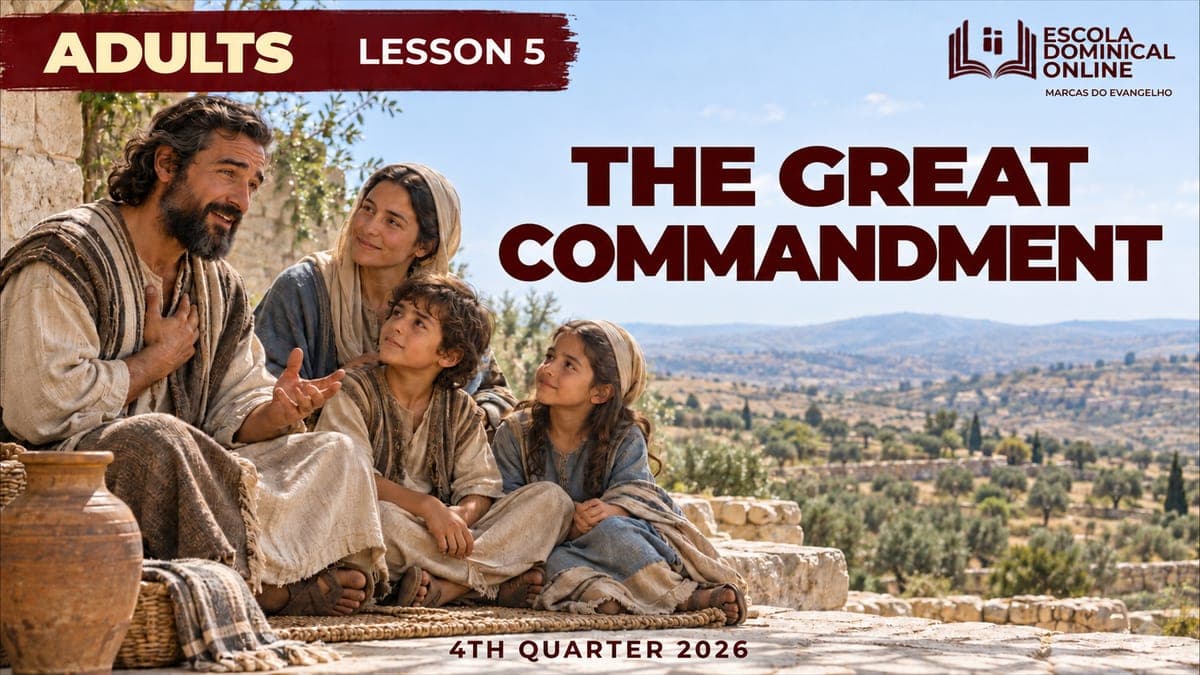
The video has automatic English dubbing. If you hear Portuguese, open the player settings (⚙) → Audio track → English.
About this lesson
Love for God is expressed in sincere obedience, in teaching at home, in constant practice of his Word, and in love for our neighbor.
Golden Text
“And thou shalt love the LORD thy God with all thine heart, and with all thy soul, and with all thy might.”
Frequently asked questions about this lesson
1.What is the Shema, and why did Jesus call it the great commandment?
Shema is the first word of Deuteronomy 6:4 in Hebrew and means "hear". It became the name of the confession: "Hear, O Israel: The LORD our God is one LORD:" (Deuteronomy 6:4), followed by the commandment to love God with one's whole being (Deuteronomy 6:5). In Jesus' day, devout Jews recited it every day. When Jesus was asked which was the first of all the commandments, He began with exactly this one (Mark 12:29-30) and joined to it the love of neighbor: "On these two commandments hang all the law and the prophets." (Matthew 22:40). It is the great commandment because it is not one rule among others: it is the spring from which the others flow. Whoever loves God like this keeps the rest as a response, not as a burden: "For this is the love of God, that we keep his commandments: and his commandments are not grievous." (1 John 5:3).
2.Why does the Portuguese lesson magazine say "with all your power" while the ACF Bible says "with all your strength"?
They are two editions of the Portuguese Almeida Bible translating the same Hebrew word, me'od. The CPAD magazine uses the Almeida Revista e Corrigida ("power"); the Almeida Corrigida Fiel, used in the video lesson, has "strength" (the King James Version reads "with all thy might"). Neither is wrong: the ancient Greek translation read the word as strength, and the versions followed from there. But me'od, in its roughly three hundred occurrences, almost always means "very", as in Genesis 1:31, where God saw that everything was very good. Literally, the end of the verse says "with all your very-much": what you have, what you are able to do, and everything life measures out to you, the good and the bad. That is why Jesus, when quoting the commandment, used more than one word to cover the meaning (Mark 12:30).
3.Does loving God "with all your very-much" mean giving everything to the church? Will God make me prosper if I give?
Neither one nor the other. Loving God with your "very-much" is laying before Him what you have, money, house, time, talent, and letting Him rule over it instead of letting it rule over you: "For where your treasure is, there will your heart be also." (Matthew 6:21). That shows up in stewardship and generosity: caring for your own family, "But if any provide not for his own, and specially for those of his own house, he hath denied the faith, and is worse than an infidel." (1 Timothy 5:8), and opening your hand to the poor (Deuteronomy 15:11). It is not emptying your house for an institution: Jesus condemned those who devoured widows' houses under a religious pretext (Mark 12:40). And it is not an investment with a guaranteed return: the only man of whom the Bible says he turned to the LORD with all his might was Josiah (2 Kings 23:25), and he died young; Job lost everything and went on loving. Whoever gives in order to receive more is loving the gift, not the Giver.
4.If "the LORD is one LORD", does the Shema deny the Trinity?
No. The Christian faith confesses the whole Shema: there is only one God (Mark 12:29). Paul quotes that confession and places Jesus inside it: "But to us there is but one God, the Father, of whom are all things, and we in him; and one Lord Jesus Christ, by whom are all things, and we by him." (1 Corinthians 8:6). We believe in one God in three Persons, the Father, the Son and the Holy Spirit, and not in a God who presents Himself now as Father, now as Son, now as Spirit: that is the Oneness doctrine, which Scripture does not support. But one honest caution is in order: the Hebrew word for "one" (echad) is the ordinary numeral, used for one day or one man; on its own, it does not prove the Trinity. The doctrine rests on the witness of all Scripture about the Father, the Son and the Spirit, not on a detail of grammar.
5.I taught my child in the way of the Lord and he went astray. Did Proverbs 22:6 fail?
It did not fail, because it is not a contract. "Train up a child in the way he should go: and when he is old, he will not depart from it." (Proverbs 22:6) is a principle of wisdom, what usually happens when one plants early, and not an automatic guarantee. Each person answers to God for himself. The father in the parable did nothing wrong and had two sons far from him: one in a distant country, the other inside the house, refusing to come in to the feast (Luke 15). What the text asks of parents is to keep going: pray, speak, keep the door open. The father in the parable went out twice: he ran to meet the younger son (Luke 15:20) and went out to plead with the older one to come in (Luke 15:29). No one should carry alone the guilt for an adult child's choice.
6.Does having a Bible verse on the wall or on the door protect the home?
The verse is a good reminder; it is not an amulet. Deuteronomy commands writing the words on the posts of the house and on the gates, "And thou shalt write them upon the posts of thy house, and on thy gates." (Deuteronomy 6:9), so that the family remembers them and lives them, not so that the paper does what only God does. Over time, many Jews came to fulfill the command literally, with small leather boxes bound to the arm and the forehead and a case on the doorpost. Jesus did not condemn the Word; He condemned those who used it to show off: "But all their works they do for to be seen of men: they make broad their phylacteries, and enlarge the borders of their garments," (Matthew 23:5). The protection of the home is the Lord, and the sign He looks for is a household that obeys.
Adults
Quarter 4