Golden Text
“For so hath the Lord commanded us, saying, I have set thee to be a light of the Gentiles, that thou shouldest be for salvation unto the ends of the earth.” (Acts 13:47, KJV) · Read in the Bible
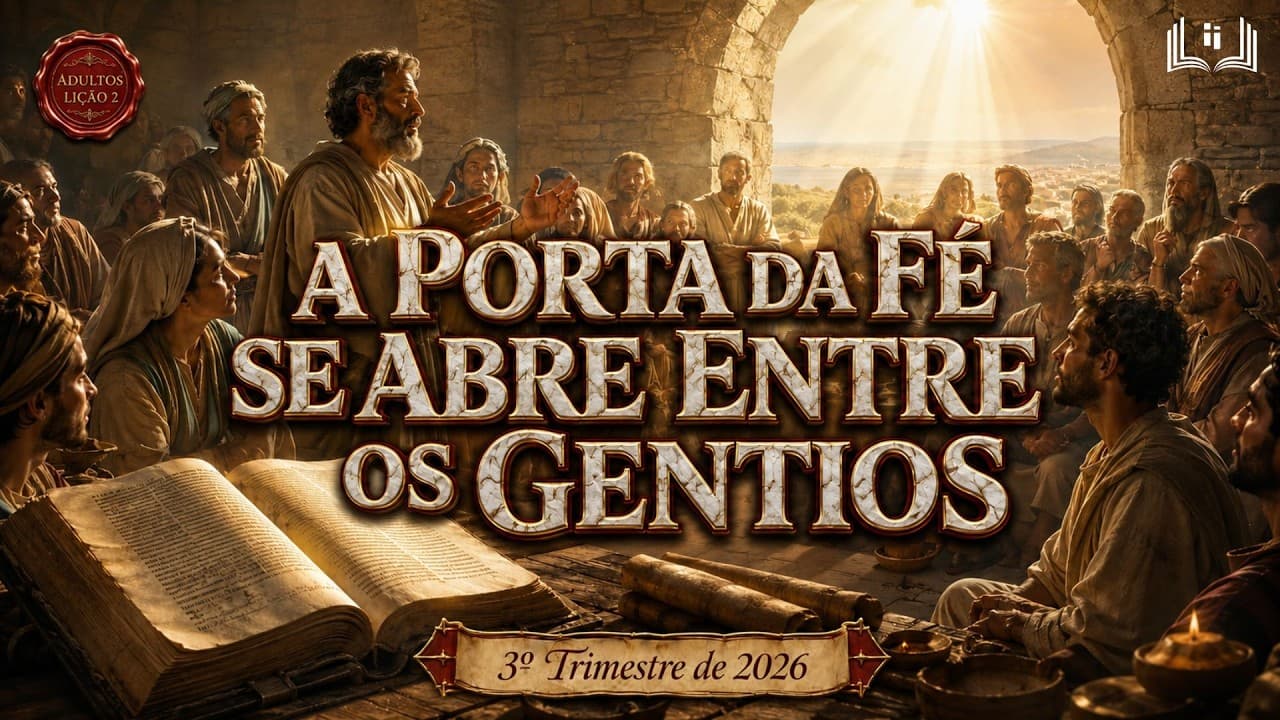
The door of faith does not open with a human key. It is not strategy that opens it, nor the preacher's charisma — it is God who opens it, and no man can shut what He opens (Revelation 3:7). Three movements: the Word expounded, responsive faith, and faithful perseverance.
The door of faith does not open with a human key. It is not strategy that opens it, nor the charisma of the preacher. It is God who opens — and no man can shut what He opens (Revelation 3:7).
There are three movements in the text of this lesson (Acts 13:13—14:28): the Word expounded in Antioch in Pisidia — the densest sermon in Acts, which we need to excavate; responsive faith before an open door — with the most debated verse of the lesson, which deserves real exegesis; and faithful perseverance along the path of suffering.
The Word Expounded (Acts 13:13-43) — the sermon as a key
Antioch in Pisidia — the setting
There are two Antiochs on Paul's map. The first is Antioch in Syria — the sending base, the city of fasting and the laying on of hands. The second, hundreds of kilometers away, is Antioch in Pisidia: a Roman colony nestled in the mountains of Asia Minor at an altitude of more than a thousand meters, with a considerable Jewish synagogue and a strong presence of God-fearing Gentiles — pagans who knew the Scriptures without having been circumcised, living on the border between Judaism and paganism. Before this mixed audience, Paul stands up on the Sabbath. And what comes out of his mouth changed the world.
The sermon — Christ on every page of the Old Testament
Acts 13:16-41 is the longest sermon of Paul preserved in Acts — twenty-six verses copied in full by Luke. When Luke preserves an entire discourse, it is because it is a model: this is how the apostle preached.
Paul did not begin with an illustration. He began in Egypt. And he walked through the history of Israel like someone unfolding a map, showing that every fold points to the same place: the Exodus (God chose, sustained, delivered); the wilderness (forty years of divine patience); the conquest; the Judges; Samuel; Saul — the king of outward appearance. And then the turning point: God raised up David, a man after His own heart (Acts 13:22), and from David's seed, a Savior — Jesus. John the Baptist prepared the way; the cross fulfilled the prophecies; the resurrection confirmed everything. And Paul concludes with what the Law could never do: complete remission of sins through faith in the risen Christ.
Typological exegesis and the argument for the resurrection
Paul's method has a name: typological exegesis — persons, events, and institutions of the Old Testament were anticipations (types) of Christ. The Exodus is a figure of redemption; David, the overlooked one raised up by God, is a figure of the rejected and risen Son. This is not a Pauline invention — it is the method of Jesus on the road to Emmaus (Luke 24:44).
To prove the resurrection, Paul cites three texts with surgical logic. Psalm 2:7 — declaring that He is the Son whom God has begotten today: that today is the resurrection, when the Son was declared with power (Romans 1:4). Isaiah 55:3 — the sure mercies of David: eternal promises are only fulfilled in someone who lives eternally. And Psalm 16:10 — that God will not allow His Holy One to see corruption: David died and saw corruption; therefore the Psalm speaks of Another. The promises to David require an eternal heir; Psalm 16 requires an incorruptible Righteous One; Jesus rose again — therefore, Jesus is the fulfillment of both.
In the original — three terms that sustain the argument
- ἀνέστησεν (anéstēsen, vv.22,33) — "raised up". The same verb for David to the throne and for the risen Christ. Deliberate theology: God always raises up what men ignore.
- διαφθοράν (diaphthorán, vv.35-37) — "corruption, decomposition". The nerve of the argument: David saw corruption; Christ did not. The bodily, physical, verifiable resurrection is non-negotiable.
- ἄφεσιν ἁμαρτιῶν (áphesin hamartiōn, v.38) — "remission of sins". Not a reduction of sentence — total cancellation of the debt.
📜 The Church Fathers and the sermon at Antioch. John Chrysostom, preaching on Acts in Antioch itself in the fourth century, observes: Paul did not begin with grace — he began with the history his listeners already knew. Preaching that transforms starts from common ground and leads to the point of rupture. And Augustine, in De Doctrina Christiana: the Old Testament is full of Christ — but Christ is there like the fruit inside the kernel; one must open the text to see Him.
Responsive Faith (Acts 13:44-52) — one door, two hearts
The second Sabbath — almost the whole city
Paul's word circulated through the city the entire week. And on the next Sabbath, Luke records that almost the whole city came together to hear the word of God (Acts 13:44). Antioch in Pisidia had between 10,000 and 15,000 inhabitants. Two itinerant preachers, without imperial credentials, without a temple, without a sponsor — and the city converging. The Word has legs of its own.
The envy that shuts the door from the inside
The rejection by the Jewish leaders was not intellectual — it was visceral: seeing the multitudes, they were filled with envy (v.45). It was not the argument that disturbed them — it was grace reaching the "unworthy". The same zēlos (zeal) that should have warmed the mission burned within as envy. And Paul notes: they judged themselves unworthy (v.46, active verb) — they were not excluded by decree. The door was open; they refused to enter. The turn to the Gentiles is not pastoral improvisation — it is the fulfillment of Isaiah 49:6, written centuries earlier.
Exegesis of Acts 13:48 — "ordained to eternal life"
The participle τεταγμένοι (tetagménoi), from tássō, is the perfect passive that divides interpreters. The perfect describes a resulting state that remains: when they heard Paul, they were already in that state. The passive voice points to an external agent — the "divine passive". Yet the passive does not imply coercion: it describes that the initiative comes from outside the subject, not that the subject is inert.
The verb tássō covers military order (Matthew 8:9), organizational arrangement (Romans 13:1), and personal commitment (1 Corinthians 16:15 — the household of Stephanas devoted themselves to the ministry). The Greek, in isolation, is genuinely ambiguous between "decreed from eternity" and "disposed by the work of the Spirit". The narrative context resolves it: Luke has just shown two groups before the same preaching — the Jews rejected it of their own will (v.46) and the Gentiles believed (active verb). If the rejection was voluntary, the reception is as well.
And Acts 14:27 illuminates 13:48 retroactively: God had opened the door of faith to the Gentiles — anoígō, to open. God opens the door (sovereign and prevenient initiative); those who are disposed enter (real and volitional response). The same verb appears in Revelation 3:7 (the One who opens and no one shuts) and in Revelation 3:20 (if anyone opens the door, He will come in). Two inseparable movements: God opens from the outside; the believer opens from the inside.
Our reading — four keys to Acts 13:48
- Prevenient grace. The Spirit was already at work before Paul preached — drawing, convicting, preparing the soil (John 6:44). But drawing is not coercion.
- Responsive faith. "Believed" — active verb, a real and personal action. Grace enables; faith responds.
- Foreknowledge, not arbitrary decree. God knows the end from the beginning and knew eternally who would respond. Knowing beforehand is not decreeing mechanically: God does not save robots.
- Universal offer, particular reception. God desires all men to be saved (1 Timothy 2:4). Same Word, same Sabbath — two groups, two responses.
The joy that reveals the heart
That they were glad (v.48) is a spiritual diagnosis. The Jews saw the multitude and were filled with envy; the Gentiles heard the Word and were filled with joy. Same city, same hour, two souls before the same door. And v.52 is the crown: with the apostles expelled, the new converts — without an apostle, without a structure — were filled with joy and with the Holy Spirit. Persecution did not put out the fire; it fed it.
Faithful Perseverance (Acts 14) — the door remains open
Iconium, Lystra, and Derbe — the same pattern, different soils
In Iconium (modern-day Konya, in Turkey), many believe — and the city conspires to stone them. They withdraw out of prudence, not cowardice (Matthew 10:23). The pattern is established: where the Word bears fruit, opposition rises up. It is not a pastoral accident — it is a spiritual law. In Lystra, Paul heals a man crippled from birth — and the crowd wants to worship them as Zeus and Hermes.
🏛 Archaeology — Lystra and the legend of Zeus and Hermes. An inscription discovered in 1909 in the region mentions priests of Zeus and Hermes together — confirming the local dual cult. Ovid, in the Metamorphoses, preserved the Lycaonian legend: Zeus and Hermes visited the region in disguise; only Philemon and Baucis welcomed them, and those who refused were destroyed. When Paul healed the crippled man, the crowd reacted within that frame: "the gods have come back".
Paul rejects the worship and proclaims the living God — and note the method: in Antioch in Pisidia he began with the history of Israel; in Lystra, before pagans without Scripture, he began with creation. The message does not change; the point of entry changes. Afterward, he is stoned and left for dead. He gets up. He goes back into the city. He departs for Derbe. The stone did not shut the door.
The return — and the report that gives the lesson its name
Paul and Barnabas do what no strategist would do: they go back — to Lystra, to Iconium, to Antioch in Pisidia, the cities of persecution. Confirming the souls of the disciples (v.22): ἐπιστηρίζω (epistērízō), to set stakes around something so that it does not fall. The mission does not end with conversion — it ends with edification. And in every church they appoint elders: local structure that survives without the apostle's presence.
The phrase that gives the lesson its name is in the return: they rehearsed all that God had done with them, and how He had opened the door of faith to the Gentiles (Acts 14:27). Not what they had done — what God had done. No stoning shut the door that God opened.
📜 The Church Fathers and perseverance. Tertullian, in the Apologeticus: "The blood of the martyrs is the seed of the Church." And Chrysostom, on the return to the cities of persecution: the courage to go back proves that the apostle was not working for himself — he was confirming souls, not building a reputation.
Christ in the Lesson
Paul cites Isaiah 49:6 — that God has set Him to be a light of the Gentiles. In the temple, Simeon declared the same verse while holding the child Jesus (Luke 2:32). Christ is the Light; the apostles are bearers. The door opens because Christ, the Light of the nations, enters through it first. And the stoned Paul, left for dead, who rises up is a living picture of 2 Corinthians 4:10-11: perseverance is not willpower — it is being anchored in the victory of Christ (John 16:33).
Practical Application
First: do you know the Old Testament — or do you merely tolerate it? Paul opened the entire Scripture like a map showing Christ in every fold. The believer who does not know the Old Testament has half the Bible closed and half of Christ hidden.
Second: there are two kinds of heart before grace that reaches others. The Jews of Antioch were religious, knew the Scriptures — and were filled with envy. When God transforms someone you judged unworthy, what is your first reaction: joy, or envy disguised as discernment?
Third: Acts 13:48 is an invitation, not a decree of exclusion. Prevenient grace is already working in you. The question is: are you responding?
Fourth: the mission includes the return. Your mission — in marriage, with your children, at work, in the church — will also have Lystras. The question of Acts 14 is not "did you succeed?"; it is "did you go back?"
Fifth: when you return, what do you recount? Paul recounted what God did — not what he did. The ministry that begins to recount what the leader accomplished begins to shut the door that God opened.
Conclusion
Paul expounded the Word — the sermon opened the door. The Gentiles responded in faith — they entered. The Jews responded with envy — they stayed outside. Paul was stoned — he got up, went back, confirmed. And upon arriving home, he recounted what God, not he, had done. One thread runs through it all: the door was opened by God — and no stone, no expulsion, no human envy could shut it. The mission advances because the One who holds the key is the Risen Lord.
That chain has reached us. Someone expounded the Word. Someone responded in faith. Someone persevered. Someone went back to confirm. You are in that chain — and now you are a bearer of the Light for those who are still outside.
Soli Deo Gloria — Scripture governs; everything else, on its knees.
Frequently asked questions about this lesson
What does it mean that the door of faith was opened to the Gentiles?+
It is the phrase from the return report of the first missionary journey, which says that God had opened the door of faith to the Gentiles (Acts 14:27). The Greek verb anoígō (to open) indicates God's sovereign initiative — the door invites all and receives those who respond with faith.
How should we understand the statement that all who were appointed to eternal life believed (Acts 13:48)?+
The Greek participle tetagménoi is grammatically ambiguous — it can indicate either 'decreed' or 'disposed.' The context resolves it: the Jews rejected of their own will (v. 46) and the Gentiles believed (active verb). Prevenient grace prepares the heart; faith responds in a real and personal way.
What is Paul's longest sermon recorded in Acts?+
The sermon in Pisidian Antioch (Acts 13:16-41), with 26 verses preserved by Luke. Paul traces the history of Israel — from Egypt to David — showing that it points to Christ, and proves the resurrection with Psalm 2:7, Isaiah 55:3, and Psalm 16:10.
Why did Paul and Barnabas return to the cities where they had been persecuted?+
To strengthen the souls of the disciples (Acts 14:22) — the verb epistērízō means to place stakes around something so that it does not fall. The mission does not end with conversion, but with edification; that is why they appointed elders in every church.
Teacher's Guide
Five questions this lesson asks the class:
- Do you know the Old Testament well enough to find Christ in Genesis, in the Psalms, and in Isaiah?
- When grace reaches someone you judged unworthy, is your first reaction joy or disguised envy?
- The Spirit is working in your heart — drawing, enabling. Are you responding in faith?
- Which Lystra are you in? The stone has fallen. Will you get up and go back — or give up before Derbe?
- When you recount your life and ministry, who is the protagonist — God or you?