Golden Text
“And the gospel must first be published among all nations.” (Mark 13:10, KJV) · Read in the Bible
The lesson that closes the quarter brings together three texts that, on their own, no one fully understands: the command (Matthew 28:18-20), the means (Acts 1:8), and the result (Ephesians 2:13-18). And it begins in a place that is almost never read in class — the verse right before the Great Commission, where Matthew writes that the group worshiped and that some doubted. It is to these people that the Risen One entrusts the evangelization of the world. Add up what the three texts say: the authority belongs to Christ, the power belongs to the Spirit, the voice is Christ speaking through the mouth of the Church, and even the preacher's words are God's creation. What was left for us was to go to the appointed mountain. The only human contribution to the greatest mission in history was availability — and that is why no one is exempt from it.
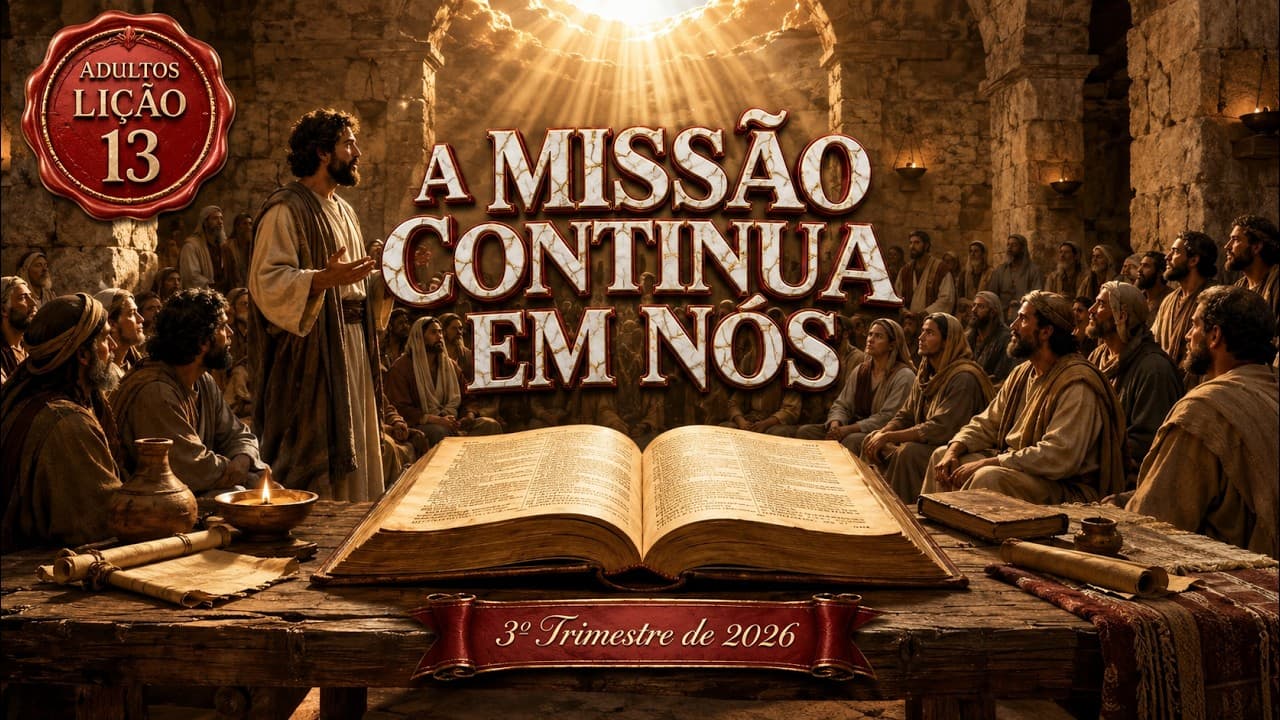
Lesson 13 • The Mission Continues in Us — Exhaustive Research Study of the Lesson.
Complete study of Matthew 28:16-20, Acts 1:8 and Ephesians 2:13-18 — exegesis of the text, the verse that precedes the Great Commission, the difference between authority and power, Ephesians 2:17 read alongside Isaiah 57:19, the story of when the church almost decided that the mission did not continue, and the closing of the quarter's arc.
Marcas do Evangelho (church in Cariacica, Brazil) • Pastor Jairo Carvalho and Pastor Jaciana Carvalho • 3rd Quarter of 2026 (Lições Bíblicas, the CPAD Sunday School quarterly — Adults).
✶ Golden Text — Mark 13:10
"And the gospel must first be published among all nations." (Mark 13:10)
Practical Truth (CPAD, the Assemblies of God publishing house in Brazil): it is necessary that the Church preach the Gospel to all nations, for this mission must advance to the ends of the earth.
- Study text — Matthew 28:16-20; Acts 1:8; Ephesians 2:13-18
- Scripture Reading in Class — Matthew 28:18-20; Acts 1:8; Ephesians 2:13-18
- Daily Reading — Mon Mark 13:10 • Tue Acts 1:8 • Wed Acts 28:30, 31 • Thu Romans 10:14, 15 • Fri 2 Timothy 2:9 • Sat Matthew 28:18-20
- Hymns (Harpa Cristã, the Brazilian Assemblies of God hymnal) — 115, 127 and 227
- Bible version — Scripture quotations in this translation are copied from the King James Version (KJV), checked letter by letter. Transliterations follow the usual academic standard.
Objectives and how to use this study
Lesson Objectives (CPAD): (I) to explain the universal mandate of Christ in light of the Great Commission; (II) to demonstrate the role of the Spirit in the missionary expansion of the Church; (III) to lead the student to make a personal commitment to missions. Objectives added here: (IV) to read the Great Commission starting from the verse that precedes it, where the commissioned group still doubted; (V) to distinguish authority and power, and to show that neither of the two belongs to the Church; (VI) to explain, from Ephesians 2:17 and Isaiah 57:19, how Christ preached the Gospel to those who were far off through the mouth of the Church; (VII) to tell the history of the reception of the text, when the church almost decided that the mission did not continue; and (VIII) to close the entire arc of the quarter.
Structure: Part I brings the overview — why the lesson joins three texts and where the name "Great Commission" comes from; Part II expounds Matthew 28:16-20 block by block; Part III deals with Acts 1:8; Part IV, with Ephesians 2:13-18; Part V connects mission and eschatology; Part VI tells the story of the two and a half centuries in which the command was read as expired; Part VII lists common interpretive mistakes; and the final sections bring Christ in the Lesson, the arc of the quarter, the application and the prayer.
Convention adopted: where a point is debated among scholars, this is stated explicitly. Here no hypothesis is presented as if it were a certainty, and no church tradition is presented as if it were biblical text.
Part I — Overview: three texts, one mandate
1) Why the lesson joins Matthew 28, Acts 1:8 and Ephesians 2
The quarterly closes the quarter with three passages that, together, form the complete architecture of the mission — and each one on its own remains only half the picture.
Matthew 28:16-20 is the command: it gives the foundation (Christ's authority), the content (making disciples, baptizing, teaching) and the guarantee (His presence). Acts 1:8 is the means: the power of the Spirit and the map of expansion. Ephesians 2:13-18 is the result: the new community in which Jews and Gentiles, once separated by a wall, have access to the same Father.
Command, means and result. That is how the quarter "The Church of the Gentiles" comes to a close: the church we have watched being born in Antioch, Philippi, Athens, Corinth, Ephesus and Rome is the exact product of these three passages. And we are the next chapter.
2) "Great Commission": where the name comes from
The expression is not in the Bible. The title "Great Commission" for Matthew 28:18-20 became established in evangelical language in the nineteenth century, at the height of the modern missionary movement; some point to earlier uses, but it was in that period that the name took hold.
This is worth knowing for two reasons. First: the name is useful, but the text is larger than the name. "Commission" sounds like a task, and the passage also contains worship, doubt, authority and presence. Second: the very history of the name reveals something that Part VI develops — there was a long time in which much of the Protestant church did not treat that text as a living command. The name was born when the church began to read it that way again.
3) The mountain in Galilee: where the command was given
"Then the eleven disciples went away into Galilee, into a mountain where Jesus had appointed them." (Matthew 28:16)
Two details of context that the teacher should not skip.
The first is Galilee. A northern province, far from Jerusalem, looked upon with reserve by the religious elite of the capital — and which Matthew, when opening Jesus' ministry, introduced by quoting Isaiah, saying that the people sitting in darkness saw a great light (Matthew 4:16). The ministry begins there and ends there. This carries weight: the command to reach all nations was given on the margin, not at the center. The Gospel never went out from a palace.
The second is the mountain. In Matthew, a mountain is a place of revelation: it was on a mountain that Jesus taught the Beatitudes (Matthew 5:1), on a mountain that He was transfigured (Matthew 17:1) and on a mountain that the devil offered Him all the kingdoms (Matthew 4:8). Keep that last one in mind, because it returns in Part II.
A note of honesty: Christian tradition associated the scene with different mountains in Galilee, but the text does not identify the place and no ancient source fixes it with certainty. What Matthew highlights is something else — it was the mountain Jesus had appointed for them, a scheduled meeting. The angels had already announced at the tomb that He was going before them into Galilee and that they would see Him there (Matthew 28:7). The Great Commission was not an improvisation. It was an appointment scheduled by the Risen One.
Part II — Matthew 28:16-20, block by block
Block 1 (vv. 16, 17) — The eleven, worship and doubt
"And when they saw him, they worshipped him: but some doubted." (Matthew 28:17)
These two verses are left out of the Scripture Reading in Class and are, perhaps, the most surprising in the passage. Three observations.
First: the eleven. Matthew does not write "the disciples". He counts them. And, in counting, he forces the reader to remember the empty chair. The universal mission began with an incomplete group and with a recent betrayal fresh in everyone's memory.
Second: worship and doubt in the same sentence. In the same group, at the same instant — and Matthew does not name who doubted. Scripture records weakness without humiliating the weak. Keep this in mind, because our tendency is the opposite: we label, whisper and expose.
Third, and decisive: it is to this group that the risen Christ entrusts the evangelization of the world. He did not wait for doubt to end before commissioning them.
The word Matthew chose helps us understand. The Greek verb distazō comes from dis, "twice", "in two": it is not the unbelief of someone who refuses to believe, it is the state of someone who is divided, pulled in two directions. And it appears only twice in the entire New Testament — here and when Peter sinks into the sea and hears Jesus ask why he doubted, calling him a man of little faith (Matthew 14:31). The connection between the two scenes is illuminating. When the disciple doubted on the sea, Jesus stretched out His hand. When the disciples doubted on the mountain, Jesus came near and spoke to them (Matthew 28:18). Both times, Christ's reaction to human hesitation was to draw near.
A note of academic honesty: there is debate among scholars over whether the Greek construction means "some doubted" (part of the group) or "they doubted" (all of them). Most translations understand "some" — and the teacher does well to teach it that way, noting that the pastoral point does not change in either case.
🕊 Pastoral care — what the text teaches and what it does not authorize
The text tears down once and for all the excuse "when I am more certain, I will serve": Christ commissioned right inside the doubt, and certainty came later, along the way, when the Spirit came down. But the text neither praises doubt nor turns it into a virtue. It is recorded as weakness, not as maturity. What is taught is that Christ does not use it as a criterion of exclusion — He calls hesitant people and later strengthens them. Whoever turns doubt into a banner stopped at verse 17 and never reached verse 18.
Block 2 (v. 18) — All power is given unto Me
"And Jesus came and spake unto them, saying, All power is given unto me in heaven and in earth." (Matthew 28:18)
The word translated as "power" here is exousia: authority — the legitimate right to act and to command, jurisdiction. It is the vocabulary of the judge and the ruler, not of brute force. It is distinct from dynamis, the word in Acts 1:8, which is power in the sense of ability or capacity. A traffic officer has the authority to stop a truck with a raised hand, without any physical strength to stop it; a strong man has the strength to push it and no authority to order it to stop. Christ has both.
And notice the verb: is given unto Me. Not "I have". The Greek form is what is called the divine passive — the implied agent is God. The authority of the incarnate Son, after the cross and the resurrection, is presented as received from the Father. If not even He claims autonomous authority on that mountain, much less the Church.
Where does this authority come from? From a vision written centuries earlier. Daniel saw one like the Son of Man coming to the Ancient of Days, and to Him was given dominion, honor and a kingdom, so that all peoples, nations and languages should serve Him (Daniel 7:14). Scholars observe that the Greek version of Daniel 7:14 uses the very same terms that reappear in Matthew 28:18, 19 — authority and all nations. Jesus, on the mountain, is saying that the vision has been fulfilled in Him, and that the disciples are the way in which all peoples will come to serve Him. This changes the nature of the Commission: it is neither an invitation nor a suggestion. It is an order from One who has the right to give orders.
📜 The two mountains and the two offers
That was not the first mountain on which someone offered Jesus the whole world. In chapter 4, the devil took Him up to an exceeding high mountain, showed Him all the kingdoms of the world and their glory, and promised to give Him all these things if He would fall down and worship him (Matthew 4:8, 9). In chapter 28, on a mountain in Galilee, the Father hands the Son all power in heaven and in earth, and the disciples worship Him without His asking for anything. Satan offered all the kingdoms without the cross, by a shortcut, in exchange for worship; the Father granted all authority after the cross, along the whole way. And the worship that the devil demanded and Jesus refused is the very same worship that the disciples offer spontaneously to the Risen One. Several commentators on Matthew point out this correspondence between the first and the last mountain. It teaches something that holds true for a whole lifetime: every offer of power that skips the cross belongs to the first mountain.
Block 3 (vv. 19, 20) — The mandate, baptism, teaching and presence
"Go ye therefore, and teach all nations, baptizing them in the name of the Father, and of the Son, and of the Holy Ghost: Teaching them to observe all things whatsoever I have commanded you: and, lo, I am with you alway, even unto the end of the world. Amen." (Matthew 28:19-20)
One imperative, three participles. Grammar settles an old debate. In the Greek sentence there is a single verb in the imperative — "make disciples" — and three auxiliary verbs surrounding it: "going", "baptizing" and "teaching". The center of the command is to form followers of Christ; "going" describes the circumstance (as you go, having gone), and baptizing and teaching describe the means by which discipleship takes place.
| Element | Form | Function in the sentence |
|---|---|---|
| going | participle | circumstance: as you go / having gone |
| make disciples | imperative | the central command |
| baptizing | participle | means: how disciples are made |
| teaching | participle | means: how disciples are made |
This does not diminish cross-cultural missions — it corrects the idea that someone who does not travel does not fulfill the Commission. And it also corrects the opposite, which is the most common excuse in the church: "I evangelize by my example". Making disciples includes teaching, and teaching requires words.
All nations. The Greek word ethnē designates a people, an ethnic group, a human group — not a modern nation-state. The quarterly is right to speak of "all ethnic groups": the target is the peoples in their cultural diversity. And the expression comes from far back: the promise to Abraham declared that in him all the families of the earth would be blessed (Genesis 12:3). The Commission is the fulfillment of that promise.
In the name of the Father, and of the Son, and of the Holy Spirit. The Greek expression is, literally, "into the name". In the commerce of the time, this formula was used for the transfer of ownership — crediting something to someone's account. To baptize "into the name" of the triune God is to declare whose that life has now become. One name, three Persons: this is not a liturgical detail, it is the signature of the Owner of the mission.
I am with you always. The promise does not come after the task, as a prize. It comes together with it, as the condition that makes it possible. And it frames the entire Gospel:
| Text | The promise | The moment |
|---|---|---|
| Matthew 1:23 | His name shall be called Emmanuel, which means God with us | The manger — the incarnation |
| Matthew 18:20 | where two or three are gathered together in His name, He is there in the midst of them | The church gathered |
| Matthew 28:20 | He is with them always, even to the end of the world | The church sent |
Three times the same "with us": in the manger, in the church gathered and in the church sent. And between the first end and the last there is a cross. This "with us" is not a feeling — it was bought.
Note for the teacher: Bible translations differ in verses 19 and 20 between rendering the main verb as teaching all nations or making disciples of all nations (the literal sense of the Greek verb, which includes teaching) and between the end of the world or the end of the age, without any doctrinal divergence.
🔬 Textual criticism — the Trinitarian formula is secure
The claim circulates in videos and on websites that the Trinitarian formula of baptism in the name of the Father, the Son and the Holy Spirit was added to the text later, because Eusebius of Caesarea, in the fourth century, quotes the verse several times in an abbreviated form ("in my name"). The datum is real; the conclusion is false. All Greek manuscripts of Matthew, without exception, and all ancient versions contain the Trinitarian formula — no known manuscript has the short form. Furthermore, the Didache, a manual of Christian instruction dated around the end of the first century, already commands baptism in the name of the Father and of the Son and of the Holy Spirit, which shows the formula in use before any surviving manuscript of Matthew. Eusebius was writing from memory and summarizing, as every author does. An author's summary is not a manuscript variant.

Part III — Acts 1:8: the power, the witnesses and the map
"But ye shall receive power, after that the Holy Ghost is come upon you: and ye shall be witnesses unto me both in Jerusalem, and in all Judæa, and in Samaria, and unto the uttermost part of the earth." (Acts 1:8)
The verse has three parts: a promise (receiving power), a consequence (being His witnesses) and a map (Jerusalem, Judea and Samaria, and the ends of the earth).
1) The power: dynamis, and why this frees the believer
The word here is dynamis — ability, operating strength; it is the word for miracles, and from it come "dynamo" and "dynamic". It is deliberately different from the exousia of Matthew 28:18. There, the right; here, the ability. And the Church receives both from outside itself.
Pause a moment over that sentence, because it resolves the life of many people in the class. If the authority does not belong to the believer, you do not need to feel worthy in order to speak of Christ. If the power is not yours, you do not need to feel capable. The two excuses that most often silence the believer's mouth — "I am not worthy" and "I am not capable" — were answered before the command was given. And notice to whom the promise was made: to men who days earlier had fled, and to a group in which some doubted. The enduement with power is neither a trophy of spirituality nor a prize for the best. It is a working tool.
Here is one of the foundational texts for our doctrine of the baptism in the Holy Spirit. We believe that it is an experience distinct from and subsequent to conversion, with the initial evidence of speaking in other tongues (Acts 2:4; 10:46; 19:6), and whose purpose is stated in the verse itself: empowerment to bear witness. The quarterly is right to say that this power "is not human, nor the result of intellectual preparation alone, but a divine enabling". Add in class what the text does not say: the enduement does not create a caste of superior believers nor does it replace study, character and obedience. It exists for the mission. Whoever has received power and has not opened their mouth has not yet understood what they received it for.
And it is worth remembering Jesus' command before the promise: to tarry in the city of Jerusalem until they were endued with power from on high (Luke 24:49). The Church's haste has always been greater than God's. He commanded them to wait.
2) The witnesses
The word is martyres, "witnesses", in the ordinary and legal sense: someone who has seen and can testify. In the early church it changed meaning, because so many who testified paid with their lives — and it became "martyr".
Notice the construction: witnesses unto Me. Witnesses of Him, of a Person, not of a doctrine, a denomination or an experience. A witness does not need to be eloquent or hold a degree; a witness needs to have seen. That is why the simplest conversation of your week can be more evangelistic than a well-crafted sermon: no one argues with what happened to you.
3) The map: the book's table of contents placed in the mouth of Jesus
| Stage | Chapters | What pushed the church forward |
|---|---|---|
| Jerusalem | Acts 1–7 | Pentecost, apostolic preaching, initial persecution |
| Judea and Samaria | Acts 8–12 | The persecution after Stephen (8:1); Philip in Samaria; Peter's vision (10) |
| Ends of the earth | Acts 13–28 | The sending from Antioch by the Spirit (13:2); Paul's journeys; Rome |
Luke wrote the book's table of contents in the mouth of Jesus before the book even began. But notice the right-hand column, because it is unsettling: the church almost never went on its own initiative. It was pushed — by persecution, by a vision, by the Spirit. This is neither praise nor accusation; it is a diagnosis. A comfortable church tends to stay, and God tends to move it. Better to get walking.
And the sequence is not only geographical, it is theological: Jerusalem was the center; Samaria, the despised people; the ends of the earth, the Gentiles. The mission advances from the center to the margin — and each stage cost the church a prejudice.
The ends of the earth, moreover, is not a loose expression. It comes from Isaiah, speaking of the Servant of the LORD, whom God gave as a light to the Gentiles, to be His salvation to the end of the earth (Isaiah 49:6). It is precisely this verse that Paul quotes in Antioch of Pisidia to explain the turn to the Gentiles, declaring that the Lord had set them to be a light of the Gentiles, to be for salvation to the ends of the earth (Acts 13:47). The mission of the Servant became the mission of the Church.
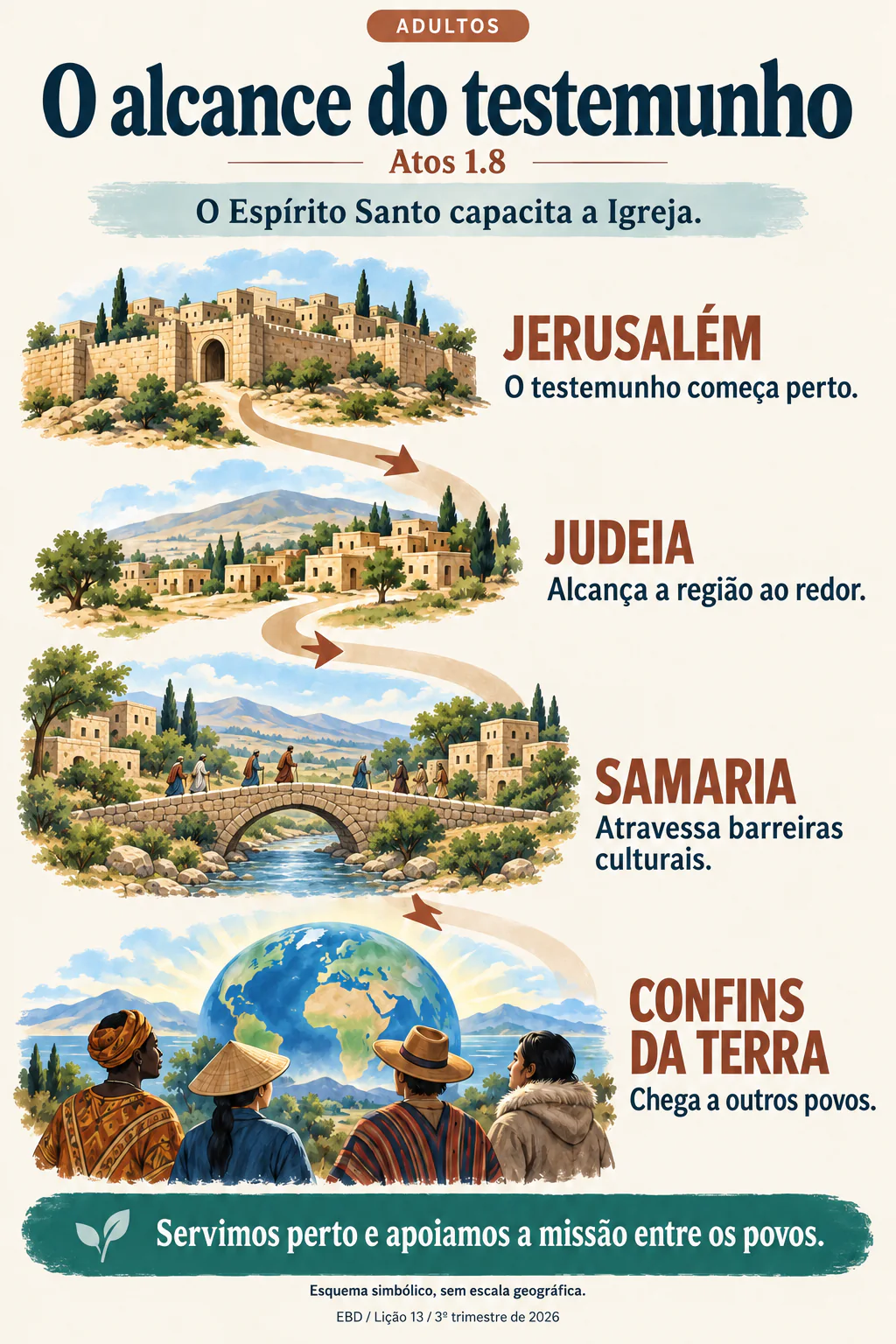
4) Starting in Jerusalem
The quarterly brings an aid that every missionary church needs to hear: the best test of our calling is spiritual zeal for our neighbor right here, where we live; someone who is not a blessing to the people whose language and customs they know will hardly be transformed by a trip. The love that transforms the world begins at home, though it does not end there.
The order of Acts 1:8 begins in Jerusalem for a reason: the mission is concentric, not selective. You do not skip the city to reach the ends of the earth. Someone who does not speak to their neighbor will not speak to the foreigner; they will only change audiences.
And the same aid brings a warning that a Sunday School (EBD) needs to hear with open eyes: there is the danger of occupying ourselves so much with the mysteries of the faith — the Trinity, the incarnation, the atonement — that we forget the Lord Himself and those for whom He died. Contemplation that does not lead to duty "is of no profit". We study in order to serve, not instead of serving.
Part IV — Ephesians 2:13-18: from far to near, from two to one
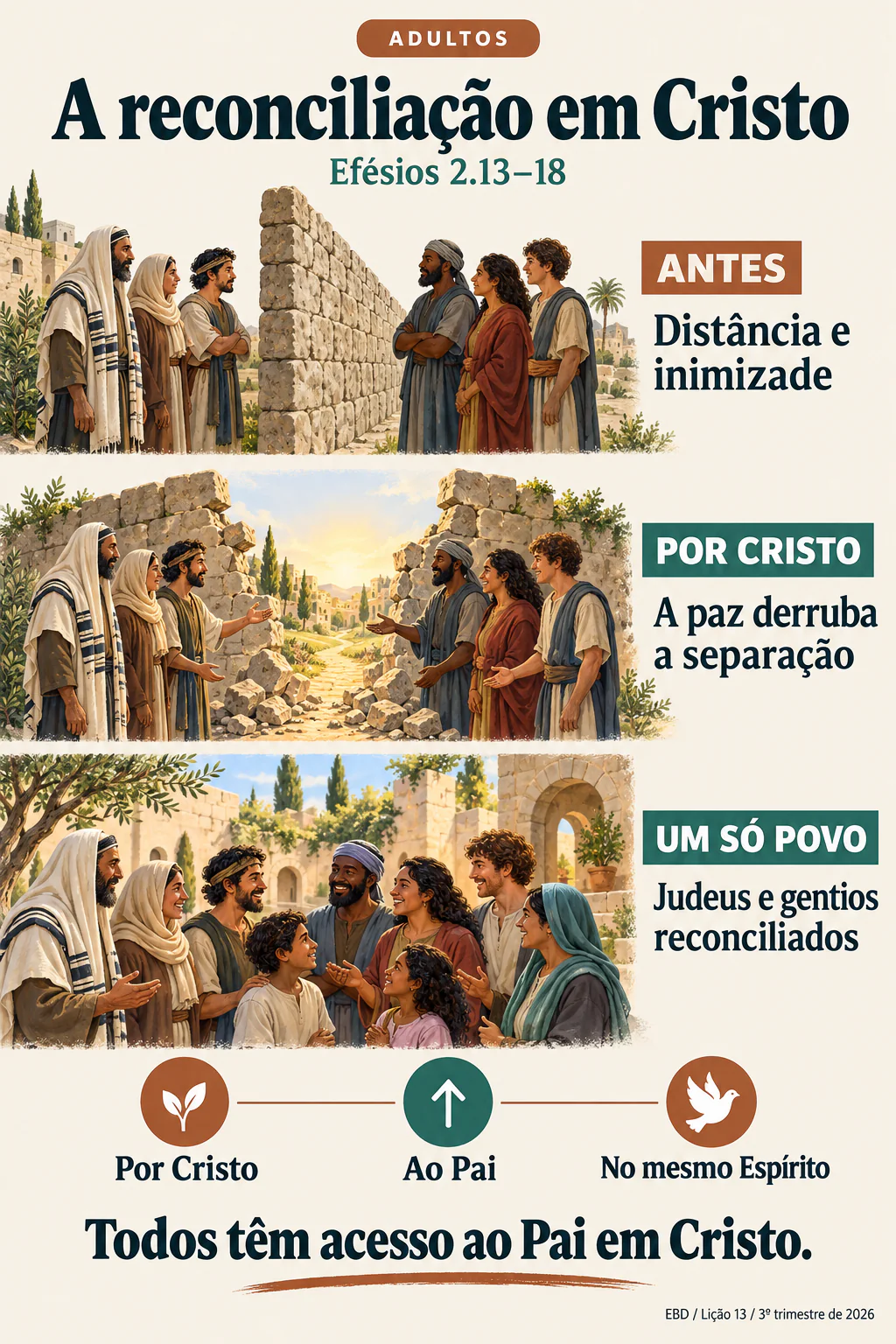
"But now in Christ Jesus ye who sometimes were far off are made nigh by the blood of Christ. For he is our peace, who hath made both one, and hath broken down the middle wall of partition between us;" (Ephesians 2:13-14)
The entire passage moves through pairs of opposites that Christ reconciles: far off and nigh (vv. 13, 17); both peoples and one (v. 14); two and one new man (v. 15); enmity and peace (vv. 14-16); and, at the close, both with access to the Father by one Spirit (v. 18).
And notice who dominates the paragraph: He. He is our peace, He made both one, He broke down the wall, He abolished the enmity, He created the new man, He reconciled, He came and preached peace. The unity of Jews and Gentiles is not a human achievement, not the fruit of dialogue and not well-managed tolerance. It is the work of a Person.
1) Far and near, and the wall
In the Jewish vocabulary of the time, "those who were far off" were the Gentiles and "those who were near", Israel. The distance was not geographical; it was a distance of covenant.
The middle wall of partition is a rare expression. Most commentators see in it an allusion to the balustrade of the temple in Jerusalem, which separated the court of the Gentiles from the inner areas, with inscriptions in Greek and Latin threatening with death any foreigner who crossed it — slabs that archaeology has found, and which today are in museums. And there is a detail that sends a chill down the spine: Paul is writing to Ephesus, and it was because of an Ephesian, Trophimus, that he had been accused of violating that very barrier (Acts 21:29). The wall that almost cost him his life is the wall he announces has been broken down.
Apply this plainly in class: every church builds walls that the text has already demolished. Walls of social class, of schooling, of accent, of length of membership, of traditional family against newcomer. Christ did not remodel the wall or put a little door in it. He broke it down.
2) The verse the reading includes and almost no one explains
"And came and preached peace to you which were afar off, and to them that were nigh." (Ephesians 2:17)
Here is the highest point of the lesson, and it begins with a real problem.
The subject of the sentence is Christ: He came and preached peace to those who were far off — the Gentiles. But when did Jesus do that? In His earthly ministry, He was explicit that He was not sent except to the lost sheep of the house of Israel (Matthew 15:24). He did not preach in Ephesus, in Corinth or in Rome. The Gentiles who were far off never heard the physical voice of Jesus of Nazareth. And yet Paul writes to Gentiles in Ephesus that He came and preached peace to them.
There is only one answer, and it changes the way we look at our own mouth: Christ preached to those who were far off through the mouth of the Church. When Paul walked into Ephesus and opened his mouth, the one preaching the Gospel was Christ.
Scripture confirms this identification in a striking way. Saul was going to Damascus to arrest Christians, and the voice from heaven did not ask why he was persecuting the church — it asked Saul why he was persecuting Him (Acts 9:4). Jesus identifies Himself with His own to the point that touching them is touching Him. And if the identification holds true for pain, it holds true for speech. That is why Paul could write that we are ambassadors for Christ, as though God were pleading through us (2 Corinthians 5:20). Scholars of Ephesians reach the same conclusion when analyzing the verse: Christ preached this message of peace through the apostles.
The missionary, then, is not someone who speaks about Christ from afar. The missionary is the mouth through which Christ continues to arrive.
אב In the Hebrew — Isaiah 57:19 and the verb of Genesis 1 in the preacher's mouth
Paul did not invent the phrase about those who were far off and those who were near. He is quoting Isaiah, almost word for word. And the prophet's full verse says: "I create the fruit of the lips; Peace, peace to him that is far off, and to him that is near, saith the LORD; and I will heal him." (Isaiah 57:19)
The verb translated as "create" is bara' — the exact verb of Genesis 1:1, where in the beginning God created the heaven and the earth. Throughout the entire Old Testament this verb has only one possible subject: God. No human being ever bara' anything; it is the word reserved for creation out of nothing.
The consequence is immense. God declares that He Himself creates the fruit of the lips that proclaims peace to those who are far off and to those who are near. Even the preacher's words are a divine creation. This takes off our shoulders the weight of having to be eloquent — and puts on our shoulders the responsibility of opening our mouth, because the word God would create only exists if someone speaks it.
3) The access
"For through him we both have access by one Spirit unto the Father." (Ephesians 2:18)
The word translated as "access" is rare and came from the world of the royal court: it was the right to be ushered into the presence of a king, the privilege that a courtier granted to someone allowed to approach the throne.
Notice the structure of the verse: through Christ, to the Father, by one Spirit — Trinitarian in form and egalitarian in reach. "Both" have the same right of approach. There is no priority line in the Kingdom, no VIP room, no human intermediary. And the result comes in the next verse: "Now therefore ye are no more strangers and foreigners, but fellowcitizens with the saints, and of the household of God;" (Ephesians 2:19)
Someone who has never set foot in a church has, in Christ, the same access as a believer of forty years in the church. Whoever understands this evangelizes without an air of superiority — because they have discovered that they too entered through the door by grace.
Part V — Mission and the end: the Golden Text read carefully
The Golden Text links the mission to the end: "And the gospel must first be published among all nations." (Mark 13:10) The parallel in Matthew is explicit about the consequence: "And this gospel of the kingdom shall be preached in all the world for a witness unto all nations; and then shall the end come." (Matthew 24:14)
Two cautions, and the teacher needs both.
First: the text does not authorize the idea that the Church "hastens" the return of Christ by its own effort. Many campaigns have been built on top of this confusion, as if missions were a button that forces God's hand. What the two verses affirm is that universal proclamation precedes the end in the divine plan — not that we control the calendar. Missions is not a bargain, not a target and not a quota. No one buys anything from God with a number of souls, and no one leaves a Sunday School class owing something that can only be paid in statistics. We preach out of obedience and out of love for those who have not yet heard.
Second: the "must" is stronger than it looks. The Greek word there is the same one the New Testament uses for divine necessity in the predictions of the passion — that which "had" to happen. Mission belongs to the same order of necessity as the cross. It is not optional for the Church because it was not optional in the plan of God.
And the quarterly insists, rightly, that mission "is not the exclusive task of leaders, but the responsibility of the whole Church" (Romans 10:13-15; 1 Peter 2:9), closing with the exhortation to Timothy to preach the word and be urgent in season and out of season (2 Timothy 4:2). It is worth highlighting that "in season and out of season": in the original, it is "on a favorable and unfavorable occasion" — when there is an opening and when there is not. Mission does not wait for the favorable moment; it creates it.
Two translation notes that help the teacher. In 1 Peter 2:9, translations differ in how they render the clause about proclaiming the praises or excellencies of Him who called us out of darkness into His marvelous light — where the Greek word points to the excellent deeds, the glorious attributes of God, showing that the priesthood of all believers is not only access, but a charge to proclaim — and in Isaiah 52:7, where versions also differ in wording when describing how beautiful upon the mountains are the feet of him who brings good news and publishes peace, using the very same word for peace that Isaiah repeats in chapter 57 and that Paul takes up in Ephesians 2:17, a single thread running from the prophet to the apostle to your Monday conversation.
Part VI — When the church almost decided that the mission did not continue
The title of this lesson is "The Mission Continues in Us". Yet there was a time, and not a short one, when much of the evangelical church read the Great Commission and concluded the opposite.
After the Reformation, it became common among Protestant theologians to understand that the command of Matthew 28 had been given to the apostles and fulfilled by them in their own generation, so that it no longer bound the church. The emphasis fell on reforming the existing church, and cross-cultural missions were, for about two and a half centuries, the work above all of Catholics and of groups such as the Moravians.
It took an English cobbler, William Carey, publishing an entire book in 1792 — an inquiry into the obligations of Christians to use means for the conversion of the heathens — just to prove that the command was still in force. From that book the modern missionary movement was born. The mission almost did not "continue in us".
Keep the lesson of method, because it is larger than the episode: an entire church can read a text with sincerity and get it wrong — and what corrects the error is neither the majority nor tradition, it is returning to what is written. If it happened to that generation, it can happen to ours.
Three other voices, in chronological order:
- John Chrysostom, in his homilies on Matthew, lingers on the phrase about Christ being with them always and observes that Jesus does not promise His presence only to the eleven, but to all who would come after — because the eleven could not live until the end of the world. Already in the fourth century the reading was one of continuity.
- Augustine treats the unity of Jews and Gentiles in Ephesians 2 as the figure of the cornerstone that joins two walls coming from opposite directions. Christ is the cornerstone where the two walls meet.
- John Wesley, in a letter of 1739, when pulpits were being denied to him, wrote the sentence that has crossed the centuries: I look upon all the world as my parish. It is the Wesleyan answer to the restrictive reading of the Commission — and it is a direct heritage of our theological family.
And Pentecostalism was born missionary. From the Azusa Street revival in 1906, missionaries went out to dozens of countries within a few years, and it was from that impulse that two Swedes, Daniel Berg and Gunnar Vingren, arrived in Belém do Pará in 1910 and founded the Assemblies of God in Brazil the following year. Our own church is the fruit of someone who understood Acts 1:8 as a standing order. You are sitting in this class because the mission continued in someone.
Note on method: reading the ancients, the Reformers and the fathers of our movement is not an appeal to human authority. Scripture governs; interpreters help.
Part VII — Common interpretive mistakes
- "The main command is 'go'." Grammar shows that the only imperative is to make disciples; going, baptizing and teaching are participles. The emphasis is not on relocating, but on forming followers of Christ wherever one is. This does not diminish cross-cultural missions; it corrects the idea that someone who does not travel does not fulfill the Commission.
- "The Great Commission was given only to the apostles and has already been fulfilled." That was the reading of much of Protestant theology for about two and a half centuries. But the promise that accompanies the command reaches to the end of the world — a timeframe that goes beyond the apostolic generation — and the Church is sent as the Father sent the Son (John 20:21). The command remains.
- "The Trinitarian formula of Matthew 28:19 was added later." All Greek manuscripts and all ancient versions contain the formula, and the Didache already uses it around the end of the first century. Eusebius's abbreviated quotations are an author's summary, not a textual variant.
- "Someone who doubts cannot serve." The group commissioned on the mountain included people who doubted (Matthew 28:17), and Christ drew near to them and commissioned them. Doubt is a weakness, not a virtue — but it is not a criterion of exclusion. Certainty came along the way, with the Spirit.
- "Power and authority are the same thing." Matthew 28:18 speaks of authority (exousia, the right to act); Acts 1:8 speaks of power (dynamis, the ability to act). Confusing the two produces two defects: someone who exercises authority without the power of the Spirit becomes authoritarian; someone who seeks power without submission to the authority of Christ becomes a fanatic.
- "Mission is for those who have the gift of evangelism." Ephesians 2:17 says that Christ preached peace to those who were far off — through the mouth of the whole Church, not of specialists. And Isaiah 57:19 affirms that God creates the fruit of the lips of the one who proclaims peace. The qualification was never talent; it was availability.
- "The Church hastens the return of Christ by preaching more." Mark 13:10 and Matthew 24:14 affirm that universal proclamation precedes the end in the plan of God — not that the Church controls the divine calendar. We preach out of obedience and love, not to manipulate the eschatological clock.
- "If I do not evangelize, that person's blood is on my hands, so I live in debt." Be careful with this shortcut. Scripture demands faithfulness, not results: no one saves anyone, and conversion is the work of the Spirit upon a person who responds. The urgency of mission is motivated by love and obedience — when it turns into chronic guilt, it produces an exhausted believer and aggressive evangelism, and neither of the two is in the text.
Christ in the Lesson — what was left for the Church to do
Add up everything the three texts say about the mission and see what remains for us.
The authority belongs to Christ — all power in heaven and in earth is given to Him. The power belongs to the Spirit — they would receive power when the Holy Spirit came upon them. The voice belongs to Christ — He preached peace to those who were far off, through the mouth of the Church. Even the preacher's words are a divine creation — God creates the fruit of the lips. Certainty was not a requirement — some doubted. The team was incomplete — there were eleven. The place was peripheral — a mountain in Galilee.
What those people contributed was one thing alone: they went to the mountain He had appointed.
The only human contribution to the greatest mission in history was availability. That is precisely why no one is excused from it — and precisely why no one needs to think themselves great in order to serve. And the Christ who commissioned hesitant people is the same One who promised to stay with them always: the mission does not depend on the size of the one who goes, because the one who goes never goes alone.
The arc of the quarter — the thirteen lessons of "The Church of the Gentiles"
This final lesson closes a journey. It is worth setting all thirteen side by side so the class can see the whole design: grace went out from the center, crossed the world and reached us here.
| Lesson | Text | What grace did |
|---|---|---|
| 1 | Acts 13 | Crossed the border: Antioch sends Barnabas and Saul |
| 2 | Acts 14 | Opened the door of faith to the Gentiles |
| 3 | Acts 15 | Refused amendments: the council and salvation by grace alone |
| 4 | Acts 16 | Guided beyond borders: Philippi, Europe |
| 5 | Acts 17 | Confronted the philosophers in Athens |
| 6 | Acts 18 | Was sufficient in Corinth |
| 7 | Acts 19 | Caught fire in Ephesus |
| 8 | Acts 20 | Said farewell in Miletus: purchased, heirs, offering |
| 9 | Acts 21–22 | Was arrested in Jerusalem: the testimony postponed and published |
| 10 | Acts 24 | Was tried in Caesarea: the prisoner was the only free man |
| 11 | Acts 27 | Was shipwrecked: the promise was certain and the means were not optional |
| 12 | Acts 28 | Arrived in Rome: with no hindrance at all |
| 13 | Matthew 28; Acts 1; Ephesians 2 | Continues in us: the command given to a group that still doubted |
Application — four points for the life of the class
1. Christ commissions those who still doubt. Certainty did not come before obedience; it came along the way. Whoever waits for doubt to end before serving will die waiting. Faith was never the absence of questions — it is the decision to obey with them in your backpack. To reflect: what would you stop putting off today if you knew that God does not require absolute certainty in order to use someone?
2. Neither the authority nor the power is yours. "I am not worthy" — the authority is His. "I am not capable" — the power is the Spirit's. Notice that neither of the two excuses speaks about the lost person; both speak about you. To reflect: which of the two is yours, and how long have you been hiding behind it?
3. Draw near to those who doubt. Before a group with doubts, Jesus came closer, and Matthew did not even name who hesitated. We do the opposite: we label, whisper, expose. There is someone faltering in your class or inside your home who needs you to draw near, not pull back. To reflect: from whom did you pull away right when that person most needed you to come close?
4. When you speak, He speaks. If Christ preached the Gospel to those who were far off through the mouth of the Church, your conversation at the gate and your voice message to a relative are the continuation of His coming — and the very words are created by God. That gives courage, because it does not depend on your talent. And it gives responsibility, because when you keep silent, someone who was far off does not hear the voice that was already on its way. To reflect: who, on your street or in your family, is still "far off" — and how long have they been waiting for the voice of Christ to arrive through your mouth?
And, at the end of it all, the prophet's question remains in the air, just as it was: whom the Lord shall send, and who will go for us (Isaiah 6:8). The answer is yours.
Closing Prayer
Lord, You who went up to the appointed mountain and found there an incomplete group, with an empty place and with people who still doubted, thank You for not waiting until we were ready. If You had waited, no one here would have been called.
Forgive us for the two excuses, Father. For the one that says "I am not worthy", when the authority has always been Yours. And for the one that says "I am not able", when the power has always been Your Spirit's. Take from our mouths the words that speak only of ourselves, and put in them the name of Your Son.
Teach us, Lord, to come close to those who falter. You drew near to those who doubted instead of drawing away from them; give us that same movement inside our homes, inside the class and inside the church. And keep us from turning Your command into pressure, into numbers or into a bargain: we do not want to buy anything from You, we want to obey You out of love for those who have not yet heard.
Open our mouths where we live, Father. On our streets, at our work, in our own family. You promised to create the fruit of the lips of those who proclaim peace — so create that word in us, because on our own we have none worth anything.
And thank You, Lord, for everyone who did not stop. For those who crossed the sea, for those who came to this land, for those who walked into our homes with a Bible under their arm when we were still far off. The mission continued in them, and that is why we exist. May it not stop now. You promised to be with us always, even to the end of the world — and that is the only reason we dare to go. In the name of Jesus, to whom all power in heaven and on earth has been given. Amen.
Soli Deo Gloria — Scripture governs; everything else, on its knees.
Frequently asked questions about this lesson
Was the Great Commission given only to the apostles and already fulfilled by them?+
No, and Jesus' own statement closes that door. The command comes attached to a promise with a time frame: "Teaching them to observe all things whatsoever I have commanded you: and, lo, I am with you alway, even unto the end of the world. Amen." (Matthew 28:20). None of the eleven lived until the end of anything — therefore, the promise extends beyond that generation, and so does the command that accompanies it. Add to this the way the Church is sent: "Then said Jesus to them again, Peace be unto you: as my Father hath sent me, even so send I you." (John 20:21). It is worth the teacher knowing that this restrictive reading is not an internet invention: for about two and a half centuries after the Reformation, much of Protestant theology understood it in exactly this way — that Matthew 28 bound the apostles and no one else. It took an English cobbler, William Carey, publishing an entire book in 1792 arguing the opposite for the modern missionary movement to begin. The mission almost did not continue in us. That is worth remembering before treating the command as a settled matter.
If the Commission applies to every believer, then is someone who cannot travel failing God?+
No, they are not. Notice the Greek phrasing behind the translation: there is a single command verb in Matthew 28:19-20 — to make disciples — and three auxiliary verbs surrounding it: going, baptizing, teaching. The center of the command is not physical travel; it is forming followers of Christ. The going describes the circumstance: as you go, wherever you go, along the path where life already takes you. This does not diminish cross-cultural missions in the slightest — the quarterly is right to insist that the Church must support, send, and go, and these are three places in the same work, not three categories of holiness. What needs correcting is the idea that those who stay do not fulfill the Commission. A bedridden person who speaks of Christ to whoever enters the room is making disciples. And it is worth stating the opposite as well, because it is the most common temptation: claiming to evangelize by example alone is usually an excuse to never open one's mouth. Making disciples includes teaching, and teaching requires words.
Matthew 28:17 says that some doubted. Can someone who has doubts serve God?+
Yes — and that is precisely what the text records. "And when they saw him, they worshipped him: but some doubted." (Matthew 28:17). Worship and doubt in the same sentence, in the same group, at the same instant. And the following verse says that Jesus came near and spoke to them (Matthew 28:18): in the face of hesitation, He drew closer. The word Matthew uses for doubting appears only one other time in the entire Gospel, when Peter sinks in the sea and hears: "And immediately Jesus stretched forth his hand, and caught him, and said unto him, O thou of little faith, wherefore didst thou doubt?" (Matthew 14:31). Both times, Christ's reaction to doubt was to come closer — on the sea, stretching out His hand; on the mountain, drawing near. Now, be careful with the next step, because that is where many people slip: the text neither praises doubt nor turns it into a virtue. It is recorded as weakness, not maturity. What is taught here is that Christ does not use doubt as a criterion for exclusion — He calls hesitant people and then strengthens them. Anyone who makes their own doubt a banner stopped at verse 17 and never reached verse 18.
What is the difference between the power in Matthew 28:18 and the power in Acts 1:8?+
They are two different words in the original, and confusing them causes damage. In Matthew 28:18 — "And Jesus came and spake unto them, saying, All power is given unto me in heaven and in earth." (Matthew 28:18) — the word is exousia: authority, the legitimate right to act and to command. It is the vocabulary of a judge and a ruler, not of brute force. In Acts 1:8 — "But ye shall receive power, after that the Holy Ghost is come upon you: and ye shall be witnesses unto me both in Jerusalem, and in all Judæa, and in Samaria, and unto the uttermost part of the earth." (Acts 1:8) — the word is dynamis: capability, strength to accomplish; from it come "dynamo" and "dynamic." The difference is simple to illustrate: a traffic officer has the authority to stop a truck with a raised hand, and no strength to stop it with his arms; a very strong man has the strength to push the truck, and no authority to order it to stop. Christ has both. And notice the detail that settles the life of the timid believer: the Church receives both from outside itself. The authority belongs to Christ, the power belongs to the Spirit. When the two are confused, the two flaws we know so well appear: whoever exercises authority without the power of the Spirit becomes authoritarian, and whoever seeks power without submission to the authority of Christ becomes a fanatic.
Ephesians 2:17 says that Christ preached peace to those who were far off. When did He preach to the Gentiles?+
That is the most interesting question in the lesson, and it has an answer. In His earthly ministry, Jesus was explicit: "But he answered and said, I am not sent but unto the lost sheep of the house of Israel." (Matthew 15:24). He did not preach in Ephesus, in Corinth, or in Rome; the Gentiles who were far off never heard the physical voice of Jesus of Nazareth. And yet Paul writes to Gentiles in Ephesus that He came and preached peace to them (Ephesians 2:17). There is only one explanation, and it is glorious: Christ preached to those who were far off through the mouth of the Church. When Paul entered Ephesus and opened his mouth, the one evangelizing was Christ. Scripture confirms this identification in a way that sends chills down the spine: Saul was going to Damascus to arrest Christians, and the voice from heaven did not ask why he was persecuting His church — it asked: "And he fell to the earth, and heard a voice saying unto him, Saul, Saul, why persecutest thou me?" (Acts 9:4). If Jesus identifies with His own to the point that their pain is His pain, their speech is also His speech. That is why Paul could write: "Now then we are ambassadors for Christ, as though God did beseech you by us: we pray you in Christ’s stead, be ye reconciled to God." (2 Corinthians 5:20). The missionary is not someone who speaks about Christ from afar; they are the mouth through which Christ continues to arrive.
Does Mark 13:10 mean that the Church hastens Jesus' return if it preaches more?+
No. The Golden Text says: "And the gospel must first be published among all nations." (Mark 13:10), and the parallel in Matthew adds: "And this gospel of the kingdom shall be preached in all the world for a witness unto all nations; and then shall the end come." (Matthew 24:14). Both affirm that universal proclamation comes before the end in God's plan. Neither says that the Church controls the clock, and it is important to state this plainly, because many campaigns have been preached on top of this confusion — as if missions were a button we press to force God's hand. It is not. Missions is not a bargain, not a target, and not a quota. We preach out of obedience and out of love for those who have not yet heard, not to move the calendar forward. One observation helps us feel the weight of the verse: the word for "must" in Mark 13:10 is the same word of necessity that the New Testament uses when it says that the Son of Man had to suffer. The mission belongs to the same order of necessity as the cross. It is not optional for the Church because it was not optional in God's plan.
Teacher's Guide
Essence of the class
Christ handed the mission to the world to an incomplete group in which some still doubted — because the authority is His, the power is the Spirit's and the only thing He asked of us was to be available.
Map of the class
| Time | Stage |
|---|---|
| 0–5 min | Opening (the hook: the verse no one reads) |
| 5–16 min | Point 1 — The group that was commissioned (Matthew 28:16-18) |
| 16–26 min | Point 2 — One imperative and one promise (Matthew 28:19, 20) |
| 26–33 min | Point 3 — The power and the map (Acts 1:8) |
| 33–39 min | Point 4 — When you speak, He speaks (Ephesians 2:13-18) |
| 39–42 min | Class activity — the name and the excuse |
| 42–45 min | Wrap-up + challenge of the week + prayer |
Start like this
Ask everyone to open to Matthew 28 and read in silence from verse 16 to 20 — one verse further back than the Scripture reading in class assigns. Then ask:
"There is a verse in there that we never read from the pulpit. Did anyone find which one it is?"
Let them look. Someone will get to verse 17. Then read aloud, slowly: "And when they saw him, they worshipped him: but some doubted." (Matthew 28:17) And ask: "That is the group that received the order to evangelize the world. If Jesus only commissioned people without doubt, how many of us would be here today?"
Wait. Silence will come first, then one or two smiles from those who recognized themselves. Quite likely someone will say "I still have doubts to this day" or "I thought doubt was a sin". Hold on to those answers — the whole class answers them.
Point 1 — The group that was commissioned (Matthew 28:16-18)
- In the quarterly: topic I ("The universal mandate of Jesus"), sub-item 1 — the authority of Christ over all nations.
- What to teach: begin with the two verses that are left out of the reading. The eleven — Matthew counts them, and by counting reminds us of the empty chair: the team was incomplete. They worshiped Him, though some doubted — worship and doubt in the same sentence, and Matthew does not give away anyone's name. Show what Jesus does next: coming near. He drew close. Say that the Greek word for "doubt" appears only one other time in the Gospel, when Peter sinks in the sea and is asked why he doubted (Matthew 14:31) — and that both times Christ answered by coming close. Then go to verse 18 and explain that power there is authority: the legitimate right to act, not brute force. And notice the verb: that all authority has been given to Him. Not even He claims an authority of His own on that mountain; He received it from the Father. Close by showing the origin: Daniel's vision, in which one like the Son of Man was given dominion, honor and a kingdom, so that all peoples, nations and languages should serve Him (Daniel 7:14). Beware of a common slip: do not turn doubt into a virtud or badge of honor. It is a weakness recorded with honesty, not a criterion for exclusion.
- Anchor verse (KJV): "And when they saw him, they worshipped him: but some doubted." (Matthew 28:17)
- Key question: "What changes in your reading of the Great Commission when you discover that some of those commissioned still doubted?"
- Likely answers (+ going deeper): "it brings relief", "I thought I had to be one hundred percent", "so God uses people who are halfway there". Go deeper: "and what have you been putting off because of that requirement God never made?"
- If no one speaks: first share a doubt of your own — without drama and without heavy confession — and hand the question back. If still no one speaks, read v. 17 and v. 18 right together and ask only: "notice what He does right after the text says that some doubted."
Point 2 — One imperative and one promise (Matthew 28:19, 20)
- In the quarterly: topic I, sub-items 2 and 3 — the order to make disciples among all ethnic groups and the promise of Christ's presence until the end.
- What to teach: show the grammar, because it settles the class. There is only one command verb in the sentence — "make disciples" — and three auxiliary participles around it: going, baptizing, teaching. In other words: the center is not traveling; it is forming followers of Christ. State the two corrections this makes, in both directions: whoever does not travel is not outside the Commission, and whoever says "I evangelize by my example" is not fulfilling it, because teaching requires words. Explain all nations: the Greek word means ethnic group, people, and echoes the promise to Abraham — that in him all the families of the earth would be blessed (Genesis 12:3). Then go to the final promise and show that it frames the whole Gospel: God with us in the manger (Matthew 1:23), Christ in their midst in the gathered church (Matthew 18:20) and Christ with us always in the church sent out (Matthew 28:20). Close by saying that between the first end and the last there is a cross: that "with us" was bought. If a student notices that different Bible translations render the command in verse 19 as either teaching all nations or making disciples of all nations, explain in ten seconds: the Greek verb literally means "to make a disciple", and there is no difference in doctrine — and move on.
- Anchor verse (KJV): "Teaching them to observe all things whatsoever I have commanded you: and, lo, I am with you alway, even unto the end of the world. Amen." (Matthew 28:20)
- Key question: "If the commandment is 'make disciples' and not 'travel', what does that change in your week starting tomorrow?"
- Likely answers (+ going deeper): "I can start at home", "my children", "the people at work". Go deeper: "and what is the difference between leading someone to a decision and making a disciple? What comes after the 'yes'?"
- If no one speaks: write the four words on the board (go / make disciples / baptizing / teaching), circle "make disciples" and ask: "which of these is the command and which are the manner?"
Point 3 — The power and the map (Acts 1:8)
- In the quarterly: topic II ("The power of the Holy Spirit in the mission"), sub-items 1 and 2 — the empowering of the Spirit to witness and the geographical and spiritual expansion of the Gospel; plus the aid "The Holy Spirit and the glory of the exalted Christ", right after the topic.
- What to teach: start with the distinction that changes everything. In Matthew 28 the word is authority — the right to act. In Acts 1:8 it is power — the ability to act. Use the traffic officer illustration: he has the authority to stop a truck with a raised hand and no strength to stop it; the strong man has strength and no authority. Christ has both, and the Church receives both from outside. Now deliver the application, slowly, because this is where the class breathes: "I am not worthy" — the authority is His; "I am not able" — the power is the Spirit's. The two excuses that most silence the believer's mouth were answered before the order was given. Teach the baptism in the Holy Spirit as our church believes it — an experience distinct from and subsequent to conversion, with the initial evidence of speaking in other tongues (Acts 2:4; 10:46; 19:6) — and stress the purpose stated in the verse itself: power to bear witness. Say also what it is not: it is neither a trophy of spirituality nor a pass into a superior caste; it was promised to men who days earlier had fled. Close with the map: Jerusalem, Judea and Samaria, the ends of the earth — which is the table of contents of the book of Acts. And show the uncomfortable column: at almost every stage the church was pushed (the persecution, Peter's vision, the sending by the Spirit in Antioch), rarely going by its own initiative. Tie it together with the quarterly's aid on starting in Jerusalem: the best test of missionary calling is zeal for the neighbor whose language you already speak.
- Anchor verse (KJV): "But ye shall receive power, after that the Holy Ghost is come upon you: and ye shall be witnesses unto me both in Jerusalem, and in all Judæa, and in Samaria, and unto the uttermost part of the earth." (Acts 1:8)
- Key question: "Which of the two excuses is yours — 'I am not worthy' or 'I am not able' — and how long have you been hiding behind it?"
- Likely answers (+ going deeper): "I don't know how to explain the Bible", "my past", "I feel ashamed", "I don't know how to answer if they ask me". Go deeper: "notice that none of those sentences speaks about the person who is far off. They all speak about you. What would happen if the conversation started with what Christ did, and not with what you know?"
- If no one speaks: ask the question without asking for an answer out loud — "you don't need to say it, just answer inwardly" — and then read Acts 1:8 again, stopping at the promise that they shall receive power.
Point 4 — When you speak, He speaks (Ephesians 2:13-18)
- In the quarterly: topic III, sub-item 1 ("The inclusion of the Gentiles in the Body of Christ"), and the closing of the topic on the Church's commitment to local and cross-cultural missions.
- What to teach: show first the movement of the text — far off and near, two and one, enmity and peace — and who is the subject of everything: He. He is our peace, He made both one, He broke down the wall. Explain the dividing wall of separation: most commentators see there the temple balustrade that barred the Gentiles, with inscriptions threatening death to anyone who passed — plaques that archaeology has found. Tell the class that every church builds walls that the text has already demolished: of schooling, of social class, of length of membership. Then go to verse 17 and ask the hard question out loud: "When did Jesus preach to the Gentiles?" Show Matthew 15:24 — He said He was not sent except to the lost sheep of Israel — and let the problem hang in the air for a few seconds. The answer: Christ evangelized those who were far off through the mouth of the Church. Confirm with Acts 9:4 (the voice did not ask why Saul was persecuting the church, it asked why he was persecuting Jesus) and with 2 Corinthians 5:20 (ambassadors for Christ, as though God were pleading through us). Close with Isaiah 57:19, which Paul is quoting — where God declares that He creates the fruit of the lips — using the same verb as Genesis 1:1, the verb that has only God as its subject. Even the preacher's words are God's creation. That takes off the student's shoulders the weight of having to be eloquent and places on him or her the responsibility of opening the mouth.
- Anchor verse (KJV): "And came and preached peace to you which were afar off, and to them that were nigh." (Ephesians 2:17)
- Key question: "If Christ keeps reaching people through the mouth of the Church, who is waiting for your mouth this week?"
- Likely answers (+ going deeper): "my brother", "a coworker", "my father", "that neighbor". Go deeper: "and what exactly has kept you from speaking? Lack of opportunity or lack of courage? Those two things are solved in different ways."
- If no one speaks: mention a generic real-life example — "that relative the whole family has already given up inviting" — and ask whether anyone has one of those.
Class activity
- Goal: to have each student leave the class with one name — a concrete person who is "far off" — and with the excuse that has kept him or her silent identified in writing.
- Materials: a small piece of paper and a pen for each student. That is all.
- Step by step: write the two sentences on the board, one below the other: "I AM NOT WORTHY" and "I AM NOT ABLE". Beside the first write "the authority is His (Matthew 28:18)"; beside the second, "the power is the Spirit's (Acts 1:8)". Then hand out the paper and ask each person to write two things, for themselves alone: on the first line, the first name of a person who is still far from Christ; on the second, which of the two sentences on the board is the one that usually silences them. No one reads aloud, no one shows anyone and no one is called on to speak — the paper belongs to the student. Ask them to keep it inside their Bible until next Sunday.
- Wrap-up (back to the text): "Look at the board. The two sentences up there are the two most-used excuses in the church, and both were answered before the order was given: the authority is His and the power is the Spirit's. Only one thing was left for us, and it is the same thing those eleven did: go to the appointed mountain. The name on your paper is your mountain this week."
If they ask you this
Question: "Wasn't the Great Commission given only to the apostles, and already fulfilled by them?" Short answer: No, and Jesus' own sentence closes that door: the order comes joined to the promise that He is with them always, even to the end of the world (Matthew 28:20). None of the eleven lived until the end of the world — the promise goes beyond that generation, and so does the command that accompanies it. Add John 20:21: the Church is sent as the Son was sent. And share the historical fact, because it strikes the class: for about two and a half centuries after the Reformation, much of Protestant theology read it that exact way, as if the order had already been fulfilled. It took William Carey publishing an entire book in 1792 to prove that it still stood — and from that book the modern missionary movement was born. The mission almost did not continue in us.
Question: "I have no way to leave my neighborhood. Am I failing God?" Short answer: No. The only command verb in the sentence is "make disciples"; going, baptizing and teaching are auxiliary participles. The center of the order is to form followers of Christ, and the going describes the circumstance — as you go, wherever life already takes you. That does not diminish cross-cultural missions in the least: the quarterly is right to say that we take part by supporting, sending and going, and those are three places in the same work, not three levels of holiness. But say the opposite as well, because it is the most common excuse in the church: "I evangelize by my example" usually means "I have never opened my mouth". Making disciples includes teaching, and teaching requires words.
Question: "How could Jesus have evangelized Gentiles who never heard His voice?" Short answer: Through the mouth of the Church. He Himself said that He was not sent except to the lost sheep of the house of Israel (Matthew 15:24), and He never preached in Ephesus, Corinth or Rome. Even so, Paul writes to Gentiles in Ephesus that He came and preached peace to them (Ephesians 2:17). The identification between Christ and His own is total: the voice from heaven did not ask Saul why he was persecuting the church, it asked why he was persecuting Him (Acts 9:4). If that holds for pain, it holds for speech. That is why we are ambassadors for Christ, as though God were pleading through us (2 Corinthians 5:20). When the believer opens his or her mouth, the one arriving is Christ.
Question: "If the Gospel has to be preached to all nations before the end, can the Church hasten Jesus' return?" Short answer: No. Mark 13:10 and Matthew 24:14 say that universal proclamation precedes the end in God's plan — not that we control the clock. Say this in plain words, because many campaigns have been built on that confusion, as if missions were a button that forces God's hand. Missions is not a bargain, not a target and not a quota. We preach out of obedience and out of love for those who have not yet heard. And add the other side: we do not live in blood-debt either. God requires faithfulness, not results — no one saves anyone, conversion is the work of the Spirit upon a person who responds. Urgency driven by love produces a witness; urgency driven by guilt produces an exhausted believer.
Question: "I heard in a video that the formula 'in the name of the Father, and of the Son, and of the Holy Spirit' was added later. Is that true?" Short answer: It is not true. Every Greek manuscript of Matthew, without exception, and every ancient version carries the Trinitarian formula; no known manuscript has the short form. The argument comes from the abbreviated quotations of Eusebius in the fourth century — but he was writing from memory and summarizing, and an author's summary is not a manuscript variant. Moreover, the Didache, a Christian manual from the end of the first century, already commands baptizing "in the name of the Father and of the Son and of the Holy Spirit", which means the formula was already in use before any surviving manuscript of Matthew.
Question: "I still have doubts of faith to this day. Can I bear witness even so?" Short answer: Yes — and verse 17 is in the Bible for you. The group that received the order had people divided inside, and Jesus' reaction was to come closer. But handle both sides with care: doubt is neither a virtue nor an identity. The text records it as a weakness and shows Christ strengthening those who doubted, not praising hesitation. The way forward is to obey with the question in hand, seek the answer in the Word and not wait for total certainty, which never comes. And if someone's doubt in class is too heavy for a five-minute answer, do not try to settle it right there: thank them for their trust, say "let's talk after class" and seek the church leadership together with the person. No one needs to be exposed in order to be helped.
Wrap-up + challenge of the week
- Wrap-up: "Add up everything we saw today and see what was left for us. The authority is Christ's — all authority has been given to Him (Matthew 28:18). The power is the Spirit's — we receive power when the Holy Spirit comes upon us (Acts 1:8). The voice is Christ's — He preached peace to those who were far off, through our mouths. Even the words are God's creation — He creates the fruit of the lips (Isaiah 57:19). Certainty was not a requirement — some doubted. The team was incomplete — there were eleven. The place was on the periphery — a mountain in Galilee. What those people did was one thing only: they went to the appointed mountain. And it was enough, because the One who sent them had bought that right on the cross and promised to go with them every day. You are here today because that mission continued in someone: someone crossed the sea, someone walked onto your street, someone sat beside you with a Bible. Now the title of the lesson becomes a question: does the mission continue in us?"
- Challenge: this week, look for one person who is still far from Christ — the name you wrote on the paper — and tell that person, out loud, one thing Jesus has done for you. One true sentence of your own, without a sermon and without an argument. It can be at the gate, at lunch, in the hallway at work, by phone or by voice message. Choose precisely that person you have been putting off the longest because you do not feel worthy or able. On Sunday, come back with the story.
Teacher's kit
- Before: read Matthew 28:16-20, Acts 1:8 and Ephesians 2:11-19 aloud, all three at once, to feel how command, means and result fit together. Mark in your Bible Matthew 28:17 and Matthew 14:31 (the two occurrences of "doubt"), Matthew 4:8, 9 (the other mountain), Daniel 7:13, 14 (the origin of the authority) and Isaiah 57:19 (the verb "create"). Check also Matthew 15:24 and Acts 9:4, which are the two pieces of the hard question in Point 4. And reread the quarterly's aid on starting in Jerusalem — it is the antidote against the class turning into a romanticism of distant missions.
- Bring: a Bible, a board or poster paper to write the two excuses, and small sheets of paper with pens for the class.
- Pray beforehand: pray to God for the student who arrives convinced that he or she is not fit to speak of Christ — the one ashamed of the past, the one who does not know how to explain the Bible, the one who already tried and was poorly received inside his or her own family. Ask for wisdom to teach the doubt of verse 17 with balance, without turning it into a virtue and without crushing the one who doubts. And pray for yourself: that the class does not end in admiration for the apostles, but in a name written on a piece of paper inside each person's Bible.
Homework
Your mission for the week
Look for one person who is still far from Christ and tell that person, out loud, one thing Jesus has done for you. One true sentence of your own, without a sermon and without an argument. It can be at the gate, at lunch, in the hallway at work, by phone or by voice message — however it fits into your week. And choose precisely that person you have been putting off the longest because you do not feel worthy or able.
Why
Because the two excuses that most silence the believer's mouth were answered before the order was given. "I am not worthy": the authority is Christ's — all power in heaven and on earth has been given to Him (Matthew 28:18). "I am not able": the power is the Spirit's — you shall receive power when the Holy Spirit comes upon you (Acts 1:8). And the words are not yours either: God declared that He creates the fruit of the lips, proclaiming peace to him who is far off (Isaiah 57:19). Only one thing was left for us — to be available. The eleven went up the mountain with an incomplete team and with doubt in the middle of the group, and that is what Christ called sufficient. This is not a target, not a quota and not a debt: no one is going to demand numbers from anyone. It is simply your turn to be the mouth through which He arrives.
How to know you did it
There is a name and there was a sentence spoken out loud. If you can say "on Tuesday I spoke with so-and-so and told what Jesus did for me", you did it. If the answer is "I thought about that person all week" or "I prayed for them", not yet — praying is wonderful, and it is not this week's assignment. The length of the conversation does not count, whether the person agreed does not count and whether you did well does not count. What counts is that your mouth was opened and the name of Jesus was spoken.
On Sunday, come back with the story
The next class begins with those who spoke. Bring what you said and what happened next — without exposing anyone and without telling what belongs to someone else's private life. If it went badly, bring that too: that story teaches as much as the other. Do not stay out.