Golden Text
“But Jesus said, “Let the little children come to Me, and do not hinder them! For the kingdom of heaven belongs to such as these.”” (Matthew 19:14, BSB) · Read in the Bible
Baby Timothy had a grandma named Lois and a mommy named Eunice, and both of them opened the Bible for him from when he was very little. When he grew up, Timothy became a companion of the apostle Paul — and the faith he had began on a lap at home. The lesson closes the quarterly with a single truth in the little one's hand: Jesus takes care of my family. And the Golden Text tells why this matters: Jesus calls the little children close to Him.
This week's Nursery lesson fits into a single object: the Bible in the baby's hand. Not the Bible kept on the shelf, nor the Bible that only adults touch — the soft, wide, washable Bible that the little one grabs, squeezes, turns upside down, and brings to their face. That is the gesture the child takes home.
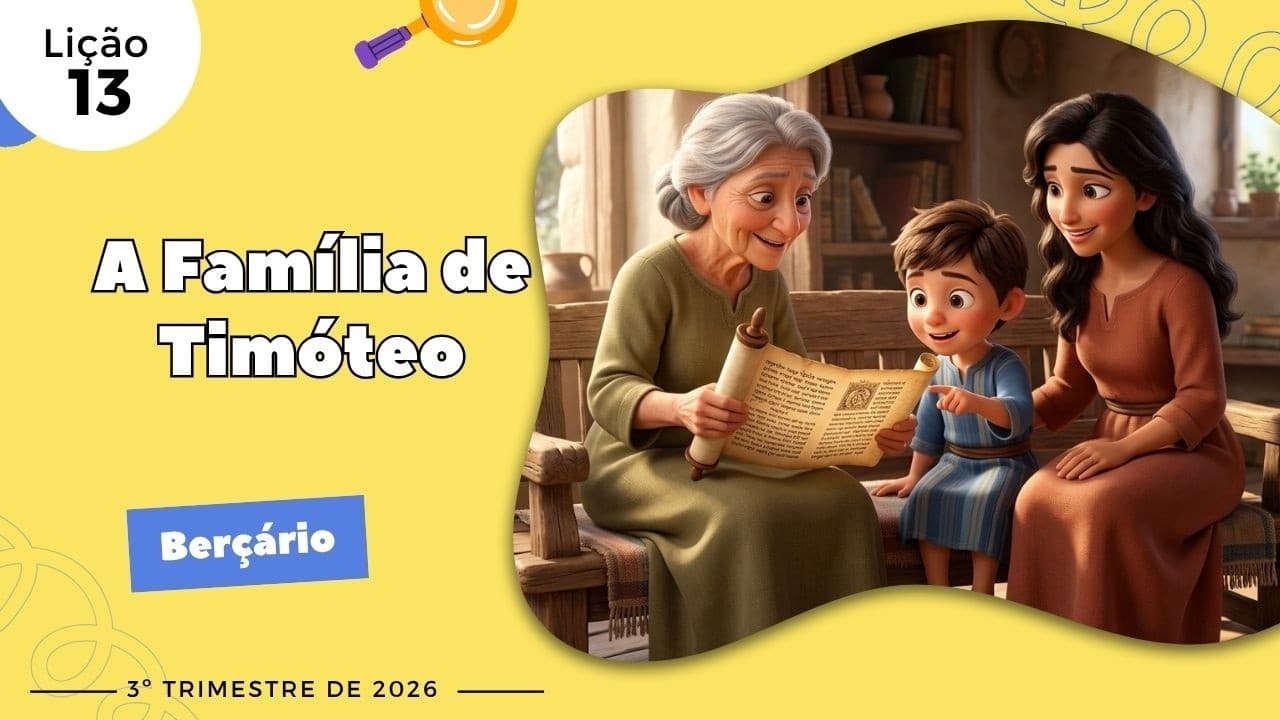
The story is very short and is found in two letters from the apostle Paul. There was a baby named Timothy. He had a grandma named Lois and a mommy named Eunice, and both of them loved the Heavenly Father. From the time Timothy was very tiny, they opened the Bible and told him what was written there. Timothy grew up, believed in Jesus, and became a traveling companion of the apostle Paul — and the faith he had did not start in a school: it started on a lap at home.
From there comes the sentence of the lesson, kept short on purpose: "Jesus takes care of my family."
And from there also comes the word of the day, which the little class will hear spoken syllable by syllable many times: "Bi-ble."
One heads-up before you begin. Timothy's father was Greek and was not a believer (Acts 16:1) — that is true and matters a great deal when talking with parents, but it does not enter the nursery circle and never, under any circumstances, becomes a comparison among the families in the room. Nor do we turn sincere faith into pressure: babies are not evaluated. A child from 0 to 2 years old hears this and only this: Grandma Lois and Mommy Eunice opened the Bible for baby Timothy, and Jesus takes care of my family. And remember that a small child does not sit through a lecture — they alternate: five to ten minutes per activity.
One last note before you prepare the room. This is the last lesson of this quarterly: next Sunday a new one begins. It is worth putting extra care into the farewell, talking about this with the parents, and encouraging them to come back — the memory a family carries from the three months is the memory of the last Sunday.
I — Welcome and the verse
Greet each family at the door, getting down to the baby's eye level, with their name on your lips: "The peace of the Lord, (name)! How wonderful that you came." Greet the parents or caregivers by name too and ask how their week went — at this age, the one who calms down first is the adult, and the baby feels it.
Take a good look around the room before everyone arrives, and do that check during the week, not on Sunday morning: sturdy cribs with no loose parts, a soft and clean floor, covered outlets, washed toys, nothing small within reach of little mouths. In this lesson, extra care is needed with the activity materials — cotton, glue, and paper are all hazards if left loose in the hands of little ones who put everything in their mouths. Keep them with you, and hand them out at the right moment, one at a time.
It is also worth remembering a warning from the quarterly itself that changes the Sunday of whoever hears it: at the beginning of the first year, a child wants much more than they can do. They want to ask for something and the word does not come out, they want to reach and their arm is too short, they want to climb and their leg is not steady — and then comes the angry cry, which is not a tantrum of bad character, but the frustration of a tiny body. At those moments, what solves it is patience and holding them, not correction. Calm them, name what they want ("you want the rattle, don't you?"), and offer a possible way out. A child learns security by being welcomed at their worst moment, not their best.
Next, the verse. Holding the baby in your lap, invite them: "Let's read the Bible, the Word of God." Open the children's Bible slowly, let the little one watch the page turn, and say, putting their name inside the sentence: "(name), Jesus loves you. Jesus calls you close to Him."
With the 1- and 2-year-olds, gather the little group in the Bible corner. Hold the cloth Bible open, show the picture, and have them repeat with you, always the same way, syllable by syllable: "Je-sus calls you!" (Matthew 19:14). Repeat it three times. Then do the word of the day, clapping little hands to the rhythm: "Bi-ble! Bi-ble!" Whoever wants to touch the Bible touches it, one at a time, while you hold it; whoever does not want to claps their hands. No one is forced to touch anything. In the Nursery, repetition does not tire them out: repetition is what teaches.
A note for whoever prepares the verse poster. "Jesus calls you" is the short form that the child can repeat, but the text is longer. Print the full verse beside it for the parents to read: "But Jesus said, “Let the little children come to Me, and do not hinder them! For the kingdom of heaven belongs to such as these.”" (Matthew 19:14). The child repeats the short version; the parents read the Word.
II — The story: Grandma Lois, Mommy Eunice, and the open Bible
Before telling the story, truly prepare the class: see who needs water, who needs a diaper change, and offer your lap to anyone who arrived crying. An uncomfortable baby does not listen to a story. Then settle everyone into the story corner and tell it like this, with the lesson pictures and the cloth Bible in your hand:
"Shhh... Look here! (Show the cloth Bible, very slowly.) What is this? It's the Bi-ble! The Bible is the Heavenly Father's Book.
Once upon a time there was a baby. His name was Tim-o-thy. Can we say it? Tim-o-thy!
Baby Timothy had a mommy. Her name was Eu-nice. And he had a grandma. Her name was Lo-is.
Mommy Eunice and Grandma Lois loved baby Timothy very much. They gave him yummy food, gave him a bath, and held him in their arms. (Make a rocking gesture.) Rock-a-bye, rock-a-bye...
And do you know what else they did? (Open the cloth Bible in front of them, slowly.) They opened the Bible and told stories to baby Timothy!
Every day, Grandma Lois opened the Bible. Every day, Mommy Eunice told him about the Heavenly Father.
And baby Timothy kept growing... and growing... (raise your hand slowly) and he got big! And he loved Jesus.
The Heavenly Father gave Timothy a family that told him about the Bible. And the Heavenly Father gave you a family too.
Jesus takes care of my family! (Wrap your arms around yourself in a tight hug and smile.) What a nice hug!"
❤ For the child's heart. The Heavenly Father gave you a family to take care of you — and He gave the Bible so your family could tell you about Jesus. Jesus calls you close to Him. Jesus takes care of my family.
III — Singing, playing, snack time, and the cotton activity
Praise. Praise is not a time-filler: even before knowing how to talk, a baby learns to worship by the example of the person in front of them. Start by saying: "Let's praise Jesus. Let's sing to the Heavenly Father." Hand out rattles — large, washable, with no parts that can come loose — and sing the song suggested in the quarterly, very slowly and in a soft voice. Afterward, if you want a single line from this lesson to repeat many times, use this one, set to a tune you already know: "My family is a gift that the Heavenly Father gave me." Sing it three or four times, swaying gently to the rhythm. You can swap "my family" for the name of each child in the room, one at a time — hearing their own name sung is what holds their attention most at this age.
Playtime. Settle the babies on the large cushions and offer each one a children's Bible storybook to flip through however they can, saying: "You are reading the Heavenly Father's Word." Let them turn the pages in their own way, even if it is all at once. With the 1- and 2-year-olds, cover the floor with mats, seat everyone in a circle, and play "Where's the Bible? Found it!" — the step-by-step instructions are under Class activity in the Teacher's Guide. You can also play a nursery version of "Simon says": just one very simple gesture done by everyone together — patting their own cheek, clapping hands, blowing a kiss. No one is singled out to stand in the middle of the circle and no one is out of the game; at this age, the game is imitating together, not competing.
Snack time. Talk with the parents beforehand about allergies and dietary restrictions, and serve only what has been approved. Never force anyone to eat or try something. Offer a healthy snack — the quarterly is very clear in asking to leave out soda, packaged juice, sandwich cookies, hard candy, and sweets. Clean their little hands first, cut everything into small, soft strips — nothing round, nothing hard, nothing ball-shaped — and stay right beside them the entire time. Before eating, thank the Heavenly Father in a single sentence, connecting it to the story: "Thank You, Heavenly Father, for our family and for our little snack."
Prayer. Call them to the prayer corner. Little hands together, little eyes closed, a very soft voice — and have them repeat after you, slowly: "Heavenly Father, thank You so much for my family. In Jesus' name, amen!" Keep three seconds of silence before the amen; it is in that pause that the baby looks at your face and learns what reverence is.
Activity. With the 1- and 2-year-olds, the quarterly calls for the lesson sheet with colored cotton glued onto the picture. Hand out the sheet, let the child point and feel the texture of the cotton under their finger — and apply the glue and press down the cotton yourself, one tiny piece at a time, never leaving a loose tuft in the little hand of a child who still puts everything in their mouth. While you work, repeat the sentence the quarterly suggests for this moment: "All of us can pray and talk with the Heavenly Father, just like Timothy did." With the younger babies, replace the gluing activity with exploring the cloth Bible on your lap and turning the pages with your hand over theirs. Write each child's name on the sheet and hand it to the family at pickup.
Farewell. Recite the verse one more time, thank God for the class, and hand each child back to their parent or caregiver with the same warmth with which you welcomed them. Let the families know that a new quarterly begins next Sunday and encourage them to return. Three months of consistency are worth more than any single pretty Sunday on its own.
Christ in the Lesson
Paul is in prison, near the end, writing to a younger man whom he treated as a son. And the first thing he does is not give an order — it is to remember where that young man came from: "I am reminded of your sincere faith, which first dwelt in your grandmother Lois and your mother Eunice, and I am convinced is in you as well." (2 Timothy 1:5). Two women. No title, no platform, no pulpit. A grandmother and a mother, inside the home, with the Word open.
Notice what Paul calls sincere, unfeigned faith. The word is strong: it is faith without a mask, without theater, the same inside and out. It is not said that Timothy's home was perfect — Luke records that he was the son of a Jewish woman who was a believer, though his father was Greek (Acts 16:1), which means that mother taught her son in the faith without having her husband beside her in it. Scripture does not hide the crack in the home, nor does it diminish what was done there because of it. God does lasting work in homes that are far from ideal. It is good to say this out loud in a nursery room, because half the mothers there carry that exact weight.
And notice also what Paul does not say. He does not say that faith was passed down through the bloodline. He names three people and three faiths: Lois's, Eunice's, and Timothy's. Faith is not inherited the way a last name is inherited. What passes from generation to generation is teaching; faith is something each person surrenders to God for themselves. God truly calls, His grace arrives first and enables — but there is a response, and that response is free. That is why the mission of a Christian home is never to guarantee the outcome; it is to be faithful in sowing and to pray that the child, one day, will say their own yes.
What did those two women teach? "From infancy you have known the Holy Scriptures, which are able to make you wise for salvation through faith in Christ Jesus." (2 Timothy 3:15). Two things stand out in that verse. The first: it began in infancy, in early childhood, on the lap — not when he was "old enough to understand." The second, which keeps the lesson from turning into mere good-family morality: Scripture makes one wise for salvation through faith in Christ Jesus. The Bible was not given to produce well-behaved children. It was given to lead people to Christ. A home can teach the entire Bible and miss the mark if it stops short of Him.
This home teaching is not a New Testament invention. God commanded that the Word be taught in the ordinary rhythm of the day: "And you shall teach them diligently to your children and speak of them when you sit at home and when you walk along the road, when you lie down and when you get up." (Deuteronomy 6:7). Sitting down, walking along, lying down, getting up — in other words, all the time, without a scheduled appointment and without stiffness. And the psalmist explains why this cannot stop with a single generation: "We will not hide them from their children but will declare to the next generation the praises of the LORD and His might and the wonders He has performed." (Psalm 78:4), "that they should put their confidence in God, not forgetting His works, but keeping His commandments." (Psalm 78:7). Lois and Eunice were doing exactly that, probably without knowing that someone would one day write their names in a book.
And now the Golden Text of this lesson, which is the heart of it all. People brought little children to Jesus so that He might place His hands on them and pray, and the disciples — the organized, busy adults with important matters to tend to — rebuked those who brought them (Matthew 19:13). Jesus' answer was a wide-open door: "But Jesus said, “Let the little children come to Me, and do not hinder them! For the kingdom of heaven belongs to such as these.”" (Matthew 19:14). Mark tells the same scene and adds the detail that no nursery should ever forget: "And He took the children in His arms, placed His hands on them, and blessed them." (Mark 10:16). Jesus took them in His arms. He did not tell them to wait until they grew up.
Put the two ends together and the lesson comes full circle on its own. On one side, a grandmother and a mother carrying the Word right up to a little boy's crib. On the other, the Lord of that Word saying: bring them, do not hinder them, let them come. What Timothy's family was doing at home was, at heart, bringing that little boy to Jesus — and that is what a nursery room does every week, with a rattle, a lap, and a cloth Bible. The work is the same. And the One who receives them at the end of the line is the same.
One final word for the teacher. Paul finishes this passage by reminding Timothy to fan into flame the gift of God that is in him (2 Timothy 1:6), and right after that: "For God has not given us a spirit of fear, but of power, love, and self-control." (2 Timothy 1:7). Those who care for babies at church often think they are doing the smallest job in the house. They are not. They are doing the first.
Practical Application
A single sentence, always repeated the exact same way. "Jesus takes care of my family." Do not invent synonyms throughout Sunday morning — a small child learns through the exact wording, not through abstract meaning.
Put the Bible into the baby's hand, for real. A cloth Bible or a sturdy, washable children's Bible with no parts that can come loose. The child needs to associate the book with something good that they are allowed to touch. A Bible that only adults hold unintentionally teaches that the Word is not for them.
Honor the Bible for what it says, never as a magical object. Do not treat the book as a lucky charm, and never put a "Bible under the pillow to ward off bad things." A child learns theology from the way we use things long before learning from words.
Do not compare the families in the room. Timothy's father was not a believer, and Scripture records that without shaming anyone. In your little class there will be homes with two believers, homes with only one, homes with none, children raised by a grandmother, children raised by an aunt. Speak of family faith without ever drawing the "ideal model" on the board — those who do not fit quietly disappear from Sunday School (EBD).
Call Grandma by name. This lesson gives a rare opportunity: to say out loud, at pickup time, that the grandmother who brings her grandchild to church is doing the exact same thing Lois did. Many of them have never heard that from anyone.
An angry cry is not bad behavior. In the first year, desire is bigger than the body, and frustration turns into a meltdown. Hold the child, name what they want, and offer a possible way out. Correction does not solve motor limitations.
Treat caregiving as part of the lesson, not an interruption. Changing diapers, rocking, offering water, and comforting a crying baby is the lesson content being taught. That is how the little one discovers, through their body, that there is someone who cares — and later discovers His name.
Closing Prayer
Heavenly Father, thank You for Your Word, which did not stay locked away in the temple but reached all the way to a little boy's crib. Thank You for Grandma Lois and Mommy Eunice, two ordinary women who opened the Bible at home and changed the story of an entire family. Thank You that Jesus did not tell the little children to wait until they grew up: He took them in His arms and blessed them. Give every father, every mother, and every grandmother in this little room the consistency to repeat the same truth without growing weary. And may these little ones, when they are able to choose, choose You, Lord. In Jesus' name, amen.
Frequently asked questions about this lesson
My child is 1 year old and doesn't understand a single word. Is there any point in reading the Bible to him?+
Yes, it does, and it is at this exact age that Scripture says it begins. Paul writes to Timothy: "From infancy you have known the Holy Scriptures, which are able to make you wise for salvation through faith in Christ Jesus." (2 Timothy 3:15). "Infancy" there points to early childhood, the time spent in a parent's arms. Your child does not retain the content yet — he retains the sound of your voice, the weight of the book in his hand, and the set time of day. When understanding comes, the Bible will already be part of his home, not something new that someone has to introduce from scratch.
In my house, I am the only believer. Is my child at a disadvantage?+
No, he is not. The Bible says that Timothy was the son of a Jewish woman who was a believer, while his father was a Greek (Acts 16:1) — his home was divided in faith, and from there came one of the men most useful to the Gospel. What Scripture praises in Timothy's family is not a perfect home: it is the genuine faith of a grandmother and a mother (2 Timothy 1:5). Do your part consistently and without turning the home into a battlefield — the New Testament points to daily conduct as the way to win over a spouse, not arguments (1 Peter 3:1, 2). Pray, teach, and leave the rest with God.
Is faith inherited? If I am faithful, is my child automatically saved by extension?+
No, it is not inherited. Notice how Paul writes: that faith lived first in Timothy's grandmother Lois and in his mother Eunice, and he was convinced it lived in Timothy as well (2 Timothy 1:5). He names each person's faith, one by one. What passes from generation to generation is the teaching; faith is something each person yields to God for themselves. That is why the nursery is not a rubber stamp, but a sowing of seed: we teach with everything we have, we pray, and we wait for the day when that child says his own yes. God truly calls and gives grace — but He does not drag anyone inside.
Can I let my baby hold, chew on, and kiss the Bible? Won't that turn into superstition?+
You can let him hold it, and it is good that he does — using a cloth Bible or a sturdy children's Bible, washed frequently and sanitized between one child and another. The caution lies elsewhere: the honor we give the Bible is for what it says and for Whom it proclaims, never for the object itself. Cover and paper have no power at all. No putting a Bible under the pillow "to ward off bad things," no treating the book like an amulet — that is not Christian faith, it is superstition, and a child learns the difference very early from the way we use things.
I don't have time and I don't know how to teach. Where do I start?+
Start small and steady. Scripture never described teaching at home as a course: it described it as conversation — "And you shall teach them diligently to your children and speak of them when you sit at home and when you walk along the road, when you lie down and when you get up." (Deuteronomy 6:7). One verse a day, always the same one, always at the same time. Lois and Eunice were not theology professors; they were a grandmother and a mother who opened the Word inside their home. You do not need to know any more than that to start tonight.
Teacher's Guide
Essence of the lesson
Grandma Lois and Mommy Eunice opened the Bible for baby Timothy — and Jesus calls the little ones close to Him. Jesus takes care of my family.
Lesson map
| Time | Stage |
|---|---|
| 0–8 min | Welcome at the door, each baby's name, chatting with the parents |
| 8–13 min | Start like this: the surprise box and the cloth Bible |
| 13–18 min | Verse (Matthew 19:14) in the Bible corner + the word "Bi-ble" |
| 18–25 min | Story: Grandma Lois, Mommy Eunice, and the open Bible |
| 25–31 min | Praise with rattles and the activity "Where's the Bible? Found it!" |
| 31–38 min | Snack time, with the prayer of thanks |
| 38–45 min | Colored cotton activity, book in little hands, and farewell to the quarterly |
Start like this
Sit on the floor at their level with a closed, colorful box on your lap. Shake the box gently: inside is a rattle, which makes noise and sparks curiosity before a single word is spoken. Say in a whispery secret voice: "Look what arrived! What could be inside here?"
Tap lightly on the lid — "Knock, knock, knock" — and count slowly: "one... two... three!" Pull out the cloth Bible, very slowly, and hug it to your chest: "It's the Bi-ble! The Bible is the Heavenly Father's Book!"
Wait. Count three seconds in silence, smiling — it is in that pause that the baby reacts. Then hide the Bible behind your back and ask, with a puzzled expression: "Where's the Bible? It's gone!" Wait again. Bring it back out: "Found it! The Bi-ble!" Let them touch it, one child at a time, always keeping the Bible in your hands. Watch for little fingers pointing and little hands reaching out to grab — that is how they ask questions.
Point 1 — Grandma Lois and Mommy Eunice opened the Bible
- In the quarterly: the Bible story time, using the lesson pictures.
- What to teach: baby Timothy had a grandma and a mommy who loved the Lord and told him about the Word from the time he was very tiny. They cared for his body — food, bath, a warm lap — and they cared for his heart by opening the Bible. In the Nursery, this is taught with an object in hand and a single sentence: "Grandma and Mommy opened the Bi-ble for baby Timothy."
- Anchor verse: "I am reminded of your sincere faith, which first dwelt in your grandmother Lois and your mother Eunice, and I am convinced is in you as well." (2 Timothy 1:5).
- Key question: "Where's the Bible? Let's find it!" (hide the cloth Bible behind your back and show it again).
- Likely responses (+ going deeper): giggles, a baby pointing, another stretching out an arm to grab it, another tugging at the page, another just watching very seriously. Go deeper: "Found it! The Bi-ble! The Bible is the Heavenly Father's Book."
- If no one speaks: do it yourself three or four times, always the same way, always with the same surprised face on "Found it!". At this age, imitating is already answering — and the child who only watches is learning too.
Point 2 — Jesus calls the little ones close to Him
- In the quarterly: the verse time in the Bible corner, and the activity time with the worksheet and colored cotton.
- What to teach: people brought little children to Jesus and the adults tried to stop them; Jesus told them to let the little children come, took them in His arms, and blessed them. That is why Timothy's family mattered and that is why this room exists: the work of every Christian home is to bring the child to Jesus. The child keeps the picture in mind: open arms, a warm lap, and the name of Jesus.
- Anchor verse: "But Jesus said, “Let the little children come to Me, and do not hinder them! For the kingdom of heaven belongs to such as these.”" (Matthew 19:14).
- Key question: "Let's say it together? Je-sus calls you!"
- Likely responses (+ going deeper): loose syllables, one child repeating only the last word, another clapping, another reaching out their arms asking to be picked up. Go deeper: "That's right! Jesus calls you. Jesus takes care of your family."
- If no one speaks: repeat it yourself, very slowly, syllable by syllable, opening your arms to the rhythm of the words. At this age, the gesture holds their attention more than the word — speak in a sing-song voice.
✝ Christ in the Lesson. What Lois and Eunice did at home had a destination: "From infancy you have known the Holy Scriptures, which are able to make you wise for salvation through faith in Christ Jesus." (2 Timothy 3:15). The Bible was not given to produce well-behaved children, but to lead people to Christ. And Christ receives them: "And He took the children in His arms, placed His hands on them, and blessed them." (Mark 10:16).
Class activity
- Objective: to feel, through play, the joy of the Bible disappearing and coming back — and to connect that joy to the Heavenly Father's Book.
- Materials: a cloth or foam Bible, large, soft, washable, with no buttons, no ribbons, no beads, and no glued-on pieces that could come loose; and a wide, short cotton cloth to cover it. Nothing else. Do not use string, thin ribbon, glitter, latex balloons, or a thin paper Bible: paper tears and goes into mouths, and small parts around babies are a choking hazard.
- Step by step: everyone on the soft floor or on the helpers' laps, with the Bible always in your hands. Show the cloth Bible, squeeze it, and let the fabric crinkle: "The Bi-ble!" Cover it with the small cloth and ask in a playful voice: "Where's the Bible?" Wait about three seconds in silence, smiling — that pause is the time the baby needs to react. Uncover it all at once: "Found it! The Bi-ble!" Celebrate with gentle clapping. Repeat three or four times. Then offer the cloth Bible to the little hand of anyone who wants to hold it, one at a time, sanitizing it between one child and the next, and let them squeeze, turn, and flip through it however they can. No one is singled out, no one stands in the middle of the circle, and no one is forced to hold it. Put the small cloth away before the babies return to their cribs.
- Wrap-up: "The Bible appeared! Grandma Lois and Mommy Eunice opened the Bible like this for baby Timothy. The Bible tells about Jesus — and Jesus calls you close to Him" (Matthew 19:14).
Wrap-up + challenge of the week
- Wrap-up: "Baby Timothy had a grandma named Lois and a mommy named Eunice. They loved the Heavenly Father and opened the Bible every day to tell him about Jesus. Timothy grew up and loved Jesus his whole life. The Heavenly Father gave you a family too, and He gave the Bible so your family could tell you about Jesus. Jesus calls you close to Him. Jesus takes care of my family."
- Challenge: parents, do this together. Once a day, always at the same time, put the open Bible in your child's little hand and read the same verse out loud all week long — suggestion: "But Jesus said, “Let the little children come to Me, and do not hinder them! For the kingdom of heaven belongs to such as these.”" (Matthew 19:14). Before reading, always say the same sentence: "This is the Heavenly Father's Book." If there is a believing grandmother, grandfather, uncle, aunt, or older sibling in the home, invite that person to be the one who reads at least once during the week. On Sunday, come back with the story. (Follow up the next Sunday: open the class by asking the parents how many days it worked out, what time of day they chose, and who else in the house read.)
Teacher's kit
- Before: during the week, read 2 Timothy 1:1-7 and 2 Timothy 3:14-17, and read Matthew 19:13-15 along with Mark 10:13-16 until the scene is on the tip of your tongue. Also read Acts 16:1-3 knowing that this detail stays with you and does not go into the circle. Set aside the cloth Bible (soft, washable, with no buttons, ribbons, or loose parts), the surprise box, and the small cloth. Do the room safety check during the week, not on Sunday — and remove any string, cord, ribbon, glitter, or small pieces. Confirm allergies and dietary restrictions with the families. Agree with the church on the rule of always having two adults in the room, with the door open or with a window panel.
- Bring: a children's Bible and a cloth Bible, the lesson pictures, the surprise box with the rattle, large washable rattles, children's Bible storybooks, crayons, the activity sheet, the colored cotton and glue (for you to use, not for the child to hold), hand sanitizer or wipes to clean the Bible between children, and the approved snack cut into soft little strips.
- Pray beforehand: thank Jesus for taking the little children into His arms instead of telling them to wait (Mark 10:16), and ask the Lord for two very concrete things: patience to repeat the same sentence without getting tired, and attentive eyes for the comfort and safety of every baby. Pray also, by name, for the families of your little class — with special care for anyone carrying the faith of the home alone, as Eunice did.
Homework
Your mission of the week
Parents, do this together. Once a day, always at the same time, put the open Bible in your child's little hand and read the same verse out loud all week long: "But Jesus said, “Let the little children come to Me, and do not hinder them! For the kingdom of heaven belongs to such as these.”" (Matthew 19:14). Before reading, always say the same sentence: "This is the Heavenly Father's Book." If there is a believing grandmother, grandfather, uncle, aunt, or older sibling in the home, invite that person to be the one who reads at least once during the week.
Why
Timothy's faith did not begin in a pulpit: "I am reminded of your sincere faith, which first dwelt in your grandmother Lois and your mother Eunice, and I am convinced is in you as well." (2 Timothy 1:5). And it began early — "From infancy you have known the Holy Scriptures, which are able to make you wise for salvation through faith in Christ Jesus." (2 Timothy 3:15). Your child does not understand the words yet. They understand your voice, the object in their hand, and the time of day that does not change. That is how the Word enters a home: repeated, on a lap, every day.
How to know you did it
Seven days, the same time, the same verse, the Bible in their little hand. If your child already reaches out their hand when they see the Bible coming, you did it.
On Sunday, come back with the story
Next week's class begins with the parents sharing: what time was chosen in your home, how many days did it work out, and who else in the family read to the baby?
Soli Deo Gloria — Scripture governs; everything else, on its knees.