Golden Text
“Be kind and tenderhearted to one another, forgiving each other just as in Christ God forgave you.” (Ephesians 4:32, BSB) · Read in the Bible
Joseph's brothers were mean to him, and Joseph went to live far from home. But Heavenly Father took care of Joseph the whole time — and when they met again, Joseph forgave them and gave food to the whole family. The class leaves the little one with just one truth: Jesus takes care of my family.
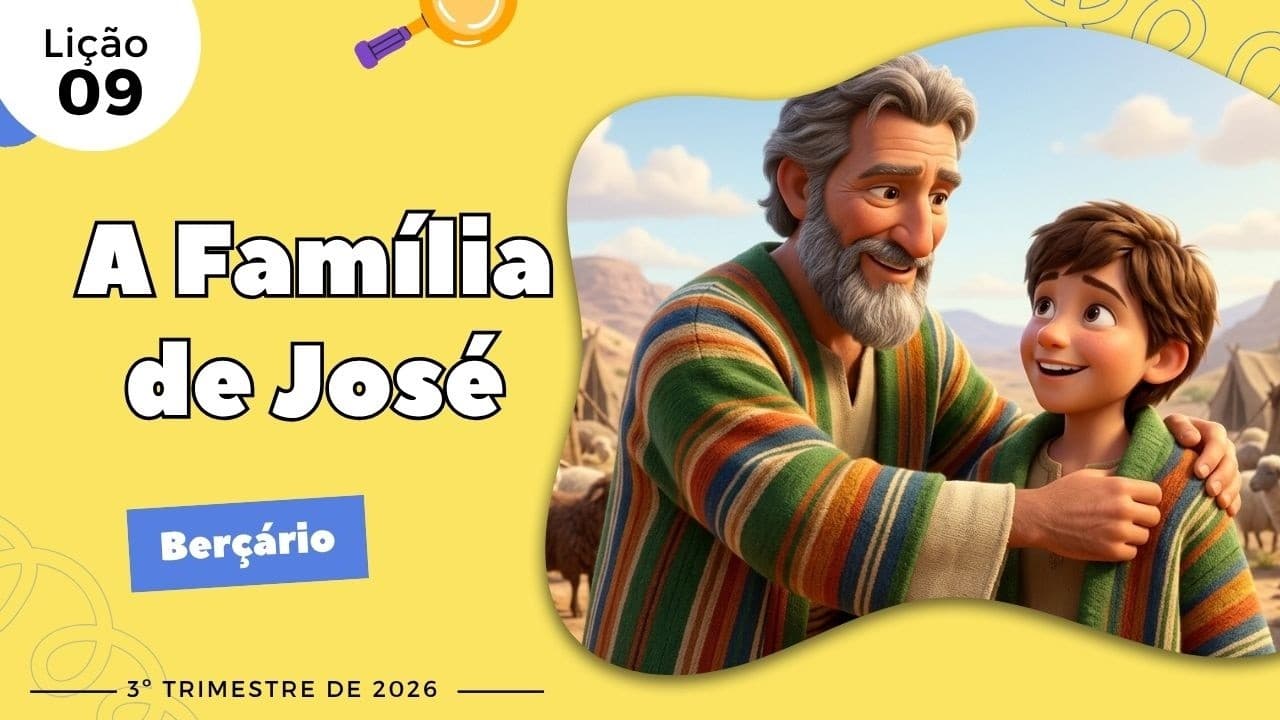
This week's Nursery lesson is about a young man who went to live very far from home. Joseph's brothers got angry and did something mean to him. But there is one thing the child needs to keep from this story, and only one: Father God took care of Joseph the whole time. Years later, when his brothers showed up hungry, Joseph did not pay back evil — he forgave and gave food to the whole family.
That is where the phrase of the class comes from, and it is short on purpose: "Jesus takes care of my family."
A heads-up before we start. Here the story does not turn into a drama. The sad moment lasts only a few seconds and the class rushes right back to joy — a baby does not need suspense, a baby needs security. And remember that a little child does not sit through a lecture, but alternates: five to ten minutes per moment.
I — Welcome and the verse
Welcome each family at the door, with a smile and the baby's name on your lips. Greet daddy and mommy too — and this is not just polite small talk: a little child reads security on the face of the one handing them over. A calm mother at goodbye means a calm child in the room. If mommy feels safe leaving the baby there, the baby feels it too.
Before everyone arrives, take a look around the room: sturdy cribs with no loose parts, a soft floor, covered outlets, clean toys, nothing small within reach of little mouths. If no one cleans the nursery during the week, set up a small volunteer schedule — caring for the space is part of the teaching.
Next, the verse. Holding the baby in your lap, invite them: "Let's read the Bible, the Word of God." Open the children's Bible, read slowly, and say, putting the baby's name in the sentence: "(name), Father God always forgives, and we are going to do just like Him."
With the 1- and 2-year-olds, gather the little group in the Bible corner, show the lesson picture, and say: "Joseph forgave his brothers. Joseph loved his brothers." Then place a big paper heart in the middle of the circle and invite everyone to put their little hand on it at the same time, while they repeat with you: forgiving one another (Ephesians 4:32). Whoever does not want to touch it can clap their hands — no one is forced to touch anyone. Repeat three times, always the same way. In the Nursery, repetition does not tire them out: it is what teaches.
II — The story: Father God took care of Joseph
Before telling the story, truly get the class ready: see who needs water, who needs a diaper change, and offer your lap to anyone who arrived crying. An uncomfortable baby does not listen to a story. Then settle each one into the story corner and tell it like this, with the picture in your hand:
"Look! This is Joseph. Father God loves Joseph!
Joseph had many brothers. A really big family!
But Joseph's brothers got upset. And they were mean to Joseph. Joseph went to live far away, very far from home.
(Make a sad face, very quickly.) Ohhh...
But look! Father God took care of Joseph. He took care of him the whole time!
A long time went by. And one day — surprise! — Joseph's brothers arrived there. They were hungry.
And do you know what Joseph did? Joseph forgave them. Joseph hugged his brothers. And Joseph gave yummy food to the whole family!
What joy! The family was all together again."
❤ For the child's heart. Father God took care of Joseph when he was far from home, alone, with no one nearby. He takes care of your home too. Jesus takes care of my family.
III — Singing, playing, and having a snack together
Praise. Praise is not a pastime or a time-filler: even without knowing how to talk, a baby is learning to worship by the example of the person in front of them. Start by saying: "Let's praise Jesus. Let's worship Father God." Sing the lesson song, very slowly: "Forgive, forgive / I will ask my brother to forgive / No matter how many times / I will always ask / Forgive, forgive." Learn the song at home beforehand — singing with confidence calms the class. With a tiny baby, rock them in your arms; with one who can already hold their head up, clap gently while holding their little hands.
Playtime. Now it is time to play "the way little brothers and sisters do." With the babies who can already sit up, play with two at a time while the others sit in the helpers' laps: "Let's play together, like brothers and sisters? Brothers and sisters clap their hands!" If the baby does not know how yet, hold their little hands and clap gently. With the 1- and 2-year-olds: "Brothers and sisters jump with both feet!" (jump with them), "brothers and sisters hop on one foot!" (not everyone will manage, and that is fine), "brothers and sisters play in a circle!" (hold hands and go around singing). No one loses, no one is left out, no one is singled out for anything.
Snack. Talk with the parents beforehand about food restrictions and serve only what has been approved. Healthy options, cut into small pieces, nothing on sharp sticks. Ask the helpers to hand out the snack and stay by each child. Before eating, thank Father God in a single sentence — and take the opportunity to connect it to the story: "Joseph gave food to his family. Father God gives food to ours."
Prayer. Call them for the moment of talking with Father God. Little hands together, little eyes closed, and have them repeat with you, very slowly: "Father God, thank You so much for taking care of my family. They are very special to me. In Jesus' name, amen!"
Activity. With the babies, show one by one the pictures of families — daddy, mommy, and children — glued onto sturdy poster board, holding the little one in your lap and always repeating the same sentence: "Jesus takes care of my family." With the 1- and 2-year-olds, hand out the picture of the family and let them spread colored glue and stick torn paper bits on it, or color it with crayons of various colors. The bits of paper are small: stay right beside them the whole time, and with anyone who still puts everything in their mouth, use only crayons. Write each child's name on the sheet and hand it to the family at pickup.
Christ in the Lesson
The quarterly opens the lesson with a strong statement: what his brothers meant for evil, God turned for good. It is good to state this with precision, because many people confuse it. God did not command Joseph's brothers to do evil — the choice was theirs, and it was sin. What the Bible says is that God is greater than the wrong choice of men and knows how to bring good out of where there was only evil: "As for you, what you intended against me for evil, God intended for good, in order to accomplish a day like this— to preserve the lives of many people." (Genesis 50:20).
Joseph himself had already understood this before, when he made himself known to his brothers: that God had sent him ahead of them to preserve life (Genesis 45:5). He went ahead to preserve life. He arrived first, suffered first, and when his own showed up hungry, he had bread in his hand: he would provide for them there (Genesis 45:11).
There is the portrait. Someone went ahead, rejected by His own, so that the family would not die. Jesus is the fulfillment of this — He came down, was rejected, and sustains with His own life those who come to Him. And the verse of this lesson does not end in our effort to forgive; it ends in the place where forgiveness comes from: forgiving one another, just as God in Christ forgave us (Ephesians 4:32). We forgive because we were forgiven first — "In Him we have redemption through His blood, the forgiveness of our trespasses, according to the riches of His grace" (Ephesians 1:7).
When the little one hears "Father God took care of Joseph," the seed of this is being planted in them: there is Someone who cares even when home is far away. And that Someone has a name. Jesus.
Practical Application
One single sentence, always repeated the same way. "Jesus takes care of my family."
A gesture that stays in the body. The little hand that gives. At this age a child already knows how to place something into someone else's hand long before knowing how to share — and it is through this gesture that they learn to care.
Care for the baby's safety as part of the class. Sturdy crib, toys with no loose parts, torn paper bits under an adult's watchful eye, snack checked with the parents. In the Nursery, caring is teaching: the child learns the care of God by being cared for.
Do not let the sadness stretch out. If the sad face in the story lasts more than a few seconds, the baby holds on to the fright and misses the lesson. Move quickly to "but Father God took care of him!"
Closing Prayer
Father God, thank You because You took care of Joseph when he was far from home. Thank You for taking care of the family of each child in this little room — daddy, mommy, brothers and sisters, grandparents. Teach these little ones, starting right now, that Jesus takes care of them. In Jesus' name, amen.
Frequently asked questions about this lesson
Can you talk about forgiveness with a baby who doesn't even speak yet?+
Yes, but not with explanations. At this age, forgiveness comes through the body: a gentle tone of voice, a little hand that opens up, affection after a disagreement. The word comes later; the gesture stays first.
The story of Joseph has brothers who were mean to him. Won't that scare my child?+
Not the way it is told here. The sad moment lasts only a few seconds, and the class quickly returns to joy: Heavenly Father took care of Joseph the whole time, and in the end the family is together again. No startled voices, no prolonged scared faces.
My child cries when I leave him in the nursery. Does that pass?+
It does, and it passes faster when dad and mom arrive calm. A young child reads security on the face of the person handing him over: if you say goodbye calmly and with a smile, he understands that the place is safe. Rushed goodbyes or sneaking away usually cost more later.
My 1-year-old doesn't share anything and gets upset when someone takes his toy. Is he doing something wrong?+
No. Before age 2, defending one's own toy is normal for that age, not meanness. That is why this week's task is to hand a little piece of food into someone else's hand, with you right there: handing something over is something the child already knows how to do, and that is how he learns to care.
Is it worth taking my baby of just a few months to Sunday School (EBD), if he doesn't even understand?+
It is. He doesn't understand the sentences, but he takes in being held, the music, the tone of voice, and the name of Jesus repeated week after week. Spiritual life begins right along with life itself — and what is planted now is not lost.
Teacher's Guide
Essence of the class
Father God took care of Joseph far from home, and Joseph took care of his brothers — Jesus takes care of my family.
Map of the class
| Time | Stage |
|---|---|
| 0–5 min | Welcome, each baby's name, winning the parents over at the door |
| 5–11 min | Praise: "Forgive, forgive" with clapping and cuddling |
| 11–18 min | Verse (Ephesians 4:32) in the Bible corner, with the paper heart |
| 18–25 min | Story: Joseph far from home and Father God's care |
| 25–31 min | Class activity: "Where's Joseph? Found him!" |
| 31–37 min | Snack, with the thank-you prayer |
| 37–42 min | Brothers and sisters game: clapping, little jumps, circle |
| 42–45 min | Activity, prayer, and goodbye |
Start like this
Sit on the floor, at their level, with a closed colorful box in your lap. Say in a whispery secret voice: "Guess what is inside here?" Count slowly — "one... two... three!" — and pull out a little doll or the picture of Joseph: "Look! It's Joseph!" Then pull out the pictures of his brothers, one by one, faster and faster: "And this is his brother... and this one... and this one... so many people!" Expect giggles, little fingers pointing, and children asking to hold them. Let them hold them. Then say: "Joseph had a really big family. And Father God took care of Joseph's family."
Point 1 — Father God took care of Joseph far from home
- In the quarterly: the Bible story moment (Genesis 45:1-15), with pictures 9.1 and 9.2.
- What to teach: his brothers chose evil and Joseph ended up far from home. God did not command that to happen, but He took care of Joseph in the middle of it and turned the outcome into life for the whole family. In the Nursery this is taught in one sentence and one tone of voice: "Father God took care of Joseph the whole time" — said with joy, never with suspense.
- Anchor verse (BSB): "And now, do not be distressed or angry with yourselves that you sold me into this place, because it was to save lives that God sent me before you." (Genesis 45:5).
- Key question: "Who takes care of you at your house?"
- Likely answers (+ going deeper): "mommy," "daddy," "grandma," a brother's or sister's name, or a quiet smile and a pointing little finger. Go deeper: "And who gave that mommy to (name)? It was Father God! Jesus takes care of your family."
- If no one speaks: say the names yourself, one by one, pointing to each child with affection — "Théo's mommy, Ana's daddy..." Hearing their own name opens the little one's mouth.
Point 2 — Joseph forgave and gave food to his family
- In the quarterly: the verse moment (Ephesians 4:32) with picture 9.2, the praise moment, and the playtime moment.
- What to teach: when his brothers arrived hungry, Joseph did not pay back evil. He forgave, hugged them, and provided for the whole family. Forgiving, for a 1-year-old, is not a speech: it is the little hand that opens again and the little piece of food that passes from one hand to another.
- Anchor verse (BSB): "Be kind and tenderhearted to one another, forgiving each other just as in Christ God forgave you." (Ephesians 4:32).
- Key question: "Shall we say it together? For-giv-ing one another!"
- Likely answers (+ going deeper): loose syllables, one child who just claps, another who repeats the last word, another standing still and watching. Go deeper: "Very good! Joseph forgave. And we are going to do the same."
- If no one speaks: repeat it yourself, very slowly, syllable by syllable, with the children's Bible open in your hand. At this age, imitating is already answering — and the child who only watches is learning too.
✝ Christ in the Lesson. Joseph went ahead, rejected by his own, so that the family would not die of hunger (Genesis 45:5). Jesus went further: He was rejected and died to give us life, and from Him comes the forgiveness we share — just as God in Christ forgave us (Ephesians 4:32).
Class activity
- Goal: to feel, through play, that Father God keeps taking care of us even when we cannot see Him.
- Materials: the picture of Joseph glued onto sturdy poster board (or a large cloth doll, with no buttons or small parts) and a soft little cloth, like a burp cloth.
- Step by step: everyone on the soft floor or in the helpers' laps. Show Joseph: "Look at Joseph!" Cover him with the little cloth and ask, in a playful voice: "Where's Joseph?" Wait about three seconds in silence, smiling — that pause is the time the baby needs to react. Pull the cloth away: "Found him!" Celebrate with clapping. Repeat three or four times; then hide your own face behind your hands and do the same, for anyone who wants to imitate. No one is singled out, no one is put in the middle of the circle, no one loses. Your voice is always cheerful — never a startling tone.
- Wrap-up: "Joseph went to live far away, and no one could see him. But Father God was there, taking care of Joseph the whole time. Jesus takes care of your family too" (Genesis 45:5).
Wrap-up + challenge of the week
- Wrap-up: "Joseph's brothers did something very wrong. But Father God took care of Joseph the whole time, and Joseph forgave and gave food to the whole family. Jesus takes care of your family — today, tomorrow, and every day."
- Challenge: parents, do this together. Once a day, at mealtime, put into your child's little hand a small piece of what is already on the plate — fruit, bread, a cracker — and help them place it into the hand of someone at home: daddy, mommy, brother, sister, grandma, whoever is at the table. While the little hand gives it, always say the same sentence: "Jesus takes care of my family." On Sunday, come back with the story. (Follow up the next Sunday: open the class by asking the parents who received food from the child's little hand.)
Teacher's kit
- Before: read Genesis 45:1-15 during the week until the story is on the tip of your tongue; learn the song "Forgive, forgive"; set aside the lesson pictures and make the paper heart for the verse. Check cribs, toys, and outlets, and remove anything broken or with loose parts. Ask the families about allergies and food restrictions.
- Bring: children's Bible, pictures 9.1 and 9.2 and the pictures of families glued onto sturdy poster board, a soft little cloth for the class activity, colored glue, colored torn paper bits, crayons of various colors, the paper heart, and the approved snack.
- Pray beforehand: Rahab hung a scarlet cord in her window and her house was kept safe — that cord points to the blood of Jesus, which keeps safe everyone who believes in Him. Before class, thank Jesus for that blood shed on the cross (Ephesians 1:7) and ask the Lord for patience to repeat without growing tired and for watchful eyes for the comfort and safety of each baby.
Homework
Your mission for the week
Parents, do this together. Once a day, at mealtime, put into your child's little hand a small piece of what is already on the plate — fruit, bread, a cracker — and help them place it into the hand of someone at home: daddy, mommy, brother, sister, grandma, whoever is at the table. While the little hand gives it, always say the same sentence: "Jesus takes care of my family."
Why
Joseph forgave his brothers and provided for the whole family with what he had in his hand, promising to sustain them there (Genesis 45:11). At this age a child does not yet know how to share, but already knows how to hand something over — and it is through this gesture, repeated every day, that they learn that in a family we take care of one another.
How to know you did it
There was at least once a day, this week, when your child's little hand placed something to eat into the hand of another person at home — and heard the same sentence right after.
On Sunday, come back with the story
Next week's class begins with the parents sharing: who received food from your child's little hand this week?
Soli Deo Gloria — Scripture governs; everything else, on its knees.