Golden Text
“After Jesus was born in Bethlehem in Judea, during the time of King Herod, Magi from the east arrived in Jerusalem,” (Matthew 2:1, BSB) · Read in the Bible
An angel, the messenger of the Heavenly Father, visited a young woman named Mary and told her: you are going to have a baby, and He will be the Savior of the world. Everything happened just as the angel said — Jesus was born, and the Heavenly Father chose Mary and Joseph to care for Him. The lesson closes the quarter by leaving the little one with a single truth and a gesture to repeat at home: the little cloth, the rocking lap, and the phrase that never changes — Jesus was born to save me.
This week's Nursery class fits into a single gesture: a lap that rocks slowly. The video opens by promising "a beautiful story, the story of a very special baby" — and it is this baby that the child takes home, in the little cloth, on the lap, and in the sentence.
The story is the best known in the Bible and remains the greatest. An angel, the messenger of Heavenly Father, visited a young woman named Mary and told her: you are going to have a baby, you will take care of Him with lots of love, and He will be the Savior of the world. Everything happened just as the angel said. The baby was born, and His name is Jesus. And Heavenly Father chose Mary and Joseph to take care of Him.
From there comes the sentence of the class, kept short on purpose: "Jesus was born to save me."
A word of caution before you begin. Matthew chapter 2 continues with Herod, the flight to Egypt, and the boys of Bethlehem — and none of that enters the nursery circle. Nor do we tell the part about there being no room for them in a sad voice: a baby does not need pity or suspense. A child from 0 to 2 years old hears this and only this: the angel told Mary, baby Jesus was born, Daddy Joseph and Mommy Mary took care of Him with lots of love, and what joy. And remember that a small child does not sit through a lecture — they alternate: five to ten minutes per activity.
One last observation before you prepare the room. This is the last class of the quarter, and the quarterly calls for a festive Sunday. It is worth taking special care: you are wrapping up three months with these families, and the memory that stays with them is the farewell.
I — Welcome and the verse
Decorate the room in a special way this Sunday and set up a photo corner, as the quarterly suggests. Greet each family at the door with a smile and the baby's name on your lips: "How wonderful that you came, (name). You brighten our class." Invite the parents or caregivers to take a photo with the baby — and here is the care that cannot be skipped: take photos only with written permission from the parents or guardians, give the picture to the family itself, and do not post anything on social media or in group chats without that permission. If the church wants to make a wall display or a class album, confirm child by child who may appear.
If a child arrives afraid to come in, do not force or rush them: draw their attention to the decorated corner or to a toy, and let curiosity do the rest. What stays recorded at this age is the association — a good room, good people, a safe place.
Check the room before everyone arrives, and do that check during the week, not on Sunday morning: cribs sturdy and with no loose parts, soft and clean floor, covered outlets, washed toys, nothing small within reach of the mouth. In this lesson there are two extra precautions. The first is the decoration: no latex balloons, glitter, beads, thin ribbons, craft wire, or small glued pieces — keep decorations high up, secure, and large. The second is the cloths for the story: use cloth diapers or cotton cloths that are washed, wide, and short, always in the adult's hand, never tied on anyone, and never near a child's face.
Then, the verse. With the baby on your lap, invite them: "Let's read the Bible, the Word of God." Open the children's Bible, read slowly, and say, putting the child's name inside the sentence: "(name), baby Jesus was born! Heavenly Father sent Jesus to save you."
With the 1- and 2-year-olds, gather the little group in the Bible corner. Hold the children's Bible open, show the picture of the baby in the manger, and have them repeat with you, always the same way, syllable by syllable: "Je-sus was born!" (Matthew 2:1). Repeat three times. Whoever wants to touch the Bible touches it, one at a time, while you hold it; whoever does not want to claps their hands. No one is forced to touch anything. In the Nursery, repetition does not tire: it is what teaches.
A note for whoever prepares the verse poster. "Jesus was born" is the short form the child can repeat, but the text is longer. Print the full verse beside it for the parents to read: "After Jesus was born in Bethlehem in Judea, during the time of King Herod, Magi from the east arrived in Jerusalem," (Matthew 2:1). The child repeats the short version; the parents read the Word.
II — The story: the baby who was born to save us
Before telling the story, truly prepare the class: see who needs water, who needs a diaper change, and offer your lap to anyone who arrived crying. An uncomfortable baby does not listen to a story. Then settle each one in the story corner and tell it like this, with the lesson pictures, the cloth doll, and the little cloth in your hand:
"Look! This is Mary. Shall we say 'hi' to Mary? Hi, Ma-ry!
One day, Mary had a visitor. Do you know who came to visit Mary? An angel! The messenger of Heavenly Father.
And the angel said this: 'Mary, you are going to have a baby. You are going to take care of Him with lots of love. And He is going to be the Savior.'
And everything happened just as the angel said.
(Bring the doll out from behind you, very slowly.) Look at the baby! Ba-by Je-sus!
His name is Jesus.
(Wrap the doll in the little cloth, slowly, letting everyone see.) Mommy Mary wrapped the baby in a little cloth, like this, and rocked Him. Rock-a-bye, rock-a-bye...
Daddy Joseph and Mommy Mary were chosen by Heavenly Father to take care of baby Jesus. And they took care of Him with lots of love.
Jesus was born! What joy! (Clap hands slowly with them.)
Jesus is the Savior of daddy, mommy, the baby, and the little brothers and sisters."
❤ For the child's heart. Heavenly Father sent the most beautiful gift in the world: baby Jesus. He was born tiny, was wrapped in a little cloth, and had a daddy and a mommy to take care of Him. And He was born for you. Jesus was born to save me.
III — Singing, playing, and having a snack together
Praise. Praise is not a pastime or a time-filler: even without knowing how to speak, a baby learns to worship by the example of the person in front of them. Start by saying: "Let's praise Jesus. Let's sing to Heavenly Father." Hand out rattles — large, washable, with no parts that can come loose — and sing the song indicated in the quarterly, very slowly and in a soft voice: "In God's house I am going to sing / Hallelujah, I want to worship / To Heavenly Father I am going to give praise." Afterward, if you want a single line from this lesson to repeat many times, use this one, to whatever tune you already know: "He was born, He was born, baby Jesus was born." Sing it three or four times. Repetition is what makes it stick. It is also worth replacing "baby" with the name of each child in the room, one at a time — the quarterly reminds us that fitting the child's name into the song is one of the best tools for this age group, and at this age hearing one's own name sung is what holds their attention most.
Playtime. Settle the babies on the floor cushions or in the crib and offer each one a children's Bible storybook to leaf through as they know how, saying: "You are reading the Word of Heavenly Father." Let them turn the pages in their own way, even if it is several at once. With the 1- and 2-year-olds, cover the floor with mats, seat everyone in a circle, and let them explore the book page by page while you repeat: "Look at baby Jesus! Jesus was born." Take the opportunity as well to play "Where is the baby? He is born!" — the step-by-step instructions are under Class activity, in the Teacher's Guide.
Snack. Talk with the parents beforehand about allergies and restrictions, and serve only what has been authorized. Never force anyone to eat or try something. The quarterly suggests a fruit "popsicle" on a stick to close the quarter with a party — the idea is nice, but with babies do not use a stick: a point and a thin stick are a hazard to the mouth and throat. Serve the same fruit very ripe, cut into small, soft strips, in their little hand or on a spoon, with an adult beside them the whole time. Nothing round, nothing firm, nothing ball-shaped. Before eating, thank Heavenly Father in a single sentence, connecting it to the story: "Thank You, Heavenly Father, for baby Jesus and for our little snack."
Prayer. Call them to the prayer corner. Little hands together, little eyes closed, a very soft voice — and have them repeat with you, slowly: "Heavenly Father, thank You so much for sending baby Jesus. In Jesus' name, amen!"
Activity. With the babies, use the mirror the quarterly calls for. Hold the acrylic mirror — always in your hand, never in the child's — in front of one baby at a time and say their name: "Look who is here! It is (name). Jesus was born to save you." With the 1- and 2-year-olds, hand out the lesson sheet and let them color with crayons. If you want something for the parents to keep, glue a small piece of colored cotton onto the sheet — the quarterly already lists cotton among the materials — always glued by you, never loose in the child's hand, because loose cotton goes straight to the mouth. With those who still put everything in their mouths, use only crayons, with you beside them the whole time. Write each child's name on the sheet and hand it to the family at dismissal, along with the photo of the day.
Christ in the Lesson
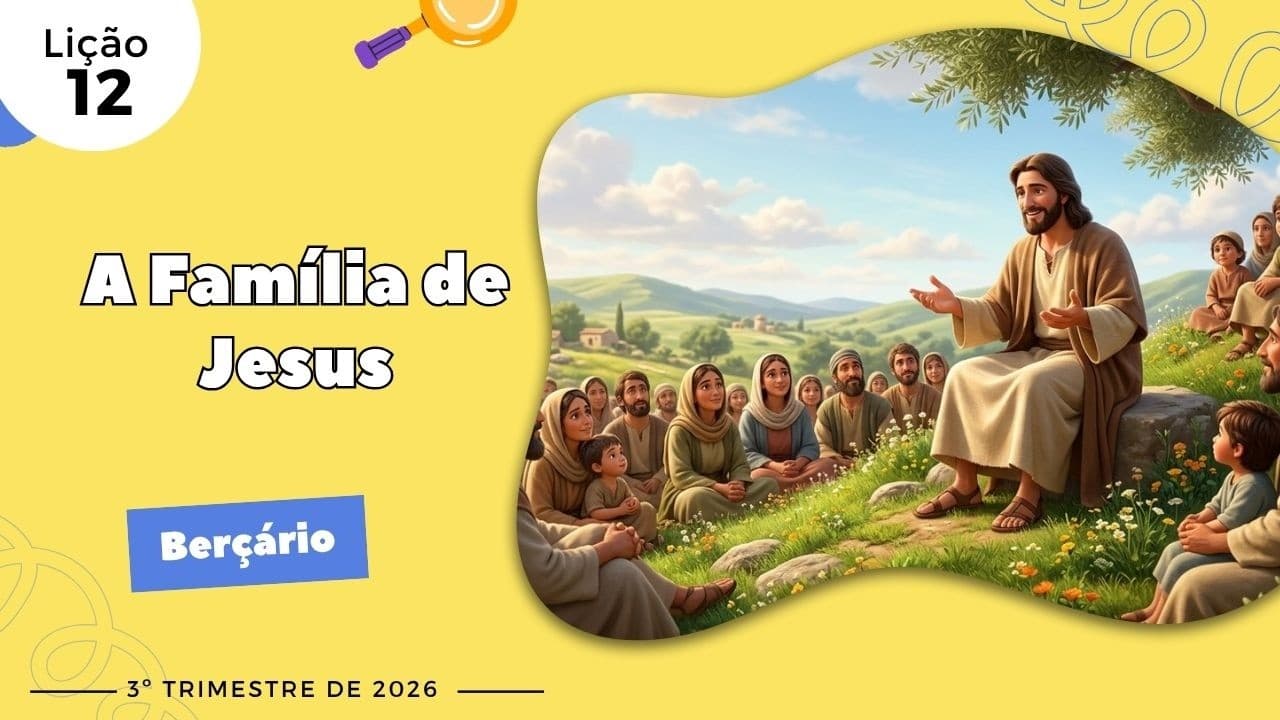
The title of this lesson says "Jesus' Family," and it is good to start by noticing what the Bible does with that expression. God could have brought His Son into the world in any way at all. He chose the most human way of all: a pregnancy, a birth, a poor couple, a small town. "But when the time had fully come, God sent His Son, born of a woman, born under the law," (Galatians 4:4). The eternal Word entered history through a door of flesh, and the first thing He knew of us was a lap.
The announcement to Mary has a gentleness that we often rush past because we know it so well. The angel arrives and the first word is peace: "So the angel told her, “Do not be afraid, Mary, for you have found favor with God.”" (Luke 1:30). Then comes the charge: "Behold, you will conceive and give birth to a son, and you are to give Him the name Jesus." (Luke 1:31). Mary does not understand, and asks the question of someone with her feet on the ground — how can this be? The answer is not an explanation; it is a Person: the Holy Spirit. And the angel's closing is a sentence that sustains any weary home: "For no word from God will ever fail." (Luke 1:37).
Notice what Mary does with this. She is not pushed; she answers. "“I am the Lord’s servant,” Mary answered. “May it happen to me according to your word.” Then the angel left her." (Luke 1:38). God invites, and His grace arrives first — but there is a human response, free and costly, and it is recorded word for word. That is how God treats people: calling, and waiting for the yes.
And Joseph? His part hardly ever appears in the pictures on the wall, yet it is one of the most beautiful in the New Testament. He discovers the pregnancy, suffers, and decides to act with mercy — being a righteous man and not wanting to disgrace her publicly, he resolved to send her away quietly (Matthew 1:19). Then God speaks to him, and the charge comes together with the name and the reason for the name: "She will give birth to a Son, and you are to give Him the name Jesus, because He will save His people from their sins." (Matthew 1:21). Not "because He will teach," not "because He will heal" — because He will save. And Joseph performs what may be the quietest act of obedience in the Bible: "When Joseph woke up, he did as the angel of the Lord had commanded him and embraced Mary as his wife." (Matthew 1:24). He took on a child who was not his by blood, and gave Him His name, His livelihood, His trade, and His family name. Every man who raises a child with that kind of faithfulness is walking on ground that Joseph walked first.
The birth itself Luke tells without any flourish: "And she gave birth to her firstborn, a Son. She wrapped Him in swaddling cloths and laid Him in a manger, because there was no room for them in the inn." (Luke 2:7). The word translated "inn" can point to more than one kind of place, and scholars have long debated what exact space that was; what the text affirms beyond a shadow of a doubt is what matters: there was no room for them. The King of the universe was born in a borrowed corner, and His first clothing was a wrapped cloth. That is the detail our class places in the child's hand — the little cloth.
And it is the angel who says what all of this is for: "Today in the city of David a Savior has been born to you. He is Christ the Lord!" (Luke 2:11). Savior. Not counselor, not example. And the Golden Text of this lesson looks at the same scene from another angle: "After Jesus was born in Bethlehem in Judea, during the time of King Herod, Magi from the east arrived in Jerusalem," (Matthew 2:1). Men from afar crossed the world to worship a boy the palace did not even know existed. The name He received said it all: they would call His name Immanuel, which means God with us (Matthew 1:23).
Here a frank word is in order, because it is often left out. Mary is blessed among women, and Scripture does not stint in honoring her — but she is a servant, not a savior. In her own song she calls God her Savior (Luke 1:46, 47), which means that she too needed Jesus, just like you and me. Our prayer goes to the Father, in the name of the Son. And Mary kept all of that in a mother's way: "But Mary treasured up all these things and pondered them in her heart." (Luke 2:19).
The purpose of it all appears in Paul's next sentence. God sent the Son, born of a woman, to redeem those who were under the law, so that we might receive adoption as sons (Galatians 4:5). Notice the pattern: the Son of God entered a human family so that human beings could enter the family of God. That is why this Nursery lesson, which looks like just a little crib and a little cloth, is the heart of the Gospel. Heavenly Father entrusted His Son to a daddy and a mommy — and the Son, grown up, opened the door so that daddy, mommy, the baby, and the little brothers and sisters could enter His house.
When the little one in this classroom hears "Jesus was born," the seed of this is being planted in them: there is Someone who came to seek us. And that Someone has a name. Jesus.
Practical Application
One sentence only, always repeated the same way. "Jesus was born to save me." Do not invent synonyms throughout the Sunday — a small child learns through the exact wording, not through abstract meaning.
Say the word "Savior" even knowing the child does not yet understand it. It will be learned as sound and affection before it is learned as doctrine, and that is how it must be at this age. What is not said now will have to be introduced from scratch later.
Caring is teaching, and in this lesson that is literal. Mary wrapped the baby in a cloth and laid Him down where there was room. The nursery does the same thing all morning long: changing, rocking, offering water, comforting tears. None of that is a break from the class — it is the class. A child learns God's care by being cared for.
Honor Joseph out loud with the parents. In a nursery class there is almost always a man who feels unsure about his own role. Joseph stepped up, provided, and gave his name. It is worth saying that at dismissal, looking at the fathers.
Do not turn "there was no room" into staged sadness. No pretend crying, no "poor little thing" voice, no suspense. Tell the good part with joy, show the baby, celebrate, and move on. A baby does not need drama; a baby needs security.
Close the quarter looking ahead. Tell each family what their child learned over these three months and hand them the task for the week written on a little slip of paper. What will sustain that child's faith is not Sunday alone — it is repetition at home.
Closing Prayer
Heavenly Father, thank You because You did not send a message — You sent Your Son. Thank You for Jesus, who was born tiny, was wrapped in a cloth and laid in a manger, and grew up in a home like ours. Thank You for Mary, who said yes, and for Joseph, who obeyed quietly and took care of Him. Teach every father and every mother in this little room to care like that. And plant in the hearts of these little ones, starting now, the name that saves. In Jesus' name, amen.
Frequently asked questions about this lesson
The birth of Jesus in September? Isn't that a Christmas topic?+
The birth of Jesus is not December content; it is the beginning of the Gospel, and it is told in any month of the year. The Bible, in fact, does not give the date on which He was born — it tells what happened and why: "Today in the city of David a Savior has been born to you. He is Christ the Lord!" (Luke 2:11). If you want to set up a nativity scene at home this week for your child to see and touch, do so without any hesitation.
The Heavenly Father chose Mary and Joseph. Does God choose who will care for each child?+
God called that couple for a specific task, and a calling is an invitation with a response — Mary answered that she was the servant of the Lord and asked that it be done to her according to His word (Luke 1:38), and Joseph did as the angel of the Lord had commanded him and took his wife into his home (Matthew 1:24). Caring for a child is an entrusted charge, not a draw of fate. And if your home does not have the family you dreamed of, that does not leave you out: Scripture calls God a father of the fatherless (Psalm 68:5), and He treats no one as leftovers.
Should I teach my child to pray to Mary or ask her for anything?+
No. Mary is honored in the Bible as the servant of the Lord and the mother of our Lord, and we respect her — but she herself called God her Savior (Luke 1:46, 47), which means she also needed Jesus. Christian prayer goes to the Father, in the name of the Son, and the New Testament knows no other way. Teach your child to talk to the Heavenly Father in Jesus' name, and that is all.
My child is 1 year old and doesn't know what "Savior" means. Is there any point in saying this word?+
Yes, there is, and right now is the very time to plant it. He will not understand the concept at this age — he will keep the sound of the word, the joy in your voice, and the security of the lap where it was spoken. When understanding comes, the word will already feel at home inside him and won't need to be introduced from scratch. Always say it the same way, without swapping it for a synonym.
This is the last lesson of the quarter. How do I continue this at home?+
Choose just one thing and stick with it. One minute on your lap before bed, the same phrase every day, a children's Bible within your child's reach for him to flip through as he pleases. It doesn't need new material or a scheduled time — it needs repetition. That is how faith has been passed down from generation to generation in Christian homes from the beginning, and that is still how it works.
Teacher's Guide
Essence of the class
Heavenly Father sent baby Jesus and chose Mary and Joseph to take care of Him. Jesus was born to save me.
Map of the class
| Time | Stage |
|---|---|
| 0–5 min | Festive welcome, each child's name, the photo with the family |
| 5–10 min | Start like this: the surprise box and the little cloth |
| 10–16 min | Praise with rattles, singing each child's name |
| 16–22 min | Verse (Matthew 2:1) in the Bible corner |
| 22–30 min | Story: the baby who was born to save us |
| 30–36 min | Class activity "Where is the baby? He is born!" |
| 36–41 min | Snack, with the prayer of thanks |
| 41–45 min | Book in their little hands, activity, and farewell to the quarter |
Start like this
Sit on the floor, at their level, with a closed colorful box on your lap. Say in a whispery secret voice: "Guess what is inside here?" Count slowly — "one... two... three!" — and pull a soft little cloth out of the box. Wave it in the air, very slowly, and say syllable by syllable: "A lit-tle cloth! So soft!" Brush the cloth gently against your own cheek, close your eyes, and smile — they will look at your face before they look at the cloth.
Wait. Count three seconds in silence, smiling — it is in that pause that a baby reacts. Then ask: "Where is the baby?" and take the doll out of the box, slowly. Wrap it in the little cloth in front of them and rock it on your lap: "Look at the baby! Ba-by Je-sus! Je-sus was born!" Let them touch it, one child at a time, keeping the doll in your hands the whole time. Watch for little fingers pointing and little hands reaching out — that is how they ask questions.
Point 1 — The angel told Mary
- In the quarterly: the Bible story time, with the lesson pictures — in this class, the story of the birth of Jesus, the same as in the video lesson.
- What to teach: Heavenly Father sent an angel to tell Mary that she would have a baby, and that this baby would be the Savior. Mary did not understand how that could happen, but she said yes. In the Nursery this is taught in one sentence and a cheerful tone of voice: "the angel spoke to Mary, and everything happened just as the angel said."
- Anchor verse (BSB): "Behold, you will conceive and give birth to a son, and you are to give Him the name Jesus." (Luke 1:31).
- Key question: "Where is the baby? Let's find Him!" (hide the doll behind the little cloth and show it again).
- Likely answers (+ going deeper): giggles, a baby pointing at the doll, one pulling the cloth, another just watching very seriously. Go deeper: "Found Him! Baby Jesus was born, just as the angel said!"
- If no one speaks: do it yourself three or four times, always the same way, always with the same surprised face on "Found Him!". At this age, imitating is already answering — and the child who only watches is learning too.
Point 2 — Jesus was born, and Mary and Joseph took care of Him
- In the quarterly: the verse time in the Bible corner, and the activity time with the mirror and the colored cotton.
- What to teach: the baby was born, was given the name Jesus, and was wrapped in cloths. Heavenly Father chose Mary and Joseph to take care of Him, and they did. The child holds on to the whole scene: the baby in the little cloth, the lap that rocks, the repeated name.
- Anchor verse (BSB): "And she gave birth to her firstborn, a Son. She wrapped Him in swaddling cloths and laid Him in a manger, because there was no room for them in the inn." (Luke 2:7).
- Key question: "Shall we say it together? Je-sus was born!"
- Likely answers (+ going deeper): loose syllables, one child repeating only the last syllable, another clapping hands, another reaching out a hand toward the doll. Go deeper: "That's right! Jesus was born. And Jesus was born to save you."
- If no one speaks: repeat it yourself, very slowly, syllable by syllable, rocking the doll to the rhythm of your voice. At this age the rocking holds their attention more than the word — speak as if singing.
✝ Christ in the Lesson. The angel did not announce a teacher or an example: "Today in the city of David a Savior has been born to you. He is Christ the Lord!" (Luke 2:11). And the name came with the reason for it: you shall call His name Jesus, because He will save His people from their sins (Matthew 1:21). The Son of God entered a human family so that we could enter the family of God (Galatians 4:4, 5).
Class activity
- Goal: to feel, through play, the joy of the baby appearing — and to connect that joy to the name of Jesus.
- Materials: a soft, washable cloth doll, with no button eyes, no long hair, no ribbon, and no parts that can come loose; washed cotton cloths or cloth diapers, wide and short; and a "manger" made from a low, sturdy box lined with a little cloth. Nothing else. Do not use real straw, string, thin ribbon, glitter, beads, or latex balloons: with babies, those are suffocation and choking hazards.
- Step by step: everyone on the soft floor or on the helpers' laps, with the doll always in your hands. Wrap the doll in the little cloth, slowly, letting everyone see: "Wrap up the ba-by." Lay it in the manger and cover the doll's little face with the corner of the cloth. Ask in a playful voice: "Where is the baby?" Wait about three seconds in silence, smiling — that pause is the time a baby needs to react. Uncover it all at once: "He is born! Je-sus was born!" Celebrate with gentle claps. Repeat three or four times. Then place a clean little cloth into the hand of anyone who wants to hold it, one at a time, and let them squeeze and let go — the cloth stays in the hand, never on the face and never tied, and comes back to you at the end. No one is singled out, no one is put in the middle of the circle, no one is forced to take it. Collect all the cloths before the babies go to the crib.
- Wrap-up: "The baby appeared! Jesus was born, and Mommy Mary wrapped Him in a little cloth, like this. Jesus was born to save you" (Luke 2:7, 11).
Wrap-up + challenge of the week
- Wrap-up: "The angel of Heavenly Father spoke to Mary: you are going to have a baby, and He is going to be the Savior. And everything happened just as the angel said. Baby Jesus was born, and Heavenly Father chose Mommy Mary and Daddy Joseph to take care of Him with lots of love. Jesus was born to save you — daddy, mommy, the baby, and the little brothers and sisters."
- Challenge: parents, do this together. Every night this week, before laying the baby down, take a soft little cloth, wrap your child on your lap — only on your lap — and rock them for one minute, saying softly, always the same sentence: "Jesus was born to save you." Then remove the cloth and lay the child in the crib, because only the baby goes into the crib: no loose cloth, pillow, or stuffed animal in there with them. On Sunday, come back with the story. (Follow up the next Sunday: open the class by asking the parents how many nights it worked and whether their child already quiets down when they see the little cloth.)
Teacher's kit
- Before: watch the video lesson and read during the week Luke 1:26-38, Luke 2:1-20, and Matthew 1:18-25, until the story is on the tip of your tongue. Also read the whole of Matthew 2 knowing that it stays with you and does not go into the circle. Set aside the cloth doll (soft, washable, with no button eyes, no long hair, no ribbon), the washed little cloths, and the manger box. Do the safety check of the room during the week, not on Sunday — and remove from the room any wire, cord, ribbon, glitter, bead, or balloon that the party decorations may have brought in. Confirm food allergies and restrictions with the families, and ask for written photo permission. Agree with the church on the rule of always having two adults in the room, with the door open or with a window panel.
- Bring: children's Bible, the lesson pictures, the cloth doll in the surprise box, the little cloths and the manger, large washable rattles, unbreakable acrylic mirror, children's Bible storybooks, crayons, colored cotton (for you to glue, not for the child to hold), the activity sheet, and the authorized snack, cut into soft strips and without a stick.
- Pray beforehand: thank Jesus for having been born under the law to give us adoption as sons (Galatians 4:4, 5), and ask the Lord for two very concrete things: patience to repeat the same sentence without tiring and watchful eyes for the comfort and safety of each baby. Pray also, by name, for the families of your little class — it is the last Sunday of the quarter with them, and it is worth asking that what was planted over these three months will keep growing at home.
Homework
Your mission for the week
Parents, do this together. Every night this week, before laying the baby down, take a soft little cloth, wrap your child on your lap — only on your lap — and rock them for one minute, saying softly, always the same sentence: "Jesus was born to save you." Then remove the cloth and lay the child in the crib, because only the baby goes into the crib: no loose cloth, pillow, or stuffed animal in there with them.
Why
"And she gave birth to her firstborn, a Son. She wrapped Him in swaddling cloths and laid Him in a manger, because there was no room for them in the inn." (Luke 2:7). The Savior of the world began wrapped in a cloth, on a mother's lap. When you rock your child saying the name of Jesus, they learn both things at the same time, and in the only way possible at this age: through the body and the voice of the one who cares for them.
How to know you did it
Seven nights, one minute on your lap, the same little cloth, and the same sentence. If your child already quiets down when they see the little cloth in your hand, you did it.
On Sunday, come back with the story
Next week's class begins with the parents sharing: how many nights did it work, and what did your child do when they heard the name of Jesus?
Soli Deo Gloria — Scripture governs; everything else, on its knees.