Golden Text
“that you will spare the lives of my father and mother, my brothers and sisters, and all who belong to them, and that you will deliver us from death.” (Joshua 2:13, BSB) · Read in the Bible
Rahab lived in a little house and believed in Heavenly Father before seeing anything happen. She took care of the two messengers, asked for her father, her mother, and her brothers and sisters, and put the little red cord in the window — and the whole house was kept safe. The lesson leaves the little one with just one truth: Jesus takes care of my house.
This week's Nursery lesson is about a little red cord in the window. The video opens with it swaying high up, and the comparison used in the lesson is too good to pass up: it is like the hallway light that daddy turns on so his child will not be afraid of the dark. That sign in the window said only one thing — this house is kept safe.
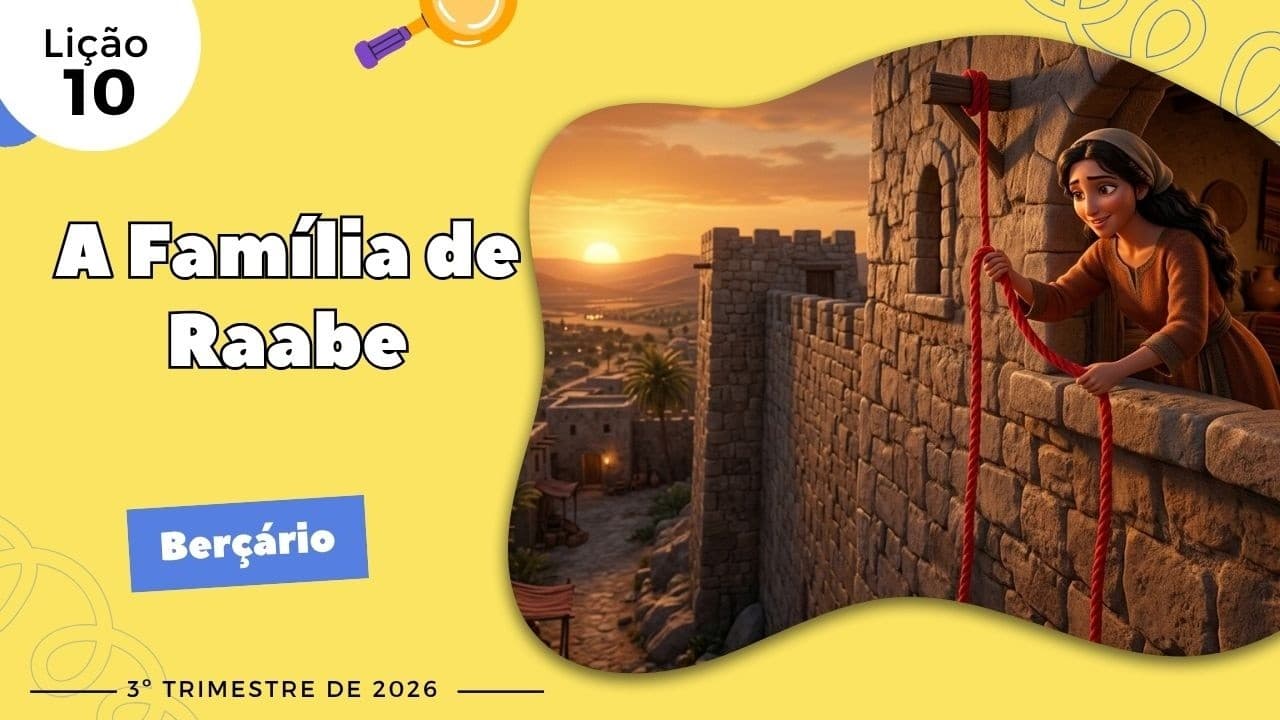
The story is about Rahab, the woman who hid Joshua's messengers and believed in God before seeing anything happen. She asked for her father, her mother, her brothers and her sisters. And the whole house was kept safe.
That is where the sentence of the lesson comes from, and it is short on purpose: "Jesus takes care of my house."
A word of caution before beginning. Joshua 6 is a hard chapter, and it does not enter the nursery circle. Nothing about war, nothing about walls falling on top of people, nothing about death. A child from 0 to 2 years old hears this and only this: Rahab believed, put the little red cord in the window, and her family stayed together and safe. And remember that a small child does not sit through a lecture — they alternate: five to ten minutes per moment.
I — Welcome and the verse
Welcome each family at the door with a smile and the baby's name on your lips. If a child arrives afraid to come in, do not force or rush them: draw their attention to a special corner of the room or to a toy, and let curiosity do the rest. What stays recorded at this age is the association — good room, good people, safe place.
Before everyone arrives, take a look around the room. And take that look during the week, not on Sunday morning: cribs sturdy and with no loose parts, soft floor, covered outlets, clean toys with no pieces that can come off, nothing small within reach of the mouth. This lesson has an extra precaution, and it is serious: no long yarn, long satin ribbon, thin cord, loose bow or finger puppet. Long string and small pieces, with a baby, are a choking and strangulation hazard. The ribbon in this lesson is wide, short and attached to the little house — and it stays in the adult's hand the whole time.
Next, the verse. Prepare beforehand a large little house cut out of craft foam, with the window marked out, and a wide red felt ribbon — short, the size of the window — attached with Velcro. With the baby on your lap, invite them: "Let's read the Bible, the Word of God." Open the children's Bible, read slowly and say, using the child's name in the sentence: "(name), Rahab believed in Heavenly Father and asked for her daddy, her mommy and her brothers and sisters. Heavenly Father kept the whole house safe."
With the 1- and 2-year-olds, gather the little group in the Bible corner and show the little house. Stick the ribbon onto the window in front of them — the little sound of the Velcro is part of the teaching, so let everyone hear it. Then have them repeat with you, always the same way: my father and my mother (Joshua 2:13). Whoever wants to touch the ribbon can touch it, one at a time, while you hold the little house; whoever does not want to can clap their hands. No one is forced to touch anything. Repeat three times. In the Nursery, repetition does not tire them out: it is what teaches.
A note for whoever prepares the verse poster. "The Lord takes care of my family" is a lovely paraphrase, but it is not Joshua 2:13. If you use the short phrase with the children, print the biblical text beside it: "that you will spare the lives of my father and mother, my brothers and sisters, and all who belong to them, and that you will deliver us from death." (Joshua 2:13). The child repeats the short version; the parents read the Word.
II — The story: the little red cord in the window
Before telling the story, truly prepare the class: see who needs water, who needs a diaper change, offer your lap to anyone who arrived crying. An uncomfortable baby does not listen to a story. Then settle each one into the story corner and tell it like this, with the lesson pictures and the little house in your hand:
"Look! This is Rahab. Shall we say 'hi' to Rahab? H-i, Ra-hab!
Rahab lived in a little house.
One day two young men arrived. The two young men love Heavenly Father.
Rahab took care of the two young men. She hid the two of them, tucked safely away. (Make the gesture of hiding behind your hands.) Shhhh...
And Rahab said: 'I believe in Heavenly Father! Save my father, my mother, my brothers and my sisters.'
The young men said: 'Put a little red cord in the window. That way your family will be kept safe.'
And Rahab put the little red cord in the window. (Stick the ribbon onto the Velcro very slowly, letting them hear the sound.) Stuck on!
Look at that! Rahab's daddy, mommy, brothers and sisters all went inside the little house. And Heavenly Father kept the whole little house safe.
What joy! The family stayed together."
❤ For the child's heart. Rahab believed in Heavenly Father when no one around her believed. She asked for her house, and Heavenly Father kept the whole house safe. He keeps yours safe too. Jesus takes care of my house.
III — Singing, playing and having a snack together
Praise. Praise is not a pastime or a way to fill time: even without knowing how to talk, the baby is learning to worship through the example of the person in front of them. Start by saying: "Let's praise Jesus. Let's worship Heavenly Father." Hand out rattles — large, washable, with no parts that can come loose — and sing the lesson song very slowly: "Oh, God loves my family / Oh, God loves my family / He is good and loves my family / God loves my family!" The quarterly suggests singing in front of a mirror, and it is well worth it: the child sees themselves, sees their little classmate and sees you praising. Use an unbreakable acrylic mirror, and keep it always in your hand — never in the child's hand.
Playtime. Settle the babies onto the floor cushions or in the crib itself. Shake the rattle, wait for their reaction and place the rattle into their little hand, letting them handle it. It is that simple, and it is꠸ exactly what this age needs. With the 1- and 2-year-olds, take the opportunity to play "Where is it? Found it!" with the little house and the ribbon — the step-by-step instructions are under Class activity, in the Teacher's Guide.
Snack. Talk with the parents beforehand about allergies and restrictions and serve only what has been authorized. Never force anyone to eat or try something. The quarterly suggests fruit with plain yogurt, and the idea is great — but do not serve it in little balls: round, firm fruit is a choking hazard. Cut very ripe melon and watermelon into small, soft strips, under an adult's eye the whole time, and no pointed toothpicks. Before eating, thank Heavenly Father in a single sentence, connecting it to the story: "Rahab's family stayed together at home. Heavenly Father brings our family together at the table."
Prayer. Call them for the moment of talking with Heavenly Father. Little hands together, little eyes closed, and have them repeat with you, very slowly: "Heavenly Father, thank You so much for saving my family. It is very special to me. In Jesus' name, amen!"
Activity. With the babies, show the little house with the red ribbon, bring it close, let them look, take the Velcro off and put it back on again, always repeating the same sentence: "Jesus takes care of my house." With the 1- and 2-year-olds, hand out the lesson sheet with the drawing of the little house and let them paint with tempera paint using their little fingers, or with crayons of various colors. Stay right beside them the whole time and use non-toxic, washable paint; with those who still put everything in their mouths, use only crayons. Put each child's name on the sheet and hand it to the family at dismissal.
Christ in the Lesson
Rahab believed before seeing. The news of what God had done in Egypt and along the way had already reached Jericho, and the whole city heard the same thing she heard. The difference is that she took it seriously: "and said to them, “I know that the LORD has given you this land and that the fear of you has fallen on us, so that all who dwell in the land are melting in fear of you.”" (Joshua 2:9). And she went further than any Israelite would expect from a woman of Jericho: "When we heard this, our hearts melted and everyone’s courage failed because of you, for the LORD your God is God in the heavens above and on the earth below." (Joshua 2:11). That is a confession of faith, spoken by someone who was still on the outside.
The Bible does not hide who she was — the New Testament calls her by the name of her profession twice. That does not enter the nursery circle, and it does not need to; for the child she is "the woman who hid the messengers and believed in God." But for the adult reading this, the detail is precious, because that is precisely where grace appears: "By faith the prostitute Rahab, because she welcomed the spies in peace, did not perish with those who were disobedient." (Hebrews 11:31). It was not her past that decided her future. It was faith.
Notice what she asked for. She could have asked only for herself: "that you will spare the lives of my father and mother, my brothers and sisters, and all who belong to them, and that you will deliver us from death." (Joshua 2:13). True faith looks back and pulls the household along with it.
And notice the condition. The messengers were very specific: "unless, when we enter the land, you have tied this scarlet cord in the window through which you let us down, and unless you have brought your father and mother and brothers and all your family into your house." (Joshua 2:18). The sign in the window, and the family inside. Outside of that, it did not count: "If anyone goes out the door of your house into the street, his blood will be on his own head, and we will be innocent. But if a hand is laid on anyone with you in the house, his blood will be on our heads." (Joshua 2:19). Rahab did not argue, did not delay, did not wait for the day of battle: "“Let it be as you say,” she replied, and she sent them away. And when they had gone, she tied the scarlet cord in the window." (Joshua 2:21). Right away. There is saving faith — the kind that believes and obeys that very hour, and that only exists because the grace of God arrived at that house first.
That red cord in the window is a picture the Church recognized early on: already in the first century Clement of Rome saw there the blood of Christ. It is not what the text of Joshua says in so many words — it is the figure it draws, and it draws it rightly. A house marked by blood, and the life of everyone inside. That is what the Christian lives by: "In Him we have redemption through His blood, the forgiveness of our trespasses, according to the riches of His grace" (Ephesians 1:7).
The end of the story is breathtaking. The woman of Jericho did not merely survive: she entered the people of God and the family of the Messiah. In Matthew 1:5, Boaz is her son; Obed, her grandson; Jesse, her great-grandson; and David, her great-great-grandson. From the window with the little red cord to the manger in Bethlehem, it is the very same line.
When the little one hears "Heavenly Father kept Rahab's little house safe," the seed of this is being planted in them: there is Someone who keeps a whole house safe. And that Someone has a name. Jesus.
Practical Application
One single sentence, always repeated the same way. "Jesus takes care of my house."
A faith that does not stay alone. Rahab believed and, in the very same sentence, asked for her father, her mother and her brothers and sisters. Whoever truly believes does not keep the blessing to themselves — they become the doorway for the whole house. That is why this week's task has the name of each person in the home spoken out loud.
Take care of the baby's safety as part of the lesson. Sturdy crib, toy with no loose parts, fruit cut into soft strips, non-toxic paint, acrylic mirror in the adult's hand — and no long string, no thin cord, no small pieces in the room. In the Nursery, caring is teaching: the child learns the care of God by being cared for.
Do not turn the story into a scare. The danger of Jericho does not need to appear for God's care to make sense. Tell the good part with joy, show the ribbon, celebrate the "stuck on!" and move forward. A baby does not need suspense; a baby needs security.
Closing Prayer
Heavenly Father, thank You because You heard Rahab and kept her whole house safe. Thank You for the blood of Jesus, which keeps safe everyone who believes in Him. Keep safe the home of every child in this little room — their daddy, their mommy, their brothers and sisters, their grandparents. And teach these little ones, starting now, that Jesus takes care of them. In Jesus' name, amen.
Frequently asked questions about this lesson
My son is 1 year old and doesn't understand any of this story. Does it do any good to bring him?+
It does. He won't remember the plot, but he holds on to the lap, the tone of voice, the music, and the name of Jesus repeated week after week. At this age, teaching enters through the senses before it enters the mind — and what is planted now is not lost.
Isn't the fall of Jericho a war story? Is that suitable for a baby?+
The whole chapter isn't suitable, and that is why it isn't told. In the Nursery, we only include the part the child can take in: the woman who hid the messengers, believed in God, and asked for her family, and the house that was kept safe. No war, no walls falling on people, no death.
Can I hang a little red ribbon on my child's crib for protection?+
No, and for two reasons. The first is doctrinal: the little cord was not an amulet — it was the agreed-upon sign of an agreement, and the One who kept the house safe was God, not the fabric. The One who guards your house is Christ, and He does not live in an object. The second is safety: ribbons, threads, cords, and bows near the crib are a strangulation hazard. None of that in the crib, ever.
Acts 16:31 speaks of you and your household. If I believe, is my family already saved?+
The verse is a promise of reach, not salvation by proxy. "They replied, “Believe in the Lord Jesus and you will be saved, you and your household.”" (Acts 16:31) — and in the same chapter the whole household hears the Word and believes. God uses the faith of one to reach everyone, but each person believes for themselves. Just as in Rahab's house: she believed and secured the agreement, but her father, mother, and brothers and sisters had to walk into the house on their own two feet.
My baby cries or gets distracted in the middle of the class. Am I disturbing the class?+
No. A baby has limited stamina, and turning their face away, squirming, or crying is their way of saying "that's enough for now." The Nursery class is built for this: the moments are short and the child is comforted right away. Crying that finds a lap passes quickly.
When do I start praying with my child?+
Now. Just one sentence, always the same, always at the same time — before bedtime is the easiest to keep up. He will learn the gesture long before he learns the words, and the gesture is the beginning.
Teacher's Guide
Essence of the lesson
Rahab believed in Heavenly Father and asked for her family — and the whole house was kept safe. Jesus takes care of my house.
Lesson map
| Time | Stage |
|---|---|
| 0–5 min | Welcome, each child's name, parents welcomed at the door |
| 5–10 min | Surprise box: the red ribbon appears |
| 10–16 min | Praise: "God loves my family," with rattles and mirror |
| 16–23 min | Verse (Joshua 2:13) in the Bible corner, with the little house |
| 23–30 min | Story: the little red cord in the window |
| 30–36 min | Class activity "Where is the little cord? Stuck on!" |
| 36–41 min | Snack, with the prayer of thanksgiving |
| 41–45 min | Rattle playtime, activity and dismissal |
Start like this
Sit on the floor at their level, with a closed colorful box on your lap. Say in a whispery secret voice: "Guess what is inside here?" Count slowly — "one... two... three!" — and pull the wide red felt ribbon out of the box. Sway it from side to side, very slowly, and speak syllable by syllable: "A ribbon! Red! Shall we say it? Red!" Wait for little fingers pointing and little hands reaching out to grab it. Let them touch it, one child at a time, with the ribbon always held firmly in your hand. Then say: "This red ribbon is going to keep our little house safe. Just look at the story of Rahab!"
Point 1 — Rahab believed in Heavenly Father
- In the quarterly: the Bible story moment, with pictures 10.1 and 10.2.
- What to teach: Rahab lived in a city that did not know the Lord, heard about what God had done and believed — before seeing anything happen. She took care of the two messengers and hid them. In the Nursery this is taught in one sentence and a joyful tone of voice: "Rahab believed in Heavenly Father."
- Anchor verse: "When we heard this, our hearts melted and everyone’s courage failed because of you, for the LORD your God is God in the heavens above and on the earth below." (Joshua 2:11).
- Key question: "Where are the two young men? Hidden!" (hide your face behind your hands and pop back out).
- Likely responses (+ going deeper): giggles, a baby who imitates you and hides their own face, one who points at your hands, one who just watches. Go deeper: "Rahab hid the young men because she loved Heavenly Father!"
- If no one speaks: do it yourself three or four times, always the same way, always with the same surprised face on "found them!". At this age, imitating is already answering — and the child who only watches is learning too.
Point 2 — The little red cord and the whole house kept safe
- In the quarterly: the verse moment (Joshua 2:13), with the craft foam little house and the red ribbon in the window, and picture 10.3.
- What to teach: Rahab did not ask only for herself — she asked for her father, her mother, her brothers and her sisters. And she obeyed right away: she tied the agreed sign in the window and gathered her whole family inside the house. The child keeps the scene: the ribbon in the window and everyone together inside.
- Anchor verse: "“Let it be as you say,” she replied, and she sent them away. And when they had gone, she tied the scarlet cord in the window." (Joshua 2:21).
- Key question: "Shall we say it together? Red!"
- Likely responses (+ going deeper): loose syllables, one child who just claps, another who repeats the sound, another who reaches out a hand toward the ribbon. Go deeper: "That's right! The little red cord kept the little house safe. Jesus takes care of your house."
- If no one speaks: repeat it yourself, very slowly, with the little house in your hand and the little sound of the Velcro between one repetition and the next. The sound holds their attention more than the word.
✝ Christ in the Lesson. Rahab's house was kept safe because it had a red sign in the window and because the family was inside it (Joshua 2:18-19). Since the first century Christians have seen in that cord a picture of the blood of Jesus — the house marked by the blood, and the life of everyone inside: "In Him we have redemption through His blood, the forgiveness of our trespasses, according to the riches of His grace" (Ephesians 1:7).
Class activity
- Objective: to feel, through play, that the little house stays safe — and that the ribbon always comes back to the window.
- Materials: a large little house cut out of craft foam or sturdy cardboard, with the window marked out; a wide and short red felt ribbon (the size of the window), attached with Velcro; nothing else. Do not use long yarn, long satin ribbon, thin cord, string or a finger puppet: with a baby, long string and small pieces are a choking and strangulation hazard.
- Step by step: everyone on the soft floor or on the helpers' laps, with the little house always in your hands. Show the empty window and ask, in a playful voice: "Where is the little cord?" Wait about three seconds in silence, smiling — that pause is the time the baby needs to react. Stick the ribbon onto the Velcro, letting them hear the "crrrch": "Stuck on!" Celebrate with clapping. Repeat three or four times. Then bring the little house close, one baby at a time, for whoever wants to touch the ribbon. No one is singled out, no one is put in the middle of the circle, no one loses. Your voice is always joyful — no startled tone when the ribbon comes off.
- Wrap-up: "The little red cord stayed in the window, and Heavenly Father kept Rahab's little house and her whole family safe. Jesus takes care of your house too" (Joshua 2:21).
Wrap-up + challenge of the week
- Wrap-up: "Rahab believed in Heavenly Father and asked for her daddy, her mommy and her brothers and sisters. She put the little red cord in the window, and Heavenly Father kept the whole house safe. Jesus takes care of your house — today, tomorrow and every day."
- Challenge: parents, do this together. Once a day, at bedtime, call someone who lives in the house over to the crib — one person per day, taking turns: daddy, mommy, brother, grandma, whoever is there — and say out loud, holding your child in your arms and looking at that person, always the same sentence: "Jesus takes care of our house." By Sunday, everyone who lives with you will have heard it. On Sunday, come back with the story. (Follow up the next Sunday: open the class by asking the parents who heard the sentence this week.)
Teacher's kit
- Beforehand: read Joshua 2 during the week until the story is on the tip of your tongue, and read Joshua 6 knowing that it stays with you and does not go into the circle. Learn the song "God loves my family." Cut out the craft foam little house and attach the Velcro and the ribbon. Do the room safety check during the week, not on Sunday — and remove from the room any string, cord, bow or small piece. Ask the families about food allergies and restrictions.
- Bring: children's Bible, pictures 10.1, 10.2 and 10.3, the little house with the Velcro red ribbon, large washable rattles, unbreakable acrylic mirror, non-toxic tempera paint, crayons, the activity sheet and the authorized snack, cut into soft strips.
- Pray beforehand: thank Jesus for the blood shed on the cross, which keeps safe everyone who believes in Him (Ephesians 1:7), and ask the Lord for two very concrete things: patience to repeat without growing tired and attentive eyes for the comfort and safety of each baby. Pray also, by name, for the families of your little class — it is the whole house that this lesson is aiming at.
Homework
Your mission for the week
Parents, do this together. Once a day, at bedtime, call someone who lives in the house over to the crib — one person per day, taking turns: daddy, mommy, brother, grandma, whoever is there — and say out loud, holding your child in your arms and looking at that person, always the same sentence: "Jesus takes care of our house."
Why
Rahab believed and, in the very same breath, asked for her father, her mother and her brothers and sisters: "that you will spare the lives of my father and mother, my brothers and sisters, and all who belong to them, and that you will deliver us from death." (Joshua 2:13). One person's faith reached the whole house. Your child does not talk yet, but they hear — and so does everyone who lives with you.
How to know you did it
By Sunday, every person who lives in your house has heard that sentence at least once, with your child there together. If you can say the name of each one, you did it.
On Sunday, come back with the story
Next week's class begins with the parents sharing: who in your house heard the sentence this week?
Soli Deo Gloria — Scripture governs; everything else, on its knees.