Golden Text
“I was glad when they said to me, “Let us go to the house of the LORD.”” (Psalm 122:1, BSB) · Read in the Bible
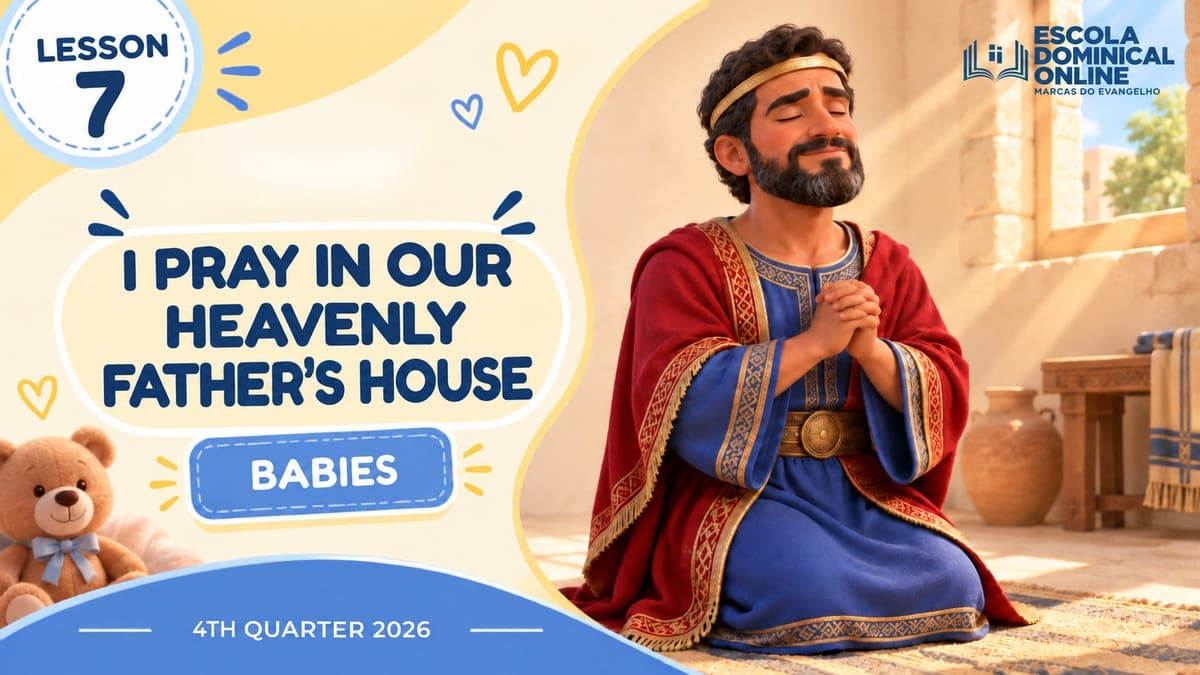
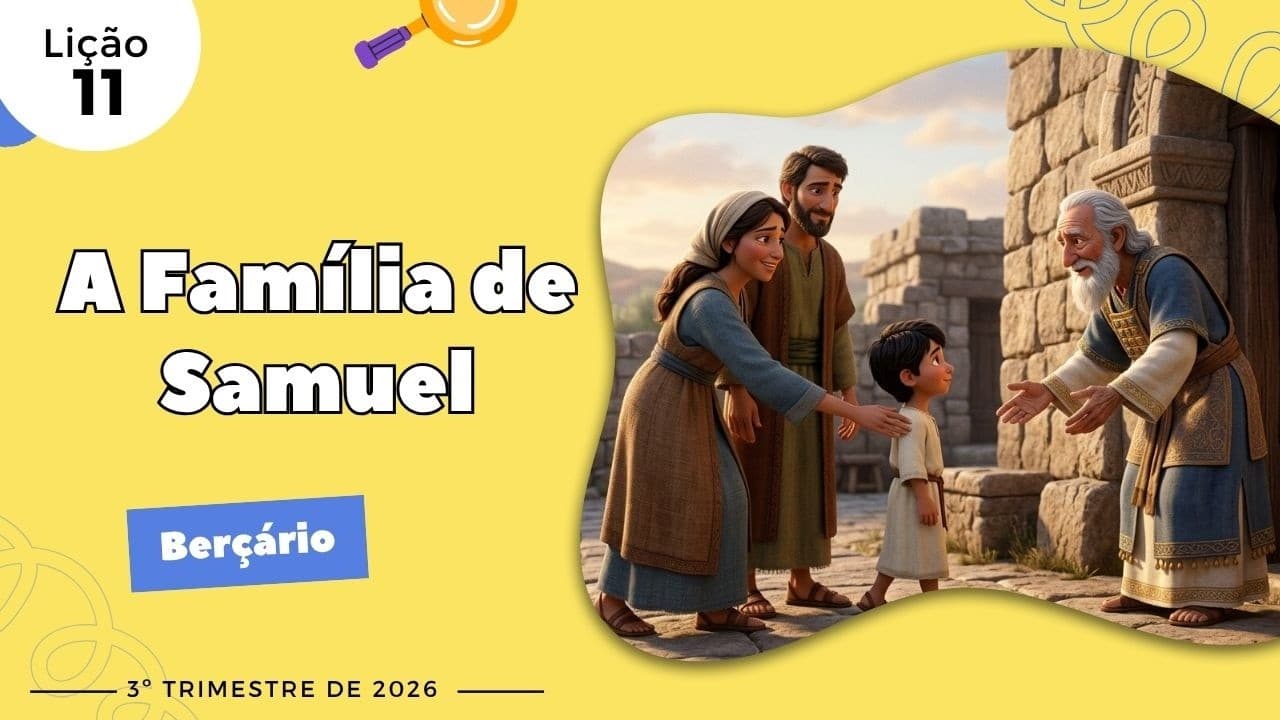
Hannah wanted a son very much and prayed so hard that her lips moved without a sound coming out. No one heard — Heavenly Father heard, and Samuel was born. When the boy grew a little, Elkanah and Hannah gratefully brought him to the house of the Lord. The lesson leaves your little one with a single truth and a gesture to repeat at home: little hands together, and Heavenly Father hears my prayer.
This week's Nursery class fits into a single gesture: two little hands coming together. The video opens with that exact invitation — "put your little hands together and pray with us" — and that is the gesture the child takes home.
The story is about a mommy named Hannah. She wanted a child very much and prayed. She prayed so much that her lips moved and no sound came out at all. No one heard. Heavenly Father heard. And Samuel was born.
From there comes the phrase of the lesson, kept short on purpose: "Heavenly Father hears my prayer."
A word of notice before you begin. The heavy part of Hannah's story — the years of waiting, the weeping, the provocation inside the home — stays with you, the adult. It does not enter the nursery circle, and it does not need to enter for the lesson to work. A child from 0 to 2 years old hears this and only this: Mommy Hannah prayed very softly, Heavenly Father heard, and baby Samuel was born. And remember that a little child does not sit through a class — they alternate: five to ten minutes per moment.
I — Welcome and the verse
Welcome each family at the door with a smile and the baby's name on your lips. If a child arrives afraid to come in, do not force or rush them: draw their attention to a toy or a cozy corner of the room and let curiosity do the rest. What stays imprinted at this age is the association — good room, kind people, safe place.
Take a look around the room before everyone arrives, and take that look during the week, not on Sunday morning: sturdy cribs with no loose parts, a soft and clean floor, covered outlets, washed toys, nothing small within reach of little mouths. In this lesson there are two extra precautions. The first is sound: the whole class revolves around hearing, so everything here is very soft. No loud noises, popping sounds, whistles, or rattles shaken near the ear — a scare truly frightens a baby, and the teaching goes away right along with it. The second is the doll: use a soft, washable cloth baby doll, with no button eyes, no long hair, no ribbon, and no loose parts that could come off, and keep it in your hands at all times.
Next, the verse. With the baby on your lap, invite them: "Let's read the Bible, the Word of God." Open the children's Bible, read slowly, and say, putting their name inside the sentence: "(name), let's go to God's house! Mommy Hannah went to God's house and prayed. Heavenly Father heard."
With the 1- and 2-year-olds, gather the little group in the Bible corner. Put your hands together in front of them, very slowly, so everyone can see the gesture, and have them repeat with you, always the same way: Let-us-go-to-God's-house (Psalm 122:1). Repeat it three times, syllable by syllable. Whoever wants to touch the Bible touches it, one at a time, while you hold it; whoever does not want to claps their little hands. No one is forced to touch anything. In the Nursery, repetition does not tire: it is what teaches.
A note for whoever prepares the verse poster. "Let's go to God's house" is the short form the child can repeat, but the text is longer. Print the full verse beside it for the parents to read: "I was glad when they said to me, “Let us go to the house of the LORD.”" (Psalm 122:1). The child repeats the short version; the parents read the Word.
II — The story: the mommy who prayed very softly
Before telling the story, truly prepare the class: see who needs water, who needs a diaper change, and offer your lap to anyone who arrived crying. An uncomfortable baby does not listen to a story. Then settle each one in the story corner and tell it like this, with the lesson pictures and the cloth doll hidden beside you:
"Look! This is Hannah. Shall we say 'hi' to Hannah? Hi, Han-nah!
Hannah loved Heavenly Father.
Hannah wanted a baby. She went to God's house and talked to Heavenly Father.
She prayed very softly. (Put your hands together and whisper.) Shhh... very softly...
No one heard Hannah. But Heavenly Father heard!
And Heavenly Father sent a gift to Hannah. (Bring the doll out from behind you, slowly.) A baby! Baby Sam-u-el!
What joy! Hannah was so happy that she said 'thank You' to Heavenly Father.
Baby Samuel grew. Daddy Elkanah and Mommy Hannah took Samuel to God's house.
And Samuel stayed there, learning to love Heavenly Father."
❤ For the child's heart. Mommy Hannah prayed so softly that no one heard her voice. But Heavenly Father heard. He hears you too — when you speak, when you cry, and even when you do not know how to talk yet. Heavenly Father hears my prayer.
III — Singing, playing, and having a snack together
Praise. Praise is neither a pastime nor a time-filler: even without knowing how to talk, a baby learns to worship through the example of the person in front of them. Begin by saying: "Let's praise Jesus. Let's sing to Heavenly Father." Hand out rattles — large, washable, with no loose parts that could come off — and sing the song indicated in the quarterly very slowly, in a soft voice. If you want a single line to repeat many times, use this one, to a melody you already know: "Put your little hands together, Heavenly Father hears me." Sing it three or four times. Repetition is what makes it stick.
Playtime. Settle the babies on the floor cushions or in the crib. Make the gentle sound of the rattle away from the ear and at a low volume, wait for their reaction, and place the rattle into their little hand, letting them handle it and bring it to their mouth — and sanitize it before passing it to another child. With the 1- and 2-year-olds, take the opportunity to play "Very softly — you heard it!": the step-by-step instructions are under Class activity, in the Teacher's Guide.
Snack. Talk with the parents beforehand about allergies and dietary restrictions, and serve only what has been authorized. Never force anyone to eat or try something. Nothing round, firm, or ball-shaped: cut very ripe fruit into small, soft strips, under an adult's watchful eye the entire time, and never use pointed toothpicks. Before eating, thank Heavenly Father in a single sentence, connecting it to the story: "Mommy Hannah said thank You for baby Samuel. Thank You, Heavenly Father, for our little snack."
Prayer. Call them to the prayer corner. Little hands together, little eyes closed, voice very soft — and have them repeat with you, slowly: "Heavenly Father, thank You because You hear my prayer. In Jesus' name, amen!"
Activity. With the babies, show the cloth doll, bring it close, let them look and touch, hide it behind your hands and show it again, always repeating the same phrase: "Heavenly Father hears my prayer." With the 1- and 2-year-olds, hand out the lesson sheet and let them color with crayons. If you want something for the parents to keep, stamp both little hands side by side on a sheet of paper using non-toxic, washable tempera paint, washing their hands right afterward — it leaves the print of praying hands. With those who still put everything in their mouths, use only crayons, with you right beside them the whole time. Write each child's name on the sheet and hand it to the family as they leave.
Christ in the Lesson
The chapter begins with an ordinary house and an old problem. Elkanah went up every year to Shiloh — "Year after year Elkanah would go up from his city to worship and sacrifice to the LORD of Hosts at Shiloh, where Eli’s two sons, Hophni and Phinehas, were priests to the LORD." (1 Samuel 1:3) — and every year Hannah came back the same way. The Bible does not soften the picture: there was provocation inside the home, and so it happened year after year (1 Samuel 1:7). Year after year. It is important to say this out loud in a nursery room, where there is almost always someone who waited a long time for a child, or who is still waiting.
What Hannah did with her pain is the heart of the lesson. She did not give up on the place of prayer: "In her bitter distress, Hannah prayed to the LORD and wept with many tears." (1 Samuel 1:10). And she prayed in a way no one around her understood — "Hannah was praying in her heart, and though her lips were moving, her voice could not be heard. So Eli thought she was drunk" (1 Samuel 1:13). The priest, who should have recognized a woman in prayer, thought she was drunk. No one heard Hannah. God heard.
Notice that Hannah did not bargain. She made a vow, and a vow is not a price — it is the advance surrender of what one will receive. When the boy was born, she fulfilled it: "I prayed for this boy, and since the LORD has granted me what I asked of Him, I now dedicate the boy to the LORD. For as long as he lives, he is dedicated to the LORD. So they worshiped the LORD there." (1 Samuel 1:27-28). She gave back in full the gift she had received. That is the opposite of negotiating with God, and it is good for the parents in this class to hear it in plain words: there is no prayer that buys an answer. There is grace that arrives first and a heart that responds.
And there is a phrase in the middle of the chapter that sustains the faith of any weary parent: and the LORD remembered her (1 Samuel 1:19). Not because she prayed more beautifully. Because that is who He is.
What comes next is greater than Samuel. When Hannah sings, she does not sing about a crib — she sings of a world turned upside down: "He raises the poor from the dust and lifts the needy from the ash heap. He seats them among princes and bestows on them a throne of honor. For the foundations of the earth are the LORD’s, and upon them He has set the world." (1 Samuel 2:8). And her song ends by pointing far ahead: "Those who oppose the LORD will be shattered. He will thunder from heaven against them. The LORD will judge the ends of the earth and will give power to His king. He will exalt the horn of His anointed." (1 Samuel 2:10). Anointed. Centuries later, another young woman, also surprised by God, would sing almost the same words in Nazareth — and the Son she carried is the Anointed One whom Hannah could only see from afar.
There is an even finer thread. The priests of that house were corrupt, and God promised: "Then I will raise up for Myself a faithful priest. He will do whatever is in My heart and mind. And I will build for him an enduring house, and he will walk before My anointed one for all time." (1 Samuel 2:35). Samuel was faithful, but he died. The truly faithful Priest, who never fails and never leaves, is Jesus — and it is through Him that our prayer arrives today, with no need for Shiloh and no need for a human intermediary (Hebrews 4:14-16).
That is why the Golden Text of this lesson is what it is. "I was glad when they said to me, “Let us go to the house of the LORD.”" (Psalm 122:1). Hannah went to the house of God weeping and came back with her countenance changed. Samuel grew up inside it. And when the little one in this room puts their little hands together and hears "Heavenly Father hears you", the seed of this is being planted in them: there is Someone who listens. And that Someone has a name. Jesus.
Practical Application
One single phrase, always repeated the same way. "Heavenly Father hears my prayer." Do not invent synonyms throughout Sunday — a small child learns through the exact form, not through abstract meaning.
Pray in front of your child, not just for them. Hannah prayed where people were present, with her lips moving. The baby does not understand the content, but records the scene: the mother who stops, puts her hands together, lowers her voice, and speaks with Someone. That scene teaches more than any explanation they cannot yet receive.
Prayer is not a trade. If someone in the room treats prayer like currency — "I promise this, God gives that" — correct it gently and with the text. God answers because He is good, not because He was paid (1 Samuel 1:27-28).
Care for the baby's safety as part of the lesson. Low sound away from the ear, a washable cloth doll with no loose parts, a large rattle sanitized between one child and another, fruit cut into soft strips, non-toxic paint, nothing small in the room. In the Nursery, caring is teaching: the child learns the care of God by being cared for.
Do not turn Hannah's waiting into staged sadness. No pretend crying, no pitiful voice, no suspense. A baby does not need drama; they need security. Tell the good part with joy, show baby Samuel, celebrate, and move forward.
Closing Prayer
Heavenly Father, thank You because You heard Hannah when no one else heard, and You remembered her. Thank You for Jesus, who opened the way for our prayer to reach You. Hear today the cry of every father and every mother in this little room — those who have already received and those who are still waiting. And teach these little ones, from right now, that when they speak with You, You listen. In Jesus' name, amen.
Frequently asked questions about this lesson
My son is 1 year old and doesn't even talk yet. Does it do any good to teach him to pray?+
It does. He learns the gesture long before he learns the words: little hands coming together, little eyes closing, a voice that grows softer, the "amen" at the end. At this age, prayer comes in through the body and through routine. When the words arrive, their place will already be ready.
What does the name Samuel mean?+
The Bible ties the name to his mother's request: "So in the course of time, Hannah conceived and gave birth to a son. She named him Samuel, saying, “Because I have asked for him from the LORD.”" (1 Samuel 1:20). The name is usually understood as "heard by God" or "God heard" — and that is how it appears in the lesson, because that is exactly what the child needs to keep in mind: God heard.
Hannah promised to give her son back to God. Do I need to promise something for God to answer my prayer?+
No. Hannah's vow was not a payment; it was a surrender: she gave back to the Lord the very gift she had received from Him — "I now dedicate the boy to the LORD. For as long as he lives, he is dedicated to the LORD. So they worshiped the LORD there." (1 Samuel 1:28). Christian prayer is not a trade, and God does not bargain. Grace comes first; we respond. Ask, do not bargain — and never make a promise to God that you cannot keep.
Does God hear every prayer? And what about when the request is not granted?+
He always hears. But hearing is not saying yes to everything, and the Bible does not hide the waiting: that family went up to the house of the Lord year after year (1 Samuel 1:7), and Hannah wept and would not eat before the answer came. Someone who prays and is still waiting is not being forgotten and does not have little faith. No baby in this room is a prize for someone having prayed better.
Hannah left Samuel in the house of God while he was still little. Does that mean I should give my child over?+
Hannah's giving of her son was tied to the vow she herself made, and it is not a model for every family. What remains for us is the heart: recognizing that a child belongs to God before belonging to us, and raising them knowing this. And notice the tenderest detail in the next chapter — "Each year his mother would make him a little robe and bring it to him when she went with her husband to offer the annual sacrifice." (1 Samuel 2:19). Hannah gave him over and continued to be a mother.
My baby cries or squirms right at prayer time. Am I being a disruption?+
No. Babies have short stamina, and crying or getting distracted is their way of saying "that's enough for now." The Nursery class is set up this way on purpose: short moments, a lap available, no one forced to stay still. Pray with him in your lap, even if he is squirming — he is hearing your voice, and that is what teaches.
Teacher's Guide
Essence of the class
Mommy Hannah prayed very softly and Heavenly Father heard. He hears my prayer too.
Map of the class
| Time | Stage |
|---|---|
| 0–5 min | Welcome, each baby's name, parents greeted at the door |
| 5–10 min | Start like this: little hands together and the surprise box |
| 10–16 min | Praise with rattles, at a low volume |
| 16–23 min | Verse (Psalm 122:1) in the Bible corner |
| 23–30 min | Story: the mommy who prayed very softly |
| 30–36 min | Class activity "Very softly — you heard it!" |
| 36–41 min | Snack, with the prayer of thanks |
| 41–45 min | Activity, prayer corner, and goodbye |
Start like this
Sit on the floor, at their level, with a closed colorful box on your lap. Before opening it, put your two hands together in front of your face, very slowly, and speak syllable by syllable, in a voice softer than usual: "Let-us-pray." Wait. Count three seconds in silence, smiling — it is during this pause that the baby reacts. Some will imitate your hands; others will just look, and looking is already responding.
Then say in a whispery secret voice: "Mommy Hannah prayed like this, very softly. And Heavenly Father sent a gift to her. Guess what it is?" Count slowly — "one... two... three!" — and take the cloth doll out of the box. Cradle it in your arms: "It's a baby! Baby Sam-u-el!" Let them touch it, one child at a time, keeping the doll in your hands at all times. Expect little fingers pointing and little hands reaching out to hold it — that is how they ask questions.
Point 1 — Mommy Hannah prayed very softly
- In the quarterly: the story time, with the lesson pictures.
- What to teach: Hannah loved the Lord, wanted a child, and took her request to the house of God. She prayed with her lips moving and no voice coming out — no one around her understood, and the priest himself was mistaken about her. In the Nursery this is taught with one sentence and a whisper: "Mommy Hannah prayed very softly."
- Anchor verse (BSB): "Hannah was praying in her heart, and though her lips were moving, her voice could not be heard. So Eli thought she was drunk" (1 Samuel 1:13).
- Key question: "Where are the little hands? Put them together! Let-us-pray." (Put yours together and wait.)
- Likely answers (+ going deeper): the baby who imitates and puts their hands together, the one who just claps, the one who points to your hands, the one who stays quiet and watches. Go deeper: "That's right! Mommy Hannah put her hands together and talked to Heavenly Father!"
- If no one speaks: do it yourself three or four times, always the same way, always in the same soft voice. At this age, imitating is already responding — and the child who only watches is also learning.
Point 2 — Heavenly Father heard
- In the quarterly: the verse time and the prayer corner.
- What to teach: the Lord remembered Hannah and gave her the child she asked for. Hannah did not pay for this — she received and gave back, taking Samuel to the house of God to serve there. The child keeps the scene: Mommy asked, Heavenly Father heard, and the baby arrived.
- Anchor verse (BSB): "I prayed for this boy, and since the LORD has granted me what I asked of Him," (1 Samuel 1:27).
- Key question: "Shall we say it together? Let-us-go-to-God's-house!"
- Likely answers (+ going deeper): loose syllables, one child who repeats only the last syllable, another who reaches out toward the Bible, another who giggles. Go deeper: "Very good! Hannah went to God's house and Heavenly Father heard her."
- If no one speaks: repeat it yourself, very slowly, syllable by syllable, with the children's Bible open in your hand. At this age rhythm holds their attention more than words — speak as though singing.
✝ Christ in the Lesson. Hannah prayed in a place where not even the priest understood her properly, and even so she was heard. Today our prayer does not depend on Shiloh or on any man: Jesus is the faithful High Priest whom God promised to raise up (1 Samuel 2:35), and it is through Him that we come to the Father with confidence (Hebrews 4:14-16).
Class activity
- Goal: to feel, through play, that even the softest sound is heard — and that Heavenly Father hears the softest prayer of all.
- Materials: a large, washable rattle with no loose parts that could come off (or simply your own hands, rubbing slowly together). Nothing small, nothing with string, cord, or ribbon. Do not use a whistle, horn, banging lid, or anything that pops: a scare truly frightens a baby and unravels the class.
- Step by step: everyone on the soft floor or on the helpers' laps. Say: "Let's listen?" and bring your finger to your lips: "Shhh..." Make the sound very softly, far from any child's ear, on one side of the circle. Wait three seconds in silence, smiling. As soon as a baby turns their head, widens their eyes, or stops moving, celebrate with gentle claps: "You heard it! You heard it!" Repeat three or four times, changing sides, so everyone gets a turn to listen. Then offer the rattle to the little hand of whoever wants to hold it, one at a time, sanitizing it between one child and another — no one is singled out, no one is put in the middle of the circle, no one is forced to take it. Close by putting your hands together: "Let-us-pray."
- Wrap-up: Mommy Hannah prayed so softly that no one heard her voice. But Heavenly Father heard. He hears you too (1 Samuel 1:13).
Wrap-up + challenge of the week
- Wrap-up: "Mommy Hannah wanted a baby and went to talk to Heavenly Father. She prayed very softly, and Heavenly Father heard. Baby Samuel was born, and the whole family went to God's house to say thank You. Heavenly Father hears your prayer too — by day, by night, and even when you speak very softly."
- Challenge: parents, do this together. Every night at bedtime, hold your child's little hands inside yours, lower your voice, and pray a single sentence, always the same one, the whole week long: "Heavenly Father, thank You because You hear my prayer." Before the amen, say out loud one request from your home — the same request every day, without changing it. On Sunday, come back with the story. (Follow up the next Sunday: open the class by asking the parents what the week's request was and whether the baby already puts their little hands together on their own.)
Teacher's kit
- Before: read the whole of 1 Samuel 1 during the week, until the story is on the tip of your tongue, and read 1 Samuel 2:12-36 knowing that it stays with you and does not go into the circle. Set aside the cloth doll (soft, washable, with no button eyes, no long hair, no ribbon) and the surprise box. Do the room safety check during the week, not on Sunday — and remove any string, cord, bow, or small part from the room. Confirm allergies and dietary restrictions with the families. Agree with the church on the rule of always having two adults in the room, with the door open or with a window panel.
- Bring: a children's Bible, the lesson pictures, the cloth doll in the surprise box, large washable rattles, crayons, non-toxic washable tempera paint, the activity sheet, and the authorized snack cut into soft strips.
- Pray beforehand: thank Jesus for being the High Priest who brings our prayer to the Father, and ask the Lord for two very concrete things: patience to repeat the same phrase without tiring and attentive eyes for the comfort and safety of each baby. Pray also, by name, for the parents of your little group — and with special care for anyone still waiting for an answer that has not arrived.
Homework
Your mission for the week
Parents, do this together. Every night at bedtime, hold your child's little hands inside yours, lower your voice, and pray a single sentence, always the same one, the whole week long: "Heavenly Father, thank You because You hear my prayer." Before the amen, say out loud one request from your home — and keep the same request every day, without changing it.
Why
Hannah prayed for years, with her lips moving and no voice coming out, and she was heard: "I prayed for this boy, and since the LORD has granted me what I asked of Him," (1 Samuel 1:27). Your child does not know how to pray yet — but they learn the gesture, the tone of voice, and the right time long before learning the words. Repeating the same request all week teaches them, and you, that prayer is not a lottery: it is persevering with the One who listens.
How to know you did it
Seven nights, the same sentence, little hands together. If you can say, without thinking, what your home's request was this week, you did it.
On Sunday, come back with the story
Next week's class begins with the parents sharing: what was the request of the week, and does your child already put their little hands together on their own when they hear "let's pray"?
Soli Deo Gloria — Scripture governs; everything else, on its knees.