Golden Text
“I delight to do Your will, O my God; Your law is within my heart.” (Psalm 40:8, BSB) · Read in the Bible
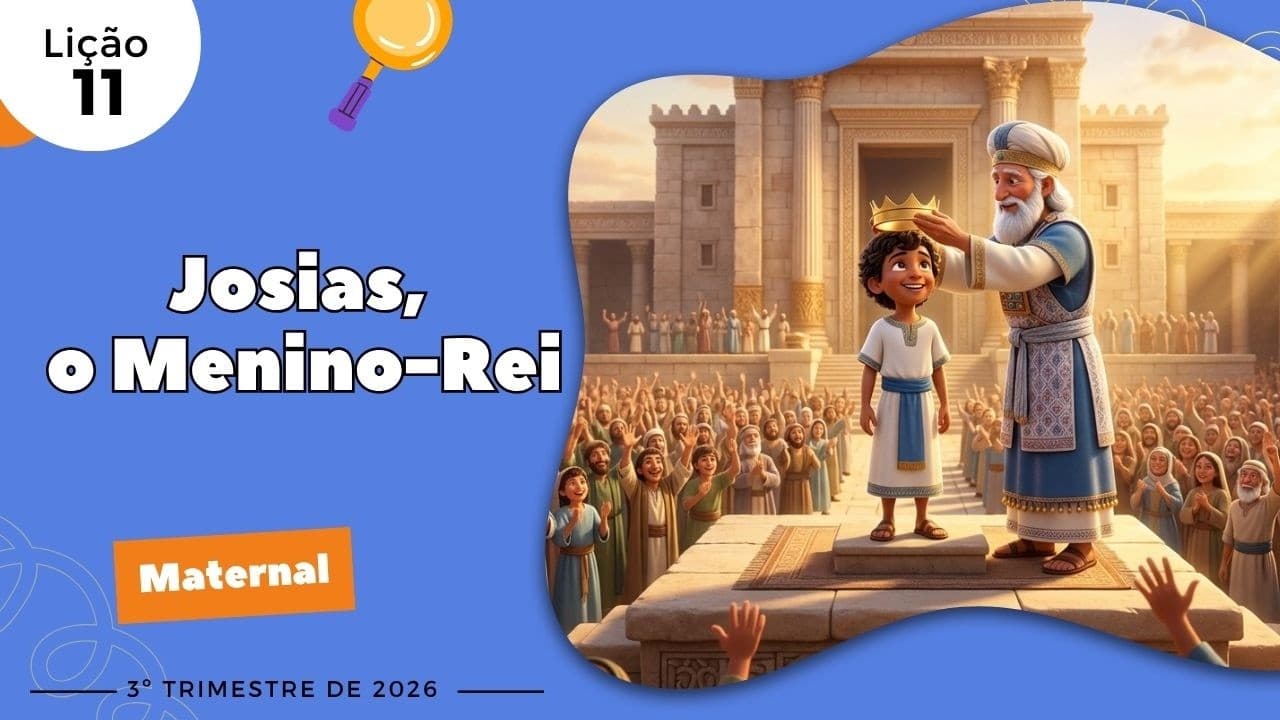
An eight-year-old boy became king. He loved our Heavenly Father, felt sad to see the House of God broken and dirty, and ordered everything to be repaired. In the middle of the cleanup, the workers found a treasure hidden in the stones: the Book of God. A lesson in short cycles about the Bible being the greatest treasure — with a crown, an invisible hammer, and one phrase repeated all morning long.
Teacher, this lesson has a present wrapped up inside it: a cleanup that ends in treasure. Keep that order in mind, because it is what holds your class's attention. First the mess, then the work, and only then the shine.
The story is about a boy. That alone is worth gold in the Preschool classroom: for the first time in the quarter, the king in the story is the size of your students. "Josiah was eight years old when he became king, and he reigned in Jerusalem thirty-one years. His mother’s name was Jedidah daughter of Adaiah; she was from Bozkath." (2 Kings 22:1) Say that and count on your fingers — the whole class will want to show how old they are.
Keep three sentences in mind and repeat them all morning long: "Josiah was eight years old and became king", "they found the Book of God hidden in the stones" and "the Bible is my treasure".
Two precautions before you begin. The first is the tone for the broken House. It comes in sad, never scary: a soft little voice, a sympathetic face, and it passes quickly. No darkness, no creatures, no danger or threats. The child leaves here with the picture of the temple clean and shining in their head — that is the picture you are building.
The second precaution is not to turn the lesson into a good-behavior medal. Josiah did not please God because he was clever; he loved our Heavenly Father, and love became obedience. If the class ends with "be a good boy," it died halfway through. It ends in Jesus, the King who cleans the heart — and it is about Him that the treasure found in the stones speaks.
I — Arrival: the Surprise Box and the shining crown
Arrive early. While you organize the supplies, pray for the children and their families. Welcome each one by name, crouching down at eye level, just as the quarterly asks: "How are you, little friend?" And encourage them to greet one another that way too.
Open the Bible and show the books of Kings and Chronicles. Say: "It is from right here, from the Book of God, that today's story comes. We have already met several kings, haven't we? Today the king is a boy — just your size!"
Now bring out the closed Surprise Box and build the mystery:
— What could be inside here today? Shall we open it together? One... two... three!
Take out from inside a crown — made of poster board, metallic paper, whatever you can manage. Hold it up high, turning it slowly so everyone can see it shine.
— Look what this is! A cro-wn! Who wears a crown? THE KING! And today our story is about a very little king. He was eight years old. Shall we count on our fingers, very slowly? (Everyone with their little hand closed.) One, two, three, four, five, six, seven... EIGHT!
Let each child put the crown on their head for a moment, if they want to — without forcing anyone and without a line of kids fighting over it. Then leave the crown in plain sight for the whole class.
Collect the offerings with a single sentence, as the quarterly guides: "our offering helps a little friend who needs food and clothes. Thank You, Heavenly Father!" And ask the children for help at several moments during the morning — handing out the crayons, picking up the papers, putting away the supplies. They love to help, and today that is the whole lesson in miniature. Thank each one by name when they help.
After that, a lively time of praise: clapping, jumping, loud voices.
🏛 Fun fact — what is a scroll? In the time of King Josiah nobody had a little book with pages like ours. The Word of God was written on long, long sheets that were rolled up on two little sticks, like a roll of paper. That is called a scroll. To open it, a person would unroll it very slowly. Make one with the class: glue the ends of a large sheet of paper onto two wooden skewers and write the verse in the middle. When you unroll it in front of them, you will get a free "wow."
II — The story: the boy king, the cleanup and the hidden treasure
Seat the children in a circle, very close to you, with the pictures from the quarterly in your hand.
A long, long time ago, there was a boy named Josiah. Shall we say his name while clapping our hands? JO-SI-AH! And do you know what happened to him? He became king. At eight years old!
(Put the crown on your head and strike a kingly pose, nice and funny.)
King Josiah was small like you. But he loved our Heavenly Father very, very, VERY much.
Except there was one thing making the king feel sad.
(Now lower your voice. Make a sympathetic face. Slowly.)
The House of our Heavenly Father was broken. And it was dirty. People had forgotten to take care of it for a very long time. Shall we make a sad face together? (Everyone does it. Hold it just a little bit — and then turn it right around.)
Then King Josiah did something very beautiful: he closed his little eyes and prayed. Shall we do the same? Little hands together, little eyes closed... "Heavenly Father, help us fix Your House." Done! You can open them!
And our Heavenly Father heard. The king called the workers and said: let's fix everything!
(Now get everyone standing up. This part is noisy, and it is meant to be.)
Little friends, on your feet! Let's help King Josiah! Grab your invisible hammer! Hold it tight! Let's hammer the little stones: TAP, TAP, TAP! (Three times, in rhythm.) Now drop the hammer and grab the big broom! Let's sweep away the dirt: SWISH, SWISH, SWISH! (Three times, sweeping the air.)
Wow! Look how nice and clean it is! (Clapping, jumping.) You can sit down very slowly.
And now comes the best part.
(Bring your voice back to a whisper. Eyes wide. Real suspense.)
While the men were working, one of them reached his hand in among the stones... and found something hidden inside there.
What could it be? A toy? (Let them guess. Listen to two or three.)
It wasn't a toy, no! It was a roll of paper all rolled up, kept in there for a very long time. (Unroll the scroll slowly, very slowly.) It was the Book of God! It was the Word of our Heavenly Father — our Bible!
Let's shout together: I FOUND THE TREASURE!
The king was so, so happy. He gathered all the people and read the Book of God out loud for everyone to hear. And everyone promised: "we are going to obey our Heavenly Father!"
(Hold the Bible up high, with both hands.)
Little friends, this book right here is the greatest treasure in the world. Prettier than a toy. Shinier than gold. Do you know why? Because right here our Heavenly Father tells us that He loves us — and right here we get to know Jesus.
❤ For the child's heart. King Josiah ordered a big house made of stone to be fixed. But do you know what our Heavenly Father's favorite little house is? (Put your hand on your chest.) It is your heart. And there is something that only Jesus knows how to do: when we do something wrong and our little heart gets dirty, Jesus cleans it. All we have to do is ask. He doesn't get mad, He doesn't go away — He cleans it and stays right close to us. That is why Jesus is our King, the best King of all.
III — Sing, memorize and keep in the heart
Sing. A short song with gestures, three times in a row: "The Bible is my treasure, the Book of our Heavenly Father." Little hands open like a book on the word "Bible," hands on the chest on "treasure."
The verse with two gestures. Unroll the scroll you made and hold it up high. The whole verse is too long for this age, so teach only the final little piece, always the same, word for word: that God's law is inside the heart (Psalm 40:8). The gestures: when speaking of the law, their little hands open like a book; when speaking of inside the heart, both hands close the book against the chest. Repeat three times. Explain very simply: "keeping the Word in your heart means listening to the Bible story and doing what it says, with joy."
The King's Helpers' Simon Says. Everyone standing, everyone doing it together — nobody singled out, nobody eliminated, nobody touching anybody. Simon says march like the king's helpers: march, march, march... and STOP! Simon says hammer the little stones: tap, tap, tap! Simon says sweep the dirt: swish, swish, swish! Simon says give yourself a big bear hug, because Jesus helps us obey! Simon says put on King Jesus' crown and strike a strong pose! Finish with applause for everyone: "you are the best helpers of the King!"
The hunt for the scroll. It is in the step-by-step of the Class activity, further ahead in the Guide — it is the moment when the whole class searches together and finds the treasure.
The crowns. Do the activity from the quarterly: poster board cut out in the shape of a crown and metallic paper cut into ovals and diamonds, imitating precious stones. Each child decorates their own, gluing on the "little gems." While they glue, chat softly: "King Josiah was small and loved our Heavenly Father. And you can love our Heavenly Father while you are little too!" At the end, fasten each crown and place it on the head of the child who made it. Praise the effort, not the result — a crooked crown is a beautiful crown, and no child compares theirs with the one next to them if you don't compare first.
Student's workbook and goodbye. Hand out the quarterlies, pencils and crayons. Ask them to look at the drawings, explain that the Word of God used to be written on a scroll, and guide them to circle the picture of the scroll and color it. After that, have them draw the crown. While they draw, ask little questions about the story: "how old was Josiah?", "what did they find in the stones?". At dismissal, sitting in a circle, talk about the House of the Lord: we don't throw candy wrappers on the floor, we help keep it nice and clean, because the House of God is a dearly loved place. And agree on the safety rule: if you see something broken, wet or sharp, do not touch it — call the teacher. The grown-up is the one who fixes it; the child tells the grown-up. Put the supplies away together while clapping in rhythm, review the three sentences, pray and say goodbye to each child by name.
Christ in the Lesson
Start with the saddest detail of the story, because it is what gives the measure of everything that comes after: the Word of God was lost inside the very house of God. It was not stolen, it was not burned by an enemy — it was forgotten. It stayed under the rubble for so long that, when it turned up, no one recognized it right away: "Then Hilkiah the high priest said to Shaphan the scribe, “I have found the Book of the Law in the house of the LORD!” And he gave it to Shaphan, who read it." (2 Kings 22:8) It is possible to have a temple standing, a priest working and a worship service happening, and even so have the Word tucked away in a corner that nobody opens. That holds true for a church. It holds true for a home.
Notice also where the Book turned up: in the middle of the repair work. Josiah did not set up a study committee; he ordered the cracks of the house to be repaired — to repair the damage of the temple (2 Kings 22:5) — and it was right there, in the dust, that the treasure appeared. God usually hands His Word to those who already have their hands dirty doing what they know needs to be done.
And look at what the king did with what he found. He did not put it away on a shelf, he did not make a luxury copy: "And he went up to the house of the LORD with all the people of Judah and Jerusalem, as well as the priests and the prophets— all the people small and great— and in their hearing he read all the words of the Book of the Covenant that had been found in the house of the LORD." (2 Kings 23:2) He read it out loud, to all the people, from the least to the greatest — the children were there. Then he stood up and committed himself: "So the king stood by the pillar and made a covenant before the LORD to follow the LORD and to keep His commandments, decrees, and statutes with all his heart and all his soul, and to carry out the words of the covenant that were written in this book. And all the people entered into the covenant." (2 Kings 23:3) The Word found became the Word read, and the Word read became a changed life. That is the whole path, and not a single step can be skipped.
Now, where all of this points. It is nice to say that Josiah loved the Law, but if the lesson stops there he becomes just a model boy and the child leaves with a burden on their lap. Jesus Himself said where the Temple scroll leads: "You pore over the Scriptures because you presume that by them you possess eternal life. These are the very words that testify about Me," (John 5:39) And, after He rose again, He did the reading aloud that was missing: "And beginning with Moses and all the Prophets, He explained to them what was written in all the Scriptures about Himself." (Luke 24:27) The treasure hidden in the stones is the same treasure the child has today on the nightstand — and the subject of the treasure is Christ.
The contrast closes the lesson. Josiah restored a house of stone, which the years tore down again. Jesus restores what no hammer can reach: "Do you not know that you yourselves are God’s temple, and that God’s Spirit dwells in you?" (1 Corinthians 3:16) He did not come to fix walls; He came to clean hearts and live inside. And the grace that does this is not a prize for good behavior — it is an invitation, and the invitation remains open to whoever responds.
To the child, say it simply: "King Josiah fixed the House of God. Jesus fixes our heart. And the Bible is the Book that tells about Jesus — that is why it is the greatest treasure."
Practical Application
Let the child see the Bible being opened. At this age it does no good to explain that the Word is important — they need to see it. A Bible that stays open on the table, a father who sits down and reads aloud, a mother who says "let's see what our Heavenly Father says today." The child figures out on their own what nobody needed to say.
A short little story is worth more than a chapter. Two minutes, every day, at the same time. Repeating the same story all week long is not laziness — it isussa—no, it isigh—it is exact: it is exactly how Preschoolers learn. They will finish the sentences before you do and will love it.
Do not use the Bible as a punishment or a demand. None of that "go read the Bible so you learn how to behave." Here the Word is a celebration, a treasure, a warm lap. Fear creates distance; joy creates a habit.
Taking care of the House of God is child-sized. On Sunday, let them help: putting away the toy, throwing the paper in the trash, carrying the little chair. And teach the rule right alongside it: anything broken, wet or sharp they do not touch — they call an adult. The adult handles it; the child tells them.
Obeying out of love, not out of fear. When they obey, do not say "what a smart boy." Say: "that made our Heavenly Father's heart glad — and mine too." The praise teaches the reason, and the reason is what stays.
Tell them when you make a mistake and ask for forgiveness. Josiah heard the Word and recognized that the people had drifted away. A child who sees their father say "I made a mistake, and Jesus forgave me" learns that the Word is not for the perfect — it is for those who want to come back.
Closing Prayer
Heavenly Father, thank You for King Josiah, who was very little and loved You with all his heart. Thank You because, in the middle of the cleanup, You let Your Book be found. Teach these children to love the Bible starting right now — even before they know how to read. May Your Word be opened this week in every little home represented in this classroom. Keep each family, keep each teacher. And thank You for Jesus, our King, who does not fix walls: He cleans our heart and lives in it. In His name, amen.
Soli Deo Gloria — Scripture governs; everything else, on its knees.
Frequently asked questions about this lesson
Who was Josiah and what does Preschool Lesson 11 teach?+
Josiah was a king of Judah who began to reign while still a boy: "Josiah was eight years old when he became king, and he reigned in Jerusalem thirty-one years. His mother’s name was Jedidah daughter of Adaiah; she was from Bozkath." (2 Kings 22:1). He loved our Heavenly Father, saw the House of God broken, and ordered it to be repaired. During the work, the high priest found the Book of the Law kept there (2 Kings 22:8). For a 3- and 4-year-old child, the lesson fits into one sentence: the Bible is the greatest treasure, and we listen and obey because we love our Heavenly Father.
How can I tell the part about the broken Temple without scaring the child?+
Use sadness, never fear. Lower your voice, make a sad face, and say only: 'our Heavenly Father's House was broken and dirty because people forgot to take care of it.' Do not describe ruins, darkness, bugs, or danger, and do not spend too much time on this part — it is only there so the joy of the cleanup and the discovery can come afterward. And never use the broken House as a threat ('if you don't obey...'). The child leaves class with the image of the temple clean and shining, not with the image of the broken temple.
What is the verse for Preschool Lesson 11 and how do I teach it with gestures?+
Psalm 40:8: "I delight to do Your will, O my God; Your law is within my heart." (Psalm 40:8). It is too long for this age, so teach only the final part, word by word, about God's law being within our heart (Psalm 40:8). Always do the same two gestures: when speaking of God's law, little hands open like a book; when speaking of it being within our heart, both hands close the book against the chest. Repeat three times, always the same way. The quarterly gives the verse with slightly different wording — the meaning is the same.
Was Josiah eight years old when they found the Bible in the Temple?+
No, and it is worth knowing so you do not get it wrong if a parent asks. He was eight years old when he began to reign (2 Kings 22:1). The Book was found much later, in the eighteenth year of his reign (2 Kings 22:3), when Josiah was already an adult, around twenty-six years old. For a 3- and 4-year-old child, none of this goes into the story: they remember 'eight years old and became king' and 'they found the Book of God.' The math stays with you.
My child cannot read yet. Does it make sense to give an activity with the Bible?+
Yes, it does, and it is the best time. A Preschool child does not learn by reading — they learn by seeing, hearing, and repeating. When they see Mom or Dad picking up the Bible, opening it, and telling a short story, they learn before knowing a single letter that this book is important in this home. That is why this week's homework is to find the Bible, open it, and listen. Reading comes later; loving it comes now.
Doesn't this lesson just turn into 'be a good boy like Josiah'?+
It does, if you stop at Josiah. That is why the class does not stop with him. The treasure found in the Temple points to Christ — Jesus said that the Scriptures testify about Him (John 5:39). Josiah ordered a house of stone to be repaired; Jesus is the King who cleanses and lives in our heart. Say it simply to the class: 'King Josiah repaired the House of God. Jesus repairs our heart.' A child's obedience is born from this love, not from trying to earn a good grade with God.
Teacher's Guide
Essence of the class
The Bible is the greatest treasure — and King Jesus, of whom it tells, cleans and lives in our heart.
Map of the class
| Time | Stage |
|---|---|
| 0–7 min | Arrival, the Surprise Box with the crown + offering and gratitude |
| 7–12 min | Lively praise + verse with the two gestures, on the scroll |
| 12–20 min | The story: the boy king, the cleanup and the hidden treasure |
| 20–26 min | Class activity "King Josiah's cleanup" (with the hunt for the scroll) |
| 26–32 min | The King's Helpers' Simon Says |
| 32–40 min | Snack + the metallic paper crowns + quarterly activities |
| 40–45 min | Goodbye circle, prayer, review and dismissal |
Start like this
Come in with the Surprise Box closed and build the mystery: "What could be inside here today? Shall we open it together? One... two... three!" Take out the crown and hold it up high, turning it slowly so it shines. Ask: "Who wears a crown?" They will shout "king!", "queen!", "princess!" — and someone will say "me!". Great, welcome it. Close like this: "That's right! And today our story is about a very little king, just your size. He was eight years old. Shall we count on our fingers?" Count slowly up to eight with the whole class and leave the crown in plain sight all morning.
Point 1 — An eight-year-old boy became king
- In the quarterly: the story section, at the opening, when it explains that the stories of the kings are in the books of Samuel and Kings and introduces the boy who became king at eight years old (pictures 11.1 and 11.2).
- What to teach: Josiah was small like the students and loved our Heavenly Father very much. Being small did not get in the way at all. Count the eight years on your fingers with the whole class, slowly, and let each child show how old they are. Do not talk about the wicked kings who came before or about idols being destroyed — for 3- and 4-year-olds, it is enough that this king loved God.
- Anchor verse (BSB): "Josiah was eight years old when he became king, and he reigned in Jerusalem thirty-one years. His mother’s name was Jedidah daughter of Adaiah; she was from Bozkath." (2 Kings 22:1)
- Key question: "Shall we count on our fingers how old Josiah was? One, two, three..."
- Likely answers (+ going deeper): tangled little fingers, a child who counts up to twenty, a child who shouts their own age. Welcome them all. Go deeper: "that's right! And do you know what? Our Heavenly Father loves little ones just as hugely."
- If no one speaks: count by yourself, nice and loud and exaggerated, showing your fingers one by one. Halfway through, the class joins in.
Point 2 — The House of God was broken, and the king prayed and ordered it repaired
- In the quarterly: the story section, when the House of our Heavenly Father appears needing repair and the king calls people to fix it (picture 11.3).
- What to teach: the House of God was broken and dirty because people had forgotten to take care of it. The king was sad, closed his little eyes and prayed, and then called the workers. Two things in the same scene: he talked with God and he worked. The sadness comes in with a soft voice and passes quickly — without fear, without darkness, without threats. The long part is the noisy cleanup.
- Anchor verse (BSB): "And let them deliver it into the hands of the supervisors of those doing the work on the house of the LORD, who in turn are to give it to the workmen repairing the damages to the house of the LORD —" (2 Kings 22:5)
- Key question: "Shall we help the king? Grab the invisible hammer! Tap, tap, tap! Now the broom! Swish, swish, swish!"
- Likely answers (+ going deeper): hammering the air at full strength, a child who sweeps the actual floor, a child who sits down in the middle. That is fine. Go deeper: "look how nice and clean it is! The king prayed and worked. We can do both too."
- If no one speaks: start by yourself, with a loud "tap, tap, tap" sound and an expression of effort. Imitation at this age is instant.
Point 3 — They found the treasure: the Book of God
- In the quarterly: the story section, when the priest finds the roll of paper in the wall, shows it to the king and the king reads it to all the people (picture 11.4); and the section where the quarterly gives the verse and teaches how to make the scroll with two sticks.
- What to teach: in the middle of the repair work, they found a hidden scroll — it was the Book of God, the Bible. The king read it out loud to everyone, and the people promised to obey. Hold up the Bible with both hands and say the sentence of the day: the Bible is the greatest treasure. Here is the climax: use suspense before and celebration after. And close in Christ: "this Book tells about Jesus, the King who cleans our heart."
- Anchor verse (BSB): "Then Hilkiah the high priest said to Shaphan the scribe, “I have found the Book of the Law in the house of the LORD!” And he gave it to Shaphan, who read it." (2 Kings 22:8)
- Key question: "What could have been hidden in the stones? A toy? (suspense) It was the BOOK OF GOD! Let's shout: I found the treasure!"
- Likely answers (+ going deeper): they will guess a toy, candy, money, gold. Perfect — the guessing is what makes the surprise work. Go deeper: "it is better than gold! Because right here is where we get to know Jesus."
- If no one speaks: unroll the scroll very slowly, in silence, with an expression of amazement. Silence draws everyone's eyes.
Class activity
- Goal: to live the story with their bodies — working together and finding the treasure together —, with everyone participating at the same time, without anyone singled out, without competition and without physical contact.
- Materials: a "scroll" (a large sheet of paper rolled onto two wooden skewers, or just a little roll of paper tied with string), the paper crown and your Bible.
- Step by step: before the class comes in, hide the scroll in a low, easy spot in the room — behind a cushion, under a little chair, in the corner of the rug. Never up high, inside a cabinet, behind wobbly furniture or near an electrical outlet. When the time comes, put on the crown and announce: "the king's helpers are going to fix the House of God!" Everyone standing. First they hammer the air together — tap, tap, tap — three times. Then they sweep the air together — swish, swish, swish — three times. Then you stop everything and whisper: "wait... the king said there is a treasure hidden here. Shall we look for it?" Everyone searches at the same time, walking (never running), with you guiding: "getting warm... getting cold...". Whoever finds it first does not win anything — the instant it turns up, gather the class and say: "we found it!" Everyone shouts together: "I FOUND THE TREASURE!" Sit in a circle, unroll the scroll slowly and read the verse out loud, just as the king did. Repeat the hunt as many times as time allows, hiding it in different places.
- Wrap-up (back to the text): "King Josiah's workers found the Book of God hidden in the stones, and the king read it for everyone to hear. The Bible is the greatest treasure — and it is what tells us about King Jesus."
Wrap-up + challenge of the week
- Wrap-up: "Josiah was eight years old and became king. He saw the House of our Heavenly Father broken, prayed and ordered everything fixed. And in the middle of the cleanup a hidden treasure turned up: the Book of God, our Bible! The king read it to everyone and promised to obey. The Bible is our greatest treasure, because it is what tells about Jesus. And Jesus is the King who does not fix walls, no — He cleans our little heart and lives in it."
- Challenge: ask the parents at the door: Dads and moms, this activity is to do together with your child, once a day this week. Play Bible treasure hunt. Hide the family Bible in an easy and safe spot, at the child's height — under the cushion, behind the door, on top of the bed. Then say: "where is our treasure?" and let them look for it. When they find it, shout together: "I FOUND THE TREASURE!" Sit on the floor, open it and read a very short little story, two minutes long — it can be the same one every day, they will love it. At the end, the child puts their little hand on top of the Bible and says on their own: "The Bible is my treasure." On Sunday, come back with the story.
Teacher's kit
- Before: read 2 Kings 22 and 23:1-3 with your Bible open and the story section of the quarterly beside you. Memorize the three anchor sentences — "Josiah was eight years old and became king", "they found the Book of God hidden in the stones", "the Bible is my treasure" — and practice your voice: the boy-king part is cheerful and counted on your fingers; the broken-House part is soft, sad and short; the cleanup is loud and noisy; the discovery starts in a whisper and ends in a shout.
- Bring: the Surprise Box with the crown, the scroll with the verse (large sheet of paper + two wooden skewers), your Bible, poster board cut out into crowns, colored metallic paper cut into ovals and diamonds, glue, stapler, crayons and the quarterly.
- Good to know (counting the years): Josiah was eight years old when he began to reign (2 Kings 22:1); the Book was found much later, in the eighteenth year of his reign (2 Kings 22:3), when he was already an adult. In the classroom that does not come up — the child keeps "eight years old and became king." But if a parent asks, you will give the right answer. The quarterly also says he reigned thirty years; the biblical text says thirty-one.
- About the verse: the quarterly brings Psalm 40:8 in a wording slightly different from what you will read in your Bible, as translations differ at this point: "I delight to do Your will, O my God; Your law is within my heart." (Psalm 40:8) With the children, use only the final piece, always with the same words and the same two gestures.
- Safety: hide the scroll in a low spot, in plain sight and free of obstacles — never up high, inside a cabinet, behind wobbly furniture or near an electrical outlet, and never let anyone climb on anything to search. In the hunt everyone searches together and the find belongs to the whole class: nobody wins, nobody loses, nobody is the chosen one. No physical contact in the games. Do not compare the crowns or put anyone's on display by itself. Agree with the class on the House of God rule: anything broken, wet or sharp the child does not touch — they call the teacher. The grown-up is the one who fixes it; the child tells the grown-up. And if any child shares something serious from home, welcome them right away without asking for details in front of the others — "thank you for telling me, let's pray right now" —, pray a single sentence and bring the matter to the leadership that same day.
- Watch the tone: the quarterly, in the crafts section, suggests praising the child by saying they are "smart and kind" when they obey. Prefer to connect obedience to love rather than merit: "that makes our Heavenly Father's heart glad." A child does not obey in order to be approved by God — they obey because they are already loved.
- Pray beforehand: ask the Lord for love for the Word. In this lesson, the way you hold up the Bible teaches more than everything you say about it.
Homework
Your mission for the week
Dads and moms, this activity is to do together with your child, once a day this week. Play Bible treasure hunt. Hide the family Bible in an easy and safe spot, at their height — under the cushion, behind the door, on top of the bed —, and ask: "where is our treasure?" Let the child look for it. When they find it, shout together: "I FOUND THE TREASURE!" Then sit on the floor, open it and read a very short little story, two minutes long — it can be the same one every day, they will love it. At the end, the child puts their little hand on top of the Bible and says on their own: "The Bible is my treasure."
Why
King Josiah's workers found the Book of God hidden among the stones, and the king read it aloud to all the people: "And he went up to the house of the LORD with all the people of Judah and Jerusalem, as well as the priests and the prophets— all the people small and great— and in their hearing he read all the words of the Book of the Covenant that had been found in the house of the LORD." (2 Kings 23:2) A 3- or 4-year-old child does not understand a lecture about the Word — but they understand a treasure hunt, a celebration and a warm lap with the Bible open. That is how they discover, before knowing how to read, that this book is the treasure of this home. And do not turn it into a contest or a test: here nobody wins, everybody finds it together.
How to know you did it
The child found the Bible and said on their own, out loud, the sentence "The Bible is my treasure." If they said it, you did it.
On Sunday, come back with the story
Tell the classroom where the Bible was hidden and what the favorite little story of the week was. On Sunday, come back with the story.