Golden Text
“Blessed is he whose transgressions are forgiven, whose sins are covered.” (Psalm 32:1, BSB) · Read in the Bible
A king chose the wrong path and refused to ask for forgiveness. A prophet obeyed and God took care of him with little birds. And our Heavenly Father forgives those who ask — and the heart becomes happy.
Teacher, this lesson has a difficult character: Ahab, a king who did not want to obey our Heavenly Father. And here is the most important care for Sunday — tell about the wrongdoing without frightening them. No scary voice, no violent detail, no acting out punishment. A three-year-old child does not distinguish very well between what is a story and what is happening right now: if your voice frightens them, fear is what stays.
The way to go is different. The story of Ahab is short and calm; the story of Elijah and the little birds is long and joyful. And the class ends on the best part of all: Heavenly Father forgives those who ask, and the heart becomes happy. Keep three phrases in mind and repeat them throughout the whole class: "Ahab did not want to listen", "God took care of Elijah", and "God forgives and the heart becomes happy".
One more care. Do not teach that God takes care of us as payment for being good — that plants a bargain in the child's heart. Teach what is true: God takes care of us because He loves us, and forgiveness is His gift, not our prize.
I — Arrival: the smile of the lesson
Welcome each child by name. Hold in your hand a poster board with the little face of a very happy child, with a big wide smile, and the verse written beside it. Show it and speak slowly:
— Look at that smile! Do you know why he is so happy? Because Heavenly Father forgives.
Ask each child to make the biggest smile they can and say: "Now our classroom is full of smiles." Do the thanksgiving and the offering with a single sentence: "Thank You, Heavenly Father, because You forgive us."
🏛 Fun fact — what is a prophet? A prophet is a friend of God who brings God's message to the people. Say: "The name of today's prophet is E-LI-JAH." Clap your hands on each syllable. "Elijah spoke what God told him to speak, even when it was hard."
II — The story: Ahab did not want to listen, and God took care of Elijah
Seat the children in a circle, very close to you, and tell the story holding the pictures from the quarterly in your hand. Remind them first: "What was the name of the king who prayed and the people sang? JE-HOSH-A-PHAT!" Clap your hands on the syllables.
We are learning about the kings of Heavenly Father's people. We have already met Saul, David, Solomon, and Jehoshaphat. Today there is one more king. His name is Ahab. Shall we say it together? A-HAB.
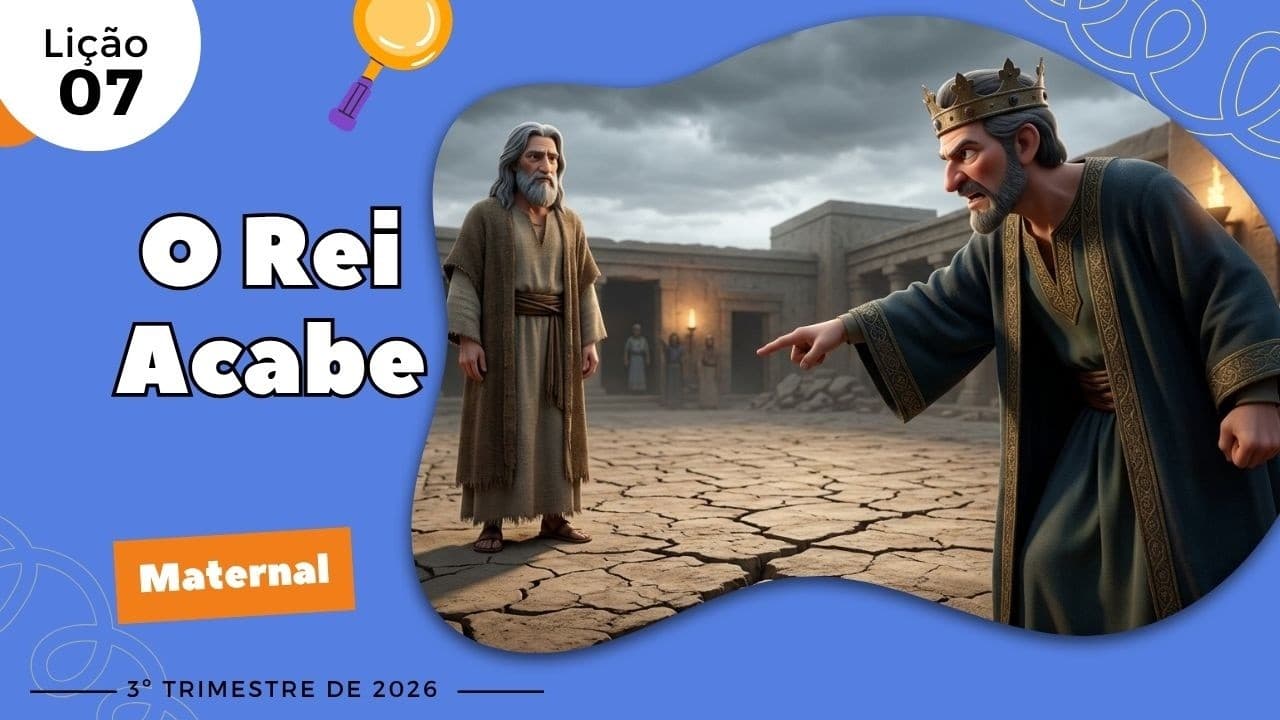
Ahab did not love Heavenly Father. Ahab did not obey Heavenly Father. He always chose the wrong way. Ahab worshiped a make-believe god, an idol named Baal — and taught the people to do the same. That made Heavenly Father very sad.
Let's wag our little finger and say together: "No, no, no, King Ahab. Not like that."
Then Heavenly Father sent the prophet Elijah to speak with the king. Elijah came and said:
— King Ahab, Heavenly Father is not pleased. You are worshiping a make-believe god and teaching the people wrong things. Because of that, there will be no rain for a long time.
And now what? Without rain the ground gets all dry. Without rain the little plants do not grow. Without rain there is no fruit, no vegetables, no flowers. Shall we droop our little bodies, very slowly, just like a thirsty little plant? (Everyone droops their shoulders and sits back up.)
Did Ahab listen to the prophet? No. He did not want to listen and got angry with Elijah. Then God told Elijah to go away to a far-off place in the desert, and Elijah obeyed.
In the desert there was a little brook with fresh, cool water. Elijah drank every day — gulp, gulp, gulp! But what about food? In the desert there is no grocery store, no refrigerator, no bakery. Do you know whom Heavenly Father sent to bring food? The little birds! Every morning and every afternoon, they came flying — flap, flap, flap! — bringing bread and meat for Elijah. Shall we flap our little wings together? (Everyone flaps their arms.)
Heavenly Father took care of Elijah. And Heavenly Father takes care of you too: your milk, your juice, your cookie, your home, your little bed. Heavenly Father is so good!
And what about King Ahab? Ahab kept asking the idol Baal for rain. He asked, and asked, and asked... and nothing happened. Do you know why? Because only Heavenly Father is the true God, and only He hears and answers our prayer.
Ahab and Queen Jezebel kept on doing what was wrong. They never asked for forgiveness. And whoever does not ask for forgiveness is left with a sad little heart. What a pity, isn't it?
But look at the good news! The Bible, God's Book, says: "Happy is the one whose wrongdoings God forgives!" When you do something wrong, do not be like Ahab: ask for forgiveness. Heavenly Father forgives — and the heart becomes happy again.
Repeat with the children, clapping hands: "Ahab did not want to listen! God took care of Elijah! God forgives and the heart becomes happy!"
❤ For the child's heart. Everyone makes mistakes — children, mommy, daddy, the Sunday School teacher. Making a mistake does not make Heavenly Father stop loving you. When you do something wrong, talk to Him: "Heavenly Father, forgive me." He forgives right away, and your heart feels light and glad.
III — Sing, jump, and keep in the heart
Sing. A short song with gestures, three times: "Heavenly Father forgives, my heart is happy." Open hands on the chest on "forgives", a big wide smile on "happy".
The verse with gestures. One piece at a time: Happy is the one (a very big smile) whose wrongdoings (little hands hidden behind the back) God (little finger pointing up) forgives (both hands open on the chest). Explain: "When we ask for forgiveness, Heavenly Father forgives and we become joyful."
The path of colors. Cut out squares of colored paper and set up a path on the floor, alternating and repeating the colors. One child at a time crosses by stepping on the papers, from start to finish, while the others clap their hands. In the next rounds, name a color to step over without stepping on it. Nobody loses, nobody is out, nobody is left behind — everyone reaches the end and everyone is applauded.
Crafts and goodbye. In the quarterly, help each child spread glue along the path in the drawing and glue the string on top; while they glue, repeat that God sent Elijah to speak with Ahab, but he did not want to listen. Then hand out the colored pencils for them to color the tree with fruit, reminding them that without rain the plants dried up. Put the supplies away together — putting things away is obeying too. Review with the three phrases and say goodbye to each child by name.
Christ in the Lesson
Ahab heard God's message and did not want to change. Elijah heard and obeyed. And what about us? We are both — there are Elijah days and there are Ahab days. That is why the Gospel is not "be good": it is forgiveness.
The lesson verse begins the good news — "Blessed is he whose transgressions are forgiven, whose sins are covered." (Psalm 32:1) — and the New Testament finishes it: "If we confess our sins, He is faithful and just to forgive us our sins and to cleanse us from all unrighteousness." (1 John 1:9) The One who covers sin is the Lord Jesus, on the cross.
And there is a beautiful bridge in this story. God sent bread to Elijah in the desert through the ravens (1 Kings 17:6). Afterward, God sent the greater Bread: "Jesus answered, “I am the bread of life. Whoever comes to Me will never hunger, and whoever believes in Me will never thirst.”" (John 6:35) To the child, say simply: "God sent little bread to Elijah. And God sent Jesus to you. Jesus forgives your sin and takes care of you."
Practical Application
Asking for forgiveness is an everyday thing. Teach the two short phrases right when a little mistake happens: "I'm sorry" to the person, "Heavenly Father, forgive me" to God. No long sermon — a three-year-old learns by what is repeated, not by what is explained.
The adult goes first. When daddy or mommy apologizes to the child, the child learns that asking for forgiveness is not a shame, it is a relief. No class teaches this better than a parent doing it.
Thanking God for what He sends. At snack time and dinner time, point out the obvious: "Look at what Heavenly Father sent today." God's care for Elijah becomes concrete on the child's plate.
No bargaining. Watch out for "if you are obedient, God will give you things." Correct it gently: "God takes care of us because He loves us. And He forgives because Jesus has already paid."
Closing Prayer
Heavenly Father, thank You because You take care of every child in this classroom, just as You took care of the prophet Elijah in the desert. Thank You because You forgive those who ask for forgiveness and make their heart happy. Help these children choose the right way and run to You when they make a mistake. Thank You for Jesus, who carried our sin on the cross. In His name, amen.
Soli Deo Gloria — Scripture governs; everything else, on its knees.
Frequently asked questions about this lesson
Who was King Ahab in the Bible?+
King of Israel, married to Jezebel. He neither loved nor obeyed God: he worshiped the idol Baal and taught the people to do the same. God sent the prophet Elijah to warn him, but Ahab refused to listen and did not repent (1 Kings 16–17).
How do you tell the story of a wicked king without frightening a 3-year-old child?+
Without violent details, without a scary voice, and without acting out punishment. Just say that the king chose the wrong path, got angry, and became sad — and move quickly to the good part: God took care of Elijah, and God forgives those who ask. The child should leave the classroom calm and joyful, not frightened.
How do you explain sin and forgiveness to the Preschool class?+
With child-sized examples: fighting over a toy, throwing a tantrum, hitting a little friend, not obeying. And with the solution in the very same sentence: 'we ask for forgiveness, Heavenly Father forgives us, and our heart becomes happy again.' Never leave the child with only the wrong part.
What is the verse for Preschool Lesson 7 and how do you memorize it?+
"Blessed is he whose transgressions are forgiven, whose sins are covered." (Psalm 32:1) Memorize it with gestures: a big smile for happy, hands hidden behind the back for wrongdoings, a little finger pointing up for God, and both hands open on the chest for forgives.
Teacher's Guide
Essence of the class
King Ahab did not want to ask for forgiveness and was left sad; whoever asks Heavenly Father for forgiveness becomes happy — and God takes care of His own, just as He took care of Elijah.
Map of the class
| Time | Stage |
|---|---|
| 0–7 min | Arrival with the happy little face + thanksgiving and offering |
| 7–12 min | Song with gestures + verse with movements |
| 12–20 min | The story of Ahab and Elijah with the pictures |
| 20–27 min | Class activity "the path of colors" |
| 27–33 min | Crafts: string on the path and the tree with fruit |
| 33–40 min | Snack + quarterly activity |
| 40–45 min | Prayer, review, and goodbye |
Start like this
Walk in with the poster board of the very happy little face turned toward the children and ask: "Does anyone know why this boy has such a big smile?" Let them guess — they will say he got a toy, it is his birthday, he got candy. Welcome every answer with joy and reveal: "He is happy because Heavenly Father forgives." Keep the poster board in sight for the entire class.
Point 1 — Ahab chose the wrong way
- In the quarterly: the story space, first part — Ahab neither loves nor obeys God, and the Lord sends the prophet Elijah (pictures 7/1 and 7/2).
- What to teach: the king worshiped an idol and taught the people to do the same. God sent Elijah to warn him, and there would be no rain for a long time. Tell it in a calm voice, without a scary face, without violent details — the child needs to understand that it was wrong, not feel frightened.
- Anchor verse (BSB): "However, Ahab son of Omri did evil in the sight of the LORD, more than all who were before him." (1 Kings 16:30)
- Key question: "What does the rain do for the little plants?"
- Likely answers (+ going deeper): "waters them", "makes them grow", "makes them pretty", or the rain gesture with their little fingers. Go deeper: "And if it doesn't rain at all, what happens to the fruit?"
- If no one speaks: make the rain gesture yourself with your fingers moving down and droop your body slowly. At this age, an imitated gesture is already an answer.
Point 2 — God took care of Elijah with the little birds
- In the quarterly: the story space, in the desert part — Elijah obeys, drinks from the brook, and receives bread and meat (picture 7/3).
- What to teach: Elijah obeyed and went to the desert. There God gave him water from the little brook and sent little birds with bread and meat, in the morning and in the afternoon. God takes care of us because He loves us, and He takes care of the child in the same way: milk, juice, cookies, home.
- Anchor verse (BSB): "The ravens would bring him bread and meat in the morning and evening, and he would drink from the brook." (1 Kings 17:6)
- Key question: "What did you eat this morning?"
- Likely answers (+ going deeper): "milk", "bread", "crackers", "I don't remember". Go deeper: "And who gave it to you? Heavenly Father gave it, through your mommy's hands."
- If no one speaks: tell what you had — "today I had coffee and bread" — and ask again looking at just one child.
Point 3 — Whoever asks for forgiveness becomes happy
- In the quarterly: the Bible space, with the verse from Psalm 32:1 and the happy little face on the poster board.
- What to teach: Ahab and Jezebel did not ask for forgiveness and were left sad. We do make mistakes — and the way forward is to ask for forgiveness. Heavenly Father forgives, and the heart becomes glad. Always end the class here, never on the part about the wicked king.
- Anchor verse (BSB): "Blessed is he whose transgressions are forgiven, whose sins are covered." (Psalm 32:1)
- Key question: "Have you ever said 'I'm sorry' to someone?"
- Likely answers (+ going deeper): "Yes!", "to mommy", "to my brother", or shy silence. Go deeper: "And how did your heart feel afterward? It feels nice and light, doesn't it?"
- If no one speaks: tell about a small, silly mistake of your own ("yesterday I spoke loudly to someone and then I said I was sorry") and do the two gestures with them.
Class activity
- Goal: to engage the whole body with the idea of choosing the right way, without competition, with no one eliminated, and with no one touching anyone.
- Materials: squares of colored paper (with colors repeated along the path), masking tape to stick them to the floor.
- Step by step: set up the path on the floor, from the starting point to the finish. One child at a time crosses by stepping on the papers while the others clap and cheer. In the second round, name a color that must not be stepped on — "today nobody steps on red" — and change the color each round. If a child steps on it, nobody corrects them and nobody is out: clap just the same and keep going. Do as many rounds as time allows, always with everyone taking a turn.
- Wrap-up (back to the text): "King Ahab chose the wrong way and did not want to turn back. We choose Heavenly Father's way — and when we misstep, we ask for forgiveness and keep walking."
Wrap-up + challenge of the week
- Wrap-up: "Ahab did not want to ask for forgiveness and was left with a sad heart. Elijah obeyed and Heavenly Father took care of him with the little birds. And you, when you make a mistake, ask for forgiveness — because Jesus forgives, and the heart becomes happy."
- Challenge: ask the parents at the door: every time a little mistake happens this week, stop and say the two phrases together — "I'm sorry" to the person and "Heavenly Father, forgive me" — and close with a hug and the sentence "God forgave, my heart is happy." On Sunday, ask the children who asked for forgiveness at home.
Teacher's kit
- Before: read 1 Kings 16:29–17:6 with your Bible open and the story space in the quarterly. Memorize the three anchor phrases and practice your voice: the part about Ahab is short and calm, the part about Elijah is long and joyful.
- Bring: the poster board with the happy little face and the verse, the squares of colored paper with masking tape, glue, string cut into pieces, colored pencils, and the quarterly.
- Good to know: the Bible says that the birds that brought food to Elijah were ravens (1 Kings 17:6). With the children, "little birds" is enough.
- Safety: no acting out punishment, no scary voice, and no saying "Heavenly Father is going to punish you." If a child gets frightened by the part about the wicked king, stop the story, go back to the smile on the poster board, and move on.
- Pray beforehand: ask the Lord for a gentle voice. In this lesson, the teacher's tone teaches more than the words.
Homework
Your mission for the week
Dads and moms, this activity is to be done together with your child. This week, every time a little mistake happens — and it will happen — stop everything, get down at eye level with your child, and say the two phrases together: "I'm sorry" to the person and "Heavenly Father, forgive me." Close with a hug and a single sentence: "God forgave. The heart is happy." If the mistake was the adult's, ask for forgiveness first — that is the part that teaches the most.
Why
Ahab did wrong and did not ask for forgiveness; he was left with a sad heart. The Bible says the opposite: "Blessed is he whose transgressions are forgiven, whose sins are covered." (Psalm 32:1) A young child learns forgiveness by seeing forgiveness happen at home, in the middle of the mess.
How to know you did it
The two phrases, right when a little mistake happens, at least three times this week — and at least one of them spoken by you, the adult. If on Saturday your child says "I'm sorry" on their own, you did it.
On Sunday, come back with the story
Ask your child: "What do we say when we make a mistake?" And come tell us in the classroom what they answered.