Golden Text
““Do not be afraid, O Daughter of Zion. See, your King is coming, seated on the colt of a donkey.”” (John 12:15, BSB) · Read in the Bible
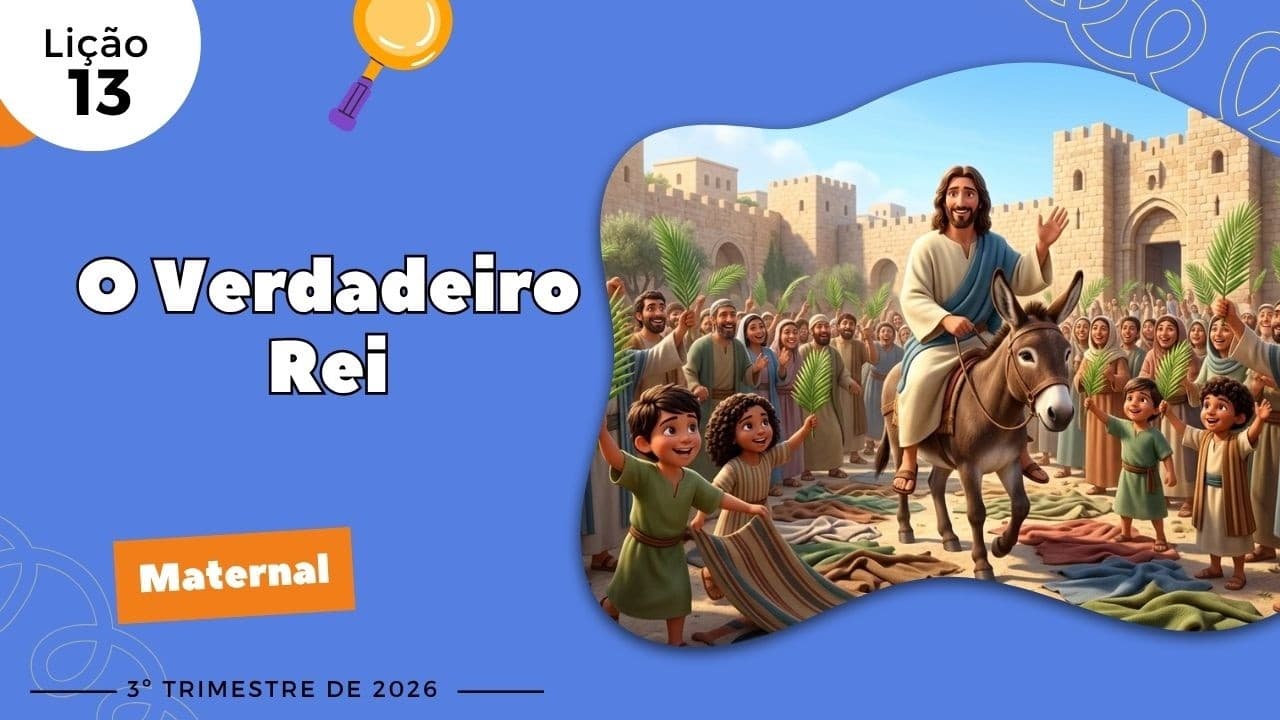
Jesus arrived in Jerusalem and the whole city turned into a celebration. He did not come on a warhorse: He came gently, riding on a little donkey, right up close to everyone. People waved palm branches and shouted 'Hosanna!' — and when the leaders got annoyed at the little ones' praise, Jesus took the children's side. A quarter-closing class in short cycles, with a branch, a crown, music, and plenty of praise to the King of kings.
Teacher, this lesson has a sound inside it, and it is that sound your class will take home: "Hosanna!", shouted out loud, with little arms up in the air. Hold on to that shout, because the whole class builds toward it.
And there is a contrast that holds the Preschool class's attention from beginning to end: the fierce horse and the gentle little donkey. Everyone expected the King to arrive on a huge horse, making a big noise, scaring everybody. Jesus arrived riding on a small little donkey, very slowly, right close to everyone — close enough for a child to come near without fear.
Keep three phrases and repeat them all morning long: "Jesus is the King of kings", "our King came gently, on a little donkey" and "Hosanna! Blessed is King Jesus!"
Two cautions before you begin. The first is the scare. The warhorse comes into the lesson only so the little donkey can appear right after — so make the big noise just once, lightly, and move right on. No monster voice, no turning off the lights, no scaring anyone for real. The long part is the party.
The second is the closing. Today is the last Sunday of the quarter, and the quarterly suggests giving an award to those who did not miss a class. Think carefully about this: a three-year-old child does not choose whether to come to Sunday School (EBD) — the family is the one who brings them. Rewarding attendance rewards the parent's transportation, not the child's effort. Celebrate all of them. An envelope for everyone, a certificate for everyone, applause for everyone, and say out loud what the quarterly itself says: the greatest prize they won this quarter was the Word of God, which will go with them for their whole life.
I — Arrival: the classroom in a party mood
Arrive early — today, even earlier. While you set up the room, pray for the children and their families, one by one, giving thanks for the quarter.
Set up the room as if preparing a party: green branches decorating the wall and the door, the children's rhythm band instruments refreshed with stickers and colorful ribbons, and the poster board for the mural already in place. Greet each child by name, crouching down at eye level, just as the quarterly asks: "How are you, little friend?" And tell them, in the voice of someone sharing a secret: "Today is a party day! It is our last class of the quarter, and the story is about the greatest King of all!"
Open the Bible and show the book of Matthew. Say: "Today's story comes from right here, from God's Book. This quarter we met a whole lot of kings, didn't we? Let's remember! The first king was Saul. Then David, the little shepherd. Solomon, the wise king. Josiah, the boy king. And Queen Esther, the brave one. But today... today our story is about the greatest King of all time. Do you know who He is? JESUS!"
Collect the offerings with a single sentence: "our offering helps a little friend who needs food and clothes. Thank You, Heavenly Daddy!"
Next, praise. Today it is the heart of the morning, not the warm-up. Choose two or three songs the class learned during the quarter and sing with all your heart: clapping, jumping, loud voices, the little band playing. If there is time, let the children choose their favorites — they will pick the same one three times, and that is wonderful.
🌿 Fun fact — why palm branches? Back then, when a king or a hero arrived in the city, the people cut green branches from the trees and waved them high up in the air. It was their way of saying, without needing words: "what joy, you have arrived!" The palm tree was the prettiest of all — a long, green leaf that makes a rushing wind sound when it waves. That is why, when Jesus entered Jerusalem, it was palm branches that appeared in the people's hands: they took palm branches and went out to meet Him (John 12:13). Bring a real branch and let the children see it up close — in your hand, without passing it from hand to hand, because a dry leaf has sharp edges that can cut.
II — The story: the King arrived on a little donkey
Seat the children in a circle, nice and close, with the pictures from the quarterly in your hand.
Little friends, one day King Jesus was going to a big city called Je-ru-sa-lem. Let's say it together, clapping our hands? JE-RU-SA-LEM! He was going with His helpers to a very important feast.
And the whole city was waiting for Him. The daddies, the mommies and lots and lots of little children stood in the street, waiting for the King to arrive.
(Now do the horse. Just once, loud, funny — and move right on.)
Only everyone thought the King was going to arrive like this: clip-clop, clip-clop, riding on a HUGE horse, running fast, making the biggest noise! Was it like that?
NO!
(Lower your voice. Very slowly. Make a gentle stroking motion in the air.)
Our King Jesus sent two helpers to fetch a little donkey. Do you know what a little donkey is? It is a small little animal with long ears that walks very slowly. He is gentle — he doesn't run, doesn't scare anyone, doesn't hurt anyone.
And King Jesus got on the little donkey and entered the city like this, nice and slow: clip-clop... clip-clop... clip-clop... (Very slowly, patting your legs with your hands.)
Why do you think Jesus chose the little donkey? Because our King is strong to take care of us, but He is kind and gentle so we can come right up close to Him. Even a little child could come close to Jesus!
(Now have everyone stand up. This part is a party.)
Stand up, little friends! When the people saw King Jesus arriving, do you know what happened? A party! The people ran, took green branches from the trees — really long leaves — and waved them high up in the air! Shall we wave them too? Arms up! Wave, wave, wave!
And they shouted out loud:
— HOSANNA! HOSANNA! BLESSED IS KING JESUS!
Let's shout together! One, two, three: HOSANNA! Louder: HOSANNA! (Three times. Let it be really noisy.)
(Now have everyone crouch down low, smoothing the floor with their hands.)
And look what else they did: they took off their coats and cloaks and laid them all on the ground, making a soft little carpet for the little donkey to walk over. Let's spread our little coats on the floor! Just like this — nice and soft! It was their way of saying to Jesus: "You are our King!"
(Everyone can sit down. Lower your voice now, but without sadness.)
Only there were some people who did not like the party. Some important men in the city got grumpy because they saw so many people liking Jesus. And do you know what else? They got angry at the little children — because the little children were right there in the middle, singing "Hosanna!" to Jesus.
And what did King Jesus do? (Suspense. Wide eyes.)
He defended the children. Jesus told those men: the praise of little children is perfect praise — it is the most beautiful praise of all!
(Open your arms. Big smile.)
Did you understand, little friends? When you sing to Jesus, at home, in the car, in the classroom — Jesus likes it. He doesn't think it's ugly, He doesn't think it's out of tune, He doesn't tell you to stop. He thinks it's beautiful!
(Now the last part. Show the towel and the empty basin in your hand, from a distance. No one takes off a shoe, no one touches anyone's foot.)
And there is one more thing King Jesus did, and it is something for you never to forget. One day He was having dinner with His helpers. Then He stood up, took a towel like this, a basin of water like this — and knelt down low to wash His friends' dirty feet.
The greatest King of all, bending down low, taking care of others! And He said: "do the same, take care of one another."
Let's do King Jesus' gesture! Little hands making a gentle stroking motion in the air, very slowly, like someone taking care of another person. (All together, in the air.)
A big clap for our King! (Clapping, jumping, celebrating.)
❤ For the child's heart. Do you know why King Jesus is the greatest of all? It is not because He has the shiniest crown. It is because He humbled Himself and bent down low — He came from heaven as a tiny baby, rode on a little donkey, washed dirty feet and then died on a cross to take away all the dirt from our hearts. No other king did that. And now He is alive, up in heaven — and right here with us too, all the time. (Put your hand on your chest.) King Jesus wants to live right inside here. All you have to do is talk to Him.
III — Singing, memorizing and keeping in the heart
Sing the whole quarter. Today praise has the place of honor. Sing again two or three songs the class learned during these three months — they will recognize them and sing louder than on the day they learned them. Add a short little song with motions, three times in a row: "Hosanna, Hosanna, Jesus is my King!" On "Hosanna", both little arms go up and wave like branches; on "is my King", little hands make a crown on the head.
The verse on the mural. Make the mural as the quarterly teaches: write the verse in the center of the poster board, in big, colorful letters, and give each child the picture of a very pretty crown, letting them know that at the right time they will glue it onto the mural. Tape the mural to the wall with masking tape, right at their eye level.
The whole verse is too long for this age, so teach only the short middle part, always the same, word for word — that your King is coming (John 12:15). Explain it in simple children's words: "that means: look, your King is coming!" The motions: on "look", a little hand goes to the forehead like someone looking far away; on "your King is coming", both little arms go up and wave. Repeat three times, always with the same words and the same motions.
Then comes gluing the crowns. The quarterly suggests that each child recite the verse alone before gluing it. Invite, but never force. Whoever wants to can say it alone; whoever does not want to says it together with you, hand in hand with the motion — and glues the crown with the exact same celebration, the same applause and the same praise. No one is left for last, no one loses their turn, no one is compared.
King Jesus' Simon Says. Everyone standing, everyone doing it together — no one singled out, no one eliminated, no one touching anyone. Simon says march very gently, just like the little donkey: clip-clop, clip-clop, clip-clop! Simon says wave the branches high up in the air and shout: HOSANNA! Simon says crouch down and spread your little coat on the floor for the King to pass by! Simon says put King Jesus' crown on your head and strike a strong pose! Simon says make a gentle stroking motion in the air, like King Jesus, who took care of His friends! Simon says put your little hands together, close your little eyes and whisper: "Come, King Jesus." Finish with applause for everyone.
The crayon branches. Do the activity from the quarterly, which is lovely and gives an effortless "wow": give each child a good piece of white poster board and a green crayon, place the palm leaf under the poster board yourself and show how to rub the crayon sideways over the top. The drawing of the branch will appear on the paper by itself — they will want to make three. The real leaf stays in your hand and the cutting is yours, with blunt-tip scissors: a dry leaf can cut and scissors are not for this age. When everyone has their paper branch, invite them to walk around the room waving them and praising Jesus: "Hosanna! Hosanna to Jesus!" — walking, never running, each child with their own branch, without touching anyone's face.
Student's section. Hand out the quarterlies and the crayons. Guide them to color the illustration nicely. Then ask them to look at the pictures and say the names of the animals, and to color the picture of the little donkey. While they color, review the main points of the story: who arrived, on what little animal, what the people waved, what they shouted. Praise the effort, not the result — a purple little donkey is a beautiful little donkey.
Goodbye time. Prepare beforehand a pretty envelope for each child, decorated with the theme of the quarter, and put inside the little quarterly that finishes today along with their saved crafts. Fill out the certificate at the end of the quarterly for each one — parents love to see their child's name recognized, and no child should leave empty-handed. Sing the song of the day one more time, say the verse one more time with the motions and reinforce: Jesus is alive in heaven and He is with us too. Pray with the children, thanking God for each one by name and for the whole quarter, and say goodbye telling them you will be waiting for them next Sunday.
Christ in the Lesson
Start with the detail that gives meaning to everything else: the little donkey was not an accident, it was an announcement. Jesus sent for that animal on purpose, because there had been a promise waiting for Him since the prophets: "Rejoice greatly, O Daughter of Zion! Shout in triumph, O Daughter of Jerusalem! See, your King comes to you, righteous and victorious, humble and riding on a donkey, on a colt, the foal of a donkey." (Zechariah 9:9). Matthew makes a point of showing the fulfillment: "“Say to the Daughter of Zion, ‘See, your King comes to you, gentle and riding on a donkey, on a colt, the foal of a donkey.’”" (Matthew 21:5). In other words: on that Sunday, Jesus publicly assumed His place as the promised King. It was not the crowd that crowned Him — it was He who presented Himself.
And notice the manner of the coronation. A king who entered riding on a horse entered for war; a king who entered on a little donkey entered in peace. The whole city understood the gesture, and responded: "A massive crowd spread their cloaks on the road, while others cut branches from the trees and spread them on the road." (Matthew 21:8). Spreading one's own clothes in the dust is the gesture of a subject. "The crowds that went ahead of Him and those that followed were shouting: “Hosanna to the Son of David!” “Blessed is He who comes in the name of the Lord!” “Hosanna in the highest!”" (Matthew 21:9). "Hosanna" is not just "hurray": it is a plea — save us now. The people were singing the right thing, even if they were expecting the wrong kind of deliverance.
The praise of that day was so rightly owed that it could not even be held back. When the Pharisees told Jesus to silence the disciples, this was the answer: "“I tell you,” He answered, “if they remain silent, the very stones will cry out.”" (Luke 19:40). Keep that sentence for the week when the church feels cold: praise to Christ does not depend on the mood, it depends on His worth.
Now the part that matters most for those who teach Preschool. When the celebration reached the temple, the ones who would not stop singing were the children — and that is what annoyed the grown-ups: "But the chief priests and scribes were indignant when they saw the wonders He performed and the children shouting in the temple courts, “Hosanna to the Son of David!”" (Matthew 21:15). Jesus' answer is the most beautiful defense of the Preschool classroom in the entire Bible: "“Do You hear what these children are saying?” they asked. “Yes,” Jesus answered. “Have you never read: ‘From the mouths of children and infants You have ordained praise’?”" (Matthew 21:16). Perfect. Not "cute", not "acceptable for their age". Perfect. The child who sings off-key, mixes up the lyrics and sings while staring at the ceiling is offering God something He Himself calls perfect praise — and the teacher who understands this never again treats worship time in class as filler until the story begins.
The whole quarter prepared for this Sunday. Saul, David, Solomon, Josiah, Esther: crown after crown, and none of them held the weight. Some fell into disobedience, others into vanity, and even the best of them died and left the throne. Scripture closes the line by pointing to One: "And He has a name written on His robe and on His thigh: KING OF KINGS AND LORD OF LORDS." (Revelation 19:16). Yet His crown came by a path no earthly king would accept: "And being found in appearance as a man, He humbled Himself and became obedient to death — even death on a cross. Therefore God exalted Him to the highest place and gave Him the name above all names," (Philippians 2:8-9). The King entered the city receiving "Hosanna" and left it carrying a cross — and it was there that the people's plea was truly answered.
That is why the scene with the towel, which the quarterly brings right after, is not an appendix: it is the same truth in another gesture. "So He got up from the supper, laid aside His outer garments, and wrapped a towel around His waist." (John 13:4) — and then: "I have set you an example so that you should do as I have done for you." (John 13:15). The King who arrived lowly, on a little donkey, bends down again at the basin. Whoever wants to be great in His Kingdom learns first to bend down.
And one last thing, so the teacher does not land the lesson in the wrong place. This King invites; He does not drag anyone. He arrived gentle, open, and continues calling — including the littlest ones, who in that temple were the only ones hitting the right note: "But when Jesus saw this, He was indignant and told them, “Let the little children come to Me, and do not hinder them! For the kingdom of God belongs to such as these.”" (Mark 10:14). The grace that saves is His from beginning to end; the response of opening our mouths and praising is ours, every day.
To the child, say it simply: "Jesus is the greatest King of all. He came gently, on a little donkey, and died on the cross to make our hearts clean. And your praise is the most beautiful praise there is to Him."
Practical Application
Sing out loud at home. A Preschool child learns theology by singing long before learning by listening. Put on a worship song at breakfast, at bath time, in the car. It does not need to be pretty — it needs to be frequent. What a child sings at three, they remember at thirty.
Do not correct the child's praise. Mixed-up lyrics, wrong notes, funny dancing: let it be. Jesus called that perfect (Matthew 21:16). Correction at this age does not put anyone in tune — it only teaches the child to shut their mouth.
Let your child see you praising. Stronger than any explanation. The father who raises his hand in the worship service, the mother who sings while washing the dishes, teach who the King is without saying a word about the subject.
Say at home that Jesus is the King — and why. It is not enough for the child to know that Jesus is King; they need to know He is a good King. One repeated sentence settles it: "Jesus is our King, and He is kind and gentle, so we can come right up close to Him."
Teach them to bend down and serve, at their own size. The King who washed His friends' feet left homework for us: picking up a toy that fell, taking a cup to the sink, helping a little sibling. Say the reason out loud: "that is what someone who learned from King Jesus does."
Keep the quarter's envelope in plain sight. The crafts, the certificate, the little quarterly. Leaf through them again during the week and ask: "who is the greatest King?" Your child will answer. Repetition is how Preschoolers learn — and now it is the family that repeats.
Closing Prayer
Heavenly Daddy, thank You for this whole quarter with these children. Thank You for the kings and queens they met — and thank You, above all, for Jesus, the King of kings. Thank You because He did not arrive scaring anyone: He came gently, on a little donkey, right close to everyone, and then humbled Himself all the way to the cross to make our hearts clean. Lord, You Yourself said that the praise of little children is perfect — so receive the praise of these children today, just the way they sing it. Keep every family from this classroom during the break and on ordinary days. Keep every teacher. And may each one of these children grow up knowing, starting right now, that Jesus is their King and that He is alive. In His name, amen.
Soli Deo Gloria — Scripture governs; everything else, on its knees.
Frequently asked questions about this lesson
Who is the King of kings and what does Preschool Lesson 13 teach?+
The King of kings is Jesus. After a whole quarter learning about kings and queens — Saul, David, Solomon, Josiah, Esther — the last lesson introduces the One who is greater than all of them: "And He has a name written on His robe and on His thigh: KING OF KINGS AND LORD OF LORDS." (Revelation 19:16). A 3- and 4-year-old child remembers the scene: Jesus arriving in Jerusalem riding on a little donkey, the people waving green branches and shouting 'Hosanna!'. And they remember the sentence: Jesus is my King, and my praise makes His heart glad.
Why did Jesus choose a little donkey and not a horse?+
Because the choice was a message. A king who arrived riding a horse came for war; a king who arrived on a little donkey came in peace. And it was already written like this, long before: "Rejoice greatly, O Daughter of Zion! Shout in triumph, O Daughter of Jerusalem! See, your King comes to you, righteous and victorious, humble and riding on a donkey, on a colt, the foal of a donkey." (Zechariah 9:9). For the class, say it simply and show it with your body: 'everyone thought the King would arrive on a huge horse, making a huge noise. But our King came gently, slowly — right up close, in a way that lets a child come near.'
What is the verse for Preschool Lesson 13 and how can I teach it with gestures?+
John 12:15: "“Do not be afraid, O Daughter of Zion. See, your King is coming, seated on the colt of a donkey.”" (John 12:15). It is too long for this age, so teach only the short middle part, always with the same words, saying that their King is coming (John 12:15), and explain it in child-friendly language — 'that means: look, your King is arriving!'. Two gestures, always the same: on the first part, a little hand goes to the forehead as if looking far away; when saying that the King is coming, both little arms go up and wave like branches. Repeat it three times. The quarterly prints the verse in a simpler wording, as translations differ at this point — use the one from your Bible.
Can we act out the foot washing with 3- and 4-year-olds?+
Do not act it out; tell it. No taking off children's shoes, no touching anyone's feet, no water and basin in the middle of the circle — that involves physical contact and exposure, and it does not belong in the classroom. Show only the objects in your hand, from a distance: a towel and an empty bowl. Say: 'King Jesus, who is the greatest of all, knelt down and washed His friends' feet.' Then do the gesture in the air, everyone together: little hands gently stroking the air, as if taking care of someone. The child understands through the gesture what they would not understand through an explanation.
My son is shy and doesn't sing. Will this class expose him?+
It must not expose him, and that depends on the teacher. The quarterly suggests having each child recite the verse alone in front of the class before gluing the crown onto the mural. Offer the invitation, but never force it: whoever does not want to speak alone says it together with the teacher, and glues the crown the exact same way, with the same celebration and the same applause. No one is left for last, no one 'loses their turn,' no one is compared. Praise is not demanded — it is contagious. The shy child who waves a little branch with wide eyes is praising just as much as the one who shouts.
Doesn't this lesson just turn into a pretty closing party?+
It does, if it stops at the party. That is why the class does not stop there. The boy waving the branch needs to hear why that King is worthy of praise — and the answer is the cross: "And being found in appearance as a man, He humbled Himself and became obedient to death — even death on a cross. Therefore God exalted Him to the highest place and gave Him the name above all names," (Philippians 2:8-9). The King entered the city on a little donkey and left it carrying a cross to save us. And He keeps calling, without forcing anyone: "But when Jesus saw this, He was indignant and told them, “Let the little children come to Me, and do not hinder them! For the kingdom of God belongs to such as these.”" (Mark 10:14). That is the invitation the celebration announces.
Teacher's Guide
Essence of the class
Jesus is the King of kings — a kind and gentle King — and a child's praise is the praise He Himself calls perfect.
Map of the class
| Time | Stage |
|---|---|
| 0–6 min | Arrival in a party mood, the classroom with branches + offering and gratitude |
| 6–13 min | Praise with the songs of the quarter and the children's rhythm band |
| 13–21 min | The story: the King arrived on a little donkey |
| 21–27 min | Class activity "The King's parade" |
| 27–32 min | The verse on the mural + King Jesus' Simon Says |
| 32–40 min | Festive snack + the crayon branches + quarterly activities |
| 40–45 min | Envelope and certificate, goodbye circle, prayer and dismissal |
Start like this
Come in marching like a fierce horse, making the biggest noise: "Clip-clop! Clip-clop! Watch out, little friends, here comes a giant horse!" Stop suddenly, look at the class and ask: "Do you think King Jesus arrived in the city like this, scaring everybody?" Really wait — count to five in silence, with your hand cupped to your ear. They will shout "no!", "yes!", they will laugh, they will imitate the horse. Welcome it all. Then lower your voice and wrap up: "No! Our King is kind and gentle. Do you know what little animal He arrived on? On a tiny little donkey, nice and slow, right close to the people — just the way a child can come near." Leave the crown and the branch in plain sight all morning long.
Point 1 — Our King came gently, on a little donkey
- In the quarterly: the story section, when it reviews the kings of the quarter — Saul, David, Solomon, Josiah, Esther — presents Jesus as the greatest and most powerful King of all time and tells how He sent two helpers to fetch the little donkey (figure 13.1).
- What to teach: everyone expected a warhorse; a gentle little donkey came instead. Jesus is strong to take care of us and kind so we can come close. The contrast is the whole lesson in a single image — act it out with your body: a tall, noisy horse just once, then the slow "clip-clop" of the little donkey, patting your legs with your hands.
- Anchor verse (BSB): "“Do not be afraid, O Daughter of Zion. See, your King is coming, seated on the colt of a donkey.”" (John 12:15).
- Key question: "Did King Jesus arrive on a big horse, scaring everyone? (wait) NO! He came on a little donkey. Let's do a very slow clip-clop?"
- Likely answers (+ going deeper): they will shout "no!", imitate the horse, or want to tell a story about a dog. Welcome it all, without correcting. Go deeper: "that's right! And do you know why? Because our King doesn't want to scare anyone. He wants you to come right up close."
- If no one speaks: do the slow "clip-clop" by yourself, with a mysterious expression. Imitation at this age is instant.
Point 2 — The party: green branches, clothes on the ground and "Hosanna!"
- In the quarterly: the story section, when the crowd welcomes Jesus by waving palm branches, laying them along the road and shouting "Hosanna! Hosanna! Blessed is the King of Israel!" (figure 13.2).
- What to teach: this is where the class stands up and makes noise — and it is meant to be really noisy. The people waved branches high up in the air, spread their own clothes on the ground like a little carpet and shouted "Hosanna!". Tell them what the word means, very simply: "Hosanna is a beautiful way of shouting: the Savior has arrived!" Shout it together three times, louder each time.
- Anchor verse (BSB): "They took palm branches and went out to meet Him, shouting: “Hosanna!” “Blessed is He who comes in the name of the Lord!” “Blessed is the King of Israel!”" (John 12:13).
- Key question: "Shall we do just like the people of Jerusalem? Arms high up in the air, wave, wave — and shout with me: HOSANNA!"
- Likely answers (+ going deeper): everyone shouting, a child jumping, a child just watching with wide eyes. All of them are participating. Go deeper: "and what else did they do? They put their little coats on the ground for the King to pass by! Let's spread our little coats?"
- If no one speaks: start it yourself, with your arm up high and the loudest shout you can manage. Within three seconds the whole room will join in.
Point 3 — Jesus said that the children's praise is perfect
- In the quarterly: the teacher's section, which tells how the children greeted Jesus with songs, how the priests were annoyed by the little ones' praise and how He rebuked them with the Word of God (Matthew 21:16); and the story section, when it says that the leaders of Israel became angry and jealous when they saw how many people were following Jesus (figure 13.3).
- What to teach: the emotional climax of the lesson. Some important men got grumpy at the little children singing — and Jesus took their side, saying that the praise of little ones is perfect praise. Say it looking right into their eyes: "when you sing to Jesus, He thinks it is beautiful." Keep the leaders to a single sentence, without a scary villain or a lingering mean face: they got grumpy, and Jesus defended the children. The quarterly takes the opportunity to teach that we should not be jealous of our siblings or of mommy and daddy — say this in one light sentence, without a lecture and without singling anyone out.
- Anchor verse (BSB): "“Do You hear what these children are saying?” they asked. “Yes,” Jesus answered. “Have you never read: ‘From the mouths of children and infants You have ordained praise’?”" (Matthew 21:16).
- Key question: "Do you like singing to Jesus? Do you know what Jesus thinks of your little singing? He thinks it is beautiful!"
- Likely answers (+ going deeper): "I sing in the car!", "I know that song!", and someone will start singing out of nowhere. Let them sing. Go deeper: "then sing with me right now — Jesus is listening to you right from where you are."
- If no one speaks: start singing the class's favorite song yourself, right on the spot. Praise is not explained; it is started.
Point 4 — The King who bent down to care for others
- In the quarterly: the story section, when King Jesus and His helpers gather for a special meal, He takes off His outer garment, ties a towel around His waist, washes His helpers' feet and says they should take care of one another (figure 13.4).
- What to teach: the greatest King of all bent down low. Tell the scene while showing the towel and the empty basin in your hand, from a distance — and never act it out: no one takes off a shoe, no one touches anyone's foot, no one puts water anywhere. Replace it with a motion everyone does together in the air: little hands making a slow, gentle stroking motion, "like someone taking care of another person". Close with Christ: He humbled Himself all the way to the cross to make our hearts clean, and He is alive.
- Anchor verse (BSB): "I have set you an example so that you should do as I have done for you." (John 13:15).
- Key question: "The greatest King of all bent down to take care of His friends. Shall we do the caring motion? A gentle stroke in the air, very slowly."
- Likely answers (+ going deeper): they will stroke their own arms, want to pet the teacher, or talk about dirty feet and laugh. Laughing is great. Go deeper, without physical contact: "the gentle stroke is in the air, and it is for King Jesus to see. He took care of us first."
- If no one speaks: do the motion by yourself, in silence, very slowly. Silence draws everyone's eyes.
Class activity
- Goal: to experience with their bodies the scene the whole lesson points to — welcoming the King with a celebration — with everyone participating at the same time, no one singled out, no competition and no physical contact.
- Materials: the paper branches the children made (white poster board + green crayon), the children's rhythm band instruments, the paper crown and, if you have one, a plush little donkey or the picture from the quarterly.
- Step by step: clear space in the middle of the room and agree on the rule before starting: "everyone walks, no one runs, and the little branch stays up high" — never pointed toward anyone's face. Put the crown on your head and announce: "King Jesus is arriving in the city! Shall we have the party?" First, all together, the little donkey's walk: a very slow march in place, patting your legs with your hands — clip-clop... clip-clop... Next, the carpet: everyone crouches down and smooths the floor with their hands, "spreading the little coat". Then the party: everyone standing, branch held high up, waving, walking in a circle around the room while you lead the shout — "HOSANNA! BLESSED IS KING JESUS!" — three times, louder each time, with the little band playing along. Finish by freezing everyone like a statue and giving one big clap together. Repeat as many times as time allows: at this age, repeating is learning.
- Wrap-up (back to the text): "That is just how it was, little friends! The people of Jerusalem waved branches and shouted 'Hosanna!' when King Jesus arrived on the little donkey. And do you know what? The little children were there too, singing. Jesus looked at them and said that a child's praise is perfect praise — the most beautiful of all. Your praise is just like that."
Wrap-up + challenge of the week
- Wrap-up: "This quarter we met a whole lot of kings: Saul, David, Solomon, Josiah, and Queen Esther. But today we met the greatest King of all: Jesus! He didn't arrive on a fierce horse, scaring everyone. He came gently, on a little donkey, and the people waved green branches shouting 'Hosanna!'. Some men got grumpy at the little children singing — and Jesus defended them, saying that a child's praise is the most beautiful in the world. Then King Jesus bent down to take care of His friends, and humbled Himself all the way to the cross to make our hearts clean. And He is alive! So sing to Him all week long, nice and loud, because He loves to hear you."
- Challenge: ask the parents at the door: Dads and moms, this activity is for you to do together with your child, once a day this week. Choose a set time — when dad or mom gets home, or at dinnertime. At that time, the child takes the little branch they made in Sunday School (or a small towel, a little cloth, or just their own little hands), waves it up high and says out loud, looking at someone in the house: "Hosanna! Jesus is my King!" Whoever heard answers right away, in the same way: "Hosanna! He is my King too!" If the little branch gets crumpled or lost, little hands work just fine — what cannot be missing is the voice. On Sunday, come back with the story.
Teacher's kit
- Before: read Matthew 21:1-16 and John 13:1-15 with your Bible open and the quarterly's story section beside it. Memorize the three anchor phrases — "Jesus is the King of kings", "our King came gently, on a little donkey", "Hosanna! Blessed is King Jesus!" — and practice your voice: the horse is loud and funny and lasts three seconds; the little donkey is slow and sweet; the party is the noisiest part of the whole morning; the scene with the towel is soft and calm. Also set aside the two or three songs from the quarter that the class sang the most.
- Bring: the cardstock crown, the crown cutouts for the mural (one per child), the mural poster board with the verse written in big letters, masking tape, white poster board and green crayons for the branches, a real palm leaf (in your hand), branches to decorate the room, the rhythm band instruments refreshed with stickers and ribbons, a towel and an empty basin, glue, blunt-tip scissors (yours, never the children's), the quarterly and one decorated envelope per child.
- About the verse: the quarterly gives John 12:15 in a simpler wording than that of standard Bible translations: "“Do not be afraid, O Daughter of Zion. See, your King is coming, seated on the colt of a donkey.”" (John 12:15). With the children, use only the short middle part — that their King is coming — and put it into simple words right away: "look, your King is coming!". Always use the same words and the same two motions.
- Good to know (to answer a parent): the little donkey was not an accident. It had been foretold in Zechariah 9:9 centuries earlier, and Matthew points out the fulfillment in Matthew 21:5. A king on a horse entered for war; a king on a little donkey entered in peace. In the classroom you do not go into this — the child keeps "gentle and right up close".
- Safety: the real palm leaf stays with you and is not passed from hand to hand (a dry leaf can cut); the child's branch is made of paper and stays pointed up, never toward anyone's face. In the parade everyone walks, no one runs and no one touches anyone. Do not act out the foot-washing: no taking off shoes, touching feet or using water — the towel and empty basin stay only in your hand, and the motion is a gentle stroke in the air. Scissors and hot glue are always yours. The warhorse is playful noise and lasts three seconds — no darkening the room and no monster voice. And if a child shares something serious from home, welcome them right away without asking for details in front of the others — "thank you for telling me, let's pray right now" — pray a single sentence and take the matter to the church leadership that very day. Remember the standing rule: the adult handles it; the child tells.
- Watch the tone: two risks today. The first is the attendance prize that the quarterly suggests at the closing — a three-year-old child does not decide whether to come to Sunday School, so rewarding attendance rewards the family and leaves out the very child who most needs to be celebrated. An envelope, a certificate and applause for everyone. The second is reciting the verse alone before gluing the crown on the mural: invite, but never force — whoever does not want to says it together with you and glues it with the same celebration. And do not let the lesson end on "sing more": it ends with the King who humbled Himself all the way to the cross and is alive.
- Pray beforehand: ask the Lord for a joyful heart. Today the way you praise teaches more than anything you will say about praise.
Homework
Your mission for the week
Dads and moms, this activity is for you to do together with your child, once a day this week. Choose a set time — when dad or mom gets home, or at dinnertime. At that time, the child takes the little branch they made in Sunday School (or a small towel, a little cloth, or just their own little hands), waves it up high and says out loud, looking at someone in the house: "Hosanna! Jesus is my King!" Whoever heard answers right away, in the same way: "Hosanna! He is my King too!" If the little branch gets crumpled or lost, little hands work just fine — what cannot be missing is the voice.
Why
When Jesus entered Jerusalem, the people waved green branches and went out to meet Him: "They took palm branches and went out to meet Him, shouting: “Hosanna!” “Blessed is He who comes in the name of the Lord!” “Blessed is the King of Israel!”" (John 12:13). And in the middle of the celebration were the children, singing. Some important men were annoyed by that — and Jesus took the little ones' side: "“Do You hear what these children are saying?” they asked. “Yes,” Jesus answered. “Have you never read: ‘From the mouths of children and infants You have ordained praise’?”" (Matthew 21:16). Perfect. That is the word He used. A three- or four-year-old child does not understand an explanation about worship, but understands an arm held high, a loud voice and a real person listening. That is how they discover, before knowing how to explain it, that their praise reaches the King — and that He likes it.
How to know you did it
Someone in the house heard the child say the sentence on their own, out loud. If there is a specific person who heard it, you did it.
On Sunday, come back with the story
Share in the classroom who heard the "Hosanna" at home and which day was the liveliest of the week. On Sunday, come back with the story.