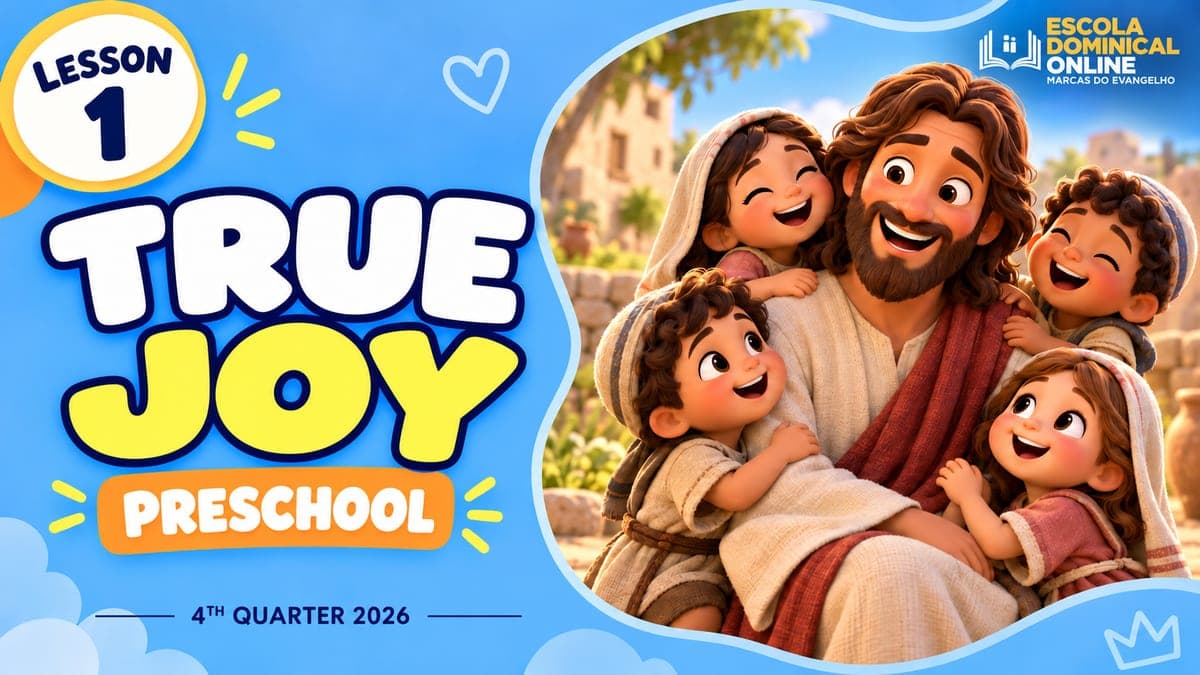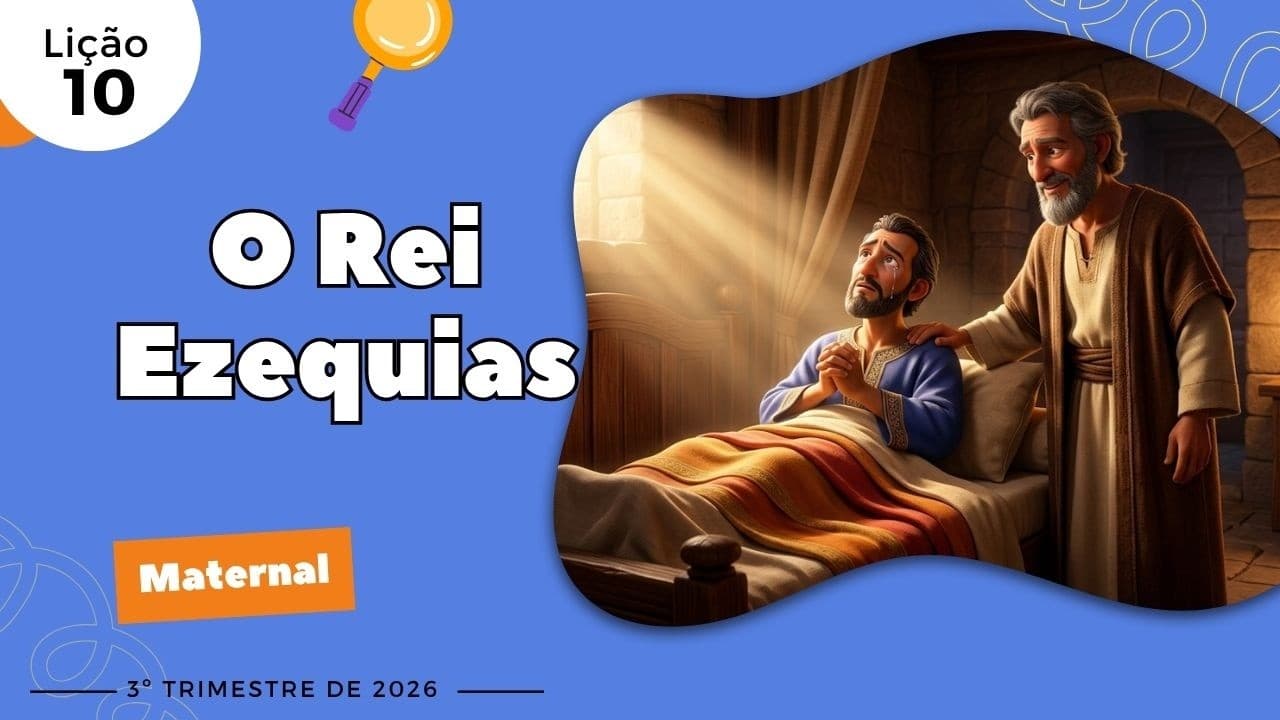
Golden Text
“Do not fear, for I am with you; do not be afraid, for I am your God. I will strengthen you; I will surely help you; I will uphold you with My righteous right hand.” (Isaiah 41:10, BSB) · Read in the Bible
Heavenly Father healed King Hezekiah's boo-boo with a very simple recipe: mashed figs placed on his sore. Later, some men came from a place far away, and the king showed everything he had just to show off — and forgot to tell them Who all those things came from. A class in short cycles about saying thank you to Heavenly Father.
Teacher, last week's lesson ended with King Hezekiah healed and happy. Today the class continues in the same story, in the part that came after: the medicine Heavenly Father sent and what the king did when he got well again.
And what he did is a scene every child in your classroom has already lived through. Visitors came to the house, and he went around showing everything: "look what I have! look! look!" Except he forgot to say the most important part — who all of that came from.
Keep three sentences in mind and repeat them all morning long: "Heavenly Father healed the king," "the king showed everything to show off," and "everything I have is a gift from Heavenly Father — thank You!"
Three precautions before you begin. The first is not to repeat last week. The boo-boo and the prayer come in a single sentence, just as a reminder — and nothing about death, nothing about describing illness. Class time stays on the new part: the mashed figs and the visit.
The second precaution is shame. It is very easy for this lesson to turn into a scolding: "a child who brags is ugly." That is not it, and a 2- or 3-year-old child does not learn through shame — they learn through joyful repetition. The one who does the showing-off gesture in the circle is you, never a child, and no one is pointed out as an example of doing wrong. What the class repeats is the good sentence: thank You, Heavenly Father.
The third precaution is bargaining. Do not teach that God takes things away from those who show off, nor that He gives more to those who say thank you nicely. Hezekiah's problem was not having treasure: Hezekiah did not respond according to the benefit done to him, because his heart was lifted up (2 Chronicles 32:25). And look at the end: Hezekiah, however, humbled himself for the pride of his heart (2 Chronicles 32:26). He repented, and God had mercy. That is the story — and that is how it ends in the classroom.
I — Arrival: the Surprise Box and the little purple fruit
Arrive early. While you organize the materials, pray for the children and their families. Greet each child by name, crouched down at eye level, and ask calmly: "how are you doing today?" Listen to the whole answer, even if it is long.
Open the Bible and show the books of Kings and Chronicles. Say: "Today's story comes from right here, from the Book of God. Remember the king who had a boo-boo and prayed? He is back — and today we are going to find out what his medicine was!"
Now bring out the closed Surprise Box and build the mystery:
— I wonder what is inside here today? Shall we open it together? One... two... three!
Take out the figs from inside — it can be a real fig, a little ball of purple playdough, or a purple poster-board cutout. Hold it up high for everyone to see.
— What is this? It is a little fruit! Purple, soft, and sweet. Its name is fig. Shall we say it together while clapping our hands? FIG! And do you know what Heavenly Father did with this little fruit? He used the fig to heal a king's boo-boo!
Do the thanksgiving and the offering in a single sentence: "Thank You, Heavenly Father, because everything I have comes from You."
After that, a lively time of praise. The quarterly calls for instruments: show the pictures (or toy instruments) and let each child "play" their own. Sing loud, clap hands, let them jump. Say: "we sing to thank Heavenly Father, because everything we have comes from Him."
🏛 Curiosity — what is a fig? A fig is a little fruit that grows on a tree called a fig tree. It is purplish on the outside, full of tiny seeds on the inside, and very sweet. Back in the time of King Hezekiah, figs were not only for eating: people mashed the little fruit until it turned into a paste, put it on top of a sore, and wrapped it with a little cloth. It was the bandage of that time. Keep that in mind — in just a little bit this fruit is going to show up in the story.
II — The story: Heavenly Father healed, the king showed off, and God taught him to say thank You
Seat the children in a circle, right close to you, with the pictures from the quarterly in your hand. Recall last week's class: "Who remembers the name of the king who had a boo-boo and prayed? HEZ-E-KI-AH!" Clap your hands on the syllables.
That's right. King Hezekiah talked to Heavenly Father, and Heavenly Father heard him right away. He sent the prophet Isaiah to bring a very happy message to the king:
— God heard your prayer! In three days you are going to be well!
Shall we count to three on our little fingers, just the way Isaiah said? ONE... TWO... THREE! (Count slowly, showing your fingers.)
And Isaiah said one more thing. He said: "take some figs and mash them up real well, and put them on top of the king's sore." Shall we help mash them? Little hands out in front, like this: mash, mash, mash the fig! (Everyone squeezes their hands in the air, three times, in rhythm.)
They put the purple paste on top of the sore, wrapped a clean little cloth around it... and the king got well! Shall we clap our hands for Heavenly Father who took care of the king? (Clapping, jumping, joy.)
Now listen to what happened afterwards.
Some time went by. The king was already well, strong, and happy. One day some men arrived from a place very, very far away, just to meet King Hezekiah. And they brought gifts! Who here likes getting gifts? (Let everyone answer. Listen to two or three.)
The king was so, so happy. And then he did something that was not good.
(Lower your voice. Do the showing-off gesture yourself, with a funny face — never ask a child to do this.)
He went around showing everything he had in his house. The shiny jewels, the little jars of sweet-smelling perfume, the gold, everything, every single thing. And he kept saying:
— Look what I have! Look how pretty it is! I have it, and you don't!
Hmm... that wasn't nice, was it? Shall we shake our little heads "no"? (Everyone shakes their head. No scolding, no pointing fingers — just the gesture.)
Heavenly Father did not like that. So He sent the prophet Isaiah to talk to the king again. Isaiah arrived and asked:
— Who were those men? What did they see in your house?
And the king answered softly:
— They came from very far away. And they saw everything.
Then Isaiah reminded the king of something very important, and it is the thing we came to learn today: all of that was a gift from Heavenly Father. The One who gave the gold was God. The One who gave the house was God. The One who healed the boo-boo was God. The king did not need to show everything to show off — he needed to say thank You.
And do you know what the king did? He understood. He felt sad, bowed his head, and said he was sorry to Heavenly Father. Shall we do just like the king? Bow your little head... and now give your cheek a nice, gentle pat, because Heavenly Father forgives those who say they are sorry. (Everyone does it. Smile big here.)
And now comes the part we are going to take home. Open your little hands upward, like this (cupped hands, turned toward the sky), and say with me nice and loud:
— Thank You, Heavenly Father!
Repeat with the children, clapping hands: "Heavenly Father healed the king! The king showed off! We say: thank You, Heavenly Father!"
❤ For the child's heart. Just look at how many things Heavenly Father has given you: your little bed, your food, your warm bath, your toy, daddy, mommy, your teacher here. None of that showed up by itself — everything is a gift from Him. That is why, whenever you get something, you open your little hands and say: "thank You, Heavenly Father!" And you don't need to say "I have it and you don't" to be important. You are already deeply loved just the way you are.
III — Singing, memorizing, and keeping in the heart
Sing. A short song with gestures, three times in a row: "Thank You, Heavenly Father, everything comes from You." Little hands open upward on "thank You," little arms stretched way up high on "Heavenly Father."
The verse with three gestures. Write the verse on a Bible silhouette cut out of poster board, as the quarterly asks, and hold it up high. Always say it the same way: do not be afraid, because I am with you (Isaiah 41:10). The gestures, always in the same order: on "do not be afraid," the little finger wags from side to side; on "because I am with you," each child gives a nice, tight bear hug to themselves; at the end, everyone strikes a strong pose. Repeat three times. Explain very simply: "God is with you. Whoever has Heavenly Father close by does not need to show off for anyone."
The Thank-You Bag. Do this all together in the circle. It is described step by step in the Class activity section further down in the Guide — it is the moment when the class opens their little hands and gives thanks object by object.
The playdough figs. Hand out playdough, as the quarterly asks, and ask them to make the figs that were mashed for the king's boo-boo. Let them shape other things too, without correcting the shape of anything. While they mash and roll the dough, review the story with short questions: "what healed the king's boo-boo?", "who sent the medicine?", "and what do we say to Heavenly Father?". The right answer is always the same, and it is the one you want to hear fifty times: thank You.
Crafts and goodbye. Use the quarterly's activities with crayons: the children color the picture with the baskets of figs, and afterwards you work on bigger and smaller by pointing out the big figs and the tiny ones. When using this activity, say only that Heavenly Father healed the king and took care of him — without describing war, an army, or an invasion. Finally, show the picture of King Hezekiah praying in the House of the Lord and ask: "what did the king go to do in the House of God?" Let them talk, and take the opportunity to chat about how we behave in the House of the Lord. Put the materials away together, clapping in rhythm: "It is time, it is time, it is time to clean up now. Let's all work together to tidy up our room!" Review with the three sentences, pray, and say goodbye to each child by name.
Christ in the Lesson
Start with the medicine, because it says a lot about how God works. The promise came first — that He would heal him (2 Kings 20:5) — and only after that came the prescription: "Then Isaiah said, “Prepare a poultice of figs.” So they brought it and applied it to the boil, and Hezekiah recovered." (2 Kings 20:7) God healed, and He healed using an ordinary little fruit. Miracle and means do not fight each other: the One who heals is the Lord, and He is free to use whatever He wants — including medicine on a little spoon and the hand of the one who treats us.
Now the stumble. When the men came from far away, Hezekiah opened his whole house: "“What have they seen in your palace?” Isaiah asked. “They have seen everything in my palace,” answered Hezekiah. “There is nothing among my treasures that I did not show them.”" (2 Kings 20:15) Notice what vanished from that tour: God. The king had an enormous testimony to tell — a healing, an answered prayer, a living God — and he chose to talk about silver. Chronicles gives the name for this: Hezekiah did not respond according to the benefit done to him, because his heart was lifted up (2 Chronicles 32:25). A testimony of victory sours quickly when it turns into a display window.
And here is the caution the lesson calls for. The problem was not the treasure; it was the heart. "Every good and perfect gift is from above, coming down from the Father of the heavenly lights, with whom there is no change or shifting shadow." (James 1:17) Receiving with joy is right. Forgetting Who gave it is what impoverishes the soul. And look at how the story ends: Hezekiah, however, humbled himself for the pride of his heart (2 Chronicles 32:26). He repented — and God, who forces no one and gives up on no one, was merciful to him. Grace remains grace, and the invitation remains open.
That isขาexactly where the lesson flows into Christ, and the contrast could not be more beautiful. Hezekiah was a rich king who opened his vaults to impress visitors. Jesus is the King of all, and He did the opposite: "For you know the grace of our Lord Jesus Christ, that though He was rich, yet for your sake He became poor, so that you through His poverty might become rich." (2 Corinthians 8:9) He did not come to show what He had. He came to give what He had. And it was like that, emptying Himself, that He gave us the only treasure no one can take away: Himself.
To the child, say it simply: "King Hezekiah showed his gold to show off. Jesus, who is the King of everything, gave everything He had to save you. That is why we say thank You."
Practical Application
Give thanks out loud in front of the child. At this age, gratitude is not taught by explaining — it is taught by contagion. At the table, in the car, at the front door: "thank You, Heavenly Father, for lunch," "thank You for this pretty day." A child repeats what they hear an adult say, and repeats it fast.
Say the name of the gift and the name of the One who gave it. "How cool your new sneakers are" is not enough. Say: "look at your new sneakers — a gift from Heavenly Father!" Two concrete things in the same sentence, and their world begins to make sense.
Do not shame the child who brags — offer the right sentence. When they come out with "I have it and you don't," no scolding and no "how ugly." Crouch down, look them in the eye, and hand back the good sentence: "it really is lovely! And the One who gave it to you was Heavenly Father. Shall we say thank You?" Correction with shame teaches them to hide; correction with a sentence teaches them to speak.
Having good things is not a sin. Do not create in the child a fear of losing what they have, and do not teach that God punishes those who rejoice over a toy. What the Bible corrects in Hezekiah is the heart that lifts itself up, not the full cupboard.
Sharing is "thank You" with hands. After the thanksgiving, let the gesture come: lending the toy for a little bit, splitting the cookie, holding out a little hand. Whoever understands that they received freely finds it natural to share.
Let the child see you giving thanks for little. This one is for parents at home. When the month is tight, give thanks anyway, out loud, for what is on the table. Seeing dad and mom give thanks on a lean day teaches more about trust than ten lessons.
Closing Prayer
Heavenly Father, thank You because You heard King Hezekiah, healed his boo-boo, and took care of everything. And thank You because, when the king made a mistake and showed off, You did not give up on him. Teach these children to look at everything they have and say thank You: for their little bed, for their food, for daddy, for mommy. Keep every family of this classroom safe this week. And thank You for Jesus, our King, who did not come to show off any riches — He came to give Himself for us. In His name, amen.
Soli Deo Gloria — Scripture governs; everything else, on its knees.
Frequently asked questions about this lesson
Who was King Hezekiah and what does Preschool Lesson 10 teach?+
Hezekiah was a king of Judah who loved God. Last week the class learned that he got sick and prayed. Lesson 10 tells what happened next: God told them to put a paste of figs on the king's sore, and he got well (2 Kings 20:7); later, visitors arrived from a distant land, and the king showed them everything he had, just to show off. For a 2- and 3-year-old child, the lesson is one sentence: everything I have is a gift from Heavenly Father, and we say thank you.
Isn't this lesson the same as last week's? Didn't we already talk about Hezekiah?+
It is the same king, but another part of his story. In Lesson 9, the topic was his boo-boo and his prayer. Today the topic is what happened after he got well: the fig recipe and the visit from the men from far away. Make the most of it: start by asking 'who remembers the king who had a boo-boo and prayed?' and follow right up with 'well, today we are going to find out what medicine Heavenly Father sent — and what the king did after he got better.' The illness comes up in just one sentence; class time stays on the new part.
How do you talk about pride and 'showing off' with a 2- or 3-year-old?+
Use a scene they live every day: 'look at my new toy, I have one and you don't.' They understand that right away. But be careful with one safety detail: the one who acts out showing off in the classroom is always the teacher, never a child. Do not point anyone out as a bad example, do not ask them to bring a toy from home to show, and do not use a scolding tone. The lesson is not 'a child who brags is bad'; it is 'we open our little hands and say thank you.'
So is having good things wrong? Does Heavenly Father take away what we have?+
No. Hezekiah's problem was not having treasure — it was his heart: "But because his heart was proud, Hezekiah did not repay the favor shown to him. Therefore wrath came upon him and upon Judah and Jerusalem." (2 Chronicles 32:25). God gives good things on purpose, and receiving them with joy is right. What is wrong is using the gift to impress others and forgetting Who gave it. And notice the end of the story: "Then Hezekiah humbled the pride of his heart— he and the people of Jerusalem— so that the wrath of the LORD did not come upon them during the days of Hezekiah." (2 Chronicles 32:26). He repented, and God was merciful. Do not plant a fear of losing things; plant the habit of giving thanks.
What is the verse for Preschool Lesson 10 and what does it have to do with gratitude?+
The opening part of Isaiah 41:10, where God tells us not to fear because He is with us (Isaiah 41:10). The connection is more direct than it seems. Someone who shows off is trying to prove they are big enough; someone who knows God is with them does not need to prove anything to anyone. Make three gestures, always in the same order: on the part about not fearing, wag your index finger from side to side; on the part about God being with us, each child gives themselves a big, tight bear hug; at the end, everyone strikes a strong pose. Repeat three times, always the same way.
What if a child asks whether figs really heal?+
Answer with the truth, sized for them: 'the fig was the way Heavenly Father chose on that day — but He was the One who healed the king.' The text is clear: God promised the healing before sending the recipe (2 Kings 20:5-7). Use this to connect with what mom does at home: God also takes care of us through medicine on a little spoon and through the doctor's hand. Miracles and medicine do not fight each other.
Teacher's Guide
Essence of the class
Everything I have is a gift from Heavenly Father — that is why we say thank You, and do not go around showing off.
Map of the class
| Time | Stage |
|---|---|
| 0–7 min | Arrival, the Surprise Box with the figs + thanksgiving and offering |
| 7–12 min | Praise with the instruments + verse with the three gestures |
| 12–20 min | The story of King Hezekiah with the pictures from the quarterly |
| 20–27 min | Class activity "the Thank-You Bag" |
| 27–33 min | The playdough figs |
| 33–40 min | Snack + quarterly activities (the baskets of figs, bigger and smaller) |
| 40–45 min | Prayer, review, and goodbye |
Start like this
Come in with the Surprise Box closed and build the mystery: "I wonder what is inside here today? Shall we open it together? One... two... three!" Take out the figs (real, playdough, or poster board) and hold them up high. Ask: "Has anyone ever seen this little fruit? Do you know its name?" Let them guess freely — they will say grape, ball, tomato, and that is fine. Close like this: "It is a FIG! And Heavenly Father used this little fruit to heal a king's boo-boo. Shall we see how?" Leave the figs in plain sight for the whole class.
Point 1 — Heavenly Father healed the king with a little fruit
- In the quarterly: the story section, in the part where Isaiah tells them to count to three and put the paste of figs on the king's sore (picture 10/1); and the crafts section, with the playdough.
- What to teach: God heard the king's prayer and sent the message through the prophet: in three days he would be well. And He also sent the prescription — mashed figs on top of the sore. Count to three on your fingers and do the mashing gesture three times. The illness stays in a single sentence, without detail and without talking about death; what matters today is God's care and the simple medicine He chose.
- Anchor verse (BSB): "Then Isaiah said, “Prepare a poultice of figs.” So they brought it and applied it to the boil, and Hezekiah recovered." (2 Kings 20:7)
- Key question: "Shall we mash the fig to help the king? Mash, mash, mash!"
- Likely answers (+ going deeper): little hands squeezing the air, a child who mashes too hard and falls back sitting down, a child who wants to hold the fig. Let them hold it. Go deeper: "That's right! And when they put the purple paste on the sore, the king got well. The One who healed him was Heavenly Father!"
- If no one speaks: start mashing yourself with a funny face and a "squish, squish" sound. Imitation comes on its own.
Point 2 — The king showed everything to show off
- In the quarterly: the story section, when the letter and the gift arrive from a king of another people (picture 10/2) and when Hezekiah welcomes the messengers and shows the whole house, the jewels, and the perfumes (picture 10/3).
- What to teach: visitors came from a place very far away, bearing gifts. The king was happy and went around showing everything he had — "look what I have, I have it and you don't." The showing-off gesture is done by you, never by a child, and without a scolding tone. Do not talk about the weapons or the message about losing everything: for 2- and 3-year-olds, it is enough that the king showed off and that this was not good.
- Anchor verse (BSB): "“What have they seen in your palace?” Isaiah asked. “They have seen everything in my palace,” answered Hezekiah. “There is nothing among my treasures that I did not show them.”" (2 Kings 20:15)
- Key question: "Was that nice? Shall we shake our little heads 'no'?"
- Likely answers (+ going deeper): little heads shaking, giggles, and almost always a child telling about their new toy. Welcome it joyfully and turn the sentence around: "how lovely! And the One who gave it to you was Heavenly Father — shall we thank Him together?"
- If no one speaks: act out the whole scene yourself, exaggerated and funny, and then correct yourself out loud: "oops! I forgot to say who gave it to me."
Point 3 — Everything we have is a gift from Heavenly Father
- In the quarterly: the teacher's section, which explains how prosperity and healing ended up making the king proud; the fellowship section, with the pictures of musical instruments to praise Heavenly Father; and the student's section, with the baskets of figs.
- What to teach: Isaiah came back and reminded the king of what he had forgotten — all those things were a gift from God. And the king understood: he bowed his head and said he was sorry. Always end here, on the good part: Heavenly Father forgives, and we learn to say thank You. Do the gesture of little hands open upward with the whole class, several times.
- Anchor verse (BSB): "Every good and perfect gift is from above, coming down from the Father of the heavenly lights, with whom there is no change or shifting shadow." (James 1:17) With the children, use only the idea: "everything that is good comes from Heavenly Father."
- Key question: "Open your little hands with me and say nice and loud: thank You, Heavenly Father!"
- Likely answers (+ going deeper): a joyful shout, a child who opens only one hand, a child who gives thanks for their dog. Go deeper by repeating their item inside the sentence: "thank You, Heavenly Father, for [name]'s puppy!"
- If no one speaks: give thanks first yourself for three visible things in the room — the little table, the window, the snack. By the third one, the class is already joining in.
Class activity
- Goal: to store the gesture of giving thanks in the body — with everyone participating together, with no one singled out, no one touching anyone else, and without comparing what each child has at home.
- Materials: a cloth or paper bag with four or five simple, everyday objects (an apple, a cup, a little shoe, a small cloth, any toy from the classroom) and a small basket or decorated cardboard box, the "Thank-You Basket."
- Step by step: seat everyone in a circle, with the bag in your lap and the basket in the middle. Take out one object at a time, hold it up high, and say its name: "look, an apple!" Everyone opens their little hands upward and says together, nice and loud: "Thank You, Heavenly Father!" Then you put the object into the basket and take out the next one. Halfway through the game, act out the king's scene once: hug an object tight against your chest and say with a silly face, "this one is all mine, nobody touches it, I have it and you don't." The class shakes their little heads "no" and you correct yourself: "oops! I forgot — thank You, Heavenly Father!" and put it into the basket. The wrong scene is always yours, never a child's. At the end, lift the basket together and say one more time: "thank You, Heavenly Father!" Repeat as many times as time allows. Do not ask anyone to bring an object from home.
- Wrap-up (back to the text): "King Hezekiah showed everything he had to show off, and forgot to say who gave it. We do it differently: we open our little hands and say thank You, because everything we have is a gift from Heavenly Father."
Wrap-up + challenge of the week
- Wrap-up: "Remember the king who had a boo-boo and prayed? Heavenly Father healed him with a little fruit, the fig. But afterwards the king went around showing everything he had, just to show off, and forgot to say that the One who gave it was God. Then he understood, bowed his little head, and said he was sorry — and Heavenly Father forgave him. Everything you have is a gift from Him. That is why we say thank You. And the greatest gift of all is Jesus, our King, who gave everything He had for you."
- Challenge: ask the parents at the door: Dads and moms, this task is for you to do together with your child, just once this week. Take the thank-you walk together. Hold your child's little hand and walk slowly through the house, stopping at three very simple things that are part of their day — their little bed, their dinner plate, the bath faucet, an old favorite toy. At each stop, open your hands upward, together with your child, and say out loud: "Thank You, Heavenly Father, for my little bed!" Choose everyday things, not new or expensive gifts — the beauty lies in discovering that the ordinary is also a gift. On Sunday, come back with the story.
Teacher's kit
- Before: read 2 Kings 20:1-19 and 2 Chronicles 32:24-26 with your Bible open and the story section of the quarterly beside you. Memorize the three anchor sentences — "Heavenly Father healed the king," "the king showed everything to show off," "everything I have is a gift from Heavenly Father" — and practice your voice: the part about the boo-boo is very short; the part about the figs is lively and noisy; the part about the king showing off is funny, never harsh; the part about saying thank You is loud and joyful.
- Bring: the Surprise Box with the figs, the bag with four or five simple objects, the decorated basket, the poster-board Bible silhouette with the verse, the pictures (or toys) of musical instruments, playdough, crayons, and the quarterly.
- About the quarterly: the Bible section talks about fear and mentions a king who threatened King Hezekiah. Use from there only what serves today — the verse and the idea that God is with us — and do not describe war, an army, or an invasion in the classroom. The student's section also includes a sentence about the king who wanted to invade the country: when doing the activity with the baskets of figs, say only that Heavenly Father took care of the king.
- Safety: do not ask any child to bring a toy from home to show, and do not do a circle of "who has what" — comparison at this age hurts quickly. The showing-off scene is always acted out by you. Do not point out any child as an example of doing wrong, do not use a scolding tone, and do not talk about losing things or about punishment. No physical contact in the activities. If a child shares that something is lacking at home, welcome them right away without asking for details in front of the others — "thank you for telling me, let's pray right now" — pray a single sentence, and bring the matter to the leadership that same day.
- Good to know: someone is going to ask whether figs really heal. Answer truthfully: back then fig paste was used as a poultice, but the text makes it clear that the promise of healing came before the prescription — the One who healed the king was the Lord. It is a great cue to tell the children that God also takes care of us through medicine and the doctor.
- Pray beforehand: ask the Lord for a grateful heart. In this lesson, the child learns more from your spontaneous "thank You" than from your explanations.
Homework
Your mission for the week
Dads and moms, this task is for you to do together with your child, just once this week. Take the thank-you walk together. Hold your child's little hand and walk slowly through the house, stopping at three very simple things that are part of their day — their little bed, their dinner plate, the bath faucet, an old favorite toy. At each stop, open your hands upward, together with your child, and say out loud: "Thank You, Heavenly Father, for my little bed!" Choose everyday things, not new or expensive gifts — the beauty lies in discovering that the ordinary is also a gift.
Why
King Hezekiah had a house full of good things and showed everything to the visitors to show off, forgetting Who had given it (2 Kings 20:15). A 2- or 3-year-old child does not understand an explanation about gratitude, but they understand a walk: stopping, pointing, opening their little hand, and speaking. It is the body learning what the head cannot yet explain — every good and perfect gift comes from above (James 1:17). And do not turn it into a bargain: we do not give thanks in order to get more; we give thanks because Heavenly Father is good.
How to know you did it
Three stops, three "thank Yous" — and at least one of them spoken by the child on their own, out loud, without you prompting them. If they said it, you did it.
On Sunday, come back with the story
Tell the classroom what the three things were that the child gave thanks for. On Sunday, come back with the story.