Golden Text
“Every word of God is flawless; He is a shield to those who take refuge in Him.” (Proverbs 30:5, BSB) · Read in the Bible
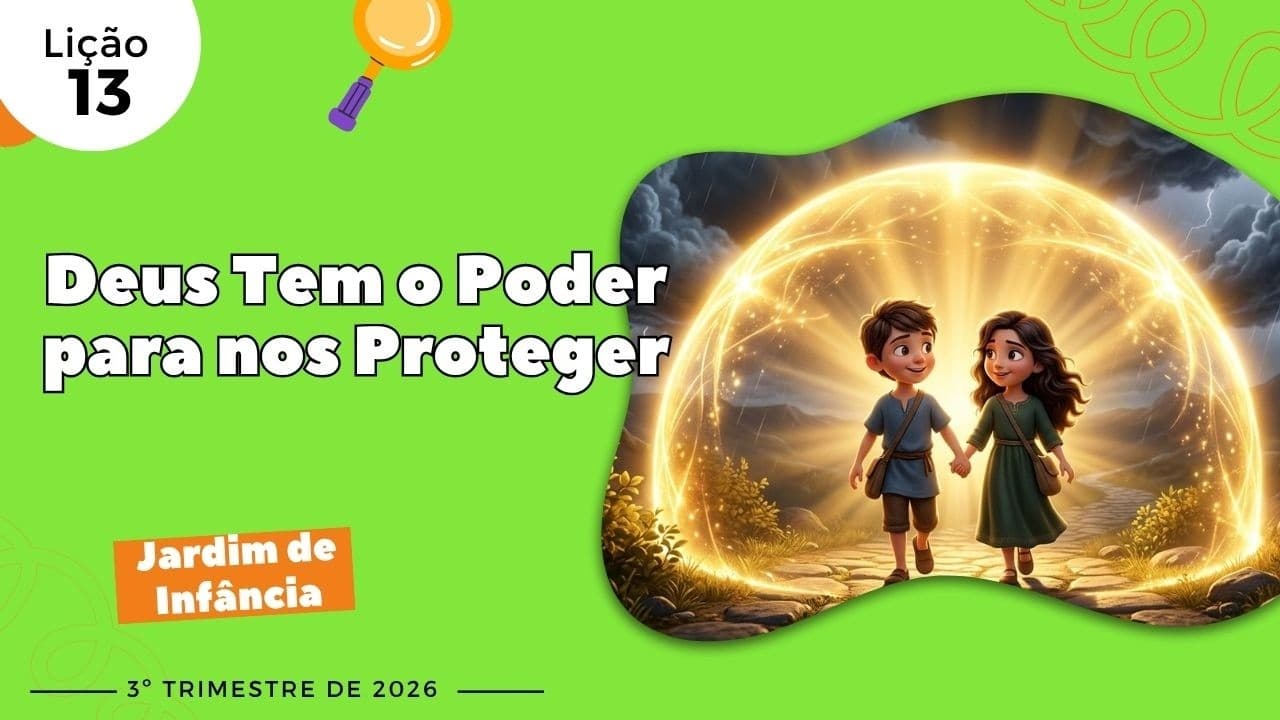
Script for the last class of the quarter for 5- and 6-year-olds: reviewing the thirteen Sundays on the wall chart, the cardboard shield in each child's hand, the verse from Proverbs 30:5 memorized in three parts, and the story of David — the shepherd who guarded the sheep — opening Psalm 23 and Psalm 91 in a child's language. The class upholds the distinction that sustains the entire quarter: God's protection is neither an amulet nor a bargain, it is the presence of a Father who does not let go of our hand even inside the valley. It ends in Jesus, the Good Shepherd who gave His life for the sheep, and sends home a mission of courage for the family to do together.
Teacher, dad, mom: this is the last class of the quarter — and it is the class that gives a name to everything the children have seen since July.
It has been thirteen whole Sundays learning the same thing in thirteen different ways: baby Moses in the little basket, the three friends in the fire, Daniel among the lions, the widow's oil, Ruth and Naomi, Queen Esther, Peter in prison, Paul and Silas singing in the dark, Paul on the ship. Today we step up one level and say the name of it: Father God has the power to protect us from all evil.
Except that this sentence has a right way and a wrong way to be taught — and the two sound very much alike in the mouth of a hurried adult. So, three agreements before we begin:
- The cardboard shield is a reminder, not an amulet. Say this out loud, more than once. No object that "keeps evil away," no sleeping with it under the pillow.
- Do not promise what the text does not promise. "If you pray, nothing bad will happen" is not in the Bible and hurts the child when life happens. God promises His Presence, not the absence of the valley.
- End with Jesus, not with courage. The story of David against the lion and the bear is beautiful and true, but the hero of the lesson is not the brave boy. It is the Good Shepherd who lays down His life for the sheep.
The lesson fits into one sentence: Father God is our shield — and our Shield has a name: Jesus, the Good Shepherd, who never lets go of His sheep.
I — The shield in hand (and the Shield that is not made of cardboard)
Hand out the shield at the door when each child arrives. Cardboard, a milk carton, a tape handle on the back — the simpler, the better, because the child needs to look at it and think, "I can make one just like this at home."
After praise and the offering, sit down at their eye level with your shield in hand and ask:
"Do you know what this is?"
Let them talk. You will hear superhero shield, soldier's shield, pot lid. Accept every answer and guide them to the right place with just one question: "and what is a shield for?"
The answer comes by itself: to protect. A shield is the thing that stays in front. Whatever comes flying hits it and does not hit the person.
Now comes the part that holds the whole class together. Hold up the cardboard shield, tap it with your finger, and say, with joy and without mystery:
"Look right here: this shield is made of cardboard. It does not protect from anything. It is only to help us remember. The One who truly protects is Father God."
Repeat that sentence two more times during the class. A five-year-old learns by repetition — and this is the sentence that keeps the lesson from turning into superstition.
Now show the poster-board Bible with the verse written in big letters, read it pointing to each word, and then read it again with them:
"Every word of God is flawless; He is a shield to those who take refuge in Him." (Proverbs 30:5).
Those are grown-up words. Explain only two:
- Pure (or flawless) means clean, with no lie at all. Everything God says is true. He never makes things up, never forgets, and never goes back on His word.
- To trust (or take refuge) is to truly believe in someone. You trust your dad when he says, "Jump, I'll catch you."
To memorize it, do as the quarterly teaches: divide the class into two groups and the verse into three pieces. Everyone together: that every word of God is pure. The girls: that He is a shield to those who trust. The boys: in Him. Then everyone together, from beginning to end, clapping on each piece. Repeat as many times as the class gladly can — and stop before they get tired.
And be careful with a detail that always shows up at this age: trusting God is not making a deal with Him. A child understands the world as an exchange ("if I eat my food, I get dessert") and will try to apply that here. Say right away, simply: we do not trust Father God so that He will do what we want. We trust Him because He is good, because He tells the truth, and because He does not go away.
🛡 Class agreement. Before the story, agree out loud and ask them to repeat: "Father God is my shield." Repeat it at the end. That is the sentence going home today.
II — The story: the shepherd who cared, and the Shepherd who cares
Tell it like this, in a storytelling voice. A calm voice in the part about danger, a firm and loud voice in the part about care.
Today our story is not about just one man: it is about two Psalms in the Bible. A psalm is a sung prayer. And the two we are going to open today are among the best known in the whole world: Psalm 23 and Psalm 91.
Who remembers David? Before he was king, David was a big boy who took care of sheep. He stayed out in the field all day long, and at night too. The sheep ate grass, drank water, slept — and he was the one who took care of them.
Did you know that a sheep is a very helpless animal? It does not know how to fight, it does not run fast, and it gets lost easily. If no one takes care of it, the sheep gets into trouble.
David also played a beautiful instrument called a harp, and he sang to God while he cared for the sheep.
Shall we be shepherds for a little bit? Stand up with me, hold your staff nice and firm with both hands, and step strong: one, two, one, two!
(March for five seconds, without running around, and have everyone sit down again.)
Except that one day real danger showed up. The Bible tells us that a lion came. And on another day, a bear came. A big animal, a strong animal, wanting to grab a little sheep from the flock.
And did David run away and leave the sheep?
He did not leave them. David stayed. And he himself told later why he was not afraid to stay: "David added, “The LORD, who delivered me from the claws of the lion and the bear, will deliver me from the hand of this Philistine.” “Go,” said Saul, “and may the LORD be with you.”" (1 Samuel 17:37).
Notice carefully what David said, because this is where the lesson lives. He did not say, "I am very strong." He said that the Lord delivered him. The one who received the strength was David; the One who gave the strength was God.
Clap your hands with me for Father God!
And it was this same David who wrote Psalm 23, and it begins like this:
"The LORD is my shepherd; I shall not want." (Psalm 23:1).
Do you see what David did? He took care of sheep and said: I am the sheep, and my Shepherd is God. He is the One who takes care of me.
And in Psalm 23 there is a part that is the most beautiful of all. David talks about a dark path, a scary path, and says this:
"Even though I walk through the valley of the shadow of death, I will fear no evil, for You are with me; Your rod and Your staff, they comfort me." (Psalm 23:4).
Pay attention to one thing, because it is important: David walked through the dark path. He did not say, "I will never go through a hard place." He said: even in there, I am not afraid — because the Lord is with me.
Now the other Psalm, 91. This one is a prayer for the time of fear, and it has a picture that a child understands right away.
"He will cover you with His feathers; under His wings you will find refuge; His faithfulness is a shield and rampart." (Psalm 91:4).
Have you ever seen a mother hen with her little chicks? When the rain comes, when the cold comes, when an animal comes, she opens her wings and the chicks run underneath. In there it is warm, it is cozy, and it is safe.
That is how Father God takes care of those who run to Him.
Shall we do the gesture? Open your arms real wide, like wings. Now close them, hug yourself real tight, and say with me: "Father God is my shield!"
And Psalm 91 says one more thing: God sends His angels to watch over us — "For He will command His angels concerning you to guard you in all your ways." (Psalm 91:11). We almost never see an angel, and that is fine: the One in charge of the angel is God, and it is God we talk to.
❤ For the child's heart. David was the shepherd of the sheep — and, at the same time, David was God's sheep. That is what we are: tiny little sheep of a great, strong Shepherd who never sleeps.
III — What God promised, and what He did not promise
Here is where the lesson can slip, so go slowly.
Psalm 91 has huge sentences: no evil, no plague, the angels, the lion and the serpent underfoot. Read in a hurry, it turns into the wrong promise — "whoever trusts in God never goes through anything bad." And then the first time life gets hard, the child will think that God failed or that she did not trust properly. Both conclusions are false, and both hurt.
Notice that the book of Psalms itself already takes care of this. A few pages earlier, in Psalm 23, the believer is inside the dark valley. The valley exists. We pass through it. And what God promises is not that the valley disappears — it is that He is with us (Psalm 23:4).
Say it to the class in the simplest sentence there is: Father God did not promise that nothing sad will ever happen. He promised that He will never let go of our hand.
And notice a second thing: no one stands still. David stood on his feet in front of the lion. Daniel kept praying. Esther went to speak with the king. Paul warned the ship's commander. God protects, and people obey, act, and call for help. God does not treat people like packages: He warns, He gives strength, and we walk.
Sized for a five- or six-year-old child, this becomes three very concrete things:
- Talking to Father God when afraid. It does not need fancy words: "Father God, I'm scared, stay with me" is already a complete prayer.
- Calling an adult when the matter is serious. If something happened that hurts, that scares, or that felt strange, tell dad, mom, or the teacher right away. The adult is the one who handles it; the child tells — and telling takes courage.
- Doing the right little thing even with butterflies in your tummy. Courage is not feeling no fear. It is feeling it and going anyway, knowing Who is by your side.
And one thing we do not teach here: trusting is not making a bargain with God. No one buys protection with good behavior, with a long prayer, or with a cardboard shield under the pillow. That has a name and it is not faith: it is superstition. God is a Father. Sometimes He takes us out of the valley, sometimes He walks through the valley with us to the other side. What He never does is let go of our hand.
Christ in the Lesson
David kept the sheep safe from the lion and the bear. It was brave, it was beautiful — and one day David grew old and died, and his sheep were left without him.
But there is a Shepherd who never ends. And He Himself introduced Himself like this:
"I am the good shepherd. The good shepherd lays down His life for the sheep." (John 10:11).
Look at the difference. David risked his life for the sheep. Jesus gave His life for the sheep — truly, completely, to the very end.
Because there is an evil that is bigger than a lion, than a bear, and than a storm: it is sin. The little lie, the tantrum, the anger kept inside, the ugly answer to mom. No one protects himself from that evil alone, not by being good, not by being clever, and not with any shield.
So Jesus did what a shield does: He stood in front. On the cross, He took in our place the punishment that was ours. On that day Jesus was left without shelter so that we might have shelter forever. And on the third day He rose again. Today He lives, reigns, and cares for those who trust in Him.
That is why the answer of the whole quarter is not "be brave." It is "the Shepherd is here."
✝ Christ in the Lesson. The shield in our class is made of cardboard and will get crumpled. The true Shield has a name, has hands marked by the cross, and is alive. Jesus is the Good Shepherd — and a sheep of the Good Shepherd is never alone.
Practical Application
1. The shield sentence, spoken out loud. Choose with the child a place in the house to hang the shield that came from class. Whenever fear hits, she looks at the shield and says: "Father God is my shield." The child is the one who says it.
2. Psalm 23 at bedtime. Read together, every day, just one verse of Psalm 23 — the same one all week long, if needed. Repetition is how a small child learns doctrine.
3. Naming the trusted adults. Sit down and name them one by one, by name: dad, mom, grandma, the Sunday School (EBD) teacher. The child tells; the adult handles it.
Closing Prayer
Father God, thank You for this whole quarter. Thank You because You kept baby Moses safe, kept the three friends in the fire, kept Daniel among the lions, kept Esther, kept Peter, kept Paul — and because You keep every child who is here today. Take fear out of their hearts and put in its place the certainty that You are the shield of those who trust. Teach each one to talk to You when fear comes, and to call dad, mom, and the teacher when something is scary. And thank You for Jesus, the Good Shepherd, who gave His life for the sheep and rose again. Now we are going home: keep us from all evil. In Jesus' name, amen.
Soli Deo Gloria — Scripture governs; everything else, on its knees.
Frequently asked questions about this lesson
The verse in my curriculum material is worded differently from the one in my Bible. Which one should I write on the shield?+
Write the one from the Bible. The text circulating in the support material is in a modern-language version, and translations differ on this point: "Every word of God is flawless; He is a shield to those who take refuge in Him." (Proverbs 30:5) Write this wording on the poster-board Bible that will stay on the wall and read it straight from your Bible in front of the class, pointing to the words. If the child is going to complete the printed activity and the wording there is different, let them complete it the way it appears on the sheet and say naturally: 'in the teacher's Bible it is written with other words, and it means the same thing — everything God says is true, and He is the shield of those who trust in Him.' Do not correct the sheet in front of the child; correct the poster, which is what stays up.
The child might think the cardboard shield actually protects them. How do I correct this without spoiling the fun?+
By telling the truth once, right at the beginning, and with joy. When handing out the shield, say it like this: 'This shield is made of cardboard; it is just to help us remember. The one who truly protects us is our Heavenly Father.' Repeat the sentence during the class activity and again at the end of the lesson. A 5-year-old learns by repetition, and three times are enough. What you need to avoid is the amulet mindset — the object that 'brings luck,' that 'wards off evil,' that has to be kept under the pillow. That is not Christian faith; it is superstition, and the Bible is against it. The shield is a reminder, the same way a photo of Grandma on the shelf is a reminder: it is not Grandma, but it makes us remember her.
Psalm 91 says that no evil will happen. What about when something bad happens in the family's life?+
That is the most important question of the lesson, and an honest answer does not weaken the text — it protects the child from disappointment down the road. Psalm 91 is not a contract guaranteeing that nothing difficult will ever cross the threshold of our home. The book of Psalms itself, just a few pages earlier, describes the believer walking through the dark valley of the shadow of death (Psalm 23:4) — in other words, the valley exists and we pass through it. What God promises is not the absence of the valley; it is His Presence inside it, assuring us that He is right there with us (Psalm 23:4). And He promises a sure end: whoever belongs to Christ is kept safe forever. Say this to the class in the simplest sentence possible: our Heavenly Father did not promise that nothing sad will ever happen; He promised that He will never let go of our hand. And never teach a bargain — there is no such thing as 'if you pray, nothing bad happens.' God is a Father, not a bargaining machine.
Can I talk about guardian angels? My student is going to want to see one.+
You can talk about angels, without making it the main subject and without folklore. "For He will command His angels concerning you to guard you in all your ways." (Psalm 91:11) Notice who is in charge: the one who gives the command is God. An angel is a servant, a messenger, carrying out what he was given to do. So we do not talk to angels, we do not ask angels for things, and we do not give names to angels — we talk to our Heavenly Father, who hears us right away. If a child asks whether they will see one, answer honestly and without making things up: almost no one sees them, and we do not need to see them to be kept safe. What we have in our hands is better: His written Word, which stays with us all the time.
How do I review the quarter without it turning into a boring list?+
Turn it into a memory game with the wall chart. Point to the picture from each Sunday and always ask the same two questions, in this order: 'Who is this?' and 'How did our Heavenly Father take care of them?' Let the class answer together, out loud, and fill in whatever is missing in one sentence — never more than one. Clap for each character. There are thirteen Sundays: go quickly, without stopping to retell the story, and save about three minutes for the question that ties everything together: 'And who was in all of these stories?' The answer is the lesson of the entire quarter — God was in all of them. If there is a new child who did not see the previous lessons, they can participate just the same: the question is simple and the others answer together.
The quarterly says to ask at the end who wants to accept Jesus. Should I do this with 5-year-olds?+
Do it, with care and with no pressure at all. Invite the whole class together, never call a child by name, and never ask them to raise their hand in front of the others to be counted. Tell the truth in a child's language: Jesus died on the cross in our place and rose again, He forgives, and He wants to be the Shepherd of each person's life; whoever wants to can talk to Him right now, with eyes closed, right where they are. Say a short prayer and let whoever wants to repeat it. Afterward, without any spotlight, write down the names of the children who talked with you and let their parents and the leadership know — not to record numbers, but so that someone continues talking with that child during the week. A young child's decision is accompanied, not collected.
Teacher's Guide
Essence of the class
Father God is our shield — and our Shield has a name: Jesus, the Good Shepherd, who never lets go of His sheep.
Map of the class
| Time | Stage |
|---|---|
| 0–5 min | Arrival: welcome each child by name and hand out the shield at the door |
| 5–11 min | Circle time: prayer of thanks led by a student, praise, offerings, and closing of the attendance chart |
| 11–17 min | Quarter review on the wall chart: whom God protected each Sunday |
| 17–23 min | The shield in hand + today's verse (Proverbs 30:5) memorized in three parts |
| 23–31 min | Bible story: David, Psalm 23, and Psalm 91 |
| 31–37 min | Class activity: the paper balls and the shield |
| 37–42 min | Quarterly activities: writing the verse on the shield, circling the psalms, coloring the scene |
| 42–45 min | Review with the Bible and the shield, wrap-up, circle prayer, and dismissal |
Start like this
Arrive early, pray thanking God for the quarter that is ending, set up the room, and leave the shields ready in a box near the door. If possible, prepare a simple closing party — cookies and juice already feel like a party at this age.
Hand the shield to each child upon arrival, calling them by name, and say just one sentence: "today our class is about the protection that comes from Father God." Let them play with the shield a little before circle time — they will play with it anyway, so it is better that it be now.
After praise and the offering, do the quarter review on the wall chart, quickly and like a game. Point to each character and always ask the same two questions: "who is it?" and "how did Father God take care of him?" Fill in whatever is missing in one sentence, never more than one, and clap for each name.
Close the review with the question that opens today's lesson: "and who was in all these stories?" Let them answer. You will hear "God," "Jesus," "Father God" — and that is Spot on.
Then sit down at their eye level, hold up your shield, and ask: "do you know what this is? And what is a shield for?" Let them talk before giving any explanation.
Point 1 — The shield is a reminder; the One who protects is God
- In the quarterly: the cardboard and milk-carton shield handed out upon arrival, with the explanation that it symbolizes God's presence over each person's life; the TO MEMORIZE section with Proverbs 30:5; the poster-board Bible with the verse written out; and the memorization technique dividing the class into two groups and the verse into three parts.
- What to teach: a shield is the thing that stays in front and takes the blow in the person's place. The cardboard one does not protect from anything — it is a reminder. The One who protects is Father God, and He protects because He is good and because everything He says is true, not because we paid for it.
- Anchor verse (BSB): "Every word of God is flawless; He is a shield to those who take refuge in Him." (Proverbs 30:5). Read it straight from your Bible and then on the poster-board Bible.
- Key question: "What is a shield for?"
- Likely answers (+ going deeper): "for the superhero," "for hitting," "so the soldier doesn't get hurt," "for hiding." Accept them all. Go deeper: "and who truly protects you when you are afraid?"
- If no one speaks: put the shield in front of your face and peek over the top, being playful: "and now, where is teacher? The shield stayed in front. That is what a shield does."
- Caution in this part: say three times during the class that the shield is made of cardboard and does not protect from anything. That is the sentence that keeps the lesson from turning into an amulet. Do not let anyone take the shield to bed "so they won't have nightmares" — correct gently with joy, without scolding. And when explaining the verse, do not promise that whoever trusts in God only has good days.
Point 2 — David, the sheep, and the Shepherd
- In the quarterly: the story of the two Psalms, with David introduced as the shepherd who cared for the sheep with affection and as the musician who played the harp; the reading of Psalm 23 with the children holding their Bibles open; and the reinforcement of verse 6 repeated as a prayer.
- What to teach: David faced the lion and the bear, but the credit is not his — he himself said it was the Lord who delivered him. And the most beautiful part is the turn: the shepherd of sheep looked at God and recognized himself as a sheep. That is what we are.
- Anchor verse (BSB): "The LORD is my shepherd; I shall not want." (Psalm 23:1). Read it straight from your Bible.
- Key question: "What does the shepherd do for the sheep?"
- Likely answers (+ going deeper): "gives food," "gives water," "takes care of them," "doesn't let the wolf get them," "finds the one that got lost." Go deeper: "and who is the Shepherd who takes care of you?"
- If no one speaks: go back to the scene: "if no one took care of the little sheep, what would happen to it?" They will answer right away.
- Caution in this part: tell the part about the lion and the bear in one sentence and without acting it out — no roaring, no imitating an animal grabbing a sheep, no turning off the lights. And do not end the story with David: pull in the very same breath toward the Good Shepherd, otherwise the lesson turns into "be brave like David," which is not the lesson.
Point 3 — Under His wings: what God promises and what He does not promise
- In the quarterly: the topic of Psalm 91 as a prayer for the time of fear, with God's protection day and night, His care while we sleep, and the angels He sends; and the activity in which the child colors the scene and marks how we feel when we have Jesus as our protector.
- What to teach: Psalm 91 speaks of God as a bird that opens its wings and hides its little ones — an image a five-year-old understands right away. And along with it, the distinction that holds the whole quarter together: God did not promise that nothing sad will ever happen; He promised that He is with us, even inside the dark path of Psalm 23.
- Anchor verse (BSB): "He will cover you with His feathers; under His wings you will find refuge; His faithfulness is a shield and rampart." (Psalm 91:4). Read it straight from your Bible.
- Key question: "What does the mother hen do when the rain comes and the little chicks are in the yard?"
- Likely answers (+ going deeper): "opens her wing," "hides them," "calls them," "they run underneath." Go deeper: "and what do we do when we get scared? Who do we run to?"
- If no one speaks: do the gesture first — open your arms like wings and call two or three children to come close. They understand with their bodies before they understand with words.
- Caution in this part: do not turn angels into the main subject of the class and do not make anything up about angels — the text says that the One who gives the command is God. Do not teach the child to talk to angels or ask angels for things. And do not promise that nothing bad will happen to someone who prays. If a child says that something sad happened at home, welcome her warmly right away, without asking for details in front of the others — "thank you for telling me, let's talk after class" — and bring it to the church leadership that same day.
Class activity
- Goal: to see with their eyes what the story says with words — nothing gets past the shield — and, in the very same gesture, learn that the real shield is not the cardboard.
- Materials: your cardboard shield (the biggest one), one sheet of used paper per child to crumple into a little ball, and a basket or box to collect them at the end. No hard objects, no real balls, no scissors.
- Step by step: (1) agree on the three rules out loud before starting, and ask them to repeat: the ball is made of paper, we only throw it at the shield, and no one throws at anyone; (2) stand in front of the class with the shield held up, and the children in a line about three steps away, sitting or standing in place; (3) call one at a time, and before throwing each child says out loud one thing that scares her — "the dark," "thunder," "a dog"; (4) she crumples the paper and throws it at the shield; (5) you hold it firm and comment: "it hit the shield, it didn't hit anyone"; (6) when everyone has thrown, lower the shield, show it to the class, and say: "look right here, the shield is in one piece. But pay attention: this shield is made of cardboard. If real rain came, it would get wet. The One who truly protects is Father God"; (7) everyone gathers the paper balls into the basket counting out loud — it turns into a game and the room stays clean.
- Wrap-up (back to the text): "Each little ball was a fear, and they all hit the shield. But the cardboard shield will get crumpled and one day will go into the trash. The shield that never ends is Father God: "Every word of God is flawless; He is a shield to those who take refuge in Him." (Proverbs 30:5). Take your shield home and hang it in a place where you can see it. Every time fear hits, look at it and say: Father God is my shield."
Wrap-up + challenge of the week
- Wrap-up: do the review as the quarterly teaches: everyone standing, the Bible in one hand and the shield in the other. Say: "this cardboard one is a reminder. This one here" — hold up the Bible — "is the Word of God, and it is what tells the truth about Who takes care of us." Repeat together today's verse and Psalm 23:1. Then close like this: "we spent thirteen Sundays learning the same thing: Father God protects. He never promised that nothing sad would happen; He promised that He never lets go of our hand, not even on the dark path. And the greatest care in all of history was Jesus, the Good Shepherd, who gave His life for the sheep on the cross and rose again. Do not forget our agreement: Father God is my shield."
- Challenge: dad and mom, do the courage mission with your child. Let her choose — she is the one who chooses — one tiny thing this week that gives her butterflies in her tummy and that she can do with you nearby: sleeping with the hallway light on instead of the bedroom light, going alone to the kitchen to get water while you stay in the living room, walking into the Sunday School classroom without crying, saying "good morning" to the neighbor. Before doing it, she holds the shield that came from class and says out loud: "Father God is my shield — He is here with me." Afterwards, hug and thank God together in one sentence. Three rules: nothing that is truly dangerous, no one pushes, and no one teases; and if she gives up halfway through, the hug comes just the same — trying is already courage.
Teacher's kit
- Before: read all of Psalm 23 and Psalm 91 and the quarterly topic. Cut out and assemble at home one shield per child (cardboard, milk carton, tape on the back for the hand), write each child's name on the back, and leave blank space in the middle for the verse activity. Put together the poster-board Bible with Proverbs 30:5. Check the attendance chart on the wall and decide the order of the characters for the review — thirteen names go by quickly if you already know the order.
- Bring: your Bible, the finished shields, the poster-board Bible with the verse, sheets of used paper for the little balls, a basket, crayons, and the quarterly activities. If you are having a closing party, also bring the snack and napkins.
- If a parent asks why God let something bad happen to his family: the honest answer fits into two sentences, and it is worth practicing. God did not promise a life without a valley — He promised to be inside the valley with His own, and He promised that nothing snatches from the Shepherd whoever belongs to Him. Christian faith is not insurance against loss; it is the certainty that the Person who keeps us is greater than the loss, and that in Christ what He keeps forever is the person. Have that conversation with the adult, calmly, away from the circle of children.
- Pray beforehand: ask God for joy to close the quarter well, eyes to see the child who arrived scared today, and a steady voice to say three times, without fear of repeating, that the shield is made of cardboard and the One who protects is the Lord. The closing prayer of the study can be reused at the end of class.
Homework
Your mission for the week
Dad and mom, do the courage mission with your child. Let her choose — she is the one who chooses — one tiny thing this week that gives her butterflies in her tummy and that she can do with you nearby: sleeping with the hallway light on instead of the bedroom light, going alone to the kitchen to get water while you stay in the living room, walking into the Sunday School classroom without crying, saying "good morning" to the neighbor. Before doing it, she holds the shield that came from class and says out loud: "Father God is my shield — He is here with me." Afterwards, hug and thank God together in one sentence. Three rules: nothing that is truly dangerous, no one pushes, and no one teases; and if she gives up halfway through, the hug comes just the same — trying is already courage.
Why
David stood on his feet in front of the lion and the bear, and later told why: "David added, “The LORD, who delivered me from the claws of the lion and the bear, will deliver me from the hand of this Philistine.” “Go,” said Saul, “and may the LORD be with you.”" (1 Samuel 17:37). The strength belonged to God, and the child who trusts in the same God can take a small step even with a pounding heart. It is the verse of the week turning into action: "Every word of God is flawless; He is a shield to those who take refuge in Him." (Proverbs 30:5). A child's courage is not pretending not to be afraid — it is feeling the fear and going anyway, knowing Who is by her side.
How to know you did it
The child chose the tiny thing, spoke the shield sentence out loud beforehand, and tried — once is enough. If she tried and could not finish, count it just the same: the mission was to try while holding on to the sentence, and she tried.
On Sunday, come back with the story
On Sunday, class begins with the question: "what was your brave little thing of the week?" Come back with the story.