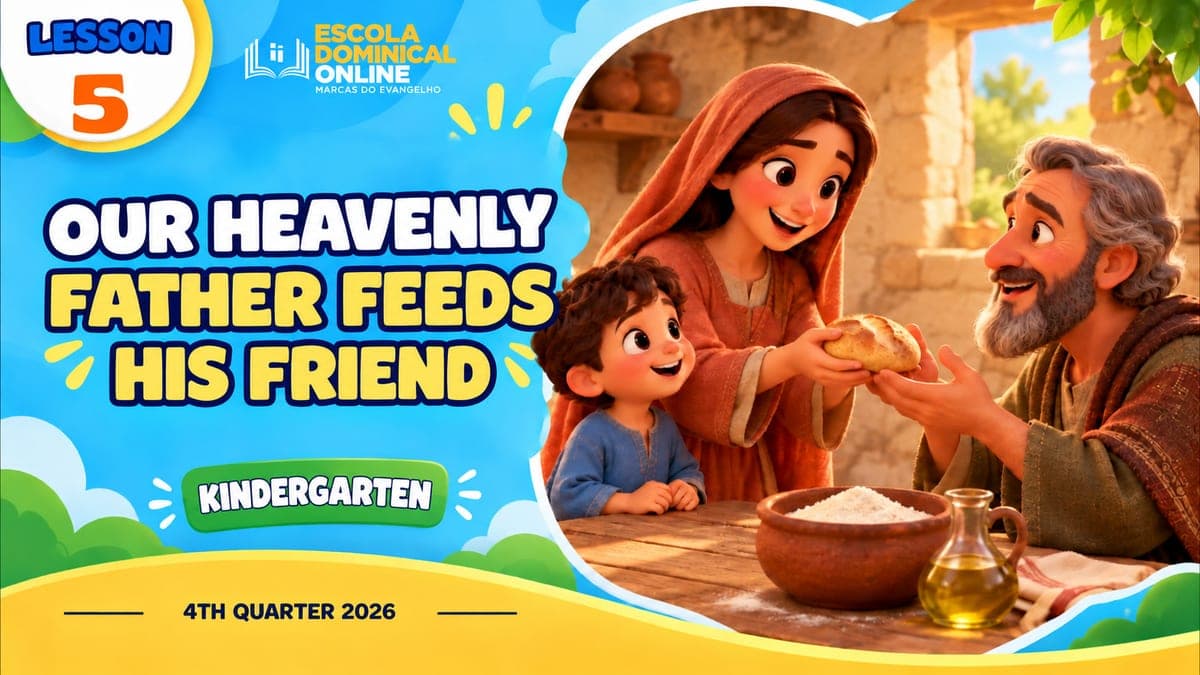
Golden Text
“Give us each day our daily bread.” (Luke 11:3, BSB) · Read in the Bible
The prophet Elisha instructs a widow in debt to gather empty vessels and pour her last bit of olive oil into them — and God multiplies the oil until there are no more vessels left to fill. The children learn that Heavenly Father cares for His children's needs and can turn a little into a lot.
Over the past few weeks, we have seen Father God doing amazing things: He saved a baby in the river, guided a people through the desert with a cloud and fire, and even made the sun stand still in the sky. Today, the story is different. There is no river, no desert, and no battle. Today there is a mommy crying, two frightened sons, and an almost empty jar of olive oil.
It seems like very little, doesn't it? But that is right where Father God shows His power: He turns little into much. And what looked like the end became the greatest miracle that family had ever experienced.
When food runs out
Let's talk about something serious. Do you know what it means to be hungry? Really hungry, not that little hunger we feel before lunch. Real hunger is when someone has nothing to eat — not even a little piece of bread, not a glass of milk, nothing.
There are many families in the world going through this. And in today's story, our character's family was in that exact situation: with no money, no food, and a huge problem ahead of them. But Father God did not abandon that family. He never abandons anyone.
The Bible teaches us to pray like this: "Give us each day our daily bread." (Luke 11:3) That is our verse for today. Father God knows what we need and takes care so that nothing is lacking.
The desperate widow
Long ago, in a city in Israel, lived a woman who was going through very hard days. Her husband had died — she was a widow, which means she no longer had a husband. She was left alone with two young sons and had no money to take care of them.
To make matters worse, her husband had left a very large debt. A man came to her to collect that money and said something terrible: "If you do not pay what your husband owed me, I will take your two sons to be my slaves!"
Imagine that mother's fear and despair! Lose her sons? Never! But she had no money to pay. What could she do?
That woman remembered that her husband had been a servant of a prophet named Elisha — a man who heard the voice of Father God. So she ran to Elisha and, crying, told him everything: the debt, the threat, the fear of losing her sons.
Elisha's question
Elisha listened carefully to the woman. The prophet did not send her away or say that the problem was hers alone. He wanted to help. And he asked a simple question:
— What do you have in your house?
The widow lowered her head, ashamed. It seemed she had nothing to offer. Then she answered in a quiet voice:
— All I have is just a jar with a little olive oil.
A tiny bit of olive oil. To her, it was almost nothing. But to Father God, that tiny bit was more than enough to work a huge miracle.
❤ For the child's heart. Sometimes we think we have very little to offer Father God — little strength, little courage, very little at all. But He does not need much to do something amazing. Give Father God the little bit you have, and He will turn it into something wonderful.
The miracle of the jars
Then the prophet Elisha gave a very clear instruction:
— Go to your neighbors and borrow many empty jars — as many as you can get. Then go inside your house with your sons, shut the door, and start pouring the olive oil from your jar into all the vessels you have gathered.
The woman might have thought it strange. "But I only have a tiny bit of olive oil! How will it be enough to fill all these jars?" Even so, she obeyed. She called her sons and told them to run to the neighbors' houses asking to borrow vessels: large pitchers, small pitchers, pots, bowls — everything they could find.
When the house was full of empty jars, the woman shut the door. Then she took her jar with that tiny bit of olive oil and began to pour. The oil fell into the first pitcher… and it filled up! She moved to the second… it filled up too! Third, fourth, fifth — the oil kept on pouring!
Her sons kept bringing more jars, and she kept filling them. The oil from the tiny jar seemed to have no end. One pitcher after another, one jar after another. Father God was multiplying the olive oil right before that family's eyes.
Until a moment came when the woman said to her son: "Bring me another jar!" And he answered: "Mommy, there isn't a single empty jar left." And at that exact moment, the oil stopped flowing.
It was not the oil jar that ran out first — it was the empty jars that ran out! If she had borrowed more jars, there would have been more oil. The miracle only stopped because there was nowhere left to put it.
The debt paid and the family saved
The widow ran to the prophet Elisha, her heart overflowing with joy, and told him everything that had happened. Elisha smiled and said:
— Now go, sell the olive oil and pay your husband's debt. And the oil that is left over will be enough for you and your sons to live on.
The woman paid the debt. No one would take her sons away anymore. And there was still olive oil left over to support the family. Father God did not just solve the problem — He gave more than enough.
How wonderful! Father God turned a little jar with a tiny bit of olive oil into a house full of provision. He made little become much. And He can do the same for every family represented in this room.
Father God uses people to help
One very beautiful thing in this story is that Father God did not drop the olive oil from the sky — He used people. He used the prophet Elisha to give the instruction. He used the neighbors who lent the jars. He used the widow's sons, who worked hard carrying the pitchers.
This teaches us something very important: Father God can use you to help someone in need. When you share your snack with a little friend who didn't bring one, you are being used by Father God. When you help Mommy at home, you are being God's instrument. You don't have to be a prophet to make a difference — you just need a willing heart.
Christ in the Lesson
In today's story, the olive oil that never ran out is a beautiful picture of something Jesus offers us: abundant life. Jesus said: "The thief comes only to steal and kill and destroy. I have come that they may have life, and have it in all its fullness." (John 10:10) Just as the oil filled every jar to overflowing, the love of Jesus fills our lives until there is no more room.
And there is another precious detail. Olive oil, in the Bible, is often a symbol of the Holy Spirit — the Comforter whom Jesus promised to send. Just as the oil never stopped flowing as long as there was a jar, the Holy Spirit never stops working as long as there is an open heart to receive Him. God's provision, through Christ and His Spirit, is more than enough for any need.
Closing Prayer
Father God, thank You because You never let Your children lack anything. You turn little into much, the impossible into the possible. Thank You for taking care of every family represented in this room. Bless the food on every table, the joy in every home, the peace in every heart. May these children learn from an early age to trust in You and to share what they have with those in need. In Jesus' name, amen.
Soli Deo Gloria — Scripture governs; everything else, on its knees.
Frequently asked questions about this lesson
What is the story of the widow's oil in the Bible?+
In 2 Kings 4:1-7, a desperate widow comes to the prophet Elisha: her husband left debts behind, and the creditor threatens to take her two sons as slaves. Elisha asks what she has in the house; she replies that she only has a jar with a little oil. The prophet tells her to borrow vessels from her neighbors and pour the oil into them. God multiplies the oil until all the vessels are full. She sells the oil, pays off the debt, and provides for her sons.
What is the memory verse for Kindergarten Lesson 4?+
"Give us each day our daily bread." (Luke 11:3) The suggestion is to make eight poster-board loaves of bread, write one word of the verse on each loaf, and hang them on a string clothesline with clothespins.
How can you explain the concept of hunger and need to 5- and 6-year-old children?+
In a sensitive and hopeful way. Explain that there are people who do not have anything to eat, but Heavenly Father cares about every single one of them. He can use people — like the prophet Elisha — to help those in need. The children can learn that God can also use them to bless others.
What activities can the teacher do in the lesson on the widow's oil?+
The activities include: (1) a maze to help the widow's sons find the vessels; (2) coloring the vessel with the right answer in a quiz about the story; (3) a role-play skit in which the children act out the story using fabrics and vessels; (4) a prayer drawing — each child draws what they are asking God for, folds the sheet, and trades it with a friend so they can pray for one another.
Teacher's Guide
Preparation. Hang the fourth umbrella on the bulletin board. Make eight poster-board loaves of bread and write one word of the verse on each one. Set up a twine clothesline in the classroom with clothespins to hang the loaves.
Opening resource. Bring a small bottle (500 ml) with water or yellow juice and four clear disposable cups. Begin the class by filling the cups: the first fills up, the second fills up, by the third the liquid starts running low, and for the fourth there is nothing left. Show surprise: "It's all gone! There wasn't enough for everyone!" Then say: "Today we are going to hear a Bible story where the opposite happened — there was no shortage of olive oil to fill the jars, but a shortage of jars for all the olive oil that Father God gave!"
Welcome and praise. Welcome the children joyfully, ask how their week went, and say a prayer of gratitude. Sing songs of praise about the power of God. Introduce visitors and collect the offerings.
Lesson topic — Hunger. Talk with sensitivity: there are people who have nothing to eat. But Father God cares and can use people to help those in need — just as He used Elisha to help the widow.
Verse (Luke 11:3). Read it from the Bible. Hang the poster-board loaves on the clothesline as you recite each word. Repeat it with the children. Explain: "Just as we eat food to grow strong, we need to feed on the Word of God. And we can ask Father God never to let food run out in our home and in our little friends' homes."
Bible story (2 Kings 4:1-7). Tell the story with emotion: the sad voice of the widow, Elisha's calmness, the sons rushing around to gather jars, the surprise of the olive oil that never ran out. Ask questions during the story: "Do you think the oil is going to run out?" "Why did the oil stop flowing?"
Activities.
- Maze — The children help the widow's sons find the jars through the maze path. Stimulates motor coordination and perception.
- Color the right jar — Visual quiz: for each question about the story (the prophet's name, what the jars were filled with, how many sons the woman had, what would happen if the debt was not paid), the child colors the jar with the correct answer.
Reinforcing the lesson — Role-play. Organize a dramatization of the story. Hand out fabrics and jars to set the scene. Choose children for the roles (widow, sons, Elisha, neighbors). Let the dialogue flow and make any needed adjustments. Conclude: "Just as God did for the widow, He will not let us lack anything."
Prayer activity. Hand a sheet of A4 paper to each child and ask them to draw something they are asking Father God for. Then ask them to fold the sheet and swap with the little friend next to them — each one prays for the other's request. Reinforce: "Father God can use people to help one another."
Closing. Check the activities, praise every achievement, put away the materials, and sing a farewell chorus (short worship song). Ask visitors to come back with a little friend. Pray and send the children off with a warm hug.