Golden Text
“for, “Everyone who calls on the name of the Lord will be saved.”” (Romans 10:13, BSB) · Read in the Bible
Short-cycle class script for 5- and 6-year-olds: the poster-board flame with the verse, the story of Shadrach, Meshach, and Abednego told without scares, and a shoebox furnace with paper-roll puppets for the children to play with.
Teacher, dad, mom: today's story has fire — and today's classroom has no fire at all. No candle, no match, no lighter, no oil lamp. The furnace will be a shoebox. The flames will be red paper with glitter.
It is worth agreeing on this before starting, because a five-year-old child already knows that fire burns. Told carelessly, this story can lead to two bad results: a fright, or the idea that it is okay to play with danger because God protects. Neither of the two is the lesson.
The lesson fits into one sentence: Father God did not leave the three friends alone in the fire — and He does not leave you alone.
I — The poster-board flame in the circle (welcome, praise, and verse)
Arrive early and have everything ready. Welcome each child by name, say how important their presence is, and settle everyone in their place. While you welcome them at the door, the helpers can teach the new chorus of the week — nice and short, with easy-to-repeat motions. Little children love something new.
Say the opening prayer, collect the offerings, and mark the attendance on the wall chart with the children.
Before the story, start a two-minute chat about friendship: "Who are your best friends?" Let everyone say a name. Then say that a good friend is one who helps us obey Father God — and that our best friend of all is Jesus.
🔥 Class agreement. Before telling the story, make this agreement out loud and ask them to repeat it: "fire hurts, fire is for adults, and I never go near it." Repeat this again at the end. This is the most important sentence of the day after the verse.
Now show the big poster-board flame with the verse written on it. Read it together: "for, “Everyone who calls on the name of the Lord will be saved.”" (Romans 10:13). Invoke is a big word; swap it for one the child uses: call. Whoever calls on Father God is helped by Him.
Repeat it three times while clapping hands. Then cover the poster and ask them to repeat it without looking. At the end, each child takes home a little red paper flame with the verse.
Explain it like this: "When we get hurt or scared, we shout for help, don't we? And mom, dad, or the teacher comes. Except there isn't always someone right nearby. With Father God it is different: He is always by our side, and He always listens when we call."
II — The story: three friends who stayed standing
Tell it like this, in a storytelling voice. A calm voice during the part about danger, a joyful voice during the part about care.
A long time ago, a very powerful king attacked the land of the people of God and took many young people away to a huge and very distant city called Babylon. Three of those young men were true friends. Their names were Hananiah, Mishael, and Azariah — but there in Babylon their names were changed to Shadrach, Meshach, and Abednego.
Shall we say them together, clapping our hands on each little part? Sha-drach! Me-shach! A-bed-ne-go!
Just imagine: they left their city and even their names changed. But one thing did not change at all — their love and obedience to Father God. Every day they prayed. Put your little hands together and close your eyes with us: "Father God, I love You."
One day, King Nebuchadnezzar had a very wrong idea. He ordered a giant gold statue to be built. Stretch your arms up really high, as high as you can — it was taller than that!
Then the king sent the message to the whole kingdom: "When the music plays, everyone must kneel down and worship my statue."
And can we kneel down to worship a statue? No! Kneeling and worshiping are only for Father God. Only He is the true God.
The day came. The music played. And everyone knelt down all at once. The whole place was full of people kneeling... except three. Shadrach, Meshach, and Abednego stayed standing. Stand up with us, nice and straight, and cross your arms over your chest like this, in an X: firm, firm, firm!
Some people ran to tell the king. The king got very angry and sent for the three. He gave them one more chance: "If the music plays again, will you kneel down?"
And the three answered very calmly: "Our God can save us. And even if He does not save us, we will not worship your statue. We worship only Father God."
Then the king ordered the three to be thrown into a furnace — a huge and very hot oven, so hot that no one could get near it.
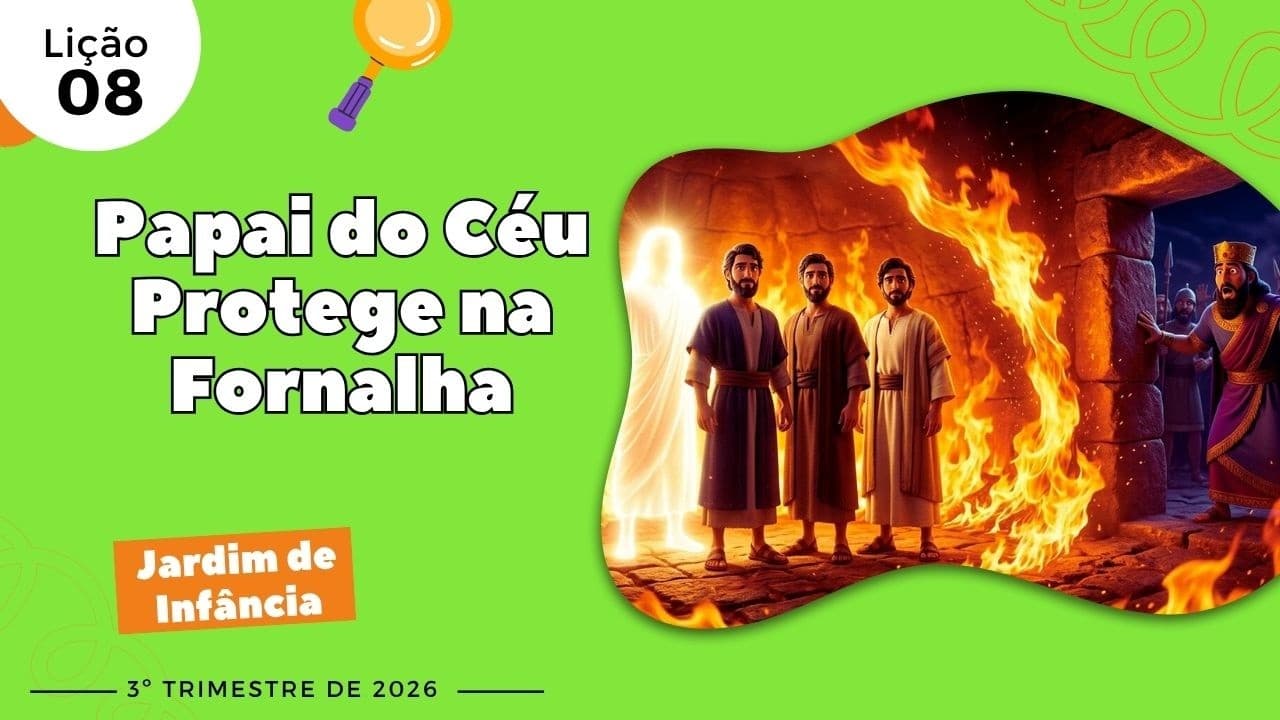
And now comes the best part of the whole story. The king looked inside and his eyes went wide like this. He counted: "I ordered three to be thrown in... why am I seeing four walking around inside, completely free?"
The three friends were not alone! Father God sent someone from heaven to stay right there with them, right in the middle of the fire. Give yourself a big tight hug: it was that close.
The king shouted out to them: "Come out of there!" And they walked out, just the way they had gone in. Not a single hurt. Not a single hair burned. Not even a little smell of smoke on their clothes. Clap your hands for our God!
The king was so amazed that he ordered a new decree to be written for the whole kingdom: no one could speak against the God of Shadrach, Meshach, and Abednego. And the three friends received a place of honor in Babylon.
❤ For the child's heart. Father God did not pull the three friends out of the fire from the outside — He went in with them. It is like that with you too: when you feel afraid, He does not just watch from far away. He is right by your side.
III — Only Father God receives worship
Notice what the three friends did not do. They did not fight with anyone. They did not shout at the king. They did not break the statue. They just stayed standing and spoke the truth calmly, and then left the rest in God's hands.
To worship is to say with your body and with your mouth: "You are my Lord." That is why we kneel only before Father God. A statue does not listen, does not speak, and does not take care of anyone — He listens, speaks, and takes care of us (Exodus 20:3).
And what does that look like at the size of a five-year-old child? Very concrete:
- Not going along with what is wrong. If your little friends are going to do something ugly, you do not go along. Just doing that is already staying standing.
- Calling an adult when something is scary. Did something happen that is scary, that hurts, or that felt strange to you? Tell dad, mom, or the teacher. The adult is the one who handles it; the child tells — and telling is being brave.
- Calling on Father God. It is today's verse with legs: when your heart feels tight, talk to Him. He listens right away.
And the most important thing of the day, once again, with everyone repeating: fire hurts, fire is for adults, and I never go near it. The three friends did not choose to go into the fire, and no one should put themselves in danger to test whether God protects. Trusting God and taking care of your body go together.
Christ in the Lesson
The three friends went into the fire and came out whole because God was with them inside. But they said something we cannot miss: and even if He does not deliver us, we will not worship (Daniel 3:17-18). They did not obey in order to buy a deliverance. They obeyed because they loved God.
And that is exactly what Jesus did, on a much greater scale. He was not taken out of suffering: He entered into it for us. Jesus went to the cross, in our place, to save us from sin. And He did not stay in death — He rose again and is alive.
✝ Christ in the Lesson. God sent someone from heaven to be with the three friends in the fire. And He sent His own Son, Jesus, to be with us and save us once and for all. Today's verse is about Him: whoever calls on the Lord is saved (Romans 10:13).
Practical Application
1. Call on Father God in times of trouble. Teach the child to say out loud, when scared: "Father God, help me." It is the shortest and truest prayer there is.
2. Call an adult when the matter is serious. Name with the child, one by one, who the trusted adults in their life are. The child tells; the adult handles it.
3. Kneel only before God. Nothing at home or at school deserves His place — not a favorite toy, not the television, not anyone.
Closing Prayer
Father God, thank You for being with us in this class. Thank You because You did not leave Shadrach, Meshach, and Abednego alone, and because You do not leave any child in this classroom alone either. Teach each one to call on You when their heart feels tight and to call dad, mom, and the teacher when something scares them. Now we are going home: keep us from all evil. And thank You for Jesus, who went to the cross for us and rose again. In Jesus' name, amen.
Soli Deo Gloria — Scripture governs; everything else, on its knees.
Frequently asked questions about this lesson
Who were Shadrach, Meshach, and Abednego?+
Three young men from the people of God who were taken to Babylon when the king attacked their land. Their birth names were Hananiah, Mishael, and Azariah, and they were replaced with Babylonian names. Their address changed, their names changed — their love for Heavenly Father did not change (Daniel 3).
Who was the fourth man inside the furnace?+
The Bible preserves both of the king's statements: he said that the fourth looked like the Son of God (Daniel 3:25) and, right after, said that God had sent His angel to deliver the three (Daniel 3:28). The quarterly speaks of the angel that Heavenly Father sent. With a 5- or 6-year-old child, stick to what is certain and what matters: Heavenly Father did not leave the three alone — He sent someone from heaven to be in there with them. Do not turn this into a debate in the classroom.
How can I tell a story with fire without scaring the child?+
Tell the danger part quickly and the care part slowly. Do not describe the fire, do not use a scary voice, do not imitate screams, and do not mention the soldiers who died. No one gets hurt in your storytelling: the three go in, Heavenly Father is there, and they come out whole. If a child gets scared, stop the story, call them close, and say: 'Heavenly Father is with you right now.'
Could a child think that fire doesn't hurt because God protects?+
Yes, and that is the greatest precaution in this lesson. Say it plainly, more than once: fire hurts, fire is for grown-ups, and we never get close to test it. God does not ask anyone to put themselves in danger on purpose. No real flame enters the classroom — the furnace in the lesson is made of a shoebox and paper.
If a child obeys God, will He deliver them from every problem?+
We do not teach a bargain. The three friends themselves told the king that God could deliver them, but that even if He did not, they would not worship the statue (Daniel 3:17-18). We obey because we love God, not to get something in return. What He promises is to be with us, never leaving us or forsaking us (Hebrews 13:5).
Teacher's Guide
Essence of the class
The three friends worshiped only Father God — and He did not leave them alone in the fire. He does not leave you alone either.
Map of the class
| Time | Stage |
|---|---|
| 0–5 min | Welcome at the door and new chorus with the helpers |
| 5–12 min | Praise with motions, prayer, visitors, offerings, and attendance |
| 12–16 min | Chat about friendship + the fire agreement |
| 16–22 min | Verse of the day on the poster-board flame (Romans 10:13b) |
| 22–30 min | Bible story: Shadrach, Meshach, and Abednego |
| 30–34 min | Word search with the three names |
| 34–42 min | Activity: the shoebox furnace and the puppets |
| 42–45 min | Wrap-up, prayer, and dismissal |
Start like this
Before any explanation, hold the poster-board flame behind your back and ask: "Who here has ever had a scare?" Let three or four children tell their story — you will hear about a dog that barked, a noise in the dark, thunder, or someone who hid and shouted "boo!".
Welcome each answer and ask the second question: "And what did you do? Who did you call?" You will hear "I yelled for mom", "I ran to dad". That is right where the class needs to get. Then say: "Today I am going to tell you about three friends who had the biggest scare in the world — and about Who was there with them."
Point 1 — They worshiped only Father God
- In the quarterly: the topic on worship, with the explanation that only the Lord may be worshiped, and the beginning of the Bible story, up to the king's order before the statue.
- What to teach: the three were taken far away and even their names were changed, but their love for Father God stayed the same. When the music played, everyone knelt down to the statue and they stayed standing — because kneeling and worshiping are only for God.
- Anchor verse (BSB): Exodus 20:3 — the commandment to have no other gods. Read it straight from your Bible.
- Key question: "Who do we kneel down to?"
- Likely answers (+ going deeper): "to God", "to Jesus", "to pray". Accept them all and go deeper: "And what about to a gold statue, can we? No! A statue does not listen and does not take care of anyone."
- If no one speaks: kneel down yourself, put your hands together, and say "I kneel down like this, and it is only for Father God". The class will copy you right away and the conversation will open up.
Point 2 — Father God was inside there
- In the quarterly: the final part of the Bible story, with the king seeing four men in the furnace, the three coming out without a single hurt, and the conclusion about God not forsaking us when we obey Him.
- What to teach: the three went into the fire and were not left alone — Father God sent someone from heaven to be there with them, and they came out whole. God does not protect from far away: He stays close.
- Anchor verse (BSB): Daniel 3:25 and 3:28 — the king's amazement at seeing four and his recognition that God sent His angel. Read it straight from your Bible.
- Key question: "What do we do when something scares us?"
- Likely answers (+ going deeper): "I call mom", "I cry", "I run", "I hide". Welcome them all, without correcting any, and go deeper: "All of that is okay. And we can do both things: call an adult and call on Father God."
- If no one speaks: share your own story first — "I once got scared by thunder and called my mom" — and the class will open up.
- Care required in this part: do not describe the fire, do not put on a voice of terror, and do not mention the soldiers who died. Move quickly through the danger and linger on the care. If any child gets scared, stop and call them close to you.
Class activity
- Goal: for the child to retell the story with their own hands, always ending with "they were not alone".
- Materials: a shoebox, red printer paper, glitter, glue, poster board, crayons, and toilet-paper rolls. No real fire at all — no candle, no match, no lighter.
- Step by step: (1) before class, assemble the furnace using the shoebox, with red paper flames around the edge; (2) using the paper rolls, make the puppets — the three friends, the king, and one more character in white and gold, the one Father God sent; (3) in class, let the children decorate the flames with glitter and color the three friends; (4) then open the box for free play: each child tells the story again with the puppets in hand, in their own way.
- Wrap-up (back to the text): "Count with me again: how many went in? Three. How many did the king see? Four! They were not alone. And neither are you — Father God kept the three friends safe and keeps you safe from all evil."
Wrap-up + challenge of the week
- Wrap-up: "The three friends knelt down only to Father God, and He did not leave them alone even in the hottest place in the world. Jesus did even more: He went to the cross in our place to save us, and He rose again. That is why we can call on Him at any time: whoever calls on the Lord is saved. And do not forget our agreement: fire hurts, fire is for adults, and I never go near it."
- Challenge: dad and mom, do the "safety patrol" with your child on one day this week. Walk through the house together and let them point out three things that can hurt and that are only for adults — the stove, the iron, the electrical outlet, the box of matches, the cleaning product. At each one, they say out loud: "this is for adults — I call dad or mom." At the end, pray together thanking Father God, who also takes care of them through the hands of the adults in the home.
Teacher's kit
- Before: read the whole of Daniel 3 and the topic in the quarterly. Assemble the shoebox furnace and the puppets at home so they are ready. Decide beforehand the exact sentence you will use when talking about the fire — that part is not to be improvised.
- Bring: a Bible, the big poster-board flame with the verse, the little red paper flames for the children to take home, the shoebox furnace, the paper-roll puppets, glitter, glue, and crayons.
- Pray beforehand: ask God for eyes to notice the fearful child in the room and a calm voice to tell the part about the fire without scaring anyone.
Homework
Your mission for the week
Dad and mom, do the "safety patrol" with your child on one day this week. Walk through the house together and let them point out three things that can hurt and that are only for adults — the stove, the iron, the electrical outlet, the box of matches, the cleaning product. At each one, they say out loud: "this is for adults — I call dad or mom." At the end, pray together thanking Father God, who also takes care of them through the hands of the adults in the home.
Why
The three friends did not choose to go into the fire, and no one should put themselves in danger to test whether God protects. Trusting God and telling an adult go together: whoever calls out is helped — "for, “Everyone who calls on the name of the Lord will be saved.”" (Romans 10:13).
How to know you did it
The child pointed out three things in the house and said the sentence out loud at each one. Once is enough.
On Sunday, come back with the story
On Sunday, class begins with the question: "what did you find on the safety patrol at your house?" Come back with the story.