Golden Text
“Rejoice in the Lord always. I will say it again: Rejoice!” (Philippians 4:4, BSB) · Read in the Bible
Class script in short cycles for ages 5 and 6: the praise poster with musical notes, the verse that repeats like a chorus, the story of Paul and Silas singing in the dark told without any scares — and the midnight choir, which starts out softly and finishes loud. The class ends with Jesus, who also sang a hymn before going to the cross, and sends home a praise song with a name and a set time.
Teacher, dad, mom: today's class is the loudest of the quarter — and that is on purpose.
The story takes place inside a prison, but what the child needs to take home is not the place: it is the sound. Two hurt men, in the dark, with their feet locked up, and in the middle of the night they do the last thing anyone would expect. They sing.
Because of that, three agreements before we start:
- Do not turn off the classroom light. The dark in this class is a word, not the room's lighting.
- Do not act out what hurts. No one gets hit, not even in play, not even with the teacher "taking it in their place."
- No chains or handcuffs on anyone's body. The paper chain, if you make it, stays on the table. What goes in the child's hand is a musical note.
The lesson fits into a single sentence: Paul and Silas sang to Father God in the hardest place — and Father God opened the prison and opened the guard's heart.
I — The praise poster and the verse that repeats
Arrive early and leave everything ready. And welcome the children singing. Stand at the door with a joyful praise song on your lips, call each one by name, and pull them right into the music. Today the class starts before class starts.
When everyone is seated, form a standing circle and sing three or four short praise songs, the ones they already know by heart, clapping along. Collect the offerings while singing too, explain that giving an offering is saying thank You to Father God, and mark attendance by gluing today's lesson umbrella onto the big umbrella of the quarter.
Now show the praise poster: a poster board with photos or drawings of smiling children, the verse written very large in the middle, and musical notes glued all around it. Ask first, before explaining anything:
- "What do you see?"
- "What are these children doing?"
Let them speak. You will hear "they are laughing," "they are singing," "they are happy." Then say: "they are singing because they are glad. And we can be glad with Jesus even on days that are not easy."
Read the verse of the day, pointing to each word:
"Rejoice in the Lord always. I will say it again: Rejoice!" (Philippians 4:4)
Those are big words. Explain just one: to rejoice means to be truly glad, glad on the inside.
And make the most of the way the verse is built, which is a gift for this age group: it repeats. Teach it the way you teach a chorus, in two parts:
- You sing the first part, and they repeat: rejoice in the Lord always.
- You say the bridge: again I say... — and they shout together: rejoice!
Do three rounds, clapping along. Then cover the poster and ask them to say it without looking. Call anyone who wants to come up front to say it out loud — only whoever wants to, never someone picked out by pointing.
🎵 Class agreement. Before the story, agree out loud and ask them to repeat: "when my day gets hard, I sing to Father God." Repeat it at the end. After the verse, this is the most important sentence of the day.
II — The story: two prisoners who sang at midnight
Tell it like this, in a storytelling voice. A calm voice for the prison part, a party voice for the singing part.
A long time ago there were two friends: Paul and Silas. They were helpers of Jesus. They traveled from city to city telling everyone wonderful news: Jesus loves you and Jesus saves you.
One day they arrived in a city called Philippi. Shall we march with them? Stand up and march with me: one, two, one, two!
Except in Philippi some men got very angry with Paul and Silas. They did not want to hear about Jesus. So they ordered the two of them to be hurt and ordered the two of them to be locked up.
(Move quickly past this part. One sentence and keep going — without describing, without imitating sounds, without acting it out.)
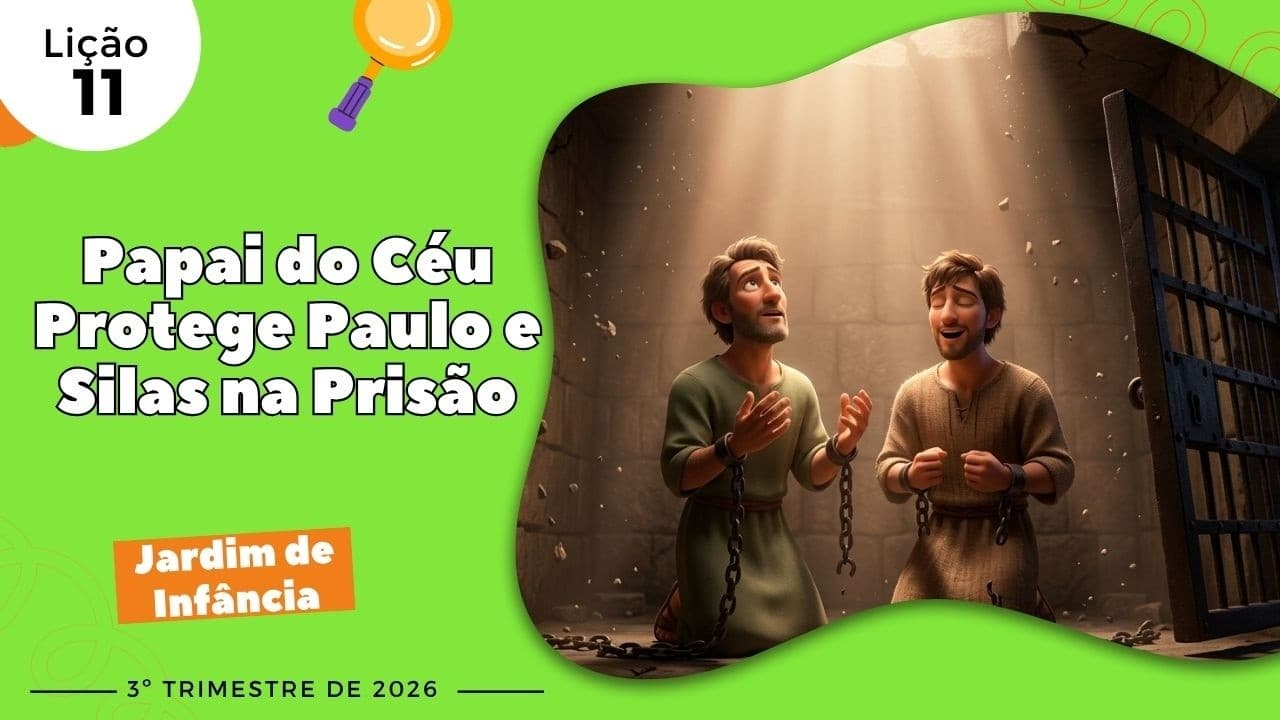
Paul and Silas were put in the deepest part of the prison. The guards locked their feet in some very heavy wooden blocks, which were called stocks, so they could not get out. Sit on the floor with me and cross your feet: they could not move their legs.
And it was dark. Cover your little eyes with your hands with me — just for a tiny bit, you can open them whenever you want. (Classroom light stays on, always.)
Now tell me: if that were you in there, what would you do? Would you cry? Would you get mad? Would you want your mom?
(Wait. Let three or four answer. Welcome every answer — all of them are normal.)
That's right. Now look at what Paul and Silas did. Right in the middle of the night, at the time called midnight, when everyone has already been asleep for a long time...
They started to sing.
Singing to Father God! Very loud! In the dark! With their feet locked up! Clap your hands with me and sing along — let's be Paul and Silas right now!
(Sing with the class a short praise song that everyone knows, clapping hands. Thirty seconds is enough.)
And do you know who was listening? The other prisoners. Everyone inside woke up and stayed listening to those two singing in the dark. They must have been thinking: "what strange people! How can anyone sing at a time like this?"
Then it happened. The ground started to shake! Shake with me: shake your hand, shake your foot, shake your little head! It was an earthquake that Father God sent.
And at that very moment all the doors opened and everyone's chains came loose. Nobody pushed any door, nobody had a key. It opened because God commanded it to open.
The prison guard woke up startled. He looked and saw everything open, everything open! And he thought: "all the prisoners ran away, and it's going to be my fault!" He was in despair.
But from way in the back, Paul shouted very loud: "We are all here!"
Notice something important: Paul and Silas did not run away. The door was wide open and they stayed. They stayed because they had something to give that guard, and it was not a scare.
The guard called for a light, ran inside, and fell on his knees in front of the two of them, trembling all over. And he asked the most important question a person can ask in their whole life:
"What do I need to do to be saved?"
And Paul answered — keep this sentence in your heart, child: "They replied, “Believe in the Lord Jesus and you will be saved, you and your household.”" (Acts 16:31)
The guard believed in Jesus that very night. And his whole family did too. He took Paul and Silas to his house, washed both of their wounds, set food on the table, and the whole house was glad — truly glad. Clap your hands really loud with me!
And in the morning, when the sun came up, the city authorities ordered Paul and Silas to be released. The two said goodbye to their friends and left in peace, to keep telling about Jesus in other cities.
❤ For the child's heart. The guard walked into that prison to watch two prisoners. He walked out with Jesus in his heart and his whole family happy. He thought he was taking care of the two of them — and it was the two of them taking care of him.
III — Singing is not a magic password: it is remembering who Father God is
This is where the lesson can slip, so go slowly.
Paul and Silas did not sing to make the door open. They did not even know there was going to be an earthquake. They sang because Jesus lived in their hearts — and whoever has Jesus inside has a joy that does not depend on where we are.
Notice: the door opened, yet they stayed inside until morning. Their praise was not a key. It was a way of saying to Father God: "You are good, Lord, even right now."
Sized for a 5- and 6-year-old child, today's lesson is very concrete:
- Singing in the hard moment. At bedtime when afraid, on the day playtime ended in tears, on the day of being sick: instead of only crying, singing a praise song to Jesus. It can be very softly.
- Singing together with someone. Calling mom, dad, or a brother or sister, and singing together. Nobody needs to sing pretty — we just need to sing from the heart.
- Telling an adult when something is scary. Did something happen that is scary, that hurts, or that felt strange to you? Talk to dad, mom, or the teacher right away. The adult is the one who handles it; the child speaks up — and speaking up is being brave.
And one thing we do not teach here: singing does not force God to do anything. God is not a wish machine. He always listens and answers as a Father — sometimes taking us out of the problem, sometimes staying with us inside it. What He never does is walk away.
Christ in the Lesson
Two iron chains fell to the floor that night. It was wonderful — but it was for one night only.
There is a chain we cannot see that is much worse than the iron one: it is sin. The little lie, the anger held inside, the ugly talk back to mom. Nobody breaks that chain alone, not by singing, not by trying hard, not by being good. The guard found that out on his knees on the floor, asking what to do to be saved. And the answer was not "do something": it was believe in Jesus.
Jesus, the Son of God, died on the cross in our place and rose again on the third day. He is the One who broke the chain of sin — not for one night, but forever.
And hold on to this, teacher, because it is the most beautiful part of all: on the last night before going to the cross, do you know what Jesus did with His friends? It is written like this: "And when they had sung a hymn, they went out to the Mount of Olives." (Matthew 26:30) Jesus sang before the hardest night of all.
✝ Christ in the Lesson. Paul and Silas sang in prison because they learned from Jesus, who sang before the cross. And it was Jesus who opened the door that matters most: the door of the guard's heart — and the door of heaven for us.
Practical Application
1. The praise song for the hard moment. Choose with the child one short praise song they already know and agree that it is "the praise song for the hard moment." Every time the day gets tough, sing that one.
2. Singing before bed, every day. Just one song, with the bedroom light on, the two of you together. It is the simplest way for a child to learn that joy with Jesus does not depend on everything going well.
3. Calling an adult when the matter is serious. Name with the child, one by one, the trusted adults in their life. The child speaks up; the adult handles it.
Closing Prayer
Father God, thank You for this class. Thank You because Paul and Silas sang to You in the hardest place, and because You heard, opened the prison, and opened the heart of that guard and his whole house. Put that joy inside every child in this room, so they know how to sing to You on the good day and also on the hard day. Teach each one to call dad, mom, and the teacher when something is scary. Now we are going home: keep us from all evil. And thank You for Jesus, who sang before the cross, died for us, and rose again. In Jesus' name, amen.
Soli Deo Gloria — Scripture governs; everything else, on its knees.
Frequently asked questions about this lesson
Will the child leave thinking that singing opens doors, like a magic password?+
That is the most important care to take in this class, and it belongs to the adult. Paul and Silas did not sing to open the door — they sang because Jesus was in their hearts, and the door opened because God decided to open it. Notice that the two of them did not even run out: they stayed inside and only left in the morning, when the authorities ordered their release (Acts 16:35, 36). God is not a machine that dispenses a miracle to whoever puts praise in. He always hears, and He answers as a Father — sometimes taking us out of the problem, sometimes staying with us inside it. Tell the child this in the simplest sentence possible: we sing because He is good, not to make Him do what we want.
Do I tell them that the jailer drew his sword to kill himself?+
Not in this class. The text says that he drew his sword and was about to kill himself (Acts 16:27), but that does not go into the Kindergarten lesson: it adds nothing to what the child needs to learn today and can frighten them in a way they take home. In your storytelling, the guard wakes up terrified thinking everyone has escaped, and Paul shouts from the back: "But Paul called out in a loud voice, “Do not harm yourself! We are all here!”" (Acts 16:28). That's it — the guard calms down and the story moves on to the good part. If a parent or an older child asks afterward, answer truthfully and without drama, away from the circle.
What about the beatings? The quarterly says they were beaten severely.+
Say that they got hurt and move on, in a single sentence. Do not describe rods, whips, or wounds, do not imitate the sound, and above all, do not act it out: no one gets hit in class, not even in play, and not even with the teacher 'taking it in their place.' The good part comes afterward and is the one that stays: the guard washed the wounds of both of them that very night (Acts 16:33). The rule for this age remains the same: quick on the part that hurts, slow on the part about care.
Can I turn off the classroom light to create a midnight atmosphere?+
No. In this class the dark is a word, not an environment. You say 'it was dark' and the children close their little eyes with their own hands, in their own way, free to open them whenever they want — the classroom light stays on the entire time. A 5-year-old child is truly afraid of the dark, and a dark room steals attention from the story and gives back distress. The contrast you want is in sound: it starts out softly and finishes loud.
Can we put the paper handcuffs on the students, as the activity suggests?+
Do make the paper chain, yes — but leave it on the table or on the floor, in plain sight of everyone, and never on anyone's body. No tying it around the wrist, ankle, or neck, not even in play: a child might pull it too tight, get scared, and repeat it with a younger sibling at home. In this lesson the chain is scenery; what the child carries in their hand is the musical note.
My child has not accepted Jesus yet. Do I talk about that with them at this age?+
Do talk about it, naturally and without pressure. The guard's question is the right question at any age, and Paul's answer fits in the mouth of a child: "They replied, “Believe in the Lord Jesus and you will be saved, you and your household.”" (Acts 16:31). Invite without putting anyone on the spot — no asking them to raise their hand in front of others, no counting who already has and who has not yet. Pray with whoever wants to pray, thank whoever just wanted to listen, and tell the parents afterward.
Teacher's Guide
Essence of the class
Paul and Silas sang to Father God in the hardest place — and Father God opened the prison and opened the guard's heart.
Map of the class
| Time | Stage |
|---|---|
| 0–5 min | Welcome at the door, singing, calling each one by name |
| 5–12 min | Standing circle: praise songs with clapping, offerings, and attendance |
| 12–19 min | The praise poster and the verse as a chorus (Philippians 4:4) + the class agreement |
| 19–27 min | Bible story: the midnight singing and the guard who believed |
| 27–32 min | Quarterly activities: circle the right answer, trace the dotted lines, and color the links |
| 32–41 min | Class activity: the musical note on a string and the midnight choir |
| 41–45 min | Wrap-up, circle prayer, and dismissal |
Start like this
Do not start by talking. Start by singing. Stand at the door with a joyful praise song on your lips, welcome each child by name, and pull them into the music before sitting down.
When everyone is in the circle, ask: "who here likes to sing?" Everyone will raise their hand. Then explain the difference in the simplest way: "praising is almost the same as singing. The difference is that praising is singing with your whole heart, telling Father God how great, good, and strong He is."
And connect today's hook: "today I am going to tell you about two men who sang in the hardest place in the whole world — and the ground shook."
If the class is restless, sing one more praise song before moving on. In this class, music is content, not filler.
Point 1 — Praising is singing with your whole heart
- In the quarterly: the topic PRAISE, with the explanation that praising is singing to show Father God that He is the greatest, the verse of the day (Philippians 4:4), and making the poster board with the smiling children and the musical notes around it.
- What to teach: Christian joy is not the joy of someone who has everything going well — it is the joy of someone who has Jesus in their heart. That is why it works on the good day and keeps working on the hard day. Paul and Silas proved this at midnight, hurt and locked up.
- Anchor verse (BSB): "Rejoice in the Lord always. I will say it again: Rejoice!" (Philippians 4:4) Read it straight from your Bible.
- Key question: "What is your favorite song about Jesus to sing?"
- Likely answers (+ going deeper): you will hear the class praise song, the one mom sings at home, the one from children's church, and also one that has nothing to do with it — accept them all without correcting. Go deeper: "and can you sing that song when you are sad too?"
- If no one speaks: start yourself — "my favorite is this one right here" — and sing. The class will join in right away.
- Caution in this part: do not correct pitch, do not make anyone sing alone in the middle of the room, and do not pick "the best singer." Whoever wants to come up front to say the verse comes; whoever does not want to participates in the circle all the same.
Point 2 — God heard the singing, opened the door and opened a heart
- In the quarterly: the story of Paul and Silas in Philippi — the prison, their feet in the stocks, the singing late at night, the earthquake, the open doors, the jailer's question, and the salvation of his household — and the "circle the right answer" and "trace the dotted lines" activities, which serve to check what stuck.
- What to teach: all the credit belongs to God. Praise was not a key: Paul and Silas did not even know an earthquake would come, and they did not run out when the door opened. God did two things that night, and the second was greater than the first — He opened the prison and opened the guard's heart. He is the same God today, and the same Holy Spirit who was with them is with the church now.
- Anchor verse (BSB): "About midnight Paul and Silas were praying and singing hymns to God, and the other prisoners were listening to them." (Acts 16:25) Read it straight from your Bible.
- Key question: "What can we do when the day gets hard?"
- Likely answers (+ going deeper): "call mom," "cry," "stay real quiet," "pray." Welcome all of them — crying is a right answer too. Go deeper: "all of that counts. And there is one more thing we can do: sing to Father God just like Paul and Silas."
- If no one speaks: tell briefly and without drama about a time when you sang on a bad day. Then sing the praise song from that story — the class will join right in.
- Caution in this part: move quickly past the beatings, in a single sentence, without describing and without imitating sounds — and never act out anyone getting hit. Do not tell that the jailer drew his sword to kill himself (Acts 16:27): in this age group he simply wakes up terrified and Paul shouts that they are all there (Acts 16:28). Do not turn off the classroom light at any point: the dark is a word, not the room's lighting. And do not put a chain, handcuffs, or string on any child's body.
Class activity
- Goal: to store in the body the truth that we can sing when things are hard — starting softly and ending loud — and to take home a reminder of it.
- Materials: poster board, crayons, glue, string, and scissors (only in your hand, never in the children's). If you assemble the paper chain from the quarterly, leave it on the table or on the floor as a prop — it does not go on anyone's body.
- Step by step: (1) before class, cut out of poster board a large musical note for each child and punch a small hole at the top; (2) each child colors their own with crayons however they like, and you write their name on the back; (3) you thread the string through and tie the knot — it becomes a hanger to put on the bedroom doorknob, and not around the neck; (4) now the choir: everyone standing in a circle, with the note in hand and the classroom light on; (5) say "midnight has come in Philippi" and lower your voice to a whisper — start singing very softly a praise song everyone knows; (6) each time you raise your hand, everyone sings a little bit louder, until the chorus comes out at the top of their lungs with clapping; (7) on the final chord, everyone holds the musical note up high and shouts together: "FATHER GOD HEARD!"
- Wrap-up (back to the text): "We started singing softly, the way someone sings on a hard day, and finished singing loud. That is how it was in that prison. Paul and Silas sang in the dark, and Father God heard — and the guard heard too, and his life changed. Take your note home and hang it on your bedroom door: when a hard moment comes, it will remind you to sing."
Wrap-up + challenge of the week
- Wrap-up: "Paul and Silas were hurt, in the dark, with their feet locked up. And they sang. They did not sing to make the door open — they sang because Jesus lived in their hearts. Father God heard, shook the ground, and opened the door. But the greatest miracle of that night was not the chain falling off: it was Jesus coming into the heart of the guard and his whole family. There is a chain we cannot see, which is sin, and the One who broke that chain was Jesus on the cross, forever. And do not forget our agreement: when my day gets hard, I sing to Father God."
- Challenge: dad and mom, choose with your child one short praise song they already know by heart and name it "the praise song for the hard moment." This week, the very first time a hard moment comes — fear at bedtime, tears over a broken toy, a sick day — instead of only comforting, sing that praise song together, out loud, the two of you. Then let the child tell someone else in the family which praise song it was and when you sang it.
Teacher's kit
- Before: read Acts 16:22-36 in full and the topic in the quarterly, and decide ahead of time the exact sentences for the prison part — that part is not to be improvised. Put together at home the praise poster (poster board, smiling children, the verse written large, musical notes around it) and cut out the poster-board musical notes, one per child, with the little hole already punched. Choose and rehearse the three short praise songs for the class: if you stumble over the lyrics, the activity falls flat.
- Bring: a Bible, the praise poster, the cut-out poster-board notes, crayons, glue, string, scissors (in your hand), and the quarterly activities.
- If a parent asks whether singing solves problems: the honest answer is no — and the lesson does not teach that. Paul and Silas sang without knowing what would happen, and they did not run away when the door opened; they only left in the morning, when the magistrates ordered them released (Acts 16:35, 36). God delivers when He wills, in His own way, and never leaves anyone alone in the middle of the night. That conversation is with the adult, calmly, away from the circle.
- Pray beforehand: ask God for a joyful voice and attentive eyes for the shy child, for the one who is afraid of the dark, and for the one who arrived sad from home today. The closing prayer of the study can be reused at the end of class.
Homework
Your mission for the week
Dad and mom, choose with your child one short praise song they already know by heart and name it "the praise song for the hard moment." This week, the very first time a hard moment comes — fear at bedtime, tears over a broken toy, a sick day — instead of only comforting, sing that praise song together, out loud, the two of you. Then let the child tell someone else in the family which praise song it was and when you sang it.
Why
Paul and Silas were locked up, hurt, and in the dark: "About midnight Paul and Silas were praying and singing hymns to God, and the other prisoners were listening to them." (Acts 16:25) It is the verse of the week turning into action: "Rejoice in the Lord always. I will say it again: Rejoice!" (Philippians 4:4) We do not sing to get God to fix things — we sing because He is good, including right now.
How to know you did it
Ask the child: "what is our praise song for the hard moment, and when did we sing it this week?" If they can answer both things, it is done.
On Sunday, come back with the story
On Sunday the class starts with the question: "who sang the praise song for the hard moment this week? Sing it for us!" Come back with the story.