Golden Text
“I am a friend to all who fear You, and to those who keep Your precepts.” (Psalm 119:63, BSB) · Read in the Bible
Short-cycle class plan for ages 4 to 6: ears of wheat in the circle, the story of Ruth and Naomi told gently, and a make-believe harvest to glue.
Teacher, dad, mom: today the class begins with a handful of wheat in your hand. A few stalks of dried wheat — the decorative kind — and a little bit of flour in a small jar. Just pass them from hand to hand in the circle and the questions will come on their own, and the lesson has already begun.
Today's story has a sad beginning, and we are going to handle that with great care. For a 4- or 5-year-old child, it is enough to say that Naomi's family became very small and that she became very sad. No details at all. The weight of the class does not lie in the sadness — it lies in what came afterward: Ruth did not let go of Naomi's hand, and Father God did not let go of their hands.
I — Wheat in the circle (welcome, praise and verse)
Welcome each child by name. Call everyone to sit in a circle on the floor and pass the stalks of wheat from hand to hand. Let them squeeze them, smell them, and rub loose a little grain.
Ask: "Do you know what this is?" Listen to the answers — you will hear "grass!", "weeds!", "a plant!". Accept them all. Then show the little jar of flour and tell them the secret: this plant right here turns into that white powder, and the white powder turns into bread, cake and pasta. It was God who invented it.
🌾 Fun fact — Bethlehem means "House of Bread." The town in our story had that beautiful name. One day the House of Bread ran out of bread, and Naomi's family had to move away. Keep that detail in mind: it comes back at the end of the class.
Afterward, sing praise songs with motions, pray, introduce the visitors, choose a helper to collect the offerings, and mark attendance on the wall chart.
Then show the two poster-board hearts with the verse and read it together: "I am a friend to all who fear You, and to those who keep Your precepts." (Psalm 119:63). Explain slowly: companion means a friend who walks alongside you, who does not go away. Repeat it three times while clapping hands. Father God is that friend.
II — The story: Ruth did not let go of her hand
Tell it like this, in a storytelling voice.
A long time ago, in a town called Bethlehem, the food ran out. Everyone's tummy was rumbling! Shall we make the sound of a rumbling tummy? So a family packed their bundles and went to live far away, in a land called Moab. In that family there was a very dear mommy: her name was Naomi.
Time went by. Naomi's sons grew up and married two young women: Orpah and Ruth. Do you know what a daughter-in-law is? It works like this: when a son gets married, his wife becomes the daughter of his mother's heart. So Ruth and Orpah were the daughters of Naomi's heart.
Except something very sad happened. Naomi's family became very small, and her heart ached with sadness. Only Naomi, Orpah and Ruth were left, the three of them together.
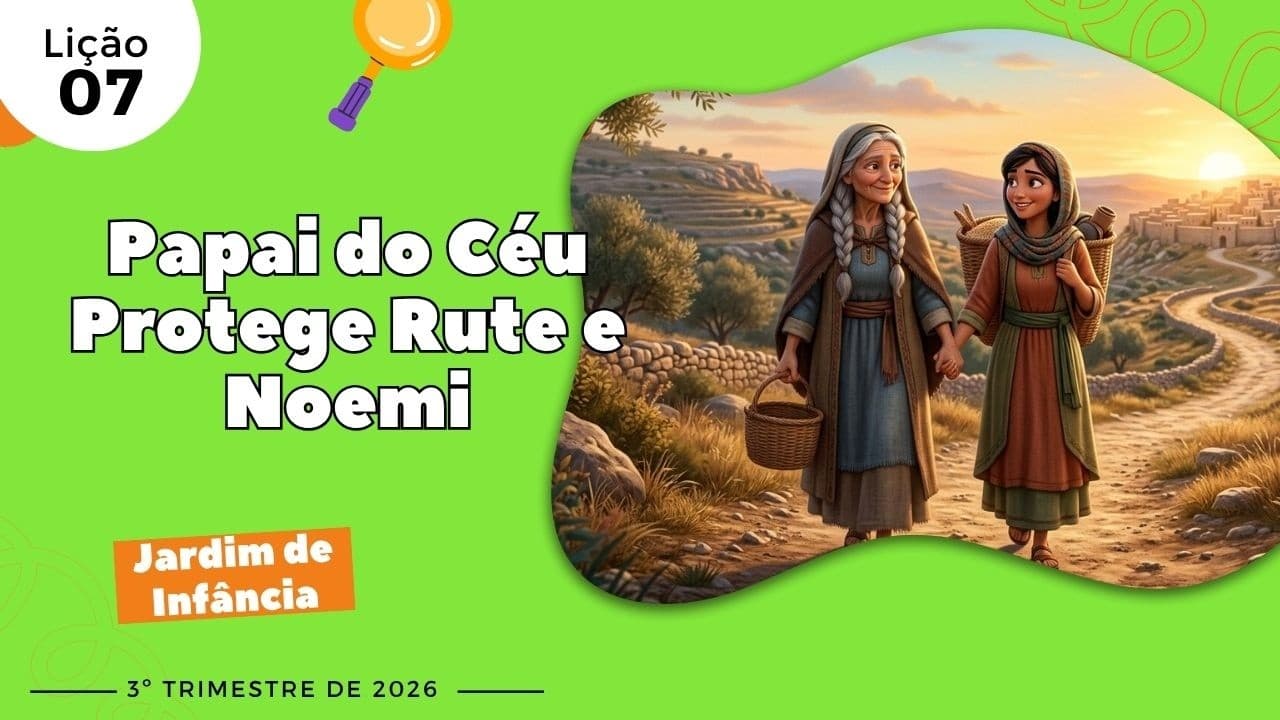
One day good news arrived: food had come back over in Bethlehem! Naomi said: "My daughters, go back to your parents' homes. I will go alone." Orpah gave Naomi a really tight hug and went back. But Ruth... Ruth gave her an even tighter hug and said: "I am not going to leave you alone. Wherever you go, I will go. Your God will be my God."
And off the two of them went. They walked, and walked, and walked. Shall we march in place with them? March, march, march — all the way to Bethlehem!
When they arrived, there was no food in the house. Naomi was already an old grandma and could not bear to work. So Ruth said: "Leave it to me. I will work for the two of us."
Ruth went to a huge wheat field. She walked behind the workers and picked up the heads of grain that fell on the ground. Squat down, pick it up, hold it to your chest. Squat, pick up, hold! She did that all day long, in the sun.
The owner of that field was named Boaz. Shall we say that name? BO-AZ! Boaz was rich and had a kind heart. He saw that young woman working so hard and asked: "Who is that over there?" The workers told him: "That is Ruth. She is the one who takes care of Naomi with so much love."
Do you know what Boaz did? He called Ruth over and said: "You may work here every day, and you may drink our water whenever you are thirsty." Then he called his workers and whispered: "Let more heads of grain fall on the ground on purpose, so she can take plenty of food home."
Time went by. Boaz saw that Ruth was loyal, hardworking and a friend of Father God. The two got married, and the family grew: a beautiful baby arrived named Obed. Naomi, who had been so sad, became a grandma and had her lap full.
❤ For the child's heart. God did not send a bolt of lightning from heaven to help Ruth and Naomi. He used the kind heart of a man named Boaz. Many times that is how God takes care of us: through people He places nearby.
III — Faithfulness means not letting go of a hand
Ruth could have gone back to her parents' house, just as Orpah did. No one would have been angry with her. But she chose to stay. That has a name: faithfulness.
Being faithful means being that friend who does not walk away when things get hard. And Father God is like that with us all the time — He Himself promised never to leave us or forsake us (Hebrews 13:5).
What does a small child's faithfulness look like? Very concrete:
- Staying close to someone who is sad. Did you see a little friend crying? Sit beside them. Just that is already a lot.
- Sharing what can be shared. The cookie, the snack, the toy you are playing with.
- Not leaving out someone who is alone. Inviting into the game someone who was left out.
- Helping at home without anyone asking. Putting away the toy, carrying the plate, fetching grandma's slippers.
And remind the child: obeying God is not buying a prize. We obey because we love Him, who loved us first.
Christ in the Lesson
Boaz was not just a generous man. In God's law there was a special person called a redeemer — the relative who paid out of his own pocket to rescue the family that had lost everything. Boaz paid and brought Ruth and Naomi into his own family.
Jesus did that for us, and on a much greater scale. He paid the highest price of all — His own life, on the cross — to redeem us and place us inside the family of God. And He did not stay dead: He rose again and is alive.
And there is more. That baby Obed became the grandfather of King David. And, a long time later, from David's family Jesus was born — right there in Bethlehem, the House of Bread (Micah 5:2). Ruth, the young woman from outside who gleaned heads of grain, entered the family of Jesus (Matthew 1:5).
✝ Christ in the Lesson. In the town that ran out of bread, the One was born who declared that He is the bread of life (John 6:35). God was taking care of Ruth and Naomi — and He was preparing the Savior of the whole world.
Practical Application
1. Stay close to someone who is crying. Teach the child to come closer instead of walking away. They do not need to say the right thing — they just need to stay.
2. Share food. This is Ruth's lesson in child size: she took the wheat home because someone was waiting.
3. Tell them that God does not go away. When the child gets scared or misses someone, repeat the promise that He will never leave us or forsake us.
Closing Prayer
Father God, thank You because You took care of Ruth and Naomi when they had nothing left. Thank You because You do not go away when we are sad. Teach every child in this room to be a faithful friend, to sit beside those who are crying, and to share what they have. And thank You for Jesus, who paid everything to bring us into Your family. In Jesus' name, amen.
Soli Deo Gloria — Scripture governs; everything else, on its knees.
Frequently asked questions about this lesson
Who were Ruth and Naomi?+
Naomi was a woman from Bethlehem who went to live in Moab because of the famine. Ruth was a Moabite and married one of her sons. When Naomi was left a widow and without her sons, Ruth chose to return with her to Bethlehem and take care of her (Ruth 1-4).
How should you talk about the deaths in this story with a 4- or 5-year-old child?+
Say the minimum and say it calmly: Naomi's family became very small and she became very sad. Do not describe illness, burial, or any details at all. If the child asks more, answer only what they asked, in a calm voice, and bring the conversation back to God's care. If the child shares a loss from their own home, welcome them right away — 'thank you for telling me' — and inform the parents and the leadership that same day.
What did Ruth do in Boaz's field?+
She gathered the ears of wheat that the workers dropped on the ground. God's law commanded the owner of the field to leave part of the harvest for widows and foreigners. Boaz went further and told his workers to drop more ears on purpose (Ruth 2).
If a child is good, does God give them a prize?+
We do not teach an exchange. God did not take care of Ruth as payment; He took care of her because He is good and faithful. A child obeys because they love God, and not to receive something in return.
Teacher's Guide
Essence of the class
Ruth did not let go of Naomi's hand — and Father God did not let go of their hands.
Map of the class
| Time | Stage |
|---|---|
| 0–5 min | Welcome and wheat circle (stalks of wheat and flour in hand) |
| 5–12 min | Praise with motions, prayer, visitors and offerings |
| 12–18 min | Verse of the day on the poster-board hearts (Psalm 119:63) |
| 18–26 min | Bible story: Ruth and Naomi |
| 26–31 min | "Was Ruth like this?" — the qualities on the poster |
| 31–40 min | Activity: Ruth's harvest |
| 40–45 min | Wrap-up, prayer and snack |
Start like this
Sit with everyone in a circle on the floor and pass the stalks of wheat from hand to hand, without explaining anything. Let the children squeeze and smell them. When curiosity is at its peak, ask: "Do you know what this is?" You will hear "grass", "weeds", "a plant". Accept everything. Then open the little jar of flour and say: "This plant right here turns into this powder — and this powder turns into the bread for your breakfast. Today I am going to tell you about a young woman who picked this up off the ground so she would not let her mother-in-law go hungry."
Point 1 — Ruth did not let go of Naomi's hand
- In the quarterly: the explanation of FAITHFULNESS and the beginning of the Bible story, up to the two women's journey to Bethlehem.
- What to teach: Naomi's family became very small and she became very sad. Orpah went back to her parents' house; Ruth chose to stay and take care of her. That is what faithfulness is — not walking away when things get hard.
- Anchor verse (BSB): "But Ruth replied: “Do not urge me to leave you or to turn from following you. For wherever you go, I will go, and wherever you live, I will live; your people will be my people, and your God will be my God.”" (Ruth 1:16)
- Key question: "What do we do when a little friend is sad?"
- Likely answers (+ going deeper): "I give them a hug", "I call their mom", "I lend my toy". Welcome them all and go deeper: "And can you sit beside them without saying anything? Yes, you can. Just staying close already helps a lot."
- If no one speaks: tell your own story first — "One day I was sad and a friend just sat down beside me. She did not say a word. And right away it felt much better." Then the class opens up.
- Caution in this part: say only "Naomi's family became very small and she became very sad". Nothing about illness, burial or any detail. If a child shares a loss from home, thank them for their trust right away, without asking for details in front of the class, and let the parents and church leadership know that same day.
Point 2 — God cared through the heart of Boaz
- In the quarterly: the part about Ruth in the field, the meeting with Boaz, and the closing on how Father God protects and blesses those who are faithful.
- What to teach: Ruth went to work picking up heads of grain from the ground. Boaz, the owner of the field, heard that she was taking care of Naomi and told his workers to let more wheat fall on purpose. God cared for the two of them by using the kind heart of a person.
- Anchor verse (BSB): "May the LORD repay your work, and may you receive a rich reward from the LORD, the God of Israel, under whose wings you have taken refuge." (Ruth 2:12)
- Key question: "Who has helped you when you needed it?"
- Likely answers (+ going deeper): "mommy", "grandma", "the teacher". Go deeper: "And who put that person in your life? It was Father God. That is how He takes care of us."
- If no one speaks: do the motion — squat down, pretend to pick up a head of grain from the floor and hold it to your chest — and invite everyone to do it together. Once their bodies are moving, the conversation comes.
Class activity
- Goal: to feel in their hands how God gave food to Ruth — with no competition and no one losing.
- Materials: heads of wheat cut out of yellow paper or craft foam (about 5 per child), a little basket or box, glue, crayons, and a sheet of paper with a drawing of a little house.
- Step by step: (1) scatter the paper heads of wheat across the classroom floor; (2) explain that it is not a race — when you clap your hands, everyone squats down together and picks them up slowly, saying "squat, pick up and hold"; (3) while they are picking them up, toss more heads of wheat onto the floor, just as Boaz told his workers to do, and say "look, more fell!"; (4) everyone puts what they gathered into the same little basket, which belongs to everyone; (5) each child glues a few heads of wheat onto their paper house and decorates it however they like, without comparing work.
- Wrap-up (back to the text): "Ruth squatted down and gathered grain just like that, in the sun, so Naomi would have food at home. And who made more wheat fall? Boaz. And who put kindness in Boaz's heart? Father God."
Wrap-up + challenge of the week
- Wrap-up: "Ruth did not let go of Naomi's hand. And Father God did not let go of their hands: He gave them food, He gave them a home, He gave them a new family. Boaz paid to redeem that family; Jesus paid with His own life on the cross to redeem us and place us in the family of God. He promised that He will never leave us or forsake us."
- Challenge: dad and mom, do "Ruth's little bread" with your child one day this week: let the child take a little food you already have at home — a piece of bread, a cookie, a piece of fruit — and place it into the hand of someone at home before eating their own, saying: "I brought this for you, just like Ruth brought food for Naomi."
Teacher's kit
- Before: read the book of Ruth (chapters 1 to 4) and the lesson topic in the quarterly. Decide beforehand, out loud, the exact sentence you are going to use about Naomi's sadness — do not improvise that part.
- Bring: a Bible, stalks of dried wheat, a little jar of flour, the two poster-board hearts with the verse, the cut-out paper heads of wheat, the little basket and the gluing supplies.
- Pray beforehand: ask God for eyes to see the child who is going through a loss at home — and a mouth to speak to that child with gentleness.
Homework
Your mission for the week
Dad and mom, do "Ruth's little bread" with your child one day this week: let your child take a little food you already have at home — a piece of bread, a cookie, a piece of fruit — and place it into the hand of someone in the family before eating their own, saying: "I brought this for you, just like Ruth brought food for Naomi."
Why
Ruth worked in the sun and took the wheat home because someone was waiting for her. Faithfulness is not a pretty feeling: it is food in the hand of someone in need. And that is how God cared for the two of them — sheltering them under His wings (Ruth 2:12).
How to know you did it
Someone at home received the little food from the child's hand, and the child said the sentence. Once is enough.
On Sunday, come back with the story
On Sunday the class begins with the question: "who handed out Ruth's little bread at home? To whom?" Come back with the story.