Golden Text
“But blessed is the man who trusts in the LORD, whose confidence is in Him.” (Jeremiah 17:7, BSB) · Read in the Bible
A short-cycle class script for 5- and 6-year-olds: a conversation about the fear everyone feels, a poster-board boat with the verse, the story of Paul's ship told in a calm voice without scare effects, and a basin of water showing a little boat rocking. The lesson keeps the distinction that holds everything together — God did not promise to save the ship, He promised to save the people — ends in Jesus, who entered the storm for us, and sends home a paper boat with a sentence for the child to say out loud.
Teacher, dad, mom: this is the lesson of the quarter with the greatest risk of slipping — and the slip is not doctrinal, it is in tone.
The story has fourteen days of wind, food running out, people thinking they are going to die, and a ship breaking in two. Told with sound effects and a scary voice, it becomes a fright that the child takes to bed. Told in a storytelling voice, it becomes exactly what it needs to be: the memory of a promise that was kept.
So, three agreements before we start:
- Do not turn off the lights and do not make thunder noises. The fear in this lesson is spoken in words, not sound effects.
- Do not act out anyone drowning. Not even as a joke. The water part is the part where everyone reaches the beach.
- Do not end with "trust and everything will work out fine." Not everything worked out fine: the ship broke apart. What worked out was what God had promised — and what He promised was the people.
The lesson fits in one sentence: Paul's ship broke apart, but not a single person was lost — because Father God keeps His promises.
I — Everyone is afraid of something
Start the class sitting down, at their eye level, and start with the rain.
Ask: "do you know what a storm is?" Let them talk. You will hear about heavy rain, wind, lightning, a roof blowing away, a tree that fell in the street. Help set the scene using their own words: it rains a lot, the wind blows so hard it knocks down trees, it makes loud noises.
Then ask the question that opens the heart of the class: "and who here has ever been afraid of something?"
Wait. Out will come the dark, the neighbor's dog, a cockroach, being alone in the bedroom, the sound of thunder. Do not correct anyone's fear and do not laugh at any of them. And, above all, tell yours first: "do you know what I was afraid of when I was little? Of..." When the adult shares theirs, the child lets theirs out.
Then say the sentence that disarms the whole room:
"Everyone is afraid of something. Children are, and adults are too. Being afraid does not mean you are bad or weak. What we do with our fear is what changes everything."
Now show the poster-board boat with the verse written in big letters. Read it while pointing to each word, and then read it again together with them:
"But blessed is the man who trusts in the LORD, whose confidence is in Him." (Jeremiah 17:7)
Those are grown-up words. Explain just two of them:
- Blessed is the same as happy, cared for. It is the person who is well because God is taking care of them.
- To trust is to truly believe in someone. You trust mom when she says "I'll be right back." You let go of her hand and know she is coming back.
Repeat it three times in short pieces, clapping on each part: blessed is the man / who trusts in the LORD. Then turn the poster around and ask them to say it without looking. Call anyone who wants to come up front to say it out loud — only whoever wants to, never anyone picked by pointing a finger.
And be careful with an important detail: trusting in God is not making a deal with Him. A five-year-old understands everything as a trade ("if I eat my food, I get dessert"), and will try to apply that here. Say right away, simply: we do not trust Father God so that He will do what we want. We trust Him because He is good and because He does not walk away.
⚓ Class agreement. Before the story, agree out loud and ask them to repeat: "have courage: Father God is with us." Repeat it at the end. That is the sentence going home today — and it was, word for word, what Paul said in the middle of the ship.
II — The story: the ship, the promise, and the beach
Tell it like this, in a storytelling voice. A calm, low voice during the part about the wind; a firm, loud voice during the part about the promise.
Do you remember Paul? In the last lesson he was in prison with his friend Silas, singing in the dark. Well, today he shows up again — and now he is inside a ship.
Paul loved Jesus very much and talked about Jesus to everyone. But some important men did not like that, and they arrested Paul once again, even though he had done nothing wrong. Now the soldiers were taking Paul to a city very far away, called Rome.
And how did people travel very far away back then? There were no airplanes, there were no cars. People went by ship. Has anyone here ever ridden in a boat?
Shall we get on the ship together with Paul? Stand up and march with me: one, two, one, two!
(March for five seconds, with big steps, and have everyone sit down again.)
At the beginning everything was lovely. Warm sun, calm sea, the wind pushing the ship slowly.
But Paul looked at the sky, looked at the wind, and felt in his heart that something was wrong. He said to the men in charge of the ship: "let's not continue the voyage right now. This is going to get dangerous."
And did they listen to Paul? They did not listen. They thought the weather was fine and ordered the ship to sail on.
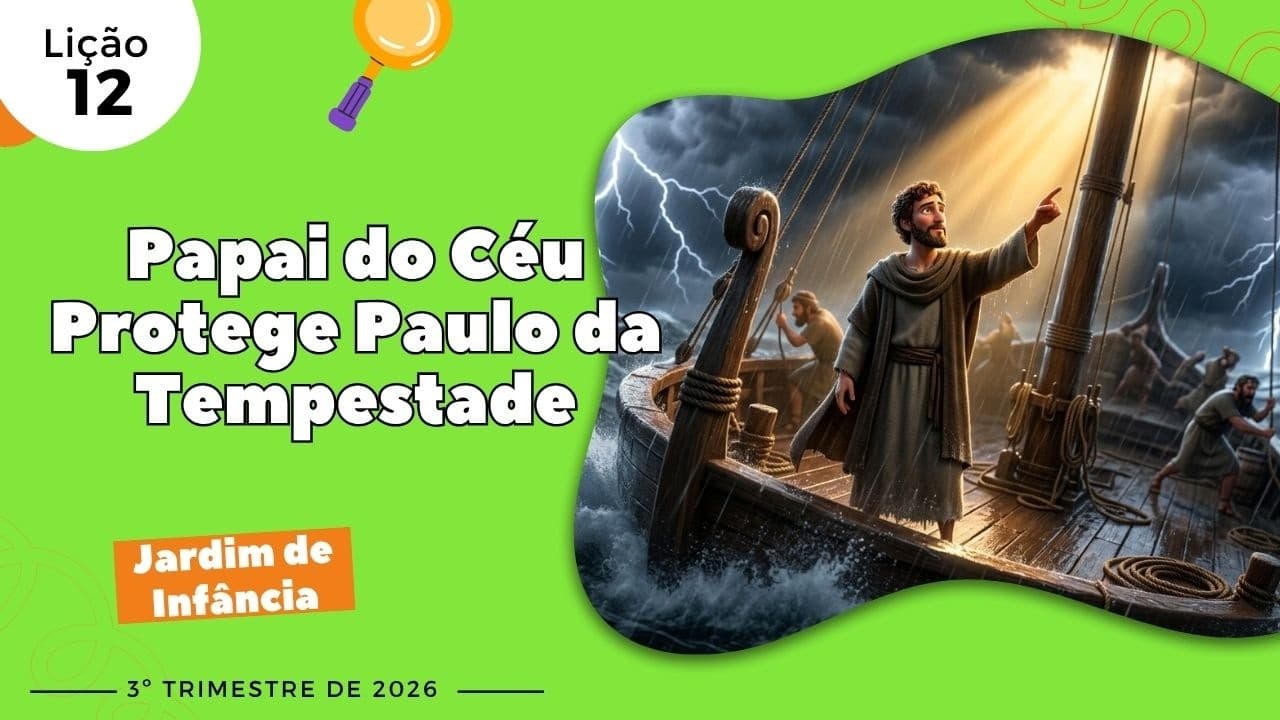
Then came the wind. A giant wind, the kind where you cannot even stand up. The ship went up on the wave... (raise your arms, on tiptoe) ...and went down into the water. (crouch down slowly) Go up and down with me, very slowly.
The sailors ran everywhere trying to save the ship. They threw the heavy boxes into the water. The next day they threw more things overboard. And the wind would not stop.
And it did not stop the next day. Nor the day after that. It went on like that for fourteen days. Two whole weeks without seeing the sun by day and without seeing a star by night — and back then it was the sun and the stars that showed the way. Nobody knew where they were anymore.
The people on the ship were so afraid that they could not even eat. Many people were already thinking there was no hope left.
(Here, lower your voice and go slowly. This is the turning point of the story.)
But at night, in the middle of all that darkness, Father God sent an angel to speak to Paul. And the angel told him not to be afraid, Paul (Acts 27:24) — which is the same as "Paul, do not be scared". And the angel said more: all the people on that ship were going to be okay.
And then, in the morning, the most beautiful part happened.
Paul stood up in the middle of everyone — in the middle of people crying, people who were hungry, people without hope — and said out loud: "have courage, because I believe in God. It will happen just the way He told me."
Say it with me, everyone together, nice and loud: "have courage: Father God is with us!"
Do you know what Paul did next? He took a piece of bread, in front of everyone, and thanked God out loud. In the middle of the storm! And then the people started eating too, and courage began returning to the whole ship.
After many days, they finally saw a beach far off in the distance. The sailors tried to steer the ship there, but the ship hit the deep sandbar and broke apart.
(One sentence, no drama, no loud noise. And go straight on to the good part.)
Then everyone jumped into the water. Those who knew how to swim, swam. (Swim with me with your little arms!) Those who did not know how held on to a piece of wood from the ship and floated slowly to the sand.
And guess what? All 276 people made it to the beach. Let's count by threes just to feel how big that is: three... six... nine... That was a lot, a whole lot of people! And not a single one was missing. Nobody was lost.
Clap your hands nice and loud with me!
❤ For the child's heart. Notice what happened there: the ship broke apart and the people were kept safe and whole. Father God had not promised to save the boat. He had promised to save the people — and He kept every single word.
III — What God promised, and what He did not promise
This is where the lesson can slip, so go slowly.
It is very easy to walk away from this story teaching something it does not teach: "if you trust in God, nothing bad will happen to you." That is not what happened on the ship. There were fourteen days of wind, hunger, fear, and a shattered ship.
What God had said was exactly this: not a single one of you will lose your life, only the ship (Acts 27:22). He was specific. And He fulfilled it just the way He said — including the part about the ship.
Say it to the class in the simplest sentence possible: Father God did not promise that the boat would not break. He promised that the people would be okay. And He did it.
Notice also a detail that the text does not hide: nobody stood still. Paul warned them. Paul spoke to the centurion so that the sailors would not abandon the ship (Acts 27:31). Paul told everyone to eat so they would have strength. The people swam and held on to the planks. God promised, and the people obeyed and acted — and the promise was fulfilled completely. God does not treat people like packages; He warns, He gives strength, and we walk.
At the size of a five- or six-year-old child, this turns into three very concrete things:
- Talk to Father God when you are afraid. It does not need fancy words: "Father God, I am afraid, stay with me" is already a complete prayer.
- Speak courage to someone. That is what Paul did: he stood up and spoke. When someone at home is afraid or sad, the child can say out loud: "have courage: Father God is with us."
- Call an adult when the matter is serious. If something happened that is scary, that hurts, or that felt strange, tell dad, mom, or the teacher right away. The adult is the one who solves it; the child tells — and telling is being brave.
And one thing we do not teach here: trusting is not making a business deal with God. Nobody buys good weather with good behavior. God is a Father — sometimes He takes us out of the storm, sometimes He stays inside it with us until the other side. What He never does is let go of our hand.
Christ in the Lesson
On that ship, God sent an angel with a message. It was beautiful — but it was a message.
When our turn came, God did not send a message. He came Himself.
Jesus, the Son of God, stepped into the world, stepped into the rain, stepped into weariness, stepped into pain. And there was a day when He was in a little boat with His friends, and such an ugly storm came up that His friends screamed in fear — and Jesus stood up and spoke to the wind, commanding it to be quiet and still, and the wind died down and there was a great calm (Mark 4:39). He spoke and the sea obeyed. Because the sea belongs to Him.
And there is a storm worse than the one on the sea, and that one is ours: it is sin. The little lie, the tantrum, the anger held inside, the ugly talk back to mom. That storm we cannot calm on our own, neither by being well-behaved nor by being clever.
That is why Jesus went to the cross. He took in our place the punishment that was ours, and on the third day He rose again. Today He lives, reigns, and takes care of those who trust in Him.
Paul endured that storm because he knew this Jesus. And his boat broke apart just the same — but he made it to the beach, and one day he made it to Rome, and one day he made it to the Father's house.
✝ Christ in the Lesson. On the ship, God promised and kept His word: the boat was lost, and not a single person. On the cross, God promised and kept His word again, and in a much greater way: the life of Jesus was given up, and ours was won. It is the same promise, from the same God, who has never failed even once.
Practical Application
1. The sentence of courage, spoken out loud. Choose with the child the sentence from the lesson — "have courage: Father God is with us" — and really use it at home, the very first time someone is afraid or sad. The child is the one who says it.
2. The one-sentence prayer at bedtime. Every day, the two of you together: "Father God, thank You because You keep Your promises." Repetition is how a young child learns doctrine.
3. Naming the trusted adults. Sit down and name them one by one: dad, mom, grandma, the Sunday School (EBD) teacher. The child tells; the adult solves.
Closing Prayer
Father God, thank You for this lesson. Thank You because You saw that ship in the middle of the wind and did not forget anyone inside it. Thank You because You spoke, and kept Your word, and all 276 people made it to the beach. Take the fear out of the heart of every child in this room and put in its place the certainty that You are near. Teach each one to talk to You whenever fear comes, and to call dad, mom, and the teacher whenever something scares them. And thank You for Jesus, who stepped into our storm, died on the cross for us, and rose again. Now we are going home: keep us from all evil. In Jesus' name, amen.
Soli Deo Gloria — Scripture governs; everything else, on its knees.
Frequently asked questions about this lesson
The verse in my curriculum material is worded differently from the one in my Bible. Which one should I write on the poster?+
Write the one from the Bible. The text circulating in the support material is in a modern-language version, and Bible translations differ in wording here: "But blessed is the man who trusts in the LORD, whose confidence is in Him." (Jeremiah 17:7) Make the poster-board boat with this wording and read it straight from your Bible in front of the class, pointing to the words. If the child is going to complete the printed activity and the wording there is different, let them complete it the way it appears on the sheet and say naturally: 'in the teacher's Bible it is written with other words, and it means the same thing — whoever trusts in God is happy.' Do not correct the sheet in front of the child; correct the poster, which is what stays on the wall.
How do I tell the story of a shipwreck to a 5-year-old without scaring them?+
By telling it with your voice, not with scares. Three practical rules: do not shout, do not imitate thunder or crashes, and do not turn off the classroom light. Where the story hurts — the fourteen-day wind, the hunger, the ship breaking apart — move through it quickly and in short sentences; where the story cares — the angel telling Paul not to be afraid, Paul standing up and speaking to everyone, the people reaching the sand — go slowly and repeat it. The child must leave the room remembering the beach, not the noise. And if any child becomes distressed in the middle of it, stop the story, call them close, and continue while sitting next to them.
Won't the child think that whoever trusts in God never goes through a storm?+
Only if we teach it wrong — and the text itself already protects the lesson from that mistake. The ship was lost. The cargo was lost. Fourteen days of fear really happened, and no one was spared from them. What God promised was something else: that not a single life among them would be lost, but only the ship (Acts 27:22). Say this plainly to the class, in the simplest sentence possible: God did not promise to keep the boat safe; He promised to keep the people safe. Trusting in God is not being sure that nothing will break; it is being sure that He will not leave while it breaks.
Can I really bring a basin of water into the classroom?+
Yes, with three ground rules. The basin stays on the table, next to you, and only your hand goes into it. The children stay seated or in a circle one step away, making the wind with their mouths from a distance — no one blows into the basin and no one touches it. And bring a towel: a wet floor in a Kindergarten classroom is a guaranteed fall. A little water, about two inches deep, is enough for the little boat to rock. If your room is small or has an electrical outlet near the floor, do the same scene without water: a paper boat in your hand, going up and down, works just the same.
A child shared that there is a storm at home. What do I do?+
Welcome what they said right away and do not ask for details in front of the others. Say quietly: 'thank you for telling me, that is important, let's talk after class' — and continue the lesson normally, without putting a spotlight on the child. After class, talk calmly, without interrogating, and bring the matter to the pastor or leadership that same day. Never ignore it, never expose the child, and never try to solve it alone. And pray for them by name during the week.
Should I mention the angel? My child will want to see one.+
Mention the angel, without making it the main topic. The angel appears in the text as a messenger: he brought God's message to Paul — telling Paul not to be afraid (Acts 27:24) — and then steps out of the scene. The one who fulfills the promise is God, not the angel. If the child asks whether they will see one, answer honestly and without making things up: we do not go around asking for angels; we talk to our Heavenly Father, who hears us right away. And today His message is already written in the Bible, which stays in our hands all the time.
Teacher's Guide
Essence of the class
Paul's ship broke apart, but not a single person was lost — because Father God keeps His promises.
Map of the class
| Time | Stage |
|---|---|
| 0–5 min | Arrival: welcome each child by name, ask how their week went |
| 5–12 min | Circle time: prayer of thanksgiving, praise song about trusting, offerings and roll call |
| 12–19 min | Conversation "what is a storm? what are you afraid of?" + the poster-board boat with Jeremiah 17:7 |
| 19–28 min | Bible story: the voyage, the wind, the promise, and the beach |
| 28–33 min | Quarterly activities: circle the ship, trace the dotted lines, complete the verse |
| 33–41 min | Class activity: the sea in the basin and the little boat that goes home |
| 41–45 min | Wrap-up, prayer in a circle, and dismissal |
Start like this
Arrive early, pray thanking God for Sunday, set out the materials, and leave the room in order. Welcome each child by name and ask how their week went before anything else.
After praise and the offering, sit down at their eye level and start with the rain, not with the Bible:
"Do you know what a storm is?"
Let them describe it in their own words — heavy rain, wind, lightning, the tree that fell. Then follow right up with the question that matters: "and who here has ever been afraid of something?"
Really wait. Out will come the dark, dogs, cockroaches, being alone, the sound of thunder. Do not correct any fear and do not let anyone laugh at anyone else. Tell yours first — "when I was little, I was afraid of..." — because that is what gets the class talking.
Close with the sentence that disarms the room: "everyone is afraid of something. Children are, adults are too. Being afraid does not mean you are bad. What we do with our fear is what changes everything." And connect it to the hook for the day: "today I am going to tell you about a man who spent fourteen days inside a real storm — and he was not alone."
Point 1 — Trusting Father God when we are afraid
- In the quarterly: the topic of the storm, which opens the lesson by asking what a storm is and what each child is afraid of; and the memory verse (Jeremiah 17:7) with the making of the large poster-board boat and the explanation that the Lord is our Father and wants us to trust in Him.
- What to teach: fear is normal and happens to everyone, including adults — the Bible does not tell a child to pretend not to be afraid. What the lesson teaches is where to take our fear: to Father God. Paul felt fear just like all those people; the difference is that he knew whom he was trusting.
- Anchor verse: "But blessed is the man who trusts in the LORD, whose confidence is in Him." (Jeremiah 17:7) Read it straight from your Bible and then from the poster.
- Key question: "What are you afraid of?"
- Likely answers (+ going deeper): the dark, dogs, bugs, being alone, thunder, shots, an older brother. Something made-up and funny will also come out — accept it just the same. Go deeper: "and what can we do when that fear hits?"
- If no one speaks: share yours, briefly and without drama. An adult who admits being afraid unlocks the whole class in five seconds.
- Caution in this part: do not turn the circle into a parade of fears — take three or four answers and move on. Do not laugh at any answer and do not let the class laugh. And when explaining the verse, do not promise that trusting in God automatically turns a bad day into a good day: say that God is good, that He blesses us, and that He stays with us even on the days that remain hard.
Point 2 — God promised to save the people, and He kept His promise
- In the quarterly: the whole story — Paul being taken by ship as a prisoner to stand trial, the storm coming back even stronger, the cargo thrown into the sea, Paul standing up in the middle of the ship to say that God promised no one would die, the ship hitting the sandbar and breaking apart, and everyone reaching the beach by swimming or holding on to planks — and the three activities: circling the means of transportation, tracing the dotted lines that reveal the name PAUL, and completing the verse.
- What to teach: all the credit belongs to God, and His promise was specific. He did not say the ship would hold together; He said the people would not be lost. The ship really did break apart and all 276 people arrived safe and sound. Keep that distinction: it is what prevents the lesson from turning into "whoever trusts never suffers."
- Anchor verse: "But now I urge you to keep up your courage, because you will not experience any loss of life, but only of the ship." (Acts 27:22) Read it straight from your Bible.
- Key question: "What can we do when we are afraid?"
- Likely answers (+ going deeper): "call mom", "cry", "run", "turn on the light", "pray". Welcome all of them — crying and calling mom are right answers. Go deeper: "all of that counts. And there is one more thing we can do: talk to Father God and speak courage to the person next to us, just like Paul did."
- If no one speaks: go back to the scene and ask directly: "and what did Paul do when everyone was crying on the ship?" They will remember — he stood up and spoke.
- Caution in this part: move quickly past the shipwreck, in a single sentence, without imitating crashing sounds, without shouting, and without acting out anyone drowning. Do not turn off the classroom lights at any point and do not use thunder sound effects. And do not let the story end with the boat breaking: the final image must be the sand on the beach with everyone standing safe.
Class activity
- Goal: to see with their eyes what the story says with words — the little boat really rocks in the storm, the boat is lost, and even so the promise is fulfilled — and to take home a little boat with the sentence of courage.
- Materials: a basin with about three fingers of water (kept on the table, right beside you), a paper boat folded by you for the demonstration, one sheet of paper per child for the little boat that goes home, a marker, and a cloth to wipe up any splashes on the floor. No scissors in the children's hands.
- Step by step: (1) before class, fold the little boats — one for the basin and one for each child — and write on each one, on one side, the child's name, and on the other, in big letters: HAVE COURAGE — FATHER GOD IS WITH US; (2) when the time comes, put the basin on the table with the little boat floating, while the class sits in a circle a step away — only your hand goes into the water; (3) say: "at the beginning the sea was calm, like this" and rock the water gently; (4) "then came the wind" — the children make the sound of the wind by blowing from far away, from their seats, while you stir the water with your hand and the little boat tosses from side to side; (5) let the little boat fill with water and tip over, and say naturally, without alarm in your voice: "look, Paul's boat really broke — that really happened"; (6) take the wet little boat out of the water, hold it up high, and ask the question: "and what about the people?" Let them answer; (7) say the key sentence of the lesson: "Father God had not promised to save the boat. He promised to save the people — and all 276 made it to the beach"; (8) now hand each child their dry little boat with their name and the sentence, and read the sentence with them out loud, three times, clapping along.
- Wrap-up (back to the text): "The little boat in the basin got wet and tipped over, and Paul's ship really broke apart. But not a single person was lost, because God had promised to save the people, and what He promises, He fulfills. Take your little boat home and leave it in a place where you can see it. When someone in your home is afraid, pick up the little boat and say nice and loud: have courage, Father God is with us."
Wrap-up + challenge of the week
- Wrap-up: "Paul spent fourteen days inside a storm. He did not pretend everything was fine, and he did not stay quiet in a corner: he stood up in the middle of the ship and spoke courage to everyone, because God had promised. And Father God kept His word — the ship broke apart, and not a single person was lost. He never promised that the boat would not break; He promised that He would not let go of our hand. And the greatest fulfillment of a promise in all of history was Jesus: God promised a Savior, and sent His own Son to the cross for us, and He rose again. Do not forget our agreement: have courage, Father God is with us."
- Challenge: dad and mom, leave the paper boat that came home from class in a very visible place in the house — the refrigerator, the bedside table, the living room shelf. This week, the first time someone at home is afraid or sad — it could be the child, a sibling, or you — pick up the little boat and let the child say out loud, looking at that person: "have courage: Father God is with us." Then pray together, the two of you, just one sentence.
Teacher's kit
- Before: read all of Acts 27 and the topic in the quarterly, and decide ahead of time the exact sentences for the storm part — that part is not to be improvised, and it is where the tone slips. Fold all the little boats at home, write each child's name and the sentence of courage, and put together the large poster-board boat with the verse from your Bible. Test the basin at home: see how much water the little boat can take before tipping over.
- Bring: your Bible, the poster-board boat with Jeremiah 17:7, the basin, the ready-made paper boats (one per child and one for the demonstration), a marker, a cloth for the floor, and the quarterly activities.
- If a parent asks why God let the ship break apart: the honest answer fits in two sentences, and it is worth practicing. God did not promise a sea without storms — He promised, right there, the life of every person on board, and He fulfilled exactly that. Christian faith is not an insurance policy against loss; it is the certainty that God is with us inside the loss, and that in Christ what He keeps forever is the person. Have that conversation with the adult, calmly, away from the circle.
- Pray beforehand: ask God for a calm voice during the part about the wind and attentive eyes for the child who arrived scared today, for the one who is afraid of the dark, and for the one who is going through a storm at home. The closing prayer of the study can be reused at the end of the class.
Homework
Your mission for the week
Dad and mom, leave the paper boat that came home from class in a very visible place in the house — the refrigerator, the bedside table, the living room shelf. This week, the first time someone at home is afraid or sad — it could be the child, a sibling, or you — pick up the little boat and let the child say out loud, looking at that person: "have courage: Father God is with us." Then pray together, the two of you, just one sentence.
Why
That is exactly what Paul did on the ship: in the middle of people without hope, he stood up and spoke. "So take courage, men, for I believe God that it will happen just as He told me." (Acts 27:25) It is the verse of the week turning into a gesture: blessed is the one who trusts in the LORD (Jeremiah 17:7). Whoever trusts in Father God has courage to give — and courage is given by speaking.
How to know you did it
Ask the child: "whom did you say the sentence on the little boat to this week?" If they can say the person's name, it is done.
On Sunday, come back with the story
On Sunday the class starts with the question: "who said the sentence of courage this week, and to whom?" Come back with the story.