Golden Text
“Therefore, as the elect of God, holy and beloved, clothe yourselves with hearts of compassion, kindness, humility, gentleness, and patience.” (Colossians 3:12, BSB) · Read in the Bible
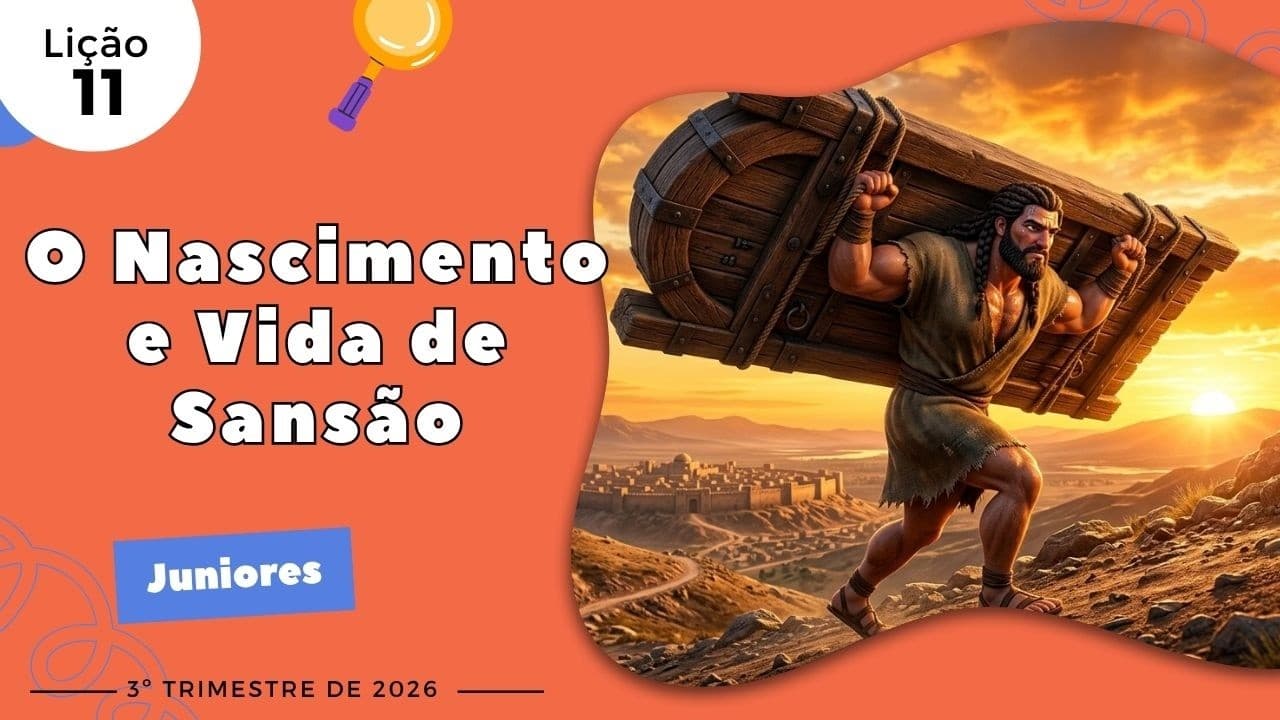
Israel had been under the Philistines for forty years when God promised a boy to a couple who could not have children. Samson was born set apart for God, with three agreements to keep his whole life — and he grew strong in a way no one could explain, because the strength was not his. Today's lesson shows where that strength truly came from, shows Samson starting to let go of the agreements without even noticing, and ends with Jesus: the only One who received a mission and did not drop a single thing.
Imagine that you get a sealed birthday present with a note taped on top: "only open at the right time."
How long could you hold out without poking at the wrapping? Without tearing a little corner "just to peek"?
Today's story is about a boy who received from God the greatest gift anyone could ever receive — and about the slow, quiet way he kept tearing at the wrapping.
His name was Samson, and the story is in Judges 13 and 14.
And there is something almost everyone gets wrong about him. Samson's strength did not come from his hair. It did not come from a gym, from training, or from special food. Hold on to this sentence, because the entire lesson revolves around it:
The strength came from the Spirit of the LORD — and it was not his.
I — A Promised Baby in a Dark Time
The story starts badly. Israel had turned away from God again, and the result came: "Again the Israelites did evil in the sight of the LORD, so He delivered them into the hand of the Philistines for forty years." (Judges 13:1).
Forty years. Think of your dad or your mom: almost their entire life. A child could be born, grow up, get married, and have children without ever having seen Israel free.
And it was right in the middle of that darkness that God moved — in the quietest way possible. No army. No thunder. A baby.
There was a man from Zorah, of the tribe of Dan, named Manoah. His wife was barren: she could not have children. In those days, that was an enormous sorrow.
One day the angel of the LORD appeared to her and said: "The angel of the LORD appeared to the woman and said to her, “It is true that you are barren and have no children; but you will conceive and give birth to a son.”" (Judges 13:3).
And then came the rest of the message, which is the heart of everything:
"For behold, you will conceive and give birth to a son. And no razor shall touch his head, because the boy will be a Nazirite to God from the womb, and he will begin the deliverance of Israel from the hand of the Philistines." (Judges 13:5)
Notice two words.
"Nazirite." In just a moment we will explain what that means.
"Begin." Not "finish." Begin. From the very first day, God warned that deliverance would not end with Samson. Someone greater would come later. Hold on to that word until the end of the lesson.
The baby was born. "So the woman gave birth to a son and named him Samson. The boy grew, and the LORD blessed him." (Judges 13:24) And the next verse lets out the first spark: "And the Spirit of the LORD began to stir him at Mahaneh-dan, between Zorah and Eshtaol." (Judges 13:25).
🔦 Did you know? — the name no one deciphered. Before he left, Manoah wanted to know that visitor's name. And he heard a strange answer: "“Why do you ask my name,” said the angel of the LORD, “since it is beyond comprehension?”" (Judges 13:18). Later, when the angel went up inside the flame of the altar, Manoah was frightened and said to his wife: "“We are going to die,” he said to his wife, “for we have seen God!”" (Judges 13:22). Because of this, many Bible readers understand that the Son of God Himself was there, appearing before being born in Bethlehem. Others understand that he was an angel sent by God, carrying His name and His word. The Bible does not settle this discussion, and we do not need to pick a side to learn the lesson. What no one disputes is this: that visit came from God, and the whole story points to Jesus.
II — What It Meant to Be a Nazirite
"Nazirite" comes from a Hebrew word that means set apart. Set apart for whom? For the Lord.
It was not a punishment. It was the opposite: it was an honor. God explained this back in Numbers 6: "“Speak to the Israelites and tell them that if a man or woman makes a special vow, the vow of a Nazirite, to separate himself to the LORD,”" (Numbers 6:2).
Usually a person chose to make this vow for a period of time. With Samson it was different: God chose before he was born, and it was for his whole life.
There were three agreements:
1. Nothing that came from the grape. Neither wine, nor fresh grapes, nor raisins. "All the days of his separation, he is not to eat anything that comes from the grapevine, not even the seeds or skins." (Numbers 6:4)
2. Not coming near a dead body. "Throughout the days of his separation to the LORD, he must not go near a dead body." (Numbers 6:6)
3. No razor on his head. "For the entire period of his vow of separation, no razor shall touch his head. He must be holy until the time of his separation to the LORD is complete; he must let the hair of his head grow long." (Numbers 6:5)
Now pay attention to this part, because this is where almost everyone misunderstands.
The hair had no power at all. It was not magic, it was not an antenna, it was not a battery. The long hair was the sign on the door. It was the way anyone could look at Samson and know, without him saying a word: "that life right there belongs to God."
If you have a school ID badge, you know how it works. The badge does not make you a student. It shows that you are one. If you lose the badge, you are still a student — but if you throw away your commitment to the school, then something has truly changed.
III — The Lion in the Vineyards: Where the Strength Came From
Samson grew up. And here begins the most famous part of the story.
He went down to the city of Timnah — also spelled Timnath in some Bibles — and saw there a young woman from the people of the Philistines. He went back home and told his parents that he wanted to marry her.
His parents were sad. They wanted their son to marry someone from the people of God, and they told him so to his face (Judges 14:3). Samson would not listen: "But his father and mother replied, “Can’t you find a young woman among your relatives or among any of our people? Must you go to the uncircumcised Philistines to get a wife?” But Samson told his father, “Get her for me, for she is pleasing to my eyes.”" (Judges 14:3).
Hold on to that detail: what pleased his eyes. It will explain a lot further ahead.
On the way to Timnah, passing through the vineyards, the unexpected happened: "Then Samson went down to Timnah with his father and mother and came to the vineyards of Timnah. Suddenly a young lion came roaring at him," (Judges 14:5).
And then came the most important verse of today's lesson:
"and the Spirit of the LORD came powerfully upon him, and he tore the lion apart with his bare hands as one would tear a young goat. But he did not tell his father or mother what he had done." (Judges 14:6)
Read that slowly again: the Spirit of the LORD came powerfully upon him.
The strength arrived at that very instant. It came from outside. Samson on his own, without that, was a young man just like the others — the size of your uncle, your neighbor, anyone.
It is exactly what God said through Zechariah many years later:
"So he said to me, “This is the word of the LORD to Zerubbabel: Not by might nor by power, but by My Spirit, says the LORD of Hosts.”" (Zechariah 4:6)
A flashlight turns on. But the light does not belong to it. Take out the battery and the flashlight looks the exact same on the outside — and does not turn on anymore.
And there is a tiny detail at the end of the verse that almost no one notices: he did not tell his father or his mother what he had done (Judges 14:6). He did not tell them. He kept that all to himself. It is the first secret of the story — and it will not be the last.
🍯 Did you know? — a tiny seal. In Beth-shemesh, an Israelite town very close to Zorah and Timnah, archaeologists found a stone seal the size of a fingernail, carved with the picture of an unarmed man facing a lion. It dates from around the time Samson lived. No one can say that drawing is Samson — there is no way to know, and that is not what proves the Bible is true. It is only suggestive evidence: in that region, in that era, a story of a man against a lion was known. The Bible does not need any seal to be true. But it is lovely when the earth keeps a little souvenir of what it tells.
IV — The Honey Inside the Lion
Some time passed. Samson went back along the same road for the wedding. And he did something that seems small.
"When Samson returned later to take her, he left the road to see the lion’s carcass, and in it was a swarm of bees, along with their honey." (Judges 14:8)
Stop here.
He turned aside from the road. No one told him to. No one forced him. He took a detour because he wanted to look.
And then: "So he scooped some honey into his hands and ate it as he went along. And when he returned to his father and mother, he gave some to them and they ate it. But he did not tell them that he had taken the honey from the lion’s carcass." (Judges 14:9).
Count on your fingers what happened in those two verses:
- He turned aside from the road on purpose.
- He touched a dead body — the exact agreement number 2.
- He ate right there.
- He gave it to his parents to eat without telling them where it had come from.
No one saw. Nothing exploded. No thunder. The honey tasted good, the day stayed nice, and he kept going on his trip.
That is how we let go of the things of God: without a sound. It is not a big, dramatic decision. It is a small detour that no one noticed, and that we hide from those who love us. That is why the Bible warns:
"Guard your heart with all diligence, for from it flow springs of life." (Proverbs 4:23)
Notice that the verse does not say to guard your muscles. It says your heart.
V — The Riddle, the Feast, and the Secret Given Away
At the wedding feast, which lasted seven days, thirty young Philistine men showed up to be with Samson. And he decided to play a game of challenge.
He proposed a riddle, betting thirty linen garments and thirty sets of clothes:
"So he said to them: “Out of the eater came something to eat, and out of the strong came something sweet.” For three days they were unable to explain the riddle." (Judges 14:14)
It was impossible to guess. The answer was the lion and the honey — and only he knew, because he himself had hidden the story from everyone. The secret he kept back then became his trap right here.
Three days went by and no one solved it. Then the guests went to speak to his wife and threatened her terribly (Judges 14:15). Afraid, she wept in front of Samson the whole week, pressing him and pressing him — until, on the seventh day, he finally told her because she pressed him so much (Judges 14:17). And she told everything to her people.
At the end of the seventh day, before the sun went down, the men came up with a smile on their faces:
"Before sunset on the seventh day, the men of the city said to Samson: “What is sweeter than honey? And what is stronger than a lion?” So he said to them: “If you had not plowed with my heifer, you would not have solved my riddle!”" (Judges 14:18)
Samson lost the bet. He was furious. He went down to Ashkelon, a city of the Philistines, paid the bet in the worst possible way — the Bible tells us that thirty men died there — and went back home burning with anger, returning to his father's house in hot rage (Judges 14:19).
We are not going to linger on that scene. The Bible records what happened without saying that it is an example for us to copy. That was war, in a time very different from ours. Today our struggle is not like that (Ephesians 6:12), and nothing — nothing at all — is solved through violence.
What matters here is the pattern of the story:
Samson was strong on the outside and unguarded on the inside. He could defeat a lion, yet he could not control his own mouth, his own anger, his own eyes.
Christ in the Lesson
Remember the word God used back at the beginning? Samson would begin to deliver Israel (Judges 13:5). Begin. Never finish.
The whole book of Judges is like this: God raises up a deliverer, the people breathe for a little while, the deliverer fails, and everything goes back to how it was. Page after page, the Bible leaves the same question hanging in the air: when will Someone come who does not fail?
He comes in Jesus.
Look at the difference side by side.
Samson was set apart for God before he was born — and slowly let go of his agreement. Jesus was sent by the Father and did not let go of anything, ever, not for a single day.
Samson was strong on the outside and weak on the inside. Jesus was truly tempted, hungry, alone, tired, and did not give in:
"For we do not have a high priest who is unable to sympathize with our weaknesses, but we have one who was tempted in every way that we are, yet was without sin." (Hebrews 4:15)
Samson kept secrets and hid from his parents what he had done. Jesus had nothing to hide from anyone.
And there is one last thing, which is the most beautiful part of the lesson.
Samson's riddle spoke of sweetness coming out of the strong. He was talking about a dead lion and a handful of honey.
But that sentence fits something much greater. From the hardest place in the history of the world — a cross — came the sweetest thing that ever existed: God's forgiveness for people like us. Out of the death of Jesus came life. Out of the worst day came the best news.
❤ For the child's heart. Maybe you look at Samson and think: "I have broken a bunch of agreements with God too." You really have. Everyone has. But look at what God did with Samson: even after everything, He kept having mercy and using his life. God does not give up on you at the first detour, or at the tenth. Jesus did not come to look for people who never messed up — that person does not exist. He came to look for you. And when you give your heart to Him, He does not tell you to be strong on your own: He gives you the Holy Spirit, who is the strength Samson had — and that God wants to give you too. You can say yes to Him right today, right where you are.
Practical Application
Notice the small detour. Samson's mistake did not start with a giant decision. It started when he turned aside from the road to look at something he already knew he should not. In your life it is the same: the big lie starts with a little lie, the big fight starts with a little jab. Ask yourself, when the urge hits: "am I turning aside from the road?"
Do not keep secrets from those who care for you. Samson hid from his father and mother what had happened — twice. And it was that very secret that turned into a trap later. If something is happening that makes you feel afraid, ashamed, or heavy-hearted, tell it today to your dad, your mom, your teacher, or your pastor. You do not have to solve anything alone, and you do not have to face anyone by yourself. The adult solves it; you let them know.
Your strength is not yours. When you manage to do what is right at a hard moment — not joining in the mocking, saying you are sorry, studying when you feel lazy — do not puff out your chest. Give thanks. "So he said to me, “This is the word of the LORD to Zerubbabel: Not by might nor by power, but by My Spirit, says the LORD of Hosts.”" (Zechariah 4:6)
Keep the small agreement. No one wakes up letting go of God all at once. We let go a little bit each day. So keep a little bit each day too: your nighttime prayer, obeying the first time you are called, the word you promised not to say. A small agreement kept is heart muscle.
Closing Prayer
Lord Jesus, thank You because the strength was never ours. You know every child in this class by name, the same way You knew Samson before he was born. Forgive us for the small detours that no one sees — the ones we hide from those who love us. Help each one here to keep this week's agreement and to run and tell a trusted adult whenever something frightens us. Fill our lives with Your Holy Spirit, because without Him we do not shine. And thank You because out of the hardest place in the world, Your cross, came the sweetest thing that exists: Your forgiveness. In Jesus' name, amen.
Soli Deo Gloria — Scripture governs; everything else, on its knees.
Frequently asked questions about this lesson
Where did Samson's strength come from?+
From the Spirit of the LORD. The Bible is very direct about this: when the lion appeared, "and the Spirit of the LORD came powerfully upon him, and he tore the lion apart with his bare hands as one would tear a young goat. But he did not tell his father or mother what he had done." (Judges 14:6). It was not training, it was not special food, and it was not his hair. Samson was like a flashlight: the flashlight lights up, but the light does not belong to it.
If his strength was not in his hair, why could he not cut it?+
Because his hair was the sign, not the engine. God had given Samson the Nazirite vow — three agreements: nothing that came from the grapevine, not going near a dead body, and no razor touching his head (Numbers 6:3-6). Long hair was the sign on the door saying "this life belongs to God." Cutting it did not take away his strength by magic; cutting it was the last step of an agreement he had already been letting go of for a long time.
Who was the Angel of the LORD who appeared to Samson's parents?+
The Bible calls him "the angel of the LORD" and does not explain more than that. What it tells us is powerful: when Manoah asked his name, he heard "“Why do you ask my name,” said the angel of the LORD, “since it is beyond comprehension?”" (Judges 13:18); and, after he went up in the flame of the altar, Manoah said: "“We are going to die,” he said to his wife, “for we have seen God!”" (Judges 13:22). Because of this, many Bible readers understand that this was the Son of God Himself, appearing before being born in Bethlehem. Others understand that it was an angel sent by God, carrying His name and His word. The Bible does not settle this question, so we do not settle it either. What is certain, and no one disputes, is that this visit came from God — and that the whole story points to Jesus.
Did God tell Samson to kill those thirty people?+
The text does not say that. It tells two things at the same time: that the Spirit of the LORD came powerfully upon Samson to begin to deliver Israel from an oppressive people (Judges 13:5) and that Samson was furious — his anger flared up, and he went back up to his father's house (Judges 14:19). The Bible records what happened without turning everything it records into an example for us. That was a war in ancient times. Today our struggle is not like that (Ephesians 6:12), and no one here solves anything with violence.
Why did God let Samson marry a Philistine girl if it was wrong?+
The Bible says that his parents did not know that this came from the LORD, because He was seeking an occasion against the Philistines (Judges 14:4). That does not mean God liked the choice, nor that He pushed Samson into doing wrong — God never does that. It means God is so great that He can bring good even out of a crooked decision made by stubborn people. He used the situation to begin delivering Israel. A wrong choice is still a wrong choice, and Samson paid dearly for it.
Is Samson a hero for me to imitate?+
He is an example to learn from in both ways. Learn from what God did in him: He chose him, empowered him, had mercy, and used his life to help the people. And learn from what he did wrong: he received something beautiful and treated it carelessly. The true Hero of the story is Jesus, the only One who received a mission and did not drop a single thing.
Teacher's Guide
Essence of the class
Samson's strength was never his own: it came from the Spirit of the LORD — and what he slowly lost was not his hair, it was his care for the agreement he had with God. Only Jesus received a mission and dropped nothing.
Map of the class
| Time | Stage |
|---|---|
| 0–5 min | Opening — the verse riddle (the hook) |
| 5–13 min | Point 1 — A promised baby and three agreements |
| 13–21 min | Point 2 — The lion in the vineyards: where the strength came from |
| 21–29 min | Point 3 — The small detour and the secret kept |
| 29–35 min | Class activity "The flashlight without a battery" |
| 35–40 min | Christ + wrap-up + agreement card + prayer |
Start like this
Arrive with the riddle poster board from the quarterly (the lesson magazine) already prepared and hang it in front of the class before saying anything. Let the class look at it for a few seconds and ask: "Can anyone here decipher this?"
Give them three or four minutes, with good-natured lively guessing, everyone chiming in together — without competing teams and without anyone left out. When the class reaches (or almost reaches) the text of Colossians 3:12, read the verse aloud and state the reference.
Then connect it like this: "Hold on to that fun of solving a riddle, because the man in today's story loved a riddle. And he himself became one: a guy who was the strongest of all, and no one knew why. Do you think it was muscle?"
Wait for the guesses — "hair," "the gym," "he ate a lot" will come up. Do not correct them yet. Write them on the board. The whole class answers this, and at the end you will come back and cross out what was wrong.
Point 1 — A promised baby and three agreements
- In the quarterly: the beginning of Exploring the Scriptures — the forty years of Philistine rule, Manoah of the tribe of Dan, the wife who could not have children, the angel's announcement, and the birth of Samson. Plus the box explaining the word Nazirite and the word consecrated from the Vocabulary section.
- What to teach: three sentences. (1) Israel had been under the Philistines for forty years — almost an entire lifetime. (2) God moved in the quietest way possible: a baby promised to a couple who could not have children. (3) That boy was born set apart for God, with three agreements for his whole life: nothing that came from the grape, not coming near a dead body, and no razor on his hair (Numbers 6:3-6). Say it plainly: the hair had no power; it was the sign on the door, the mark that this life belonged to God. Use the comparison of the school ID badge. Underline the word in verse 5: God said he would begin to deliver — never that he would finish. Ask the class to hold on to that word until the end of the lesson.
- Anchor verse: "For behold, you will conceive and give birth to a son. And no razor shall touch his head, because the boy will be a Nazirite to God from the womb, and he will begin the deliverance of Israel from the hand of the Philistines." (Judges 13:5)
- Key question: "If someone watched you for a whole day without you saying a word, what would that person notice is important to you?"
- Likely answers (+ going deeper): "that I like soccer," "that I like drawing," "that I talk a lot." Go deeper: "And would they be able to tell that you belong to God? By what?" Accept simple answers — the way you talk, not joining in mean jokes, helping out.
- If no one speaks: start yourself. Show an object of yours that gives away something you care about (the worn Bible in your bag, a notebook, a keychain) and say what it tells about you. Then ask again.
Point 2 — The lion in the vineyards: where the strength came from
- In the quarterly: the section of Exploring the Scriptures on the trip to Timnah — the Philistine young woman, the parents' sorrow, the lion that comes out roaring in the vineyard, and the strength that came upon Samson.
- What to teach: read Judges 14:6 in the Bible, aloud, and stop at the phrase where the Spirit of the LORD came powerfully upon him. Drive this point home: the strength arrived at that instant and came from outside. Samson on his own was an ordinary young man. Tie it to Zechariah 4:6. Tell the encounter with the lion in a single sentence, without describing details and without acting it out — the class is 9 and 10 years old and takes things literally: "God gave him strength and he defeated the lion." Period. Then go back to the opening board and cross out "hair" and "the gym." Close with the detail at the end of the verse: he did not tell his parents. It is the first secret of the story.
- Anchor verse: "So he said to me, “This is the word of the LORD to Zerubbabel: Not by might nor by power, but by My Spirit, says the LORD of Hosts.”" (Zechariah 4:6)
- Key question: "Has there ever been a time when you did the right thing and afterward thought, 'I don't even know where I got the courage for that'?"
- Likely answers (+ going deeper): "when I told my mom the truth," "when I apologized," "when I didn't join in the trouble." Go deeper: "What if that courage wasn't just yours? What if God helped you right there?"
- If no one speaks: tell a short one of your own, without heroism — a time when you did the right thing while afraid. Then ask: "who here has ever been afraid and did it anyway?"
Point 3 — The small detour and the secret kept
- In the quarterly: the section of Exploring the Scriptures on the honey found in the lion's body, the riddle proposed at the feast, the pressure on Samson's wife, and the outcome of the bet; plus the words carcass and riddle from the Vocabulary section.
- What to teach: this is the most important point of the lesson, and it goes slowly. Read Judges 14:8-9 and count on your fingers in front of the class: he turned aside from the road (no one told him to), he touched a dead body (agreement number 2), he ate, he gave it to his parents without telling them where it came from. Say the sentence the class needs to take home: "there was no thunder, there was no punishment on the spot, and no one noticed — that is how we slowly let go of the things of God." Then show the trap: the secret he kept became the riddle no one could solve, and it was because of that very secret that he ended up betrayed. About the end of the chapter — the lost bet and the thirty men killed — say it in a single sentence, without staging any scene: "Samson was furious and many people died that day." Immediately add that the Bible tells what happened without saying it is an example, that it was war in an ancient time, and that today nothing is solved through violence. Do not open a debate about this; go back to Proverbs 4:23.
- Anchor verse: "Guard your heart with all diligence, for from it flow springs of life." (Proverbs 4:23)
- Key question: "What is your 'turning aside from the road' — that small thing you do knowing you shouldn't?"
- Likely answers (+ going deeper): "using my phone in secret," "a little lie so I don't get in trouble," "cheating on a test," "talking back to my mom." Go deeper, without judging anyone: "And what happens to that small thing after a month of doing it every day? Does it get smaller or bigger?"
- If no one speaks: do not force it and do not ask anyone for an example. Say: "you don't need to say it out loud. Just think of yours. In a little bit I'm going to give you a card to do something with it."
Class activity
- Goal: to make the class see with their own eyes that Samson's strength was not in him — the flashlight turns on, but the light does not belong to it.
- Materials: a simple battery-powered flashlight (the cheapest one works; if you do not have one, a battery-operated toy that makes light or sound). Nothing else. The teacher is the one who opens and closes the flashlight — the batteries are not passed from hand to hand.
- Step by step: (1) Turn on the flashlight and let each student press the button once while you hold it. (2) Ask: "where does this light come from?" Let them answer. (3) In front of everyone, open the flashlight, take out the battery, and close it again. Do not show the battery like a magic trick — show it calmly, explaining what you are doing. (4) Pass it around again and ask them to press the button. Nothing turns on. (5) Ask: "what changed on the outside?" Nothing. The flashlight looks the exact same. "And what changed on the inside?" (6) Put the battery back in, turn it on, and leave the light shining on the table until the end of the class.
- Wrap-up (back to the text): "This flashlight is Samson. On the outside he always looked like the same man. But the strength was not his — it belonged to the Spirit of the LORD, who came powerfully upon him (Judges 14:6). That is why we cannot keep poking at our agreement with God thinking the strength is ours." Finish by reading "So he said to me, “This is the word of the LORD to Zerubbabel: Not by might nor by power, but by My Spirit, says the LORD of Hosts.”" (Zechariah 4:6).
If they ask you this
- Question: "If the strength wasn't in his hair, why couldn't he cut it?" Short answer: Because the hair was the sign, not the engine. It was the sign on the door saying "this life belongs to God" (Numbers 6:5). Cutting it did not take away the strength by magic — cutting it was the last step of an agreement he had already been letting go of for a long time. It is like a school ID badge: the badge does not make you a student, it shows that you are one.
- Question: "Who was the Angel of the LORD who appeared to Samson's dad and mom?" Short answer: The Bible calls him "the angel of the LORD" and does not explain more than that. He said that his name was wonderful, beyond understanding (Judges 13:18), and afterward Manoah said they had seen God (Judges 13:22). Because of this, many people who study the Bible understand that the Son of God Himself was there, before being born in Bethlehem; others understand that he was an angel sent to carry God's name. The Bible does not settle that question, and we do not settle it either. What is certain is that the visit came from God, and the whole story points to Jesus. (Teacher: do not turn this into a closed doctrine in front of the class. "Many understand that..." is the honest way, and children learn early that we can respect those who read it differently.)
- Question: "Did God tell Samson to kill those people?" Short answer: The text does not say that. It tells both things together: that the Spirit of the LORD came upon Samson to begin to deliver Israel from those who oppressed them (Judges 13:5) and that Samson was furious — his anger burned within him (Judges 14:19). The Bible records what happened without turning everything it records into an example. That was war, in a time very different from ours. Today our struggle is not like that (Ephesians 6:12), and nothing is solved through violence.
- Question: "Was Samson a superhero?" Short answer: No. A superhero is a fictional character, and the power belongs to him. Samson was a real man, with strength borrowed from God for a mission. And he made many mistakes — the Bible does not hide that from us. The true Hero of the story is Jesus: the only One who received a mission and fulfilled all of it, without dropping anything (Hebrews 4:15).
Wrap-up + challenge of the week
- Wrap-up: "God said from the very beginning that Samson would only begin to deliver Israel. Begin. Never finish. The whole book of Judges leaves us waiting for Someone who does not fail — and that Someone is Jesus. Samson was set apart for God and slowly let go; Jesus was sent by the Father and did not let go of anything, ever. And look at how his riddle comes true in the most beautiful way: out of the strong came sweetness. From the hardest place in the world, a cross, came the sweetest thing that ever existed — God's forgiveness for you."
- Challenge: this week, make one agreement with God and keep it for all seven days. Just one, small and concrete — praying before going to sleep, obeying the first time you are called at home, not saying that word, reading two verses a day. Write it on the card you received today, and mark an X for each day you kept it. Samson had three agreements and let them go one by one without anyone noticing. You are going to keep one, for seven days, and you will be able to show it. On Sunday, come back with the story.
Teacher's kit
- Before: read Judges 13 and 14 in full, aloud, and also read Numbers 6:1-8 to understand the Nazirite vow before explaining it. Decide beforehand how far you will go at the end of chapter 14 — the outline in Point 3 already sets the limit: a single sentence, without staging a scene. Prepare the riddle poster board from the quarterly and cut out the agreement cards (one per student, with seven little boxes to check off). Test the flashlight and practice opening and closing it in two seconds.
- Bring: your Bible, the riddle poster board, a battery-powered flashlight, the agreement cards already cut out, pencils for the students.
- Pray beforehand: ask God for every child in your class who is carrying a heavy secret today — that they may leave the lesson with the courage to tell a trusted adult. And ask that none of them leave here thinking Samson was a superhero; may they leave knowing where true strength comes from.
Homework
Your mission for the week
Make one agreement with God and keep it for seven days. Just one — small and very concrete, the kind where you can clearly tell whether you did it or not. For example: praying before going to sleep, obeying the first time you are called at home, reading two verses a day, or stopping saying that ugly word. Choose one, write it on the card you received in class, and mark an X on each day you keep it.
Why
Samson had three agreements with God and let them go one by one, little by little, without anyone noticing — until very little was left (Judges 14:8-9). God does not ask impossible things of you; He asks you to keep what you agreed on with Him. "Therefore, as the elect of God, holy and beloved, clothe yourselves with hearts of compassion, kindness, humility, gentleness, and patience." (Colossians 3:12) And the strength to keep it is not yours: "So he said to me, “This is the word of the LORD to Zerubbabel: Not by might nor by power, but by My Spirit, says the LORD of Hosts.”" (Zechariah 4:6). Ask God every day before trying.
How to know you did it
Look at the card. If there is an X on all seven days, you kept your agreement the whole week. If you failed on some day, do not tear up the card or make up an X: ask God for forgiveness and keep going the next day. Bringing back an honest card is worth more than bringing back a perfect card.
On Sunday, come back with the story
Bring your card and tell what your agreement was, how many days you managed to keep it, and which day was the hardest. Next week's class starts with whoever has a story to tell.