Golden Text
“For the LORD gives wisdom; from His mouth come knowledge and understanding.” (Proverbs 2:6, BSB) · Read in the Bible
Israel's only female judge heard the voice of God, encouraged a fearful man, and saw the Lord defeat an army with rain and mud. Wisdom cannot be bought: you ask God for it.
Imagine nine hundred iron chariots approaching, making a sound like thunder on the ground. On the other side, a tired people, without good weapons, very afraid. It looks like the end, doesn't it? But that battle was not decided by iron: it was decided by God — and it began with a woman sitting under a tree, listening to what the Lord said.
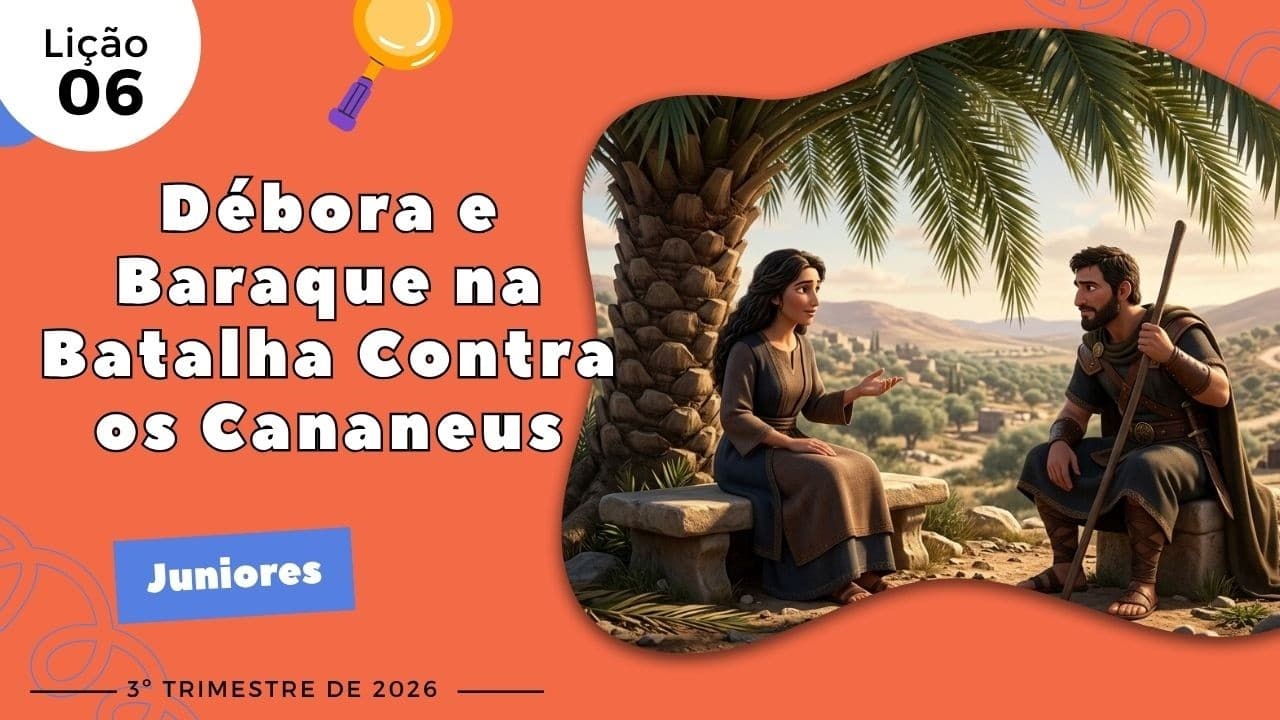
Her name was Deborah, the only woman judge in the history of Israel; along with her God called Barak. The story is in Judges 4 and teaches something for a lifetime: wisdom comes from God.
I — The judge who listened to God under the palm tree
After the death of the judge Ehud, Israel went back to doing what was wrong. Then Jabin, king of Canaan, ruled over the people for twenty years — longer than you have been alive! The commander of his army was named Sisera, and the Bible explains the fear: "Then the Israelites cried out to the LORD, because Jabin had nine hundred chariots of iron, and he had harshly oppressed the Israelites for twenty years." (Judges 4:3)
That was when the people did the only right thing: they cried out to the Lord. And God already had someone prepared. "Now Deborah, a prophetess, the wife of Lappidoth, was judging Israel at that time." (Judges 4:4) She had neither a palace nor an army: she sat under a palm tree, between Ramah and Bethel, and the people went up there to tell their problems and hear what God said (Judges 4:5).
Why did they trust her so much? Because her wisdom was not her own: it came from God — "For the LORD gives wisdom; from His mouth come knowledge and understanding." (Proverbs 2:6) In Hebrew, Deborah means bee: small, hardworking, and doing enormous good to everyone around.
🏛 Fun fact — the iron chariots. A war chariot with iron parts was, in that time, like a tank today. The Canaanites knew how to work iron; Israel did not. Jabin reigned in Hazor — archaeologists excavated the site and saw that it was the largest fortified city in the region.
II — "I will only go if you go with me"
One day Deborah sent for Barak, son of Abinoam, with a message that she had not made up: it was a command from God. Gather ten thousand men, go up Mount Tabor, and the Lord will deliver Sisera into your hands (Judges 4:6, 7). Notice the plan: go up a mountain, because an iron chariot cannot climb a steep slope. God did not just give the command: He gave the strategy. That is what wisdom is — knowing what to do and how to do it, because God showed the way.
Barak answered very honestly: "Barak said to her, “If you will go with me, I will go; but if you will not go with me, I will not go.”" (Judges 4:8) In other words: "I am afraid; I will only go if you go with me." Look at what Deborah did not do: she did not laugh at him or go around telling people about his fear. She simply said that she would certainly go with him (Judges 4:9) and stayed by his side the whole time. That is wisdom too: encouraging someone who is afraid instead of mocking them. When you see a classmate shaking before a test, you can laugh — or you can say, "Come on, I'll go with you."
And Barak went. Even though he was afraid, he obeyed — so much so that the New Testament placed his name among the heroes of faith (Hebrews 11:32). Faith is obeying even when you feel afraid.
❤ For the child's heart. Feeling afraid does not mean God cannot use you. Talk about your fear with God and with a trusted adult — your dad, your mom, your teacher. No one needs to carry fear alone.
III — The rain, the mud, and the victory that belonged to God
The day arrived. Sisera gathered the nine hundred chariots in the valley, near the Kishon River, and from the top of Tabor the ten thousand men saw them gleaming in the sun. Then Deborah spoke the right word at the right time: "Then Deborah said to Barak, “Arise, for this is the day that the LORD has delivered Sisera into your hand. Has not the LORD gone before you?” So Barak came down from Mount Tabor with ten thousand men following him." (Judges 4:14) That is: go down now — God has already gone ahead!
Barak ran down the mountain, and God did His part. A storm came: the Kishon overflowed and the hard ground turned into a swamp of mud. The iron chariots got bogged down — the wheels spun and could not move from the spot. The enemy's greatest strength became his greatest trap. "And in front of him the LORD routed with the sword Sisera, all his charioteers, and all his army. Sisera abandoned his chariot and fled on foot." (Judges 4:15) Notice the subject of the sentence: the LORD. And the song of the two of them says: "The River Kishon swept them away, the ancient river, the River Kishon. March on, O my soul, in strength!" (Judges 5:21)
The Kishon runs through the Valley of Jezreel, a flat plain, perfect terrain for war chariots. But, with heavy rain, the river rises quickly and the dark soil turns into sticky mud: God set the battle where the enemy's strength would be good for nothing.
Sisera fled on foot to the tent of Jael, whose family lived in peace with the Canaanites, thinking he would be safe there. She welcomed him, gave him milk, and covered him; tired, he fell asleep. And there God used Jael to put an end to the power of the enemy general — as Deborah had warned: God would deliver Sisera into the hands of a woman (Judges 4:9). "On that day God subdued Jabin king of Canaan before the Israelites." (Judges 4:23)
Christ in the Lesson
Deborah and Barak won a great battle, but afterward the people fell again. Each judge brought relief; none of them fixed people's hearts forever. That is why God sent the greater Deliverer: Jesus. Barak was afraid and God sent someone to stay by his side; we are also afraid, and Jesus stays by our side forever, promising that He is with us every day (Matthew 28:20).
And look at the pattern of the story: the strongest weapon (the iron chariot) was defeated by something weak (rain and mud). On the cross it was the same, on a giant scale: what looked like defeat was the greatest victory of all. Christ became for us wisdom from God (1 Corinthians 1:30) — and that is not a prize for good behavior: it is a gift.
Practical Application
Ask for wisdom before deciding. "Now if any of you lacks wisdom, he should ask God, who gives generously to all without finding fault, and it will be given to him." (James 1:5) Before a test, before choosing who to hang out with: stop and ask.
Encourage those who are afraid, as Deborah did. A classmate shaking before presenting schoolwork, a younger sibling afraid of the dark: come close and say, "I'll go with you."
When it is something serious, tell a trusted adult. If someone is being hurt or threatened, you do not need to confront anyone: your role is to tell — dad, mom, teacher, pastor. That is not fear: it is wisdom.
Closing Prayer
Lord, thank You because wisdom is Yours and You give it as a gift to those who ask. Thank You for Deborah, who listened to Your voice, and for Barak, who obeyed even while afraid. Teach every child in this class to ask You before deciding and to trust that You go ahead of us. Thank You for Jesus, who has already won the greatest battle of all. Amen.
Soli Deo Gloria — Scripture governs; everything else, on its knees.
Frequently asked questions about this lesson
Who was Deborah in the Bible?+
A prophetess and the only female judge of Israel. Married to Lappidoth, she received the people under a palm tree between Ramah and Bethel (Judges 4:4, 5).
Why did Barak only want to go to battle if Deborah went with him?+
Because he was afraid of the enemy's nine hundred iron chariots: "Barak said to her, “If you will go with me, I will go; but if you will not go with me, I will not go.”" (Judges 4:8). And Deborah went with him.
How did Israel defeat the Canaanites' iron chariots?+
God fought for Israel: the brook Kishon overflowed, the field turned into mud, and the chariots got stuck (Judges 4:15; 5:21).
What does the lesson of Deborah and Barak teach children?+
That wisdom is a gift from God, not something you buy or earn: whoever asks, receives (James 1:5).
Teacher's Guide
Essence of the lesson
Wisdom cannot be bought: God gives it as a gift to those who ask — and with it great battles are won.
Lesson map
| Time | Stage |
|---|---|
| 0–5 min | Opening (the impossible challenge) |
| 5–13 min | Point 1 — Deborah, the judge who listened to God |
| 13–21 min | Point 2 — Barak was afraid (and went anyway) |
| 21–28 min | Point 3 — The rain, the mud, and God's victory |
| 28–36 min | Class activity "The chariots that got bogged down" |
| 36–40 min | Christ + wrap-up + challenge + prayer |
Start like this
Throw out an impossible question: "An army with nine hundred iron chariots is coming and you only have stones and sticks. What do you do?" Let three or four answer — funny ideas will come up (dig a hole, run away, climb a tree). Laugh along with them. Then hold their attention: "Today you are going to see God's plan — better than all of ours."
Point 1 — Deborah, the judge who listened to God
- In the quarterly: the topic about Deborah, the only woman judge of Israel, who attended to the people under a palm tree, and the twenty years of Jabin's oppression.
- What to teach: the people were dominated, afraid, and cried out to God. Deborah was respected because her wisdom came from the Lord.
- Anchor verse: "Now Deborah, a prophetess, the wife of Lappidoth, was judging Israel at that time." (Judges 4:4)
- Key question: "When you don't know what to do, who do you ask?"
- Likely answers (+ follow-up): mom, dad, grandma, teacher. Take it deeper: "And can we ask God? How?" (by praying and reading the Bible).
- If no one speaks: share a decision you made this week and tell whom you asked.
Point 2 — Barak was afraid (and went anyway)
- In the quarterly: the calling of Barak, the ten thousand men, Mount Tabor, the fear of going alone, and Deborah's encouragement.
- What to teach: God gave the command and the strategy — an iron chariot cannot climb a steep slope. Barak admitted his fear; Deborah did not laugh: she went with him. Obeying while afraid is still obeying.
- Anchor verse: "Barak said to her, “If you will go with me, I will go; but if you will not go with me, I will not go.”" (Judges 4:8)
- Key question: "How can we help a friend who is afraid?"
- Likely answers (+ follow-up): stay by their side, hold their hand, pray for them. Take it deeper: "And what happens when we laugh at someone who is afraid?"
- If no one speaks: give an example — "I used to be terrified of [something simple]; it helped me to hear: I'll go with you."
Point 3 — The rain, the mud, and God's victory
- In the quarterly: the battle, the Kishon overflowing, the ground turning into a swamp of mud, the bogged-down chariots, and the end of Jabin's rule.
- What to teach: God fought: the enemy's greatest strength became his biggest problem in the mud. In Jael's tent, God put an end to the general's power — tell it without graphic details. The focus is: God fulfills what He says.
- Anchor verse: "Then Deborah said to Barak, “Arise, for this is the day that the LORD has delivered Sisera into your hand. Has not the LORD gone before you?” So Barak came down from Mount Tabor with ten thousand men following him." (Judges 4:14)
- Key question: "Who really won this battle: the soldiers or God?"
- Likely answers (+ follow-up): "God!", "both", "the soldiers fought". Take it deeper: "They ran down the mountain — but who sent the rain?"
- If no one speaks: slowly reread Judges 4:15 and ask: "Who does the verse say defeated Sisera?"
Class activity
- Objective: to drive home, through drawing, that the enemy's strength is nothing before God.
- Materials: one sheet of paper per child and colored pencils or crayons (including brown and blue).
- Step by step: each child folds the sheet in half. On top, they draw Sisera's iron chariot. On the bottom, they color the mud brown and the Kishon blue, with the same chariot bogged down up to the wheel. In the middle, everyone writes: "For the LORD gives wisdom; from His mouth come knowledge and understanding." (Proverbs 2:6) Walk around the room praising each piece of work; no one competes or presents in front of the class.
- Wrap-up (back to the text): "The chariot is the same in both drawings. What changed was that God entered the story."
If they ask you this
- Question: "Was Barak a coward?" Short answer: No. He felt afraid and obeyed anyway — the Bible places his name among the men of faith (Hebrews 11:32). Courage is going forward with your heart beating fast.
- Question: "Why did Jael do that to Sisera?" Short answer: Sisera commanded the army that had made the people of God suffer for twenty years, and God used Jael to put an end to his power. The joy of the chapter is not violence: it is the people set free.
Wrap-up + challenge of the week
- Wrap-up: "Deborah did not have an army: she had her ears open to God. Wisdom is not being the smartest kid in the room — it is asking God and obeying. And the greatest victory of all He has already won for us, on the cross."
- Challenge: make your wisdom card — a piece of paper with today's verse and the sentence "God, give me wisdom." Keep it in your pocket, and every time a hard choice comes up this week, stop and pray that sentence before deciding; then make a tally mark on the back. On Sunday, come back with the story.
Teacher's kit
- Before: read Judges 4 and the topic in the quarterly; set aside sheets of paper, colored pencils, and card-sized pieces of paper.
- Bring: Bible, sheets of paper, colored pencils (brown and blue), the cards.
- Pray beforehand: ask God that each child would learn to ask for wisdom before deciding.
Homework
Your mission for the week
Make your wisdom card: on a piece of paper, write today's verse ("For the LORD gives wisdom; from His mouth come knowledge and understanding." (Proverbs 2:6)) and, underneath, "God, give me wisdom." Keep it in your pocket or backpack, and every time a hard choice comes up this week — what to say, what to do, whether to go along or not — stop, pray that sentence, and only then decide. Make a tally mark on the back each time.
Why
Deborah knew what to do because she listened to God, who even delivered the battle strategy (Judges 4:6, 14). The Bible promises the same to you: "Now if any of you lacks wisdom, he should ask God, who gives generously to all without finding fault, and it will be given to him." (James 1:5) It is not a prize: it is a gift.
How to know you did it
The card is with you, it has at least one tally mark on the back, and you can tell what the choice for that mark was.
On Sunday, come back with the story
Bring the card in your hand: next week's class begins with whoever wants to share a choice made after asking God for wisdom.