Golden Text
“Not that we are competent in ourselves to claim that anything comes from us, but our competence comes from God.” (2 Corinthians 3:5, BSB) · Read in the Bible
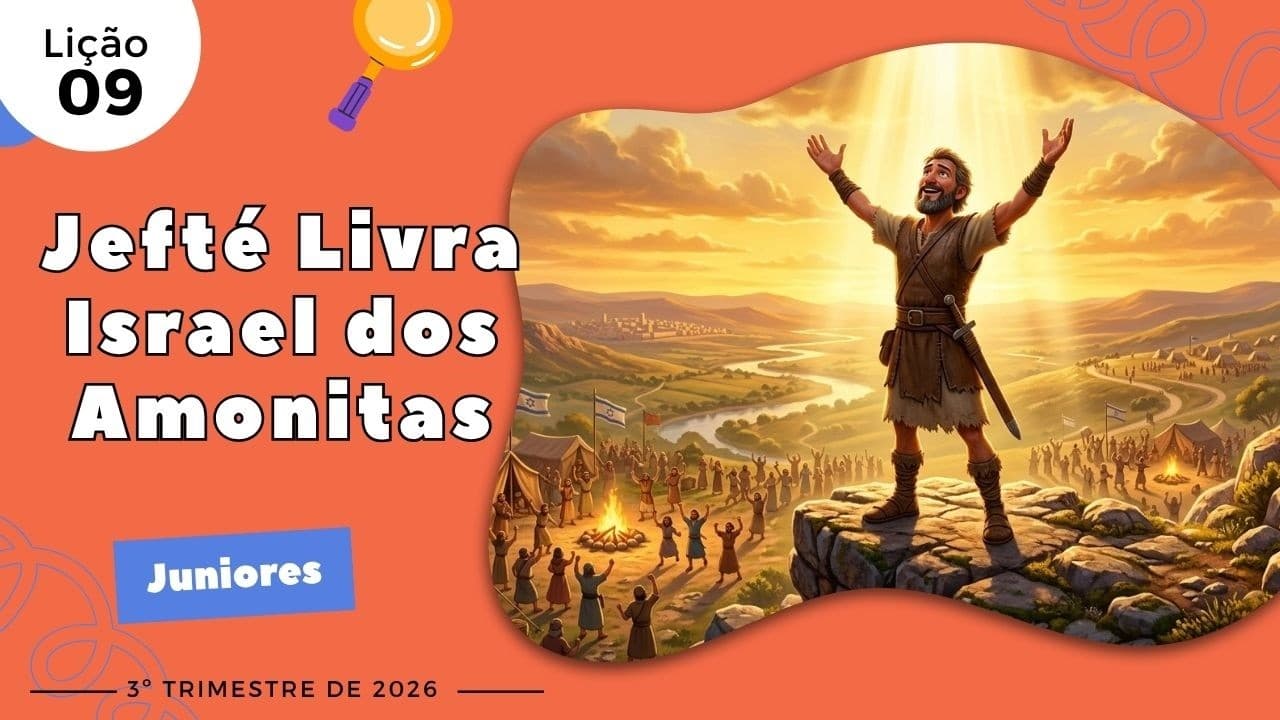
Jephthah was driven from home by his own brothers because of something he did not choose. Years later, the people who had sent him away came to fetch him to face the Ammonites. He forgave them, tried peace first, and won — not by the sword, but because the Spirit of the LORD came upon him. In the midst of that victory, a promise made in haste brought great sorrow. God delivers freely; our part is to trust and watch what our mouth says.
Imagine that you are in line for the team to be picked. One captain calls a name, the other calls another, and the names keep coming out. Only yours does not come out. And then you hear someone say, without lowering their voice: "not that one."
It hurts. It hurts even more when the one who says that is from your own home.
Today's story is in Judges 11 and begins just like that: a man who was sent away from home by his own brothers. His name was Jephthah. And the end of this story teaches something we need to learn early: the place where your story began does not decide where it is going to end — because our competence comes from God.
I — The brother who was sent away
Israel was in bad times. The people had turned away from the LORD, and the Ammonites, a neighboring people, oppressed the Israelites for eighteen years (Judges 10:8). It was at that time that the Bible introduces our character: "Now Jephthah the Gileadite was a mighty man of valor; he was the son of a prostitute, and Gilead was his father." (Judges 11:1).
Valiant means courageous, brave, a person of worth. But his family did not see any of that.
Jephthah's mother was not his father's wife. When his half-brothers grew up, they went to him and said: "And Gilead’s wife bore him sons who grew up, drove Jephthah out, and said to him, “You shall have no inheritance in our father’s house, because you are the son of another woman.”" (Judges 11:2). Translating: "you have no right to anything here. Go away."
And he went. "So Jephthah fled from his brothers and settled in the land of Tob, where worthless men gathered around him and traveled with him." (Judges 11:3) Far from home, far from his family, with no inheritance at all.
Notice two things before moving on.
First: Jephthah was rejected because of something he did not choose. No one chooses what family they are born into. If today you carry something that you did not choose — a messy home, a different way of being, a nickname people stuck on you —, keep this verse, because it is about you too.
Second: Jephthah did not stay still in the desert crying over his life. He moved forward. And, very importantly, he did not let his heart harden. You will see that in a little bit.
🌿 Did you know? — who the Ammonites were. They lived on the other side of the Jordan River and worshiped an idol called Milcom. They were not villains from a children's story: they were a strong people, with a real army, and they pressed hard against Israel for eighteen years in a row. It is against this people that today's lesson unfolds.
II — They called back the one they had driven out
Time passed. The Ammonites decided to attack Gilead once and for all, and the leaders of the people fell into despair: they had no one to lead them.
Then they remembered a name. The name of the man they themselves had sent away.
The elders of Gilead crossed the desert to the land of Tob and said to Jephthah: "“Come,” they said, “be our commander, so that we can fight against the Ammonites.”" (Judges 11:6).
Stop here and think about the scene. The very same people who had shut the door were now knocking on it, asking for help.
Jephthah did not pretend that nothing had happened. He looked at them and asked what anyone would ask: "Jephthah replied to the elders of Gilead, “Did you not hate me and expel me from my father’s house? Why then have you come to me now, when you are in distress?”" (Judges 11:7). He spoke the truth, to their face, without shouting and without revenge.
And then he did the hardest thing in the whole story: he forgave and went to help.
Not because what they had done to him was small. It was huge. But because Jephthah did not let resentment take over him. Whoever holds on to hatred stays trapped in the day they were hurt. Jephthah chose to be useful to the people of God instead of settling old scores.
III — Before the war, he tried peace
Here there is a detail that almost no one notices, and it is very good.
Jephthah accepted the command, but he did not run out to fight. The first thing he did was send messengers to the king of the Ammonites to talk. He explained the history of that land calmly and with facts (Judges 11:12-27), and ended the message by placing the decision in the right hands: "I have not sinned against you, but you have done me wrong by waging war against me. May the LORD, the Judge, decide today between the Israelites and the Ammonites." (Judges 11:27).
The king of the Ammonites refused to listen. But notice what Jephthah did: the strongest man in the story tried peace first.
This applies to you right now, at school and at home. Truly strong people do not start hitting or yelling at the first spark. They talk, explain, try to work things out. And when the problem is too big — when someone is hurting you, threatening you, or making you afraid —, then it is not something to solve on your own: it is a case for telling a trusted adult, your dad, mom, teacher, or pastor. The adult handles it; you speak up.
IV — The Spirit of the LORD came upon Jephthah
The time for battle arrived. And the Bible records the sentence that explains everything that comes next:
"Then the Spirit of the LORD came upon Jephthah, and he passed through Gilead and Manasseh, then through Mizpah of Gilead. And from there he advanced against the Ammonites." (Judges 11:29)
Keep that sentence. It is the heart of the lesson.
Did Jephthah have experience? He did. Did he have courage? He did. But none of that won the war. The one who won was God, enabling the man He called. That was how the people crossed over to fight, and the LORD delivered them into his hand (Judges 11:32). Twenty cities were taken, and Israel was freed from the Ammonites (Judges 11:33).
Israel was free because God delivered them.
That is exactly what today's verse says, and that is why it is the Golden Text of this lesson: "Not that we are competent in ourselves to claim that anything comes from us, but our competence comes from God." (2 Corinthians 3:5). And the book of Proverbs sums it up the same way: "A horse is prepared for the day of battle, but victory is of the LORD." (Proverbs 21:31).
You do your part — study, practice, try, obey. But the strength that makes it happen comes from Him. God does not choose by résumé, and you do not have to make yourself capable on your own: He enables those He calls.
V — The promise made without thinking
Now the sad part of the story. Let us talk about it calmly, because it has a lot to teach.
Before the battle, Jephthah made a vow to God. A vow is a promise a person makes to the Lord of their own free will — no one was required to make one. But once made, it was to be kept.
The problem was not that he spoke with God. The problem was what he promised and how he promised it: in a hurry, under pressure, promising to offer up whatever came out of the door of his house when he returned victorious (Judges 11:30-31).
And look at the detail that hurts: the victory was already guaranteed. The Spirit of the LORD had already come upon him in verse 29 — before the vow. God was already going to deliver Israel by grace. Jephthah tried to pay for something that had already been given.
When he returned victorious, his daughter came out to meet him with tambourines and dancing, and she was his only child (Judges 11:34). The celebration turned into weeping. Jephthah tore his clothes and said: "As soon as Jephthah saw her, he tore his clothes and said, “No! Not my daughter! You have brought me to my knees! You have brought great misery upon me, for I have given my word to the LORD and cannot take it back.”" (Judges 11:35).
The young woman asked for two months to go to the mountains with her friends, and then she returned. The Bible says that Jephthah fulfilled with her the vow he had made, and she never knew a man (Judges 11:39). From that day on, the young women of Israel went every year to remember her (Judges 11:40).
The Bible does not tell in detail what that fulfillment meant, and serious people who study the Scriptures understand this passage in more than one way. We are not going to invent what the text does not say. What the Bible makes very clear is the rest: that promise was not asked for by God, was not necessary, and brought enormous sadness into that home.
And this is what it wants you to learn:
"It is better not to vow than to make a vow and not fulfill it." (Ecclesiastes 5:5)
"Do not be quick to speak, and do not be hasty in your heart to utter a word before God. For God is in heaven and you are on earth. So let your words be few." (Ecclesiastes 5:2)
A word given is a serious thing. The mouth speaks fast; life pays slowly.
🥁 Did you know? — the tambourines. The tambourine (or timbrel) was a frame drum, with stretched skin, played with the hands. In Israel, when the army returned victorious, the women went out into the street playing the tambourine, singing and dancing to celebrate. It was the most joyful celebration there was. That was how Jephthah's daughter came out of the house on that day — celebrating her father's victory.
❤ For the child's heart. No one needs to make a deal with God. You do not have to promise "I will never do this again, and then the Lord will help me" in order to be heard. God does not sell help: He gives it. So talk to Him for real — ask, thank Him, tell Him what hurts. And when it comes time to promise something to someone, breathe and think first: "will I be able to keep this?" If not, do not promise. A small word kept is worth more than a big word forgotten.
Christ in the Lesson
Look at Jephthah's life from a distance, like someone looking at a whole picture, and see whom it speaks of.
A man rejected by His own. "He came to His own, and His own did not receive Him." (John 1:11) That is not about Jephthah — it is about Jesus. And the prophet Isaiah had written centuries earlier: "He was despised and rejected by men, a man of sorrows, acquainted with grief. Like one from whom men hide their faces, He was despised, and we esteemed Him not." (Isaiah 53:3).
A man who lived among those left aside. Jephthah gathered in the desert people whom no one wanted. Jesus walked with those the city avoided, sat at the table of those no one invited — and that is why today there is a place for you.
A man who came back to save those who rejected Him. The leaders of Gilead only went to get Jephthah when they were lost. We did the exact same thing: we rejected God with our sin, and even so He came to save us. Peter said of Him: "This Jesus is ‘the stone you builders rejected, which has become the cornerstone.’" (Acts 4:11).
And there is a difference that changes everything. Jephthah promised something he could not pay. Jesus paid something we could never promise. No one buys salvation with a vow, a promise, or a sacrifice. Jesus gave His life on the cross, and salvation reached us for free — we only have to receive it.
That is why today's lesson does not end with "be a good kid." It ends with Jesus: the Rejected One who became the Savior, the Son who did not come to make a deal with us, but to bring us home.
Practical Application
Let God write the end of your story. No one here is what others said they are. Jephthah left home as the son who would inherit nothing and returned as the man God used to deliver an entire people. "You did not choose Me, but I chose you. And I appointed you to go and bear fruit — fruit that will remain — so that whatever you ask the Father in My name, He will give you." (John 15:16)
Do not hold on to hatred toward those who hurt you. Jephthah spoke the truth without becoming a bitter person, and even helped those who had sent him away. Holding on to anger does not punish the other person — it punishes you. And if what happened was something serious, tell a trusted adult. The adult handles it; you speak up.
Watch what your mouth promises. "Simply let your ‘Yes’ be ‘Yes,’ and your ‘No,’ ‘No.’ Anything more comes from the evil one." (Matthew 5:37) Did you promise? Keep it. Won't be able to keep it? Don't promise. "He who guards his mouth and tongue keeps his soul from distress." (Proverbs 21:23)
Ask God for competence, not favors in return. Before a test, a presentation, or a hard conversation, pray like this: "Lord, I cannot handle this on my own. My competence comes from You." That is faith. Bargaining is not.
Closing Prayer
Lord, thank You because You choose those whom men have left aside, and because our competence comes from You. Guard the heart of every child in this class from bitterness and from the desire to settle scores. Set a guard over our mouth, so that we may promise little and keep everything. And thank You for Jesus, the Rejected One who became our Savior and paid what no one could pay. In His name, amen.
Soli Deo Gloria — Scripture governs; everything else, on its knees.
Frequently asked questions about this lesson
Who was Jephthah in the Bible?+
A judge of Israel who lived in Gilead. The Bible calls him a mighty warrior (Judges 11:1). He was driven from home by his half-brothers, lived far away in the land of Tob, and was later called back to deliver the people from the Ammonites (Judges 11).
Why did Jephthah's brothers drive him from home?+
Because his mother was not their father's wife. His brothers told him that he would have no inheritance in their father's house because he was the son of another woman (Judges 11:2). In other words, they drove Jephthah out because of something he did not choose and was not at fault for at all.
What is a vow in the Bible?+
It is a promise made to God of one's own free will. No one was required to make a vow — but once made, it had to be kept. That is why the Bible warns: "It is better not to vow than to make a vow and not fulfill it." (Ecclesiastes 5:5).
What happened to Jephthah's daughter?+
The Bible says that she asked her father for two months to go to the mountains with her companions (Judges 11:37-38) and that afterward Jephthah fulfilled the vow he had made concerning her, and she never knew a man (Judges 11:39) — she never had a husband or a family of her own. The text does not explain in detail what fulfilling that vow meant, and people who study the Bible seriously understand the passage in more than one way. What is clear is the sorrow that a promise made without thinking brought to that home.
If Jephthah made a mistake, why does he appear in Hebrews 11?+
Because the list in Hebrews 11 is not a list of perfect people — it is a list of people who believed. Jephthah appears there among those who through faith conquered kingdoms and practiced righteousness (Hebrews 11:33). God does not expect perfection from us; He expects trust.
Does God answer when we promise something in return?+
God cannot be bought. The Spirit of the LORD had already come upon Jephthah before the vow (Judges 11:29) — the victory had already been given, freely. We pray, ask, and trust; we do not make bargains with God.
Teacher's Guide
Essence of the class
God chooses and enables those whom men rejected — and whoever has God's enabling does not need to bargain with Him for anything.
Map of the class
| Time | Stage |
|---|---|
| 0–4 min | Opening (the team line) |
| 4–12 min | Point 1 — The rejected one whom God chose |
| 12–20 min | Point 2 — The victory came from the Spirit |
| 20–27 min | Point 3 — The mouth that speaks without thinking |
| 27–35 min | Class activity "The hand that God enables" |
| 35–40 min | Christ + wrap-up + challenge + prayer |
Start like this
Start standing up, without a Bible in your hand yet, and tell a short scene: "Imagine they are picking teams. They call one, they call another, and your name does not come out. And then someone says out loud: 'not that one.'" Pause and ask: "Who here has ever felt like the last one to be picked?" Let three or four answer — and do not force anyone to speak. Usually you will hear "me," "in soccer," "in dance," "my brother always picks the other one." Welcome each answer with a single sentence, without commenting on anyone's personal life, and connect: "Today we are going to meet a man who was sent away from his own home. And he was the one God chose to save the entire people."
Point 1 — The rejected one whom God chose
- In the quarterly: the topic that introduces Jephthah, son of Gilead — the half-brothers who did not accept him, being driven out of the house, fleeing to the city of Tob, and the moment when the leaders of Gilead go to bring him back for the war.
- What to teach: Jephthah was rejected because of something he did not choose — his mother was not his father's wife. Say this naturally and without any further detail; the child understands "he had no right to the inheritance and they sent him away." The point is what came afterward: he did not let his heart harden, and when the very same men came asking for help, he forgave and went to help.
- Anchor verse (BSB): "“Come,” they said, “be our commander, so that we can fight against the Ammonites.”" (Judges 11:6)
- Key question: "If the people who sent you away came back asking for help, what would you do?"
- Likely answers (+ going deeper): "I wouldn't help," "I would help, but I'd stay mad," "it depends." Go deeper: "Jephthah spoke the truth to their face — and went anyway. Is it possible to speak the truth without becoming a bitter person?"
- If no one speaks: tell a very small one of your own first, without naming anyone: "I was once left out of something and it took me a while to get over it. Do you know what helped me? Talking to God before talking to the person."
Point 2 — The victory came from the Spirit
- In the quarterly: the topic that tells how Jephthah sought peace first, sending messengers to the king of the Ammonites, and how the Spirit of the Lord filled him and enabled him to lead the battle — plus the "Memorizing" verse of the lesson, in 2 Corinthians 3:5.
- What to teach: two things in this order. (1) The strongest man in the story tried peace before trying war — true strength talks first. (2) The victory did not come from the sword or from training in the desert: it came because the Spirit of the LORD came upon him. God enables those He calls.
- Anchor verse (BSB): "Then the Spirit of the LORD came upon Jephthah, and he passed through Gilead and Manasseh, then through Mizpah of Gilead. And from there he advanced against the Ammonites." (Judges 11:29)
- Key question: "In what do you need God's strength this week?"
- Likely answers (+ going deeper): "on the test," "to not fight with my brother," "to talk to someone." Go deeper: "What if, instead of promising God something in return, you just ask for His competence?"
- If no one speaks: write on the board "our competence comes from God" and ask everyone to read it aloud twice. Then ask again, more concretely: "what is hard for you on Monday morning?"
Point 3 — The mouth that speaks without thinking
- In the quarterly: the section that explains what a vow is — an optional promise, but mandatory to keep once made — and the point where the lesson calls Jephthah's vow rash and unnecessary; plus the reading of Ecclesiastes 5:5 assigned for the week.
- What to teach: Jephthah made a promise in a hurry, under pressure, when the victory had already been given by grace (the Spirit came upon him in v. 29, before the vow). When he returned, his only daughter came out to meet him with tambourines and dancing, and the celebration turned into weeping. Tell the story up to here and stop. Say honestly that the Bible does not explain in detail what the fulfillment of the vow meant, that serious people understand the passage in more than one way, and that we do not invent what the text does not say. Do not dramatize and do not describe any scene. What the lesson calls for is the meaning: a promise made without thinking costs dearly, and no one needs to bargain with God.
- Anchor verse (BSB): "It is better not to vow than to make a vow and not fulfill it." (Ecclesiastes 5:5)
- Key question: "Have you ever promised something and then couldn't manage to keep it? What happened?"
- Likely answers (+ going deeper): "I promised to clean my room," "I promised to return something and forgot," "I promised my dad." Go deeper: "And which is better: to make a big promise and not keep it, or to make a small promise and keep it?"
- If no one speaks: tell about a small promise of your own that you did not keep and what you did to make it right. Then ask: "who here has an unfinished promise at home waiting to be kept?"
Class activity
- Goal: to fix the Golden Text in memory and connect the child's hand (what he or she does) to the competence that comes from God.
- Materials: bond paper or pieces of poster board, pencils, blunt-tip scissors, markers or colored pencils. Nothing else.
- Step by step: (1) Each student places their own hand on the paper and traces around it with the pencil. (2) Cut out the hand shape — anyone who has trouble with the scissors cuts it out with your help, without rushing and without anyone waiting in front of the room. (3) Write the Golden Text on the board and ask each one to copy it inside the hand: "Not that we are competent in ourselves to claim that anything comes from us, but our competence comes from God." (2 Corinthians 3:5). (4) Decorate freely, turning it into a card. (5) All together, standing up, recite the verse three times holding the paper hand up — the whole class at the same time, no one alone in front of the others.
- Wrap-up (back to the text): "In our hands is the work God gave us to do. But the strength to do it is not ours: Jephthah only won because the Spirit of the LORD came upon him. Take this hand home and leave it where you study."
If they ask you this
- Question: "Did Jephthah kill his daughter?" Short answer: The Bible does not say that in those words. It says that he fulfilled with her the vow he had made, and she never knew a man (Judges 11:39) — that is, she never had a husband or a family of her own —, and before that it tells that the young woman spent two months in the mountains with her companions (Judges 11:37-38). People who study the Bible seriously understand this passage in more than one way, and we do not invent what the text does not tell. What the Bible says clearly is that that vow was not asked for by God, was not necessary, and brought great sadness. If the child insists, be honest: "that is a part the Bible left open, and I am not going to invent an answer. What God wants us to learn here is very clear: be careful with what your mouth promises."
- Question: "If I promise something to God, is He required to do what I want?" Short answer: No. God cannot be bought. Notice the order of the chapter: the Spirit of the LORD came upon Jephthah in verse 29, before the vow — the victory had already been given by grace. We pray, ask, and trust. Bargaining is not prayer.
- Question: "Why did God choose the very guy who lived with bad people in the desert?" Short answer: Because God does not choose by address or last name. He looks at the heart and enables those He calls. It was the same God who said to Moses: "Now go! I will help you as you speak, and I will teach you what to say." (Exodus 4:12).
- Question: "Does someone who messes up like that lose their place with God?" Short answer: It is not like that. God forgives whoever repents and confesses (1 John 1:9), and Jephthah continued to be a judge of Israel — so much so that the New Testament places him in the list of those who by faith conquered kingdoms and practiced righteousness (Hebrews 11:33). God does not expect perfection; He expects trust and obedience.
Wrap-up + challenge of the week
- Wrap-up: "Jephthah promised something he could not pay. Jesus paid something we could never promise. No one buys God with a promise: salvation is by grace, and the competence to live is too. Our part is to trust Him and watch what our mouth says."
- Challenge: this week, keep a promise you made and have not kept yet. Think of something you promised someone — your dad, mom, brother, grandmother, teacher, a friend — and did not do. Do that thing by Sunday and then go to the person and say: "I had promised this and now I kept it." If you cannot remember any unfinished promise, make a very small promise today to someone in your home and keep it before Sunday. On Sunday, come back with the story.
Teacher's kit
- Before: read the whole of Judges 11 and the topic in the quarterly, and decide ahead of time how far you will go on the subject of the vow (the outline in Point 3 already sets the limit). Cut bond paper or poster board into pieces the size of an open hand.
- Bring: a Bible, paper for the hands, pencils, blunt-tip scissors, markers or colored pencils.
- Pray beforehand: pray to God for every child in this class who has ever heard that they were not good enough for something — and that they may leave the class knowing that their competence comes from the Lord.
Homework
Your mission for the week
Keep a promise you made and have not kept yet. Think of something you promised someone — your dad, mom, brother, grandmother, teacher, a friend — and ended up not doing. Do that thing by Sunday. Then go to the person and say in so many words: "I had promised this and now I kept it." If you cannot remember any unfinished promise, make a very small promise today to someone in your home and keep it before Sunday.
Why
Jephthah opened his mouth in a hurry and promised God something that brought great sadness to his home — even though the victory was already guaranteed by grace (Judges 11:29). The Bible warns: "It is better not to vow than to make a vow and not fulfill it." (Ecclesiastes 5:5). A word given is a serious thing, and keeping a small promise is worth more than making a big promise.
How to know you did it
The promise is kept and the person heard you say that you kept it. If they know, you did it.
On Sunday, come back with the story
Tell what the promise was, who it was for, and the look on the person's face when you came and kept it. Next week's class starts with whoever has a story to tell.