Golden Text
“For no word from God will ever fail.” (Luke 1:37, BSB) · Read in the Bible
Jairus was the most respected man in Capernaum, but he could not heal his own daughter. He ran to Jesus and knelt down in front of everyone. Halfway there, the worst news arrived — and Jesus, instead of turning back, told him not to be afraid, just to believe. At the house, He took the girl by the hand, she got up, and Jesus even told them to give her something to eat. The lesson shows children that Jesus has power even over death, and that He is the right place to take what we cannot solve.
Capernaum was packed that day. Jesus had just stepped out of the boat and the crowd was already pressing in on Him — pushing from here, pushing from there, everyone wanting to get close.
And in the middle of all that commotion, a man pushed his way through, running.
He was not just any man. He was the most respected man in town. And when he got close to Jesus, he did something no one expected: he threw himself on the ground.
Today's story is in Mark 5 and Luke 8. And it begins with the worst day of a father's life.
I — The man who could not solve it on his own
His name was Jairus. He was the ruler of the synagogue in Capernaum — the synagogue was the place where the Jews gathered to worship God and learn the Scriptures. Being ruler of the synagogue was like being the most important person in the church of the whole town. Everyone knew him. Everyone respected him.
And Jairus had only one daughter. A single daughter, twelve years old. And she was dying.
Notice the size of the problem. Jairus had a position. He had respect. He had money to call anyone he wanted. And he could do absolutely nothing to save his own daughter.
So he did the only thing left to do.
"A synagogue leader named Jairus arrived, and seeing Jesus, he fell at His feet and pleaded with Him urgently, “My little daughter is near death. Please come and place Your hands on her, so that she will be healed and live.”" (Mark 5:22-23)
Falling at His feet means that he knelt down and touched his face to the ground. In front of the crowd. In the dust of the street.
Do you know what that teaches us? That asking for help is not weakness. We have a strange habit: we only run for help after trying everything on our own and failing. Jairus could have felt ashamed — "what will people think of me, the ruler of the synagogue kneeling on the ground?" He did not care. He went straight to the only person who could solve it.
And Jesus went with him. Right away, without delay.
🏛 Fun fact — what a synagogue was. It was not a huge temple like the one in Jerusalem. It was a meeting house, one in each town, where the people gathered on the Sabbath to hear the Word of God. Jesus taught in several of them. And it was the leader of one of those houses who knelt at His feet.
II — The worst news on the way
Jesus and Jairus set out walking together. But it was slow going. The crowd pressed in, everyone wanted to touch Jesus, and the pushing and shoving never stopped.
And, halfway there, Jesus even stopped to care for a woman who had been sick for twelve years and had spent everything she had on doctors, without getting any better. She touched Jesus' clothes and was healed (Mark 5:25-34).
Now imagine Jairus's heart in that minute. His daughter waiting at home. And time passing by.
That was when a servant from his house arrived, running and tired, with the sentence no father wants to hear:
"While He was still speaking, messengers from the house of Jairus arrived and said, “Your daughter is dead; why bother the Teacher anymore?”" (Mark 5:35)
In other words: it is over. There is no need to bother Jesus anymore. It is no use now.
And here is the most important moment in the whole story. Jesus heard that. And He did not turn back. He looked at Jairus and spoke these words:
"But Jesus overheard their conversation and said to Jairus, “Do not be afraid; just believe.”" (Mark 5:36)
Just that. Jesus did not explain the plan, did not tell what He was going to do, and did not give any written guarantee. He only said: do not be afraid, keep trusting in Me.
And Jairus trusted. With his heart aching, without understanding anything, he kept walking with Jesus all the way home.
❤ For the child's heart. Have you ever received bad news? That tightness in your chest, that urge to cry? It can be small news — the trip was canceled — or very big news, the kind that changes the whole house. Jesus did not say to Jairus, "pretend it is nothing." The pain was real. He said something else: "I am here, do not let go of My hand." If you are carrying news like that in your heart today, tell your dad, your mom, or your teacher. You do not have to carry it alone.
III — "Little girl, get up"
When the two arrived, the crying could be heard from far away. The house was full of sad people.
Jesus walked in and said something that left everyone confused:
"He went inside and asked, “Why all this commotion and weeping? The child is not dead, but asleep.”" (Mark 5:39)
The people laughed at Him. They really laughed — the Bible tells us that (Mark 5:40). They were sure there was no way anymore.
Jesus did not argue. He made everyone leave and took only five people with Him: Peter, James, John, and the girl's father and mother. He went into the room where she was.
And then:
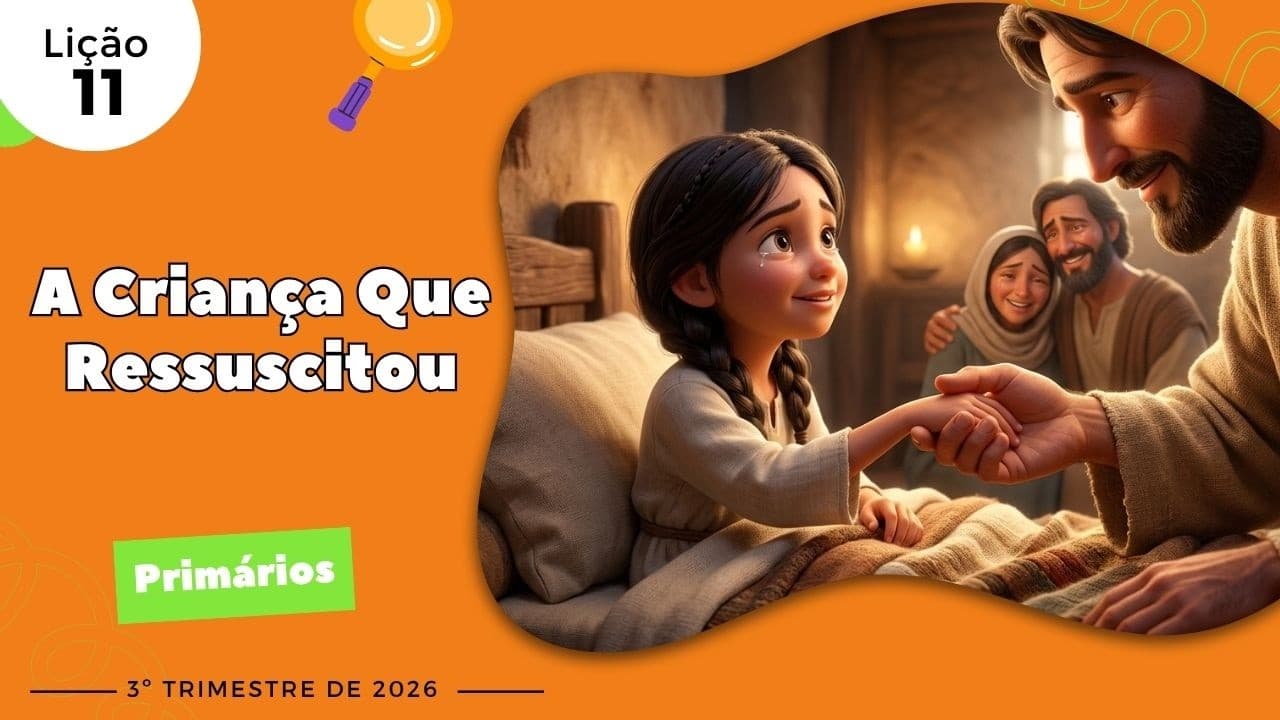
"Taking her by the hand, Jesus said, “Talitha koum!” which means, “Little girl, I say to you, get up!”" (Mark 5:41)
Stop and think about how gentle that is. Jesus did not shout. He did not put on a show. He held her hand — just the way your mom holds your hand when you are sick in bed — and called her affectionately, like someone waking a person up in the morning.
"Immediately the girl got up and began to walk around (she was twelve years old). And at once they were utterly astounded." (Mark 5:42)
She opened her eyes. She got up. She walked around the room.
And then comes the detail that almost no one notices. After the biggest miracle of the day, Jesus said one more thing: He told them to give her something to eat (Mark 5:43).
The girl was hungry. She had spent days sick. And the Son of God, who had just defeated death, remembered her plate of food.
Jesus is powerful enough for the giant miracle and caring enough for the tiniest detail. Both at the same time.
🏛 Fun fact — "Talita cumi." That was the language the girl's family spoke at home, called Aramaic. Mark kept the exact words, just the way they came out of Jesus' mouth, and then translated them for those who would read it. It is as if he wanted to say: I was there, I heard it like this.
🏛 Fun fact — twelve years on both sides. Look how interesting this is: the girl had twelve years of life, and the woman Jesus healed on the way had been sick for twelve years. One was rich and from the most important family in town; the other had spent everything she owned and had nothing left. Jesus stopped for both of them. He has no VIP line.
Christ in the Lesson
Here the lesson finds its place.
Many people read this story and take away only a moral: "have faith and it will work out." But that is not it. The story is not about the size of Jairus's faith — his faith was shaking, and he was heartbroken halfway there. The story is about whom he held on to.
Think about what happened in that room. A man walked into a place where there was a dead child, spoke two words, and life came back. There is only one person in the universe able to do that: the Lord of life.
Jesus Himself said: "Jesus said to her, “I am the resurrection and the life. Whoever believes in Me will live, even though he dies.”" (John 11:25)
And notice what He did after this story. Jesus went to the cross. He died — for real, not pretend — to pay for our sin. He stayed three days in the grave. And on Sunday morning He Himself rose again, alive, with death defeated forever.
Jairus's daughter got up because Jesus commanded it. Jesus got up because He is life itself.
Now, something important, and let us speak with complete honesty: Jesus did not promise that no one will ever get sick again or that no one we love will ever pass away. That little girl grew up, became an old woman, and one day passed away too. Anyone who tells you, "if you have enough faith, nothing bad will happen in your family," is saying something the Bible does not say — and hurting those who have already lost someone.
What Jesus promised is greater and is true: for those who belong to Him, death is not the end, it is a door. One day He will call by name, the same way He called in that room, and all who belong to Him will rise.
That is why the question of the lesson is not "is your faith big?" It is another one: have you already given your heart to Him? Ask forgiveness for your sins, give your life to Jesus, and follow Him. That is the most important miracle of all — and the Bible says that there is joy in heaven over one sinner who repents (Luke 15:10).
In the previous lesson you saw Jesus taking an ordinary child and placing him in the middle of the adults. Today you see the same Jesus walking into a child's room where no one else could go, and holding her hand.
He cares for children. He always has.
Practical Application
- Run first, not last. We usually try to solve everything on our own and only ask for help afterward. Jairus did the opposite: he went straight to Jesus. When something hard comes up, pray before panicking.
- Talk to God about the thing that seems impossible. That test, that fear of the dark, that fight with a friend, that difficulty at home. Tell God the name of the problem, in your own words. He never gets tired of listening.
- Trust even when you do not understand. Jesus told Jairus not to be afraid and only to believe (Mark 5:36). God answers in His way and in His time — sometimes differently from what we asked, and always with love. Trusting is not guessing what is going to happen; it is holding the hand of the One who knows.
- Do not be ashamed to ask for help. The most important man in town knelt in the middle of the street. Asking your dad, your mom, your teacher, or your pastor for help is what brave people do, not weak people.
- Take care of people's small details. Jesus raised the girl to life and still remembered her food. Notice who is hungry, thirsty, without a pencil, or without someone to play with. Caring about the small detail is being like Jesus.
- If you are sad about someone who passed away, you can talk about it. You do not have to pretend everything is fine, and it is not your fault. Tell your dad, your mom, or your teacher, and pray with them. Jesus wept along with a grieving family (John 11:35) — He understands how much you miss them.
- If someone hurts you or scares you, tell a trusted adult. If a person does, says, or asks for something that hurts you, scares you, or has to be kept a secret, you do not solve that on your own. Tell your dad, your mom, your teacher, or your pastor right away. The adult solves it; the child tells.
Closing Prayer
Lord Jesus, thank You because You are the Lord of life. Thank You because, when everyone said "it is over," You said "do not be afraid." Help every child in this class to run to You first, before anything else, with whatever seems impossible. Comfort those who are sad today and hold the hand of those who are afraid. And save our hearts, Lord — that is the greatest miracle of all. In Jesus' name, amen.
Soli Deo Gloria — Scripture governs; everything else, on its knees.
Frequently asked questions about this lesson
What is the main point of Primary Lesson 11?+
That nothing is impossible with God — and that the right place to take the problem we cannot solve is Jesus. Jairus had position, respect, and money, and none of that healed his daughter. He ran to Jesus, and Jesus did what no one else could do (Luke 1:37).
Was the girl really dead or just sleeping?+
She was truly dead. So much so that people laughed at Jesus when He spoke that way (Mark 5:40). Jesus said that she was not dead, but sleeping (Mark 5:39), because for Him, waking that girl up was as easy as waking someone who is taking a nap. Death looks like a locked door to us; to Jesus, it does not.
If I pray a lot, will no one in my family die?+
That is not what the Bible promises, and we are not going to mislead you. Everyone passes away one day — Jairus's own daughter, many years later, also passed away. What Jesus promised is much greater: that death is not the end for those who belong to Him. He said: "Jesus said to her, “I am the resurrection and the life. Whoever believes in Me will live, even though he dies.”" (John 11:25). If someone you love has already passed away, that was neither your fault nor a lack of prayer on your part. And you can talk to Jesus about how much you miss them as many times as you want — He understands.
What does 'Talitha cumi' mean?+
It is the phrase Jesus spoke in the language spoken at home in that region, Aramaic. The Bible itself gives the translation right after, where He tells the little girl to get up (Mark 5:41). Just two little words. Jesus did not need effort, or medicine, or anyone's help.
Why did Jesus tell them to give the girl something to eat?+
Because He takes care of both big and small things. The girl had been sick for days and was hungry. Jesus performed the giant miracle and, right after, remembered the plate of food (Mark 5:43). That shows His heart: He is not only powerful, He is caring.
Jairus was so important. Why did he kneel in the middle of the street?+
Because at that moment his position meant nothing. The Bible says that he fell at His feet (Mark 5:22), in front of the whole city. Asking for help is neither a shame nor a weakness. The real shame is trying to solve on your own something that only Jesus can solve.
Teacher's Guide
Essence of the class
For God nothing is impossible — and the right place to take what we cannot solve is Jesus, who has power even over death.
Map of the class
| Time | Stage |
|---|---|
| 0–4 min | Welcome, prayer, and the hook |
| 4–10 min | Memory in action (Luke 1:37) with the little prayer slips |
| 10–18 min | Point 1 — The important man who could not do it |
| 18–25 min | Point 2 — The worst news on the way |
| 25–32 min | Point 3 — "Little girl, get up" + Christ in the Lesson |
| 32–37 min | Class activity: Jairus's key |
| 37–40 min | Wrap-up + challenge of the week + prayer |
Start like this
Arrive early and welcome each child by name. Briefly review last Sunday's challenge: who brought the lamp? Listen to two or three stories, thank God for them, and do not compare those who did it with those who did not.
Then open like this, holding something in your hand — a closed little box, a padlock, a jar with a stuck lid: "Who here has ever tried to open something and could not do it no matter what?" Let three or four try to open it. Kids usually mention a jar lid, a stuck door, or a cookie package.
Then ask: "And whom do you call when you cannot do it by yourselves?" They will answer dad, mom, an older brother, the teacher. Hold on to that answer.
And say: "Today's story is about the most important man in town, who had a problem he could not solve no matter what. And you are going to see whom he went to talk to."
Before opening the Bible, read this. This lesson talks about the death of a child. There may be someone in your room who lost a sibling, a grandparent, a classmate, or a parent. Lead calmly and without suspense: no spooky tone, no "and then she died!" in a dramatic voice, no acting out a funeral. If a child opens up about a loss, welcome them right away without asking for details in front of the class — "thank you for trusting me, let's talk after class" — pray for them, and inform the pastor or leadership the same day. Never ignore, never expose, never handle it alone.
Point 1 — The important man who could not do it
- In the quarterly: the beginning of the story in Capernaum, the crowd following Jesus, and the arrival of Jairus, the ruler of the synagogue, who knelt at Jesus' feet for his 12-year-old daughter (figures 11.1 and 11.2).
- What to teach: Jairus was the most respected person in town — he had position, resources, and everyone's respect. And none of that healed his only daughter. That is why he threw himself on the ground, in front of the whole crowd, and begged Jesus. Drive the idea home: asking for help is not shameful; what is shameful is insisting on doing alone what only Jesus can solve.
- Anchor verse (BSB): "and pleaded with Him urgently, “My little daughter is near death. Please come and place Your hands on her, so that she will be healed and live.”" (Mark 5:23)
- Key question: "Jairus was rich and important. Why did that not help at all?"
- Likely answers (+ going deeper): "because he was not a doctor," "because money does not heal," "because only God heals." Go deeper: "There are things no amount of money can solve. And that is exact where we discover whom we truly need."
- If no one speaks: first tell a situation of your own where you could not solve something alone and had to ask for help — something simple and light from everyday life. Then ask the question again.
Point 2 — The worst news on the way
- In the quarterly: the walk to Jairus's house, the news brought by the servant that the girl had already died, and the question "how do you think Jairus felt?" to hear from the children (figure 11.3).
- What to teach: the walk was slow because of the crowd, and halfway there came the news that his daughter had died and he should not bother the Teacher anymore. Jesus heard it and did not turn back. He spoke to Jairus and told him not to be afraid, only to believe. Teach that trusting is not understanding — Jairus kept walking with his heart aching and without any explanation. Ask the question from the quarterly and truly listen, without rushing.
- Anchor verse (BSB): "But Jesus overheard their conversation and said to Jairus, “Do not be afraid; just believe.”" (Mark 5:36)
- Key question: "Have you ever received bad news? How does our heart feel?"
- Likely answers (+ going deeper): "it feels tight," "it makes me want to cry," "I feel scared." Go deeper carefully: "Jesus did not tell Jairus to pretend everything was fine. His sadness was real. Jesus said: do not let go of My hand." If a child brings up a real loss, welcome them in one sentence, thank them for their trust, and move on — then talk privately afterward.
- If no one speaks: do not force anyone to share something sad. Start with a small, neutral example of your own ("the school trip was canceled and I felt discouraged") and move forward.
Point 3 — "Little girl, get up"
- In the quarterly: arriving at the house, Jesus letting only Peter, James, John, and the girl's parents come in, Jesus' word inside the bedroom, the girl getting up, and the request that she be given food (figure 11.4).
- What to teach: tell the scene calmly and without scary-movie suspense. Jesus held the girl's hand — a gesture of affection, like someone waking another person up — and called her. She got up and walked. Highlight the detail of the food: the same Jesus who defeated death remembered that the girl was hungry. Close in Christ: He is the Lord of life, and after this story He Himself died on the cross for us and rose again.
- Anchor verse (BSB): "Taking her by the hand, Jesus said, “Talitha koum!” which means, “Little girl, I say to you, get up!”" (Mark 5:41)
- Key question: "After a miracle that big, what was the last thing Jesus asked for?"
- Likely answers (+ going deeper): "that they give her food," "food." Go deeper: "Look at His heart. He is powerful for the giant miracle and caring for the tiniest detail. He takes care of the impossible and takes care of your hunger."
- If no one speaks: read Mark 5:41-43 slowly, from beginning to end, and ask again. The detail about the food always comes up when the whole text is read.
Class activity
- Goal: to leave the room holding something that helps the child pray during the week for what seems impossible to them — the Essence of the class on paper.
- Materials: one large paper key per child, already cut out by the teacher (simple shape: a circle, a shaft, and a few teeth). Colored pencils or markers. No sharp objects.
- Step by step: hand one key to each child — everyone gets one, no one is left out. On one side, the child writes or copies the verse of the day; write it yourself for those who cannot yet write on their own. On the other side, the child draws one thing that seems impossible to them today. Say clearly that they do not have to show this drawing to anyone and that no one will be called to the front to share — it is between them, God, and their family. Then trace (or ask them to trace) seven teeth on the key: one for each day of the week.
- Wrap-up (back to the text): "The key is not your drawing and it is not your prayer. The key is Jesus — He is the One who opens. You are just taking your padlock to the hand of the One who holds the key, the same way Jairus did."
- Attention: if a child draws something serious (severe illness, someone who passed away, a bad fight at home), do not comment on it in front of the class. Praise the drawing as you would any other, pray for the child in the closing prayer without mentioning the case, talk privately after class, and bring it to the leadership the same day.
If they ask you this
- Question: "Was she really dead or just sleeping?" Short answer: Really dead — so much so that people laughed when Jesus spoke of sleeping. He spoke that way because, for Him, waking that girl up was as easy as waking someone from a nap.
- Question: "If I pray a lot, will no one I love ever die?" Short answer: That is not what the Bible promises, and we are not going to deceive you. Everyone passes away one day. What Jesus promised is greater: for those who belong to Him, death is not the end. He said that He is the resurrection and the life (John 11:25).
- Question: "Well, I prayed and it did not happen. Was it because I did not have enough faith?" Short answer: No. Jairus's faith was shaking halfway there, and the miracle happened all the same — because the power is in Jesus, not in the size of our faith. God always hears; sometimes He answers differently from what we asked, and always with love.
- Question: "What does 'Talita cumi' mean?" Short answer: It is the language the girl's family spoke at home. The Bible itself translates it right after, saying to the little girl to get up (Mark 5:41).
- Question: "Why didn't Jesus let everyone into the bedroom?" Short answer: Because He does not perform miracles to put on a show. He wanted to care for that girl and that family with respect, not put on a performance for an audience.
Wrap-up + challenge of the week
- Wrap-up: "Keep today's scene in mind: the most important man in town kneeling in the dust, and Jesus holding a little girl's hand and calling her back. For God nothing is impossible. And the same Jesus who walked into that room later went to the cross, died for our sin, and rose again on the third day. He does not promise that we will never cry. He promises something greater: that He is with us, and that for those who belong to Him death is not the end."
- Challenge: this week, take the key you made in class and pray every day, with your dad, your mom, or the adult who takes care of you, for that thing you drew — the one that seems impossible. A short prayer, in your own words. Each day you pray together, color in one tooth of the key. On Sunday, come back with the story.
Teacher's kit
- Before: read Mark 5:21-43 and Luke 8:40-56 in full and set aside figures 11.1 to 11.4. Cut out the paper keys, one per child, and write the verse on the keys for the children who cannot yet write on their own. Prepare the verse poster, little slips of paper for prayer requests, and choose choruses (short worship songs) about Jesus' power and His miracles.
- Bring: a Bible, the verse poster, the pre-cut keys, extra colored pencils, the prayer slips, and a closed object (a small box or a jar with a tight lid) for the opening hook.
- Memory in action: put up the Luke 1:37 poster, read the verse in your Bible, and ask the students to read it in theirs. Then hand out the slips of paper: each child writes a prayer request or an answered prayer — help those who are still learning to write. Whoever wants to may read theirs aloud; no one has to. After each slip is read, the whole class answers together with the Golden Text, declaring that with God nothing is impossible. Repeat until they know it by heart. If someone brings a heavy request, pray for it without turning the child into the topic of the room.
- Quarterly activity: save a little time for the activity page — the symbol code that reveals "Little girl, get up," the little faces showing how Jairus arrived and how he felt at the end, and the question about the name of the town. Check the answers together, out loud, with the whole class participating.
- On the role-play in the quarterly: if your class likes acting things out, do it without a death scene. The child playing the girl stays sitting on a chair, with eyes closed, and stands up when Jesus speaks — no one lying on the floor, no one covered up, no one pretending a funeral or wailing like mourners. Do not cast in this role (or in the role of those crying) any child who has gone through a recent loss; offer another part naturally. Assign roles by drawing lots or taking volunteers, and let everyone take part in something. If you sense the class is feeling heavy about the theme, skip the role-play and do only the key — that is completely fine.
- Pray beforehand: ask God for sensitivity to notice the child whose heart is hurting today — and that no child leaves the room thinking they lost someone because they did not pray enough.
Homework
Your mission for the week
Take the key you made in class, with the drawing of that thing that seems impossible to you. Every day this week, pray for it together with your dad, your mom, or the adult who takes care of you — a short little prayer, in your own words. Each day you pray together, color in one tooth of the key.
Why
Jairus brought to Jesus the problem that no one in the world could solve — and Jesus told him not to be afraid, only to believe (Mark 5:36). You do not need to have the answer or understand everything. You just need to take your padlock to the One who holds the key: "For no word from God will ever fail." (Luke 1:37)
How to know you did it
Look at your key: each colored tooth is a day when you truly prayed with someone at home. If you can count the colored teeth, you did it.
On Sunday, come back with the story
Bring your key and share: how many teeth you colored in, who prayed with you, and how your heart feels now. You do not have to show the drawing if you do not want to. Next week's class starts with those who did it — do not miss out.