Golden Text
“Therefore, my beloved brothers, be steadfast and immovable. Always excel in the work of the Lord, because you know that your labor in the Lord is not in vain.” (1 Corinthians 15:58, BSB) · Read in the Bible
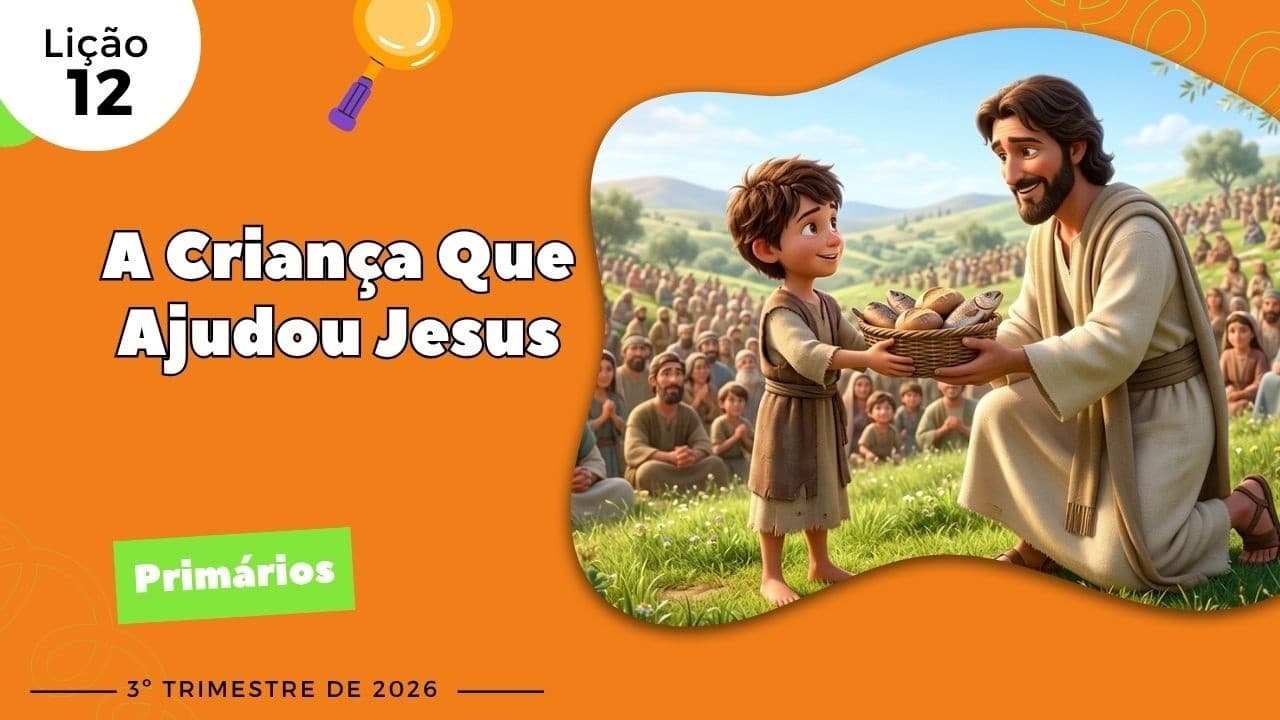
Near the Sea of Galilee, a huge crowd followed Jesus up a mountainside. When evening came, everyone was hungry and there was nowhere to buy food — the disciples' math simply did not add up. That was when Andrew found a boy in the crowd with five barley loaves and two small fish. He could have kept his lunch just for himself, but he placed everything into Jesus' hands. Jesus gave thanks to the Father, distributed the food, and everyone ate until they were full: there were even twelve baskets left over. The boy gave the little he had; the miracle belonged to Jesus — the very One who would later say that He is the bread of life.
Imagine a green hill near the Sea of Galilee, late in the afternoon. Sitting on the grass is a huge crowd: five thousand men, plus the women and children who were with them. People as far as the eye could see.
Everyone had spent the day there, listening to Jesus and watching Him heal the sick. But the sun was going down — and everyone was hungry. And there was no bakery, no market, and no one to bring food to that place.
In the middle of all those people, there was a boy. He was not rich, he was not famous, and the Bible does not even tell us his name. He had only one thing: a very simple lunch, five loaves of bread and two small fish.
Today's story is in John 6. And it asks a question that is for you too: when what you have seems small — do you hand it over or keep it to yourself?
I — The math that did not add up
Jesus was the first to notice how hungry those people were:
"When Jesus looked up and saw a large crowd coming toward Him, He said to Philip, “Where can we buy bread for these people to eat?”" (John 6:5)
Notice that Jesus asked Philip. But the Bible right away explains why: "But He was asking this to test him, for He knew what He was about to do." (John 6:6) In other words, Jesus already had the plan ready in His mind. He had no doubt at all. He wanted to see what Philip would answer.
And Philip did what many people do when the problem is big: he picked up a pencil and started doing the math.
"Philip answered, “Two hundred denarii would not buy enough bread for each of them to have a small piece.”" (John 6:7)
Putting his answer into plain words: "Lord, there is no way. Even if we had a lot of money, it still would not be enough for each person to eat even a tiny piece."
Philip was not lying. His math was completely right. Except he had forgotten to put one thing into the equation: Jesus.
🏛 Fun fact — how much two hundred denarii was. Back then, one denarius (a silver coin) was a man's pay for a whole day of work. So two hundred denarii was more than six months of work! It really was a lot of money — and even so, it would not be enough. The problem was truly huge.
II — The simplest lunchbox in the world
While Philip was doing the math, another disciple was looking at the people. And he found someone.
"One of His disciples, Andrew, Simon Peter’s brother, said to Him, “Here is a boy with five barley loaves and two small fish. But what difference will these make among so many?”" (John 6:8-9)
Just look at the way Andrew spoke: he found the boy, brought the boy to Jesus — and in the very same breath said, "but what good is this for so many?" Even the one who brought the little thought that the little was far too little.
And the boy? He handed it over. He could have hidden his little bag behind his back. He could have eaten it quietly in a corner, and no one would even have known. But he placed everything he had into the hands of Jesus.
🏛 Fun fact — barley bread and salted little fish. Barley was the cheapest grain of that time, the bread of poor families — hard, dark, without much flavor. And the little fish were not fresh fish on a platter: they were small, salted, dried fish, the way food was preserved in a time when there were no refrigerators. In other words, the boy did not bring the best lunch in the world. He brought the lunch he had.
❤ For the child's heart. Think about what went through that boy's mind. He saw the crowd. He heard the grown-up say, right in front of him, that what he had was good for nothing. And he handed it over anyway. Have you ever felt that what you have is too small? Your prayer is short, your handwriting is still crooked, your voice goes off-key during praise, your help at home is tiny. The boy had little too. And it was His very little that Jesus used.
III — Jesus gave thanks, and the bread never ran out
Now comes the most beautiful part.
"“Have the people sit down,” Jesus said. Now there was plenty of grass in that place, so the men sat down, about five thousand of them." (John 6:10)
First Jesus organized everyone. Then:
"Then Jesus took the loaves and the fish, gave thanks, and distributed to those who were seated as much as they wanted." (John 6:11)
Before the miracle, Jesus thanked the Father. With five little loaves in His hand and five thousand mouths in front of Him, He gave thanks. And then He kept breaking the bread and handing it out, breaking and handing it out — and the bread never ran out. Everyone ate as much as they wanted, until they were full.
When it was over, there was still one detail that shows Jesus' care:
"And when everyone was full, He said to His disciples, “Gather the pieces that are left over, so that nothing will be wasted.” So they collected them and filled twelve baskets with the pieces of the five barley loaves left over by those who had eaten." (John 6:12-13)
Count it on your fingers: it started with five loaves. It ended with twelve full baskets. There was much more left over than there was at the beginning.
And the people understood that this was not the work of mere human beings: "When the people saw the sign that Jesus had performed, they began to say, “Truly this is the Prophet who is to come into the world.”" (John 6:14)
The size of the lunch was never the problem. What changed everything was whose hands held the lunch in the end.
🏛 Fun fact — so that nothing would be wasted. Jesus had just made food appear out of nothing — and even so, He told them to gather up the little pieces from the ground. The One who can do all things is the very One who wastes nothing. If He cares for a piece of bread, imagine how much He cares for you.
Christ in the Lesson
This is where today's lesson finds its true center.
If the story stopped with the boy, it would turn into just a piece of advice: "be nice, share your things." Sharing is good, but that is not the heart of the story. Look closely: the boy handed it over; the One who multiplied it was Jesus. The boy did not perform any miracle. He simply did not keep it to himself.
And the next day, the people went looking for Jesus wanting more bread. Then He explained what that miracle really meant:
"Jesus answered, “I am the bread of life. Whoever comes to Me will never hunger, and whoever believes in Me will never thirst.”" (John 6:35)
Do you see? That bread on the hill satisfied hunger for one day. The next day, everyone was hungry again. But there is a hunger bigger than the hunger in your stomach: it is the hunger the heart has for God. And only one Person can satisfy that hunger — Jesus.
Long before, in the wilderness, God had sent manna from heaven to feed the people of Israel every day. The manna sustained the body. Jesus is the living Bread who came down from heaven to give life forever.
And look at how He did that. On the hill, He took the bread, gave thanks, and the bread was broken to feed the crowd. On the cross, it was His own body that was given up and wounded, to pay for our sin and give us eternal life. He died, rose again on the third day, and is alive. Whoever believes in Him and asks forgiveness for their sins receives that life.
In the last lesson you saw Jesus walking into the room of a little girl whom everyone had already given up on, and giving her life back. Today you see the same Jesus taking the lunch of a boy that everyone thought was not enough — and feeding a crowd with it.
He does not need your "a lot." He wants your "little" handed over from the heart.
Practical Application
- Hand it over instead of keeping it. The boy could have hidden his little bag and no one would have known. When you realize you can help with what you have — your pencil, your spot in line, your time, your help — hand it over. Do not stand there calculating whether it will make a difference; that part is up to Jesus.
- Do not wait until you grow up. No one needs to wait to get big to serve God. You can pray, sing in praise, invite a friend to Sunday School (EBD), help the teacher put away the supplies, take care of your younger sibling. It is a privilege to serve God, and there is no minimum age.
- Offer what you already know how to do. Drawing, writing neatly, singing, organizing, listening carefully, being kind to someone who arrived today. Put that into Jesus' hands — He knows what to do with what seems small.
- Give thanks beforehand. Jesus gave thanks before the miracle happened, with five little loaves in His hand. Thank God for your food, your home, and your family even on the days when it seems like little.
- Do not waste. Jesus told them to gather up the leftovers so that nothing would be wasted (John 6:12). Do not throw food away, take care of your school supplies, put your toys away. Whoever is grateful takes care of what they have received.
- If someone hurts you or scares you, tell a trusted adult. If a person does, says, or asks for something that hurts you, scares you, or has to be kept a secret, you do not have to handle it alone. Tell your dad, your mom, your teacher, or your pastor right away. The adult handles it; the child speaks up.
Closing Prayer
Dear God, thank You for the Lord Jesus, who is the Bread of life and satisfies the hunger of our hearts. Thank You for the boy who did not keep his lunch for himself. Forgive us when we think our little is good for nothing and so we hand over nothing at all. Take our hands, our voice, our time, and the little bit we have, Lord, and use it all for Your glory. And may every child in this class know Jesus as their Savior. In Jesus' name, amen.
Soli Deo Gloria — Scripture governs; everything else, on its knees.
Frequently asked questions about this lesson
What is the main point of Primary Lesson 12?+
That the little placed in Jesus' hands becomes something great — because He is the One who performs the miracle, not the size of the offering. The boy gave five loaves and two small fish, and Jesus fed an entire crowd and still filled twelve baskets with what was left over (John 6:13).
What was the name of the boy with the loaves and fish?+
The Bible does not say. We do not know his name, what family he was from, or where he lived. The Bible only mentions that there was a boy there who had five barley loaves and two small fish (John 6:9). For God to use someone, that person does not need to be famous.
How did five small loaves feed so many people?+
Nobody can explain how it happened — the Bible does not say. What it does tell us is who did it: Jesus took the loaves, thanked God, and kept distributing them, and the food never ran out (John 6:11). That is called a miracle: something only God can do. Jesus is the Son of God, and for Him there is no math that does not add up.
Did the boy go without eating?+
No. He gave his lunch and then ate along with everyone else — the Bible says that everyone ate as much as they wanted and were satisfied (John 6:11, 12). Whoever places what they have in Jesus' hands is never left out of what Jesus does.
If I give something of mine, will God give me back double?+
It does not work like that. God is not a machine for trades, and we do not give in order to get more back. The boy did not hand over his lunch to get rich; he gave it because Jesus needed it right then. We give because we love Jesus — and He, who already gave His own life for us, takes care of us in His own way and in His own time.
Why was there so much food left over if everyone had already eaten?+
So that no one would have any doubt that it was God's doing. And notice Jesus' care: He told them to gather up the leftover pieces so that nothing would be wasted (John 6:12). God never wastes anything — not a tiny piece of bread, nor the little bit that you place in His hands.
Teacher's Guide
Essence of the class
The boy handed over the little he had and Jesus performed the miracle — because what truly sustains us is not the size of the offering, but Christ, the Bread of life.
Map of the class
| Time | Stage |
|---|---|
| 0–4 min | Welcome, prayer, and the hook |
| 4–11 min | Memory in action (1 Corinthians 15:58) and the verse poster |
| 11–18 min | Point 1 — The math that did not add up |
| 18–25 min | Point 2 — The simplest lunchbox in the world |
| 25–32 min | Point 3 — Twelve baskets and the Bread of life |
| 32–37 min | Class activity: the boy's little basket |
| 37–40 min | Wrap-up + challenge of the week + prayer |
Start like this
Arrive early, set the supplies aside, and greet each child by name. Quickly revisit last Sunday's challenge: who prayed using the key they made in class? Listen to two or three stories, thank God for them, and pray with those who did not manage to do it — without scolding and without comparing those who did with those who did not.
Then pick up a cloth bag (or an empty lunchbox) and show it to the class. Ask: "How many people can you feed with a lunch that fits inside here?" Let three or four answer. Usually you will hear "one," "two," "me and my brother." Do not correct anyone.
Then say: "Today our story is about a boy who had a little bag like this, with a very simple lunch. And with that lunch more than five thousand people ate until their bellies were full. How? That is what we are going to find out."
Point 1 — The math that did not add up
- In the quarterly: Jesus going up the hill with the disciples, the crowd coming near Him, and the question He asked Philip about where to buy food for so many people (figure 12.1).
- What to teach: Jesus spent the day teaching and healing, and as evening came He saw that those people were hungry. He asked Philip where they could buy bread — but He already knew what He was going to do; He was testing the disciple. Philip answered with math: not even two hundred denarii would be enough. His math was right and yet it was incomplete, because it did not count on Jesus. Make it clear that Philip was neither bad nor foolish: he just looked at the problem and not at the Lord.
- Anchor verse: "Philip answered, “Two hundred denarii would not buy enough bread for each of them to have a small piece.”" (John 6:7)
- Key question: "If you were Philip and Jesus asked you where to buy food for that whole crowd, what would you answer?"
- Likely answers (+ going deeper): "there is no way," "there wouldn't be enough money," "I'd go to the market." Go deeper: "That is more or less what Philip said. And mind you, his math was right. Only one thing was missing from his math — who was standing right there beside him."
- If no one speaks: do the math on the board in a very visual way: draw five little loaves on one side and write 5,000 on the other. Ask: "is it enough?" The class will answer in chorus and the conversation will start on its own.
Point 2 — The simplest lunchbox in the world
- In the quarterly: the disciple Andrew telling Jesus that there was a boy there with five loaves and two small fish, and the boy handing over his food (figure 12.2).
- What to teach: in the middle of thousands of people, Andrew found a boy with five barley loaves and two small fish — and even he thought that would not be enough for anything. Explain what that lunch was: barley was the cheapest grain, the bread of a poor family, and the little fish were salted and dried because there were no refrigerators. The boy could have kept it and eaten it in secret; he handed everything over. Hold firmly to the main point: the merit does not belong to the lunch or to the boy — the boy simply did not keep it to himself.
- Anchor verse: "“Here is a boy with five barley loaves and two small fish. But what difference will these make among so many?”" (John 6:9)
- Key question: "What do you have today that seems too small to serve God?"
- Likely answers (+ going deeper): "I'm a kid," "I don't have money," "I don't know how to do anything right," "my prayer is really short." Go deeper: "Do you know the size of what the boy had? Five hard little loaves. And that was what Jesus used."
- If no one speaks: share first yourself, with something simple and true from your own life ("what I have is this right here: I know how to tell you stories"). Then ask again, looking at one child at a time, without forcing anyone to answer.
Point 3 — Twelve baskets and the Bread of life
- In the quarterly: Jesus telling the people to sit down, thanking God and sharing the loaves and the fish with everyone, and the disciples gathering up twelve baskets of what was left over (figures 12.3 and 12.4).
- What to teach: Jesus organized the crowd, took the loaves, gave thanks to the Father, and kept handing them out — and the food never ran out. Everyone ate as much as they wanted and there were still twelve baskets left over: it ended with much more than it started with. Close on Christ here, not on the moral of sharing your lunch: the next day Jesus declared that He is the bread of life. The bread on the hill satisfied hunger for one day; He satisfies the hunger of the heart forever. Connect it to the cross — on the hill the bread was broken to feed the crowd; on the cross His body was given up for us, and He rose again on the third day.
- Anchor verse: "Jesus answered, “I am the bread of life. Whoever comes to Me will never hunger, and whoever believes in Me will never thirst.”" (John 6:35)
- Key question: "It started with five loaves and ended with twelve full baskets. Who made that happen?"
- Likely answers (+ going deeper): "Jesus," "God," "the boy." Gently go deeper on the third one: "The boy handed it over. But the One who multiplied it was Jesus. He is the Son of God — that is why the math that did not add up finally added up."
- If no one speaks: read John 6:11-13 slowly and ask them to count on their fingers along with you: five loaves… twelve baskets. Then ask: "was there more or less left over than there was at the beginning?"
Class activity
- Goal: to place in the child's hands, on paper, the "little" they have — and have them leave the room having handed it over to Jesus.
- Materials: one paper or cardstock basket per child (cut out by the teacher beforehand), plus five paper loaves and two paper fish for each one, colored pencils, glue or tape. Do not ask the families for any supplies.
- Step by step: hand each child the little basket and the seven cutouts. On each little loaf and each little fish, the child writes or draws something that is already theirs and seems small: my prayer, my help at home, my colored pencil, my "good morning," my voice to sing, my hug, my time to play with someone who is alone. The teacher writes for those who cannot write on their own yet, and helps anyone who gets stuck — everyone makes their own at their own pace, and no one is left without a basket. Then all together, standing up, they hold up their baskets with both hands while you pray aloud: "Lord Jesus, this right here is little, but it is ours, and we hand it over to You." Each child takes their basket home.
- Wrap-up (back to the text): "That is just what the boy did. He did not perform any miracle — he simply did not keep it to himself. The One who multiplied it was Jesus. What is in your basket is small, just like the five loaves. And that is how Jesus likes to begin."
If they ask you this
- Question: "What was the boy's name?" Short answer: The Bible does not say. It only tells us that there was a boy there with five barley loaves and two small fish (John 6:9). For God to use someone, that person does not need to be famous.
- Question: "How were five little loaves enough for so many people?" Short answer: The Bible does not explain the "how" — it tells us who did it. Jesus gave thanks and kept handing it out, and the food never ran out. That is called a miracle: something only God can do.
- Question: "Was the boy left hungry afterward?" Short answer: No. Everyone ate until they were full, and he was right there among them. Whoever places what they have into Jesus' hands is never left out of what Jesus does.
- Question: "If I give something of mine, will God give me double back?" Short answer: It is not a trade with God. We do not hand things over in order to get more. The boy handed his lunch over because Jesus needed it right then, and we hand things over because we love Jesus — who already gave His life for us.
- Question: "I'm small; can I help in God's work?" Short answer: Yes, you can, and God loves that. There is no minimum age to serve the Lord: you can pray, sing, invite a friend, help in the classroom. It is a privilege, not an obligation.
Wrap-up + challenge of the week
- Wrap-up: "Keep today's scene in your mind: five thousand hungry people, math that did not add up, and a boy with the simplest lunch in the world. He handed over his little; Jesus performed the miracle; twelve baskets were left over. And the next day, Jesus explained the message: that He Himself is the bread of life. He filled those people's bellies for a day, but He came into the world to fill your hearts forever — and for that He went all the way to the cross and rose again. Hand your little over to Him. The rest is up to Jesus."
- Challenge: this week, choose one thing that is already yours and truly hand it over to someone — without anyone telling you to: sharing a toy of yours with your sibling or neighbor, lending your colored pencil for the whole day, giving up your spot at the front of the line, giving your time to play with someone who is alone. Just one thing, but for real. Then draw in your basket what you handed over and write the name of the person who received it. On Sunday, come back with the story.
Teacher's kit
- Before: read John 6:1-14 and 6:32-35 in full and set aside figures 12.1 to 12.4. Cut out the paper baskets, one per child, along with the five little loaves and the two small fish, and write the verse on the baskets of the children who do not write on their own yet. Prepare the poster board for the verse and choose two or three songs about serving the Lord and about the gifts He has given us.
- Bring: a Bible, the poster board and supplies for the poster (colored pencils, markers, tape, blunt-tip scissors, pictures to decorate), the baskets and cutouts already cut out, extra colored pencils, and a cloth bag or empty lunchbox for the opening hook.
- Memory in action: read 1 Corinthians 15:58 in your Bible and ask everyone to open and read it in theirs too. Explain in simple words: nothing we do for the Lord is ever thrown away. Then make the verse poster together, each child using the skill they have — one writes, another draws, another decorates, another dictates, another holds the tape. What matters is that everyone takes part and no one is left out. At the end, repeat the verse aloud two or three times and put the poster up in a visible spot.
- Activity in the quarterly: save a little time for the activity page — filling in the verse, marking (T) for true and (F) for false, and drawing the five loaves and two small fish in the basket. Go over the answers together, out loud, with the whole class participating.
- About the snack: if you serve a snack at the end of class, the class itself provides it — never ask the children to bring food from home and never suggest that they share their own snacks with one another. Not every family is able to send a snack, and no child should ever be put through that in front of the others. If there is a snack, everyone receives the same thing, from your hands, without mentioning who brought what. If it is not possible to have a snack, the class works just fine without one.
- Pray beforehand: ask God that no child leaves the room thinking they need to have a lot in order to serve the Lord — and that each one leaves knowing that Jesus is the Bread of life and that the little placed in His hands is never little.
Homework
Your mission for the week
Choose one thing that is already yours and truly hand it over to someone this week, without anyone telling you to: sharing a toy of yours with your sibling or neighbor, lending your colored pencil for the whole day, giving up your spot at the front of the line, giving your time to play with someone who is alone. Just one thing, but for real. Then draw in your basket what you handed over and write the name of the person who received it.
Why
The boy had five barley loaves and two small fish (John 6:9) — almost nothing next to five thousand hungry people. He could have kept it, but he placed it into Jesus' hands. He did not perform any miracle: he simply did not keep it to himself. The One who multiplied it was Jesus. It is not a trade with God, and we do not hand things over to get more: we hand them over because Jesus has already given everything for us.
How to know you did it
Look at your basket: is there a drawing and a name written on it? If you can tell what you handed over and to whom, you did it.
On Sunday, come back with the story
Bring your basket and tell what happened: what you handed over, to whom, and how the person reacted. Next week's class starts with those who did it. Do not be left out.