Golden Text
“For God has not given us a spirit of fear, but of power, love, and self-control.” (2 Timothy 1:7, BSB) · Read in the Bible
Seven strong brothers walked past the prophet, and God did not choose any of them. The chosen one was the youngest in the house, who was far away in the field, tending his father's sheep.
Imagine a field in the late afternoon. A boy sitting on a rock, covered in dust, counting his father's sheep one by one to see if any are missing. No one is watching. No one is clapping. And that is right where God is looking.
Today's story is in 1 Samuel 16. On that day, seven strong and handsome young men walked in front of a prophet — and God did not choose any of them. The chosen one was far away, doing the job nobody wanted. Just as in the lesson about the girl who saved a warrior, God keeps noticing those whom the world forgets.
I — A prophet with a jar of oil
Israel had a king named Saul. He started out well, but he kept disobeying God, again and again, until the Lord said He would choose someone else to reign over His people.
Then God called the prophet Samuel and commanded: "Now the LORD said to Samuel, “How long are you going to mourn for Saul, since I have rejected him as king over Israel? Fill your horn with oil and go. I am sending you to Jesse of Bethlehem, for I have selected from his sons a king for Myself.”" (1 Samuel 16:1).
Samuel was worried. If King Saul found out about that trip, he could get very angry with him. But Samuel trusted God and went anyway — and look how interesting this is: Samuel's courage also began with simple obedience. He did what God commanded, the way God commanded, and God took care of the rest.
🏛 Fun fact — what "to anoint" meant. To anoint was to pour olive oil (a fragrant oil made from olives) on someone's head, in front of everyone. It was a way of saying in public: "this person has been set apart by God for a task." Kings, priests, and prophets were anointed this way. And the word Christ means precisely "the Anointed One."
II — "The LORD looks at the heart"
Samuel arrived in Bethlehem, at the house of Jesse, and Jesse began presenting his sons, one by one.
The oldest came: tall, strong, looking like a king. Samuel looked and thought right away: "I found him!" But God said something we need to keep for our whole lives: "But the LORD said to Samuel, “Do not consider his appearance or height, for I have rejected him; the LORD does not see as man does. For man sees the outward appearance, but the LORD sees the heart.”" (1 Samuel 16:7).
The second passed by. It was not him. The third, the fourth, the fifth... Seven sons passed in front of the prophet, and the answer was always the same: "Thus Jesse made seven of his sons pass before Samuel, but Samuel told him, “The LORD has not chosen any of these.”" (1 Samuel 16:10).
Samuel then asked if those were all of them. And the father answered: "And Samuel asked him, “Are these all the sons you have?” “There is still the youngest,” Jesse replied, “but he is tending the sheep.” “Send for him,” Samuel replied. “For we will not sit down to eat until he arrives.”" (1 Samuel 16:11). That is to say: there is one more, the youngest — but he is out there in the field, tending the flock. They had not even called the boy.
Samuel did not sit down or eat until he arrived. And the boy came running from the field, looking like he had no idea what was going on. His name was David. The Bible says that he was ruddy, with beautiful eyes and a handsome appearance — but that was not why God chose him. God said to Samuel: "So Jesse sent for his youngest son and brought him in. He was ruddy, with beautiful eyes and a handsome appearance. And the LORD said, “Rise and anoint him, for he is the one.”" (1 Samuel 16:12).
"So Samuel took the horn of oil and anointed him in the presence of his brothers, and the Spirit of the LORD rushed upon David from that day forward. Then Samuel set out and went to Ramah." (1 Samuel 16:13).
The last in line became God's chosen one — right in front of his seven older brothers.
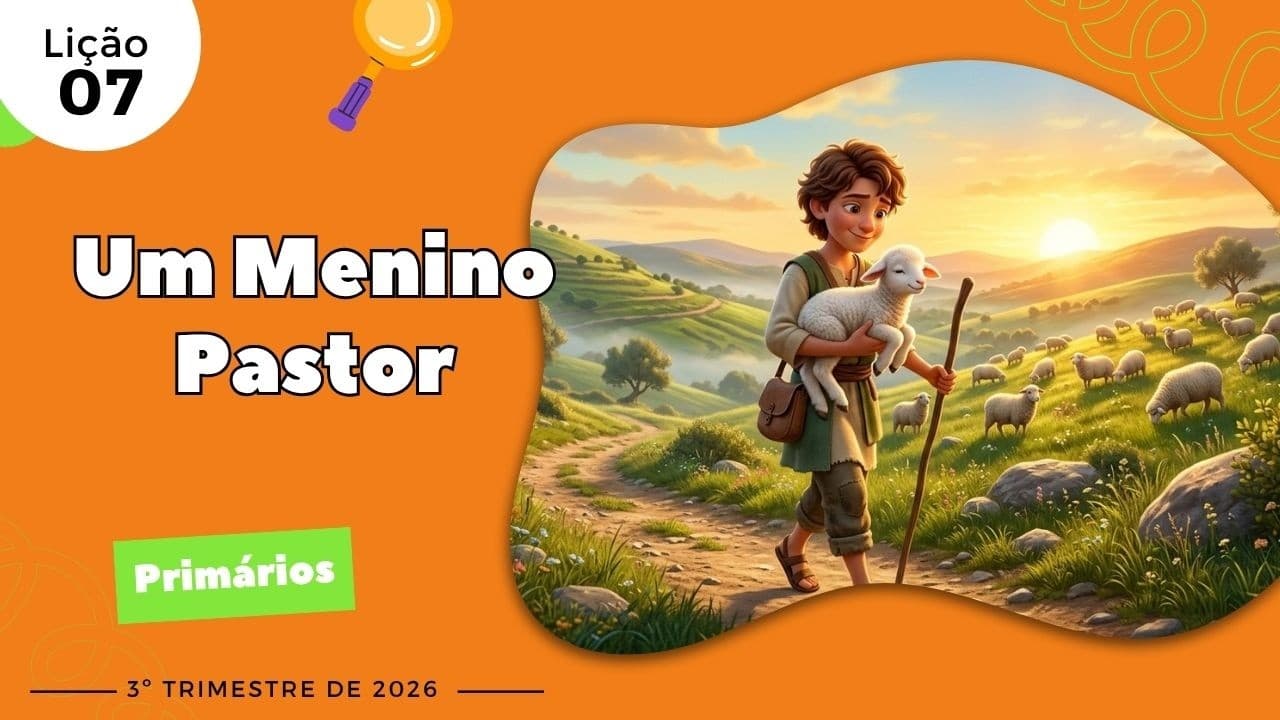
🏛 Fun fact — what it was like to care for sheep. It was neither a glamorous nor an admired job. The shepherd slept in the field, looked for green grass and calm water for the flock, and used a staff, a long rod with a curved end, to pull a sheep out of a hole and bring it back to the path. It was the job that was usually left to the youngest son in the house.
III — What David had learned in the field
After that day, David did not go around shouting, "I'm going to be king!" He went back to the sheep. He kept doing the same everyday task well.
And meanwhile, in the palace, King Saul was doing very badly: the Spirit of the Lord had departed from him and an evil spirit was tormenting him (1 Samuel 16:14). The servants had an idea: to look for someone who played an instrument well, because music calmed the king.
That was when one of the young men in the palace spoke of a boy over in Bethlehem, a son of Jesse — who knew how to play, was brave and strong, a man of war, wise in speech, and of good appearance (1 Samuel 16:18) — and, best of all, the Lord was with him.
Notice: no one said, "he is the tallest" or "he is the richest." They spoke of what he did well and of the fact that God was with him. And where did David learn all of that? In the field, alone, where no one was watching. He played the harp while the sheep rested. He cared for the flock with affection. And when a lion and a bear came to attack his father's sheep, God helped him rescue them (1 Samuel 17:34-36). Every ordinary day in the pasture was training that David did not even know he was doing.
So David went to the palace. "And whenever the spirit from God came upon Saul, David would pick up his harp and play. Then Saul would find relief and feel better, and the spirit of distress would depart from him." (1 Samuel 16:23). It was not magic in the harp: it was God. The shepherd boy had the Spirit of the Lord, and that gave him courage to walk right into the king's palace.
The king liked him so much that he asked him to stay close by. God was preparing that boy, little by little, for a task he could not even imagine yet.
🏛 Fun fact — David's harp. The harp in the Bible was not that huge orchestra harp. It was a small wooden stringed instrument that you could hold in your lap and carry slung over your shoulder. You could play it sitting on a rock in the middle of the pasture — and that was how David learned. Many of the psalms we read today were written by him.
Christ in the Lesson
David cared for his father's sheep. They were neither clever nor grateful sheep: they were real sheep, which get lost, fall into holes, and do not know how to come back on their own. And he risked himself for them.
Many years later, a boy from David's family was born in the very same town of Bethlehem. That is Jesus. And He said of Himself: "I am the good shepherd. The good shepherd lays down His life for the sheep." (John 10:11).
David cared for a flock of sheep. Jesus gave His life for His flock — which is us. We also get lost, we also lose our way, we also cannot come back on our own. And the Good Shepherd went out to look for us. It was David himself who wrote, when he was grown up, the best-known sentence in the world about this: "The LORD is my shepherd; I shall not want." (Psalm 23:1).
Practical Application
- Take good care of what is already in your hands. David was not waiting around for an important task: he was doing the small task well. Your "little sheep" might be your homework, your younger sibling, your bedroom, your pet, or the pen you borrowed.
- God sees what no one else sees. There is no point in being good only when Mom is watching. The Lord looks at the heart — and He looks with affection, to help us become better on the inside.
- A child's courage is child-sized. You do not need to face a lion, a bear, or any bully. Your courage is doing what is right even when others do not, being kind to someone who is alone, and — when something is serious or scary — telling a trusted adult right away: Dad, Mom, your teacher, your pastor. Speaking up is already being brave. The adult handles it; you tell them.
❤ For the child's heart. Has it ever happened that everyone else was called and you were not? That you were the last in line, the smallest, the forgotten one? David was forgotten too — by his own father, on that day. But God did not forget him for even a second. And He does not forget you.
Closing Prayer
Dear God, thank You because You do not look at the outside, but at the heart, and because none of us is too small for You to see. Teach every child here to take good care of the small things and to have the courage that comes from You. And thank You for Jesus, the Good Shepherd, who gave His life for His sheep. In Jesus' name, amen.
Soli Deo Gloria — Scripture governs; everything else, on its knees.
Frequently asked questions about this lesson
What is the central point of Primary Lesson 7?+
That God blesses careful and courageous people to fulfill His purposes. He did not choose David for his height or his strength: He chose him because He looked at the heart of that boy who took good care of his father's sheep (1 Samuel 16:7).
Who was David in the Bible, explained for children?+
The youngest son of Jesse, from Bethlehem. He had seven older brothers and tended his father's sheep in the field. God sent the prophet Samuel to anoint him, and one day he would be king of Israel — but at that moment he was just a shepherd boy.
What does it mean to anoint with oil, to explain to children?+
It meant pouring olive oil on someone's head, in front of everyone, to say: this person has been set apart by God for a task. Samuel did this with David, and from that day on the Spirit of the Lord came powerfully upon him (1 Samuel 16:13).
How does the story of the shepherd boy point to Jesus?+
David cared for his father's sheep and risked himself for them. Jesus is the true Good Shepherd: "I am the good shepherd. The good shepherd lays down His life for the sheep." (John 10:11). David cared for a flock; Jesus gave His life for His own.
Teacher's Guide
Essence of the class
God blesses careful and courageous people to fulfill His purposes — He did not choose David for his height or his strength, but because He looked at the heart of a boy who took good care of what was small.
Map of the class
| Time | Stage |
|---|---|
| 0–5 min | Welcome + the hook |
| 5–10 min | Memory in action (2 Timothy 1:7) with the cube |
| 10–17 min | Point 1 — A prophet with a jar of oil |
| 17–24 min | Point 2 — God looks at the heart |
| 24–31 min | Point 3 — The shepherd boy in the palace + Christ in the Lesson |
| 31–37 min | Class activity: the Good Shepherd's little sheep |
| 37–40 min | Wrap-up + challenge + prayer |
Start like this
Ask: "Who here is the youngest at home? And who has ever waited to be called and was called last?" Let three or four children share — you will usually hear "my brother goes first," "they always pick me last," "nobody calls me." Hold on to those answers and say: "Today's story is about the youngest son in a house full of brothers. He was so far away, caring for the sheep, that they didn't even remember to call him. And he was the very one God chose."
Point 1 — A prophet with a jar of oil
- In the quarterly: the rejection of Saul's reign and God's command for Samuel to go to Bethlehem, to Jesse's house (figure 7.1).
- What to teach: Saul disobeyed God and lost the kingdom. Samuel was afraid of the king's reaction, but he obeyed and went. Courage begins with simple obedience, the size of what God commanded.
- Anchor verse (BSB): "Now the LORD said to Samuel, “How long are you going to mourn for Saul, since I have rejected him as king over Israel? Fill your horn with oil and go. I am sending you to Jesse of Bethlehem, for I have selected from his sons a king for Myself.”" (1 Samuel 16:1).
- Key question: "Samuel was afraid. What did he do with that fear?"
- Likely answers (+ going deeper): "he went anyway," "he trusted God," "he obeyed." Go deeper: "Feeling afraid is not a sin. Being brave is obeying God even with butterflies in your stomach."
- If no one speaks: tell them first about a time when you obeyed God even though you were afraid — and it worked out.
Point 2 — God looks at the heart
- In the quarterly: Jesse's seven sons presented to Samuel, God's warning about appearance, and the youngest son who was in the field with the sheep (figures 7.2 and 7.3).
- What to teach: Samuel was impressed by the oldest, tall and strong. God said no seven times in a row. The chosen one was the smallest in the house, who had not even been invited to the feast. God looks on the inside.
- Anchor verse (BSB): "But the LORD said to Samuel, “Do not consider his appearance or height, for I have rejected him; the LORD does not see as man does. For man sees the outward appearance, but the LORD sees the heart.”" (1 Samuel 16:7).
- Key question: "If you were going to choose a king, how would you choose? And how did God choose?"
- Likely answers (+ going deeper): "the strongest," "the tallest," "the most handsome." Go deeper: "That was得的 exactly what Samuel thought. But God looked at something no one can see from the outside."
- If no one speaks: act out the scene — ask the class to "choose" the king between two drawings (a big warrior and a simple boy), and then tell them what God said. No one needs to stand up or be compared to anyone else.
Point 3 — The shepherd boy in the palace
- In the quarterly: what they told King Saul about David — a good musician, brave, a good soldier, well-spoken, and God is with him — and the harp that brought relief (figure 7.4).
- What to teach: David learned in the field, where no one was watching: he played the harp, cared for the flock, and God rescued him from the lion and the bear. It was not the harp that healed Saul: it was God. Close by connecting to Christ, the Good Shepherd.
- Anchor verse (BSB): "And whenever the spirit from God came upon Saul, David would pick up his harp and play. Then Saul would find relief and feel better, and the spirit of distress would depart from him." (1 Samuel 16:23).
- Key question: "Where did David learn to be careful and brave?"
- Likely answers (+ going deeper): "in the field," "with the sheep," "with God." Go deeper: "Every ordinary day, doing a small thing well, was training. God was preparing him without anyone seeing."
- If no one speaks: ask it another way: "Who plays an instrument well on the very first day? Then how did David get so good?"
Class activity
- Goal: to keep in their memory, with their hands, that David cared for the sheep — and that Jesus is the Good Shepherd who cares for us.
- Materials: one empty toilet paper roll per child, cotton balls, white glue, two popsicle sticks cut in half (the four little legs), white cardstock for the little face and to cover the other end of the roll, markers, colored pencils, and blunt-tip scissors.
- Step by step: each child spreads glue on the roll and glues on the cotton until the sheep is fluffy; glues the cardstock circle onto one of the ends; draws the little face on the cardstock, cuts it out, and glues it on the front; finally, glues the four little legs underneath. While they work, talk about how David cared for his father's flock. Everyone makes their own, at their own pace — no one competes and no one is left out. Write underneath the roll, for those who already know how to write: The Lord is my shepherd.
- Wrap-up (back to the text): "David cared for these little sheep with great affection, and God noticed. When you take yours home, remember: you are a little sheep too — and your Shepherd is Jesus, who gave His life for you."
If they ask you this
- Question: "So God doesn't like strong and good-looking people?" Short answer: Yes, He does — He is the One who made each of us. It is just that He does not choose by appearance: He looks at the heart, which is the part no one else sees.
- Question: "Was David's harp magic?" Short answer: No. It was God who was with David. The Bible does not talk about magic: it talks about the Spirit of the Lord, who came powerfully upon him from the day Samuel anointed him.
- Question: "Do I need to face a lion to be brave?" Short answer: Not at all. David was caring for his father's sheep when that happened, and it was God who rescued him. Your courage is doing what is right, being kind to someone who is alone, and calling a trusted adult when something is serious or scary.
Wrap-up + challenge of the week
- Wrap-up: "God blesses careful and courageous people to fulfill His purposes. While no one was watching, God was looking at the heart of a boy who took good care of the sheep. And the greatest Shepherd of all is Jesus, who gave His life for His sheep — for you."
- Challenge: this week, sit down with someone in your family — Dad, Mom, a grandparent, an older sibling — open the Bible together to 1 Samuel 16, and read it. Then tell the story of the shepherd boy in your own words. Write on your little sheep the name of the person who listened, and bring it on Sunday. On Sunday, come back with the story.
Teacher's kit
- Before: read all of 1 Samuel 16 and set aside figures 7.1 to 7.4. Put together the memory cube (a box with a different way to recite on each side: singing, jumping, whispering, with eyes closed) and prepare the verse poster. Note: the Golden Text is in 2 Timothy 1:7 — check it before writing the poster.
- Bring: a Bible, the verse poster, the cube, and the little sheep craft materials already sorted out for each child.
- Pray beforehand: ask God that no child leaves the room thinking they are too small to be seen by Him.
Homework
Your mission for the week
Sit down with someone in your family — Dad, Mom, Grandpa, Grandma, or an older sibling — and open the Bible together to 1 Samuel 16. Read the story and then tell it yourself, in your own words: who the shepherd boy was and why God chose him. Write on the little sheep you made in class the name of the person who listened.
Why
David cared for his father's sheep where no one could see, and God was looking at his heart: "But the LORD said to Samuel, “Do not consider his appearance or height, for I have rejected him; the LORD does not see as man does. For man sees the outward appearance, but the LORD sees the heart.”" (1 Samuel 16:7). Whoever knows this story has something good to tell — and telling is a way of keeping it in your heart.
How to know you did it
There is a name written on your little sheep: the name of the person who sat down with you, opened the Bible, and listened to the whole story. If the name is there, you did it.
On Sunday, come back with the story
Bring your little sheep and tell the class who listened to you — and which part that person liked best.