Golden Text
“Therefore if anyone is in Christ, he is a new creation. The old has passed away. Behold, the new has come!” (2 Corinthians 5:17, BSB) · Read in the Bible
The fourth mark of a healthy church is true conversion — and it is the mark on which all the others depend. This lesson explains what the Bible calls conversion: repentance and faith, two sides of the same coin; the grace that comes before and enables, yet which man can refuse; and the new birth, a work that only God performs. Then it comes down to the ground: the fruits of Ephesians 4, self-examination done before God and in private, and the distinction that saves many people from despair — the criterion is the direction of life, not instant perfection.
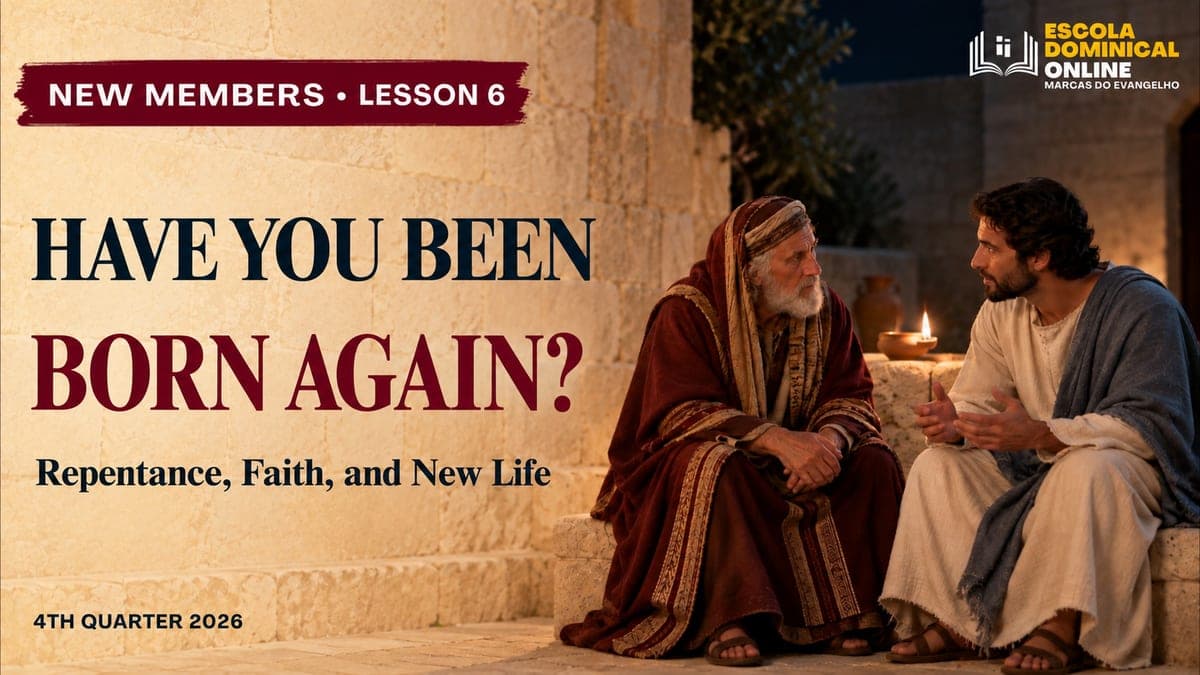
Lesson 6 • True Conversion: Repentance, Faith, and New Birth — New Members (discipleship class).
The fourth mark of a healthy church, and the most decisive of all: true conversion. What happens when someone truly converts, what conversion is not, and how to examine yourself without falling into despair or flippancy.
Marcas do Evangelho (church in Cariacica, Brazil) • New Members Class • 3rd Quarter of 2026.
✶ Golden Text — 2 Corinthians 5:17
"Therefore if anyone is in Christ, he is a new creation. The old has passed away. Behold, the new has come!" (2 Corinthians 5:17)
- Study texts — Mark 1:15 · John 3:1-8 · Titus 3:4-6 · Ephesians 2:1-10 · 2 Corinthians 7:10 · Acts 26:20 · Ephesians 4:17-32
- Scripture Reading in Class — John 3:1-8 and Ephesians 4:22-32
- Bible version — Scripture quotations in this translation follow the Berean Standard Bible (BSB), checked word for word. Greek transliterations follow the standard academic convention.
The mark on which the others depend
Beloved new member, open with me once again the first line of our Church Covenant. Before any commitment, before any signature, the Covenant begins like this:
"Having, as we believe, been brought by divine grace to repentance and faith in the Lord Jesus Christ so as to surrender our lives wholly to Him, and having been baptized upon our profession of faith, in the name of the Father, and of the Son, and of the Holy Spirit, we do now, unanimously, as one body in Christ Jesus, solemnly and joyfully enter into a covenant of commitment with one another in the presence of God."
— Preamble to the Church Covenant of ADME
Notice what the first weighty words of the entire document are: repentance and faith. Before baptism, before membership, before everything that comes after. The Covenant does not begin by asking you to behave. It begins by presupposing that something happened to you.
And it is that something that we are going to deal with today.
We are studying the marks of a healthy church, a biblical church. The fourth mark is true conversion. And if there is one mark on which the existence of all the others depends, it is this one.
Think calmly. A church where people have not truly been converted keeps doing everything: it keeps holding worship services, keeps singing, keeps baptizing, keeps serving the Lord's Supper, keeps receiving members. Except that each of these things loses its core. The pulpit becomes a stage. Baptism becomes a ceremonial bath. The Lord's Supper becomes a symbolic snack. The worship service becomes a spectacle. Everything keeps happening, and nothing is what it should be anymore.
Nothing in this house makes sense without genuine conversion. Rich preaching, deep hymns, fellowship, discipleship, baptism, the Lord's Supper, membership — all of this is a blessing for the converted, and none of it saves someone who has not been converted.
✶ The sentence that sustains the entire lesson
Without genuine conversion there is no church. There is only a religious association of unregenerate people.
And here I need to be honest with you about what we are reaping in Brazil. There is a lot of preaching out there that has reduced conversion to a quick manifestation, an adherence, a social bond, a pleasant study group — without the person ever having experienced the miracle of the new birth. Evangelizing is not getting people to raise their hand. It is making disciples.
In this class you will understand what biblical conversion is, what it demands, who begins the work, what God does, and what falls to you. And at the end I will hand you an examination — an examination to be taken before God, in private, and not to be used as a measuring stick over anyone else's life.
Part I — What conversion is
1) A definition to carry with you
Let us set down a definition and then unpack each piece of it.
✶ Conversion
It is the human response, conscious and voluntary, enabled by the grace of the Holy Spirit, by which a person turns to God in repentance and faith.
Three things in this sentence deserve attention right away.
"Response." Conversion is a response, not an initiative. No one wakes up one day and decides, on their own and out of nowhere, to seek God. God speaks first; we respond.
"Conscious and voluntary." No one is converted in their sleep, nor dragged against their will. You know what you are doing and you want to do it.
"Enabled by grace." You would not even have the strength to respond if God did not give you that strength beforehand. We will return to this in Part II, because it is the heart of the matter.
2) Two sides of the same coin
Conversion involves two movements, and they are inseparable. The first sermon of the Lord Jesus already brings both, side by side:
"“The time is fulfilled,” He said, “and the kingdom of God is near. Repent and believe in the gospel!”" (Mark 1:15)
Repent and believe. Notice that these are not two stages separated by an interval — as if someone might believe today and repent later on, whenever convenient. They are two sides of the same coin.
Whoever truly believes, repents. Whoever truly repents, believes.
Think of it this way: repentance is turning your back on sin; faith is turning your face toward Christ. Now, those two movements are the same movement. No one turns their face toward one side without turning their back on the other. There is no such thing as halfway turning around.
Therefore, one without the other is not conversion. Faith without repentance is intellectual assent — the person agrees with the doctrine and does not change their life. Repentance without faith is remorse — the person suffers over what they did and does not run to Christ. Isolated from each other, the two produce emotion, religiosity, a cultural bond with the church. Neither of the two, on its own, produces biblical conversion.
3) Repentance is much more than remorse
Here is the most common misunderstanding in the lesson, and it costs dearly.
Many people hear "repentance" and think of feeling bad. Crying. Having a heavy conscience. That impoverishes the word to almost nothing — because it is perfectly possible to cry today and sin tomorrow. To cry at the altar and sin in the parking lot.
⚓ In the original — the word the Bible chose
μετάνοια (metánoia) — the noun the New Testament uses for repentance. It is formed from μετά (metá), "beyond, change," and νοῦς (noûs), "mind, understanding." The corresponding verb is μετανοέω (metanoéō).
Literally: a change of mind that goes beyond what the person was. It is not a passing feeling; it is a reorientation of the understanding, the affections, and the will. It is turning away from oneself and turning toward God.
Keep the difference: remorse is feeling the weight of what you did. Metánoia is changing direction because of who God is.
We are about to unpack the three movements of repentance carefully in Part III. For now, just hold on to this: repentance that does not change the direction of your life is not yet biblical repentance. It is a feeling.
4) Saving faith has three dimensions
On the other side of the coin is faith. And here too there is a common impoverishment: reducing faith to "believing that Jesus existed."
Saving faith has at least three dimensions, and they are inseparable.
| Dimension | What it is | What is missing when it is lacking |
|---|---|---|
| Knowledge | Knowing the content of the Gospel: who Christ is, what He did, and why. | How can anyone believe in the One of whom they have not heard? (Romans 10:14). Without a minimum of biblical content, all that remains is religious sentimentalism. |
| Assent | Recognizing that this is true — and that it is true concerning you. | The person knows the doctrine and treats it as third-party information. The devil also knows the facts. |
| Trust | Surrendering one's life to the lordship of Christ, staking everything on Him. | The person agrees with everything and rests in nothing. Faith becomes an opinion. |
The third is the one that decides. Saving faith is not thinking that a Jew named Jesus existed. It is surrendering your whole life to Him — the present, the future, and eternity.
"that if you confess with your mouth, “Jesus is Lord,” and believe in your heart that God raised Him from the dead, you will be saved." (Romans 10:9)
And when that surrender is real, it does not stay in a corner of your life. It begins to reprogram everything — your home, your work, your money, your mouth, your schedule. Christian faith is not a department of your life. It is the axis of it.
✶ Christ cannot be received as Savior without being received as Lord.
Whoever wants His help without His authority is not believing — they are negotiating.
Part II — Who begins, who responds, who works
Now the underlying question: if conversion is a human response, where does the strength to respond come from?
5) Fallen man does not rise on his own
Scripture is hard and clear about our starting point. Speaking of us before Christ, Paul says:
"And you were dead in your trespasses and sins," (Ephesians 2:1)
Dead. Not sick, not delayed, not disoriented. Dead. And a dead man does not cooperate with his own rescue — a dead man does nothing.
Therefore, the initiative of salvation belongs entirely to God. There is no room here for human merit, not one little step that we climbed on our own:
"For it is by grace you have been saved through faith, and this not from yourselves; it is the gift of God," (Ephesians 2:8)
6) The grace that comes before — and that can be refused
Then, if we are dead, how does anyone respond?
By prevenient grace. The name sounds intimidating, but the idea is simple: it is the grace that comes before. It is the action of the Holy Spirit upon a human being before conversion — the grace that illuminates the conscience, convicts of sin, righteousness, and judgment, and enables the will wounded by the fall to say yes or no to the divine call.
Have you ever felt, someday, a discomfort with your own life that did not come from outside? A strange desire to please God, without quite knowing why? A sharp awareness that something in you was wrong? That was not you. That was Him knocking.
"For it is God who works in you to will and to act on behalf of His good purpose." (Philippians 2:13)
God works the willing — He produces in you even the desire to will. But pay attention to this sentence, because it is the axis of everything we believe in this house: grace does not eliminate your responsibility; it enables it.
We are not robots dragged into the Kingdom. We are sinners graciously enabled to believe. And that grace can be refused:
"Behold, I stand at the door and knock. If anyone hears My voice and opens the door, I will come in and dine with him, and he with Me." (Revelation 3:20)
Look at the division of labor in that verse, and never forget it again. He knocks — the initiative is His, decisive, first. Someone opens — the responsibility is ours, real, free. He does not break the door down. And that is why no one can say, "God did not want to save me": He knocked, and He is knocking still.
7) The new birth
Let us turn now to what happens when the door is opened. Here is the most shocking truth the Lord Jesus ever spoke to a religious man.
Nicodemus was a teacher of the law, a member of the council, a respected man. He came to Christ by night, probably with compliments prepared. And he heard this:
"Jesus replied, “Truly, truly, I tell you, no one can see the kingdom of God unless he is born again.”" (John 3:3)
Notice what was not said. It was not "unless one improves." It was not "unless one tries harder." It was not "unless one becomes more religious." It was: unless one is born again. In other words: the human problem is not a lack of improvement. It is a lack of life.
⚓ In the original — born again, born from above
ἄνωθεν (ánōthen) — the adverb in John 3:3. It carries two ideas at the same time: "again" and "from above." Nicodemus understood the first and therefore asked whether a man could enter his mother's womb a second time. The Lord was also speaking of the second: a birth whose origin is heaven.
παλιγγενεσία (palingenesía) — "regeneration," the word in Titus 3:5. It is formed from πάλιν (pálin), "again," and γένεσις (génesis), "birth, origin." It is your re-origin: the point at which your story begins anew.
And the Lord explains how this happens: no one can enter the kingdom of God without being born of water and the Spirit (John 3:5). Water and Spirit, here, walk together as the image of a single work: purification and new life, wrought by God.
Paul says the same thing in other words, and this is the verse for you to mark in your Bible today:
"He saved us, not by the righteous deeds we had done, but according to His mercy, through the washing of new birth and renewal by the Holy Spirit." (Titus 3:5)
Not by works of righteousness that we had done. None. Not even the good ones.
So hold on to the four characteristics of the new birth, because they tear down four very common imitations:
| The new birth is... | And therefore it is not... |
|---|---|
| The exclusive work of God | Not your achievement, nor the result of religious effort |
| A miracle — spiritual resurrection | Not moral reform, nor "becoming a better person" |
| Secret and supernatural | Not the intense emotion you felt in a worship service |
| Instantaneous | Not a slow process of human self-improvement |
Be careful with this distinction, new member, because many people trade one thing for the other their whole life long: moral reform is the old man in new clothes. New birth is a new man. The first you can achieve with discipline. The second only God does.
And because only God does it, it does not always come accompanied by a spectacle:
"The wind blows where it wishes. You hear its sound, but you do not know where it comes from or where it is going. So it is with everyone born of the Spirit." (John 3:8)
You do not see the wind. You see what it moves.
8) The order of things
It is worth arranging all of this in a sequence, because confusion here produces a great deal of doctrinal error.
| Order | Who acts | What happens |
|---|---|---|
| 1st | God | Prevenient grace comes beforehand, illuminates, convicts, and enables the will |
| 2nd | You | The free and conscious response: repentance and faith |
| 3rd | God | Regeneration — the new birth, the exclusive work of the Spirit |
Observe that grace is first and grace is last. In the middle, and only in the middle, is your response — and it is real, it is yours, and you are accountable for it.
✶ Grace enables. The sinner responds. God regenerates.
Part III — The three movements of repentance
Let us return to repentance, because that is where most people deceive themselves.
When John the Baptist saw the Pharisees and Sadducees approaching the Jordan, he did not welcome them. He called them a brood of vipers (Matthew 3:7) and demanded:
"Produce fruit, then, in keeping with repentance." (Matthew 3:8)
Fruit. That is to say: something that shows. Biblical repentance reaches the whole person — what they understand, what they feel, and what they decide.
9) The understanding: seeing sin as God sees it
The first movement happens in the mind, through the illumination of the Spirit. You stop seeing your sin as a mistake, a flaw, a slip, the result of what others did to you — and you begin to see it as it is: rebellion against a holy God.
David had sinned against many people. Against a woman, against a faithful soldier, against his own army, against the entire nation. And yet he wrote:
"Against You, You only, have I sinned and done what is evil in Your sight, so that You may be proved right when You speak and blameless when You judge." (Psalm 51:4)
It is not that other people were not hurt — they were, and gravely so. It is that the central weight of all sin is always against God. As long as your sin is, in your mind, merely a problem with people or with yourself, repentance has not yet reached where it needs to reach.
10) The affections: two very different sorrows
The second movement happens in the heart. And here the Bible makes a distinction worth its weight in gold:
"Godly sorrow brings repentance that leads to salvation without regret, but worldly sorrow brings death." (2 Corinthians 7:10)
Two sorrows. One leads to life; the other kills. And they look alike on the outside — both weep.
| Worldly sorrow | Godly sorrow | |
|---|---|---|
| Why it hurts | Because of getting caught, because of the consequences, because of fear of punishment | Because of having offended the Father, dishonored the Lord, grieved the Spirit |
| Looks at | Oneself and the loss suffered | God and His holiness |
| Ends in | Despair or hardening | Repentance, forgiveness, and life |
Judas felt the first and ended in despair. Peter felt the second, wept bitterly, and was restored. Both betrayed the Lord in the same week. What separated them was not the size of the sin; it was the kind of sorrow.
Ask yourself, then, honestly: when you are saddened by your sin, are you sad because you were found out, or because you offended God?
11) The will: forsaking, confessing, making restitution
The third movement happens in the will, and it is the decisive test. Genuine repentance produces a change of life. Not perfectly — but decisively.
Paul summed up what he preached his whole life in a single sentence, before a king:
"First to those in Damascus and Jerusalem, then to everyone in the region of Judea, and then to the Gentiles, I declared that they should repent and turn to God, performing deeds worthy of their repentance." (Acts 26:20)
There are three verbs in sequence: to repent (the inward sorrow), to turn to God (the turning around, the change of direction), and to do works worthy of repentance (the visible fruit). None of them is optional, and none of them comes alone.
And there is a fourth step, which almost no one wants: restitution. Whoever is reconciled with God seeks, as far as possible, to be reconciled with those they have wronged. That is what happened in the house of Zacchaeus on the day he was converted:
"But Zacchaeus stood up and said to the Lord, “Look, Lord, half of my possessions I give to the poor, and if I have cheated anyone, I will repay it fourfold.”" (Luke 19:8)
No one ordered him to. No one demanded it. It was repentance reaching his wallet.
✶ The promise on the other end
"He who conceals his sins will not prosper, but whoever confesses and renounces them will find mercy." (Proverbs 28:13)
Notice the two verbs: confesses and forsakes. Confessing without forsaking is mere talk. Forsaking without confessing is willpower. Both together are repentance — and the promise is mercy.
12) Five questions of repentance
Put it all together and you have five questions. They are not for anyone to answer out loud. They are for you to take to God, alone.
- Do I see my sin as rebellion against God — and not merely as a human flaw?
- Do I feel deep sorrow for having offended God — and not merely fear of the consequences?
- Am I willing to forsake and confess this sin, whatever the cost?
- Do I seek to repair the harm I have caused to other people, as far as possible?
- Does my life produce visible fruit of change?
Where these five are present, there is repentance. Where none of them is present, for now there is only religiosity — and the good news is that religiosity has a cure, and the cure begins today.
Part IV — The fruits: the before and after of Ephesians 4
Paul devotes an entire passage to describing, item by item, the before and after of the new birth. It is the most concrete portrait the Bible gives us of the fruits of conversion.
13) Changing clothes
The central image is that of taking off filthy clothes and putting on others.
"to put off your former way of life, your old self, which is being corrupted by its deceitful desires; to be renewed in the spirit of your minds; and to put on the new self, created to be like God in true righteousness and holiness." (Ephesians 4:22-24)
There are three movements:
- Putting off the old man — taking off the dirty clothes: the old habits, desires, patterns, and also the circles that lead back to sin.
- Being renewed in the mind — letting the Scriptures reconfigure your way of thinking. And here is a good thermometer: do you seek the Word out of duty or out of hunger?
- Putting on the new man — imitating Christ, walking by the Spirit, letting His character show in yours.
14) The visible marks
And then Paul comes down to the ground, to everyday life, to the place where real people live.
| Mark | The text | What changes in practice |
|---|---|---|
| Speaking the truth | "Therefore each of you must put off falsehood and speak truthfully to his neighbor, for we are all members of one another." (Ephesians 4:25) | Lies of convenience and hypocrisy come to an end. You keep your promises, confess when you are wrong, and are honest in your dealings and contracts. |
| Mastering anger | "“Be angry, yet do not sin.” Do not let the sun set upon your anger, and do not give the devil a foothold." (Ephesians 4:26-27) | Anger in itself is not sin. Sin is hosting it: brooding, feeding bitterness, living in vengeance and slander. |
| Working honestly | "He who has been stealing must steal no longer, but must work, doing good with his own hands, that he may have something to share with the one in need." (Ephesians 4:28) | It is not enough to stop taking what belongs to others. One works to provide for the household and to have something to share. |
| Building up with the mouth | "Let no unwholesome talk come out of your mouths, but only what is helpful for building up the one in need and bringing grace to those who listen." (Ephesians 4:29) | Language changes: foul language, gossip, slander, and destructive sarcasm fall away. The mouth becomes an instrument of grace. |
| Putting away bitterness | "Get rid of all bitterness, rage and anger, outcry and slander, along with every form of malice." (Ephesians 4:31) | Whoever loves God is approachable, teachable, respectful. Wherever the person arrives, they do not need to stir up trouble. |
| Forgiving | "Be kind and tenderhearted to one another, forgiving each other just as in Christ God forgave you." (Ephesians 4:32) | The decisive mark. We forgive much because we have been forgiven much. |
Read the middle column slowly and notice one thing: none of these marks is religious. None speaks of worship services, spiritual gifts, or ministry. All of them speak of the mouth, money, work, anger, and forgiveness — that is to say, of Monday.
That is because conversion is not proved on Sunday. It is proved in traffic, in the kitchen, in the family group chat, and when it is time to settle the bill.
15) Direction, not perfection
Now I need to hold both ends of this truth with you, because whoever lets go of either one errs badly — and in both directions there are people suffering.
The first end. You cannot call a life converted when it has not changed in anything. There are people who get baptized, attend, get excited, get involved — and remain the exact same person they always were: the same marriage, the same character, the same habitual sins, the same indifference toward God. We call this nominalism, and it is not harmless: it is a person being reassured along a road that leads nowhere.
The second end, and listen carefully. No true believer is perfect, and all of us will fight against sin until the end. If the criterion were never sinning again, this class would be empty and I would not be in it.
✶ The distinction that decides everything
The difference is not in perfection. It is in direction.
The converted person fights against sin, sometimes falls, yet gets up, repents, and presses on. Whoever has not been converted settles in, rationalizes, justifies — and never produces that godly sorrow that leads to repentance.
So the right question is never, "Have I already arrived?" No one has arrived. The question is: where is my life pointing?
If you are fighting a sin and losing some battles, you are alive, and the way forward is to keep fighting — and, almost always, to stop fighting in secret and ask for help. If you have made peace with your sin, found a comfortable explanation for it, and no longer feel anything, now is the time to stop everything and go to the feet of Christ.
"Therefore, since we are surrounded by such a great cloud of witnesses, let us throw off every encumbrance and the sin that so easily entangles, and let us run with endurance the race set out for us." (Hebrews 12:1)
Notice that the text calls the Christian life a race — a course, a distance run, something one runs with endurance. No one runs an entire race without stumbling. But everyone who is running is going somewhere.
Part V — The examination before God
16) How to take this examination — and how not to
I am going to hand you an examination now. But first, three rules for using it, and they are no minor detail.
First: this examination is yours and it is before God. It is done in private, on your knees, with the Bible open. No one in this class needs to answer anything out loud, and no one here is going to ask their neighbor how they did. If at any point this examination turns into conversation about other people's lives, it has ceased to be what it is.
Second: it is not a measuring stick to gauge anyone else's salvation. You do not have access to the heart of your brother, your spouse, your child, or that member you think is lukewarm. God does. Use this on yourself.
Third: it is not for passing hasty judgment on yourself. If the answers leave you in doubt — and they will leave many sincere people in doubt — the next step is not to conclude anything on your own, crying in bed in the middle of the night. It is to seek out a pastor or a mature brother or sister in this house and talk. This examination was made to lead you to someone, not to leave you alone with a verdict.
With those three caveats in place, look at these five areas:
- Trust. Was there a moment when I recognized my sin as rebellion, repented, and trusted in Christ as Lord and Savior? Today, does my hope rest in what He has done — or in what I have been doing?
- Inward transformation. Is there in me a sign that I am a new creation, or only a few behavioral improvements that I manage on my own?
- Habits and desires. Have my words, attitudes, habits, and desires been moving toward Christ? Which way has the arrow been pointing over the last few years?
- The Word, prayer, and fellowship. Do I hunger for Scripture, or do I grow tired of it? Do I take delight in praying, or do I only pray in a pinch? Do I rejoice in being with the people of God, or do I attend out of obligation?
- Forgiveness. Have I been forgiving those who offend me, as God forgave me?
And now the caution that closes the section: these five areas describe the direction of a life, not the performance of a bad week. If you answered poorly on three of them today, that is not a sentence. It is an invitation — and there are people in this house ready to sit down with you.
17) Three places where you may be today
As you answered, it is quite possible that you recognized yourself in one of these three places. None of them is a label, and none of them is permanent.
Perhaps you have never truly been converted. It may be that you have been in church for years, baptized, raised your hand at some point — and, looking at your marriage, your work, and your relationships in the light of the Word, you realize there has never been real repentance or surrender to the lordship of Christ. If that is your case, listen well: this is not a shame, it is mercy. God is showing you now, while there is time. You can be converted today — recognize your sin, surrender your life to Christ, and be saved. Do not wait to feel worthy; no one ever became worthy.
Perhaps you were converted and later drifted away. There was a genuine conversion in the past, but habitual sin came, coldness came, and today you are far off. The word for you is this:
"Therefore, keep in mind how far you have fallen. Repent and perform the deeds you did at first. But if you do not repent, I will come to you and remove your lampstand from its place." (Revelation 2:5)
You do not need a reconversion. You need deep repentance and restoration. Confess, return to the means of grace, seek the help of mature brothers and sisters. Christ has not given up on you — and He does not accept half-measures either.
Perhaps you are walking with Christ. You have been born again, you hunger for the Word, take delight in prayer, have sincere fellowship, and the fruits are growing despite the struggle. Then press on: go deeper, sanctify yourself, serve, evangelize, teach the newer ones. And do one thing more — look around in this class and help someone who is in the other two places.
18) How we care for this in this house
You have already understood why this is the fourth mark. Now see what it produces in practice, here.
- Clear and solemn biblical appeals, never manipulative. We preach by the authority of the Word, not by manufactured emotional appeal. We do not use music to extract tears, we do not apply psychological pressure, and we do not offer what the Gospel does not promise. A decision wrenched out under pressure is not conversion.
- The cost of discipleship is explained before the decision. Christ never hid the price He Himself would pay; why would we do otherwise? Whoever decides to follow Him must count the cost — and it will be necessary to give up a great deal.
- Every new convert is discipled. Conversion without discipleship is a garden no one waters.
- There is a new converts course before baptism — it is this very class. And we baptize out of doctrinal conviction, never out of emotional immersion.
- Membership is integrated with care, with those who demonstrate fruit worthy of repentance. This is neither elitism nor exclusion; it is faithfulness to the New Testament pattern. As the Covenant says, partial or conditional membership is not biblical membership.
And the goal of all this: we want transformed lives, not numbers for a report. We have no interest in a full sanctuary or a baptism of crowds. If we baptize a single brother who has been born again, that baptism is extraordinary.
Christ in the Lesson
✝ Conversion is not your masterpiece. It is His.
Read this entire lesson again and notice who the subject of the most important sentences is.
The One who knocks at the door is He. The One who illuminates the conscience is the Spirit. The One who works in us both to will and to do is God. The One who regenerates is God. The One who saved us not by works of righteousness that we had done, but according to His mercy, is God (Titus 3:5). Exactly one verb was left for you: to open the door. And even the strength to open it was given by Him.
That is why biblical conversion does not produce proud people. No one is converted and goes around thinking they had merit — because they had none. All the merit lies on a cross outside Jerusalem, where the Son of God died in the place of sinners, and in an empty tomb that proved the payment was accepted.
And notice what that does to your fear. If your salvation depended on your performance, every bad week would be a threat of losing everything. But your trust is not in your performance; it is in His. You fight against sin because you are a child, not in order to become a child.
Nicodemus was a teacher of the law. Saul was a zealous Pharisee. Lydia sold purple cloth. The Philippian jailer was an official of a Roman prison. Each conversion was unique in its circumstance, and all were identical in their nature: the Spirit enabling, the sinner responding in repentance and faith, the Father regenerating, the Son being glorified.
That is what the Golden Text announces about you: if anyone is in Christ, he is a new creation; the old things have passed away, and all things have become new (2 Corinthians 5:17). Not "is becoming new." Is. The rest of life is your old garment being taken off, piece by piece, by the One who has already given you the new one.
Three questions to take from this class
- Where does my trust rest today — in what Christ did on the cross, or in what I have managed to do since I entered this church?
- Where is my life pointing? Not "have I already arrived," but: over the last few years, has the arrow been pointing toward Christ or away from Him?
- Is there a sin today with which I have already made peace — one that I explain, justify, and do not intend to give up?
Final word
Beloved new member, I did not write this lesson to leave you insecure. I wrote it to make you secure in the right way.
There are two ways to leave a class like this, and both are bad. The first is flippancy: "Everything is fine with me, I have already been baptized, this is for other people." The second is despair: "Then I was never converted, nothing is any use, I am no good." The first sleeps without waking; the second weeps without getting up.
The way of the Bible is neither of the two. It is this: look honestly, acknowledge what needs to be acknowledged, and run to Christ — today, just as you are.
Because the same grace that knocked at your door on the first day keeps knocking. It does not knock just once and walk away offended. It has been patient with you for longer than you imagine.
And if, this week, as you take your examination before God, you discover that you are carrying something you already know needs to be forsaken — do not negotiate with it for another year. Forsake it.
✶ What is covered up never prospers. What is confessed and forsaken obtains mercy.
You will not do this alone. This house exists for this very purpose: a community of people who have been born again, walking together, lifting one another up, until the day we see the One who loved us first.
This is the mark of our church. And, far more than that, it is the mark of Christ upon His bride.
Closing Prayer
Lord our God, we thank You because salvation begins in You. Before any one of us sought You, You were already at the door, knocking. Before we were willing, You worked in us the willing. Nothing that we have came from us; everything came from Your mercy.
Father, if there is anyone in this class who has attended for years, was baptized, raised their hand — and has never been born again, have mercy today. May that person not leave here comforted by mistake, nor crushed by shame, but surrendered to Your Son. Convert them truly, Lord, while there is time and while You are still knocking.
Holy Spirit, to whom this work belongs, do what only You can do: generate life where there is death. Do not let us be content with moral reform, with the old man in new clothes, with Sunday emotion that evaporates on Tuesday. We want resurrection.
And look, Lord, upon those here who are fighting and losing some battles, afraid that this means they were never Yours. Teach us that the difference lies not in perfection, but in direction — and sustain each one who is still standing and fighting, even when tired. Give courage to those who need to stop fighting in secret and ask for help.
Strengthen this week the hand of each one who is going to drop something. You know what is written on that folded paper, and You know how much it costs. Give a day, a time, and steadfastness. And keep us from judging one another on the inside, because You alone search the heart, and it is ours to search our own.
May this house be, until the day Christ returns, a community of people who have truly been born again. In Christ. Amen.
"Scripture governs; everything else, on its knees."
Frequently asked questions about this lesson
How do I know if I am truly converted?+
First, understand that this question, asked with sincere fear, is already a good sign. Someone who has never cared about their own state before God does not lose sleep over it. That said, the Bible does not tell you to look for the memory of a day, an hour, or an emotion. It tells you to look at two things. The first is where your trust is placed today: are you resting in what Christ did on the cross, or in what you have managed to do? "For it is by grace you have been saved through faith, and this not from yourselves; it is the gift of God," (Ephesians 2:8). The second is the direction of your life: where is it pointing? Do not ask "Have I already arrived?", because no one has arrived. Ask "Am I heading there?". A truly converted person also falls — but he gets up, repents, and presses on; he does not make peace with his own sin. And if, after looking honestly, you still have no answer, do not keep carrying this alone or pass a hasty sentence on yourself. Seek out a pastor or a mature brother in this house and talk. This kind of doubt is almost never resolved inside our own head; it is resolved by talking with someone who will open the Bible with you.
I was converted, but I keep falling into the same sin. Does that mean I have not been born again?+
Not necessarily — and it is very important that you hear this clearly, because this doubt has already plunged sincere believers into despair. No converted person is perfect, and all of us fight against sin until the end. Scripture is direct: "If we say we have no sin, we deceive ourselves, and the truth is not in us." (1 John 1:8). The difference between the converted and the unconverted does not lie in the absence of falling; it lies in what happens after the fall. The converted person falls and grieves over it, confesses, gets up, and keeps walking. The unconverted heart settles in, finds excuses, justifies itself, and goes on at peace with what God condemns. So ask the right question: are you fighting this sin, or have you already signed a coexistence agreement with it? If you are fighting, even losing at times, you are alive — and the remedy is to keep going: "If we confess our sins, He is faithful and just to forgive us our sins and to cleanse us from all unrighteousness." (1 John 1:9). One more thing: a sin that always repeats itself in the same place usually needs help, and not just willpower. Do not fight in secret. Seek the leadership of this house. Hidden shame is the best ally of repeated sin.
I did not cry, I did not tremble, I did not have any dramatic experience. Does my conversion count?+
Yes, it does. Emotion is not the criterion, and how good it is that it isn't — if it were, salvation would be easier for those who cry easily, and that is nowhere in the Bible. What saves is the work of Christ, received by a faith that repents and trusts. Scripture itself shows conversions of completely different temperatures. A teacher of the law came to Jesus at night with questions. A seller of purple cloth had her heart opened by the Lord while listening to preaching by a riverside. A jailer fell trembling in the middle of the night. A Pharisee was knocked to the ground on a road. Every conversion is unique in its circumstance; all are the same in nature: the Spirit enables, the sinner responds in repentance and faith, God regenerates. So do not keep searching your memory for a moving scene. Ask what matters: did I recognize my sin as rebellion against God? Did I surrender my life to Christ as Lord, and not just as a helper in trouble? Has my life changed direction? Many people who cried a lot one night remained the exact same person. And many people who did not shed a tear were never the same again.
I raised my hand in a worship service and was baptized. Isn't that enough?+
Raising your hand is not wrong, and baptism is an ordinance of the Lord that we take very seriously in this house. But neither one is conversion — both are responses that only mean something if there is conversion underneath them. You can raise your hand out of the emotion of the moment, pressure from the environment, fear, or a sincere desire to please the person who invited you. And you can go down into the waters without having been born again: whoever enters the water without faith comes up wet and nothing more. The Lord Jesus did not tell Nicodemus "whoever does not raise their hand," nor "whoever is not baptized"; He said that no one can see the kingdom of God without being born again (John 3:3). So the question is not what you did in that worship service. It is what happened to you. Was there repentance — did you come to see your sin the way God sees it? Was there faith — did you surrender your life to the lordship of Christ? Is there fruit — has your life changed direction? If the answer is no, that is no reason for shame or hiding. It is the best reason in the world to be truly converted today and start right.
If salvation is by grace alone, why does the church require a change of life?+
Because the two things do not compete with each other. Salvation is by grace, through faith, and does not come from works, so that no one may boast (Ephesians 2:9). No one in this house believes that you buy heaven with good behavior. Yet the very next verse, which is almost never read alongside it, tells us what we were saved for: "For we are God’s workmanship, created in Christ Jesus to do good works, which God prepared in advance as our way of life." (Ephesians 2:10). Works are not the root of salvation; they are its fruit. A tree does not become an apple tree because it produced apples — it produces apples because it is an apple tree. And that is precisely why the total absence of fruit is a serious matter: not because fruit saves, but because a tree that never bears anything makes us ask whether it is alive. What the church cannot do is the opposite: preach a grace that costs nothing, demands no repentance, asks for no submission to Christ as Lord, and walks with no one afterward. That is not generosity. It is abandoning a person halfway down the road and calling it love.
Do I need to ask forgiveness and return what I took from people in my old life?+
As far as possible, yes — and this is part of true repentance, not an extra for the more spiritual. When Zacchaeus was converted, the first thing that came out of his mouth was not a speech: "But Zacchaeus stood up and said to the Lord, “Look, Lord, half of my possessions I give to the poor, and if I have cheated anyone, I will repay it fourfold.”" (Luke 19:8). Whoever is reconciled with God seeks, as far as it depends on him, to be reconciled with those he has wronged. Now receive three pastoral cautions along with that yes. First: "as far as possible." There are harms that cannot be undone and people who can no longer be sought out; in those cases you hand over to God what is no longer in your hands. Second: making restitution does not mean exposing yourself to danger or destroying what is healthy today. There are situations — involving the law, safety, marriage, third parties — in which the way and the timing to make things right need to be talked through beforehand with a pastor. Do not go out on your own opening doors you do not know how to close. Third: restitution does not buy forgiveness from God. Forgiveness was already bought on the cross. You make restitution because you have been forgiven, not in order to be.
Can a believer be lost after being converted?+
We believe so, and that is why this church speaks so much about persevering. The same grace that enabled you to say yes did not cancel your freedom to later say no. God does not drag anyone: "Behold, I stand at the door and knock. If anyone hears My voice and opens the door, I will come in and dine with him, and he with Me." (Revelation 3:20). He knocks — the initiative is His; someone opens — the responsibility is ours. And the same holds true for continuing to walk. That is why the Lord commands an entire church, which He Himself had saved, to remember from where it had fallen and return to its first works (Revelation 2:5). Now, understand the tone of this, because here many people hear a threat where the Bible places care. This does not mean that you lose your salvation every time you stumble and have to start over from scratch every week — that is the fear of sincere people, and it does not come from the text. It means that the Christian life is a path to be walked to the end, with the grace of God sustaining every step, and that abandoning this path by persistent decision is a possible and serious thing. Whoever is fighting is not falling away. He is fighting — which is exactly what a converted person does.
Teacher's Guide
Essence of the class
True conversion is repentance and faith — two sides of the same coin —, produced by enabling grace and crowned by the new birth that only God works; and the criterion for recognizing it is not instant perfection, it is the direction of life.
Map of the class
| Time | Stage |
|---|---|
| 0–5 min | Opening (the hook: the first line of the Covenant) |
| 5–15 min | Point 1 — Repentance and faith: two sides of the same coin |
| 15–25 min | Point 2 — Who begins: enabling grace and new birth |
| 25–34 min | Point 3 — The fruits of Ephesians 4 and the direction of life |
| 34–39 min | Class activity (the arrow) |
| 39–45 min | Wrap-up in Christ + challenge of the week + prayer |
Start like this
Arrive with the Church Covenant in hand and read aloud, slowly, only the first line of the Preamble: "Having been brought, as we believe, by divine grace to repentance and faith in the Lord Jesus Christ..."
Stop there. Close the document and ask: "Notice that our Covenant does not begin by asking anything of you. It begins by stating that something has already happened to you. What are the first two weighty words of the entire document?"
Let them answer. Someone will say "grace", someone will say "repentance", someone will say "faith". All of them are right. Write on the board, in very large letters, REPENTANCE and FAITH, and say: "Before baptism, before membership, before signing anything, the Covenant presupposes this about you. Today we are going to discover what this truly is — and how to know whether it has happened."
If the class remains silent, read the line a second time and underline the two words on the board yourself.
Point 1 — Repentance and faith: two sides of the same coin
- In the class material: the Preamble of the Church Covenant ("brought by divine grace to repentance and faith") and Mark 4, true conversion, which the class is studying in this lesson.
- What to teach: conversion is the conscious and voluntary human response, enabled by grace, by which a person turns to God in repentance and faith. The two are inseparable — Christ's first sermon already brings them together (Mark 1:15). Use the image the class takes home: repentance is turning your back on sin; faith is turning your face to Christ — and it is the same movement. Then correct the two impoverishments: repentance is not remorse (you can cry today and sin tomorrow), and faith is not thinking that Jesus existed. Present the three dimensions of faith — knowledge, assent, and trust — and say that the third is the one that decides.
- Anchor verse (BSB): "“The time is fulfilled,” He said, “and the kingdom of God is near. Repent and believe in the gospel!”" (Mark 1:15)
- Key question: "Can someone believe in Jesus and not change anything in their life? Why?"
- Likely answers (+ going deeper): "yes, there are plenty of people like that", "no, if you believe you change", "it depends on the person". Make use of the first answer, which is the most honest, and go deeper: "and that person who has changed nothing — what exactly is missing in them: repentance or faith?" Lead the class to realize that the whole pair is missing, because one without the other does not exist.
- If no one speaks: draw a coin on the board, write "REPENTANCE" on one side and "FAITH" on the other, and ask: "has anyone ever seen a one-sided coin?"
Point 2 — Who begins: enabling grace and the new birth
- In the class material: Mark 4 and the commitment of this house to make biblical and non-manipulative altar calls, explaining the cost of discipleship before calling for a decision.
- What to teach: three steps, in this order. (1) The starting point is hard: we were dead in trespasses and sins (Ephesians 2:1) — a dead person does not cooperate with their own rescue, so the initiative is entirely God's. (2) How then does anyone respond? By prevenient grace, the grace that comes before: the Spirit illuminates the conscience, convicts of sin, and enables the wounded will to say yes or no. Speak the sentence that is the axis of our doctrine: grace does not eliminate responsibility; it enables it. We are not robots dragged along — we are sinners graciously enabled to believe, and that grace can be refused (Revelation 3:20: He knocks, someone opens). (3) And what God does when the door opens is the new birth — His exclusive work, a miracle and not moral reform (John 3:3; Titus 3:5). Close with the table of the four imitations: it is not an achievement, it is not becoming a better person, it is not the emotion of a worship service, it is not slow self-improvement.
- Anchor verse (BSB): "Jesus replied, “Truly, truly, I tell you, no one can see the kingdom of God unless he is born again.”" (John 3:3)
- Key question: "What is the difference between becoming a better person and being born again?"
- Likely answers (+ going deeper): "being born again is something God does", "a better person is only on the outside", "I don't know, it seems like the same thing". The third is gold — treat it with respect, because it is what most people truly think. Go deeper: "a very disciplined man can stop drinking, lying, and fighting without God at all. Was he born again?" Let the class arrive there on its own: moral reform is the old man in new clothes.
- If no one speaks: tell the scene of Nicodemus — a religious man, respected, a teacher of the law, who went to speak with Jesus at night and heard that he needed to be born again. Ask: "if a man like that needed it, who does not need it?"
Point 3 — The fruits of Ephesians 4 and the direction of life
- In the class material: Mark 4 and the Covenant's commitment to live in faithfulness to the Scriptures in every dimension of life — in the home, at work, in social relationships, and in citizenship —, and not only in a religious context.
- What to teach: read Ephesians 4:22-32 with the class and show the image of changing clothes: putting off the old man, being renewed in the mind, putting on the new man. Then come down to the concrete list — truth, anger, honest work, a mouth that builds up, bitterness, forgiveness — and make the class notice what leaps out: none of these marks is religious. They are mouth, money, work, anger, and forgiveness. Monday, not Sunday. And then comes the most important pastoral point of the class: hold both ends. One end: you cannot call a life converted when it has not changed at all. The other end, spoken with the same force: no believer is perfect and all wrestle against sin until the end — the difference is not in perfection, it is in direction. The converted person falls, gets up, repents, and presses on; the unconverted person settles in, rationalizes, and justifies. Do not let the class end without that sentence on the board.
- Anchor verse (BSB): "First to those in Damascus and Jerusalem, then to everyone in the region of Judea, and then to the Gentiles, I declared that they should repent and turn to God, performing deeds worthy of their repentance." (Acts 26:20)
- Key question: "If no one is perfect, how do we distinguish someone who is converted from someone who just attends?"
- Likely answers (+ going deeper): "by their fruits", "by the way they treat people", "only God knows". The third deserves praise before anything else — it is right, and that is precisely why the examination is about ourselves. Go deeper: "so, regarding yourself, what is the right question: 'have I already arrived?' or 'where am I heading?'"
- If no one speaks: draw a dot and an arrow on the board, side by side. Ask: "which of the two does the Christian life look more like?" That usually makes it click for the whole room.
- Pastoral care at this point: this is the moment in the class when sincere people panic and hardened people get comfortable. Say it plainly, out loud: no one here needs to say out loud what their sin is, and this class is not for measuring anyone's salvation — not your brother's, not your spouse's, not your child's. If someone begins to confess details in front of the class, interrupt gently: "thank you for trusting us, let's talk after class" — and look for the leadership that very day.
Class activity
- Goal: to turn the examination of the lesson into something personal and private, and to prepare the challenge of the week without anyone having to expose themselves.
- Materials: a sheet of paper and a pen for each student. Board and marker.
- Step by step: draw a large horizontal arrow on the board. Say: "this arrow is your life. It does not matter what point it is at; what matters is where it points." Hand out the paper and ask each person to draw their own arrow. No one writes their name. No one shows it to anyone. No one is going to read anything out loud — say this clearly before handing out the paper, and keep your word. Then read slowly, one by one, the five questions of repentance (Part III of the study), with about fifteen seconds of silence between them. At the end, ask for only one thing: that each person write, beneath their arrow, one word — the name of something they recognize before God as a sin or as a weight that hinders the race. One word only, which only they understand. Afterwards, everyone folds the paper and puts it in their pocket. The paper goes home; it is the fuel for the task of the week.
- Wrap-up (back to the text): "Hebrews 12 calls the Christian life a race — and commands us to lay aside every weight and the sin that so closely entangles us (Hebrews 12:1). Notice that the text did not tell you to run faster. It told you to drop the weight. No one runs a whole race holding a sandbag and thinking the problem is their leg. That word folded in your pocket is your sandbag this week."
If they ask you this
Question: "How do I know if I am truly converted?" Short answer: Start by praising the question — someone who does not care about their own standing before God does not ask that question. Then point to two places, and neither of them is the memory of an old emotion: where your trust is today (in what Christ has done or in what you have been doing — Ephesians 2:8) and where your life points (direction, not perfection). And always close the same way: if the doubt continues, do not pass sentence on yourself alone — set up a conversation with a pastor or a mature brother. That kind of doubt is almost never resolved inside one's own head.
Question: "I always fall into the same sin. Have I not been born again?" Short answer: Not necessarily — and say this quickly, before anything else, because the person is afraid. "If we say we have no sin, we deceive ourselves, and the truth is not in us." (1 John 1:8) The difference is not falling; it is what happens afterwards. The converted person falls, grieves, confesses, gets up, and keeps going. The complacent heart comes up with an explanation and makes peace with sin. Return the right question: "are you fighting this sin or have you already signed a coexistence agreement with it?" And always add the practical step: a sin that repeats in the same place usually needs help, not just willpower — seek the leadership, do not fight in secret.
Question: "I didn't feel anything, I didn't cry. Does my conversion count?" Short answer: It counts, and thank goodness — if emotion were the criterion, salvation would be easier for those who cry easily, and that is not in the Bible. Show the variety of conversions in the New Testament: a teacher of the law with questions at night, a seller of purple listening to preaching by a riverside, a jailer trembling in the middle of the night, a Pharisee knocked down on a road. Different circumstances, identical nature. And redirect: "the question is not what you felt; it is whether there was repentance, surrender, and a change of direction."
Question: "Can a believer be lost?" Short answer: We believe so, and that is why we speak so much about persevering. The same grace that enabled the yes did not cancel the freedom to say no later — He knocks, we open (Revelation 3:20); and He commands an entire church to remember from where it has fallen and return to the first works (Revelation 2:5). But be very careful with your tone here, because this is where sincere people hear a threat: this does not mean losing salvation at every mistake and starting over from scratch every week. It means that the Christian life is a path to be walked to the end, sustained by grace. Someone who is fighting is not falling away — they are fighting.
Question: "Do I need to return what I took and ask forgiveness from the people of my old life?" Short answer: As far as possible, yes — that is what Zacchaeus did without anyone telling him to (Luke 19:8). But give the three cautions together: "as far as possible" (there are harms that can no longer be undone); making restitution is not exposing yourself to danger or destroying what is healthy today — in cases involving the law, safety, marriage, or third parties, the manner and timing need to be talked through beforehand with a pastor; and restitution does not buy forgiveness from God, which has already been bought on the cross.
Wrap-up + challenge of the week
- Wrap-up: "Go back to the arrow you drew. The whole lesson was for you to understand one single thing: God is not measuring the distance you have already traveled. He is looking at where you are going. And look at who did what in this lesson — He knocked at the door, He illuminated the conscience, He worked in you the willing, He regenerated. One verb was left for us: to open. Even the strength to open was given by Him. That is why no one leaves a class like this proud, and no one needs to leave in despair. Your confidence is not in your performance; it is in His. You fight against sin because you are already children, not in order to become children. Now take the paper out of your pocket — it is time to do something with that word."
- Challenge: this week, drop for good that one thing you wrote on the paper — the practice you have already recognized before God as a sin or as a weight. Not "cutting back", but dropping it: a single act, with a day and time, that puts that thing out of your reach. On Sunday, come back with the story — telling what changed, not what it was.
Teacher's kit
- Before: read the whole of Ephesians 4:17-32 aloud, in one sitting — the list only works as a block. Also read John 3:1-8, Titus 3:4-6, and 2 Corinthians 7:8-11. Then open the Church Covenant at the Preamble (the words "repentance and faith") and at the passage on living in faithfulness to the Scriptures in the home, at work, and in social relationships. Mark in your Bible: Mark 1:15 · John 3:3, 5 · Ephesians 2:1, 8 · Philippians 2:13 · Revelation 3:20 · Titus 3:5 · 2 Corinthians 7:10 · Acts 26:20 · Proverbs 28:13 · Hebrews 12:1 · Ephesians 4:22-32 · 2 Corinthians 5:17.
- Bring: a Bible, the printed Church Covenant, board and marker, and enough sheets of paper and pens for the whole class (the class activity depends on this — without paper in hand, the examination turns into conversation and someone ends up exposing themselves).
- Pray beforehand: pray for anyone in this class who has been attending for years and has never truly converted — that today may be the day, and without embarrassment. Pray for anyone who will panic in Point 3 thinking they lost their salvation because they fell this week — that the word "direction" may reach that person before fear does. Pray for anyone who has drifted away and is ashamed to return. And pray for yourself: that the class may not end in anxious self-examination, but in Christ.
Homework
Your mission for the week
Drop, this week, one thing — the one you have already recognized before God as a sin or as a weight that hinders your race. Just one, the one you wrote on your paper.
And drop it in a way that has a day and a time. It is not "I will cut back", it is not "I will try", it is not "from now on I will make an effort". It is a single, concrete act that puts that thing out of your reach: deleting the app, throwing away the object, leaving the group, blocking the contact, canceling the subscription, giving the thing to someone, ending the conversation you know should not continue. You choose what the act is. It only needs to be an act, and not an intention.
Two safeguards, so you can do this safely and without shame:
- No one needs to know what it was. You are not going to tell anyone what the thing was, not on Sunday, not ever, if you do not want to. That is between you and God.
- If what you recognized is something that already masters you — an addiction, a dependency, a bondage you have already tried to break on your own many times —, then your single act this week is a different one, and it is equally concrete: seek out a pastor or a mature brother in this house and say that you need help. That phone call is your task. No one in this house drops alone what they have never managed to drop alone.
Why
The whole class flows into this point. Biblical repentance does not stop at feeling: it reaches the will, and the will proves itself when something is actually abandoned. "He who conceals his sins will not prosper, but whoever confesses and renounces them will find mercy." (Proverbs 28:13) — notice the two verbs, confesses and forsakes, because confessing without forsaking is just talk, and forsaking without confessing is willpower. And note what the text promises on the other side: not punishment, mercy.
The race of faith works the same way: "Therefore, since we are surrounded by such a great cloud of witnesses, let us throw off every encumbrance and the sin that so easily entangles, and let us run with endurance the race set out for us." (Hebrews 12:1) The text did not tell you to run faster. It told you to drop the weight.
And if the fear of not being able to keep it up hits you: you are not dropping it in order to become a child of God. You drop it because you already are. The strength is His — "For it is God who works in you to will and to act on behalf of His good purpose." (Philippians 2:13)
How to know you did it
You know the day and the time, and the thing is no longer within your reach the way it was. If you can say "on Tuesday night I deleted it" or "on Saturday I handed it over", you did it. If the answer is "I decided in my heart that I am going to stop", not yet — the decision has been made, but the act is still waiting.
On Sunday, come back with the story
The next class begins with those who dropped it. Tell what changed in your week, not what it was — the emptiness that remained, the hour when the urge came, whom you sought out, what God did. No one here is going to ask what the thing was. Do not stay out.