Golden Text
“Unless the LORD builds the house, its builders labor in vain; unless the LORD protects the city, its watchmen stand guard in vain.” (Psalm 127:1, BSB) · Read in the Bible
Before there was a church, a school, or a government, God made a house. The family is the first institution in history and the first school of faith — and it is there, in the ordinary routine of sitting down, walking along, lying down, and getting up, that the Word is passed down from one generation to the next. This lesson shows what the church does for your home and what it cannot do in your place, and introduces the two places where you will keep learning for your whole life: Sunday School (EBD) and the midweek exposition of the Word. In the end, a very practical reason for all of this: a taught believer is a believer who is hard to deceive.
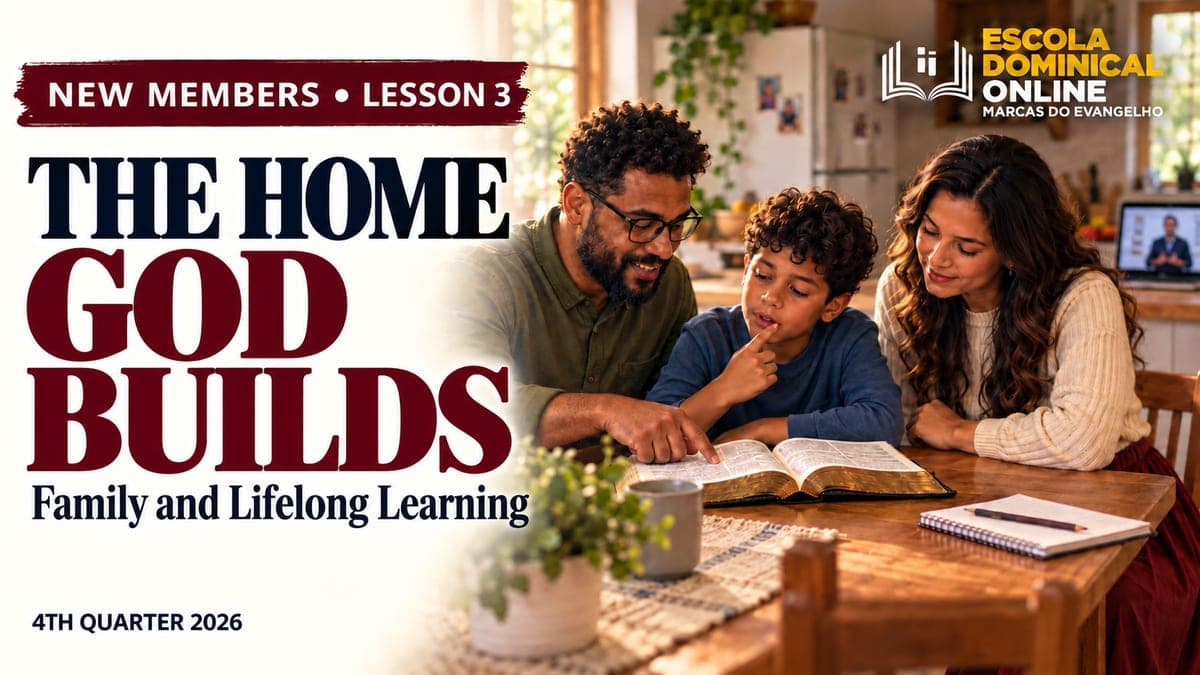
Lesson 3 • The House That God Builds: Family and Ongoing Formation — New Members (discipleship class).
What God made first — before the church, before the school, before any government — was a house. This class deals with your home and your formation: what the church does for your family, what it cannot do in your place, and where you will go on learning the Word for the rest of your life.
Marcas do Evangelho Church — Cariacica, Brazil • New Members Class • 3rd Quarter of 2026.
✶ Golden Text — Psalm 127:1
"Unless the LORD builds the house, its builders labor in vain; unless the LORD protects the city, its watchmen stand guard in vain." (Psalm 127:1)
- Study texts — Genesis 2:18-25 · Psalm 127 · Deuteronomy 6:4-9 · Ephesians 5:22-33 · Acts 20:27 · Ephesians 4:11-16
- Scripture Reading in Class — Deuteronomy 6:4-9 and Ephesians 4:11-16
- Bible version — Scripture quotations follow the Berean Standard Bible (BSB). Hebrew and Greek transliterations follow the usual academic standard.
Who taught you your first prayer?
Beloved new member, before anything else, a simple question.
Who taught you your first prayer?
For many people the answer is a grandmother. For others, a tired mother at the edge of the bed. For some, no one — and that is also an answer, and it hurts. But notice: almost no one answers "the church". The first word about God that most of us heard was not heard in a temple. It was heard inside a house, on the lips of someone who lived with us.
That is no accident. It is God's design.
When God decided to plant faith in the world, He did not begin with a religious institution. He began with a man, a woman, and a house. And to this day that is how it works: the church teaches, preaches, corrects, equips — but the one that repeats the truth a hundred times a week, at breakfast and at bedtime, is your home.
✶ The sentence that holds up the whole lesson
The family is the first school of faith. The church is the school that never closes.
In this class we are going to look at both. First at your home — what God made of it and what He expects from it. Then at the places where you will continue to be taught for as long as you have breath: Sunday School (EBD) and the midweek exposition of the Word.
And in the end you will understand why this house insists so much on teaching. It is not a taste for study. It is protection.
Part I — The house that God built
1) Before everything else
Open Genesis 2 with me. Before there was a temple, before there was a priesthood, before there was a nation, a city, or a law, God looked at the man He had made and said:
"The LORD God also said, “It is not good for the man to be alone. I will make for him a suitable helper.”" (Genesis 2:18)
Notice what happens next (Genesis 2:21-25): God does not create a crowd, does not organize a system, does not summon an assembly. He makes a house. One man, one woman, one covenant, one flesh.
The family is, therefore, the first institution in history. It is prior to the church. It is prior to the State. It is prior to any organization that human beings invented afterward. And this has a consequence that you need to take seriously: the family is not a cultural arrangement that each era adjusts as it pleases. It is an ordinance of the Creator. The Lord Jesus Himself went back to Genesis to settle a discussion about marriage in His time (Matthew 19:4-6) — in other words, when He wanted to say what marriage is, He did not quote custom, He quoted creation.
⚓ In the original — God did not manufacture a house, He built it
בָּנָה (bānāh) — "to build, to edify". This is the verb that appears in Genesis 2:22 for God's action in forming the woman, and it is the same verb used throughout the Old Testament for the building of cities, altars, and the temple itself. Many understand that the choice of the word is not casual: from the very beginning, the home is presented as a building — something raised stone upon stone, with a design, with labor, and with a builder.
בַּיִת (bayit) — "house". It is a word of broad meaning in Hebrew: it means at the same time the physical building, the family that lives in it, and the lineage that comes from it. It is the word of Psalm 127:1, which speaks of the LORD building the house. That is why the verse speaks of both things at once: the roof and the people under it.
Put the two together and you have the portrait: God builds houses. And what He builds is not just a place to live — it is a people that will cross generations.
2) Unless the Lord builds
And here enters our Golden Text, which is one of the most realistic verses in the entire Bible.
"Unless the LORD builds the house, its builders labor in vain; unless the LORD protects the city, its watchmen stand guard in vain." (Psalm 127:1)
Read slowly, because the psalm is not saying what many people think it says.
It does not say "do not work". The builders in the psalm are working, and the watchman is keeping watch. The psalm is not an invitation to spiritual laziness, as if we could fold our arms and wait for God to fix the marriage, raise the children, and pay the bills. The work remains ours.
What the psalm says is something else, and it is more serious: work without God is work in vain. You can raise the whole house — the structure, the livelihood, the children's schooling, the plan for the future — and, in the end, have erected a beautiful and empty building. Many people discover this too late: the house remained standing and the family did not.
And right after, in the same psalm, comes the sentence that repositions everything:
"Children are indeed a heritage from the LORD, and the fruit of the womb is His reward." (Psalm 127:3)
A heritage. That means: they are not your property. They are a treasure that the Lord entrusted to your hand for a time, and for which you will give an account. Whoever understands this raises a child one way; whoever does not understand it raises a child another way.
✶ Keep this in mind
When homes fall sick, the church weakens. When the church stops caring for homes, homes fall sick. The two things go together, always.
3) The Shema: faith is passed on in the routine
Now let us go to the most important text of this lesson. It is the text that Israel recited every day and that the Lord Jesus called the greatest commandment.
⚓ In the original — the word that opens everything
שְׁמַע (shemá) — "hear". It is the first word of Deuteronomy 6:4 and became the name of the entire passage. Notice that Israel's central commandment does not begin with "do" or with "feel". It begins with hear. Biblical faith enters through the ear before going out through the hands — just as Paul would say centuries later: "Consequently, faith comes by hearing, and hearing by the word of Christ." (Romans 10:17)
After commanding us to love God with all our heart, the text says where that love is passed on:
"These words I am commanding you today are to be upon your hearts. And you shall teach them diligently to your children and speak of them when you sit at home and when you walk along the road, when you lie down and when you get up." (Deuteronomy 6:6-7)
Look carefully at the order of things, because by itself it dismantles a lot of wrong ideas about Christian education.
First: these words must be on your heart (Deuteronomy 6:6). Before teaching, the parent must have them. You do not pass on what you do not have. A home where the Bible is only opened to correct the children, and never to correct the parents, is not teaching the Word — it is using the Word as a whip, and children notice this much sooner than we imagine.
Second: impressing them on your children (Deuteronomy 6:7). The verb is one of insistent repetition, of engraving by reiteration. It is not an annual lecture on Christian values. It is the same truth, spoken many times, at different moments, until it becomes part of the way that child thinks.
Third — and this is where almost everyone is surprised: sitting in your house, walking along the road, lying down, and getting up (Deuteronomy 6:7).
Notice what God lists. He does not say "at the Sunday worship service". He does not say "in the Sunday School class". He does not say "during the formal devotional time". He lists the four most ordinary times in the life of any family:
| What the text says | What that is today |
|---|---|
| Sitting in your house | The table, the couch, the kitchen, the quiet time inside the home |
| Walking along the road | The commute — the car, the bus, the walk to school or work |
| Lying down | Bedtime, the last conversation of the day |
| Getting up | The start of the day, breakfast, the morning rush |
In other words: God did not ask for one more slot on your schedule. He asked for your entire schedule. Faith is not an isolated subject studied in a separate moment — it is the subject that runs through the ordinary day.
And this is excellent news for anyone who thinks they do not have time. You do not need to manufacture a new hour. You need to bring the Word into the hours that already exist.
✶ The most common mistake of those who are starting
Many people put off the Word at home waiting for the ideal scenario: everyone gathered, no one complaining, the house in order. That scenario almost never arrives. Start small, start today, start with whoever is nearby.
4) Marriage as a portrait — and what to do when it hurts
The New Testament gives marriage a dignity that no relationship manual reaches. Paul says that marriage is a portrait:
"Husbands, love your wives, just as Christ loved the church and gave Himself up for her" (Ephesians 5:25)
Read again the measure being asked of the husband. It is not "love your wives as long as it is easy". It is loving as Christ loved the church and gave Himself up for her (Ephesians 5:25). The standard of Christian marital love is the cross — love that gives itself, that spends itself, that serves first. And the same chapter goes on to ask for mutual respect, honor, and care inside the home (Ephesians 5:22-33).
And to parents, a short and cutting word:
"Fathers, do not provoke your children to wrath; instead, bring them up in the discipline and instruction of the Lord." (Ephesians 6:4)
Both halves matter. There is the parent who brings up a child in doctrine and provokes to wrath — rigor without tenderness, truth without affection, and the child leaves home hating the parent's religion. And there is the parent who does not provoke to wrath and also does not bring up in doctrine — affection without direction, and the child leaves home with nothing in hand. The commandment asks for both things together.
Now I need to be very clear with you, and you need to hear me without half-measures, because this is the point where the church errs the most when it speaks too quickly.
Conflict and violence are not the same thing.
Conflict is arguing, accumulated hurt, days of silence, debt, jealousy, exhaustion, distance. Almost every home faces this at some point. That isatus-quo where the church wants to come close: with pastoral care, with prayer, with teaching, and with honest work from both sides. In the face of conflict, our word is: do not give up too soon and do not decide alone. Seek help while there is still something to heal. Many homes that seemed lost were restored because someone asked for help in time.
Violence is something else, completely different: physical aggression, threats, systematic humiliation, coercion, abuse of anyone at all inside the home — woman, man, child, elderly person. In the face of violence the guidance is not the same, and it is non-negotiable: protect whoever is at risk, go to the leadership of this house that very day, and go to the authorities.
No one in this house is going to tell you "endure and pray". Pray, yes, always — but praying has never replaced protecting. The same God who instituted marriage is the God who defends the oppressed, and the church that loves the family is the exact same church that does not cover up for anyone who harms it.
5) What the church does — and what it cannot do in your place
This house invests heavily in your family. There is pastoral care for couples, there are gatherings, there is training aimed at couples, men, and women, dealing with very concrete things: communication, conflict resolution, marital relationships, finances, and devotional life. If you need this, go to the leadership and ask what is available for your situation.
But now hear the part that no one can do for you.
The church can equip your home. It cannot be your home.
The church can teach your child for one hour on Sunday. It cannot teach him or her during the other one hundred and sixty-seven hours of the week. The one who is there is you.
And here is the silent trade-off that most sickens the Christian family: the parent who outsources the spiritual formation of the children. He takes the child to every event, pays for everything, misses nothing — and has never opened a Bible with that child inside the home. In the end, the child learns exactly what was truly taught: that God is a church matter, not a home matter. And when he leaves home, he will leave the matter behind along with the address.
✶ The standard
The church supports the family. The church does not replace the family. Whoever delegates entirely what God placed in his or her hand is not saving work — he or she is giving up an inheritance.
Our Church Covenant says this in a very direct way when describing the member's commitment: to live "in faithfulness to the Scriptures as the only rule of faith and practice in all dimensions of life, not only in the religious context, but in the home, at work, in social relations, and in citizenship".
In the home. It is written there, and you signed beneath it.
Part II — The school that never closes
If the first school is the home, the second is the church — and this one takes no vacation.
6) Why systematic teaching is not a luxury
The prophet Hosea recorded one of the gravest sentences in the Old Testament: the people of God are destroyed for lack of knowledge (Hosea 4:6). Not for lack of emotion. Not for lack of structure. For lack of knowledge.
And pay attention to the kind of knowledge the prophet speaks of. It is not the accumulation of information to win arguments. It is the knowledge that comes from a relationship with God and that shapes the entire life of the one who has it — knowing who God is, what He has said, and what He wants.
That is still the sickness of our time. There has never been so much preaching available and so many believers who do not know the basics. Emotion in the place of instruction. Experience in the place of doctrine. And the result shows up in the first crisis, when faith needs roots and only has leaves.
Therefore, in this house, Sunday School is not an activity for the most enthusiastic. It is the duty and privilege of every member. It is not a course that you graduate from; it is a diet that does not end.
Our Church Covenant places this among the commitments you take on when you join: to sustain and promote the spiritual health of this congregation "through regular attendance at worship services, participation in Sunday School, ministerial engagement, each one with his or her gift, and faithful financial giving". Sunday School is right there, in the middle of the commitments, and not as a side detail.
7) What Sunday School (EBD) does for you
Our Sunday School is, today, a Bible school without borders — the video lessons premiere on the channel and remain available afterward. That has brought things that the traditional classroom could not give:
- It reaches those who would never set foot in a temple. A lesson published on the internet reaches people who would never accept an invitation to church, and who end up hearing the Gospel explained calmly. Sunday School has ceased to be only discipleship and has also become a front door.
- It allows active study. In a classroom, someone who lost the thread of thought does not ask the teacher to rewind. At home you pause, open the Bible with your family, discuss the point, and only then continue. It is Deuteronomy 6:7 happening in practice — the Word entering the rhythm of your home.
- It embraces those who are usually left out. The elderly person with limited mobility, the bedridden brother or sister or the one undergoing treatment, the mother of a newborn, the person with a rigid work schedule. No one needs to go without the spiritual diet of the church.
- It builds an archive. The lessons do not die at noon on Sunday. Week after week a library of teaching is formed that serves both the longtime student and the one who arrived yesterday — and that stays documented for the next generations (2 Timothy 2:2).
- It has accountability. Here Sunday School is not watching just to watch: each student takes on a commitment to the class. This is not bureaucracy; it is the horizontal reflection of what is vertical, because each of us will give an account of himself to God (Romans 14:12).
8) The screen serves — the screen does not replace
And now the line that this lesson does not let you cross.
Digital resources serve teaching. Digital resources do not replace in-person fellowship.
This is not a footnote caveat; it is doctrine. The screen brings teaching to you, but it does not place you beside a brother or sister. Over video you do not weep with those who weep. Through an app you do not receive prayer with someone's hand upon your head. Over a livestream you are not sought out by a brother who noticed you were missing.
"Let us not neglect meeting together, as some have made a habit, but let us encourage one another, and all the more as you see the Day approaching." (Hebrews 10:25)
Notice the diagnosis built into the verse: giving up meeting together was already the habit of some in the first century (Hebrews 10:25), long before there was any screen to blame. The problem has never been technology; it is the heart that prefers distance.
And look at the portrait of the early church: "They devoted themselves to the apostles’ teaching and to the fellowship, to the breaking of bread and to prayer." (Acts 2:42) Four things together, and none of them alone makes the church. Doctrine without fellowship turns into cold study. Fellowship without doctrine turns into a club. The screen delivers the first with excellence; the second depends on your feet.
✶ To take with you
Use the screen to learn more. Use your feet to belong.
9) Wednesday: when the Word sets the subject
Besides Sunday School, this house has a second training environment in the middle of the week: the service for the exposition of the Word. And it is worth your understanding what "expository" means, because it is not a pretty adjective — it is a method with consequences.
"For I did not shrink back from declaring to you the whole will of God." (Acts 20:27)
⚓ In the original — what "counsel" is this?
βουλή (boulḗ) — "counsel, purpose, deliberate plan". It is not counsel in the sense of a friendly suggestion. It is God's intentional plan, decided by Him. To proclaim the whole counsel of God (Acts 20:27) is, therefore, to expose the entire plan of redemption — without convenient selection, without omitting what is uncomfortable, without choosing only the parts that please the listener.
In topical preaching, the preacher chooses the subject and then looks for verses to support it. In the expository preaching of a book, the text chooses the subject. The pastor enters the book, walks verse by verse, chapter by chapter, and preaches whatever comes ahead.
This changes five things at once:
| What changes | Why |
|---|---|
| Authority returns to its place | The pulpit ceases to be a space for the opinions of the preacher and becomes the loudspeaker of the text |
| The diet becomes balanced | Every preacher has his favorite topics; a series forces him to pass through doctrine, ethics, promise, warning, grace, and judgment |
| Hard texts are not skipped | Whoever preaches the whole book has no way to sweep what is uncomfortable under the rug |
| The church learns to read | Week after week, the listener learns context, sequence, and the thread of redemption — and begins to read the Bible better alone, at home |
| The congregation is protected | Whoever knows the whole line of a book is not deceived by an isolated verse |
That fourth item is the most underestimated of all. When the pastor preaches expositorily, he is not merely delivering content — he is teaching his church how to handle the Bible. And that is what makes you go back home and manage to read with your family what previously seemed confusing. Wednesday feeds Sunday, and both feed your home.
Already in Nehemiah 8 we find the portrait of what a good exposition is: they read from the book, gave the meaning, and helped the people understand what was being read (Nehemiah 8:8). Read, explain, apply. That is it, and that is all.
10) Why teaching protects you
We have reached the most practical point of the entire lesson. Why so much effort in teaching?
Because a taught believer is a believer who is hard to deceive.
"Then we will no longer be infants, tossed about by the waves and carried around by every wind of teaching and by the clever cunning of men in their deceitful scheming." (Ephesians 4:14)
Notice the image Paul chooses: a small child in a boat without a rudder, tossed from side to side by whatever wind blows. It is the exact portrait of the believer without teaching. Today he hears a video and changes his conviction. Tomorrow he hears another and changes again. Every new wind carries him to one side.
And look at where the solution comes from, in the context itself: God gave teaching gifts to the church precisely so that the people may grow up and stop being tossed back and forth (Ephesians 4:11-13). Teaching is not an ornament of the Christian life. It is the rudder.
There is an old saying among those who study the Bible: a text out of context is a pretext for heresy. Almost every distortion circulating out there is born from a verse ripped from its place. The promise made to a king, in a specific situation, becomes a guarantee of getting rich. The order given to a prophet becomes a method for anyone. The warning addressed to a church in crisis becomes a generic threat.
Whoever has followed the whole book spots the fraud right away. Whoever only knows loose verses swallows it.
✶ Three questions that disarm almost every deception
- Is this verse being read within the text, or was it ripped out of it?
- Does this teaching lead to Christ — or does it lead to me, to my success, to my achievement?
- Did I take this doubt to someone more mature, or am I deciding alone?
And that is why Peter wrote that we must always be prepared to give an answer, with gentleness and respect, to everyone who asks us for the reason for the hope that we have (1 Peter 3:15). Notice that the requirement belongs to every Christian, not to specialists. You do not need to become a scholar; you need to know why you believe what you believe — and for anyone who wants to go deeper, this house also offers a theology course, in levels, to go deeper in an organized way.
11) The only prerequisite
After all this, the commitment the church asks of you is surprisingly simple. It is not a diploma. It is not years as a believer. It is not ease with reading.
It is a teachable heart.
Come to the worship services with your Bible open and a notebook in hand. Watch and rewatch what you did not understand. Ask the teacher about what remained confusing — the question you are embarrassed to ask is the same one half the class is holding back. Take notes. Come back. Read again.
"Be doers of the word, and not hearers only. Otherwise, you are deceiving yourselves." (James 1:22)
Because the goal was never to accumulate classes. The goal is for the word of Christ to dwell in you richly in all wisdom (Colossians 3:16) — for the Word to come live in you, and from there come live in your home.
Christ in the Lesson
✝ The Master who taught while walking along the road
Come back with me to Deuteronomy 6:7, to the place where faith was meant to be passed on: sitting at home, walking along the road, lying down, and getting up.
Now go to Resurrection Sunday. Two disciples leave Jerusalem devastated, heading home, and a stranger joins them on the road. And what does the risen Christ do in the first recorded appearance of that day? He does not open the heavens. He does not perform a spectacular sign. He teaches the Scriptures while walking along the road — beginning with Moses and all the Prophets, explaining what was written about Himself in all the Scriptures (Luke 24:27).
The first biblical exposition of the Christian era was preached to two listeners, on foot, on a dirt road. Exactly the setting that Deuteronomy 6 describes.
And they themselves told the result:
"They asked each other, “Were not our hearts burning within us as He spoke with us on the road and opened the Scriptures to us?”" (Luke 24:32)
Keep this in mind, new member. Christian teaching is not a technique that the church developed. It is the Lord's own method. He explained, opened the text, showed the thread that runs through all of Scripture — and the thread was Himself.
That is why, when you sit down with your family and open the Bible, you are not merely fulfilling a commandment from Deuteronomy. You are doing, inside your home, what Christ did on that road.
And that is also why the house the psalm promises is not the one you raise up by yourself: unless the LORD builds the house, its builders labor in vain (Psalm 127:1). The Builder has a name: He is the One of whom it is written that He is faithful as a Son over God's house — and we are that house (Hebrews 3:6).
He builds houses. And yours is included in the count.
Three questions to take with you from this class
- Inside my home, which of the four moments of Deuteronomy 6:7 could already have the Bible in it — the table, the commute, bedtime, or the start of the day — and simply does not have it yet?
- Am I outsourcing to the church the spiritual formation of those who live with me? What the church does for them in one hour on Sunday, am I doing in the other hours of the week?
- Does my faith today have a rudder or is it being tossed back and forth? When I hear a new teaching, do I check it in context and ask someone — or do I accept it because it sounded nice?
Final word
Beloved new member, I want you to leave this class with two settled convictions.
The first is about your home. It is not a detail of your Christian life; it is the first place where your faith is lived and tested. No one is going to do there what God placed in your hand. If the Word does not enter your kitchen, your living room, and your commute, it will go on being a Sunday subject — and a Sunday subject does not sustain anyone on a hard Tuesday.
The second is about your formation. You have not finished learning. You have begun. Sunday School on Sunday, the exposition of the Word in the middle of the week, devotional reading every day — these three are not competing activities fighting for your schedule. They are the same diet served at three times.
And understand why we insist so much: it is not so that you accumulate knowledge or win arguments with anyone. It is so that you are not tossed back and forth. It is so that, when a crooked teaching shows up — and it will show up, with a verse in hand and a gentle voice — you recognize the deception before it recognizes you.
✶ In this house the Bible is not an illustration for the sermon. It is the sermon.
You will find here a church that does not offer self-help, motivational speeches, or religious shortcuts. What we have to give you is Scripture, whole, with its glory and its hard parts. It is our greatest treasure and it is our greatest inheritance for you.
Come with your Bible open. Come with a notebook. Come with a teachable heart.
And do not come alone — bring your household along.
Closing Prayer
Lord our God, You who built the first house before there was a temple, a city, or a nation, we thank You because You did not leave us alone and You did not leave us without teaching.
Father, look upon the homes represented in this class. You know each one of them from the inside — those that are at peace, those that are at war, those that are empty, those that are full of people and yet lonely. Build these houses Yourself, Lord, because without You our labor is in vain, no matter how hard we try.
Give courage to the father and the mother in this class who have not yet opened the Bible before their children out of embarrassment, out of fear of getting it wrong, or because they think they do not know enough. Remind them that You never asked for scholarship — You asked for presence and repetition.
Lord, have mercy on anyone who is in a home that hurts. Where there is conflict, give healing, humility, and the help of mature brothers and sisters in time. And where there is violence, O God, give courage to seek help, and give Your church eyes to see and hands to protect. May no one in this house be sent back into danger in the name of patience.
Comfort those who live alone and heard this class about family. Remind them that Your house is also theirs, that this church is their family, and that Your Word fills an empty living room the same way it fills a full one.
Holy Spirit, give us a teachable heart. Take from us the laziness to study, the vanity of thinking we already know, and the fear of asking questions. Make Your Word our diet, and not our ornament. Keep us from being unstable children, tossed back and forth by every wind of doctrine.
And as You did with those two disciples on the road, open the Scriptures to us, Lord Jesus, until our hearts burn again. May Your Word dwell richly in us, and from us may it overflow into our homes.
In Christ, who is a Son over His own house. Amen.
"Scripture governs; everything else, on its knees."
Frequently asked questions about this lesson
My family is not Christian. How do I do family worship in a home like that?+
You do it small, and you do it on your turn. Many people put off the Word at home waiting for a scenario that may never come — everyone sitting down, no one complaining, the house quiet. Do not wait for that. Start with what is already within your reach: read the Bible out loud in the living room at a time when people are around, without summoning anyone and without demanding anything from anyone. Whoever wants to stay, stays; whoever does not want to, does not stay — and you do not make an ugly face at whoever leaves. Notice what Deuteronomy 6 asks: the Word enters the schedule the house already has, while sitting at home, walking along the road, lying down, and getting up (Deuteronomy 6:7). It is not one more event on the calendar; it is your routine with an open Bible inside it. And hold on to this dearly: you are not responsible for the conversion of your household; you are responsible for your faithfulness in it. Joshua said that he and his household would serve the LORD (Joshua 24:15), starting with himself. Many homes that pray together today started with just one person reading out loud in the kitchen and being treated with patience.
I don't know how to teach the Bible. Isn't it better to leave that to the pastor and Sunday School?+
No, and that is one of the costliest trades a new member can make. The church exists to equip you, not to replace you. Notice whom God commands to teach in Deuteronomy 6: it is not the priest, it is the father and the mother, at home, in ordinary conversation. The parents of Israel were not theologians — they were farmers, shepherds, working people. And the text does not ask for scholarship; it asks for repetition and presence. You do not need to know how to explain Romans in order to read a psalm out loud with your family and say one honest sentence about what you understood. In fact, saying "I didn't understand this verse, let's ask in Sunday School" teaches more than pretending you know: it shows your household that the Bible is meant to be investigated and that no one is born knowing. And then things turn around beautifully — the more you try to teach at home, the hungrier you become to be taught at church. That is why Sunday School, the expositional worship service, and the study material of this house exist: to fill your hand, not to take the task out of it.
My marriage is very difficult. Is the church going to tell me to suffer in silence?+
No. And I need to separate two things here very clearly, because confusing them hurts people. One thing is conflict: arguments, accumulated hurt, silence, debt, jealousy, exhaustion, distance. Almost every home faces that at some point, and that is precisely where the church wants to come close — with pastoral care, with prayer, with teaching, and with honest work from both sides. In those cases our word is: do not give up too soon and do not decide alone; seek help while there is still something to heal. Another thing, completely different, is violence: physical aggression, threats, systematic humiliation, coercion, abuse of anyone in the home — woman, man, child, elderly person. In the face of violence the guidance is not the same, and it is non-negotiable: protect whoever is at risk, go to the leadership of this house the same day, and go to the authorities. No one here is going to tell you "endure it and pray." Pray, yes, always — but praying has never replaced protecting. The God who instituted marriage is the same God who defends the oppressed, and the church that loves the family is the same church that does not cover up for someone who harms it.
I watch the lessons on my phone during the week. Does that count, or do I really need to go to church?+
It counts as study, and it is great that you do that — pausing the video, rewinding a section, opening the Bible alongside it, and rewatching is a privilege that a traditional classroom does not give. But it does not count as fellowship, and that is where the difference lies that this lesson makes a point of marking. The screen brings the teaching to you; it does not place you beside a brother or sister. You cannot weep with those who weep through a video, you cannot receive the laying on of hands through an app, you cannot be lovingly corrected by someone who does not even know you missed church. That is why Scripture does not treat gathering together as optional: "Let us not neglect meeting together, as some have made a habit, but let us encourage one another, and all the more as you see the Day approaching." (Hebrews 10:25). Our own lesson says this in plain words: technology serves biblical teaching; it never replaces fellowship. Use the screen to learn more. Use your feet to belong.
I have little schooling and I read slowly. Aren't Sunday School and the theology course for better-prepared people?+
They are for you, and the Bible is quite stubborn on this point. The twelve whom the Lord called did not come from the academy; they came from the boat, from the tax booth, from ordinary life. Apostolic preaching was addressed to slaves, to widows, to people who could not read — and those people learned deep doctrine by listening attentively, week after week, and asking questions. What biblical training requires of you is not a diploma, it is consistency: showing up, listening with an open Bible, writing down what you did not understand, and asking questions. Reading slowly, by the way, is no disadvantage at all in studying Scripture; it is almost a virtue. And when you do not understand, do not leave ashamed — ask the teacher, go to the leadership, go back to the recorded lesson, and listen again. This house does not measure the student by their speed. It measures by a teachable heart, and that has no prerequisite.
I try to read the Bible on my own and understand almost nothing. Where do I start?+
First, breathe: you have just described the experience of practically every believer in the early days, including those who teach today. Second, understand the real problem — yours is usually not a lack of intelligence, it is a lack of context. When we open the Bible to just any page and read three isolated verses, we are trying to understand a conversation by walking into the middle of it. That is why this house insists on two things at the same time. One is daily devotional reading, with a plan that takes you through the whole Scripture instead of staying on the same familiar pages. The other is systematic teaching — Sunday School on Sunday and the exposition of the Word midweek — where someone walks through a book from beginning to end with you and shows how the pieces fit together. One feeds the other: reading raises the questions, teaching answers them, and the following month you read the same text seeing things you did not see before. Do not trade reading for teaching or teaching for reading. Walk on both feet.
How do I know if that teaching I saw on the internet is deception?+
That is the most practical question in this entire lesson, and the answer has three steps. The first: see whether the verse is being read within the text or ripped out of it. Almost every distortion is born from an isolated verse — which is why preaching that walks through whole books is the best vaccine there is. Anyone who has followed a series through a book from beginning to end recognizes right away when someone takes a promise made to a specific king, in a specific situation, and sells it as a guarantee for your financial life. The second step: see where the teaching points. If it leads to Christ, the cross, repentance, and holiness, it is from Scripture. If it leads to you — your potential, your success, your achievement — be suspicious, no matter how many verses it has. The third: do not decide alone. Bring your question to your teacher, to the pastor, to a more mature brother or sister. This is exactly what Paul says the teaching of the church produces: "Then we will no longer be infants, tossed about by the waves and carried around by every wind of teaching and by the clever cunning of men in their deceitful scheming." (Ephesians 4:14). A taught believer is not an arrogant believer. They are a believer who is hard to deceive.
Teacher's Guide
Essence of the class
The family is the first school of faith and the church is the school that never closes: God commands the Word to enter the ordinary routine of the home, and the ongoing teaching of the church exists to equip the believer — not to replace him or her — and so that he or she will not be deceived.
Map of the class
| Time | Stage |
|---|---|
| 0–5 min | Opening (the hook: "who taught you your first prayer?") |
| 5–17 min | Point 1 — The house that God built: Genesis 2, Psalm 127, and the Shema |
| 17–27 min | Point 2 — What the church does and what it cannot do in your place |
| 27–38 min | Point 3 — The school that never closes: Sunday School, the exposition of the Word, and protection against deception |
| 38–42 min | Class activity (the week on paper) |
| 42–45 min | Wrap-up in Christ + challenge of the week + prayer |
Start like this
Start without opening the Bible. Ask the question and truly wait:
"Who taught you your first prayer?"
Let three or four people answer. Grandmother, mother, aunt, a neighbor will come up. Someone will also say "no one" — and that answer deserves a second of warmth, without drama and without putting them on the spot: "thank you for saying so, that is also part of what the class is going to deal with."
When the answers finish, make the observation that opens the lesson: "Notice something. Almost no one answered 'the church'." Let the silence work for a moment and continue: "The first word about God that most of us heard was not heard in a temple. It was heard inside a house. And that is no accident — it is God's design. Today we are going to see why, and what that requires of each one of us."
Only then open to Genesis 2.
Point 1 — The house that God built
- In the class material: the commitment of the Church Covenant to live in faithfulness to the Scriptures "not only in the religious context, but in the home, at work, in social relations, and in citizenship". It is the bridge between the biblical text and what the class signed.
- What to teach: before church, school, or State, God made a house (Genesis 2:18-25) — the family is the first institution in history and is not an adjustable cultural arrangement, it is an ordinance of creation, confirmed by Christ Himself in Matthew 19:4-6. Then go to Psalm 127:1 and correct the misunderstanding right away: the psalm does not command us to stop working; the builders are building and the watchman is keeping watch. It says that work without God is work in vain — it is possible to raise the house and lose the family. Close with the Shema (Deuteronomy 6:6-7) and insist on the four times the text lists: sitting at home, walking along the road, lying down, and getting up. God did not ask for one more slot on the schedule; He asked for the whole schedule.
- Anchor verse (BSB): "These words I am commanding you today are to be upon your hearts. And you shall teach them diligently to your children and speak of them when you sit at home and when you walk along the road, when you lie down and when you get up." (Deuteronomy 6:6-7)
- Key question: "Of the four moments the text mentions — the table, the commute, bedtime, and the start of the day — which one is the easiest in your home today?"
- Likely answers (+ going deeper): "bedtime, because of the kids", "the car on the way to work", "none, at my house everyone arrives at a different time". All of them work. Go deeper: "notice that the text did not ask for a new hour. It asked for the hours you already have. Why do you think God did it that way?"
- If no one speaks: tell your own routine first — at what moment of your week the Bible effectively enters and at what moment you know it does not enter. The teacher's honesty unlocks adults better than any question.
Point 2 — What the church does (and what it cannot do in your place)
- In the class material: the covenant commitment to sustain the spiritual health of the congregation "through regular attendance at worship services, participation in Sunday School, ministerial engagement, each one with his or her gift". Show the class that Sunday School is listed among the commitments assumed, and not as an extra activity.
- What to teach: the church equips the family — there is pastoral care for couples and training aimed at couples, men, and women, dealing with communication, conflict, marital relationships, finances, and devotion. Say that it exists and guide the class to seek out the leadership to find out what is currently open. Next, mark the limit clearly: the church teaches the child one hour a week; the other one hundred and sixty-seven belong to the father and mother. Name the silent trade-off that sickens the Christian family — outsourcing the spiritual formation of the children and never opening the Bible at home with them. Close with Ephesians 5:25 and Ephesians 6:4: the standard of marital love is the cross, and the commandment to parents has two halves (not provoking to wrath and bringing up in doctrine) — if one is missing, the child leaves hurt or leaves empty.
- Anchor verse (BSB): "Fathers, do not provoke your children to wrath; instead, bring them up in the discipline and instruction of the Lord." (Ephesians 6:4)
- Key question: "What have you ever expected the church to do for your family that, when you think about it, only you can do?"
- Likely answers (+ going deeper): "for my child to learn to pray", "for my husband to change", "for the kids to enjoy reading the Bible". Go deeper carefully: "and what on your part has not yet been tried?" — without pressuring, without a tone of judgment.
- If no one speaks: put the standard-sentence on the board — "The church supports the family. The church does not replace the family." — and ask the class to give a practical example of each side.
- Mandatory pastoral care on this point: when speaking of marriage restoration, make the distinction out loud, without hurry. Conflict (arguing, hurt, debt, silence, distance) calls for pastoral help, prayer, and work from both — and the guidance is not to give up too soon. Violence (aggression, threats, systematic humiliation, coercion, abuse of anyone in the home) calls for something else, immediately: protecting whoever is at risk, going to the leadership that very day, and going to the authorities. Say in so many words that in this house no one tells you to "endure and pray". And if someone begins to recount a situation like that in front of the class, interrupt gently — "thank you for trusting us, let's talk after class" — and take it to the leadership that very day. No one gives details in public.
Point 3 — The school that never closes
- In the class material: participation in Sunday School as a covenant commitment of the member; also revisit, if the class has already studied it, what was said about the five things this house does with the Word — read, preach, sing, pray, and see.
- What to teach: begin with the diagnosis of Hosea 4:6 — the people perish for lack of knowledge, and the knowledge in question is not information to win arguments, it is knowing God. Present Sunday School as an ongoing diet, not a course that ends. Acknowledge the real advantages of the online format (it reaches those who would never set foot in a temple, allows pausing and studying with the family, embraces the elderly, the bedridden, mothers of newborns, and those with rigid schedules, and builds an archive) and then draw the line: the screen serves, the screen does not replace in-person fellowship — Hebrews 10:25 and Acts 2:42. Then explain the exposition service: in topical preaching the preacher chooses the subject; in the exposition of a book, the text chooses. Use the table of the five changes. End on the point that ties the whole class together: systematic teaching is a rudder (Ephesians 4:14) — a taught believer is a believer who is hard to deceive.
- Anchor verse (BSB): "Then we will no longer be infants, tossed about by the waves and carried around by every wind of teaching and by the clever cunning of men in their deceitful scheming." (Ephesians 4:14)
- Key question: "Have you ever heard a teaching on the internet that seemed biblical and later found out it was not? How did you find out?"
- Likely answers (+ going deeper): "someone explained it to me", "I went to read the whole chapter and saw it wasn't that", "the pastor preached about it". Go deeper: "notice that in every answer what saved you was context or someone. It was never you alone with an isolated verse."
- If no one speaks: read Ephesians 4:14 and ask them to describe the image — a small child in a boat without a rudder, tossed by any wind. Then ask: "who here has ever felt like that in the faith?" It usually loosens up the class.
Class activity
- Goal: to turn Deuteronomy 6:7 into a concrete commitment, with day and time, without anyone having to expose their own home in public.
- Materials: a slip of paper and a pen for each student (or the back of their own handout). A board or poster paper.
- Step by step: write on the board the four moments of the verse, one below the other: SITTING AT HOME · WALKING ALONG THE ROAD · LYING DOWN · GETTING UP. Ask each person, alone and in silence, to write on the slip of paper what time those four moments happen in their home — for real, with the actual time, not the ideal time. Give two minutes. Then ask them to circle one of those four, the one most feasible to carry out this week, and write the day next to it. That is all. No one reads the slip out loud and no one hands the paper to the teacher — the slip goes into the student's pocket and is their reminder. If someone wants to comment spontaneously, that is fine; but do not ask for names, do not pass the slip along, and do not go around the room reading.
- Wrap-up (back to the text): "Notice what you just did. You did not invent a new time slot, and God did not ask for that either. He asked for the time slot that already exists in your home. What changes this week is not your schedule — it is what enters into it."
If they ask you this
Question: "Is the church going to tell me to endure a marriage that is hurting me?" Short answer: Here you separate two things with complete clarity and without hurry. Conflict — arguing, hurt, debt, silence, distance — calls for pastoral help, prayer, and work from both, and in those cases the guidance is not to give up too soon or decide alone. Violence — physical aggression, threats, systematic humiliation, coercion, abuse of anyone in the home — calls for something else and calls for it now: protecting whoever is at risk, going to the leadership that very day, and going to the authorities. Say out loud that in this house no one tells you to "endure and pray", because praying has never replaced protecting. And do not ask for details in front of the class: welcome the person, close the subject in public, and talk after class, taking it to the leadership that very day.
Question: "My family is not Christian. How do I hold family worship in a home like that?" Short answer: Small, and on your turn. Read aloud, in the living room, at a time when people are nearby, without summoning and without pressuring anyone — whoever wants to stay, stays. Remind them that Deuteronomy 6:7 puts the Word inside the routine that already exists, not into a new program. And relieve the conscience of the one asking: their responsibility is their own faithfulness, not the conversion of the house. Joshua declared that he and his household would serve the LORD (Joshua 24:15), starting with himself.
Question: "If I watch everything on my phone, do I still need to go to church?" Short answer: Yes, you do, and the reason is not an attendance rule — it is what the screen does not do. It delivers teaching with excellence; it does not deliver fellowship. Over video no one weeps with you, no one prays with a hand on your head, no one notices you are missing. Hebrews 10:25 already dealt with this when there was no screen at all to blame: giving up meeting together was already the habit of some (Hebrews 10:25). Close with the sentence from the lesson: use the screen to learn more, use your feet to belong.
Question: "I have little formal education. Are Sunday School and the theology course for me?" Short answer: Yes, they are. The twelve did not come from the academy, and the first-century church taught deep doctrine to people who could not read. What biblical study asks for is not a diploma, it is consistency: showing up, listening with an open Bible, writing down what you did not understand, and asking questions. Say this looking at the whole class, not at the person who asked — it is common for there to be more people with the same embarrassment in the room.
Wrap-up + challenge of the week
- Wrap-up: "Go back to the question from the beginning: who taught you your first prayer? Almost no one answered 'the church'. Now you know why — God designed it that way. The home is the first school, and the church is the school that never closes: one equips the other, and neither replaces the other. And look at where this leads. On Resurrection Sunday, the risen Christ met two devastated disciples and taught them the Scriptures while walking along the road — the exact setting of Deuteronomy 6. They themselves recounted afterward how their hearts were burning within them while He talked with them on the road and opened the Scriptures to them (Luke 24:32). When you open the Bible inside your home this week, you will not be checking off a religious box. You will be doing, in your living room, what the Lord Himself did on that road."
- Challenge: this week, pick a day and a time, open the Bible at home, and read Psalm 127 aloud with whoever lives with you — five minutes, followed by one sentence of your own about what you understood and a one-sentence prayer. Whoever lives alone does the same task in their own home, aloud, and then calls or sends a voice message to one person telling them the verse that stood out. On Sunday, come back with the story.
Teacher's kit
- Before: read all of Deuteronomy 6:1-9 and Psalm 127 aloud — both are short and change in weight when read that way. Also read Ephesians 4:11-16 in one sitting, to see that teaching appears there as what gives the believer a rudder. Reread in the Church Covenant the two passages the class quotes: the commitment to the Scriptures "in the home, at work, in social relations, and in citizenship" and the commitment to participation in Sunday School. Mark in your Bible: Genesis 2:18 · Psalm 127:1, 3 · Deuteronomy 6:6-7 · Ephesians 5:25 · Ephesians 6:4 · Acts 20:27 · Ephesians 4:14 · Hebrews 10:25 · Luke 24:32.
- Bring: a Bible, a board or poster paper and marker, and enough slips of paper and pens for the whole class (no one can be left without, or the activity puts on the spot the very person who does not have one). Also bring information on whom the class should seek out to learn what is currently open in couples' care and training for men and women — it will be asked.
- Pray beforehand: pray for those in this class who carry a home in conflict, that they may find real help and not hurried advice. Pray, by name before God, for anyone who may be experiencing violence inside the home and has not yet told anyone — that this class may be the door for that person to seek help. Pray for those who live alone, that the homework may reach them with dignity and not with sadness. And pray for yourself: that the class may not end in admiration for the structure of the church, but in Christ opening the Scriptures along the road.
Homework
Your mission for the week
Pick a day and a time this week, open the Bible inside your home, and read Psalm 127 aloud with whoever lives with you. Five minutes are enough: read the whole psalm, say one honest sentence about what you understood — it can be "I didn't quite understand it all, but this part here stood out to me" — and finish with a single-sentence prayer. If you live alone, your home is a home all the same and the task is the same: read aloud in your living room, at the time you picked, and then call or send a voice message to one person telling them which verse stayed with you.
Once. It is not about starting a project; it is about opening the Bible once, at home, this week.
Why
Because this isatus-quo what God asked for: "And you shall teach them diligently to your children and speak of them when you sit at home and when you walk along the road, when you lie down and when you get up." (Deuteronomy 6:7) Notice that the commandment does not ask for a new program — it asks for the Word inside the times your home already has. And the chosen psalm is the one from the lesson itself: "Unless the LORD builds the house, its builders labor in vain; unless the LORD protects the city, its watchmen stand guard in vain." (Psalm 127:1) The work is His; the obedience of opening the book is yours. What the church does for you on a Sunday does not replace what only happens when the Bible is opened under your roof.
How to know you did it
You know the day, you know the time, and you know which verse stood out to you the most. If you can say "it was on Tuesday, after dinner, and what caught me was verse 1", you did it. "I read it alone on my phone during the week" does not count: the task is aloud, inside the home — with whoever lives with you, or, for those who live alone, told afterward to someone.
On Sunday, come back with the story
The next class begins with those who read. Bring the day, the verse, and the reaction of whoever was there with you — including if no one wanted to stay to listen. Do not stay out.