Golden Text
“So they read from the Book of the Law of God, explaining it and giving insight, so that the people could understand what was being read.” (Nehemiah 8:8, BSB) · Read in the Bible
This is the lesson that opens the twelve marks — the portrait that the New Testament paints of a healthy church, and the reason for the name of this house. Two marks come in today. The first is biblical, expositional preaching: reading the text, explaining the text, applying the text, so that the main idea of the passage is the main idea of the message. The second is sound doctrine: Scripture as the sole rule of faith and practice, and a teaching that produces health in the soul instead of disease. Along the way, you receive in writing what this house believes — and learn to check, with an open Bible, everything you hear from now on, including from the pulpit.
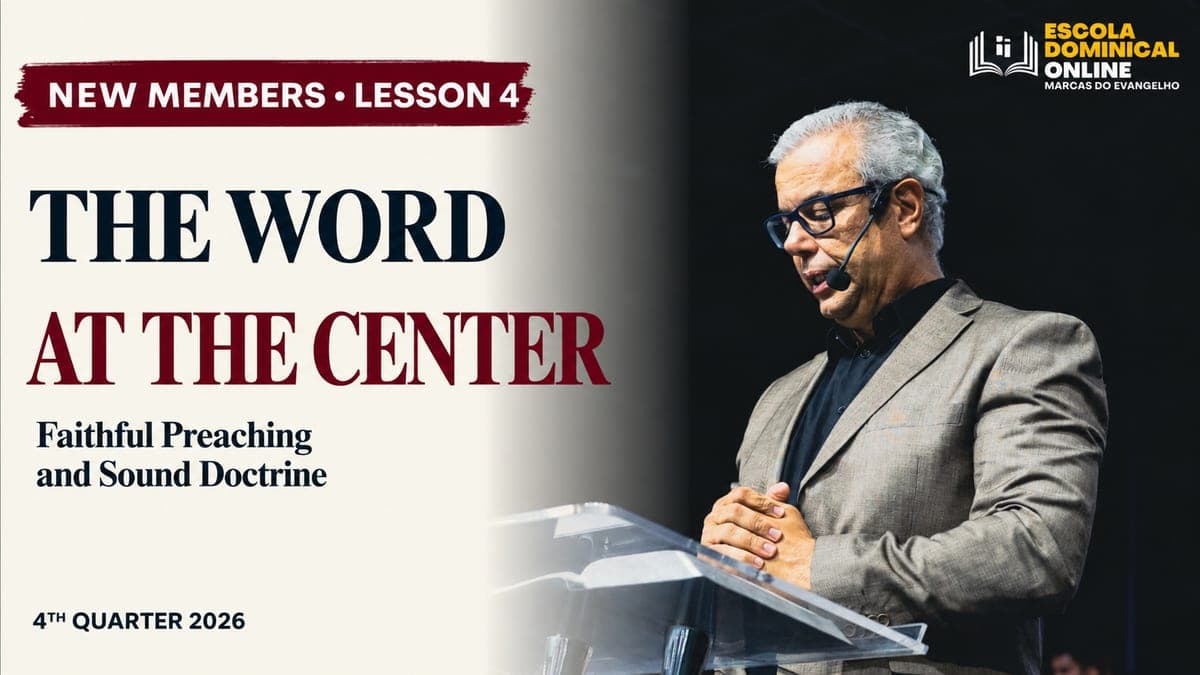
Lesson 4 • The First Two Marks: Preaching and Sound Doctrine — New Members (discipleship class).
The class that opens the twelve marks of a healthy church and explains the name of this house. Today the first two enter: biblical and expository preaching, and sound doctrine. And you receive, in writing, what this church believes.
Marcas do Evangelho (church in Cariacica, Brazil) — Cariacica/ES • New Members Class • 3rd Quarter of 2026.
✶ Golden Text — Nehemiah 8:8
"So they read from the Book of the Law of God, explaining it and giving insight, so that the people could understand what was being read." (Nehemiah 8:8)
- Study texts — Nehemiah 8:1-8 · 2 Timothy 4:1-4 · Acts 17:10-12 · Titus 1:9 · 2 Timothy 3:15-17 · Jude 3
- Scripture Reading in Class — Nehemiah 8:1-8 and 2 Timothy 4:1-4
- Bible version — Scripture quotations in this translation are copied from the Berean Standard Bible (BSB), checked word for word. Greek transliterations follow the usual academic standard.
Why this church has this name
Beloved new member, have you ever noticed the name on the front of this building?
Marcas do Evangelho. It is not a pretty name chosen in a meeting. It is not a communication strategy. It is a statement of identity — and, if I am honest with you, it is also a standard to which the church held itself accountable the day it adopted that name.
The conviction behind it is this: the Church of Jesus Christ is the bride of the Lamb, bought with His own blood. Paul said this to the elders of Ephesus when speaking of the flock that He purchased with His own blood (Acts 20:28). A church bought at that price deserves the best of our theology, our obedience, and our passion. It does not deserve improvisation.
And the concern behind it is this: in times of pragmatism, relativism, and the commercialization of the sacred, many churches have traded biblical health for numerical swelling, depth for superficiality, holiness for popularity.
So this house called itself Marcas do Evangelho to put itself in debt. To carry in its name what the New Testament points to as evidence of a healthy community. Each mark is a line in the portrait the Holy Spirit painted in the Scriptures of what the Church ought to be.
✶ The sentence that opens this module
The health of a church is not measured by the number of those who walk in, but by the depth of those who stay, the faithfulness of what is preached, and the purity of what is lived.
Starting today, and over the next classes, we are going to walk through twelve marks. Today the first two enter — and it is no accident that they are these two. Take biblical preaching and sound doctrine out of a church and all the other ten collapse for lack of a foundation.
One note on method before we begin. In this module we read, with profit, authors from several Christian traditions — people who studied the church seriously and whom we do not follow in everything. We read, we learn, and we filter everything through Scripture and through our doctrinal heritage. No author has a vote here. The sacred text does.
Part I — What a church is, and how it gets sick
Before speaking of the marks, we need to know what we are talking about when we say "church." Much confusion begins right there.
1) The word and what it carries
⚓ In the original — the word the New Testament uses
ἐκκλησία (ekklēsía) — "assembly, congregation." In the Greek world, it was the assembly of free citizens, summoned to deal with the affairs of the city. The word is formed from the verb to call (kaléō), with the prefix ek-, and the underlying sense is that of a summoned people, gathered by a call that came from outside itself.
An honest caution: the weight of the word in the New Testament does not lie in its etymology, but in its use. What defines what the Church is is not the origin of the Greek term — it is the sentences in which the Holy Spirit employed it. Etymology helps; it does not decide.
The New Testament takes this common word and invests it with sacred meaning. The Church is the assembly of the redeemed, summoned by King Jesus to be His people: "But you are a chosen people, a royal priesthood, a holy nation, a people for God’s own possession, to proclaim the virtues of Him who called you out of darkness into His marvelous light." (1 Peter 2:9).
Pause over that for a moment, because it has an immediate practical consequence for you:
- The church is not the building. You can be in the church without being in the building, and be in the building without being in the church.
- The church is not one religious organization among others.
- The church is not a social club of like-minded people.
- The church is not a business that provides spiritual services to clients.
The church is a people. The people of God, redeemed by the blood of the Lamb, indwelt by the Holy Spirit, walking toward glory. And when you sign our Church Covenant, you will not be joining an institution: you will be entering a people.
2) Five portraits of the same family
The New Testament does not define the Church with a formula. It draws her with images. At least five, and each one corrects a possible mistake.
| Image | Where it appears | What it teaches | The mistake it corrects |
|---|---|---|---|
| Body of Christ | 1 Corinthians 12; Ephesians 1:22-23; Colossians 1:18 | Organic union, Christ as head, each member with a proper and irreplaceable function | Thinking you are an accessory |
| Bride of the Lamb | Ephesians 5:25-32; Revelation 19:7-9 | Exclusive love, required purity, glorious consummation at the wedding feast | Treating the church as one option among many |
| Temple of the Spirit | 1 Corinthians 3:16-17; Ephesians 2:19-22 | Required holiness, presence of God in the midst of His people | Separating the sacred from daily life |
| Flock of God | John 10:11-16; Acts 20:28; 1 Peter 5:2-4 | Need for shepherding, vulnerability before wolves, safety in the hand of the Chief Shepherd | Thinking you can walk alone |
| Family of God | Galatians 6:10; Ephesians 2:19; 1 Timothy 3:15 | Intimacy, mutual commitment, fatherhood of God over His children | Attending without belonging |
And there is one image that ties them all together: "built on the foundation of the apostles and prophets, with Christ Jesus Himself as the cornerstone." (Ephesians 2:20). Keep this verse well in mind, because today's two marks are born from it. The foundation is the apostolic teaching — and the stone that aligns the entire building is Christ.
3) Why so many churches get sick
The diagnosis is severe, but it is necessary — and you need it now, at the beginning, so you will not be startled later.
The root of the sickness has a name: pragmatism. The philosophy according to which what works is what is true. Once a church accepts that premise, everything else follows: if it works, do it; if it fills the room, keep it; if it empties the room, cut it — including doctrine.
From that root sprouted two currents that devoured biblical ecclesiology over the last century.
The first is theological liberalism, which was born in nineteenth-century German universities and spread through Western seminaries. It denies the inerrancy of the Scriptures, treats miracles as symbolic language, relativizes the deity of Christ, and reduces the Gospel to a code of social kindness. The fruit is in plain sight across much of the world: empty historic sanctuaries and entire denominations shrinking.
The second is the model built to please the consumer. Popularized in recent decades, it imitates the world in Christian clothing, reduces preaching to motivation, turns the worship service into a show, softens uncomfortable doctrines — sin, hell, repentance, holiness — and treats the visitor as a customer to be pleased. It produces entertained crowds and few disciples.
And in our Brazilian context there is a third, which must be stated plainly: prosperity theology, which turned the Gospel into commerce, traded holiness for emotionalism, doctrine for unbridled experience, and the Holy Spirit for religious manipulation.
We reject all three. Not with arrogance — with biblical firmness. And without confusion: numerical growth can be a sign of health — the book of Acts records the church growing in number (Acts 2:47). What it is not, ever, is a guarantee of health. A crowd is not a synonym for the presence of God. Crowds followed Jesus while there was bread; when the preaching pressed hard, many disciples turned back and no longer walked with Him (John 6:66).
4) Then how do you measure the health of a church?
By purity. By the degree of freedom from false doctrine. By conformity to the will revealed in the Scriptures. By holiness truly lived out.
The more a church grows in holiness, the healthier it is. And a faithful church is, at the same time, apostolic in doctrine and fervent in devotion — both things, never just one.
✶ The question that organizes this entire module
If this church were examined today in the light of the New Testament, what would be the marks by which her Lord would recognize her as His own?
It was by answering that question that we arrived at the twelve marks. There are others, and we make no claim to exhaust the subject. These are the main ones. Let us go to the first two.
Part II — Mark 1: biblical and expository preaching
5) The final order of a dying man
Paul is imprisoned in Rome. He knows martyrdom is near. He writes the last letter we have from him, addressed to Timothy, the young pastor of the church in Ephesus.
Think of the weight of that. It is the last thing a spiritual father will say to his son in the faith. What does he choose? He does not send an administrative strategy. He does not send a growth technique. He does not send an innovative program. He makes a solemn oath and gives an order:
"I charge you in the presence of God and of Christ Jesus, who will judge the living and the dead, and in view of His appearing and His kingdom: Preach the word; be prepared in season and out of season; reprove, rebuke, and encourage with every form of patient instruction." (2 Timothy 4:1-2)
Preach the word. Not your opinion about the word. Not your experience with the word. The word.
And the following verse explains why he was so solemn:
"For the time will come when men will not tolerate sound doctrine, but with itching ears they will gather around themselves teachers to suit their own desires. So they will turn their ears away from the truth and turn aside to myths." (2 Timothy 4:3-4)
Read that prophecy slowly, because it describes our time with uncomfortable precision. Notice that the problem does not begin in the pulpit — it begins in the ear. People with itching ears go after teachers who say what they already wanted to hear. Demand creates supply. And the antidote, according to Paul, is only one: the faithful, continuous, and whole preaching of the Word.
6) The oldest model: a pulpit, a book, and a people who understood
Now go back eight centuries before Paul, to Nehemiah 8, and see the first great portrait of a worship service of biblical exposition.
The people had returned from exile. Ezra, the scribe, steps up to a wooden pulpit made for that purpose. He opens the book of the Law before all the people — and when he opened it, all the people stood up (Nehemiah 8:5). The people stand up when the book is opened. Keep that scene in mind.
And then comes the verse that is the Golden Text of this class, and that is the DNA of biblical preaching:
"So they read from the Book of the Law of God, explaining it and giving insight, so that the people could understand what was being read." (Nehemiah 8:8)
Three movements, in order, in a single verse:
| Movement | What it is | If it is missing |
|---|---|---|
| Read | The text is truly read aloud before the people | The message has no text, it has a theme |
| Explain | The sense is declared — what the passage says, in its context | The listener applauds without understanding |
| Understand | The people comprehend and can obey | Preaching has turned into a performance |
That is the goal. Not to impress: to cause to understand. And note that the aim is not for the preacher to shine — it is for the people to leave knowing what God said.
7) What expository preaching actually is
In technical language, expository preaching is the communication of a biblical concept, drawn from a passage through the study of its historical, grammatical, and literary context, which the Holy Spirit applies first to the preacher and, through him, to the listeners.
In everyday language:
✶ The definition to take home
Expository preaching is preaching in which the main idea of the text is the main idea of the sermon.
Just that. And that is a lot. Because it means the preacher does not choose the subject — the text chooses. It means he does not take a verse as a pretext to say what he already wanted to say. He submits to the text and lets the text speak.
⚓ In the original — the verb of the pulpit
κηρύσσω (kērýssō) — "to proclaim, to announce as a herald." It is the verb for preaching the word in 2 Timothy 4:2. The herald of the ancient world was neither a commentator nor a debater: he was the man who brought the people the message of the king, without subtracting and without adding. His authority did not lie in his eloquence — it lay in the one who sent him and in the message entrusted to him.
8) Three kinds of preaching that are not preaching
For you to recognize what is right, you need to recognize what is wrong. There are three deformed forms that infest pulpits today:
Pragmatic preaching. Thirty minutes of spiritualized self-help, with biblical splashes for decoration, designed to make the listener feel good. You leave church excited and unchanged.
Superficial topical preaching. A trendy topic is chosen — finances, relationships, success, performance — and verses out of context are stitched together to support the preacher's ideas. The text becomes an alibi.
Motivational preaching. Emotional shouting without doctrinal content. It fills with adrenaline and empties of holiness. By Monday nothing is left, because nothing was there.
None of the three looks heretical on the surface. That is where the danger lies: they quote the Bible. They just do not preach it.
9) The Pentecostal dimension: study and fire are not rivals
Here we must dismantle a false opposition that has done great damage among us. On one side, those who say that whoever studies grows cold. On the other, those who say that whoever seeks the Spirit becomes delusional. We refuse both.
We are a Pentecostal church. We believe in the present-day operation of the gifts of the Spirit and we live that out. And it is precisely because we are Pentecostals that we demand biblical preaching — because the Holy Spirit is the author of the text, and He does not contradict what He Himself inspired.
"My message and my preaching were not with persuasive words of wisdom, but with a demonstration of the Spirit’s power, so that your faith would not rest on men’s wisdom, but on God’s power." (1 Corinthians 2:4-5)
"because our gospel came to you not only in word, but also in power, in the Holy Spirit, and with great conviction — just as you know we lived among you for your sake." (1 Thessalonians 1:5)
Notice Paul's expression: not in word only. It was not only — but it was in words too. The power of the Spirit does not dispense with the word: He accompanies it and makes it pierce.
✶ What we want in our pulpit
Preachers who study on their knees and preach with tears. Who plunge into the text and plunge into prayer. Rigorous exegesis and a heart on fire — never one without the other.
And the promise that sustains the preacher when he steps up there is this: "so My word that proceeds from My mouth will not return to Me empty, but it will accomplish what I please, and it will prosper where I send it." (Isaiah 55:11).
10) How this works in this house
Let me show you what you will see in practice, Sunday after Sunday, and why.
- Authority is not in the preacher. Neither in his eloquence, nor in his charm, nor in the experiences he has lived. Authority is in Scripture. When he speaks what the text says, listen as one who listens to God. When he speaks what the text does not say, it is only a man's opinion.
- We preach whole books in expository series, so as to cover, over the years, the whole counsel of God (Acts 20:27). That way the text chooses the subject and no one can say the pastor prepared that message to target someone.
- Preparation has an order: first discover what the text meant in its context; then identify the theological intention of the inspired author; then build the bridge to today without doing violence to the text; then apply it concretely to the life of the flock; and, over all of this, cry out for the power of the Spirit.
- Every member holds a physical Bible in hand. When preaching, we announce the page number. It is not an operational detail: it is a conviction. We want the entire congregation with an open Bible.
- And we want you to check. You look at the preacher and you look at the text, to verify whether what is being said is truly written there.
That last point is so important that the Bible gives a name and praise to those who do this:
"Now the Bereans were more noble-minded than the Thessalonians, for they received the message with great eagerness and examined the Scriptures every day to see if these teachings were true." (Acts 17:11)
⚓ In the original — Luke's praise for the Bereans
εὐγενέστεροι (eugenésteroi) — "more noble," the comparative of eugenḗs, a word that described someone of good birth, well-born. Luke uses the language of nobility to praise listeners. And notice the two halves of the praise: they received the word with all eagerness (they were not cynics) and examined the Scriptures daily (they were not naive). Christian nobility is that combination — an open heart and an open Bible.
A faithful pastor is not afraid of your open Bible. He counts on it.
Part III — Mark 2: sound doctrine
11) Teaching that produces health
In the pastoral letters, Paul uses an expression that our translation renders as "sound doctrine." It is worth looking at what it says in the original, because the image is unexpected.
⚓ In the original — the metaphor is medical
ὑγιαίνουσα διδασκαλία (hygiaínousa didaskalía) — literally "teaching that is healthy," "teaching that produces health." The participle comes from hygiaínō, "to be healthy, to be sound" — the same root from which our word hygiene comes.
The image, therefore, is neither legal nor academic: it is medical. Just as there is food that nourishes and food that sickens the body, there is teaching that nourishes and teaching that sickens the soul and the church.
That changes the conversation. Doctrine, in the Bible, is not the boring subject theologians debate while the people live their lives. Doctrine is diet. It is what goes into your family's soul every week. And no one thinks it is fussy to ask what is on the children's plate.
That is why the pastor's responsibility, according to Paul, is twofold:
"He must hold firmly to the faithful word as it was taught, so that he can encourage others by sound teaching and refute those who contradict it." (Titus 1:9)
Two things, not one. To build up the faithful and to refute false teachers. To affirm the truth and to deny error. It is not enough to be kind — one must have discernment. A pastor who only knows how to affirm leaves the flock exposed; one who only knows how to refute leaves the flock starving.
12) The sole foundation: the Scriptures
The Bible is the foundation of this church. And when we say that, we are affirming specific things, which you need to know one by one.
| What we affirm | What this means | Where it rests |
|---|---|---|
| Canon | We receive as Scripture the 66 books of the Old and New Testaments | Jude 3 |
| Inspiration | They are breathed out by God, given by the Spirit through the personality of the human writers | 2 Timothy 3:16; 2 Peter 1:21 |
| Inerrancy | Without error in the original autographs, in all that they affirm | 2 Timothy 3:16 |
| Infallibility | They will never fail to fulfill the purpose for which God sent them | Isaiah 55:11 |
| Sufficiency | They contain everything necessary for Christian faith and practice | 2 Timothy 3:15-17 |
| Authority | They stand above tradition, human reason, subjective experience, and any ecclesiastical decree | 2 Peter 1:20-21 |
| Clarity | What is necessary for faith is understandable to the ordinary believer who reads them in prayer | Nehemiah 8:8 |
⚓ In the original — the word that appears only once
θεόπνευστος (theópneustos) — "God-breathed," from Theós (God) and pnéō (to breathe). It is the term in 2 Timothy 3:16, rendered as divinely inspired. The picture is not that of God inspiring men the way a poet is inspired: it is that of a text that came out of the breath of God. The origin of Scripture does not lie in the genius of the one who wrote — it lies in the breath of the One who breathed it out.
And see what all of this is for, in the very next sentence from Paul: "All Scripture is God-breathed and is useful for instruction, for conviction, for correction, and for training in righteousness, so that the man of God may be complete, fully equipped for every good work." (2 Timothy 3:16-17).
Biblical doctrine does not end in debate. It ends in good works.
The practical consequence of this is the commitment you are going to sign. Our Church Covenant says that members take on "the commitment to live in faithfulness to the Scriptures as the sole rule of faith and practice in all dimensions of life, not only in the religious context, but in the home, at work, in social relationships, and in citizenship." And it says of the document itself that "it does not replace the Scriptures and, on the contrary, it submits to the Scriptures."
The Covenant kneels before the Bible. Everything else in this house does too.
13) What this house believes — the statement, in summary
Now I am going to lay the cards on the table, so that you know exactly what you are stepping into. Nothing here is a secret, and you have the right to know before signing anything.
We are Arminian-Wesleyan in the doctrine of salvation. That means, in brief lines:
- The fallen human being is dead in trespasses and sins and is unable, of himself, to seek God.
- God, in mercy, pours out upon humanity a prevenient grace — grace that comes before, awakens the conscience, enlightens the mind, and enables the will to respond to the call. "For the grace of God has appeared, bringing salvation to everyone." (Titus 2:11).
- Christ died for all people, offering genuine salvation to everyone who believes.
- Salvation is received by grace, through faith — "For it is by grace you have been saved through faith, and this not from yourselves; it is the gift of God, not by works, so that no one can boast." (Ephesians 2:8-9) — and this faith is, at the same time, a gift from God and the responsible response of a person enabled by grace.
- The regenerated believer is called to grow in progressive sanctification.
- And the believer can, through persistent and unrepentant rebellion, make shipwreck of the faith. This is not meant to produce insecurity: it is meant to produce holy fear and daily fellowship.
We are Pentecostal. We believe that baptism in the Holy Spirit is an experience distinct from and subsequent to regeneration, available to every believer, with the initial evidence of speaking in new tongues, and that the gifts of the Spirit continue in full operation in the church.
We are dispensationalist in hermeneutics and pretribulationist in hope. We believe that God deals with humanity in distinct economies throughout history, that the Church has not replaced Israel, and that Christ will come to take His Church before the great tribulation, returning afterward in glory. It is the blessed hope (Titus 2:13) — and it does not serve to feed curiosity about dates, but to keep us watchful, pure, and focused on the mission.
✶ A word about this list
You have just read, in a few lines, subjects that deserve entire classes — and they will have them. Salvation, repentance, and faith have their own lesson in this course. The centrality of the Gospel does too. Worship and life in the Spirit do too. Today they appear only as our doctrinal identity card, so that you know from the outset whom you are walking with. Do not try to learn all of this today. Keep the list and come back to it.
And there is a distinction worth its weight in gold, which many believers take years to learn: there are doctrines that define who is a Christian — God, Christ, the cross, the resurrection, salvation by grace through faith — and there are doctrines on which true Christians differ among themselves. On the first there is no negotiation. On the second we hold a firm position, declared and taught, without turning disagreement into a sentence of condemnation.
Clear conviction with a humble spirit. Never the reverse.
14) Why doctrine is not a luxury
Today's church is under pressure to trade the truth for a content-free Christianity, and to treat every absolute statement as bad manners. The result, when the church gives in, is predictable: sincere people, full of goodwill and without a single bone — vulnerable to anything that shows up with a firm voice and a microphone.
"Then we will no longer be infants, tossed about by the waves and carried around by every wind of teaching and by the clever cunning of men in their deceitful scheming." (Ephesians 4:14)
Notice the image: children tossed to and fro by the wind. It is not falling all at once; it is spinning around. Today one novelty, tomorrow another, the day after tomorrow a teacher who showed up on the internet. Whoever has no doctrinal root does not walk in a straight line — he walks in circles.
And that is why Jude, in his brief and stern letter, writes with urgency:
"Beloved, although I made every effort to write to you about the salvation we share, I felt it necessary to write and urge you to contend earnestly for the faith entrusted once for all to the saints." (Jude 3)
Once for all delivered. The Christian faith is not a project under construction that each generation rewrites. It was delivered. It is up to us to guard it, proclaim it, and defend it — and to distrust, with all the calm in the world, anyone who arrives with a new revelation that corrects Scripture.
✶ The sentence that closes mark 2
Sound doctrine is not a theologian's luxury. It is oxygen for the soul of the church. Where it is lacking, the flock does not argue — it suffocates.
15) How we guard sound doctrine in this house
- We do not negotiate doctrine in the name of cultural relevance, and we do not silence biblical truths to please passing trends.
- We systematically teach the great doctrines of the faith throughout the yearly cycle — who God is, who Christ is, who the Holy Spirit is, what the human being is, what sin is, what salvation is, what the church is, what will come at the end.
- We disciple new converts in a structured course of basic doctrine — which is exactlty what you are doing right now, in this chair.
- We train leaders with theological depth, because whoever is going to teach needs to know more than what he is going to say.
- And we send out preachers with a commitment: they will preach the Word, only the Word, and the whole Word.
And your commitment, as members, is the other side of that same coin: to read the Bible every day, come to the teaching, and check what you hear. It has been that way from the beginning: the first Christians devoted themselves continually to the apostles' teaching, to fellowship, to the breaking of bread, and to prayer (Acts 2:42). Notice the order in which Luke wrote. Doctrine comes first. Not because it is more important than fellowship, but because it is what holds fellowship standing.
Christ in the Lesson
✝ Why expository preaching exists
If the lesson stopped here, you could walk out thinking today's subject is pulpit technique and a list of beliefs. It is not. Today's two marks exist because of a Person.
Why must Scripture be explained and not merely quoted? Because it has a center, and the center is He. The Lord Jesus Himself said to those who had the Scriptures on the tip of their tongue and did not recognize Him: "You pore over the Scriptures because you presume that by them you possess eternal life. These are the very words that testify about Me," (John 5:39). You can read the whole Bible and miss the mark. You can know the text and not know the One of whom the text speaks.
And the first expository sermon on this side of the resurrection was preached by Him Himself, on a dirt road, to two discouraged men: "And beginning with Moses and all the Prophets, He explained to them what was written in all the Scriptures about Himself." (Luke 24:27). He explained to them. The risen Christ took the Bible and explained the meaning — the same action as in Nehemiah 8, now on the lips of the Lord.
And what happened in the hearts of those two while He was explaining? "They asked each other, “Were not our hearts burning within us as He spoke with us on the road and opened the Scriptures to us?”" (Luke 24:32). Notice that their hearts burned while He was opening the Scriptures. Not before. Not instead. Pentecostal fire and the open text were born together on that road.
So this is it: expository preaching is not a stylistic preference of this church. It is the consequence of believing that the Bible speaks of Christ — and that, when it is opened and explained, He is the One who shows Himself. And sound doctrine is not a fence around an empty lot. It is the outline of a face. Every doctrine you will learn in this course draws a line of that face, until you recognize, across the whole of Scripture, the One who died for you and rose again.
Take Christ out of preaching and what is left is oratory. Take Christ out of doctrine and what is left is a filing cabinet.
Three questions to take home from this class
- When I hear a sermon, do I check it in the text — or do I accept everything because the speaker has a microphone and I like the person?
- What have I been putting into my soul during the week? If doctrine is diet, what has been on my plate: Scripture, or whatever the algorithm hands me?
- Can I state, in my own words, what this house believes — and why? Or am I joining a church whose foundation I have never examined?
Final Word
Beloved new member, I want you to walk out of here with two things in your hand.
The first is an open Bible. Literally. From next Sunday on, when the preacher announces the text and the page, open it. Follow along with your finger, if it helps. Look at the preacher and look at the text. You are not policing a man — you are doing what the Bereans did, and Scripture called that nobility.
The second is a new expectation. Many people come to church hoping for a good moment. I want you to start expecting food. Because what goes into your soul Sunday after Sunday is what will be available to you on the day crisis comes — and it will come. Whoever has fed on the text has somewhere to draw strength from. Whoever has fed on emotion discovers, at the wrong hour, that the pantry is empty.
You are entering a house that chose to carry in its very name the demand to be biblical. That means that, here, no one is going to promise you a painless life in exchange for faithfulness. They are going to hand you the Word of God, explained, Sunday after Sunday, until it forms Christ in you.
✶ Take the expository sermon out of the pulpit and you take the heart out of the church. Restore expository preaching and you restore the health of the flock.
That is why this house called itself Marcas do Evangelho. Not because it has already arrived — but because it chose to be measured by that standard. And starting today, so have you.
Closing Prayer
Lord our God, we thank You because You have spoken. You did not leave us guessing who You are, nor depending on what each generation invents about You. You breathed out Your Word, and it has reached us.
Father, give this church a faithful pulpit. Keep those who preach from the temptation to please, the temptation to impress, and the temptation to speak out of their own heads. May they study on their knees and preach with tears. May the main idea of Your text always be the main idea of the message, and may no one here leave entertained and starving.
Holy Spirit, You are the author of the Scriptures and their interpreter. Open the minds of these new members. Give them hunger for the pure spiritual milk. Give them the habit they do not yet have, the discipline they have not yet won, and the patience to start over on Wednesday when they fail on Tuesday.
Lord, heal those who arrived here hurt by a sermon. Those who heard a promise and received a demand. Those who gave what they did not have because someone said that was faith. Restore in them trust in Your Word without restoring naivety — may they be like the Bereans, with an open heart and an open Bible.
And guard this house, Lord. May we not deny doctrine in the name of relevance, nor trade holiness for popularity. May the faith that was once for all delivered to the saints be guarded here, proclaimed here, and lived out here, until the day You come.
May it be Your Son who appears in every sermon in this house, from beginning to end. In Christ. Amen.
"Scripture governs; everything else, on its knees."
Frequently asked questions about this lesson
Is it disrespectful to check in the Bible what the preacher is saying?+
It is the exact opposite: it is the highest compliment you can pay a faithful preacher. When Paul preached in Berea, Luke recorded the behavior of those people with a word of honor: "Now the Bereans were more noble-minded than the Thessalonians, for they received the message with great eagerness and examined the Scriptures every day to see if these teachings were true." (Acts 17:11). Notice the two halves. They received the word with all readiness — they were not grumpy listeners, with their arms crossed, waiting for the preacher to slip up. And they examined the Scriptures daily — they did not swallow anything just because it came from an apostle. Both things together, and in that order, are what the Bible calls nobility. In this house we train you to do this: that is why the preacher announces the page, that is why everyone holds a physical Bible in their hand, that is why you look at the preacher and look at the text. A pastor who is afraid of your open Bible is a pastor you should be afraid of. Now, a word of balance: checking is not fault-finding. It is following along. Whoever checks in order to learn grows; whoever checks in order to judge turns sour.
Why does the pastor preach through entire books of the Bible instead of choosing a topic for each Sunday?+
Because, by preaching through entire books, the text is what chooses the subject — not the preacher. When the pulpit is topical all the time, something silent and dangerous happens: year after year, the church ends up hearing only one man's favorite subjects. The hard texts never arrive. The uncomfortable doctrines are left out. And the congregation, without realizing it, is shaped by the limits of one person instead of being shaped by God. Paul was able to say to the elders of Ephesus: "For I did not shrink back from declaring to you the whole will of God." (Acts 20:27). The whole counsel. Not a selection. Preaching through entire books, from cover to cover, over the years, is the simplest and most honest way to fulfill this. That does not mean there will never be a topical message — it means the norm of this house is to follow the text. And see the advantage for you: when the Sunday comes on which the text speaks directly to your sin, no one will be able to say the pastor prepared that because of you. It was already on the calendar.
If it is the Holy Spirit who teaches, why study so much?+
That question comes from a division the Bible does not make. We reject the idea that study and anointing are rivals, as if the preacher had to choose between the mind and the fire. Paul wrote to the Thessalonians: "because our gospel came to you not only in word, but also in power, in the Holy Spirit, and with great conviction — just as you know we lived among you for your sake." (1 Thessalonians 1:5). Notice: it did not come in word only — but it did come in words too. And to the Corinthians: "My message and my preaching were not with persuasive words of wisdom, but with a demonstration of the Spirit’s power," (1 Corinthians 2:4). The same Paul who says this is the one who commands Timothy to devote himself to reading, exhortation, and teaching (1 Timothy 4:13). The Holy Spirit is the author of the text; studying the text is listening carefully to the Spirit, not bypassing Him. What we want are preachers who study on their knees and preach with tears. Study without prayer produces a cold lecture. Fervor without the text produces noise. Both together produce preaching.
Doesn't doctrine divide the church? Wouldn't it be better to just stick to love?+
Yes, it does divide — and sometimes that is exactly what it is for. Doctrine is the line that separates the Christ of the Bible from any other invented christ, and that line needs to exist. But notice that Scripture never pits doctrine against love. It commands both in the same sentence: "Instead, speaking the truth in love, we will in all things grow up into Christ Himself, who is the head." (Ephesians 4:15). Truth in love. Whoever has truth without love becomes harsh and quarrelsome; whoever has love without truth has nothing to offer anyone in the hour of suffering. And think about what happens to a church that gives up teaching in order to keep the peace: "Then we will no longer be infants, tossed about by the waves and carried around by every wind of teaching and by the clever cunning of men in their deceitful scheming." (Ephesians 4:14). Without doctrine, the believer does not become more loving — he becomes easier to deceive. Sound doctrine is not a wall to isolate; it is a skeleton to stand upright.
You say the Bible is inerrant "in the originals." Does my Bible have errors, then?+
Your Bible is the Word of God, and you can trust it completely. The expression "in the originals" is not an escape hatch; it is honesty. The texts that came from the hands of the inspired writers — the autographs — were without error in all that they affirm. What we have today are copies in vast numbers and translations made from them, and no copyist or translator was inspired in the same way as the author. The differences among the copies exist, are well known, have been studied exhaustively, and in the overwhelming majority of cases involve spelling and word order. No Christian doctrine depends on a doubtful passage. Therefore, the practical statement is this: the Bible in your hand faithfully conveys what God spoke, and it is sufficient to lead you to salvation and to govern your life. "All Scripture is God-breathed and is useful for instruction, for conviction, for correction, and for training in righteousness," (2 Timothy 3:16). Read it with confidence. And if one day someone tries to use this discussion to make you doubt your copy, know that the goal is not precision — it is to disarm you.
Why 66 books? What about the books that appear in other Bibles?+
We receive as Scripture the 39 books of the Old Testament and the 27 of the New — 66 in all. Regarding the Old Testament, the main reason is simple and strong: this is the collection that Israel recognized as its Scripture and that the Lord Jesus Himself treated as the Word of God, citing the Law, the Prophets, and the Psalms. The additional books that appear in other editions have historical value and are ancient, but they were not received by that people — the very people of whom Paul wrote that they were entrusted with the words of God (Romans 3:2). Regarding the New Testament, the church did not create the canon by decree: over time, it recognized the writings that came from the apostles and their immediate circle and that the churches were already reading publicly from the beginning. Keep the principle behind all of this: "For no such prophecy was ever brought forth by the will of man, but men spoke from God as they were carried along by the Holy Spirit." (2 Peter 1:21). And keep the practical consequence: the faith was once for all delivered to the saints (Jude 3). It needs no additions, and be wary of anyone who shows up with a new revelation that corrects or replaces Scripture.
You call yourselves Arminian-Wesleyan, Pentecostal, and dispensationalist. Are those who believe differently not saved?+
No, and that distinction is one of the most important things you will learn in this course. There are doctrines that define who is a Christian — who God is, who Christ is, what He did on the cross, the resurrection, salvation by grace through faith. Whoever denies these is outside the Christian faith, and on this point there is no negotiation. And there are doctrines on which true, God-fearing Christians, reading the same Bible, reach different conclusions — such as how grace operates, spiritual gifts today, and the order of end-time events. On these, we hold a firm, taught, and stated position, because a church without a position cannot teach anyone. But a firm position is not a sentence of condemnation upon brothers and sisters. We profitably read authors from traditions different from our own and filter everything through Scripture and our heritage. What we ask of you, new member, is this: learn what this house believes and why it believes it, with an open Bible. Clear conviction with a humble spirit — and never the other way around.
How do I know if a sermon I heard somewhere is good?+
Ask three questions, in this order. First: was the text read and explained, or was it only quoted? Biblical preaching reads the passage, shows what it says in its context, and applies it. If the verse appeared at the beginning as an ornament and never came back, you heard a speech with biblical decoration. Second: is the main idea of the message the main idea of the text? Or did the preacher use the text as a springboard for the subject he already wanted to talk about? Third: where did the message lead — toward Christ and obedience, or toward you, your potential, and your prosperity? A sermon can be lively, well spoken, full of good stories, and still have fed no one. Peter uses a household image for what sustains us: "Like newborn babies, crave pure spiritual milk, so that by it you may grow up in your salvation," (1 Peter 2:2). Unadulterated. There is watered-down milk in the religious marketplace, and a child who nurses on weak milk does not die on the spot — he wastes away slowly.
Teacher's Guide
Essence of the class
A church is healthy when the text governs the pulpit — reading, explaining, applying — and when sound doctrine feeds the people; and the mature listener is the one who receives with eagerness and checks in the Bible, like the Bereans.
Map of the class
| Time | Stage |
|---|---|
| 0–5 min | Opening (the hook: why this church has this name) |
| 5–12 min | Point 1 — What the church is and how it gets sick |
| 12–24 min | Point 2 — Mark 1: preaching that reads, explains, and applies |
| 24–34 min | Point 3 — Mark 2: sound doctrine and what this house believes |
| 34–39 min | Class activity (the three filter questions) |
| 39–45 min | Wrap-up in Christ + challenge of the week + prayer |
Start like this
Arrive, do not open the Bible yet, and ask a simple question: "Why do you think this church is called Marcas do Evangelho?"
Let three or four take a guess. You will hear "because it marks people's lives," "because it leaves a mark," "because of the publishing house." All good, none of them is the answer. Write on the board whatever comes up and then say:
"The name is a statement of identity. The New Testament paints a portrait of what a healthy church looks like — and each feature of that portrait is a mark. This house chose to carry that in its name, which means it chose to be held accountable by it. Today begins the module of the twelve marks, and we are going to see the first two."
Right after that, throw out the second question, which is the real hook: "How do you evaluate whether a church is healthy?" Hold the answers — you will get size, liveliness of the worship service, number of programs, how long it has existed. Do not correct any of them now. Write them all on the board and say: "Keep that list. At the end of class we will come back here."
Point 1 — What the church is and why so many get sick
- In the class material: the Church Covenant, which defines the church as a covenant community and not as a voluntary association of interested people, and which commits the member to live "in faithfulness to the Scriptures as the sole rule of faith and practice in all dimensions of life." Show also that the Covenant itself declares that "it does not replace the Scriptures and, on the contrary, it submits to the Scriptures."
- What to teach: the church is a people, not a building, not an organization, not a club, not a spiritual-services business — it is the assembly of the redeemed, summoned by the King. Move quickly through the five images (body, bride, temple, flock, family) using the Study table, without exhausting any of them. Then go to the diagnosis: the root of the sickness is pragmatism, the idea that what works is what is true. Out of it come theological liberalism, the consumer-pleasing model, and, in Brazil, prosperity theology. Close with the correction that avoids misunderstanding: numerical growth can be a sign of health (Acts 2:47), but it is never a guarantee — when the preaching pressed hard, many disciples turned back (John 6:66).
- Anchor verse: "built on the foundation of the apostles and prophets, with Christ Jesus Himself as the cornerstone." (Ephesians 2:20).
- Key question: "What have you seen, somewhere, being used as proof that a church is doing well — when in fact it proves nothing?"
- Likely answers (+ going deeper): "a full church," "lots of young people," "the worship is good," "the pastor is well known." Go deeper: "and which of those things can a sick church also have?" It usually clicks right then that almost everything on the list is achievable without God.
- If no one speaks: tell yours first. "I once thought a good church was a full church. I changed my mind when I discovered that..." — and then hand the question back. If silence still remains, read the sentence from the Study and ask them to explain it: "health is not measured by the number of those who walk in, but by the depth of those who stay."
Point 2 — Mark 1: biblical and expository preaching
- In the class material: the section on the Word in the Covenant, in which the house commits itself to read, preach, sing, pray, and see the Word. State it plainly: today's mark is the second of those five actions, preaching the Word.
- What to teach: start with the weight of the scene — Paul imprisoned, about to die, writing his last letter, and what he commands is not strategy, it is to preach the word under a solemn charge (2 Timothy 4:1-2). Show the reason in the next verse: the problem begins in the ear, with people who have itching ears and gather teachers to suit their own desires (2 Timothy 4:3). Then go to Nehemiah 8 and show the model in three movements — reading, explaining, causing to understand (Nehemiah 8:8). Then hand over the definition to take home: expository preaching is preaching in which the main idea of the text is the main idea of the sermon. List the three deformations (pragmatic, superficial topical, motivational) and say why they are dangerous: all three quote the Bible, they just do not preach it. Close with the Pentecostal dimension: study and anointing are not rivals (1 Thessalonians 1:5; 1 Corinthians 2:4-5) — we want preachers who study on their knees and preach with tears.
- Anchor verse: "So they read from the Book of the Law of God, explaining it and giving insight, so that the people could understand what was being read." (Nehemiah 8:8).
- Key question: "What was the last sermon you truly remember — and do you remember the text or do you remember the story the preacher told?"
- Likely answers (+ going deeper): almost everyone will remember the illustration and not the text. Do not embarrass anyone with that — use it: "that does not mean you are a bad listener; it means illustrations stick and texts slip away. That is why we train our eyes on the text." Go deeper: "and what changes if, on the way out, you can state in one sentence what that text taught?"
- If no one speaks: read Nehemiah 8:8 twice and ask the class to find the three verbs. Write on the board READ · EXPLAIN · UNDERSTAND as they come up. Then ask: "which of these three is most often missing in pulpits out there?"
Point 3 — Mark 2: sound doctrine (and what this house believes)
- In the class material: the Church Covenant, which "clearly outlines what we do, how we live, and what we believe" — and the doctrinal statement of this house, which the class presents in summary.
- What to teach: open with the medical metaphor, because it disarms prejudice against doctrine: hygiaínousa didaskalía is "teaching that produces health," from the same root as hygiene. Doctrine is diet, not debate. Show the twofold responsibility of Titus 1:9 — building up the faithful and refuting error. Walk through the table of what we believe about Scripture (canon, inspiration, inerrancy, infallibility, sufficiency, authority, clarity) without turning it into a systematic theology lecture: the goal is for the student to know that a list exists and where to find it. Then present the identity of the house in a few lines: Arminian-Wesleyan in salvation (highlighting prevenient grace, Titus 2:11), Pentecostal, dispensationalist, and pretribulationist. Hold back here: do not open up any of those subjects. State expressly that salvation, conversion, the Gospel, and life in the Spirit have their own lessons in this course and that today they appear only as an identity card. Finish with Ephesians 4:14 and Jude 3: without doctrine, the believer does not become more loving — he becomes easier to deceive.
- Anchor verse: "He must hold firmly to the faithful word as it was taught, so that he can encourage others by sound teaching and refute those who contradict it." (Titus 1:9).
- Key question: "If doctrine is diet, what have you been eating during the week?"
- Likely answers (+ going deeper): "short videos," "sermons on my phone," "nothing," "only on Sunday." Go deeper without shaming: "and who chose the menu — you or the app?" That is the point where many people decide to start daily reading, so have the practical answer ready.
- If no one speaks: read Ephesians 4:14 and ask only this: "why does Paul say to and fro instead of downward?" Let them think. The image of spinning in circles usually opens the conversation on its own.
Class activity
- Goal: to leave class with a tool the student will use on Monday — three questions to evaluate any message he hears, from any preacher, including our own.
- Materials: board or poster paper and marker. Each student's Bible, open to Acts 17:11.
- Step by step: write on the board, very large, the number 3. Say: "you are going to walk out of here with three questions in your head." Ask someone to read Acts 17:11 aloud. Ask: "what did those people do?" — gather the answers until they arrive at the two halves: they received with eagerness and they examined. Write both on the board. Then build together with the class the three filter questions, writing them down as they come out: (1) Was the text read and explained, or only quoted? (2) Is the main idea of the message the main idea of the text? (3) Did the message move toward Christ and obedience, or toward me and my success? Ask each person to copy the three at the back of their notebook or on their phone — right there, in front of you, to make sure they leave with it written down.
- Wrap-up (back to the text): "Notice that Luke called those people noble — and what they did was what you have just written down. They were not suspicious: they received with eagerness. They were not naive: they examined. That is the combination the Bible praises, and that is what this house wants from you. Including with me, when I am standing up here in front."
If they ask you this
Question: "Isn't checking the sermon in the Bible a lack of respect toward the pastor?" Short answer: It is the opposite — it is what the Bible calls nobility (Acts 17:11). The Bereans received the word with eagerness and examined the Scriptures every day, and Luke recorded that as praise. Say it calmly: a faithful pastor counts on your open Bible; the one who is afraid of it is the one who should worry you. And add the balance, or the class will take it the wrong way: checking is not fault-finding. Whoever checks in order to learn grows; whoever checks in order to judge turns sour.
Question: "If the Holy Spirit teaches, why study so much?" Short answer: Because the Bible does not make that division. Paul says the Gospel did not come in word only, but also in power and in the Holy Spirit (1 Thessalonians 1:5) — it was not in word only, yet it was in words too. The same Paul who says his preaching was in demonstration of the Spirit and of power (1 Corinthians 2:4) is the one who commands Timothy to devote himself to public reading, exhortation, and teaching (1 Timothy 4:13). The Spirit is the author of the text; studying the text is listening to Him attentively. Study without prayer yields a cold lecture; fervor without the text yields noise.
Question: "Why not preach on the topics the people need to hear?" Short answer: Because then the one who decides what the people need to hear becomes a man, and no man has the repertoire for the whole counsel of God (Acts 20:27). By preaching whole books, the hard texts arrive in their own time and no one can say the pastor prepared that message to target someone — the calendar was already set. And note that expository preaching does apply: Nehemiah 8:8 ends with helping the people understand the reading. Explaining without applying is a lecture; applying without explaining is a talk.
Question: "You are Arminian, Pentecostal, and dispensationalist. Are those who believe differently not saved?" Short answer: No. Separate the two categories in front of the class: there are doctrines that define who is a Christian — God, Christ, the cross, the resurrection, salvation by grace through faith — and there are doctrines on which true Christians differ. On the first there is no negotiation; on the second we hold a firm position, taught and declared, without turning disagreement into a sentence of condemnation. That distinction prevents two disasters: the believer who fights over everything and the believer who stands for nothing.
Question: "The Bible is inerrant 'in the originals' — so does mine have errors?" Short answer: No. Your Bible faithfully transmits what God spoke and is sufficient for your salvation and for your life (2 Timothy 3:15-17). The expression exists out of honesty: the autographs were without error, and what we have are copies and translations made by uninspired people. The known differences among the copies are, almost all of them, matters of spelling and word order, and no Christian doctrine depends on a doubtful passage. Close like this: if someone uses that subject to make you doubt your copy, that person's goal is not precision.
Wrap-up + challenge of the week
- Wrap-up: "Go back to the board from the beginning, to the list you made of how to evaluate a church. Now look at it with today's eyes. None of those things is a sin — but none of them is a mark. The first two marks are these: a pulpit where the text is in charge, and teaching that feeds instead of making sick. And notice where that leads. When the risen Christ met two devastated men on a road, He did not perform a miracle first: beginning with Moses and all the Prophets, He explained to them what was said concerning Himself in all the Scriptures (Luke 24:27). He opened the Bible and explained. And their hearts burned while He was opening the Scriptures. That is why we preach this way. It is not style — it is because, when the text is opened, He is the One who appears."
- Challenge: this week, listen to or read one exposition of the Word with your Bible open to the text — Sunday's message, the teaching service, a recorded sermon, or you yourself reading the chapter aloud. And when you finish, write in one sentence, in your own words, what the main idea of that text is. One written sentence, in your notebook or on your phone. On Sunday, come back with the story.
Teacher's kit
- Before: read Nehemiah 8:1-12 in full aloud — the scene only works when it is heard. Read 2 Timothy 4:1-5 and Acts 17:10-12. Then open the Church Covenant to the parts the class quotes: the definition of the church as a covenant community, the commitment to Scripture as the sole rule of faith and practice, and the section on the Word (read, preach, sing, pray, see). Mark in your Bible: Nehemiah 8:8 · 2 Timothy 4:1-4 · Titus 1:9 · 2 Timothy 3:15-17 · Acts 17:11 · Acts 20:27 · Ephesians 4:14 · Jude 3 · Luke 24:27, 32.
- Bring: a Bible, a board or poster paper, and a marker. A spare physical Bible — there will be a student without a copy, and in a class about following the text, that matters. Also have on hand the information on where the church makes recorded messages available, because the challenge of the week will raise that question.
- Pray beforehand: pray for those who arrived at this class wounded by a pulpit — people who heard a promise and received a demand, people who gave what they did not have because of a sermon. Pray that this class restores trust in the Word without restoring naivety. Pray for those who have never read the Bible on their own and will leave here with the task of writing one sentence; that they do not give up on Tuesday. And pray for yourself, as you teach about faithful preaching: that your own class may be what it describes.
Homework
Your mission for the week
This week, listen to or read one exposition of the Word with your Bible open to the text — it can be next Sunday's message, the teaching service, a recorded sermon, or you yourself reading aloud the chapter from your devotional reading. Follow along the way we train here: eyes on the text, eyes on the speaker. And when you finish, write one sentence, in your own words, stating what the main idea of that text is. Just one sentence, in your notebook, on the inside back cover of your Bible, or in the notes on your phone. It does not need to look pretty. It needs to be yours.
Why
Because that is exactly what today's lesson taught you to do, and it is exactly what the Bible praises: "Now the Bereans were more noble-minded than the Thessalonians, for they received the message with great eagerness and examined the Scriptures every day to see if these teachings were true." (Acts 17:11). Both halves matter — receiving with eagerness and examining. And the goal of biblical preaching was never to impress, it was to cause people to understand: "So they read from the Book of the Law of God, explaining it and giving insight, so that the people could understand what was being read." (Nehemiah 8:8). If you can state in one sentence what the text was teaching, you understood. And whoever understands, obeys.
How to know you did it
There is a written sentence, and you know which text it summarizes. If it is there — "Psalm 23: the Lord cares for me as a shepherd, and therefore I lack nothing essential" — you did it. If it stayed only in your head, or if you wrote what you found pretty in the sermon instead of what the text said, the task is still waiting.
On Sunday, come back with the story
The next class begins with those who wrote it down. Bring the sentence, state the text, and tell whether it was easy or hard to find the main idea. Do not stay out.