Golden Text
“But you are a chosen people, a royal priesthood, a holy nation, a people for God’s own possession, to proclaim the virtues of Him who called you out of darkness into His marvelous light.” (1 Peter 2:9, BSB) · Read in the Bible
Two marks, one church. Mark 5 pushes the church outward: making disciples, and not merely collecting decisions. Mark 6 constitutes the church from within: truly belonging to a house with a name, a covenant, and pastors who answer for you. This lesson answers the question that opens the entire course — what is the difference between attending a church and being a member of it — and explains, without softening and without frightening, what you are taking on when you sign the Covenant of this house.
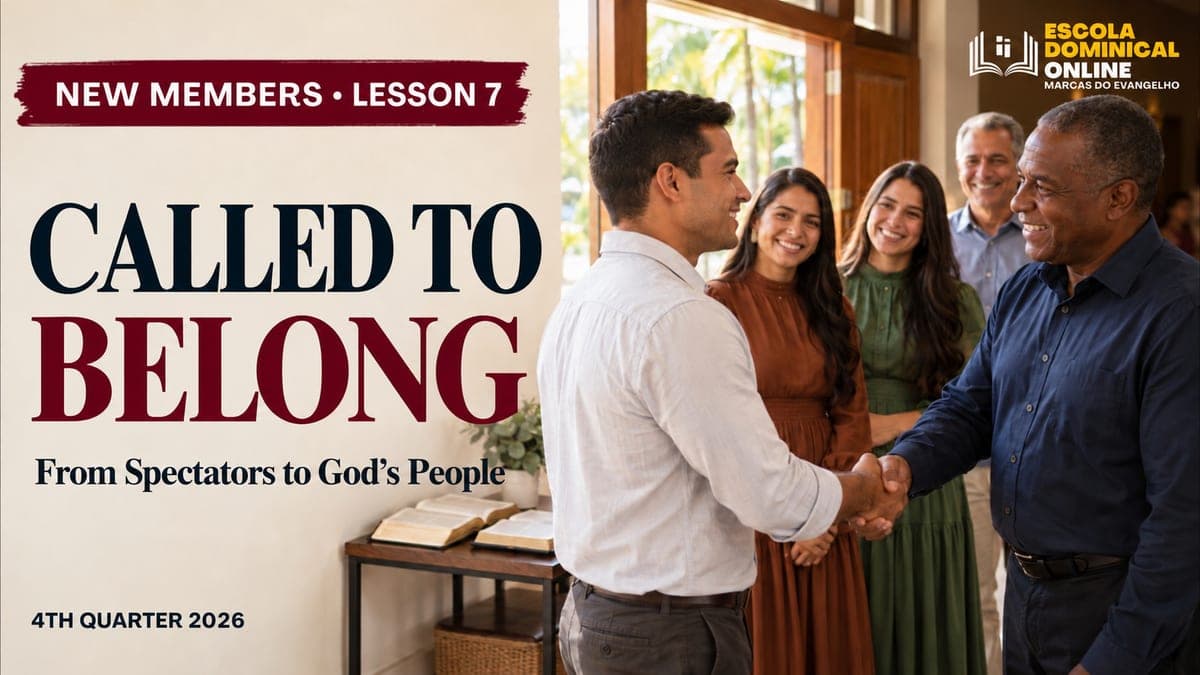
Lesson 7 • A People, Not an Audience: Mission and Membership — New Members (discipleship class).
Marks 5 and 6 of a biblical and healthy church: evangelism that makes disciples and membership that makes a people. One moves the church outward; the other constitutes it from within. This lesson explains both together, because apart neither of them works.
Marcas do Evangelho (church in Cariacica, Brazil) — Assemblies of God · Cariacica/ES • New Members Class • 3rd Quarter of 2026.
✶ Golden Text — 1 Peter 2:9
"But you are a chosen people, a royal priesthood, a holy nation, a people for God’s own possession, to proclaim the virtues of Him who called you out of darkness into His marvelous light." (1 Peter 2:9)
- Study texts — 1 Peter 2:9 · Acts 2:41-42 · Matthew 28:19-20 · Acts 1:8 · Hebrews 13:17 · Matthew 16:18-19 · Matthew 18:15-17 · 1 Timothy 3:15
- Scripture Reading in Class — Acts 2:41-47 and Hebrews 13:17
- Bible version — All Scripture quotations follow the Berean Standard Bible (BSB), checked letter by letter. Greek transliterations follow the usual academic standard.
The question that opens everything
Dear new member, I want to begin this lesson with a simple question. Think about it honestly before answering.
What is the difference between attending a church and being a member of a church?
Perhaps you will answer that attending is just going, and a member is someone who is registered. Perhaps you will say that a member participates more. Perhaps you will conclude that it is just a formality. All these answers touch lightly on the subject. None of them reaches what is actually at stake — and what is at stake is much deeper than most believers imagine.
Start with the text that sustains this lesson. Read slowly the words that the apostle Peter chose:
"But you are a chosen people, a royal priesthood, a holy nation, a people for God’s own possession, to proclaim the virtues of Him who called you out of darkness into His marvelous light." (1 Peter 2:9)
He did not write "you are individual Christians who occasionally get together." He wrote generation, priesthood, nation, people. Four collective nouns, one after another. Four words that do not fit inside a single person alone.
And notice the so that. Being this people has a purpose: to proclaim. Collective identity and mission come joined together in the same verse. That is why this lesson deals with two marks at the same time — because Peter wrote them in a single sentence.
Look now at the first day of the Church. In Acts 2, nearly three thousand people believed and were baptized:
"Those who embraced his message were baptized, and about three thousand were added to the believers that day. They devoted themselves to the apostles’ teaching and to the fellowship, to the breaking of bread and to prayer." (Acts 2:41-42)
They did not hear Peter's sermon and go back home each with their own private experience. They were added — incorporated, on the same day, into an identifiable community, with gatherings, with teaching, with a table, and with prayer. And the chapter ends by saying that the Lord added to the church, day by day, those who were being saved (Acts 2:47). Added to what? To the church. To a concrete reality, with names.
✶ The sentence that sums up the whole lesson
The church is not a place where you go. It is a people to whom you belong.
Part I — Mark 5: the church that goes out to seek
Before speaking of membership, we must speak of mission. And the order matters, because the church only receives those whom someone went out to seek first.
Evangelism without membership produces a scattered crowd: people who said a prayer and were never cared for by anyone. Membership without evangelism produces a family that does not grow: a tidy, warm house with no new crib. The two marks are two sides of the same coin.
1) The last command: make disciples
The last instruction that the Lord Jesus left before ascending to heaven appears in the four Gospels and in Acts. The best-known version is this:
"Therefore go and make disciples of all nations, baptizing them in the name of the Father and of the Son and of the Holy Spirit, and teaching them to obey all that I have commanded you. And surely I am with you always, even to the end of the age." (Matthew 28:19-20)
In English they look like four parallel tasks: go, make disciples, baptize, teach. In Greek the structure is different, and that difference changes the way we read the whole text.
⚓ In the original — one imperative, three participles
μαθητεύσατε (mathēteúsate) — "make disciples". It is the only verb in the imperative in the sentence. It is the command.
πορευθέντες (poreuthéntes) — "going", "having gone". Participle.
βαπτίζοντες (baptízontes) — "baptizing". Participle.
διδάσκοντες (didáskontes) — "teaching". Participle.
The three participles are not loose commands: they describe how the single command is fulfilled. The mission of the Church is not going for the sake of going, nor baptizing for the sake of baptizing, nor teaching for the sake of teaching. It is making disciples — by going, baptizing, and teaching.
And this has an immediate practical consequence. The Great Commission is not a special church project, run by a department, with a date marked on the calendar. It is the reason the church exists. Without this mark, any congregation becomes just one more religious association among many.
2) Converting and discipling are not the same thing
Here is a distinction that needs to be engraved in you.
| Conversion | Discipleship | |
|---|---|---|
| How long it takes | Can happen in one night | Is formed over years |
| What it asks for | A decision | A life |
| Where it ends | In a prayer | Does not end; starts over every week |
| Who does the work | God, by His grace | God, by His grace, using the church |
Look closely at the last line, because it keeps you from two mistakes.
Conversion is the work of God. We have already seen this carefully in this class: no one is converted by persuasion techniques, by well-guided emotion, or by an unanswerable argument. The grace of God goes ahead of the person, awakens, convicts, and enables — and that same grace can be resisted, because God does not drag anyone into His Kingdom. You proclaim; He is the one who converts.
Discipleship is a work that God entrusts to the church. Forming someone in doctrine, in obedience, in character, and in service — this He placed in our hands. It is costly, it takes time, and it cannot be outsourced.
That is why the Great Commission does not say "get conversions." It says make disciples — and immediately explains what that involves: baptizing, which is public incorporation into that community, and teaching them to obey everything Christ commanded, which is whole formation, ethical and doctrinal.
3) The whole gospel, not the palatable version
Not every proclamation that uses the name of Jesus is the Gospel. There is a preaching that promises prosperity, there is one that offers therapeutic relief, and there is one that settles for religious sentiment — and none of them saves anyone, because none of them tells the whole truth.
Biblical evangelism does not silence the uncomfortable parts. It speaks:
- of real sin, which is transgression against a holy God, and not merely a wrong turn;
- of eternal judgment as the destiny of those who reject Christ;
- of the exclusivity of Christ, the only mediator between God and men;
- of repentance as a decisive change of direction, and not as passing remorse;
- of the lordship of Jesus over everything — finances, sexuality, schedule, choices.
Take away those five things and what is left is a version pleasant to the ear that transforms no life at all. The love of God remains the heart of the message; yet the love of God, told by halves, ceases to be good news and becomes empty comfort.
4) The four fronts of Acts 1:8
Before ascending, the Lord gave His people the promise of power and the map of the work:
"But you will receive power when the Holy Spirit comes upon you, and you will be My witnesses in Jerusalem, and in all Judea and Samaria, and to the ends of the earth." (Acts 1:8)
The verse has three parts: a promise (receiving power), a consequence (being His witnesses), and a map (Jerusalem, Judea and Samaria, and the ends of the earth). Notice that the mission comes after the power. A witness is not someone brave by temperament; it is someone clothed with power.
Now, a necessary honesty. We usually read this map as four fronts of our mission today. That is missionary application, and it is a good application — but it is not the letter of the verse. Luke wrote about real places in the first century, and in Acts he narrates precisely that geographical advance. When we transport the map to our city, we are making an applicational reading, and it is fair that you know this.
With that caveat made, here is the map applied to your life:
| Front | Where it is, in your life |
|---|---|
| Jerusalem | Your close network: your home, your neighborhood, your workplace, the relatives who have not yet believed |
| Judea | Your city and your region — Cariacica, Greater Vitória, Espírito Santo |
| Samaria | People culturally distant from you: those on the street, those struggling with substance addiction, the migrant, the neighbor from another world |
| Ends of the earth | Peoples beyond the borders, lands where the Gospel has not yet arrived, cross-cultural mission |
And there is a pastoral care that needs to be stated here, because many good people get hurt at this point.
There are those who wait to evangelize their whole family before thinking about missions, and end up doing neither. And there are those who run to the ends of the earth while ignoring the relative who lives next door. A healthy church works all four fronts at the same time, and you are invited to operate on at least one of them — probably on more than one.
✶ Your part and God's part
You answer for the faithfulness of your testimony. You do not answer for its result.
The Lord said that you will be His witnesses (Acts 1:8). A witness tells what he saw; he does not pronounce the sentence. Sow, pray, live in such a way that your mouth is not contradicted by your life — and leave the fruit with the Lord of the harvest.
This is no excuse for silence. You still owe the word to your neighbor, your co-worker, the driver, your relative. You just should never, ever carry on your shoulders the guilt for a conversion that did not happen. That weight is not yours. It never was.
Part II — Mark 6: the church that receives
When someone is reached, believes, and begins to be discipled, where does he go? Into what visible reality is he incorporated?
The New Testament answer is always the same: into a local church. Not into a vague notion of a universal mystical body, but into a specific congregation, with names, with a covenant, and with pastors who answer for it.
I need to warn you: this is perhaps the most countercultural mark of all.
5) Attending, belonging, and cafeteria Christianity
Never has there been so much talk about community, family, and brothers and sisters. And rarely has so little real commitment been seen.
Crowds pass through churches without ever becoming members. People float from congregation to congregation without putting down roots. They hear the sermon at one church on Sunday, go to another on Wednesday, pick up a small group there, a liturgy here, one doctrine there and another elsewhere — until they form a faith assembled in pieces, patched together to suit the taste of the one assembling it.
This phenomenon has a name: cafeteria Christianity. People take what pleases them and leave what bothers them.
The New Testament presents something else. True Christians do not merely join churches: they give themselves to them. See the difference, because it is the whole lesson:
| Joining | Belonging | |
|---|---|---|
| The image | A club | A family |
| Who decides what you do there | You | You and the house, together |
| When you leave | Whenever you want, without telling anyone | Through conversation, with a blessing and a letter |
| What happens when it hurts | You switch | You stay and work through it |
| In the face of correction | You take offense | You let yourself be taught |
An audience chooses what to hear. A people lets itself be taught. An audience changes the channel when it gets uncomfortable. A people lets itself be shepherded.
6) Hebrews 13:17 — responsible trust, never blind obedience
We come to a text that frightens the modern ear, and it is better to face it head-on than to skip over it.
"Obey your leaders and submit to them, for they watch over your souls as those who must give an account. To this end, allow them to lead with joy and not with grief, for that would be of no advantage to you." (Hebrews 13:17)
Our century has trained every person to hear the word "authority" and think of tyranny. The New Testament does not tremble before it — but neither does it hand it as a blank check to anyone.
⚓ In the original — two words that calibrate the verse
πείθεσθε (peíthesthe) — a form of the verb πείθω (peíthō), which carries the idea of persuading; in the voice used here, "to let oneself be persuaded, to trust, to yield voluntarily". It is not the obedience of someone receiving an order from a military superior. It is the yielding of someone who has been convinced.
ἀγρυπνοῦσιν (agrypnoûsin) — from ἀγρυπνέω (agrypnéō), "to go without sleep, to stay awake, to keep watch". This is the word translated "keep watch". It describes someone who spends a sleepless night caring for someone else.
Put the two together and you have the whole picture. On one side, a leader who loses sleep over you. On the other, a believer who lets himself be persuaded by the one who loses sleep over him. That is responsible trust — and it is the opposite of blind obedience.
Now hold on to both ends, because whoever lets go of one of them makes a terrible mistake.
- One end. The biblical pastor is not a Sunday speaker; he is a watchman over souls. And he cannot watch over someone he does not know. Distrusting for sport, questioning everything, switching churches every time the Word makes you uncomfortable — that is not maturity; it is religious consumerism with a veneer of discernment.
- The other end. No leader is the owner of your conscience, your home, or your money. Scripture governs leadership, and not the other way around. Peter, who was an apostle, wrote to leaders: "not lording it over those entrusted to you, but being examples to the flock." (1 Peter 5:3) The heritage belongs to God. If any leadership asks you to do what the Word forbids, the answer is no — and you should seek help, without fear and without guilt.
Here is the question that separates an audience from a people, and I ask you to answer it in silence, just between God and you: if this church needed to correct you in love because of a known sin, what would your reaction be? If the answer is irritation, defensiveness, and switching churches the following week, the bond was that of a consumer. If the answer is to listen, humble yourself, and let yourself be corrected, the bond is that of a child.
7) The church as an embassy
Here is an image that helps us understand what a local church is — and what it is not.
The local church is not the Kingdom of Christ. The local church is an embassy of the Kingdom of Christ.
What does an embassy do? It represents one nation inside another nation. The Brazilian embassy in Washington is not Brazil, but it speaks for Brazil on foreign soil, defends Brazil's interests, protects Brazilian citizens who live there, and issues documents that officially declare who is Brazilian.
That isatus-quo ante exactly what the local church does. It represents the interests of King Jesus in the midst of this world. It protects the citizens of heaven who are pilgrims here. And it has authority, given by Christ, to publicly affirm who belongs to the people of God.
Paul says the same thing with another image: so that you may know how one ought to conduct himself in the house of God, which is the church of the living God, the pillar and ground of the truth (1 Timothy 3:15). The house of God. A house has an address, a door, and responsible people inside it.
8) The power of the keys — what it is and, above all, what it is not
This authority has a biblical name. In Matthew 16:18-19, the Lord speaks to Peter about building His church and giving him the keys of the Kingdom of heaven, with the formula of binding and loosing. In Matthew 18:15-17, He repeats the same formula — this time not to one man, but to the gathered church, in the process of brotherly correction.
And now pay close attention, because this is the point where the most people get lost in the history of the Church.
The power of the keys is not the power to save or to condemn. No one in this house forgives sin in God's place. No congregational vote opens or closes heaven for anyone. The one who saves is Christ, and He alone.
What the church receives is declaratory authority — that is, of public recognition:
| What the church does | What this means | What this does not mean |
|---|---|---|
| Publicly receives a new member | "By what we see and hear, this person professes faith in Christ, and we recognize them as ours" | "We saved them" or "we guarantee their salvation" |
| Warns someone who persists in unrepentant sin | "What we are seeing does not match their profession of faith, and this needs to be addressed" | "We condemn them to hell" |
Many people today think that salvation is an exclusively private matter between a person and God. Salvation is indeed God's work in someone's soul — but the public testimony of that salvation, the Lord willed that it happen inside the church, through the church, and with the church. It is not a bureaucratic detail: it is the place where the community, before the world, says of someone: this person is ours.
And because it is human, the church can err in both directions — it can recognize someone who has not believed and it can hurt someone who has believed. That is why these keys are only used with fear, with due process, with witnesses, and always under Scripture.
9) Six places where membership is already at work
The word "membership" does not appear in the Bible by that name. The reality it describes is everywhere. Look at six places:
1. The church in Jerusalem counted the converts. Acts 2:41 says that nearly three thousand souls were added on that day, and Acts 5:13 says that none of the rest dared join them. How can you count who came in and say that others did not join, unless there was some way of distinguishing who belonged and who did not belong?
2. We are members of one another. Paul uses this expression in Romans 12:5 and Ephesians 4:25, and the word he chooses comes from anatomy.
⚓ In the original — club member or body part?
μέλος (mélos) — "member" in the sense of a part of the body: arm, eye, hand. It is not the word for a "club member" or an "affiliate of an association".
The difference is huge. A club member cancels his membership when the monthly fee gets tight. A body member is part of the body — and a body part does not detach itself from the body when the body hurts.
3. Biblical discipline presupposes membership. Matthew 18 commands telling the matter to the church; 1 Corinthians 5 speaks of removing from among them the one who persists in sin. Both things only make sense if the church knows who is inside. You do not remove from the midst someone who was never in the midst.
4. Pastors will give an account for specific sheep. Hebrews 13:17 says that they keep watch over souls as those who must give an account for them. Which souls? Not those of the whole neighborhood. Not those of all the Christians in the city. Identifiable souls, known by name.
5. The Lord's Supper presupposes identified fellowship. Paul can only speak of discerning the body, examining oneself, and eating in an unworthy manner (1 Corinthians 11:17-34) if the church knows who partakes at its table. The Supper is not an open event without criteria; it is a family meal.
6. Paul's lists of greetings. Romans 16 names dozens of people, one by one. Colossians 4 does the same. First-century believers were not an anonymous mass: they knew one another by name, by gift, and by service.
10) The covenant: the content and the form
The idea of covenant is one of the pillars of Scripture. God is a covenantal God: He makes a covenant with Noah, with Abraham, with Israel, with David. And salvation in Christ is presented as the new covenant — that is what He Himself said when He raised the cup on the night He was betrayed.
⚓ In the original — the word for covenant
בְּרִית (berît), in Hebrew, and διαθήκη (diathḗkē), in Greek: "covenant, alliance, testament". It is not a commercial contract between parties negotiating advantages. It is a solemn commitment that creates a new relationship and binds the one who takes it on.
If God acts covenantally with His people, it is natural that His people organize themselves covenantally. Now, here we must very carefully separate two layers that almost always appear stuck together — and it is my pastoral duty that you leave this lesson knowing how to distinguish the two.
The first layer is the content, and it binds every Christian. Caring for one another, not forsaking the congregation, contributing to the work, serving with one's gifts, pursuing holiness, accepting correction: this is not the internal arrangement of any church. It is a New Testament commandment. It holds here, it holds in China, it held in 1950, and it holds in 2026.
The second layer is the form, and it is a choice of this house. A written document, read in public and signed by each new member. This form has honest roots in Scripture: in Nehemiah 9 and 10 the people make a faithful covenant and write it down, with detailed commitments; in Joshua 24 there is a public renewal of the covenant; in 2 Chronicles 15 King Asa leads Judah into a public covenant to seek God. Protestant churches of past centuries recovered this practice, and we received it from them.
But take note: there is no verse that commands a signed document. The written form is the way this house has chosen to say out loud what Scripture already requires — and it does a very good thing: it prevents anyone from coming in blindly and discovering later, hurt, what was expected of them.
✶ The distinction that avoids two injustices
Whoever despises the content despises the Word of God. Whoever turns the form into a divine commandment puts weight where God did not put it.
The Covenant binds the one who signed it, because a word given is a word given. But no one is more saved than anyone else because of a signature.
11) What you take on when you sign
Let me organize, in one very clear way, what you are taking on. This is a teaching arrangement, made to fit into a lesson; the binding text is that of the Church Covenant of ADME, which you will read in full and sign. If anything here seems different from the wording of the Covenant, the Covenant governs.
| The commitment | Where Scripture asks for it |
|---|---|
| Gathering with the brothers and sisters, without forsaking the congregation | Hebrews 10:25 |
| Welcoming the established spiritual leadership, with responsible trust | Hebrews 13:17 |
| Loving, serving, praying, encouraging and, when necessary, exhorting | Romans 12:10-16 |
| Contributing to the support of the work, with joy | 2 Corinthians 9:6-8 |
| Pursuing holiness in all areas of life | 1 Peter 1:15-16 |
| Serving with the gifts received | 1 Peter 4:10-11 |
| Bearing witness to Christ in the world | Matthew 5:14-16 |
| Receiving brotherly correction when falling into sin | Galatians 6:1; Matthew 18:15-17 |
Notice one thing: every row in this table has a biblical address. You are not promising what a church invented. You are promising to live what the Word already commands.
On the sixth item, keep the exact wording, because it is beautiful: "As good stewards of the manifold grace of God, each of you should use whatever gift he has received to serve one another." (1 Peter 4:10) A steward is someone who manages what belongs to another. The gift belongs to God; your role is to distribute it.
And an honest observation, so that you do not get confused along the course: this arrangement into eight commitments is not the same division you will see in other lessons of this class. The Covenant is one; what changes is the way of grouping its sections for teaching. Do not count how many boxes the chart has — read the Covenant.
12) How one enters this house
At Marcas do Evangelho, the reception of a new member follows five steps. This is the path told the way we walk it; the official details are in the Covenant and in the guidance of the leadership.
First: the pastoral interview. Before admission there is a conversation with the leadership. It is not an interrogation, and no one fails for not knowing theology. We talk about your testimony of conversion, your present life, your basic understanding of the faith, and your free consent to the Covenant. And the church also introduces itself: what we believe, what we do, who we are.
Second: the public reception ceremony. The new member is presented before the congregation, makes his or her vows, and receives from the church the reciprocal vow: we commit ourselves to care for you. There is prayer, the laying on of hands, and joy. It is not a liturgical detail — it is the moment when the church uses those keys and publicly declares: this person belongs to the people of God in this place.
Third: the mandatory membership class. That is this one, which you are taking right now. No one becomes a member of this house by accident. You learn our doctrine, our vision, our Covenant, our structure, and our mutual commitments before taking on anything. This is not bureaucracy: it is love. We do not receive anyone in the dark.
Fourth: ongoing pastoral care. Every member is accompanied by the pastors and by the leaders of the ministries in which he or she participates. We want to know your name, your family, your story, your struggles, and your gifts. Without this, membership becomes a dead-file card.
Fifth: orderly transfer. If one day you need to move to another city, state, or country, there is a way to leave through the front door: a pastoral conversation, a letter of transfer, and, whenever possible, the recommendation of a healthy church in the place where you are going. A soul is too precious to leave just any way. One hands it over from pastor to pastor.
Christ in the Lesson
✝ The two marks do not begin with you. They begin with Him.
It is easy to walk out of a class like this feeling that you have been handed a list: evangelize, participate, sign, obey, contribute, accept correction. But go back to the Golden Text and notice who acts first.
"But you are a chosen people, a royal priesthood, a holy nation, a people for God’s own possession, to proclaim the virtues of Him who called you out of darkness into His marvelous light." (1 Peter 2:9) Who called? He did. From where? Out of darkness. You did not apply to join this people; you were sought out when you had no condition whatsoever to seek yourself.
Notice also who owns the mission. The command to make disciples ends with a promise, not a threat: that He is with us always, even to the end of the age (Matthew 28:20). The final argument of the Great Commission is not the size of the task — it is His presence within it.
And notice, finally, who holds the keys. The church did not manufacture any authority: it received it. The one who builds the church is He. The one who saves is He. The one who keeps watch over souls, in the end, is the Good Shepherd — and human pastors are only men who will give an account to Him for a flock that was never theirs.
That is why membership is not a club that demands performance for you to get in. It is a family bought by blood, which you enter by grace and of which you become a part forever. Belonging is not the price of salvation. It is the shape salvation takes when it falls upon real people.
Three questions for you to take from this class
- Am I attending this church or do I belong to it? The difference does not show up on Sunday morning. It shows up on Tuesday, when no one is looking.
- Of the commitments in the Covenant, which ones am I already living out and which ones do I still need to learn to live? Name one. Just one, the hardest one.
- If this church needed to correct me in love, would I react like a child or like a consumer? Answer only to God. Your honest answer says more about your bond than seven years of attendance.
Final word
Dear new member, I want you to understand that being officially received as a member of this house is a serious matter. It is not a detail, it is not paperwork, and it is not a courthouse formality. It is a holy covenant.
In this class, you have already heard of a family in this house who chose the very church farthest from where they lived — and who thought of staying here for six months, at most a year, until they found something closer. Years have gone by, and today they cannot imagine themselves anywhere else. It was not distance that decided. It was belonging.
That is what is being offered to you. Not a better program. Not a more pleasant preacher. A people. People who will know your name, who will pray for you when you do not ask, who will notice when you disappear, and who will have the courage to look for you when you go astray.
And, on the other side of the same coin, a mission. Because this house does not exist only to care for those who have already arrived. It exists to go seek those who are still out there — on your street, at your workplace, in your family, and in the places of the world where no one has yet spoken the name of Jesus.
✶ May the Lord make you a true people, a true family, a true embassy.
Because the church is not the place where you go. It is the people to whom you belong.
Closing Prayer
Lord Jesus, Head of Your Church, we thank You because You did not save us to live on our own. You called us out of darkness into Your marvelous light and placed us inside a people, with a name, a face, and a home. Thank You for not leaving us alone with our faith.
Father, forgive us for the days when we treated Your Church like an audience: when we chose what to hear, switched places when the Word made us uncomfortable, and called that freedom. Give us the heart of a child, and not of a consumer.
Holy Spirit, clothe us with power, because without You our mouth does not open. Put before us, this week, the right person. Take from us the fear of saying whose we are. And take away also the weight that is not ours — the weight of thinking that someone's salvation depends on our eloquence. We sow; the fruit is Yours.
Look, Lord, upon anyone in this class who has been hurt by leadership elsewhere and today heard Hebrews 13:17 with a tense body. Heal that memory. Give them pastors who truly keep watch, and give them the courage to trust again — without that meaning handing over their conscience to any man, because Your Word governs us all.
And look upon anyone who is afraid to sign, thinking they will not be able to keep up. Remind them that no one here can keep up on their own, that this is why You came, and that Your grace is the same grace that saves and teaches us how to live.
Keep this house as a faithful embassy of Your Kingdom: may we be a people that goes out to seek and a family that truly receives. In Christ. Amen.
"Scripture governs; everything else, on its knees."
Frequently asked questions about this lesson
If I evangelize and the person does not convert, have I failed?+
No. And this is one of the misunderstandings that most hurts a sincere new believer. Notice what the Lord said: that you would be his witnesses (Acts 1:8). A witness is someone who tells what they have seen. The witness is responsible for the truth of what they say, never for the verdict. The one who converts is God — grace goes ahead, opens the heart, convicts of sin, and enables the person to believe; and that same grace can be resisted, because God does not drag anyone into salvation. This means two things at the same time, and you need both of them. First: you do not carry the guilt for the relative who has not yet believed. You do not have that weight on your shoulders, and whoever put that weight on you was wrong to do so. Second: you remain responsible for speaking. Not speaking because "God converts people anyway" is abandoning your post, and not speaking because "I don't have the gift" is confusing a gift with a duty. Sow faithfully, pray persistently, live in such a way that your testimony does not contradict your mouth — and leave the fruit to the Lord of the harvest.
I am already a believer and already attend the church. Why do I need to formally become a member?+
Because attending and belonging are two different things, and only one of them can be shepherded. Think of "Obey your leaders and submit to them, for they watch over your souls as those who must give an account. To this end, allow them to lead with joy and not with grief, for that would be of no advantage to you." (Hebrews 13:17). The text says that someone will give an account for specific souls. Which souls? Not those of the entire neighborhood, not those of all the evangelicals in the city. Known souls, with a name, a story, and struggles that the pastor knows about. No one can watch over someone they do not know. Membership is not a registration form: it is the public agreement that makes care possible in both directions — the church commits to shepherding you, and you commit to letting yourself be shepherded. Until this is said out loud, each side is left guessing what it can expect from the other. And guesswork is a terrible foundation for a family.
Does obeying your pastors (Hebrews 13:17) mean obeying everything the pastor commands?+
No, and it is important that the answer be exactly that, with no middle ground, because people have already been hurt because of this confusion. The verb that appears there carries the idea of allowing oneself to be persuaded, trusting, yielding voluntarily — it is responsible trust, not blind obedience. The pastor is not the owner of your conscience, is not the lord of your home, and does not decide your life for you. And the one who sets the limit is the Apostle Peter himself, who was an apostle and even so wrote to the leaders: "not lording it over those entrusted to you, but being examples to the flock." (1 Peter 5:3). The heritage belongs to God, not to the leader. So hold on to both ends. First: distrusting everything, questioning for sport, and changing churches every time the Word makes you uncomfortable is not maturity; it is consumerism. Second: if any leadership asks you to do something that Scripture forbids, the answer is no, and you should seek help. Scripture governs leadership, not the other way around. Responsible trust means exactly this: I trust those whom God has placed to help me grow, and I keep the Bible open on my lap.
Does the power of the keys mean that the church decides who goes to heaven?+
By no means, and this is the most important question of this lesson. When the Lord speaks of the keys of the kingdom in Matthew 16, and later repeats the formula to the gathered church in Matthew 18, he is not handing anyone the power to save or to condemn. The one who saves is Christ, and he alone. What the church receives is declaratory authority — it publicly recognizes. When the church receives a new member before everyone, it is saying: by what we see and hear, this person professes faith in Christ and we recognize them as a brother or sister. When the church warns someone who persists in unrepentant sin, it is saying: what we see does not match the profession. It is public recognition, not an eternal sentence. And because it is human, the church can err in both directions — it can recognize someone who has not believed and it can hurt someone who has believed. That is why this authority is only exercised with fear, with due process, with witnesses, and always under Scripture. No man in this house forgives sin in God's place, and no assembly vote closes heaven to anyone.
Is signing a written covenant biblical, or is it a church invention?+
Here we need to separate two layers, and confusing them produces unnecessary quarrels. The first layer is the content, and it is clearly biblical: caring for one another, not forsaking the assembly, contributing, serving with your gifts, pursuing holiness, accepting correction. That is not a church arrangement; it is a New Testament commandment, and it binds every Christian anywhere in the world. The second layer is the form: a written document, read in public and signed by each member. This form has an honest root — in Nehemiah 9 and 10 the people make a faithful covenant and write it down, in Joshua 24 there is a public renewal of the covenant, and Protestant churches in past centuries recovered the practice. But it is a form, not a commandment: there is no verse ordering a signed document. We adopt this form because it does something very good — it prevents someone from entering in the dark and later discovering, hurt, what was expected of them. So the honest answer is: the content binds because it is the Word of God; the written form is the way this house has chosen to say that content out loud, and it binds whoever signed it, because a word given is a word given.
What if one day I need to move to another city or change churches? Is that betrayal?+
It is not, and this house does not treat it that way. Moving to another city, marriage, work, study, health — life happens, and the New Testament knows no church that traps people. What exists among us is an orderly way of leaving: a pastoral conversation, a letter of transfer, and, whenever possible, the recommendation of a healthy church in the place where you are going. The idea is simple and loving: no one drops a soul off in the middle of the street. A soul is handed from pastor to pastor. What we ask you to avoid is the other path, that of disappearing — stopping showing up, not telling anyone, and appearing months later in another congregation. That does not hurt a rulebook; it hurts people who prayed for you and were left wondering what happened. Leave through the front door, with your head held high, with the blessing of the house. That is what we do in any self-respecting family.
I am afraid of signing and not living up to the commitments. Is it better to wait?+
That fear is usually a sign that you are taking this seriously, and that is good. But notice what the Covenant is not: it is not a performance test, and it is not the condition of your salvation. You were saved by the grace of God in Christ before signing anything, and you will remain saved by that same grace. What you are taking on is not a promise never to fail; it is the direction in which you have decided to walk and the people you have authorized to help you when you fail. No one here lives out these commitments with a perfect score — not even the one teaching the class. That is precisely why fraternal correction exists, why restoration exists, and why a class like this exists, explaining everything beforehand instead of demanding it afterward. Now, if your hesitation is not a general fear, but rather a specific point of the Covenant with which you disagree, do not sign in silence: schedule a conversation with the leadership and bring that point. Asking beforehand is a sign of seriousness; signing in the dark is what sustains no one on a difficult day.
Teacher's Guide
Essence of the class
The church is not a place where one goes, it is a people to whom one belongs — a people that exists to go out and seek those who are still outside and to care, by name and with commitment, for those who have already arrived.
Map of the class
| Time | Stage |
|---|---|
| 0–5 min | Opening (the question: attending or being a member?) |
| 5–17 min | Point 1 — Mark 5: make disciples and the four fronts |
| 17–29 min | Point 2 — Mark 6: belonging, and Hebrews 13:17 without blind obedience |
| 29–37 min | Point 3 — The keys, the Covenant, and the path into this house |
| 37–41 min | Class activity (the two columns) |
| 41–45 min | Wrap-up in Christ + challenge of the week + prayer |
Start like this
Arrive without opening the Bible and ask the question directly, looking at the class: "What is the difference between attending a church and being a member of a church?"
Let three or four people answer before saying anything. You will hear "a member is someone who is registered," "a member participates more," "a member has the right to vote," "I think it is just a formality." Write the answers on the board without correcting any of them — you will come back to them at the end of the lesson.
Then say: "All these answers touch lightly on the subject. None of them reaches what is actually at stake. And what is at stake is much deeper than most believers imagine."
Then open to 1 Peter 2:9 and read it aloud, slowly. Stop at the four words and ask: "How many of these four words fit inside a single person alone?" Generation, priesthood, nation, people. None. That is where the lesson begins.
Point 1 — Mark 5: make disciples, and the map of the four fronts
- In the class material: Mark 5 (evangelism and missions) and the Covenant commitment to bear witness to Christ in the world. Also review what the class has already seen about conversion as the work of God.
- What to teach: start with the Greek of Matthew 28, because it changes the reading of the entire text: there is only one imperative — mathēteúsate, "make disciples" — and three participles (going, baptizing, teaching) that tell how the command is fulfilled. Therefore, the mission is not collecting decisions: it is forming people. Mark the difference between conversion (can happen in one night, is the work of God) and discipleship (takes years, is a work God entrusts to the church). Then go to Acts 1:8 and teach the four fronts — close network, city and region, culturally distant people, peoples beyond the borders — saying out loud that this is our missionary application of the map, and not the letter of the verse. Close with the most important pastoral care of the point: the student answers for the faithfulness of the testimony, not for its result.
- Anchor verse (BSB): "But you will receive power when the Holy Spirit comes upon you, and you will be My witnesses in Jerusalem, and in all Judea and Samaria, and to the ends of the earth." (Acts 1:8)
- Key question: "Who is the person closest to you who still does not know Christ — and how long has it been since you spoke to them about this?"
- Likely answers (+ going deeper): "my husband," "my mother," "a co-worker," "I have spoken so much that I got tired." Go deeper carefully: "and what holds you back — fear of ruining the relationship, or the feeling that you already tried and it did not work?" Guilt will surface here. Address the guilt on the spot: a witness answers for the truth of what he says, not for the verdict.
- If no one speaks: tell your own first — "the person I most want to win and still have not won is..." — and the class will open up. Caution: no one needs to say any relative's name out loud. If someone begins to expose a family member's life, gently redirect them to their own part of the story.
Point 2 — Mark 6: belonging, and what Hebrews 13:17 does not say
- In the class material: Mark 6 (meaningful membership) and the Covenant commitments to gather with the brothers and sisters and to welcome the established spiritual leadership.
- What to teach: open with "cafeteria Christianity" — taking what pleases and leaving what bothers — and use the table from the Study (joining vs. belonging). Then go into Hebrews 13:17 and disarm the fear the verse produces: the verb there carries the idea of letting oneself be persuaded, trusting, and not obeying with eyes shut; and the verb translated "keep watch" describes someone who stays awake through the night caring for someone. Responsible trust, never blind obedience. And state the limit in plain words, in the same breath: no leader is the owner of anyone's conscience, Scripture governs leadership, and if anyone asks for what the Word forbids, the answer is no — cite 1 Peter 5:3. Close with the image of the embassy: the local church is not the Kingdom; it is the embassy of the Kingdom.
- Anchor verse (BSB): "Obey your leaders and submit to them, for they watch over your souls as those who must give an account. To this end, allow them to lead with joy and not with grief, for that would be of no advantage to you." (Hebrews 13:17)
- Key question: "If this church needed to correct you in love because of a known sin, what would your first reaction be, honestly?"
- Likely answers (+ going deeper): "it would hurt," "it would depend on who spoke," "I would be ashamed to come back," "I would accept it." All honest. Go deeper: "and what would make the difference between you listening and you shutting down?" Almost always the answer is relationship — and that is预设 exactly the argument of the lesson: only those who were already caring beforehand can correct well.
- If no one speaks: no one needs to answer out loud. Say so: "this question is to be answered in silence." Then write on the board the two sentences from the lesson — "An audience chooses what to hear. A people lets itself be taught." — and ask them to explain the difference, one at a time. That moves it away from the personal and the conversation flows.
Point 3 — The keys, the Covenant, and the entrance door
- In the class material: the Church Covenant — the section on mutual commitments — and the path for receiving new members in this house.
- What to teach: three things, in this order. (1) The power of the keys (Matthew 16 and Matthew 18) is declaratory authority, of public recognition — never human power to save or to condemn. Say this twice, in different words the second time; it is the point that generates the most fear. Add that the church is human and can err in both directions, and therefore uses these keys with fear and under Scripture. (2) The covenant has two layers: the content (mutual care, gathering, contributing, serving, holiness, correction) binds every Christian because it is the Word of God; the written and signed form is the way this house has chosen, rooted in Nehemiah 9 and 10 and in Joshua 24, but without a verse that commands it. Do not mix the two — mixing them produces undue weight on one side and contempt on the other. (3) Present the five-step path of entry: interview, public reception, class, ongoing care, orderly transfer. And let the class know that this is a teaching summary: what governs is the text of the Covenant.
- Anchor verse (BSB): "in case I am delayed, so that you will know how each one must conduct himself in God’s household, which is the church of the living God, the pillar and foundation of the truth." (1 Timothy 3:15)
- Key question: "Why do you think this house insists on teaching all of this BEFORE someone signs, instead of demanding it afterward?"
- Likely answers (+ going deeper): "so the person knows what they are getting into," "so there are no surprises," "so it does not cause hurt feelings." Go deeper: "and what usually happens when someone discovers the rules of the house only after already being inside?" The class will arrive at the word on its own: resentment. That is the argument.
- If no one speaks: tell the logic in reverse — "imagine signing an employment contract without reading it, and in the third month discovering what was written in it" — and ask: "why would it be any different in a church?"
Class activity
- Goal: to make the class see, all at once, that the two marks are a single movement — the church goes out and the church receives — and to leave knowing on which of the four fronts each person is already standing.
- Materials: a board or poster paper, a marker, and a small slip of paper per student.
- Step by step: divide the board into two columns, GOING OUT and RECEIVING. Ask the class to fill them in together: what the church does when it goes out (speaking, inviting, praying for those who have not believed, supporting missions) and what the church does when it receives (knowing by name, teaching, caring, correcting, accompanying). Then hand out the slips of paper and say: "write down there, just for yourself, one of the four fronts of Acts 1:8 where you can already stand this week — your close network, your city, people culturally distant from you, or peoples beyond the borders. No one is going to read it." Give a full minute of silence. Ask them to fold the paper and keep it in their pocket.
- Wrap-up (back to the text): "Notice that the two columns are not two departments. They are the same people in two movements. If we only go out, we gather a crowd that no one cares for. If we only receive, we become a family that does not grow. And the paper in your pocket is your part in this: it is not the whole world, it is one front. Acts 1:8 begins with power and ends with witnesses. That is the order — first the clothing with power, then the mouth."
If they ask you this
Question: "If I evangelize and the person does not convert, have I failed?" Short answer: No. The Lord said we would be His witnesses (Acts 1:8) — a witness answers for the truth of what he says, never for the verdict. The one who converts is God: His grace goes ahead, awakens, and enables, and it can be resisted, because no one is dragged into the Kingdom. Say this firmly, because there is almost always someone in the room carrying guilt over a husband, a mother, or a child who has not believed. And hold the other end in the same answer, or the class will only hear half: this does not authorize silence. The duty to speak remains whole; what is not yours is the result.
Question: "Does obeying your pastors in Hebrews 13:17 mean obeying everything?" Short answer: No, and answer this without half-measures. The verb carries the idea of letting oneself be persuaded and trusting — responsible trust, not blind obedience. And the limit is in the Bible itself, written by an apostle to leaders: "not lording it over those entrusted to you, but being examples to the flock." (1 Peter 5:3) The flock belongs to God, not to the leader. So: if any leadership asks for what Scripture forbids, the answer is no, and the person should seek help. At the same time, do not let the class leave with the opposite idea — switching churches every time the Word makes you uncomfortable is not discernment, it is consumerism.
Question: "Does the power of the keys mean that the church decides who is saved?" Short answer: No, and this is the point that needs the most clarity in the lesson. The keys are declaratory authority: the church publicly recognizes those who profess faith and publicly warns those who persist in unrepentant sin. It does not save, it does not condemn, and it does not forgive sin in God's place. No congregational vote opens or closes heaven. And add the necessary humility: the church is human and can err in both directions, which is why these keys are only used with fear, with due process, and under Scripture.
Question: "Is signing a covenant biblical or a church invention?" Short answer: Separate the two layers, because confusion between them causes needless arguments. The content is biblical and binds every Christian: gathering, caring, contributing, serving, pursuing holiness, accepting correction. The form — a written and signed document — has honest roots (Nehemiah 9 and 10, Joshua 24, 2 Chronicles 15) and was recovered by Protestant churches, but there is no verse that commands it. It is the way this house has chosen to say out loud what the Word already commands, and it serves so that no one comes in blindly. It binds the one who signed it, because a word given is a word given — and it makes no one more saved than anyone else.
Question: "What if one day I need to leave this church?" Short answer: Leaving is not betrayal, and it is good to say so before anyone asks. Moving to another city, work, marriage, health — life happens. What exists here is an orderly way of leaving: a pastoral conversation, a letter of transfer, and, when possible, the recommendation of a healthy church at your destination. One hands a person over from pastor to pastor. What no one should do is disappear without telling anyone: that does not hurt a regulation, it hurts people who were praying for the person and were left not knowing what happened.
Question: "I am afraid of signing and not being able to keep up." Short answer: That fear is usually a sign of seriousness, and it is worth commending. But make it clear: the Covenant is not a performance test and is not a condition of salvation. The person was saved by grace before signing anything. What they take on is not a promise never to fail — it is the direction they have chosen and the people they have authorized to help them when they fail. And if the concern is concrete (a point of the Covenant with which they disagree), guide them to schedule a conversation with the leadership before signing. Asking beforehand is seriousness; signing in silence is what sustains no one.
Wrap-up + challenge of the week
- Wrap-up: "Go back to the board, to the answers you gave at the beginning of the lesson. They all touched lightly on it. Now you know what was at stake: it is not registration, it is not attendance, it is not voting rights. It is belonging to a people. Notice who started this story — you did not apply to join this family; you were called out of darkness by Someone who went out to seek you (1 Peter 2:9). And notice how the command to make disciples ends: not with a threat about the size of the task, but with a promise — that He is with us always, even to the end of the age (Matthew 28:20). That is why here no one signs in order to be saved. You sign because you have already been saved, and true salvation always ends up putting down roots somewhere. The church is not the place where you go. It is the people to whom you belong."
- Challenge: this week, acknowledge out loud, before one person, the house to which you belong. If you have not yet taken the next step of membership, your person is the leadership of this house: seek them out and say, "I want to take the next step." If you have already taken it, your person is someone outside — a co-worker, a neighbor, a relative: tell them which church you belong to and invite them to come with you on Sunday. One person, one conversation, this week. On Sunday, come back with the story.
Teacher's kit
- Before: read all of Acts 2:37-47 in one sitting, and then Matthew 28:16-20 and Acts 1:1-8. Also read Hebrews 13:7-17 and 1 Peter 5:1-4 in the same breath — it is reading them together that keeps the lesson from turning into authoritarianism. Open the Church Covenant to the section on mutual commitments; that is where the table in Point 3 comes from. Mark in your Bible: 1 Peter 2:9 · Acts 2:41-42 · Matthew 28:19-20 · Acts 1:8 · Hebrews 13:17 · 1 Peter 5:3 · 1 Timothy 3:15 · 1 Peter 4:10.
- Bring: a Bible, a board or poster paper and a marker, small slips of paper for the class activity, and a copy of the Church Covenant in hand — the class will want to see the document the lesson talks about. Also bring information on the next date for receiving new members in this house: the lesson raises this, and it is frustrating when the teacher does not know the answer.
- Pray beforehand: pray for those in this class who carry guilt over a relative who has not believed — that the lesson may lift that weight without loosening the duty to speak. Pray for those who have been hurt by leadership elsewhere and will hear Hebrews 13:17 today with a tense body; may they hear the limit together with the command. Pray for those who are afraid to sign. And pray for yourself: that the lesson may not end in admiration for the structure of the church, but in Christ, who bought it with His own blood.
Homework
Your mission for the week
Acknowledge out loud, this week, before one person, the house to which you belong.
If you have not yet taken the next step of membership, your person is the leadership of this house: look for someone in the leadership and say, in these words or similar ones, "I want to take the next step." If you have already taken that step, your person is someone outside — a co-worker, a neighbor, a relative: tell them which church you belong to and invite that person to come with you on Sunday.
One person. One conversation. This week. You do not need to expose anyone's life, or confess anything in public, or convince anyone at all. You only need to say out loud, in front of someone, something that until now perhaps existed only inside you.
Why
Because the whole lesson revolves around the difference between attending and belonging — and a belonging that no one has ever heard you state has not yet left your thoughts. Peter writes: "But you are a chosen people, a royal priesthood, a holy nation, a people for God’s own possession, to proclaim the virtues of Him who called you out of darkness into His marvelous light." (1 Peter 2:9) Notice that the purpose is to speak. Collective identity and an open mouth are in the same verse, and that is why this assignment serves both marks at once: whoever acknowledges out loud whose he is has already begun to bear witness. And, on the other side, this is how the church is able to care: no one keeps watch over someone he does not know (Hebrews 13:17).
How to know you did it
You know the person's name and you know the day. If you can say "on Tuesday I spoke with so-and-so" or "on Saturday I looked for the leadership," you did it — even if the person answered with a "hmm" and changed the subject, because the part that was yours was to open your mouth. If the answer is "I thought about speaking" or "I intend to speak later," the one thing the assignment asked for is still missing: your voice.
On Sunday, come back with the story
The next class begins with those who spoke. Bring what you said and how the person reacted — even if it was awkward. Do not stay out of it.