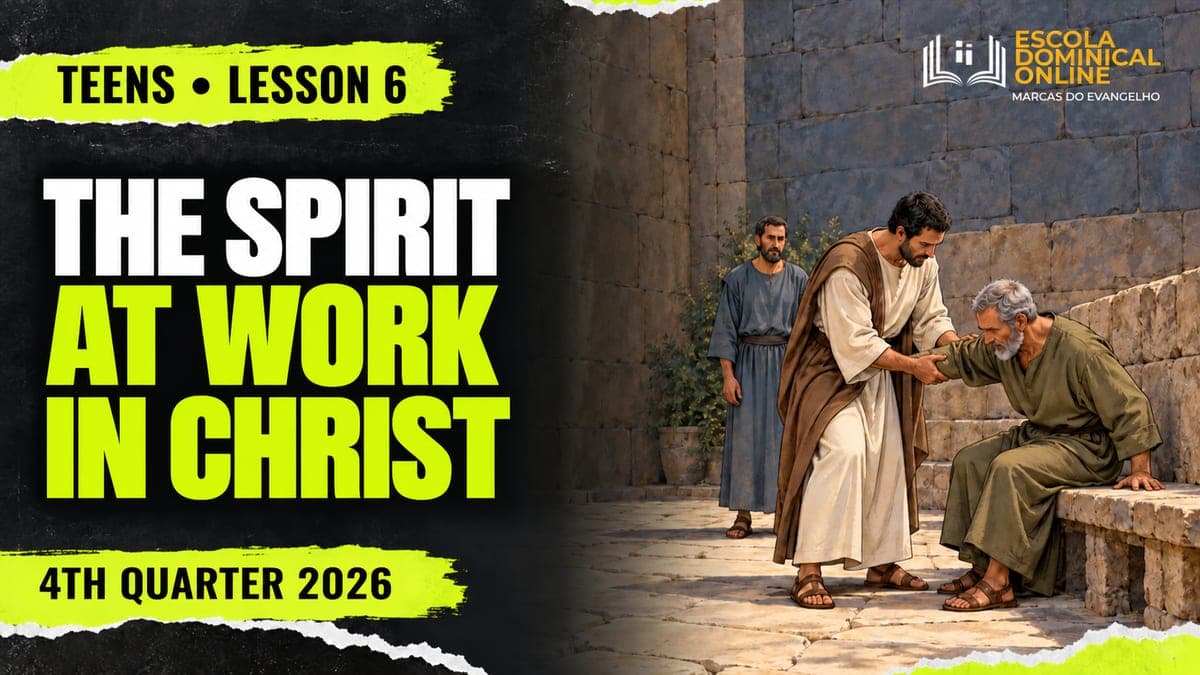
Golden Text
“And this is love, that we walk according to His commandments. This is the very commandment you have heard from the beginning, that you must walk in love.” (2 John 6, BSB) · Read in the Bible
Starting from 2 John, the shortest letter in the Bible, the lesson shows why saying 'no' is part of loving. John writes to a church invaded by teachers who denied that Jesus came in the flesh, and he does two things at the same time: he commands them to love and commands them not to give a platform to error. Love without truth becomes complicity; truth without love becomes cruelty. The lesson closes with the greatest 'no' in history — Jesus' in the wilderness — and the 'yes' He said in Gethsemane.
There is a three-letter word that almost no one wants to pay the price to say. It has two letters and an accent: no.
Notice how this works in your day. Saying "yes" is easy, it is quick, it does not create an awkward silence in the group. Saying "no" changes the mood at the table. Someone raises an eyebrow, someone lets out a "come on, relax," someone says the sentence that hurts the most at your age: "do you think you're better than us?"
And today there is a new accusation, heavier than the old one. It is no longer "you're square." It is "you're intolerant." It is "who are you to judge." Many people your age would rather agree with everything than carry that label — and little by little, they end up agreeing with things they know are harmful.
Today's lesson takes a tiny letter, the shortest in the entire Bible, to answer this exact problem. And the way it answers is rare: instead of choosing between being loving and being firm, it commands both in the same breath. "And this is love, that we walk according to His commandments. This is the very commandment you have heard from the beginning, that you must walk in love." (2 John 6).
In this lesson we are going to understand where this letter came from and the problem it faced, confront the verse in it that is most often misused, and learn what separates saying "no" from becoming a person full of rules.
1. A tiny letter with a huge problem
Second John has thirteen verses. It fits on a postcard. It is the shortest letter in the New Testament, and even so its subject is the size of the entire Christian faith.
The writer is the apostle John, around AD 90, already an old man, when he was a pastor in Ephesus. He writes to a local church in Asia Minor — the region that is modern-day Turkey — and calls that church "the chosen lady."
🏛 Did you know — who is the "chosen lady"? The letter begins like this: "The elder, To the chosen lady and her children, whom I love in the truth — and not I alone, but also all who know the truth —" (2 John 1). Some understand that she was an actual Christian woman, the owner of the house where the church met. But the most widely accepted reading is that the "chosen lady" is the congregation itself, and her "children" are its members. The text helps settle this: the letter speaks to the lady in the singular and right after to you all in the plural, like someone writing to a group. And it closes by sending greetings from the children of her chosen sister (2 John 13) — the sister church where John was. In other words: the church here is called a family, not an institution.
The problem was this: traveling teachers had come into the middle of that church teaching against the person of Jesus. By all indications, they were followers of an early form of Gnosticism — a movement that, among other things, denied that Jesus had been a real human being.
Keep in mind the expression John uses for them, because it is a heavy accusation: "For many deceivers have gone out into the world, refusing to confess the coming of Jesus Christ in the flesh. Any such person is the deceiver and the antichrist." (2 John 7).
2. Love and truth cannot be separated
Before giving any warning, John does two things at the same time — and this is where the letter gets interesting.
He says he loves that church in the truth (2 John 1). He says this happens because of the truth that remains in us and will be with us forever (2 John 2). And then he defines love in a way no one expected: "And this is love, that we walk according to His commandments. This is the very commandment you have heard from the beginning, that you must walk in love." (2 John 6).
Read that slowly. John did not define love as a feeling, or as accepting everything. He defined it as walking.
Ω In the original — Greek. The verb is peripatéo (περιπατέω): literally "to walk around," to go about. In biblical Greek it almost never refers to physical movement; it refers to a way of life, the habitual way a person behaves day to day. "Walking in the truth" is not agreeing with a list of doctrines in your head — it is having your whole life walking in that direction. And the other key word in the letter is agápe (ἀγάπη), the love that decides, that acts, that does not depend on today's mood.
This knocks down at once the two counterfeit versions of the Christian faith, and it is worth naming both:
Love without truth becomes complicity. It is the person who, so as not to displease anyone, watches in silence while a friend destroys himself. That is comfortable, it is well liked, and it is not love — it is fear of losing approval. No one who truly loves keeps smiling while the person they love walks toward a cliff.
Truth without love becomes cruelty. It is the Christian who has all the right answers and no patience, who takes pleasure in correcting, who treats anyone who disagrees as an enemy. That is not the Gospel either — it is pride using a Bible verse as a weapon.
John does not let you keep either of the two. He commands love and he commands not making room for error, in the same letter, in the same paragraph. Both things together, always.
🔬 Our reading. That is why the accusation of "intolerance" must be answered calmly, not angrily. If intolerance means mistreating someone who thinks differently, the Bible forbids that — and when a Christian does that, he is wrong, period. But if intolerance means "believing that right and wrong exist," then no one escapes: the person who accuses you of being intolerant is claiming that your position is wrong, which is the exact same move. The issue was never about having convictions. It is about how you treat the person who disagrees with you.
3. What those teachers denied — and why it reaches all the way to you
The most dangerous claim of those false teachers was this: Jesus was not 100% human. His body was only an appearance, an illusion, a kind of ghost. He looked like a person, but He was not.
That sounds like a debate for specialists. It is not. Look at what falls apart with it if that idea is true.
If Jesus did not have a real body, He was not truly human. If He was not truly human, He could not fulfill all the righteousness of God in our place — because the one who had to die there on the cross was a man, representing mankind. And if there was no real man dying, there is no salvation. The math does not add up.
That is why John is so firm. He was not fighting over a technical detail. He was defending the only door through which you can be saved.
And today's version of this is quieter than it was back then. Almost no one is going to tell you to your face that Jesus did not come in the flesh. What happens is a dilution: short videos, clips, podcast excerpts, and conversations at school that slowly turn Jesus into a nice moral teacher, a revolutionary leader, an inspiring character — anything except God made man who died and rose again. They do not deny Him outright. They just erase Him little by little.
And there is a second layer, even closer to you. Those people separated body and spirit as if the body did not count. Today that same reasoning shows up like this: "what I do with my body has nothing to do with my spiritual life." The letter's answer is direct: the body matters so much that God took one on. The choices you make with your body are not a separate area from your faith.
4. The most misused verse
Now for the most delicate part of the letter. Read carefully, because many people have already used this text to hurt others:
"If anyone comes to you but does not bring this teaching, do not receive him into your home or even greet him. Whoever greets such a person shares in his evil deeds." (2 John 10-11)
If you read this in isolation, through 2026 eyes, you understand something terrible: that the Bible is telling you to slam the door in the face of your neighbor of another religion, refuse to say hello to your atheist classmate, and cut off the relative who does not think like you. That is not what it means. Not even close. To understand it, you need to know two things about the first century.
First: "receiving into your house" meant giving a platform. Back then there were no Christian church buildings. The church met in homes. A traveling teacher who was received into a believer's house gained three things at once: lodging, financial support, and the right to teach the congregation gathered there — the dining room was the pulpit. Receiving that man was not a personal courtesy; it was funding his work and handing him the church's microphone.
Second: "greeting" was a public endorsement. The greeting John is talking about is not a hallway "hi." It was the greeting that declared fellowship in the faith, the equivalent of our "the peace of the Lord" — a declaration that this person was a brother in the faith and could be listened to as such.
Put the two together and the command becomes clear: do not fund, do not host, and do not publicly endorse anyone who denies that Jesus came in the flesh. It is an instruction about who steps up to the church pulpit, not about who sits next to you in the classroom.
So it is worth spelling out in plain words what this text does not authorize:
- It does not authorize you to cut ties with a relative of another religion.
- It does not authorize you to ignore, humiliate, or mistreat an atheist, agnostic, or classmate of any other faith.
- It does not authorize you to abandon a friend who messed up. In fact, that is the opposite of what John commands: for a brother who has fallen, the path is restoration, not rejection.
- It does not authorize you to decide on your own who is a heretic. That is a matter for the church, with its pastor and leadership — not for a teenager in a WhatsApp group.
- It does not authorize rudeness. Nowhere does the Bible trade good manners for firmness.
What it does authorize — and commands — is this: you are not obligated to give space, daily attention, and credibility to someone who works to destroy your faith. That door is yours, and you decide who comes in.
🔬 Our reading. The most honest translation of this for today is not the door of your house: it is the door of your mind. Who has daily access to you? Who speaks into your ear fifteen minutes before you go to sleep? There is a huge difference between living alongside someone who thinks differently — which is good, and is how we love real people — and handing the microphone to someone who is slowly deconstructing your faith. Living alongside, yes. Giving a platform, no.
5. Learning to say "no" (without turning into a list of prohibitions)
Here the lesson comes down to ground level. Because it is not only false doctrines that threaten the Christian life: it is bad company that, in the name of friendship, pulls you away from church; alcohol and drugs offered as a joke; the classmate who invites you to cheat, copy on a test, or join a scheme; and the crooked use of social media, which opens the door to pornography and to a lot of things no one talks about at home.
And the invitation almost never arrives looking like a bad invitation. It arrives looking nice, light, coming from someone who calls himself your friend. That is why the lesson brings up that ancient warning: "There is a way that seems right to a man, but its end is the way of death." (Proverbs 14:12).
The Bible does not deal with this through theory. It shows people. On one side, those who said "no." On the other, those who said "yes."
| Who said NO | What happened |
|---|---|
| Joseph, to Potiphar's wife (Genesis 39:7-8) | He prospered |
| Moses, to Egypt (Hebrews 11:24) | God blessed him |
| Jesus, to the Devil (Matthew 4:11) | The angels ministered to Him |
| Who said YES | What happened |
|---|---|
| Judah, to the prostitute (Genesis 38:15-16) | He was put to shame |
| Aaron, to the golden calf (Exodus 32:4) | He was rebuked |
The lesson also includes Abraham, who had to say "no" to Ishmael and Hagar (Genesis 21:14) — and a note is worth making here: that was not cruelty on Abraham's part, it was obedience to a specific command from God at that moment (Genesis 21:12), and God Himself took care of Ishmael afterward (Genesis 21:20). It is not a model for cutting people off; it is an example of letting go of what God told him to let go of.
Now look at the two most useful "nos" for your age.
Joseph. He was far from his family, far from the watchful eye of anyone who knew him, a slave, with every chance of not getting caught. And his argument was not "I'll get caught." It was: "No one in this house is greater than I am. He has withheld nothing from me except you, because you are his wife. So how could I do such a great evil and sin against God?" (Genesis 39:9). Notice: for Joseph, the problem was not his boss. It was God. And when the harassment stopped being talk and became a hand grabbing his clothes, Joseph did not stay there arguing — he ran out (Genesis 39:12). Remember this, because it is the part we do not like to hear: sometimes the most effective "no" is spoken with your feet. Leaving the conversation, leaving the place, closing the app, walking away. That is not cowardice. It is strategy.
Moses. "By faith Moses, when he was grown, refused to be called the son of Pharaoh’s daughter. He chose to suffer oppression with God’s people rather than to experience the fleeting enjoyment of sin. He valued disgrace for Christ above the treasures of Egypt, for he was looking ahead to his reward." (Hebrews 11:24-26). He had the palace of the greatest superpower in the world in his hands and said no. But notice the reason: it was not because he despised comfort. It was because he was looking at something else — he was looking ahead to the reward. No one lets go of something great for nothing. You let go of it for something greater.
And here we need to say what this lesson is not. It is not a list of prohibitions for you to memorize. Memorized rules do not hold anyone steady; someone who only has rules gives up at the first real pressure. What sustains you is loving the truth so much that you do not want what destroys. Go back to the Golden Text: John defines love as walking in the commandments (2 John 6). In other words, every Christian "no" is the child of a greater "yes." If all you have are the "nos," you are still missing the main thing.
Ω In the original — Greek. Two words show up when John dissects what pulls us down (1 John 2:15-17). Epithumía (ἐπιθυμία): intense desire, strong appetite, lust — the epi in front is an intensifier. The word itself is not bad; the problem is desire out of place, out of time, and out of measure. And alazoneía (ἀλαζονεία): arrogance, boasting, the bragging of someone showing off what he has. In ancient Greek it was used for the street peddler who claimed powers he did not possess. The classic example of this in the Bible is the rich young ruler: he received the most direct invitation anyone has ever received and walked away in silence, because he had great possessions (Matthew 19:22).
And John closes the subject with a warning and a promise. The warning: "Watch yourselves, so that you do not lose what we have worked for, but that you may be fully rewarded." (2 John 8). It is possible to lose what has already been gained — the letter says this in plain words, and that is why being careful matters. The promise comes right after: "Anyone who runs ahead without remaining in the teaching of Christ does not have God. Whoever remains in His teaching has both the Father and the Son." (2 John 9). It is not you holding on to God by the strength of your own fist. It is God giving you grace to persevere — and you cooperating, every day, with that grace.
Christ in the Lesson
All this talk about saying "no" leads to a single scene.
The greatest "no" in history was not spoken by Joseph, or by Moses. It was spoken in the wilderness of Judea, by a hungry man after forty days without food, facing three proposals carefully designed to strike right where human beings give in: the hunger of the body, the dazzle of the eyes, and the vanity of showing off.
And notice how He overcame. It was not by willpower, nor by a speech: it was with Scripture on His lips, three times. "But Jesus answered, “It is written: ‘Man shall not live on bread alone, but on every word that comes from the mouth of God.’”" (Matthew 4:4). "Jesus replied, “It is also written: ‘Do not put the Lord your God to the test.’”" (Matthew 4:7). "“Away from Me, Satan!” Jesus told him. “For it is written: ‘Worship the Lord your God and serve Him only.’”" (Matthew 4:10). And the text ends like this: "Then the devil left Him, and angels came and ministered to Him." (Matthew 4:11).
Keep that detail in mind: He did not argue. He answered and ended it. Someone who already knows what he believes does not need to win any debate to remain standing.
But the lesson does not end in the wilderness. It ends in a garden.
Because the same Jesus who said the greatest "no" in history also said the greatest "yes." In Gethsemane, knowing exactly what lay ahead, He prayed: "Going a little farther, He fell facedown and prayed, “My Father, if it is possible, let this cup pass from Me. Yet not as I will, but as You will.”" (Matthew 26:39).
Right there is the heart of everything. His "no" to the Enemy and His "yes" to the Father are the same decision seen from two sides. And it was because of that "yes" that the cross exists, forgiveness exists, and you are here reading this today.
So when you say "no" this week, know where the strength for it comes from. It is not your own toughness. It is the grace of Someone who already said "no" in your place, and "yes" for you.
Practical Application
Decide beforehand. No one improvises integrity at eleven o'clock at night, in the middle of peer pressure, with everyone watching. Jesus had it is written ready before the tempter spoke. Decide today, with a clear head, what you will not do — and which sentence you will use.
Have a short sentence. "I'm sitting this one out." "I'm not getting into that." "Thanks, but no." No sermon, no long explanation, no speech. The shorter the sentence, the easier it is to say and the less room it leaves for negotiation.
Walk away from the situation. Joseph did not win by arguing; he won by leaving. Getting up from the table, closing the app, leaving the group chat, changing seats — that is not weakness, it is the method the Bible shows working.
If the pressure is heavy, call an adult. If the invitation comes from a group, or if there is any threat, blackmail, or fear involved, it is not for you to handle alone and it is not for you to confront anyone. Say your no, leave, and tell a trusted adult: your mom, your dad, a teacher, a pastor, a youth leader. Courage, at your age, is about your own behavior. The rest is an adult's job.
Guard who has access to you. You do not choose everyone who crosses your path, but you do choose who speaks into your ear every day. Look at the list of accounts you follow and ask about each one: is this drawing me closer to Christ or pulling me away from Him?
And do not confuse firmness with rudeness. You can disagree with someone and still be the kindest person in the room. In fact, that is ordering your life around exactly what John is asking for: love and truth, together, without choosing one over the other.
Closing Prayer
Lord Jesus, thank You that You did not tell me to choose between loving people and remaining in the truth — You taught me to do both at the same time. Give me courage to say "no" when needed, and keep me from saying it with arrogance or contempt for anyone. Help me decide beforehand, with a clear head, what I will not do. And when I do not have the strength, remind me that You already said "no" in the wilderness and "yes" in Gethsemane for me. May I not lose what I have already gained, and may I reach the end walking in the truth. In Your name, amen.
Soli Deo Gloria — Scripture governs; everything else, on its knees.
Frequently asked questions about this lesson
Isn't saying that someone is wrong being intolerant?+
It depends on what you call intolerance. If it means 'mistreating those who think differently,' the Bible forbids that — John, in the very same text, commands us to love. If it means 'believing that not every idea is true,' then everyone is intolerant, including the person accusing you: when someone says you are wrong for believing in Jesus, that person is also claiming that right and wrong exist. The difference is not in having convictions; it is in how you treat those who disagree. Firm conviction and good manners fit in the same person.
2 John 10 commands us not to receive someone into our house or greet them. Do I have to cut off my friends who are not believers?+
No. And it is important to understand this properly. In the first century there was no church building: the church met in homes, and a traveling teacher who was 'received into the house' gained lodging, financial support, and the community's pulpit — he taught from there. And 'greeting' was not a casual hello in the hallway; it was the salutation that declared fellowship in the faith. So John is telling the church: do not fund, do not host, and do not endorse anyone who denies that Jesus came in the flesh. This is about who steps up to the pulpit, not about your atheist classmate, your cousin of another religion, or a friend who made a mistake. With those people, the commandment remains the same: to love.
If God is love, why does doctrine matter so much?+
Because doctrine is the description of who God is. If Jesus did not truly come in the flesh, then there was no real man dying on the cross in our place — and then salvation falls apart. It is not a fight over a technical detail: it is the difference between a Savior and a nice idea. John was not defending an opinion; he was defending the possibility of your being saved.
Everyone has their own truth. Why would yours be worth more?+
The phrase 'everyone has their own truth' contradicts itself: whoever says it expects it to be true for everyone, including you. Truth is not personal taste — everyone has their own favorite ice cream flavor, but whether a medicine cures or kills does not change according to opinion. In John's letter, truth is not even a thesis: it is a Person. Jesus said that He is the way, the truth, and the life (John 14:6). You are not defending your opinion; you are pointing to Someone.
Does saying no mean becoming a joyless person full of rules?+
No, and that is a common confusion. A memorized list of prohibitions holds no one back — anyone who only has rules gives up at the first sign of pressure. What sustains you is loving the truth to the point of not wanting what destroys. Look at the Golden Text: John defines love as walking according to the commandments (2 John 6). The 'no' is the consequence of a greater 'yes.' If all you have are the 'nos,' the main thing is still missing.
What if the pressure comes from a group and I end up alone?+
Then the guidance is simple and not heroic: you do not need to confront anyone head-on. Say your short line, leave the situation, and tell a trusted adult — your father, mother, teacher, pastor, or leader. Facing a group alone is not courage; it is a risk. Courage, at your age, is about your own behavior: not going along with it. The rest is a matter for adults. Jesus, in the wilderness, did not argue with the tempter either — He answered and ended it.
Teacher's Guide
Essence of the class
Saying "no" to what destroys is not intolerance: it is the other half of love — and the strength for it comes from Christ, who said the greatest "no" in the wilderness and the greatest "yes" in Gethsemane.
Map of the class
| Time | Stage |
|---|---|
| 0–5 min | Opening (the three-letter word) |
| 5–14 min | Point 1 — Love and truth cannot be separated |
| 14–22 min | Point 2 — The most misused verse (2 John 10-11) |
| 22–31 min | Class activity — "The invitation on the table" |
| 31–38 min | Point 3 — Who said no, who said yes |
| 38–42 min | Christ in the Lesson + hard questions |
| 42–45 min | Wrap-up + challenge of the week + prayer |
Start like this
Start by asking: "When was the last time you said 'no' and felt like you were going to pay a high price for it?" Let two or three students answer — and make it clear beforehand that no one needs to say what it was about; they can just say whether it was hard or not. You will hear things like "everyone gave me a dirty look," "they called me square," "I pretended I didn't hear." Then say: "Today there is a new word for that. It is no longer square. Now it is intolerant." Let the word hang in the air for two seconds and open the Bible to 2 John. "This letter has thirteen verses. And it answers that accusation in a way almost no one expects."
Point 1 — Love and truth cannot be separated
- In the quarterly: topic 1 ("Introduction to the epistle," sub-items 1.1 and 1.2).
- What to teach: 2 John was written around AD 90, from Ephesus, to a church in Asia Minor called the "chosen lady," which had false teachers in its midst. John weaves two themes together the whole time: love and truth. And he defines love as walking in the commandments, not as a feeling or as accepting everything. Say the two counterfeit versions out loud: love without truth becomes complicity; truth without love becomes cruelty.
- Anchor verse (BSB): "And this is love, that we walk according to His commandments. This is the very commandment you have heard from the beginning, that you must walk in love." (2 John 6).
- Key question: "If loving means accepting everything a person does, what do we do with a friend who is destroying himself?"
- Likely answers (+ going deeper): "you have to warn him," "it's none of my business," "everyone knows what they're doing." Go deeper: "What if it were the other way around? Would you rather have your best friend warn you, or stay quiet so as not to upset you?"
- If no one speaks: share first, with a simple example and without naming anyone in the class — someone who stayed silent out of fear of ruining a friendship and later regretted it. Then go back to the Greek: peripatéo is walking, a way of life, not an opinion kept in your head.
Point 2 — The most misused verse
- In the quarterly: topic 3 ("Do not lose your reward," sub-item 3.2), which covers 2 John 9 and 10.
- What to teach: this is the most important point of the class in terms of pastoral care. Read 2 John 10-11 aloud and say right away: "If we read this the wrong way, people will walk out of here thinking the Bible tells us to mistreat our neighbor. It does not." Explain the two keys: (1) in the first century the church met in homes, and "receiving into your house" a traveling teacher meant hosting, supporting, and giving the pulpit to him; (2) "greeting" was the salutation that declared fellowship in the faith, a public endorsement. Conclusion: the text forbids funding and endorsing someone who denies that Jesus came in the flesh. It is not a license to cut off a relative of another religion, an atheist classmate, or a friend who messed up. Say that whole sentence out loud — do not leave it implied.
- Anchor verse (BSB): "If anyone comes to you but does not bring this teaching, do not receive him into your home or even greet him." (2 John 10).
- Key question: "What is the difference between living alongside someone who thinks differently and handing that person the microphone?"
- Likely answers (+ going deeper): "living alongside is normal," "I don't know," "I think it's the same thing." Go deeper: "You have classmates who don't believe and are still your friends, right? That is living alongside — and it is good. Now, what about the account you watch every night before going to sleep that keeps tearing down what you believe? What did that person get from you?"
- If no one speaks: give the example yourself. "I live and work alongside people who think completely differently from me, and that does not threaten me at all. What would harm me is if I spent two hours a day listening to someone convince me that Jesus is not who He says He is." Then ask again.
Point 3 — Who said no, who said yes
- In the quarterly: topic 2 ("Learning to say 'no,'" sub-items 2.1 to 2.3) and the chart with the biblical examples.
- What to teach: walk through the chart in the quarterly: Joseph said "no" to Potiphar's wife and prospered; Moses said "no" to Egypt and God blessed him; Jesus said "no" to the Devil and the angels ministered to Him. On the other side, Judah said "yes" and was put to shame; Aaron said "yes" to the calf and was rebuked. Highlight two details: (1) Joseph did not stay arguing to the end — he ran out (Genesis 39:12); (2) Moses left the palace because he was looking at something greater, not because he despised comfort. And close with the warning: this lesson is not a list of prohibitions. Every Christian "no" is born out of a greater "yes."
- Anchor verse (BSB): "No one in this house is greater than I am. He has withheld nothing from me except you, because you are his wife. So how could I do such a great evil and sin against God?" (Genesis 39:9).
- Key question: "Joseph didn't say 'I'll get caught.' He said 'how could I sin against God?' What changes when we think that way?"
- Likely answers (+ going deeper): "it changes because God always sees," "then hiding doesn't help," "it carries more weight." Go deeper: "If your only reason is not getting caught, what happens on the day you are sure no one will ever find out?"
- If no one speaks: read Genesis 39:11-12 aloud, slowly, and make just this comment: "Notice that the Bible recorded running away as a victory. There was no speech. He left his garment behind and got out."
Class activity
- Goal: practice the "no" sentence before needing it — without any student having to confess anything about their own life.
- Materials: six folded slips of paper, written before class, and a pen for each pair of students. Suggestions for the slips: "give me the answer to the test, no one will know" · "come on, it's just one sip" · "post that, it'll blow up" · "watch this video, it's real quick" · "tell them you were with me, your parents won't even suspect" · "stop being such a goody-goody, everyone does it".
- Step by step: set one clear rule before starting: "we are going to answer the slip of paper, not anyone's personal life. No one here is going to share anything they have done." A volunteer draws a slip and reads it aloud. The whole class — together, not a singled-out student — comes up with one short sentence of refusal: five words at most, polite and firm. Write the sentence on the board. Go through three or four slips, at the class's pace. After each sentence, ask just two more questions: "and how do you walk away from that situation?" and "in which of these cases do you need to tell an adult?"
- Wrap-up (back to the text): "Notice what we just did: we prepared the answer before we needed it. That is exactly what Jesus did in the wilderness — He already had it is written on His lips when the tempter arrived (Matthew 4:4, 7, 10). And notice this too: He did not argue, He did not set up a debate. He answered and ended it. Someone who knows what he believes does not need to win an argument to remain standing."
If they ask you this
- Question: "Aren't you Christians intolerant? Who are you to say I'm wrong?" Short answer: Separate the two things. If intolerance means mistreating someone who thinks differently, the Bible forbids that — and any Christian who does that is wrong. But if intolerance means "believing that right and wrong exist," then everyone is intolerant, including the person making the accusation: saying that my position is wrong is the exact same move. Having convictions is not the problem; the problem would be mistreating you. And John commands both things together: to love and to remain in the truth.
- Question: "Does that Bible of yours tell you not even to talk to me because I'm not a believer?" Short answer: No. If someone told you that, they read 2 John 10 out of context. Back then the church met in homes; "receiving into your house" a traveling teacher meant hosting, supporting, and handing the pulpit to him, and "greeting" meant publicly declaring that the person was a brother in the faith. John is telling the church not to fund or endorse anyone who denies that Jesus came in the flesh. It has nothing to do with talking to, living alongside, or being friends with someone who does not believe. Say this in class in plain words — there is always someone ready to misuse this verse.
- Question: "Everyone has their own truth. Why is yours worth more?" Short answer: That sentence contradicts itself — whoever says it expects it to be true for everyone. Truth is not personal taste: whether a medicine cures or kills does not change according to each person's opinion. And in John's letter, truth is not even a thesis: it is a Person (John 14:6). I am not defending my opinion; I am pointing to Someone.
- Question: "If Jesus loved everyone, why does the church keep excluding people?" Short answer: When the church excludes people out of prejudice, it is wrong and needs to repent — that is not the Gospel. What the Bible addresses in 2 John is something else: someone who publicly teaches against the person of Christ should not be given the pulpit or the financial support of the church. That is protecting the flock, not driving away those who have doubts. In fact, anyone who has doubts is welcome here — you can ask whatever you want.
Wrap-up + challenge of the week
- Wrap-up: "John did not ask you to choose between loving people and standing firm in the truth. He asked for both, in the same letter, in the same paragraph. And the ultimate example of this is not Joseph or Moses: it is Jesus. He said the greatest 'no' in history in the wilderness and the greatest 'yes' in history in Gethsemane — not as He willed, but as the Father willed. It was because of that 'yes' that the cross exists, forgiveness exists, and we are here today. So the strength to say no this week does not come from you. It comes from Him."
- Challenge: this week, write on a piece of paper — or in your phone's notes app — the exact sentence you are going to use to say "no" to one specific thing you already know is going to show up. Write alongside it the Bible verse you are going to lean on. Then tell one trusted person what your decision was. On Sunday, come back with the story.
- How to follow up on Sunday: open the class by asking who wrote the sentence and who they told. Do not ask whether the student "succeeded" or what the temptation was — the assignment is to decide and write the sentence, not to confess sin. If someone wants to share more, let them; if no one wants to, move on without putting anyone on the spot. And if a student opens up about something serious, receive them warmly without asking for details in front of the class — "thank you for trusting me, let's talk after class" — and bring it to the church leadership that same day.
Teacher's kit
- Before: read all of 2 John (it is thirteen verses, it takes two minutes) and the topic in the quarterly. Also read Matthew 4:1-11 and Matthew 26:36-46, because the lesson closes with both. And prepare your own answer to "you Christians are intolerant" — that question will come up, and the worst-case scenario is the teacher freezing on it.
- Bring: a Bible, the six folded slips of paper for the class activity already written at home, and pens and paper for the class. Bring extra Bibles: not every student has their own.
- Pray beforehand: ask for wisdom to teach firmness without putting ammunition into the hands of a teenager. The risk of this lesson is not the class becoming too soft; it is someone walking out of here thinking they have permission to mistreat people who think differently. Pray that the class leaves firmer and kinder.
Homework
Your mission for the week
Write on a piece of paper — or in your phone's notes app — the exact sentence you are going to use to say "no" to one specific thing you already know is going to show up this week. Keep it short, polite, and firm: five words at most. Write underneath it the Bible verse you are going to lean on. Then tell one trusted person what your decision was.
Why
No one improvises integrity in the middle of pressure. Jesus already had it is written on His lips when the tempter came in the wilderness — He answered and ended it, without arguing (Matthew 4:10-11). And John reminds us that loving means walking in the commandments: "And this is love, that we walk according to His commandments. This is the very commandment you have heard from the beginning, that you must walk in love." (2 John 6). Whoever decides beforehand does not have to decide on the spot.
How to know you did it
There is a written sentence, with a verse underneath it, and there is one person who knows what it is. If both exist, you did it.
On Sunday, come back with the story
The next class opens with those who wrote it down. Bring the paper — no one is going to ask you what the temptation was, only what sentence you prepared.