Golden Text
“For we do not have a high priest who is unable to sympathize with our weaknesses, but we have one who was tempted in every way that we are, yet was without sin.” (Hebrews 4:15, BSB) · Read in the Bible
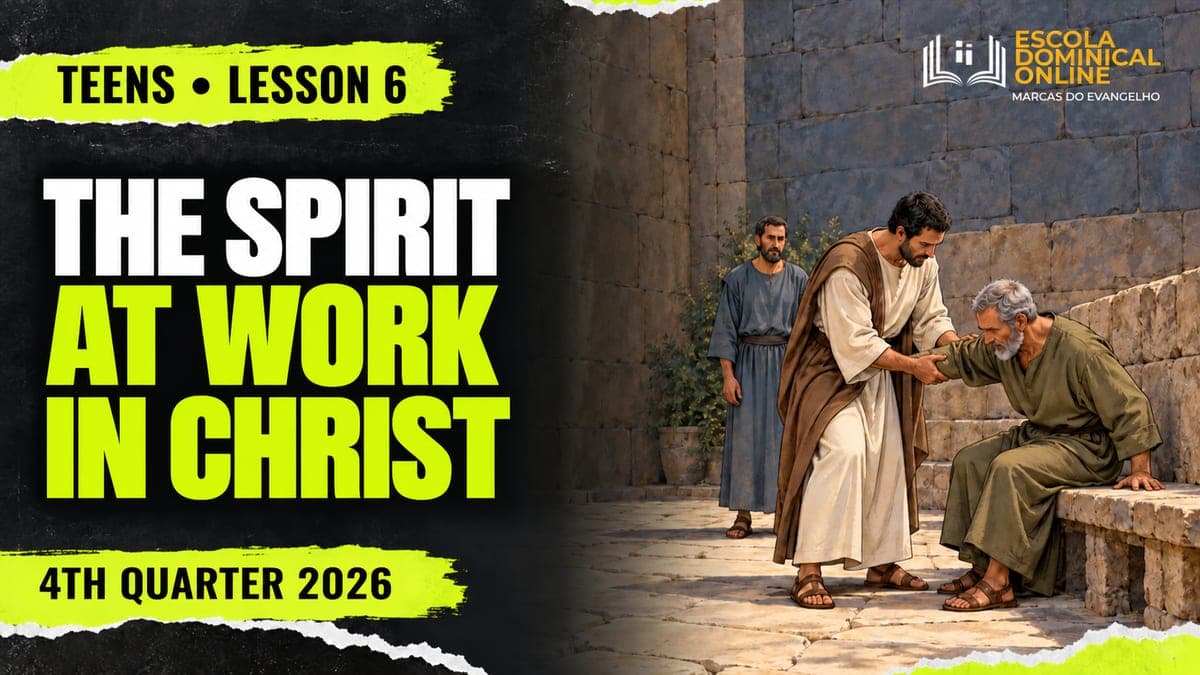
Jesus did not come down to Earth disguised as a person: He was truly human, felt hunger, tiredness, and sadness, and was tempted in every way — yet He never sinned. That is why He is our great High Priest, able to understand your weaknesses and bring you with confidence to the throne of grace.
Imagine being invited to a party and showing up dressed completely wrong — all dressed up in formal wear at a child's birthday party, or in shorts and flip-flops at a graduation. Awkward, isn't it? We know there is a right way to arrive at every place. Well, that is exactly what the Bible shows about Jesus: He knew how to come to us. He did not come as a distant superhero or disguised as a person. He came as a poor little baby, in a manger, and lived a truly human life.
The whole quarter studies the General Epistles, from Hebrews to Jude, with a theme that runs through everything: Jesus is superior to everything and everyone. And today's lesson shows a surprising side of that superiority. The Epistle to the Hebrews proves that Jesus is God — yet it also makes a point of showing that He was just as human as you are. He felt hunger, tiredness, sadness. He was tempted in every way. There is only one difference: He never sinned.
And here is the good news of this lesson: because He was truly human, Jesus understands you. He knows your struggles from the inside; He knows what it is like to want to do what is right and feel that it is hard. Today, at the Father's side, He is our great High Priest — the perfect bridge between you and God. Let us discover what this changes in your life.
1. The Great High Priest, human like us
1.1. What is a high priest?
In Bible times, the priest was the person who served as an intermediary between humanity and God: he offered the sacrifices, prayed for the people, gave counsel. There were many priests. But there was one who was the chief of them all: the high priest, that is, "the greatest of the priests."
Notice an important distinction the Bible makes. The prophet was the "bridge" that brought God's message to the people. The priest — and especially the high priest — was the "bridge" that brought the people to God. In Hebrews 4:14, Jesus receives an even greater title: He is called a great high priest. He is not just one more; He is the perfect intermediary.
🏛 Did you know? In the Old Testament, the high priest could only enter the most sacred place of the tabernacle — the "Holy of Holies" — once a year, and even then carrying the blood of animals to pay for his own sins and the sins of the people. It was a serious ritual, full of care. Jesus changed all that: He entered the presence of God once and for all, not with the blood of animals, but by offering Himself.
1.2. Great in compassion
Now comes the part that changes your day. Hebrews 4:15 says that our great High Priest has compassion on us. To have compassion (to sympathize) means "to suffer together," "to feel with." In other words: Jesus does not look at your difficulties from afar, with His arms crossed. He knows what you are going through because He went through it Himself.
The text says that Jesus was tempted in every way, yet without sin. Pay attention to these two parts. Tempted in every way — He knows firsthand the force of a temptation, the urge to do what is wrong, peer pressure from friends, fear, anger. Yet without sin — He never gave in. That is wonderful: we have before God a mediator who completely understands our failings (though He does not agree with them) and who has already experienced victory over sin — including over those "weak spots" that trip us up the most.
❤ For your life. Have you ever had one of those days when you felt nobody understood you? Not your parents, not your friends? Hold on to this: there is Someone who understands. Jesus is not a distant God who only makes demands. He was a teenager, He was tempted, He felt firsthand what it is like to be human in a difficult world. When you pray, remember: on the other side is Someone who suffers with you and is rooting for you.
1.3. The Throne of Grace
After showing that we have such a High Priest, the writer of Hebrews adds in 4:16: do not be afraid to approach the throne of grace!
That is surprising. In many parts of the Bible, coming before a "throne" was a dangerous thing, because there you would be judged for your wrongs (Proverbs 20:8; Revelation 20:11). But the throne of grace is different: there, through the merits of Jesus, we find mercy and grace to keep standing firm on the journey. When we come to this throne, we are not condemned — we receive an embrace from the Father.
Do you know who discovered that throne? The prodigal son. After spending everything and coming back ashamed, he expected to be treated like a hired servant. But the Bible says: "So he got up and went to his father. But while he was still in the distance, his father saw him and was filled with compassion. He ran to his son, embraced him, and kissed him." (Luke 15:20). That is how God receives anyone who draws near through faith in Jesus.
2. He was human like us
2.1. "For it was fitting for us"
As we have already seen, the high priest entered the Holy of Holies once a year carrying the blood of animals to pay for sins. But there was a huge problem: those rituals did not solve once and for all the problem of sin. They had to be repeated year after year.
That is why Hebrews 7:26 says that such a High Priest was fitting for us — that is, suitable, appropriate, exactly what we needed. We needed Someone perfect, who would set us free from rituals that could not get the job done. But where could we find that perfect person, if all have sinned (Romans 3:23)? The answer could only come from one place: from Heaven. And that is what happened. Jesus, being God, came down and took on a complete human nature.
🕊 Our reading. Philippians 2:7-11 shows that Jesus, by His own decision, emptied Himself — self-limiting the use of His divine power — to live as a man among us. Nobody took anything from Him by force; it was love and humility. He is 100% God and 100% man at the same time. That is the only way there can be a perfect bridge between Heaven and Earth: Someone who reaches both sides.
2.2. Once for all
Here is the heart of the difference. When He died on the cross, Jesus shed His own blood as payment for our sins (Hebrews 9:11-14). And He did this once for all (Hebrews 7:27).
Do you see how huge this is? The old sacrifices had to be repeated endlessly. The sacrifice of Jesus was made once and counts forever. There is no longer any need for the death of animals. The merits of what Christ did for us are permanent. What remains for you and me? To believe in the work of salvation and, through the power of the blood of Jesus, to receive purification from sins to serve the living God.
2.3. The "sea of forgetfulness"
There is a feeling that often weighs heavily on our hearts: remembering the sins we have already committed (and the ones we still struggle with) and thinking, "I do not deserve to approach such a holy God."
And it is true — on our own, we deserve nothing more than the consequence of sin (Romans 6:23). But the merits of our salvation are not ours: they belong to Jesus. And the Bible uses a beautiful image: sin forgiven by the blood of Christ is cast into the "sea of forgetfulness." God says that He blots out our transgressions and remembers our sins no more (Micah 7:18, 19; Isaiah 43:25). When God forgives, He does not keep holding against you what Jesus has already paid for.
❤ For your life. At your age, it is common to keep dwelling on a mistake, feeling like the worst person of all. Hold on to this truth: if you handed that sin over to Jesus and asked for forgiveness, God threw it into the "sea of forgetfulness." Stop fishing back up what God has already sunk. God's forgiveness is real forgiveness.
3. A perfect humanity
3.1. Jesus, the perfect One
Among the Hebrews, the high priest was the chief religious minister, the only one who could perform the ritual of atonement for the sins of the people. Yet there was one detail: he was also an ordinary man, full of the same imperfections as everyone else. He sinned too.
The priesthood of Jesus is completely different — it is superior. Hebrews presents Him as being in the order of Melchizedek, without beginning of days or end of life (Hebrews 6:20; 7:3). That is: a divine, perfect, eternal priesthood. The priesthood of Christ replaces the earthly priesthood (Hebrews 9:11). That is why we do not need to appeal to any earthly intermediary to obtain forgiveness: we have in Christ the ideal representative before God, the One who can sympathize with us. Christ understands you and sees your effort to do what is right. In return, He expects you to hold fast your confidence (Hebrews 3:6) — that is, not to abandon the faith.
3.2. The perfect person
God asks a high standard of us: He commanded Abraham to walk blamelessly (Genesis 17:1), and Jesus said something similar (Matthew 5:48). But here an honest question hits us: how can we be perfect if we keep making mistakes?
The apostle Paul himself lived through this conflict. He wrote: "I do not understand what I do. For what I want to do, I do not do. But what I hate, I do." (Romans 7:15). Who has never promised not to repeat a mistake and then repeated it? Or failed to do the good they wanted to do? That is the condition of all human beings: we are born with moral shortcomings.
And this is where Jesus becomes incredible. He faced the same situation — He lived as a man, surrounded by temptations — yet He never did wrong. As a true man, He knew our imperfections up close and discovered in practice how hard it is to be righteous in this world. And it was precisely by experiencing human nature without sinning that He became the perfect High Priest.
Pay attention to an important point: this is not an excuse for us to accept sin as something natural. Our constant concern must be not to sin. But if we fail, we are not alone: "My little children, I am writing these things to you so that you will not sin. But if anyone does sin, we have an advocate before the Father — Jesus Christ, the Righteous One." (1 John 2:1).
3.3. The impossible made possible
Hebrews 10:4 is direct: it is impossible for the blood of animals to take away sins. That was the great problem in the relationship between humanity and God — sin separated us from Him (Isaiah 59:2), and no sacrifice on Earth could solve it.
That is where Jesus comes in, the Lamb of God who takes away the sin of the world (John 1:29). He did what was impossible for anyone else: He made the impossible possible. What bulls and goats could never accomplish, the perfect blood of Christ accomplished once and for all. That is the superiority of Jesus that the entire quarter celebrates.
Christ in the Lesson
This whole lesson is about Jesus — and His superiority appears in a beautiful way here. Hebrews 4:14 calls Him a great High Priest, Jesus (His human name), the Son of God (the divine title). In a single verse, both natures: human and divine.
Why does this matter so much? Because no priest on Earth could truly save us — all of them were sinners. Christ is superior precisely because He meets all the requirements of God's justice at the same time. He is 100% human — He felt thirst, hunger, tiredness, He wept, He was tempted — and therefore He understands you. And He is 100% God — holy, innocent, undefiled, and exalted (Hebrews 7:26) — and therefore He can truly save you.
An ordinary priest comes and goes, dies and is replaced. Jesus has been made perfect forever (Hebrews 7:28) and lives eternally to intercede for you. He is not the best option among many: He is the only bridge, and He is a perfect bridge. That is why the quarter insists: in everything, Christ is superior.
Application
In the hour of temptation. When that urge to do what is wrong hits you, remember that Jesus went through it and overcame. And He overcame not by hiding the power of God, but by using the Word and depending on the Father. You do not fight alone: the same Jesus who overcame is with you.
In the hour of guilt. Made a mistake? Do not run away from God — run to Him. The throne where Jesus is seated is the throne of grace, not of condemnation. Confess, ask for forgiveness, and believe: sin handed over to Christ goes into the "sea of forgetfulness."
When it comes to valuing Jesus. We do not need human intermediaries, amulets, or shortcuts to reach God. We have Jesus, the perfect High Priest. That should fill your heart with gratitude and confidence every time you pray.
Closing Prayer
Lord Jesus, thank You because You did not stay far from us: You became a man, You felt hunger, tiredness, and sadness, You were tempted in every way — and even so, You never sinned. Because of that, You truly understand me. Thank You for being my great High Priest, the perfect bridge between me and the Father. Help me to run to Your throne of grace when I make a mistake, instead of running away in fear. And teach me to trust that the sin I hand over to You is cast into the sea of forgetfulness. May I live in gratitude because You understand me and save me. In Your name, amen.
Soli Deo Gloria — Scripture governs; everything else, on its knees.
Frequently asked questions about this lesson
What does it mean that Jesus is our High Priest?+
A priest was the person who served as the link between the people and God, presenting sacrifices and prayers. The high priest was their leader. Hebrews calls Jesus the great High Priest (Hebrews 4:14): He is the only perfect intermediary between you and God, a position He attained by offering Himself on the cross. We do not need any other earthly mediator.
If Jesus was God, how could He have been tempted like us?+
Jesus is 100% God and 100% man at the same time. Without ceasing to be God, He lived a truly human life: He experienced hunger, thirst, and tiredness, He wept, and He was tempted by the Devil in every way (Hebrews 4:15). The difference is that He never gave in to sin. That is why He truly understands our struggles — He went through them and overcame.
What is the throne of grace in Hebrews 4:16?+
In the Bible, coming before a throne normally meant being judged for your mistakes. But the throne of grace is different: because of the merits of Jesus, anyone who approaches it does not receive condemnation, but mercy and help at the right time. It is like the father of the prodigal son, who ran to embrace his son instead of punishing him (Luke 15:20).
Why is the sacrifice of Jesus better than animal sacrifices?+
Hebrews 10:4 says that it is impossible for the blood of bulls and goats to take away sins — they only covered the problem for a time, year after year. Jesus, the Lamb of God, offered Himself once for all (Hebrews 7:27). His sacrifice is perfect and permanent: anyone who believes in Him receives complete forgiveness and does not need any other sacrifice.
Teacher's Guide
Opening class activity (suggested by the quarterly): start by asking the class whether they would go to a child's birthday party dressed in super-elegant formal wear. Nobody would — it would be awkward. Use this to explain: there is a right way to "show up," and Christ knew it. He did not come as a distant and unapproachable king; He came humbly, as a poor baby, self-limiting the use of His divine power (Philippians 2:7-11) to come very close to us. If you can, set up a board with the outline "Jesus — True Man" and ask the students to read the references: the Bible calls Him a man (Acts 2:22; 1 Timothy 2:5), He was born like anyone else (Luke 2:7), and He had a family, a name, a genealogy, a profession, and fulfilled His duties in society (Matthew 1:21; Matthew 13:55; Matthew 17:24-27).
Five questions for the class:
- What is the difference between the prophet and the priest in being the "bridge" between God and the people?
- What does it mean to say that Jesus sympathizes with our weaknesses? Why is He able to do so?
- Why is the throne of grace (Hebrews 4:16) different from the other thrones in the Bible?
- Why is the sacrifice of Jesus "once for all" superior to animal sacrifices?
- How can the truth "Christ Understands You" help you the next time you are tempted or feel guilty?