Golden Text
“In those days there was no king in Israel: every man did that which was right in his own eyes.” (Judges 21:25, KJV) · Read in the Bible
The book of Judges closes without a hero, without a victory, and without a happy ending. It closes with a people who wept before God but did not ask God, who kept worship going while mercy walked out, and who tried to fix one tragedy with three others. And it closes with a sentence that is a diagnosis: there was no king. This final lesson of the quarter reads this rock bottom with sobriety — without softening what was a crime and without turning horror into a spectacle — and shows where the entire book was pointing: the King who was missing has arrived, reigns, and is coming back.
The book of Judges ends without a hero, without a victory, and without a happy ending.
No final chapter with the people gathered together, no one holding a banner, no pretty closing line. The book simply stops — and the last thing it says is not a conquest, it is a diagnosis:
"In those days there was no king in Israel: every man did that which was right in his own eyes." (Judges 21:25)
That sentence appears four times in the final chapters, like someone repeating a warning for those who did not hear it the first time. And it closes the book at its darkest point: a tribe cut off from within, an Israelite city wiped out over an attendance roll, young women taken by force during a religious feast — and, in the middle of it all, the people worshipping as usual.
First of all, we must state what we are reading. These chapters narrate without approving. There is no model to imitate here, nor a divine command behind every decision of the people. There is a portrait — and the portrait is an indictment. God is not the author of what men did there. When the Bible records a crime, it is not recommending it; it is showing where a nation ends up when it replaces the judge of its own conscience.
And the last lesson of the quarter does not end there. It ends right where the book had been pointing since the first chapter: a king was missing. Not one more military chieftain, not one more charismatic judge — a King. The rest of the Bible is the story of that King arriving.
I — Vengeance and civil war among the people of God
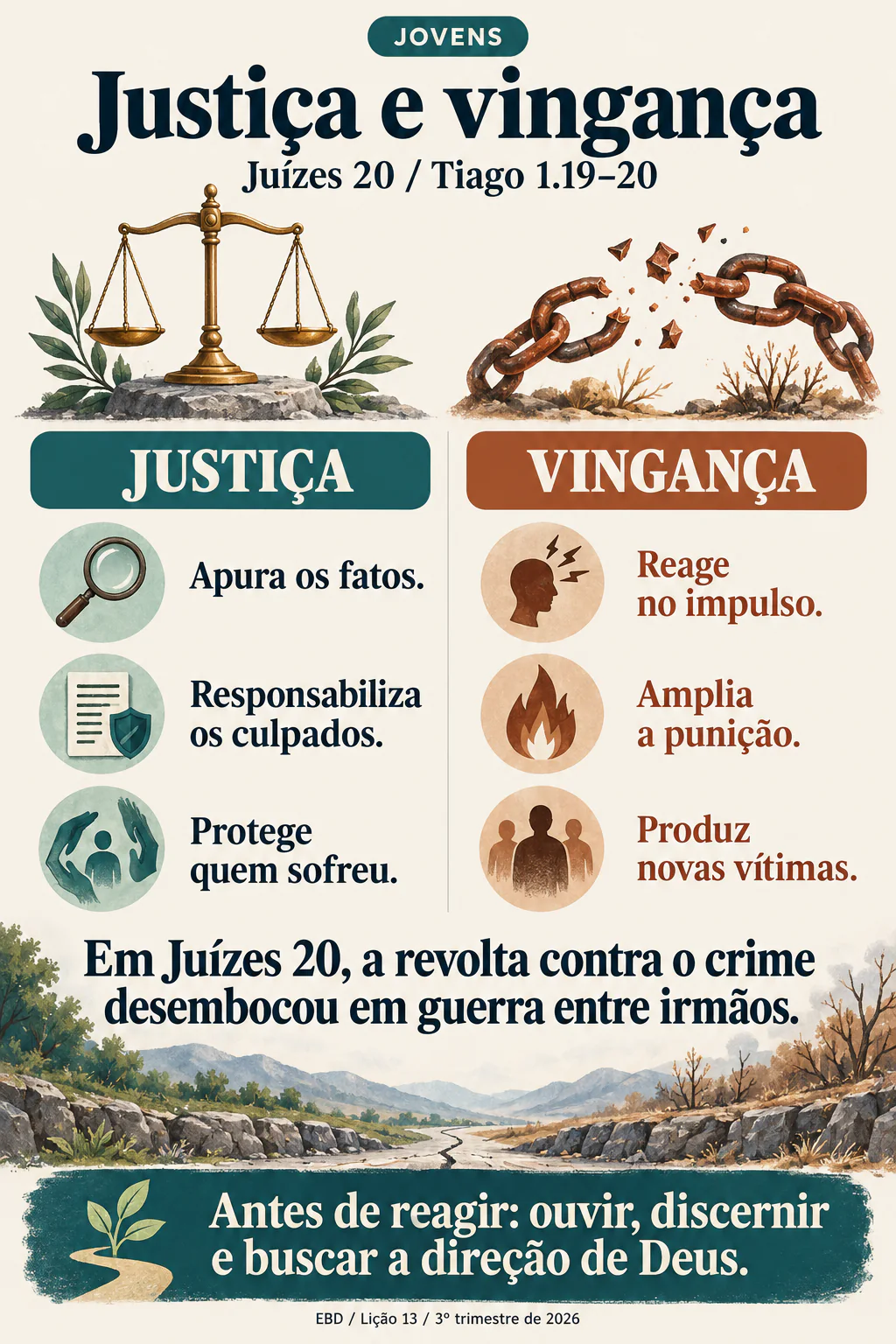
The outcry was just. What came after was not.
The crime committed by the men of Gibeah caused a national outcry, and Israel organized to punish the guilty. It is important to state this clearly, because the lesson is not about indignation being wrong: the outcry was just. What happened in that city was a crime, and crime calls for justice. God never commanded His people to remain indifferent in the face of evil.
The mistake does not lie in wanting justice. The mistake lies in what came after.
And there is an irony that the text makes a point of underlining. The tribes rose up as one man — an impressive national unity. Except that this unity had never appeared when the enemy was from outside. Chapter after chapter, the book shows foreign oppression and disjointed tribes. The first time Israel marched together was against a tribe of Israel itself.
That people did not lack strength. They lacked the will to use their strength at the right time.
🔬 Our reading — indignation is fuel, not a compass. It moves you, but it does not know where to go. It is the easiest thing in the world today: a piece of news appears, outrage rises, the group boils over, someone has to pay — and no one asks whether the path that outrage is pointing to is the path of God. Israel was right in the cause and destroyed everything anyway. Scripture knows this mechanism and provides the brake: "Wherefore, my beloved brethren, let every man be swift to hear, slow to speak, slow to wrath:" (James 1:19). And it completes the reason: "For the wrath of man worketh not the righteousness of God." (James 1:20). It is not coldness — it is a brake. There is a place reserved for vengeance, and it is not yours: "Dearly beloved, avenge not yourselves, but rather give place unto wrath: for it is written, Vengeance is mine; I will repay, saith the Lord." (Romans 12:19).
Benjamin chose the team instead of justice
Before any attack, Israel demanded that the guilty be handed over. It was a concrete and just request: "Now therefore deliver us the men, the children of Belial, which are in Gibeah, that we may put them to death, and put away evil from Israel. But the children of Benjamin would not hearken to the voice of their brethren the children of Israel:" (Judges 20:13)
Benjamin refused.
Notice the scale of that choice. Not a single Benjamite outside Gibeah had committed the original crime. Their sin was another: protecting those who had committed it. Tribal loyalty spoke louder than the recognition of justice, and an entire tribe preferred to go to war rather than hand over a handful of criminals.
The Bible treats both sides with the same weight: "He that justifieth the wicked, and he that condemneth the just, even they both are abomination to the LORD." (Proverbs 17:15)
And the New Testament goes a step further. After listing all kinds of evil, Paul writes about those who know the judgment of God and not only practice such things themselves, but also take pleasure in those who practice them (Romans 1:32). To consent is to know and let it pass.
❤ For your life — protecting the wrong on your side seems cheaper. It is the choice that repeats itself every day, and almost never with that face. It is the friend who crossed the line and you downplayed it because he is your friend. It is the co-worker who did something ugly and you did not want to cause trouble. It is the brother in the church whom everyone knows about and no one speaks up about. It is the relative who humiliates his wife at family gatherings and the whole family pretends it is just his way. Benjamin was not defending the crime. He was defending the team. That is how it almost always happens — and that is why you can do it without thinking of yourself as evil. Ask the honest question: in what situation in your life today is it easier to defend your own than to defend what is right? And when you answer, remember that silence there is not neutral. The text calls it complicity.
Four hundred thousand against twenty-six thousand — and Israel lost
Israel gathered about four hundred thousand men. Benjamin had about twenty-six thousand seven hundred. Fifteen to one. And in the first two battles the Israelites were defeated, with enormous losses — tens of thousands of men in two days, with right on their side.
How? Because, as the lesson says, without divine direction, numbers are not a sign of strength.
And notice what they asked in the first inquiry. It was not "should we go?". It was: "And the children of Israel arose, and went up to the house of God, and asked counsel of God, and said, Which of us shall go up first to the battle against the children of Benjamin? And the LORD said, Judah shall go up first." (Judges 20:18). The decision had already been made; they went to God to ask for the marching order. Then they wept and asked again (Judges 20:23). Only on the third day does something else appear in the text — fasting, genuine mourning, burnt offerings, and peace offerings before the Lord (Judges 20:26). Then the strategy changed, and the narrator makes a point of saying whose victory it was: "And the LORD smote Benjamin before Israel: and the children of Israel destroyed of the Benjamites that day twenty and five thousand and an hundred men: all these drew the sword." (Judges 20:35).
The order matters: they turned to God, obeyed, and only then did the strategy change. Never the other way around. Strategy without direction is organized guesswork.
אב In the original — "son of the right hand", and the elite were left-handed. The name Benjamin comes from ben-yamin, "son of the right hand" — the name Jacob gave his youngest son (Genesis 35:18). "Right hand" in Hebrew carries the idea of strength, honor, and a place of prominence. And the elite troop of that tribe, the text informs us, was something else: "Among all this people there were seven hundred chosen men lefthanded; every one could sling stones at an hair breadth, and not miss." (Judges 20:16). Yes, they were left-handed — not ambidextrous, as is sometimes said. Men of absolute precision, trained, chosen, the best at their craft. And they were on the wrong side. Keep the conclusion, because it aims straight at your age of life: talent is not approval. A gift used to defend what is wrong saves no one — it only speeds up the fall. Being very good at what you do is a blessing from God; it is not a sign that God approves of what you are doing with it.
This bloody chapter shows what sin is capable of causing within the people of God themselves: division, war, and spiritual death, compromising the mission. A people at war with itself proclaims nothing to anyone. It is a direct warning for the church today — that all should speak in agreement and that there should be no divisions among them (1 Corinthians 1:10) — and it is worth remembering where James says wars among brothers come from: not from outside, but from the passions that wage war within each person (James 4:1, 2).
II — Israel's hypocrisy: decisions without wisdom, religion without mercy
Four decisions, one after another
Once the war was over, Israel realized the scale of the damage and mourned the near extermination of their own brothers. The mourning was sincere. They went to Bethel, wept until evening, and brought the question to God:
"And said, O LORD God of Israel, why is this come to pass in Israel, that there should be to day one tribe lacking in Israel?" (Judges 21:3)
And the following verse is even harder: "And the children of Israel repented them for Benjamin their brother, and said, There is one tribe cut off from Israel this day." (Judges 21:6)
Cut off. Not lost, not defeated by a foreign enemy — cut off from within, by their own brothers.
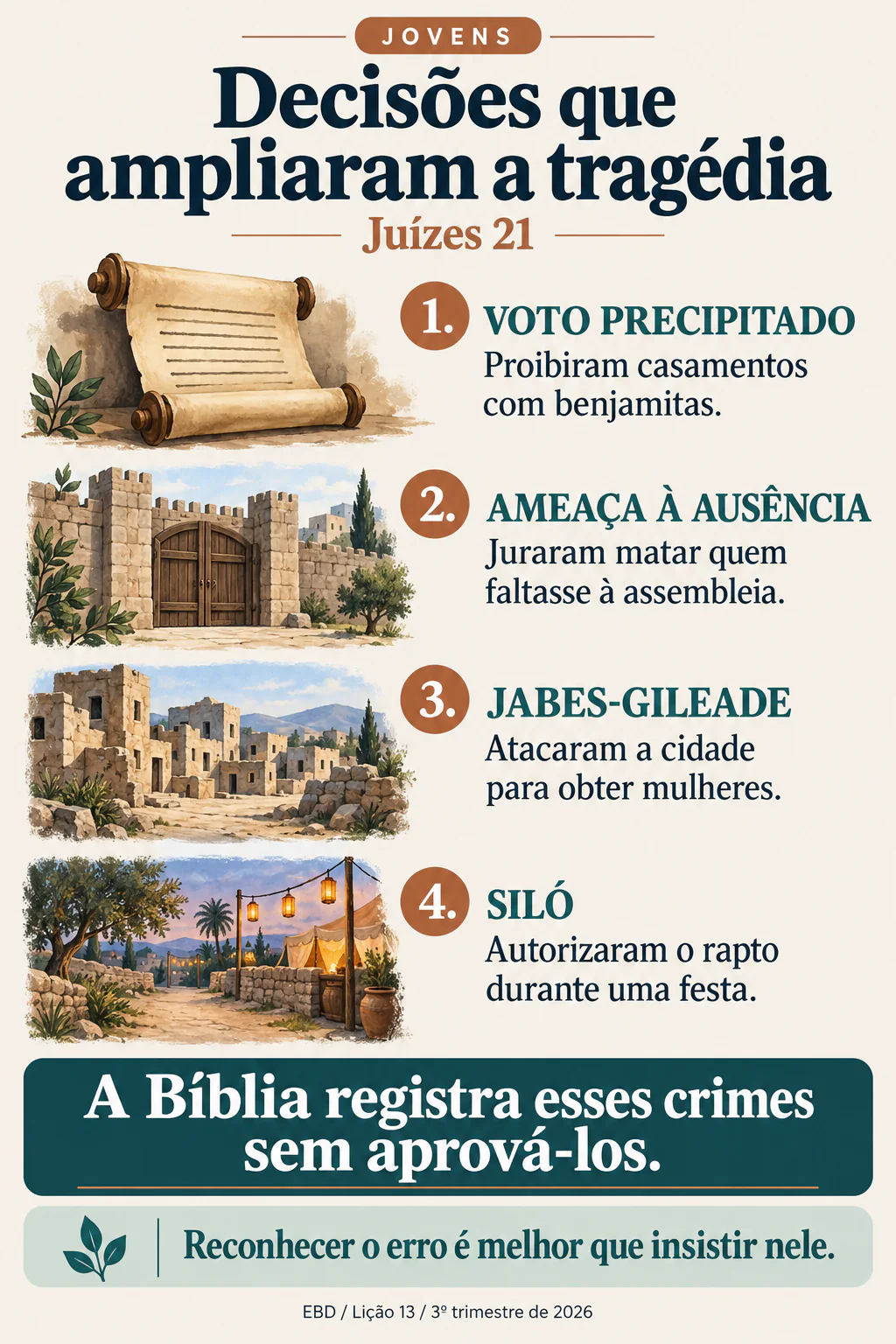
The feeling was right. The conduct that followed was not. And that is where the danger lies, because it is possible to have both at the same time. Then come four tragic decisions, each creating the problem for the next:
First: a rash oath, made before the battle in the heat of indignation, forbidding the daughters of Israel from marrying Benjamites (Judges 21:1). No one asked what the consequence of that would be a month later.
Second: a second oath, with the penalty already built in — whoever had not come up to the assembly would be put to death (Judges 21:5). A vow to solve the problem created by the first. They legislated their own next tragedy.
Third: discovering that Jabesh-gilead had not attended, they sent an army against their own city and wiped it out, sparing four hundred young women, who were handed over to the Benjamites (Judges 21:8-12). For the second time in the same chapter, the sword turned inward — and the criterion for the target was not a crime, it was absence from an attendance roll.
Fourth: since women were still lacking, they authorized the Benjamites to seize by force young women who were dancing at a feast of the Lord in Shiloh (Judges 21:19-23). The elders even agreed beforehand on the legal argument they would use with their fathers (Judges 21:22).
Four human attempts to fix a spiritual problem. And every attempt cost people — not spreadsheet errors, but errors with a name and a face on the other side. None of them went through the simplest question in the world: Lord, what do we do now? It does not appear a single time in the chapter.
🔬 Our reading — weeping before God is not the same as asking God. Israel was in Bethel, which means "house of God". Right place, right emotion, wrong decision. They wept, lifted up their voices, offered burnt offerings (Judges 21:4) — and then met among themselves to decide what to do. Those are two different things, and the second never came. It applies to you, and it applies this week: emotion in a worship service does not replace direction. You can leave a meeting weeping, sincerely touched, and on Monday make a decision that God never told you to make. The biblical order is different: "Trust in the LORD with all thine heart; and lean not unto thine own understanding. In all thy ways acknowledge him, and he shall direct thy paths." (Proverbs 3:5-6). And the next verse seems written for Judges: "Be not wise in thine own eyes: fear the LORD, and depart from evil." (Proverbs 3:7).
The way out that the Law had already written
Here is one of the most painful details of the chapter, and it almost always goes unnoticed: there was a legal way out for that oath, and it was in the Law they claimed to keep.
"Or if a soul swear, pronouncing with his lips to do evil, or to do good, whatsoever it be that a man shall pronounce with an oath, and it be hid from him; when he knoweth of it, then he shall be guilty in one of these." (Leviticus 5:4)
And the remedy was not to carry out the folly:
"And it shall be, when he shall be guilty in one of these things, that he shall confess that he hath sinned in that thing:" (Leviticus 5:5)
Confess and bring the trespass offering (Leviticus 5:6). That was it. God had foreseen that human beings speak too much on impulse, and He left a way back that passes through admitting the mistake before Him.
Israel did not use it. They preferred to keep the vow and sacrifice people rather than confess a rash act. It is the same mistake Jephthah made a few lessons back, with the same root: stubbornness dressed up as faithfulness.
And this is where the lesson touches your life with a very concrete question: how many times have you preferred to maintain a wrong position because admitting you were wrong cost more than the damage of continuing?
Worship standing, mercy on the ground
In the middle of all this chaos, the people kept worshipping. An altar built, burnt offerings offered, peace offerings, the annual feast of the Lord taking place in Shiloh on the right date. The liturgy was impeccable.
They were still religious. They were just far from God.
And that is what makes the chapter so uncomfortable. It is not the story of a people who abandoned religion; it is the story of a people who kept religion and lost God. There was a strong, legalistic desire to fulfill the oaths, without looking at the consequences of what was being fulfilled. The rule stood above the person the rule was meant to protect.
The inconsistency is glaring: the entire war began in order to punish a crime against one woman; to solve the problem created by the war, the people destroyed a city and authorized the abduction of hundreds of others. The cause that began by defending a victim ended up manufacturing hundreds of them.
It was this exact reasoning that Jesus confronted in the religious leaders of His day:
"Ye blind guides, which strain at a gnat, and swallow a camel." (Matthew 23:24)
Straining out a gnat is obsessive care over a ceremonial detail. Swallowing a camel is trampling over what truly matters. Jesus chose the two unclean animals furthest apart in size that those people knew — the distance between them is the size of the inconsistency. And notice that He names what was being swallowed: judgment, mercy, and faith — the things that ought to be done without leaving the others undone (Matthew 23:23). The three things Israel abandoned in that chapter.
Notice also that Jesus does not command them to drop the detail. He commands them to do both, without omitting the weightier matters. The problem was never care; it was the reversal of priorities.
And it is not just a Pharisee's problem. No one wakes up wanting to be a hypocrite — a person becomes one, one decision at a time.
🏛 Where this happened — four names within a small radius. The entire tragedy unfolds along the central ridge of the hill country, where the cities were only a few kilometers apart: Gibeah, Mizpah, and Bethel practically neighbors, Shiloh a little to the north, and Jabesh-gilead across the Jordan. That changes the tone of the reading: it was not a war between distant peoples, it was a tragedy among neighbors. Regarding the sites: Shiloh is identified with Khirbet Seilun, where excavations found a major Iron Age I settlement destroyed around the eleventh century BC; Bethel is generally located at Beitin, with its identification debated; Gibeah is usually associated with Tell el-Ful, excavated throughout the twentieth century, with an ancient burn layer; and Jabesh-gilead has more than one proposed location in Transjordan. In every case, our house rule holds: there is suggestive evidence, not closed proof. Identifying ancient sites is reconstructive work, and an excavation does not come labeled with the biblical name. The spade illustrates; Scripture decides.
What this text narrates and what this text does not authorize
Before moving on, this must be put in writing, because a text like this, misused, hurts people.
The text authorizes calling evil evil, without euphemism. It authorizes saying that sexual violence is a crime and a sin, always, with no mitigating excuse. It authorizes calling what happened in Jabesh-gilead a massacre and what happened in Shiloh an abduction. It authorizes affirming that those women were victims, and that a victim is a victim — full stop. It authorizes looking at Israel's leadership and saying that it failed, because the text itself shows it failing.
The text does not authorize treating any of this as a model. It does not authorize saying that God ordered the extermination of Jabesh-gilead or the abduction at Shiloh — He did not order it, and no one even consulted Him there. It does not authorize using the Bible to justify violence against women, against children, or against anyone at all. It does not authorize morbid curiosity: Scripture is restrained in these accounts, and we will be as well. And it does not authorize leaving this class angry at groups of people — it was precisely by dehumanizing the other that those people ended up where they did.
The rule for our reaction is written, and it is short: "Be not overcome of evil, but overcome evil with good." (Romans 12:21)
III — Awaiting the coming of the King
The sentence that closes the book
"In those days there was no king in Israel: every man did that which was right in his own eyes." (Judges 21:25)
This verse sums up the entire book. It describes the spiritual, moral, and social anarchy of a people without leadership to guide them in the fear of the Lord. And anarchy here is not merely political disorder: it is every conscience becoming its own courtroom, with nothing above it.
Notice the word the text chooses: every man did that which was right in his own eyes. It does not say they thought they were wrong and did it anyway. It is the same family of words the Bible uses for what is right before God — except that the judge changed. They kept the right word and replaced the one who decides what it means.
That is对外—no, that is exactly what relativism does today. And when each person decides, no common standard remains: what remains is the strongest imposing his own. That is what happened there — whoever had four hundred thousand men decided what was right on that day.
What is frightening is not that they knew they were wrong. It is that they thought they were right. Wrong people who know they are wrong still have somewhere to return to. Wrong people convinced that they are right look for no way back at all.
🔬 Our reading — "only I know what is best for me" has an address. The phrase comes packaged as freedom: my truth, no one tells me what is right, everyone lives as they please. Judges shows the bill. When the standard moves from outside and becomes each person's taste, no one is left without a law — everyone becomes their own law, and in the end the one in charge is whoever has the most force. Hence the sentence of the lesson: where no one is king, everyone becomes judge of himself. And here a note of academic honesty belongs: many scholars understand that the epilogue of Judges also functions as an implicit critique of the origins of the house of Saul, who was from Gibeah of Benjamin. It is a possible and interesting reading, not a consensus. The traditional reading — and the one the lesson follows — is simpler and more serious: the refrain is the spiritual diagnosis of a nation that rejected, in practice, the government of its God.
Samuel, Saul, David — and the problem no throne solved
The entire book is the demonstration that those people could not govern themselves: cycles of sin, oppression, outcry, and deliverance, always starting over. Into this setting comes Samuel, who also served as judge (1 Samuel 7:15-17). He called the people to repentance, and through God's intervention Israel defeated the Philistines (1 Samuel 7:7-14).
Samuel was God's right answer for that moment. Except that the people did not want God's answer; they wanted the answer their neighbors had, and began demanding a human king (1 Samuel 8:5). God permitted the choice, even though it was not the center of His will (1 Samuel 8:7) — and warned them beforehand of the price that king would exact.
Keep this distinction for life: God permitting something is not the same as God willing that thing. He respects human decision and lets it produce what it produces. That is not abandonment; it is taking seriously the freedom He Himself gave.
Saul became the first king and was rejected by the Lord for disobedience. In his place, God raised up David (1 Samuel 13:13, 14), who, despite his failings, unified the nation, consolidated the kingdom, and brought the Ark to Jerusalem (2 Samuel 6). David did not build the Temple, but he prepared the resources and left the mission to Solomon (2 Samuel 7; 1 Chronicles 22).
And the problem continued. Good kings, bad kings, and the cycle going on. No throne changed the heart of an entire people, because the problem was never on the throne. Changing leaders does not solve what only a change of heart can solve.
The promise that crossed the centuries
Hope did not stop with Saul or with David. God promised David something greater than a reign:
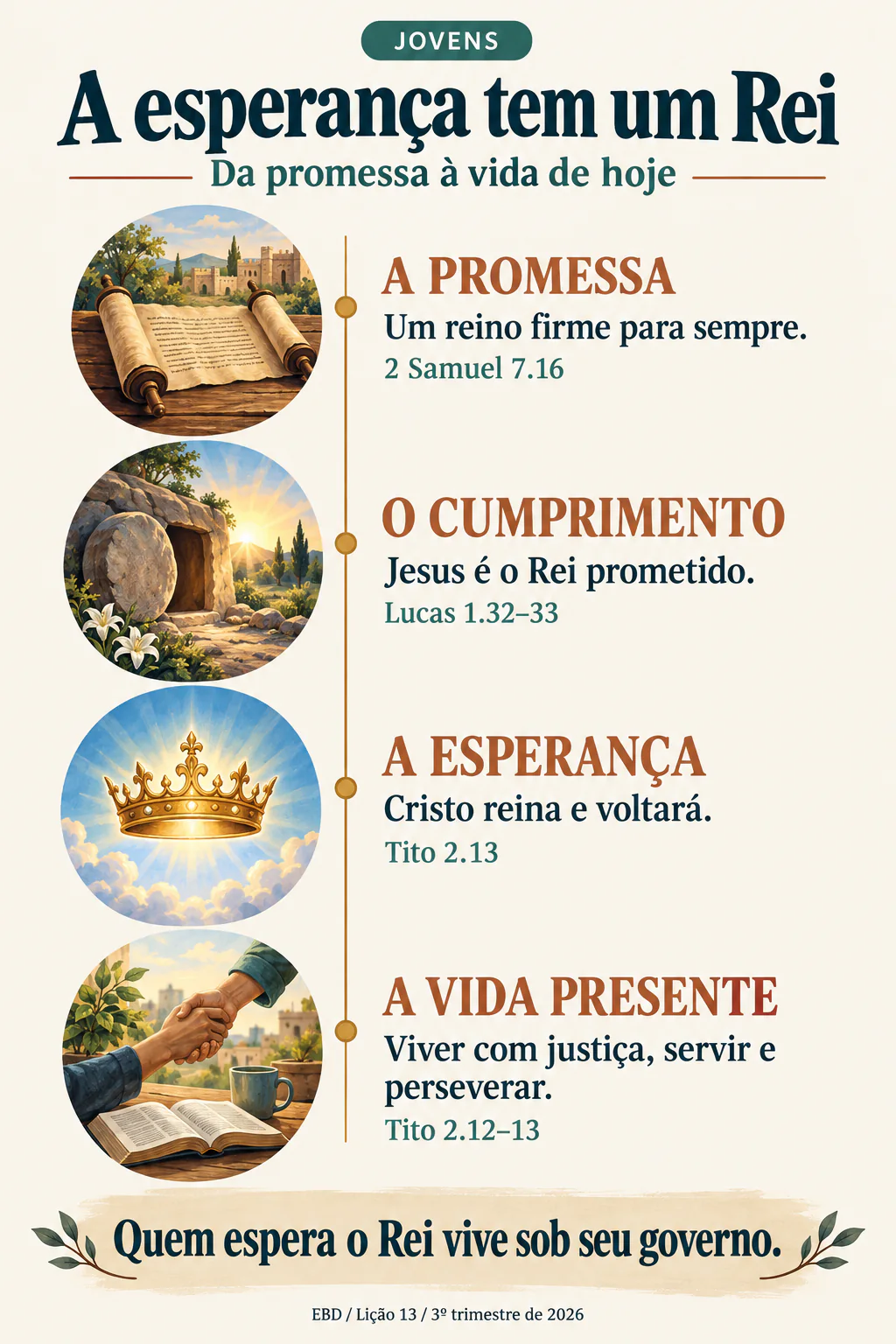
"And thine house and thy kingdom shall be established for ever before thee: thy throne shall be established for ever." (2 Samuel 7:16)
That promise crossed centuries, exile, and four hundred years of prophetic silence — and arrived intact, with a name, on the lips of an angel, in a small town, to a young woman whom no one knew:
"He shall be great, and shall be called the Son of the Highest: and the Lord God shall give unto him the throne of his father David: And he shall reign over the house of Jacob for ever; and of his kingdom there shall be no end." (Luke 1:32-33)
The King who was missing in Judges arrived. And He arrived in a way no one had imagined: not in a palace, but in a manger.
❤ For your life — hope is not optimism. Optimism needs the data to improve. Hope needs God to be who He said He is. That is why Christian hope does not vanish when the news is bad: it was never resting on the news. It is anchored in God and in the conviction that the Lord guides history — "For I know the thoughts that I think toward you, saith the LORD, thoughts of peace, and not of evil, to give you an expected end." (Jeremiah 29:11). And notice what comes right after, because it is the part Israel skipped: "Then shall ye call upon me, and ye shall go and pray unto me, and I will hearken unto you. And ye shall seek me, and find me, when ye shall search for me with all your heart." (Jeremiah 29:12-13). The promise and the seeking walk together. If your year was hard, if college stalled, if the job did not come through, if the relationship ended — your hope does not depend on circumstances turning around. It depends on Him being who He is.
Christ in the Lesson
The book of Judges is a void with the exact shape of Christ.
A king was missing — and the King came. The sentence that closes the book is not a political observation; it is a cry. And the New Testament answers that cry with a name. Where everyone was judge of himself, there came the One who is the standard in person. Not a king who helps himself to the people: One who came to serve and to give His life as a ransom for many (Mark 10:45).
His reign began through the cross, not through an army. It is the exact opposite of the chapter studied today. There, four hundred thousand armed men and forty thousand dead in two days. Here, one Man handed over. He died on the cross in our place and rose again on the third day — and that is why our hope is not optimism, it is historical fact with an empty tomb.
He is the justice that does not turn into vengeance. Israel tried to fix horror with more horror and only multiplied victims. At the cross the opposite happened: sin was judged in full, without a single additional victim. The justice of God did not need Jabesh-gilead or Shiloh. It needed a Lamb.
He reigns now and is coming to reign in fullness. "And he hath on his vesture and on his thigh a name written, KING OF KINGS, AND LORD OF LORDS." (Revelation 19:16). He is the same Christ who today reigns at the right hand of the Father and who will return to establish His righteous government over all creation (Psalm 2:6). In the meantime, the people of God do not stand still: they proclaim salvation, serve, bear witness, and persevere (Isaiah 61:1-3; Matthew 28:18-20).
And that is how the quarter closes. Thirteen weeks ago we opened a book about a people who could not govern themselves. Today we close knowing the name of the One who governs. Judges ends without a hero because the Hero could not fit inside that book.
Practical Application
Ask before deciding, not after. The question that does not appear once in Judges 21 is the simplest of all: Lord, what do we do now? Put it in front of your decisions this week — and not as a formality after you have already decided.
Do not swear on impulse. A promise made in the heat of emotion exacts a high price, and insisting on it is not faithfulness. If you have already made one, confess the rashness to God and fix what can be fixed. God foresaw this in the Law; He is not scandalized by your honesty.
Check whose team you are defending. Loyalty to people is good; loyalty above justice is complicity. If you had to twist a fact to protect someone on your side, you already know where you stand.
Do not confuse emotion with direction. A good worship service, beautiful praise, and tear-filled eyes are a blessing — and they do not replace seeking God's will in the Word, in prayer, and in the counsel of mature believers.
Take care that the rule does not trample the person. Every time you use a right principle to be harsh with someone, stop and check whether you are straining out a gnat and swallowing a camel.
Live like someone who awaits a King. It is not standing still waiting for the end: it is working, studying, dating, serving, and deciding under the government of the One who is coming. "Looking for that blessed hope, and the glorious appearing of the great God and our Saviour Jesus Christ;" (Titus 2:13).
Closing Prayer
Lord, thank You for not editing the story of Your people to make it look pretty. Thank You because You recorded even the chapter where no one comes out looking good, and gave us eyes to see there the portrait of our own heart. Forgive us, Lord, for the times when we wept before You and decided without You. Forgive us when we defended our own instead of defending what is right, when we made promises on impulse and insisted on them out of pride, and when we used Your rules to be harsh with those whom they were meant to protect. Keep us from being the people who maintain religion and lose mercy. Look, Lord, upon each young adult in this class who carries in silence a wound that no one knows — draw near, as only You draw near, to the brokenhearted, and do not let this class hurt anyone who has already been hurt. Thank You for this entire quarter, for the thirteen weeks in which You showed us a people without a king so that we would recognize the King. He came, Lord. He was born in a manger, reigned through the cross, rose again, and on Him is written King of kings and Lord of lords. Govern our decisions this week, give us the courage to ask before deciding, and sustain our hope until the day You return. In Jesus, our King, amen.
Frequently asked questions about this lesson
Why is a story like this in the Bible? War between brothers, a city wiped out, young women kidnapped at a religious feast — what is the benefit of reading this?+
Because the Bible is not a curated photo album of the people of God; it is an honest account, and an honest account includes rock bottom. Keep a distinction in mind that answers almost every question of this kind: for the Bible to narrate is not for the Bible to approve. There is a difference between a book that records what happened and a book that recommends what happened. Judges 20 and 21 are a record — and a record of indictment. Notice that the narrator praises nothing: he recounts the massacre of Jabesh-Gilead and the abduction at Shiloh without a single line of applause, and closes the book with the sentence that condemns all of it at once: "In those days there was no king in Israel: every man did that which was right in his own eyes." (Judges 21:25). The discomfort you feel when reading is the exact intended effect. And there is a very concrete benefit: a people who only read about their own victories learn nothing. Israel needed this portrait to understand that the problem was not in the enemies outside, and the church needs it for the same reason. Add to this what the text prepares: it is precisely through this void that the promise of a King runs through the Bible until it arrives at Christ.
Did God command the extermination of Jabesh-Gilead and the abduction of the young women of Shiloh?+
No. And it is worth reading carefully to see the difference. In the chapters on the war against Benjamin, Israel does indeed inquire of the Lord and receives an answer (Judges 20:18, 23, 28). There was a cause: a city committed a barbaric crime and the tribe refused to hand over the guilty men (Judges 20:13). Now go to chapter 21 and look for the inquiry. It does not exist. No one asks the Lord before marching against Jabesh-Gilead, and no one asks the Lord before instructing the ambush at Shiloh. It is the elders settling things among themselves, by their own criteria, to get around an oath they themselves had made (Judges 21:5, 8-10, 19-23). The text even gives the cynical legal argument they agreed to use with the young women's fathers (Judges 21:22) — and approves of it nowhere. Say it plainly in your class: those young women were victims of kidnapping, the men of Jabesh-Gilead and their families were victims of a massacre, and none of this is God's command. It is the book's refrain in action for the last time.
If the cause was just and they inquired of God, why did Israel lose forty thousand men in the first two days? Did God deceive the people?+
He did not deceive them, and the answer lies in what they asked. In the first inquiry, the question is not 'should we go?', it is 'who goes first?' — "And the children of Israel arose, and went up to the house of God, and asked counsel of God, and said, Which of us shall go up first to the battle against the children of Benjamin? And the LORD said, Judah shall go up first." (Judges 20:18). They had already decided; they went to ask God for the parade order. The second time, they weep and ask again (Judges 20:23). Only on the third day does the text describe something else: fasting, genuine mourning, burnt offerings, and peace offerings before the Lord (Judges 20:26) — and then comes the victory, and the narrator makes a point of saying whose it is: "And the LORD smote Benjamin before Israel: and the children of Israel destroyed of the Benjamites that day twenty and five thousand and an hundred men: all these drew the sword." (Judges 20:35). The lesson is hard and very timely: being right about the issue does not guarantee being right about the method, and inquiring of God is not asking for a rubber stamp on what has already been decided. God is not a confirmation oracle. Notice also that He did not approve of everything that came afterward — intervening to put an end to a war is not the same as endorsing what the people did with the victory.
I made a promise to God on impulse that I now see was foolish. Do I have to keep it no matter what?+
This is the most practical question the chapter raises, and the Law had already answered it before Judges took place. Leviticus deals with the exact case of an oath made on impulse: "Or if a soul swear, pronouncing with his lips to do evil, or to do good, whatsoever it be that a man shall pronounce with an oath, and it be hid from him; when he knoweth of it, then he shall be guilty in one of these." (Leviticus 5:4). And the prescribed remedy is not to carry out the folly: it is to confess. "And it shall be, when he shall be guilty in one of these things, that he shall confess that he hath sinned in that thing:" (Leviticus 5:5), and then to bring the trespass offering (Leviticus 5:6). In other words: God had left a way out, and the way out required admitting the mistake. Israel did not use it. They preferred to keep the vow and produce tragedy. For you today, the application is direct: a rash promise does not become a license to do evil, and stubbornness is not faithfulness. Go to God, acknowledge the haste, ask for forgiveness in the name of Christ, and fix what can be fixed — if the promise involved someone else, talk to that person and own up to it. And take the lesson for next time: "Wherefore, my beloved brethren, let every man be swift to hear, slow to speak, slow to wrath:" (James 1:19). If it is a serious commitment and you are in doubt, take it to your church leadership before deciding alone.
How do I teach this lesson without making it sound like the Bible tolerates violence against women? There are people in my class who have been through heavy things.+
By speaking the exact way the text speaks, and with sobriety. First, name it: what happened in Gibeah was a crime, what happened in Jabesh-Gilead was a massacre, and what happened in Shiloh was kidnapping. A victim is a victim — there is no mitigating factor, there is no context that softens it, and no one provoked anything. Second, make it clear that the narrative is not a model: the book is showing the abyss, not teaching a path. Third, do not spend the class on graphic details. The Bible is restrained in these episodes; we will be too. Morbid curiosity edifies no one and hurts those who are listening in silence. Fourth, and most importantly: start from the assumption that someone there has lived through something similar. Do not ask for personal examples, do not force anyone to speak, and let the class know beforehand that no one needs to share anything personal out loud. If someone comes to you, listen without interrogating and say three things: I believe you, it is not your fault, and you are not going to deal with this alone. Then take it to the pastoral leadership that same day and help the person seek appropriate support. And end where Scripture ends: the God who recorded these pages is the same One who is near to the brokenhearted (Psalm 34:18).
If the world is like this anyway and Christ is coming back, isn't waiting for the King just sitting still waiting for the end?+
It is the opposite of that. Waiting, in the New Testament, is a verb for someone who is working. Paul brings both things together in a single sentence about how grace teaches us to live: "Teaching us that, denying ungodliness and worldly lusts, we should live soberly, righteously, and godly, in this present world; Looking for that blessed hope, and the glorious appearing of the great God and our Saviour Jesus Christ;" (Titus 2:12-13). Notice the order: we live now because He is coming. Someone waiting for a king does not decide alone while he has not yet arrived — they govern their home, work, and choices by the standard of the One who is coming. And it is good to mark the difference between Christian hope and optimism. Optimism needs the data to improve; hope needs God to be who He said He is. That is why it does not collapse when the news is bad — it was never resting on the news. The promise made to David of a throne established forever (2 Samuel 7:16) crossed centuries, exile, and silence and arrived whole in Jesus (Luke 1:32, 33). A God who keeps a promise of that size is not going to give up in the middle of your hard year. Until He comes, the people of God proclaim, serve, and persevere — that is the biblical way to wait.
Teacher's Guide
Essence of the class
Where no one is king, everyone becomes judge of himself — and the Christian's hope is not that chaos will end tomorrow, it is that the King who was missing in Judges has already come, reigns today, and is coming back.
Map of the class
| Time | Stage |
|---|---|
| 0–5 min | Opening (the book that ends without a hero) |
| 5–14 min | Point 1 — The just outcry that turned into war between brothers (Judges 20) |
| 14–24 min | Point 2 — Four tragic decisions and the way out that was in the Law (Judges 21:1-23) |
| 24–30 min | Class activity "the knot no one unties" |
| 30–39 min | Point 3 — The sentence that closes the book and the King who came (Judges 21:25) |
| 39–45 min | Wrap-up of the quarter + challenge of the week + prayer |
Start like this
Start standing up, without a Bible in your hand, and say in a conversational tone: "Think of a movie or a series you watched that ended badly. Not poorly made — it really ended badly, without a happy ending, leaving that feeling of 'now what?'" Let two or three answer; names of series, movies, or shows will come up. Hold the answers and continue: "Today we close a book of the Bible that ends just like that. Without a hero, without a victory, without a happy ending. The last chapter of Judges ends with the people of God worse off than when they started." Pause. "And the last sentence of the book is not a conquest. It is a diagnosis." Then open the Bible and read Judges 21:25 slowly, just once. Write on the board: THERE WAS NO KING. Warn the class before getting into the text: "These chapters contain heavy violence. We are going to name what happened, with respect, and we are not going to go into detail. The goal is not to shock anyone." Close the opening with the question of the lesson: "When everything around you seems out of order, where have you been placing your hope?" — and say that the answer is in the last part of the class.
Point 1 — The just outcry that turned into war between brothers
- In the quarterly: topic I ("Vengeance and civil war among the people of God"), sub-items 1 to 3.
- What to teach: (1) The outcry was just — the crime of Gibeah was a crime and crime calls for justice; the mistake was not wanting justice, it was what came after. Highlight the irony: the tribes had never marched together against an outside enemy, and the first time they united was against a tribe of their own people. (2) Benjamin refused to hand over the guilty (Judges 20:13): no one there, outside Gibeah, had committed the crime — their sin was protecting those who had committed it. Connect this with Proverbs 17:15 and Romans 1:32: covering up carries the same weight. (3) Four hundred thousand against twenty-six thousand, and Israel loses two days in a row. Show the difference between the inquiries: in Judges 20:18 they ask who goes first, not whether they should go; only in Judges 20:26 do fasting and genuine mourning appear, and then comes the victory, which the text attributes to God (Judges 20:35). Close with the sentence from the lesson: without divine direction, numbers are not strength.
- Anchor verse (KJV): "Now therefore deliver us the men, the children of Belial, which are in Gibeah, that we may put them to death, and put away evil from Israel. But the children of Benjamin would not hearken to the voice of their brethren the children of Israel:" (Judges 20:13).
- Key question: "In what situation in your life today is it easier to defend your own than to defend what is right?"
- Likely answers (+ going deeper): "a friend", "family", "the crowd at work", "the church itself". Go deeper: "and what is the cost of saying 'what you did is wrong' to someone on your side?" Lead the class to see that Benjamin was not defending the crime — he was defending the team. Attention: if someone starts naming names or bringing up a real case from the church, gently cut it short ("no need to say who") and talk in private afterward.
- If no one speaks: take an impersonal approach. "Why do you think an entire tribe preferred to go to war rather than hand over a few men?" It is an easy question, and the class itself will arrive at "because they were their own".
Point 2 — Four tragic decisions and the way out that was in the Law
- In the quarterly: topic II ("Decisions without wisdom, religion without mercy"), sub-items 1 and 2.
- What to teach: (1) The mourning was sincere — Bethel, weeping until evening, the question of Judges 21:3 and the statement of Judges 21:6 that a tribe had been cut off from Israel that day. Highlight the key to the lesson: weeping before God is not the same as asking God, and they only did the first thing. (2) List the four decisions quickly, without detailing any scene: rash oath (21:1); second oath with the death penalty built in (21:5); the massacre of Jabesh-gilead (21:8-12); the ambush at Shiloh (21:19-23). State clearly that God is not consulted in any of them and that the text narrates without approving. (3) The discovery of the lesson: the Law already had a way out for a rash oath — Leviticus 5:4, 5, 6: confess and bring the offering, do not carry out the folly. Israel preferred to sacrifice people rather than admit a rash act. (4) The hypocrisy: worship remained standing (altar and burnt offerings, 21:4; feast of the Lord in Shiloh, 21:19) while mercy walked away. Close with Matthew 23:23, 24 — straining out a gnat and swallowing a camel — and underline that Jesus does not command dropping the detail, He commands not omitting what weighs more.
- Anchor verse (KJV): "Or if a soul swear, pronouncing with his lips to do evil, or to do good, whatsoever it be that a man shall pronounce with an oath, and it be hid from him; when he knoweth of it, then he shall be guilty in one of these." (Leviticus 5:4); and "And it shall be, when he shall be guilty in one of these things, that he shall confess that he hath sinned in that thing:" (Leviticus 5:5).
- Key question: "Is there any rule you keep strictly that you have already used to justify being harsh with someone?"
- Likely answers (+ going deeper): silence at first; then "with a younger sibling", "with a friend who messed up", "in leading a ministry", "at home". Go deeper: "and the person the rule existed to protect — where did they end up in that story?" If the class stays in the abstract, bring it to the concrete: punctuality, dress, church work schedules.
- If no one speaks: tell one of your own first, small and nothing serious — a time when you held on to the rule and lost the person. Or go through the text: "Israel swore they would not give their daughters to the Benjamites. They kept the oath. What did it cost?"
Point 3 — The sentence that closes the book and the King who came
- In the quarterly: topic III ("Awaiting the coming of the King"), sub-items 1 to 3.
- What to teach: (1) Read Judges 21:25 and work the word: every man did that which was right — they thought they were right. That is what is frightening. Someone who knows he erred has somewhere to return to; someone who is convinced does not look for a way back. Connect this with today's relativism: people keep the right word and replace the one who decides what it means. (2) The historical sequence in three minutes: Samuel (1 Samuel 7:15-17), the people demanding a king like their neighbors' (1 Samuel 8:5), God permitting it without it being the center of His will (1 Samuel 8:7), Saul rejected, David raised up (1 Samuel 13:13, 14). Highlight the pastoral distinction: God permitting is not God willing. (3) The problem was never on the throne — good and bad kings, and the cycle continuing. What was missing was a change of heart. (4) The promise: 2 Samuel 7:16 crosses centuries and arrives in Luke 1:32, 33. The King arrived through a manger, reigned through the cross, rose again, and Revelation 19:16 records the name. (5) Close the entire quarter: Judges ends without a hero because the Hero could not fit inside that book.
- Anchor verse (KJV): "In those days there was no king in Israel: every man did that which was right in his own eyes." (Judges 21:25); and "And thine house and thy kingdom shall be established for ever before thee: thy throne shall be established for ever." (2 Samuel 7:16).
- Key question: "Has Christ truly been the King who governs your day-to-day decisions, or only the Sunday topic?"
- Likely answers (+ going deeper): honesty usually shows up here — "more Sunday than weekday", "in the big things yes, in the small ones no", "I decide and then ask God to bless it". Go deeper: "and what was the last decision you brought to Him beforehand?" Do not press for public confession; let the question land.
- If no one speaks: make it impersonal with a list. "Think of three decisions a young adult makes in a week: accepting or turning down a job, starting or ending a relationship, entering or staying out of a conversation. In how many of those do we ask God beforehand?" No one needs to answer out loud — the question already does its work.
Class activity
- Goal: to have the class see, with their own hands, that every human solution in Judges 21 pulled the previous knot tighter — and that a way out existed and was something else altogether.
- Materials: a piece of string, shoelace, or twisted strip of paper about 50 cm long for each group of three or four people (a shoelace from their own sneakers works). Nothing needs to be bought.
- Step by step: hand out the strings and ask each group to tie one knot for each decision you narrate. Narrate the four, one at a time, slowly: (1) "they swore they would not give their daughters to the Benjamites" — knot; (2) "they swore to kill whoever had not gone up to the assembly" — knot; (3) "they destroyed Jabesh-gilead to obtain women" — knot; (4) "they authorized seizing by force the young women at the feast of Shiloh" — knot. Now ask them to try to undo the knots without undoing any oath, that is, without untying the first knot. Give them thirty seconds. No one can do it — and that is the point. No one is competing, no one will be called to the front.
- Wrap-up (back to the text): "Each knot was tied to solve the previous one, and each one pulled it tighter. That is capítulo 21—that is chapter 21 to the letter. And look at what is saddest: there was a pair of scissors, and it was in the Law they claimed to keep. Leviticus 5 said what to do with an oath made on impulse — confess the mistake and bring the offering. It was not 'fulfill it no matter what'. It was 'admit it'. Israel preferred to sacrifice people rather than say 'we were wrong'. Keep the string in your backpack this week: every time you are pulling a knot tighter so as not to admit a mistake, remember Judges 21."
Careful, teacher — sobriety and pastoral care (read before class). These chapters narrate sexual violence, the massacre of civilians, and the abduction of women. First, the content: name the facts with gravity and economy — "the city was wiped out", "the young women were taken by force" — and do not describe any scene, do not use dramatic adjectives, and do not read the harshest verses aloud. The goal is moral gravity, not shock. If the class asks for details, cut it short naturally: "the Bible does not spend time on that, and neither will we." Second, the distinction that sustains the class: say out loud, at least once, that the Bible narrates without approving. The text is a diagnosis of chaos, not a model of conduct; God is not the author of what those men did and was not consulted in any of the decisions of chapter 21. Third, the victims: the woman of Gibeah, the inhabitants of Jabesh-gilead, and the young women of Shiloh are victims. Never imply blame, provocation, or desert — and if a student raises that argument, correct it on the spot, firmly and without humiliating the speaker. Fourth, and most important: in a young adults class it is statistically likely that there is someone who has experienced sexual or domestic violence, and that person will be listening in silence. Let them know before the key questions that no one needs to share anything personal out loud, and do not ask any question that calls for a personal example. If someone approaches you — during or after class — welcome them without asking for details in front of the class: "thank you for trusting me, let's talk afterward in a private place." Do not interrogate, do not question their account, do not suggest blame, do not promise absolute secrecy. Say three sentences and no more: I believe you; it is not your fault; you are not going to deal with this alone. And bring it to the pastoral leadership on the very same day — you do not handle this alone and you do not need to. Fifth: do not let the class turn into indignation against groups of people or a competition of pessimism about the world. The close of the quarter is hope, not panic.
If they ask you this
- Question: "Why is this in the Bible? What good does it do to read about civil war, massacre, and abduction?" Short answer: Use the distinction that settles almost everything — to narrate is not to approve. The Bible is an honest account, and an honest account includes rock bottom. Show that the narrator praises nothing and closes the book by condemning it all at once (Judges 21:25). The discomfort of the class is the intended effect. And add the benefit: a people who only read their own victories learn nothing — Israel needed this portrait to understand that the problem was not in the enemies outside, and the church needs it for the same reason. Close by showing that it is precisely this void that makes the promise of a King run through the Bible all the way to Christ.
- Question: "Did God command the destruction of Jabesh-gilead and the abduction of the young women of Shiloh?" Short answer: No. Teach the class to look for the inquiry. In the war against Benjamin it is there (Judges 20:18, 23, 28); in chapter 21 it does not appear a single time. It is the elders sorting things out on their own to escape an oath they themselves made — the text even records the argument they agreed to use with the young women's fathers (Judges 21:22) and approves none of it. Say it in plain words: those people were victims, and nothing there is a command from God.
- Question: "If they inquired of God and He told them to go up, why did they lose forty thousand men?" Short answer: Because the first question was not "should we go?", it was "who goes first?" (Judges 20:18). They had already decided and went to ask for the marching order. Only on the third day do fasting and genuine mourning appear (Judges 20:26), and then comes the victory, which the text attributes to the Lord (Judges 20:35). Direct application for the class: being right about the issue does not guarantee being right about the method, and inquiring of God is not asking for a rubber stamp on what has already been decided.
- Question: "I made a promise to God on impulse and today I see it was foolish. Do I have to keep it?" Short answer: No, and the answer comes from the Law itself. Leviticus 5:4-6 deals with an oath spoken rashly and commands confessing it and bringing the trespass offering — not carrying out the folly. Israel had that way out and did not use it; they preferred to sacrifice people rather than admit the rashness. Guide the student: bring it to God, acknowledge the mistake, ask forgiveness in Christ, fix what can be fixed, and if another person is involved, talk with them. If it is a serious commitment, have them seek out leadership before deciding alone. And teach the brake for next time: James 1:19, 20.
- Question: "So the world only gets worse and Christ comes at the end. Is there any point in doing anything now?" Short answer: There is, and the New Testament joins both things in a single sentence: living soberly, righteously, and godly while awaiting the appearing of the glory of Christ (Titus 2:12, 13). To await is the verb of someone who is working. Separate hope from optimism: optimism needs the data to improve, hope needs God to be who He is. And warn the class about the opposite risk to panic — religious pessimism used as an excuse to do nothing.
Wrap-up + challenge of the week
- Wrap-up: "Thirteen weeks ago we opened a book about a people who could not govern themselves. Today we close that book at its darkest point: a tribe cut off from within, a city destroyed over an attendance roll, young women taken by force at a religious feast — and worship going on as usual in the middle of it all. And worst of all: they thought they were right. Every man did that which was right in his own eyes. But notice one thing: the same book that shows the chaos points to the way out. That people needed a king. And the King came. Not in a palace, in a manger. Not with four hundred thousand armed men, but Himself handed over. He died on the cross in our place, rose again, and on Him is written King of kings and Lord of lords. Judges ends without a hero because the Hero could not fit inside that book. So our hope is not that chaos will end tomorrow. It is that the King has already come, reigns today, and is coming back. And until He returns, we do not decide alone — whoever awaits a king lives under the government of the One who is coming."
- Challenge: ask before deciding. Choose one real decision in your week — an answer you have to give, a purchase, a difficult conversation, an invitation, an agreement at work. Before deciding: write the decision in one sentence, bring it to God in prayer with your Bible open, look for a passage that speaks to that matter, talk with someone who has walked with God longer than you have (your teacher counts), and do not decide on the same day of haste or anger — give it at least 24 hours. On Sunday, come back with the story.
Teacher's kit
- Before: read Judges 20 and 21 in full, calmly, and not on Sunday morning — it is a text that shakes whoever reads it. Then reread the pillars of the lesson: Judges 20:13, 16, 18, 26, 35; Judges 21:1, 3, 4, 5, 6, 19, 22, 25; and Leviticus 5:4-6. Decide beforehand, in writing, the exact sentences you will use to state what happened in Gibeah, in Jabesh-gilead, and in Shiloh — so you do not improvise and end up going into detail. Skim the three topics of the quarterly and set aside two minutes at the end to recap the entire quarter.
- Bring: a Bible, a piece of string or shoelace per group for the class activity, a board or poster paper to write "THERE WAS NO KING", and the phone number of your pastoral leadership saved on your phone. If you need to guide someone after class, also have on hand the women's violence helpline and the suicide prevention and emotional support helpline (in Brazil, 180 and 188). You probably will not use them. Have them anyway.
- Pray beforehand: ask God for sobriety to handle a hard text without sensationalism and without cowardice. Pray for the students who will hear this lesson carrying something no one knows about, that they may find in you a refuge and not judgment. And pray that the quarter closes where it must close: not in the horror of Judges, but in the hope of the King.
Homework
Your mission for the week
Ask before deciding. Choose one real decision in your week — an answer you need to give, a purchase, a difficult conversation, an invitation, an agreement at work — and, before deciding, do four things: write the decision in one sentence; bring it to God in prayer with your Bible open and look for a passage that speaks to that matter; talk with someone who has walked with God longer than you have (your teacher counts); and do not decide on the same day of haste or anger — give it at least 24 hours. If the decision is too big for one week, choose its first step.
Why
In Judges 21 the people wept before God, offered burnt offerings, and met to decide — and the question "Lord, what do we do now?" does not appear a single time in the chapter. The result was four tragic decisions, each creating the problem for the next. The biblical order is the opposite: "Trust in the LORD with all thine heart; and lean not unto thine own understanding. In all thy ways acknowledge him, and he shall direct thy paths." (Proverbs 3:5-6).
How to know you did it
You can state what the decision was, which passage you read, whom you talked with — and what changed between what you were going to do and what you did. If the decision in the end was the same, that is fine: what changed was who decided with you.
On Sunday, come back with the story
The first class of the next quarter begins with those who asked beforehand. Tell what happened and tell what was harder: waiting the 24 hours, or opening the decision to another person. Do not stay out.