Golden Text
“Submit yourselves for the Lord’s sake to every human institution, whether to the king as the supreme authority,” (1 Peter 2:13, BSB) · Read in the Bible
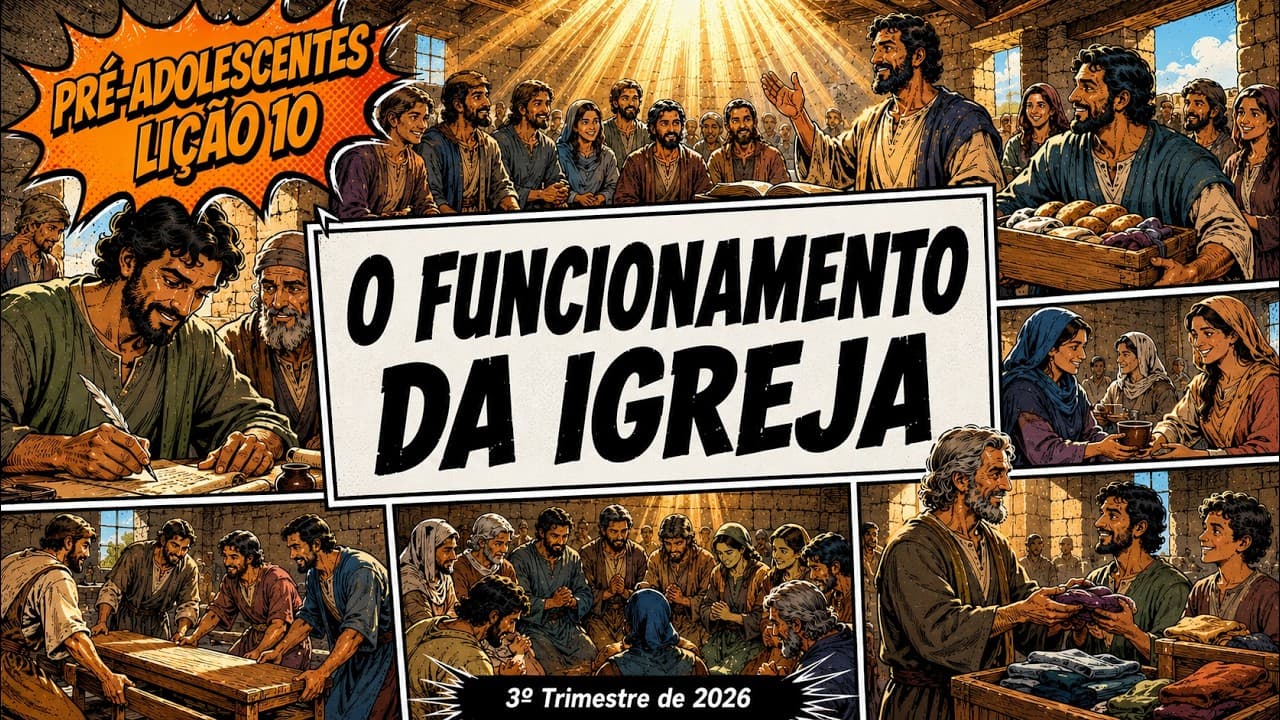
The lesson shows the side of the church that almost no one sees: the laws it obeys, the bills it pays, and the organization that holds everything together. It explains how the Assemblies of God are organized — the local church assembly, the ministry, the departments, and the conventions — and why this is not bureaucracy, but stewardship. It also shows the limit of obedience, with Acts 5:29, and ends where the church begins: in Christ, the Head, who bought the church with His own blood.
Sunday morning. You walk into the Sunday School (EBD) classroom and everything is ready: lights on, fan running, sound working, floor clean, chairs in place, the class starting on time. It feels as if the church simply happens.
Now think about your own home. The lights on, water coming out of the tap, food on the table. None of that appears out of nowhere. Behind an organized home there are bills paid, chores divided, and responsible people working behind the scenes.
With the church it is the exact same thing — and that is not our comparison, it is the Bible's. Paul wrote to Timothy: "in case I am delayed, so that you will know how each one must conduct himself in God’s household, which is the church of the living God, the pillar and foundation of the truth." (1 Timothy 3:15). The house of God. A house has an address, a door, an electric bill, and someone in charge.
And if you think talk of laws, bills, and organization is just for adults, get ready: this whole set of gears only works because there are people keeping their word. Including people your age.
In this lesson we are going to see four things: why the church respects the laws, why it pays its bills, how it organizes itself without ceasing to be a living body, and how far obedience goes — because there is a limit, and you need to know what it is.
I — The church respects the laws
Start with the basics: what are laws for?
Imagine a day without a single rule. No rules in traffic, no rules at school, no rules in a game. It would not turn into freedom — it would turn into chaos, and in chaos the one who comes out on top is always the strongest, trampling the weakest. The law does not exist to ruin anyone's fun. It exists so that life together can be possible.
God has always known this. When Israel came out of Egypt and walked through the wilderness, those people had no rules at all for living together — they came out of four hundred years of learning the ways of the Egyptians. So, on Mount Sinai, the Lord gave the Law to Moses (Exodus 20). It was not only about worshiping God: it was about respecting life, family, one's given word, and what belongs to one's neighbor.
And Jesus did not come against this. He Himself said that He did not come to destroy the law or the prophets, but to fulfill them (Matthew 5:17). He walked within the rules of His time, paid what He owed, and gave no one the right to say that people of faith are careless people.
The apostle Paul wrote the same thing, in plain words: "Everyone must submit himself to the governing authorities, for there is no authority except that which is from God. The authorities that exist have been appointed by God." (Romans 13:1). And Peter, in our Golden Text, sent the same message to Christians who were being persecuted and insulted: "Submit yourselves for the Lord’s sake to every human institution, whether to the king as the supreme authority," (1 Peter 2:13).
Notice three words that change everything: for the Lord's sake. A Christian does not obey out of fear of a fine. He obeys because that honors God. And Peter explains the practical effect of this in the following verse: "For it is God’s will that by doing good you should silence the ignorance of foolish men." (1 Peter 2:15). In those days people said terrible things about Christians. The answer was not a fight: it was conduct. When the neighbor has nothing to complain about, gossip dies on its own.
αβ In the original — Greek. The word Peter uses for "to submit" is hypotássō (ὑποτάσσω), from hypó (under) and tásso (to arrange, to put in order). It was military vocabulary: soldiers who arrange themselves in formation, each at his post, of their own free will. In other words: biblical submission is not being a doormat or obeying with your head down out of fear. It is choosing to stay in your place so that the whole team works.
II — The church pays its bills
The temple building where you meet every week does not live on air.
For the lights to turn on, the sound system to work, the fan to spin, and the water to come out of the tap, real bills arrive every month. There is maintenance, there is cleaning, there is Sunday School material, there are people hired to work there. All of that costs money.
Now imagine the opposite. A church orders a renovation, receives the service, and does not pay the bricklayer. What is the bricklayer going to tell the whole neighborhood? "They preach honesty on Sunday and don't pay what they owe on Monday." And then it is not the church's name that gets dirty — it is the name of God.
That is why the biblical command is direct: "Pay everyone what you owe him: taxes to whom taxes are due, revenue to whom revenue is due, respect to whom respect is due, honor to whom honor is due." (Romans 13:7).
Jesus took this seriously in an impressive way. Once the Pharisees set a trap and asked: "So tell us what You think: Is it lawful to pay taxes to Caesar or not?" (Matthew 22:17). If He said yes, He would be accused of flattering Rome; if He said no, He would be arrested. Jesus asked for the coin, asked whose face was stamped on it, and answered: "“Caesar’s,” they answered. So Jesus told them, “Give to Caesar what is Caesar’s, and to God what is God’s.”" (Matthew 22:21). Faith in God was never an excuse for ignoring one's duty in the real world.
And there is an even more impressive scene. In Capernaum, the collectors of the temple tax came to Peter and asked whether the Teacher paid it. Peter answered yes. At home, Jesus spoke first and showed Peter that, as the King's Son, He was exempt (Matthew 17:24-26). But notice what He decides to do even so: "“But so that we may not offend them, go to the sea, cast a hook, and take the first fish you catch. When you open its mouth, you will find a four-drachma coin. Take it and give it to them for My tax and yours.”" (Matthew 17:27).
Read that slowly: Jesus had the right not to pay — and paid anyway, so as not to cause anyone to stumble. He preferred to give up a right rather than stain His testimony.
🏛 Did you know? — the exact coin. The temple tax was two drachmas per person. The stater that appeared in the fish's mouth was worth four drachmas: exactly two for Jesus and two for Peter. Nothing left over, nothing short. And notice where the money came from: from the sea, by a miracle. The Lord who created the universe commanded a fish to come up with the exact coin just so that the bill would be settled and no one would have anything to talk about.
III — A living body needs a skeleton
Here is the heart of the lesson, and it is the part that usually gets tangled up in everyone's head.
The church is two things at the same time.
It is a living organism — the spiritual body of Christ on earth. Paul writes that God "And God put everything under His feet and made Him head over everything for the church, which is His body, the fullness of Him who fills all in all." (Ephesians 1:22-23). That is the invisible side: salvation, the moving of the Holy Spirit, spiritual gifts, love among brothers and sisters. In 1 Corinthians 12 the apostle shows this body with different members: the eye is not the hand, the foot is not the ear, and none of them can say to the other, "I do not need you."
And it is also an organization — with an address, a name on the front, worship service times, departments, and documents.
Think about your own body. You have life: blood circulating, heart beating, brain thinking. But if there were no skeleton, all that life could not even stand up. And if there were only the skeleton, without life, it would be a pile of dry bones, without strength and without movement.
In the church it is the exact same way. Organization is the skeleton that supports the living organism. Because of it, the church is able to support missionaries, keep Sunday School running, help those in need, and welcome a new family with order and safety.
And this is not a modern invention. Already in the first century the apostles appointed elders by common consent in each church, with prayer and fasting (Acts 14:23). When a problem with food distribution arose, the church set apart seven men for the task (Acts 6:1-6) — that was last week's lesson. Paul wrote a list of qualifications for overseers and deacons (1 Timothy 3) and commanded that in the church in Corinth everything be done fittingly and in order (1 Corinthians 14:40), because "For God is not a God of disorder, but of peace— as in all the churches of the saints." (1 Corinthians 14:33).
And how is our church organized? It is worth knowing, because it is your house.
In the Assemblies of God, the local church governs itself: big decisions are made in a church business meeting, when the members gather to deliberate, hear the financial report, and vote. Leading the work is the ministry — pastors, evangelists, elders, and deacons — and the senior pastor answers for the church before the law and leads the flock. Alongside this, the departments operate: Sunday School, youth, the prayer circle, praise, missions, the secretary's office, and the treasury.
And the churches do not each live in their own corner. They unite, of their own free will, in conventions — the state convention and the General Convention of the Assemblies of God in Brazil, the CGADB. No convention bosses the local church around as if it were a chief: they exist so that the churches walk together in the same doctrine, care for the ministry, and do the work together, in a way no one could do alone.
On the paperwork side, the church has bylaws (the rules that state what it is, what it is for, and how it makes decisions), internal regulations (day-to-day life: schedules, rosters, departments), and a CNPJ (Brazil's national registry ID for legal entities) — the document that allows it to open a bank account, rent or buy property, hire workers, and pay what it owes. It is the church's "ID card" as an institution.
🏛 Did you know? — how our church was organized. In 1911, in Belém do Pará, the Swedish missionaries Daniel Berg and Gunnar Vingren and a group of brothers and sisters began the work that would become the Assemblies of God in Brazil. In 1918, as the work grew, the brothers officially adopted the name Assemblies of God and registered the bylaws at the notary's office — in other words, they put the church in good standing with the law of the land. And in 1930, in Natal (RN), the first General Convention took place, bringing together church workers from several regions to unify doctrine and organize the work. Revival and organization walked together from the very beginning.
Just do not confuse one thing with the other: the organization is human, imperfect, and temporary. Buildings grow old, bylaws are updated, departments change their names. The spiritual Church does not fit inside any building — and that is the one the Lord Jesus will return to take for Himself.
IV — How far obedience goes
Now for the most serious part of the lesson. Pay close attention to it, because it is for you right now, not for when you grow up.
The Bible commands us to obey. It really does, and you have already seen it: 1 Peter 2:13 and Romans 13. But that very same Bible shows the limit.
In Acts 5, the religious council forbade the apostles to speak in the name of Jesus. They did not take up weapons, they did not curse anyone, and they did not run away. They answered with one sentence, and that sentence is the standard: "But Peter and the other apostles replied, “We must obey God rather than men.”" (Acts 5:29).
Keep this in mind: submission is not obeying everything. If a human rule tells you to disobey God, our loyalty is to God, and we accept the consequences in peace, without violence and without rudeness.
And now the application that matters most at your age. No adult — not one, of any position, inside or outside the church — has authority to tell you to do what God forbids, or to do anything with you that hurts you, scares you, shames you, or that they ask you to keep a secret. No authority covers that. It never has.
If that happens, you do not argue and you do not confront the person. You leave and tell, on the very same day, a trusted adult: your father, your mother, your Sunday School teacher, or another leader. If the first one does not listen to you, tell a second one. That is not disobedience, it is not betrayal, and it is not gossip. You report it; the adult handles it.
❤ For your life. There is a phrase that trips up a lot of good people: "I'll do it later." The whole church runs on a schedule — someone opens the gate at 8 a.m., someone turns on the sound, someone checks the supplies for your classroom. A schedule is people who show up on the agreed day. At your age, stewardship looks like this: arriving on time, returning what you borrowed, taking care of what belongs to God's house as if it were your own, completing the homework task you agreed to do. Nobody suddenly becomes responsible at age 20. Responsibility is trained right now, in small things.
Christ in the Lesson
Here the lesson changes scale.
After talking so much about laws, bills, and bylaws, it is easy to walk out of class thinking that being a Christian means being a well-organized good citizen. It does not. If it were only that, the church would be a club of polite people — and no one would need a cross for that.
The church is not a brick building or a social club. It belongs to Jesus. He is the one who promised to build it (Matthew 16:18), and the Bible says that He bought it with His own blood, shed on the cross (Acts 20:28). The temple building is made of concrete; the church is made of transformed people: "you also, like living stones, are being built into a spiritual house to be a holy priesthood, offering spiritual sacrifices acceptable to God through Jesus Christ." (1 Peter 2:5).
And notice who obeyed perfectly. You cannot keep all the rules — neither can I, nor can anyone else. Jesus kept them. He lived the whole Law without failing once, paid the tax He did not even owe, and on the cross paid the bill you had no way of paying. You do not obey so that God will like you. You obey because He already loved you first and bought you at a price no one else could give.
Now understand the order of things, because it is the key to everything: the organization serves the Head, and not the other way around. Bylaws, schedules, treasury, departments — all of that exists so that the body may obey Jesus better, never to replace Him. The day the structure becomes the boss, the body has turned into a dry skeleton.
And being a living stone is not a family inheritance or the result of attending worship services. He forces no one, but He calls everyone. Surrender your life to Jesus, ask forgiveness for your sins, and let the Holy Spirit work in you. Without being connected to the Head, no one is a member of the body — just someone sitting on a pew.
Practical Application
At church. This week, find one concrete task that needs people at your church and that you can do. Ask your teacher or a church worker. Start small, start for real.
At school. Keep your word without anyone having toremind you: being on time, group work, the part that was yours to do. Whoever follows through where no one is watching is the one who can later be put on the schedule.
At home. Take care of what is not yours as if it were: school supplies, the remote control, the dishes, a borrowed bicycle. That is stewardship — taking good care of what belongs to someone else.
When things get serious. If anyone — of any position — tells you to do what God forbids, hurts you, scares you, or asks you to keep a secret, tell a trusted adult the very same day. "But Peter and the other apostles replied, “We must obey God rather than men.”" (Acts 5:29). You report it; the adult handles it.
Closing Prayer
Lord Jesus, thank You because the church is Yours — You promised to build it and bought it with Your own blood. Thank You for every brother and sister who opens the gate, turns on the sound, cleans the room, pays the bills, and takes care of what belongs to Your house without anyone seeing. Bless our church, our pastor, and every church worker. Help me to be faithful in the small things: arriving on time, taking care of what is not mine, keeping my word even when no one is checking up on me. And give me courage, Holy Spirit, to obey You above all else, and to speak to a trusted adult whenever something is not right. May my life be a living stone fitted into You, and not just an occupied spot on a pew. In Jesus' name, amen.
Soli Deo Gloria — Scripture governs; everything else, on its knees.
Frequently asked questions about this lesson
If Jesus is the Head of the church, why have bylaws, a tax ID (CNPJ), and a treasury?+
Because a living body needs a skeleton. Jesus is the life of the church — "And God put everything under His feet and made Him head over everything for the church," (Ephesians 1:22) —, but this body functions in the real world, with an address, an electric bill, and people to care for. Organization does not replace the Holy Spirit; it is the bone that lets the body stand up to work. Without life, the skeleton is just a pile of dry bones. Without a skeleton, life cannot even stand up.
Isn't the church exempt from taxes? Then why does the lesson talk about paying bills?+
They are different things. The Constitution guarantees that churches do not pay certain taxes tied to religious work — and only that. The electric bill, water bill, trash fee, operating permit, employee wages, and whatever the church buys are still paid as usual. 'Not paying some taxes' has never meant 'not paying anything.' That is why Paul wrote: "Pay everyone what you owe him: taxes to whom taxes are due, revenue to whom revenue is due, respect to whom respect is due, honor to whom honor is due." (Romans 13:7).
So do I have to obey everything an adult tells me to do?+
No. The rule is to obey, but it has a limit, and the Bible itself says what it is: "But Peter and the other apostles replied, “We must obey God rather than men.”" (Acts 5:29). No adult, of any position, has the authority to tell you to do what God forbids, or to do something that hurts or scares you. At that moment, you do not argue or confront them: you leave and tell a trusted adult that same day.
And what if someone from the church asks me to keep a secret about something like that?+
A secret requested by an adult about something that hurts or scares you is the very thing you need to tell. It does not matter what position the person holds. Speak that same day with your father, mother, teacher, or another leader. That is not gossip, it is not betrayal, and it is not disrespect. You speak up; the adult handles it.
Doesn't so much organization quench the moving of the Holy Spirit?+
No — and look where it is written. The chapter of the Bible that talks the most about spiritual gifts, speaking in tongues, and prophecy is 1 Corinthians 14, and that very chapter ends like this: "But everything must be done in a proper and orderly manner." (1 Corinthians 14:40). Order is not a dam that holds back the river; it is the riverbed that lets the river flow without flooding everything. The same God who fills also organizes.
I am 11 years old. What do I have to do with how the church works?+
More than you think. No one is going to hand you the treasury, but the church runs on schedules, and a schedule means people showing up on the agreed day. Arriving on time, taking care of what belongs to the house of God, returning what you borrowed, taking on a small role and seeing it through to the end: that is real stewardship. "As good stewards of the manifold grace of God, each of you should use whatever gift he has received to serve one another." (1 Peter 4:10) was written for you too.
Teacher's Guide
Essence of the class
The church is the living body of Christ — and every living body needs a skeleton: order, bills paid on time, and people who take on the task, all to serve the Head, who is Jesus.
Map of the class
| Time | Stage |
|---|---|
| 0–4 min | Opening — who pays the electric bill for this room? |
| 4–11 min | Point 1 — The church respects the laws |
| 11–18 min | Point 2 — The church pays its bills |
| 18–25 min | Class activity — The schedule of God's house |
| 25–31 min | Point 3 — Living body, firm skeleton |
| 31–36 min | Point 4 — How far obedience goes + Christ in the Lesson |
| 36–40 min | Wrap-up + challenge + prayer |
Start like this
No introduction. Walk in and ask, pointing at the lightbulb: "Who pays the electric bill for this room?" Wait. You will hear "the church," "the pastor," "I don't know." Follow right up: "And who pays for the water you are going to drink? Who bought these chairs? Who cleaned this floor last night? And who signed the paperwork so this church could exist?" Let the silence feel a little uncomfortable and say: "You walked in here and everything was working. That doesn't happen out of nowhere — there are bills paid, tasks divided, and responsible people behind the scenes. Today's lesson is about the side of the church almost nobody sees. And, in the end, about whose church this is."
Point 1 — The church respects the laws
- In the quarterly: the "Knowing + About God" box (what laws are for, with the exodus from Egypt) and topic 1 ("The church respects the laws"), with the sub-items Guided by the law and Jesus and the laws.
- What to teach: the law does not exist to ruin anyone's fun; it exists so that life together can be possible — without law, the strongest does whatever he wants to the weakest. God gave the Law at Sinai (Exodus 20) to lead the people in a holy way and organize life together. Jesus did not come to destroy the law, but to fulfill it (Matthew 5:17), and Paul commanded the church to submit to the authorities (Romans 13:1-7). Highlight the words of 1 Peter 2:13: for the Lord's sake — the Christian does not obey out of fear of a fine, but to honor God, and good conduct silences gossip (1 Peter 2:15).
- Anchor verse (BSB): "Submit yourselves for the Lord’s sake to every human institution, whether to the king as the supreme authority," (1 Peter 2:13).
- Key question: "Which rule do you find most annoying — and what would happen if it disappeared today?"
- Likely answers (+ going deeper): "standing in line"; "schedules"; "uniforms"; "no phones in class." Go deeper: "And what if the rule disappeared for everyone, including people who are stronger than you?" Let the class reach the conclusion on its own. Do not let it turn into complaining about a schoolteacher or a brother or sister at church by name; keep it on the principle.
- If no one speaks: give your own first — "the rule I found most annoying was..." — and tell what you understood once you became an adult.
Point 2 — The church pays its bills
- In the quarterly: topic 2 ("The church pays bills"), with the sub-items The Church is the example and Church, a place of order, and the matching-columns activity with Romans 13:1, Matthew 22:21, 1 Corinthians 14:33, and Matthew 5:17.
- What to teach: the temple building does not live on air — electricity, water, sound, maintenance, and supplies cost real money. A church that does not pay what it owes sullies the name of God in the neighborhood, not only its own. Tell the two scenes of Jesus: the trap about the tribute, which He dismantles by commanding them to give to Caesar what is Caesar's and to God what is God's (Matthew 22:21), and the temple tax, in which He had the right not to pay and paid anyway so as not to offend them (Matthew 17:27). The stater from the fish covered exactly two shares: His and Peter's.
- Anchor verse (BSB): "Pay everyone what you owe him: taxes to whom taxes are due, revenue to whom revenue is due, respect to whom respect is due, honor to whom honor is due." (Romans 13:7).
- Key question: "What would the church's neighbor think if we preached honesty on Sunday and didn't pay the bricklayer on Monday?"
- Likely answers (+ going deeper): "that they're hypocrites"; "that believers are all the same"; "they wouldn't want to set foot in here." Go deeper: "And whose name gets dirty in that story — the church's or God's?"
- If no one speaks: tell a simple, real case from your city (without naming names) of a business that ran off with someone's money, and ask whether anyone would trust the people who work there after that.
Point 3 — Living body, firm skeleton
- In the quarterly: topic 3 ("The church is an organization"), with the sub-items Institutional organization and Aspects of organization, plus the Theological Aid (the church as a living organism whose Head is Christ, Ephesians 1:22-23) and the "Learn More" box from the Declaration of Faith on the structure of the first Christian communities.
- What to teach: the church is two things at the same time. Living organism: the body of Christ, with Him as the Head (Ephesians 1:22-23), different members and all of them necessary (1 Corinthians 12). Organization: address, schedule, departments, and documents. Use the analogy of the body and the skeleton — life without bone cannot stand up; bone without life is a pile of dry bones. Show that this has been biblical from the beginning (Acts 6:1-6; Acts 14:23; 1 Timothy 3; 1 Corinthians 14:33, 40). Then present the organization of our church, without dragging it out: the local church makes decisions in a business meeting; the ministry (pastors, evangelists, elders, and deacons) leads the work, with the senior pastor answering for the church; the departments run day-to-day life (Sunday School, youth, prayer circle, praise, missions, secretary's office, treasury); and the churches unite of their own free will in conventions — the state convention and the General Convention of the Assemblies of God in Brazil (CGADB) — to walk together in doctrine and in the work, without anyone "bossing around" the local church. Mention the paperwork (bylaws, internal regulations, CNPJ registration) in a single sentence: they are what allow the church to have a bank account, rent or buy property, hire workers, and pay what it owes. Close by reminding them that the organization is human and temporary; the spiritual Church is the one the Lord will return to take for Himself.
- Anchor verse (BSB): "And God put everything under His feet and made Him head over everything for the church, which is His body, the fullness of Him who fills all in all." (Ephesians 1:22-23).
- Key question: "How many departments or ministries of our church can you name in 30 seconds?"
- Likely answers (+ going deeper): praise, sound, media, Sunday School, youth, prayer circle — and silence for the treasury, secretary's office, and general services. Go deeper: "Why do we remember the ones that are seen and forget the ones that hold everything up?"
- If no one speaks: list five departments of your church yourself, with the name of a brother or sister who serves in each one, and ask how many in the room knew that existed.
Point 4 — How far obedience goes
- What to teach: this is the closing that the teacher leads, and it must not be cut short for lack of time. The rule is to obey (1 Peter 2:13; Romans 13:1), but it has a limit, and the Bible says what it is: "But Peter and the other apostles replied, “We must obey God rather than men.”" (Acts 5:29). State it in plain words: no adult, of any position, inside or outside the church, has authority to tell a student to do what God forbids, or to do anything with them that hurts them, scares them, or requires secrecy. And give the procedure, not just the principle: the child does not confront anyone — they leave and tell, on the very same day, a trusted adult (father, mother, teacher, or another leader); if the first one does not listen, they tell a second one. Repeat the sentence and ask the class to repeat it with you: "You report it; the adult handles it." Flow straight into Christ in the Lesson.
- Anchor verse (BSB): "But Peter and the other apostles replied, “We must obey God rather than men.”" (Acts 5:29).
- Key question: "Is there any order you should not obey, even if the one giving it is an adult?"
- Likely answers (+ going deeper): "telling you to steal"; "telling you to lie"; "telling you to hit someone"; and probably silence on the part that matters most. Go deeper yourself, without waiting: "And what if it is an adult asking you to keep a secret about something that makes you feel bad? That is on the list too." Do not ask anyone for a personal example and do not let any student tell a personal case in front of the class. If someone starts to, welcome them warmly and gently redirect: "thank you for trusting me — let's talk right after class" — and take it to the leadership that very same day.
- If no one speaks: do not force it. State the whole rule yourself, slowly, and write on the board: "You report it; the adult handles it."
Class activity
- Goal: to see that God's house works because every task has an owner — and to walk out with a concrete role in hand.
- Materials: A4 sheets of paper (one per group, plus one per student), pencils or pens, board and chalk or marker. Everything the quarterly already asks for.
- Step by step: divide the class into three groups and hand each one a sheet with the name of a department: General Services, Economy and Finance, Communications Office. Explain that you are going to read a list of tasks and that each group should write down the ones that belong to its department. Read slowly, mixing them up: cleaning, accounting, worship service announcements, maintenance, purchasing, treasury, outreach, upkeep, social media, food service. Everyone works at the same time — no one goes to the front alone, no one is singled out. Check the answers on the board (General Services: food service, maintenance, upkeep, and cleaning; Economy and Finance: accounting, treasury, purchasing; Communications Office: announcements, outreach, social media). If you like, add departments from your own church. Now the twist: read three tasks that you did not put into any department (for example: putting away the chairs after the worship service, letting someone know the Sunday School supplies have run out, welcoming someone who arrives late) and ask: "whose job is this?" Let the silence hang. Finish by giving a sheet to each student with a single prompt: "Write down one role that a preteen can truly take on — here at church or in your home."
- Wrap-up (back to the text): "A task that belongs to everyone ends up belonging to no one — and that is why God commanded that in His house everything be done fittingly and in order (1 Corinthians 14:40). Organization is not bureaucracy: it is the skeleton that holds the body upright. And what you wrote on that sheet is the challenge of the week."
If they ask you this
- "If Jesus is the Head, what are bylaws, CNPJ registration, and a treasury for?" Because a living body needs a skeleton. Jesus is the life of the church (Ephesians 1:22-23), but that body operates in the real world, with an address and an electric bill. Organization does not replace the Holy Spirit — it keeps the body standing so it can work. Life without bone cannot walk; bone without life is a pile of dry bones.
- "Doesn't the church pay no taxes? Then why talk about paying bills?" Be careful here, because the popular answer is wrong. The Constitution guarantees that houses of worship do not pay certain taxes tied to religious work — and only that. The electric bill, water bill, municipal fees, permits, employee salaries, and everything the church buys continue to be paid normally. "Not paying certain taxes" has never meant "not paying anything." That is precisely why Romans 13:7 commands us to give to everyone what is owed.
- "Doesn't so much organization quench the moving of the Holy Spirit?" Show where it is written: the chapter that speaks the most about gifts, tongues, and prophecy is 1 Corinthians 14 — and it is the very one that ends by commanding that everything be done fittingly and in order (v. 40), after saying that God is not a God of confusion, but of peace (v. 33). Order is not a dam that holds back the river; it is the riverbed that makes the river flow without flooding everything. The same God who fills also organizes.
- "What if an adult at church tells me to do something wrong, hurts me, or asks me to keep a secret?" State this plainly in class: policing leaders is not a student's job, and talking just to talk is gossip. But if anyone — of any position — tells the child to do what God forbids, hurts them, scares them, or asks for secrecy about something like that, they must tell a trusted adult on the very same day: father, mother, teacher, or another leader; if the first one does not listen, tell a second one. The Bible backs this up: "But Peter and the other apostles replied, “We must obey God rather than men.”" (Acts 5:29). You report it; the adult handles it.
Wrap-up + challenge of the week
- Wrap-up: "We started by asking who pays the electric bill for this room. Today you discovered that the church has a side almost nobody sees: laws obeyed, bills paid, schedules, treasury, bylaws. That is not bureaucracy — it is the skeleton that holds a living body upright. But never flip the order of things: the organization serves the Head, and the Head is Jesus. This church does not belong to the pastor, it does not belong to the board, and it does not belong to us: He bought it with His own blood (Acts 20:28). You do not obey so that God will like you — you obey because He has already paid for you the bill that no one had any way of paying."
- Challenge: make your own schedule. Choose one task — at church or at home —, agree on it with a responsible adult, write the days of the week on a piece of paper, and check off each day you completed it. Just one task, from start to finish. On Sunday, come back with the story.
Teacher's kit
- Before: read the three topics in the quarterly and mark in your Bible 1 Peter 2:13-15, Romans 13:1-7, Matthew 22:15-21, Matthew 17:24-27, Ephesians 1:22-23, 1 Corinthians 14:33, 40, and Acts 5:29. Memorize the key phrase: "a living body needs a skeleton." Find out before class three real facts about your church to mention: who takes care of the treasury, what the departments are, and which state convention the church belongs to. Also check three small, real roles that an 11- or 12-year-old student could take on there.
- Bring: a Bible, A4 sheets of paper (one per group and one per student), pencils or pens, chalk or marker for the board.
- Pray beforehand: ask God for a church of integrity, with honest accounts and a good testimony in the neighborhood; that no student leaves class thinking that faith is just bureaucracy or that obedience means obeying everything; and that each one of them is connected to the Head, and not merely sitting on a pew.
Homework
Your mission for the week
Make your own schedule. Choose one task — at church or in your home —, agree on it with a responsible adult, write the days of the week on a piece of paper, and check off each day you completed it. Just one task, from start to finish, without anyone having to remind you.
Why
Because the house of God works with people who take on the task and show up on the agreed day: "But everything must be done in a proper and orderly manner." (1 Corinthians 14:40). A schedule is not red tape — it is responsibility with a name on it. And whoever is faithful in the small task is being trained by God for the big one.
How to know you did it
You have the paper in your hand, with the task written down and the days checked off, and the adult who agreed on it with you confirms it. If you cannot show it, it did not count — start over tomorrow.
On Sunday, come back with the story
Next week's class starts with whoever shows their schedule and tells which task they took on and how many days they completed it. Do not stay out.